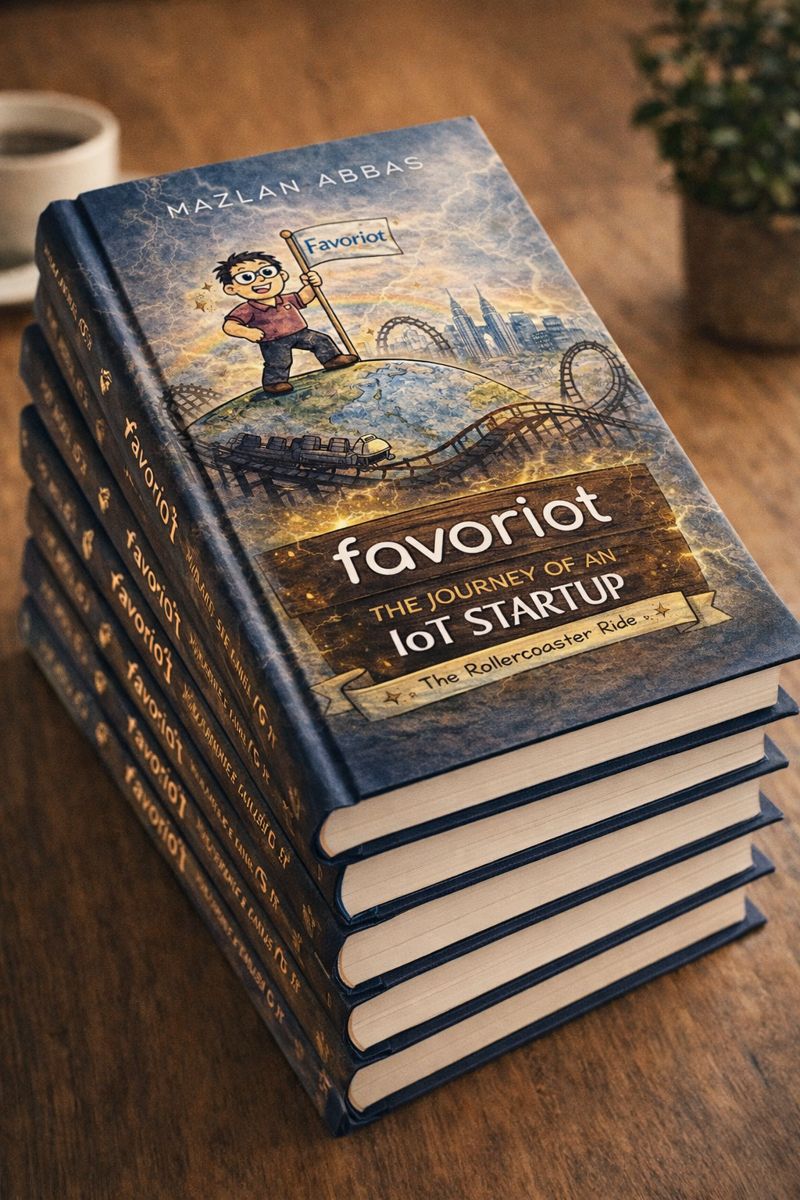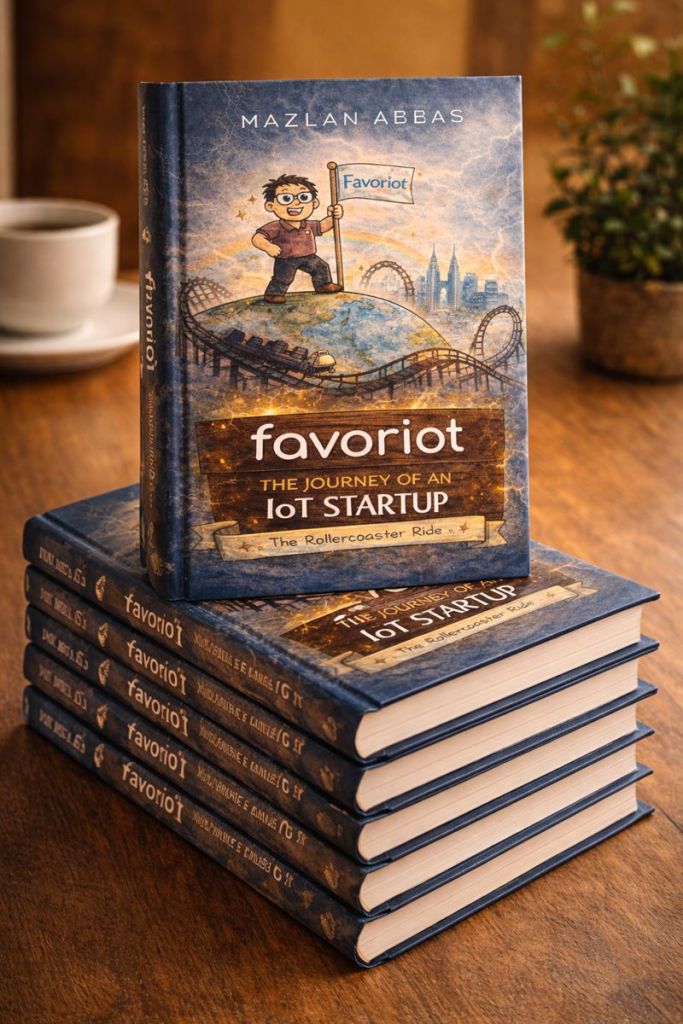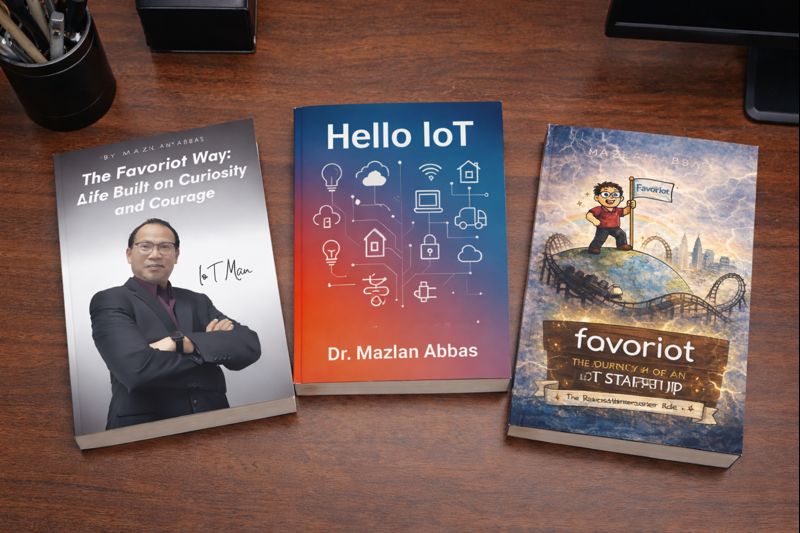
Favoriot – The Journey of an IoT Startup: A Free eBook for Thoughtful Makers, Thinkers, and Doers by Mazlan Abbas

Today (1 January 2026), I’m thrilled to share something that’s been quietly taking shape over the past year. My latest eBook titled “Favoriot – The Journey of an IoT Startup” is now officially released and available for free download. You can get your copy right here: https://payhip.com/b/GbOyo

Writing this book was not a sprint. It was more like those slow early mornings when you sit with a cup of coffee before the world wakes up and try to make sense of what you’ve learned, what you’ve unlearned, and what still puzzles you.

“What if I just write this down now before I forget how it felt?” I asked myself more times than I can count.

That question became this book.

Why This eBook Exists

I didn’t set out to write an eBook that checks all the “how to succeed” boxes. I wrote something more honest. More personal. More reflective of real work and real life.

This is a piece of writing that came from:

  • Conversations I had with founders and students
  • Moments when I wasn’t sure if something would work
  • Times when a quiet insight changed my view more than any big announcement ever could

Some parts feel calm and clear. Some parts feel messy and uncertain. In all of them, you’ll find reflections that resonate with the kinds of questions we all silently carry with us.

If you’ve ever asked yourself, “Am I doing this right?” or “What truly matters here?” then this book was written with you in mind.

What You’ll Find Inside

This eBook isn’t a step-by-step guide or a list of formulas that promise success. You won’t find shortcuts here. What you will find are reflections rooted in real experience:

  • How clarity often arrives slowly
  • Why patience matters more than speed
  • What it really takes to think long term
  • Why credibility beats noise
  • How do you navigate uncertainty when the path ahead isn’t clear

These are not theories. They came from living through questions that didn’t have neat answers.

“Oh… so this is what that moment was really teaching me,” I found myself saying as I shaped these chapters.

A Free Book for the Curious Mind

You might wonder why this eBook is free. There are reasons.

Most books you see are behind paywalls. You sign up. You subscribe. You unlock. All of that has its place.

But I wanted this one to be different.

I wanted it to be reachable by anyone who might benefit from it — no barriers. No barriers, no hoops, no strings attached.

Just download it, read it at your pace, and keep what matters to you.

Who Should Read This

This is a book for people who:

  • Are you building something without a clear path
  • I’m thinking about the next step, but don’t know exactly what it is
  • Feel the tension between urgency and patience
  • Need space to reflect instead of being told what to do

If you’re looking for hype or fast answers, this may not be a perfect match.

If you’re looking for thoughtful reflections that support your own thinking, then this book might feel like a companion for that journey.

Grab Your Copy

Here’s the link again:

👉 https://payhip.com/b/GbOyo

Download it, read it, and then take a moment to reflect on one question:

Which part stayed with me the longest after I closed it?

If you feel like sharing what that was, I’d really like to hear it. Drop a comment. Send a message. Pass the link to someone else who might need it.

Because sometimes the meaning of a book only shows up after you’ve walked a few steps beyond the last page.

Thank you for being here. I’d love to hear your thoughts.

Let’s continue the conversation.

Why Most Advice Sounds Good but Fails on the Ground

Advice is often clean. Reality is not.

Advice does not account for context.
Or timing.
Or people.
Or fatigue.

I have learned to listen for patterns, not prescriptions.

What worked for someone else may collapse under a different set of constraints. And that does not mean anyone is wrong.

The doodle character keeps walking through uneven ground. Same pace. Same posture.

Good judgment is not borrowed.
It is built.

Reflecting on 2025: A Year of Growth, Connection and Insights

This year felt like a ride that neither my coffee nor my journal could have prepared me for. When I looked at the blog stats for 2025, I couldn’t help but smile and go “Wait… we actually did that?” The numbers tell a story of momentum, curiosity, and growing engagement from readers all over the world.

Let’s take a step back together and walk through what happened with the blog this year, what content resonated most with you, and where we’re heading next.

The Big Picture: Numbers that Tell a Story

Over the whole year from January to December 26, 2025, the blog registered about 14,000 viewsa massive increase compared to last year. The number of visitors hit around 9,400, and social engagement soared. We saw 4,300 likes and 163 comments across posts, both reflecting the highest interaction we’ve ever seen.

The month charts tell the same story of rising interest. February kicked off strong, March sustained momentum, and December wrapped up with one of the highest monthly view counts, a clear sign that this year’s topics connected with many of you.

These milestones are something I literally paused and said to myself, “This isn’t small potatoes… this is real.”

Where You’re Reading From

Geographically, the audience is truly global. The top countries by views were:

  1. United States – 3,376 views
  2. India – 2,117 views
  3. China – 1,785 views
  4. Malaysia – 1,715 views
  5. United Kingdom – 514 views
  6. Canada – 356 views
  7. Pakistan – 299 views
  8. Bangladesh – 257 views
  9. Philippines – 252 views
  10. Nigeria – 244 views

That spread tells me two things: your interests are diverse, and the need for thoughtful tech and life content spans borders and cultures.

That made me think: “One idea sparked by one person can travel around the globe faster than I can make coffee.”

The Top 10 Articles of 2025

Here are the posts that stood out this year, ranked by views and engagement, each with a link so you can revisit or share them easily.

1. Stories
👉 This is a composite link on the blog showing curated standout posts.
https://mazlanabbas.com/tag/stories

2. ChatGPT, CoPilot, Gemini, Grok, Perplexity, Claude & DeepSeek: Which One Should You Choose?
👉 https://mazlanabbas.com/2025/01/30/chatgpt-copilot-gemini-grok-perplexity-claude-deepseek-which-one-should-you-choose/ (Dr. Mazlan Abbas)

This article became a go-to breakdown for people curious about how all these popular AI platforms compare.

3. How Influencers Fake Their Way to the Top: The Dark Side of Social Media Fame
👉 https://mazlanabbas.com/2025/02/09/how-influencers-fake-their-way-to-the-top-the-dark-side-of-social-media-fame/ (Dr. Mazlan Abbas)

This one struck a chord far beyond tech circles, showing how online behavior impacts identity and trust.

4. Why I’m Leaving Medium: A Writer’s Journey to Rediscovering Joy
👉 https://mazlanabbas.com/?s=Why+I%E2%80%99m+Leaving+Medium

A personal reflection on why creative freedom matters more than platform popularity.

5. About
👉 https://mazlanabbas.com/about

A quieter favorite: many of you wanted to know who I am before jumping into ideas.

6. How AI Democratization by Alibaba is Changing the World—And Why It Matters to You
👉 https://mazlanabbas.com/2025/01/31/how-ai-democratization-by-alibaba-is-changing-the-world-and-why-it-matters-to-you/ (Dr. Mazlan Abbas)

This explores how AI access is shifting and why it matters in real life, especially outside big tech hubs.

7. My Dream Home: Where Innovation Meets Nature
👉 https://mazlanabbas.com/?s=My+Dream+Home

A more personal piece that blended tech, design and what “home” means.

8. Understanding the Difference Between AI Agents and Agentic AI
👉 https://mazlanabbas.com/?s=Understanding+the+Difference+Between+AI+Agents+and+Agentic+AI

A deep dive that many readers used to clarify a tricky topic in AI.

9. Why I’ve Been Quiet Here: My Journey with Medium
👉 https://mazlanabbas.com/?s=Why+I%27ve+Been+Quiet+Here

An honest update that resonated with folks navigating their own creative blocks.

10. Leading LLMs of August 2025: Who’s Winning the AI Race?
👉 https://mazlanabbas.com/2025/08/25/leading-llms-of-august-2025-whos-winning-the-ai-race/ (Dr. Mazlan Abbas)

A timely survey of where AI large language models stood mid-year, and why the future was already wide open.

What This Means to Me (and Why It Matters)

When I look at these stats and see your comments, your likes, and the way you shared ideas with others, it reminds me that blogging isn’t just about articles… it’s about connection.

When I first started writing here, I thought to myself “Who’s really going to read this?” And then you showed up from the US, India, China, Malaysia, and all over — and that response was humbling.

Each comment wasn’t just a number. Each share wasn’t just a count. They were reminders that ideas matter when they’re read by real people thinking in real worlds.

And that’s what made 2025 unique.

What’s Next

Going into 2026, I want to keep telling stories — about tech, about how we live with technology, and about how our personal and professional worlds interact. I want to explore more questions like:

  • What comes after AI ubiquity?
  • How might IoT change how we feel about cities and communities?
  • Where do we balance innovation with humanity?

I invite you to be part of that conversation.

Drop a comment below and tell me which article you connected with most this year and what you want to explore next.

Let’s write 2026 together.

Download eBooks from Mazlan Abbas

  1. Favoriot – The Journey of an IoT Startup
  2. The Favoriot Way – Life of Curiosity and Courage
  3. Hello IoT
  4. Mastering IoT with Favoriot: A Comprehensive Guide for Business and Educational Institutions
  5. Internet of Things (IoT): A Beginner’s Guide
  6. Startup Survival: The Journey of a Tech Entrepreneur
  7. Your IoT Journey
  8. IoT Notes

How Experience Changes the Way You Think

Early on, every opportunity felt loud.

Emails marked urgent.
Meetings framed as once-in-a-lifetime.
Partnerships dressed up with big names and bigger promises.

Back then, speed felt like wisdom. If something moved fast, it must be important.

Experience slowly rewired that instinct.

Today, when an opportunity appears, I don’t react immediately. I read it. I reread it. I sit with the discomfort if something feels off. And very often, what initially looked exciting begins to lose its shine.

Experience does not eliminate opportunity.
It filters it.

The doodle character walks forward here, eyes open, not rushing, not stopping. Just observing.

How Experience Changes the Way You Read Opportunities

I still remember a time when every opportunity felt loud.

Emails with subject lines screaming “URGENT”. Invitations packed with promises. Partnerships that sounded big just because the logos looked familiar. If something moved fast, talked fast, and felt urgent, I assumed it must be important.

Back then, my instinct was simple. Say yes first. Figure it out later.

These days, my reaction is quieter.

Sometimes an opportunity lands in my inbox and I do nothing. I reread it. I sit with it. I let it breathe. And often, after a few days, the excitement fades. Or something else surfaces.

Why am I uneasy about this?
Why does this feel rushed?
Why am I being pulled, instead of invited?

That shift did not come from books or frameworks. It came from experience. From years of building, stalling, restarting, and learning the hard way.

Experience does not make you smarter.
It makes you calmer.

And calm changes the way you read opportunities.

When Everything Looks Like an Opportunity

Early in my career, opportunities looked like doors. Open doors everywhere. Each one felt like progress. Each one felt like movement.

Speaking slot? Yes.
New market? Yes.
Custom feature request? Yes.
Side project? Yes.

Saying yes felt productive. It felt brave. It felt like momentum.

But there is a hidden cost to saying yes too easily.

You spread yourself thin.
Your focus fractures.
Your core work slows down.

I did not notice it immediately. Work was happening. Meetings were full. Calendars were packed.

I told myself, this must be growth.

It was not.

It was motion without direction.

Experience teaches you that not all movement is forward. Some movement is just energy leaking out in every direction.

The Difference Between Noise and Signal

One of the biggest changes experience brings is pattern recognition.

You start noticing familiar shapes in new offers.

The vague partnership that wants commitment before clarity.
The pilot project with no real owner.
The “strategic collaboration” that quietly becomes unpaid consulting.
The customer who wants everything customised but avoids long-term commitment.

I have seen these shapes before. Many times.

So when they appear again, my body reacts before my mind does. A small pause. A slight discomfort.

This feels familiar.

Experience trains your intuition, not through talent, but through repetition. Through scars. Through outcomes you wish had gone differently.

You stop being impressed by presentation.
You start listening for intent.

Noise sounds exciting. Signal sounds simple.

Urgency Used to Excite Me. Now It Warns Me.

There was a time when urgency felt flattering.

“We need an answer by tomorrow.”
“This window won’t stay open.”
“Others are waiting.”

It felt like being chosen.

Now, urgency makes me slow down.

Real opportunities do not pressure you into rushed decisions. They respect timing. They allow questions. They survive scrutiny.

False urgency often hides uncertainty, weak planning, or someone else’s panic.

Why must this be decided now?
What happens if I say no today?
Will this still make sense next month?

Experience turns urgency into a test. Not of speed, but of substance.

Experience Teaches You to Ask Different Questions

Earlier, my questions were external.

How big is this?
Who else is involved?
What can I gain?

Now my questions are internal.

Does this strengthen what we are already building?
Does this pull us away from our core?
Do I want to be solving this problem for the next three years?

That last question matters more than people realise.

Opportunities do not just take time. They take mental space. They shape what you think about when you wake up. They decide what problems you will be carrying in your head.

Experience makes you protective of your attention.

Do I really want this problem?

The Quiet Opportunities Are Often the Real Ones

Some of the most meaningful opportunities in my journey did not arrive with fanfare.

They arrived quietly.

A conversation that kept returning.
A customer who stayed, even when things were slow.
A niche problem that refused to go away.
A small project that kept compounding.

At the time, they looked ordinary.

Experience teaches you that quiet consistency often beats loud potential.

Big promises fade.
Small traction compounds.

When you have lived through cycles, you stop chasing fireworks. You start valuing steady flames.

You Learn the Cost of “Almost Right”

Another lesson experience drills into you is the cost of misalignment.

An opportunity can be good and still be wrong for you.

Wrong timing.
Wrong focus.
Wrong energy.

Earlier, I believed any good opportunity could be bent into place. With effort. With late nights. With sacrifice.

Now I know better.

Forcing alignment costs more than walking away.

I have learned that saying no early is cheaper than fixing misalignment later.

This is interesting, but it is not us.

That sentence used to be hard to say. Now it feels respectful. To both sides.

Experience Changes How You Read People

Opportunities come through people. And experience sharpens how you listen to them.

Not just what they say, but how they say it.

Do they listen, or only wait to speak?
Do they ask about your constraints, or only their goals?
Do they talk about shared outcomes, or only personal wins?

Experience trains your ear.

You notice when someone avoids specifics.
You notice when accountability is vague.
You notice when enthusiasm disappears after the first obstacle.

These are not red flags you learn from slides. You learn them from being burned.

The Role of Timing Becomes Clearer

One thing I underestimated earlier was timing.

I thought good ideas succeed anytime.
I thought readiness could be rushed.

Experience corrects that illusion.

The same opportunity can be wrong today and right two years later.

The same partnership can fail early and thrive later.

Experience teaches patience. Not passive waiting, but active readiness.

We are not there yet.

That sentence used to feel like failure. Now it feels honest.

You Stop Confusing Opportunity With Validation

This one is subtle.

In the early days, opportunities felt like proof. Proof that we mattered. Proof that we were seen.

Every invite felt personal.

With experience, you stop outsourcing validation to external signals.

You build internal confidence. From shipping. From surviving. From solving real problems.

So when an opportunity arrives, you no longer ask, What does this say about me?

You ask, What does this ask of me?

That changes everything.

Experience Slows You Down in a Good Way

From the outside, it may look like hesitation. Or caution.

From the inside, it feels like clarity.

I still say yes. Often.
But I say yes with open eyes.
With fewer illusions.
With clearer boundaries.

Experience does not kill ambition. It sharpens it.

You stop chasing everything.
You start choosing deliberately.

And that choice is quiet. Grounded. Intentional.

Reading Between the Lines

Today, when I read an opportunity, I read the spaces between the words.

What is not being said?
What assumptions are hidden?
Who carries the real risk?
Who holds the long-term responsibility?

These questions come naturally now.

Not because I am smarter.
Because I have been there before.

Experience does not shout.
It whispers.

And if you listen closely, it usually tells you exactly what you need to know.

If you are earlier in your journey, saying yes is part of learning. It is how you collect data. It is how you build instinct.

If you are further along, discernment becomes the work.

Both phases matter.

I am curious how your relationship with opportunities has changed over time. What do you read differently now compared to before?

Share your thoughts. I would love to hear your story.

When Saying “Not Yet” Is Better Than Saying “Yes”

There was a time when I thought saying “yes” was the mark of progress.

Yes to meetings.
Yes to collaborations.
Yes to pilot projects.
Yes to opportunities that sounded exciting on paper.

I told myself this is how momentum works. You say yes, doors open, things move.

Then one quiet evening, after another long day, I stared at my notebook. It was full. Pages packed with ideas, arrows, half plans. And yet, nothing felt complete.

Why does being busy feel so hollow right now? I asked myself.

That was the moment I began to respect the power of “not yet”.

Not no.
Not rejection.
Just not yet.

The Hidden Cost of Saying Yes Too Quickly

Early in my career, and even during the early years of building Favoriot, I treated every opportunity like a rare train that might never come back. If I missed it, I feared regret.

So I boarded many trains.

Some took me forward.
Some took me sideways.
A few quietly took me backwards.

Each “yes” came with invisible baggage. Time. Energy. Attention. Emotional load. Once you say yes, you owe something. A reply. A follow-up. A delivery. A meeting. Another meeting.

One day I caught myself replying to emails at midnight, agreeing to things I barely remembered discussing.

This isn’t growth, I muttered. This is drift.

Saying yes too fast often means borrowing time from the future. And the interest rate is brutal.

Why “Not Yet” Is Not a Weak Answer

Many people hear “not yet” and assume hesitation or fear.

That couldn’t be further from the truth.

“Not yet” is clarity without arrogance.
It is patience without laziness.
It is confidence that does not need applause.

When I say “not yet” today, it usually means one of three things.

I have not thought this through deeply enough.
My current priorities would suffer.
The timing is wrong even if the idea is right.

Why rush something that deserves care? I often ask myself.

In a world addicted to speed, restraint feels radical.

Timing Is a Strategy, Not an Excuse

I have seen great ideas fail not because they were flawed, but because they arrived at the wrong time.

Too early and the ecosystem is not ready.
Too late and the window has closed.

I learned this the hard way.

There were moments when partnerships looked perfect. Strong names. Good intentions. Big promises. On paper, it all made sense.

But something inside me hesitated.

Can we execute this properly right now?
Do we have the mental space to do this well?

When I ignored that inner voice and said yes anyway, the result was often messy. Delays. Frustration. Quiet disappointment on both sides.

Now I treat timing as a first-class decision variable.

A good idea at the wrong time is still the wrong move.

The Discipline of Protecting Focus

Focus is fragile.

Once broken, it takes far longer to restore than we admit.

Every “yes” competes with what you are already building. It steals attention in small, almost polite ways. One extra call. One more document. One more thread to keep in your head.

I used to pride myself on juggling many things. Then I realised juggling means nothing ever truly rests in your hands.

What if fewer things, appropriately done, are the real advantage?

Saying “not yet” protects the work that matters most. It keeps the main thing the main thing.

Relationships Respect Honest Timing

Here is something I learned with age and a few scars.

Serious people respect honesty more than enthusiasm.

When you say yes too quickly and later underdeliver, trust erodes quietly. No drama. No argument. Just a subtle shift.

When you say “not yet” with clarity and respect, something else happens.

People listen.

They know you are not chasing noise. They sense you are playing a longer game.

I have had conversations where a simple “not yet, let me come back to this in a few months” led to stronger partnerships later.

Good relationships survive patience. Weak ones do not.

Saying “Not Yet” to Protect Your Future Self

There is a version of you six months from now who will inherit today’s decisions.

That future self will deal with the consequences. The deadlines. The stress. The regret.

I try to picture him often.

Tired? Calm? Proud? Frustrated?

When I say yes impulsively, I am often being unfair to that future version of myself.

“Not yet” is a gift to him.

It buys space.
It buys clarity.
It buys better decisions.

When “Yes” Becomes a Reflex

Reflexive yes is dangerous.

It feels polite. Productive. Cooperative.

But reflexes bypass thinking.

I noticed this pattern during periods of pressure. When things feel uncertain, the instinct is to grab everything. To say yes to feel safe.

Ironically, that is when restraint matters most.

What am I trying to compensate for? I ask myself now.

Scarcity mindset whispers lies. It tells you this is your last chance. Those opportunities are rare.

Experience teaches otherwise.

The right opportunities return. Often better prepared. Often clearer.

The Confidence to Wait

Waiting is uncomfortable.

Silence feels awkward.
Unanswered emails create tension.
Pauses invite doubt.

Yet waiting is where conviction forms.

Some of my best decisions were made slowly. They survived weeks of thinking, rewriting, second-guessing, and walking away before returning.

The bad decisions? They were fast. Exciting. Urgent.

Confidence is not loud. Sometimes it looks like waiting calmly while the world rushes.

What “Not Yet” Sounds Like in Practice

It does not need drama.

It can be simple.

“Let me revisit this after we complete our current milestone.”
“This deserves more thought. Can we talk again later?”
“I like the direction, but the timing isn’t right for us now.”

Clear. Respectful. Honest.

No long explanations. No guilt.

You do not owe the world your exhaustion.

Building Things That Last Requires Patience

Startups. Products. Careers. Even personal growth.

They all punish haste.

I have come to believe that longevity favours those who can delay gratification. Those who can sit with incomplete answers. Those who can say “not yet” without anxiety.

Am I building momentum or just motion? That question guides me now.

Motion looks busy. Momentum compounds quietly.

The Quiet Strength of Saying “Not Yet”

There is a strange calm that comes with this shift.

Fewer meetings.
Clearer priorities.
Deeper work.

And when I finally say yes, it means something.

It means I am ready.
It means I can commit fully.
It means the answer has weight.

Not yet creates space for better, yes.

A Question for You

Where in your life are you saying yes out of habit rather than intention?

What would happen if you replaced one of those yeses with a calm, honest “not yet”?

You might find that nothing collapses.
You might find respect grows.
You might find your focus returning.

I am curious to hear your thoughts.

Have you ever said “not yet” and later realised it was the right move?

Share your story in the comments.

Download eBooks from Mazlan Abbas

  1. Favoriot – The Journey of an IoT Startup
  2. The Favoriot Way – Life of Curiosity and Courage
  3. Hello IoT
  4. Mastering IoT with Favoriot: A Comprehensive Guide for Business and Educational Institutions
  5. Internet of Things (IoT): A Beginner’s Guide
  6. Startup Survival: The Journey of a Tech Entrepreneur
  7. Your IoT Journey
  8. IoT Notes

Why I Stopped Chasing Visibility and Focused on Credibility

There was a time when I thought visibility was the game.

More views.
More likes.
More stages.
More mentions.

I watched founders celebrate follower counts like revenue. I saw announcements dressed up as progress. I saw loud success everywhere.

And quietly, I asked myself a question I did not say out loud.

“Is this what winning looks like?”

That question stayed with me longer than I expected.

I come from a background where results mattered more than noise. Engineering. Telecommunications. Research. Systems that break if you get one assumption wrong. You cannot bluff physics. You cannot sweet-talk a network into stability. Either it works, or it fails. Publicly. Painfully.

When I stepped into entrepreneurship and started building FAVORIOT, I carried that same mindset with me, though I did not realise how rare it would feel in a world obsessed with attention.

At the beginning, I tried to play both games.

Build quietly, but also stay visible.
Ship code and post updates.
Solve problems, but also explain myself repeatedly.

It was exhausting.

Not because visibility is bad. But because chasing it changes how you think.

The Seduction of Being Seen

Visibility feels productive. That is the danger.

You post something.
People react.
The numbers move.
Your brain rewards you instantly.

I felt it too.

A speaking invitation arrives.
A panel slot opens up.
A logo appears on a slide.

“This must mean we are doing well,” I told myself.

But late at night, when the office lights were off, and the dashboards were still open, another voice appeared.

“Would this platform survive if nobody mentioned it tomorrow?”

That question became my compass.

Because visibility without substance is fragile. The moment the spotlight shifts, so does the relevance.

I had seen this pattern before, long before startups.

In telco projects.
In smart city pilots.
In technology programs with beautiful launches and quiet endings.

Everyone remembers the launch. Few recognise the maintenance.

Credibility works the opposite way.

It grows slowly.
It compounds quietly.
It shows up when no one is clapping.

When I Noticed the Shift

The shift did not happen because I decided to be noble or disciplined.

It happened because of a simple pattern.

People started finding us without us having to chase them.

An email would come in.
A message from overseas.
A partner inquiry that started with, “We’ve been reading your work.”

And every time, I asked the same question.

“How did you hear about us?”

The answers were almost boring.

They searched.
They read.
They compared.
They waited.

No viral post.
No paid campaign.
No dramatic announcement.

Just years of writing, building, fixing, and explaining the same things again and again.

That was when it hit me.

Credibility travels further than visibility, but it moves on its own timeline.

The Cost of Chasing the Wrong Metric

Here is the uncomfortable truth.

Visibility rewards what looks good today.
Credibility rewards what holds up tomorrow.

When you chase visibility, you optimise for speed.
When you build credibility, you optimise for truth.

Speed loves shortcuts.
Truth does not forgive them.

I learned this the hard way in IoT.

You can demo anything.
You can mock data.
You can polish dashboards.

But real deployments are unforgiving.

Sensors fail.
Connectivity drops.
Edge devices behave badly.
Security holes appear where nobody looked.

If your system only works when everything is perfect, it is not a system. It is a slide deck.

So I made a quiet decision.

I stopped asking, “How do we look?”
I started asking, “Would I trust this if I were the customer?”

That question shaped everything.

The way the platform was designed.
The way documentation was written.
The way training was structured.
The way we said no to shortcuts that looked tempting.

No announcement could replace that.

Writing Without Chasing Applause

My writing changed, too.

I used to wonder why some posts did not perform.
Why do some articles feel invisible?
Why did the numbers look flat?

Then I realised something.

I was writing to be understood, not to be shared.

Those are two different goals.

Writing for shares means simplifying until nothing is left to challenge.
Writing for understanding means explaining until clarity replaces confusion.

Clarity takes time.
Understanding takes patience.

And patience does not trend.

But credibility remembers.

Months later, someone would quote an old article.
A student would reference a post I barely remembered writing.
A partner would say, “This helped us avoid a mistake.”

That mattered more than any spike.

Credibility Is Built When Nobody Is Watching

Here is the part nobody glamorises.

Credibility is built in moments that feel invisible.

Fixing a bug nobody will thank you for.
Rewriting documentation for the third time.
Saying no to a deal that feels wrong.
Admitting uncertainty instead of pretending confidence.

These moments never trend.

But they stack.

I spent years in environments where mistakes had consequences. Networks go down. Cities stall. Systems fail publicly. That background wired me to respect fundamentals.

So when trends shifted, buzzwords changed, and hype cycles rotated, I anchored myself to a simple principle.

If this disappears from the internet tomorrow, would the work still stand?

That question saved me from many distractions.

Panels, Stages, and the Quiet Filter

I still speak.
I still write.
I still show up.

But the filter is different now.

I no longer ask, “Will this increase my visibility?”
I ask, “Does this reflect what I actually believe?”

If it does not, I pass.

That choice costs opportunities.
It also protects credibility.

When I sat on panels discussing AI, IoT, and cybersecurity, I was not there because I was loud. I was there because of years of consistent work connecting systems, understanding risks, and dealing with consequences.

That is the kind of visibility credibility earns on its own.

The Long Game: Most People Quit

Here is something I wish more foundershad heard earlier.

Visibility is rented.
Credibility is owned.

Visibility disappears when platforms change.
Credibility stays when people remember.

Visibility flatters.
Credibility humbles.

One feeds the ego.
The other feeds trust.

Trust is slower to build.
It is also harder to destroy.

I chose the long game because I have seen what happens when shortcuts collapse. I have seen systems that looked impressive but could not survive reality.

I did not want to build that.

What I Focus On Now

Today, my priorities are boring in the best way.

Does the platform work when things go wrong?
Can a student learn without being overwhelmed?
Can a partner deploy without calling us every hour?
Can the system explain itself clearly?

These questions do not trend.
They endure.

I still share stories.
I still write reflections.
I still show the work.

But I no longer chase the spotlight.

If it comes, it comes.
If it does not, the work continues.

Because credibility has a strange habit.

It introduces you when you are not in the room.

A Quiet Invitation

If you are building something today and feeling invisible, let me say this gently.

You might not be behind.
You might be early.

Keep building things that last.
Keep explaining things clearly.
Keep choosing substance over speed.

The world is loud.
Credibility whispers.

And whispers travel further than we think.

I would love to hear your thoughts.

Have you felt this tension between being seen and being trusted?
Where are you placing your energy right now?

Share your reflections in the comments.

What Running a Startup Taught Me About Patience

Most people think startups teach you speed.

Move fast. Execute faster. Ship now. Fix later.

I used to believe that too.

Then I actually ran one.

And somewhere between missed targets, delayed deals, unanswered emails, broken assumptions, and quiet months where nothing seemed to move, I realised something unexpected.

Running a startup did not teach me speed first.

It taught me patience.

Not the polite, wait-in-line kind of patience.

But the stubborn, teeth-gritted, stay-the-course patience that only shows up when quitting would be easier.

I did not learn this lesson from books or talks. I knew it the hard way. Day by day. Year by year.

And often, while talking to myself.

Why is this taking so long?
Why does progress feel invisible?
Am I doing something wrong?

This is what running a startup feels like when nobody is watching.

The Early Myth: Effort Equals Immediate Results

When I first stepped into building a startup, I carried a simple mental model.

If you work hard enough, things move.
If you work longer hours, you see results faster.
If the idea is good, people will notice.

That belief did not survive long.

I remember days when I felt exhausted yet strangely empty. I had meetings, emails, plans, documents, and dashboards. Everything looked busy.

But externally, nothing changed.

No new customers.
No exciting announcements.
No visible breakthroughs.

This feels wrong, I thought. Shouldn’t the effort show results by now?

That was my first real encounter with patience. The uncomfortable kind.

Progress Often Happens Underground

One of the most critical lessons patience taught me is this.

Most progress in a startup happens where you cannot see it.

It happens in conversations that go nowhere today but matter next year.
It happens in drafts that never get published, but sharpen your thinking.
It happens in failed pitches that quietly improve the next one.

From the outside, it looks like stagnation.

From the inside, it feels like pushing a heavy object that barely moves.

I had to remind myself often.

Roots grow before branches.
Foundations come before buildings.
Understanding comes before momentum.

Patience is learning to trust work that hasn’t yet received applause.

Timing Is a Ruthless Teacher

There were moments when I was sure something should work.

The product made sense.
The message was clear.
The market seemed ready.

But reality disagreed.

People listened politely. Then disappeared.
Emails went unanswered.
Follow-ups ended with silence.

At first, I blamed myself.

Maybe I am not convincing enough.
Maybe the idea is flawed.
Maybe I started too late.

Only later did I realise another truth.

Sometimes you are early.
Sometimes the market needs to catch up.
Sometimes people need their own pain first.

Patience taught me to stop forcing doors that were not ready to open.

Not every no means never.
Some no simply means not yet.

Building Trust Is a Slow Craft

In startups, everyone talks about traction.

Users. Numbers. Growth charts.

But very few talk about trust.

Trust does not move at startup speed.
Trust moves at human speed.

I learned that credibility cannot be rushed.

People watch quietly.
They read what you write.
They observe how you respond when things do not work.

They take mental notes long before they ever reach out.

There were times when someone contacted us and said, “We have been following you for years.”

Years.

And I would pause.

All that writing. All that sharing. Someone noticed.

Patience taught me that consistency compounds even when feedback is silent.

The Loneliness of the Long Game

One part nobody warns you about is how lonely patience can feel.

When you are patient, you wait.
When you wait, you stand still.
When you stand still, it feels like everyone else is moving ahead.

You see announcements.
You see funding news.
You see loud successes on social media.

And you ask yourself quietly.

Am I falling behind?

Patience is staying in your lane while others sprint past you, not knowing who will last longer.

I learned to stop comparing timelines.

Every startup runs its own race.
Some are sprints.
Some are marathons.
Some are endurance climbs.

Mine taught me endurance.

Small Wins Are Not Small

Patience sharpened my ability to notice small wins.

A clearer conversation.
A better question from a customer.
A mistake was avoided because of a past failure.

Earlier in my career, I would have ignored these moments.

Now, I pay attention.

Because patience is not passive waiting.
It is active noticing.

Noticing progress that does not trend on charts.
Noticing growth that does not fit a slide deck.

These moments keep you sane when the big wins take time.

Control Is an Illusion

Running a startup slowly strips away the illusion of control.

You cannot control timing.
You cannot control decisions made in other boardrooms.
You cannot control the budget tightening elsewhere.

At first, this frustrated me.

If I just work harder, I can control this, I told myself.

Patience taught me a calmer truth.

You control effort.
You control preparation.
You control how you respond.

Everything else is negotiation with reality.

Once I accepted that, my energy shifted. Less panic. More focus.

Patience Does Not Mean Lack of Ambition

This is important.

Patience is often misunderstood as complacency.

It is not.

Patience is ambition with discipline.

It is knowing what you want while accepting that forcing outcomes usually backfires.

I still push.
I still aim high.
I still feel restless at times.

But patience gives that restlessness direction rather than panic.

The Quiet Confidence That Comes With Time

Something subtle changed over the years.

I stopped rushing to explain myself.
I stopped needing immediate validation.
I stopped chasing every shiny opportunity.

Patience built a quieter confidence.

Not the loud kind.
The grounded kind.

The kind that says, I know what I am building, even if it takes longer than expected.

That confidence is hard-earned. And fragile if you rush.

What I Would Tell My Younger Self

If I could sit across the table from my younger self, I would say this.

You are not slow.
You are early in the process.

You are not failing.
You are learning in public.

You are not stuck.
You are building something that needs time.

And most importantly.

Patience is not the absence of action.
It is action without desperation.

Closing Thoughts

Running a startup did not just teach me how to build products, teams, or strategies.

It taught me how to wait without giving up.

How to stay calm when timelines stretch.
How to keep showing up when results whisper instead of shout.
How to trust work that feels invisible today.

And if you are in that quiet phase right now, where effort feels heavy and progress feels distant, know this.

Patience is not wasted time.

It is preparation disguised as waiting.

I would love to hear your story.

What has patience taught you on your own journey?

Why Quiet Years Often Matter More Than Busy Ones

Some years shout.

They announce themselves with launches, awards, headlines, travel photos, packed calendars, and endless updates. They feel loud even before they are over.

Then some years barely whisper.

No fireworks. No dramatic milestones to post about. No big celebration dinners. Just long days, repetitive work, silent thinking, and a calendar that looks strangely empty from the outside.

For a long time, I feared those quiet years.

Am I falling behind?
Why does it feel like everyone else is moving faster?
Did I miss something important?

Only later did I realise something that changed how I look at time, work, and progress.

Quiet years often matter more than busy ones.

Not in obvious ways. Not in ways that attract applause. But in ways that shape everything that comes after.

Let me explain.

The Illusion of Busy Years

Busy years are addictive.

They make you feel relevant. Needed. In demand. Every week is filled with meetings, events, decisions, and quick wins. You move from one task to another with momentum. There is little time to question direction because speed itself feels like purpose.

I have lived through those years.

There were times when my calendar looked impressive. Meetings stacked back-to-back. Travel plans every month. Panels, talks, deadlines, emails at midnight. From the outside, it looked like progress.

Inside, something else was happening.

Thinking time disappeared.

Reflection became a luxury. Decisions were made reactively. You respond more than you choose. You move fast, but you are not always sure where you are heading.

This feels productive, I used to tell myself.
At least things are happening.

Busy years reward motion. Quiet years demand clarity.

What Quiet Years Feel Like

Quiet years feel uncomfortable at first.

Fewer external signals are telling you that you are doing well. Fewer invitations. Fewer people are checking in. Less validation. Your work becomes less visible and more internal.

Most of the effort goes into things that do not translate into instant results.

Reading.
Thinking.
Fixing fundamentals.
Rewriting plans.
Building systems that nobody sees yet.

You spend more time alone with your thoughts than with applause.

I remember sitting in the office late one evening during one of those quiet stretches. No urgent calls. No deadlines screaming for attention. Just me, a notebook, and an uneasy feeling.

Is this stagnation? I asked myself.
Or is this preparation?

That question stayed with me.

Quiet Years Are When Foundations Are Rebuilt

When everything is loud, you rarely touch the foundations. You are too busy adding floors.

Quiet years force you to look down instead of up.

You start noticing cracks you ignored before. Processes that no longer make sense. Assumptions that worked five years ago but feel wrong today. Goals that were inherited rather than chosen.

During quiet periods, I found myself revisiting basic questions:

Why are we building this?
Who are we really serving?
What should we stop doing?
What must work even when attention disappears?

These are not questions you answer in between meetings. They need space.

Quiet years give you that space.

They allow you to rebuild without pressure to perform for an audience. You can redesign systems, rethink direction, and strengthen weak links while nobody is watching.

By the time noise returns, the structure is already stronger.

The Invisible Compounding Effect

One of the hardest things about quiet years is that progress becomes invisible.

There is effort, but little evidence. Work is happening, but outcomes lag behind. You plant seeds without knowing which ones will grow.

This is where many people quit.

They mistake silence for failure. They assume that if nothing is visible, nothing is working.

I have learned that quiet years often hide compounding effects.

Writing without immediate readers.
Building products before the market is ready.
Training people who will only show results years later.
Documenting processes that will save time long after you forget writing them.

None of these produces instant feedback.

Yet, when momentum finally arrives, it feels sudden to outsiders.

Overnight success, they call it.

You and I know better.

Busy Years Consume Energy, Quiet Years Restore Direction

Busy years strangely drain energy.

Even when things go well, you feel stretched. Decisions pile up. Context switches exhaust the mind. There is constant urgency, even when nothing is truly urgent.

Quiet years slow things down.

Energy flows differently. Instead of being pulled in ten directions, it focuses on fewer priorities. You stop chasing everything and start choosing deliberately.

I noticed this shift clearly.

In busy years, my thinking stayed tactical. Solve this problem. Respond to that request. Fix today’s issue.

In quieter years, thinking became strategic again. Long arcs. Five-year questions. Structural changes.

If we continue like this, where will we end up?
What must be true for the next phase to work?

These questions do not scream for attention. They wait patiently.

Quiet Years Test Your Relationship With Ego

This might be the most uncomfortable part.

Busy years feed ego. Quiet years starve it.

When external recognition fades, you are left with one question.

Do you still believe in the work when nobody is watching?

I had to confront that question honestly.

There were moments when I missed the noise. The feedback. The sense of being visible. Quiet years strip away performance, leaving only intention.

If this never gets applause, would I still do it?
If progress takes longer than expected, do I still commit?

These questions reshape you.

They make motivation cleaner. Less dependent on reactions. More grounded in purpose.

The Trap of Measuring Life in Short Bursts

We live in a culture that celebrates bursts.

Quarterly results.
Monthly growth.
Weekly metrics.

Busy years fit perfectly into this worldview. They produce frequent updates and visible milestones.

Quiet years refuse to cooperate.

They stretch across time. They do not fit neatly into slides or social posts. They demand patience in a world that rewards speed.

I have come to see life less as a series of sprints and more as a series of seasons.

Some seasons are for harvesting.
Some are for planting.
Some are for repairing tools.
Some are for letting the soil rest.

Quiet years are not empty seasons. They are preparation seasons.

Why Many Breakthroughs Are Born in Silence

Look closely at most meaningful breakthroughs, and you will notice something.

They rarely happen during the noisiest periods.

They emerge after long stretches of thinking, trial, error, and refinement that nobody paid attention to at the time.

The idea matures quietly.
The skill sharpens privately.
The system stabilises out of sight.

Then one day, the world notices.

It looks sudden. It never is.

Quiet years create the conditions for breakthroughs. Busy years often only showcase them.

Learning to Trust Quiet Progress

Trust is hard when evidence is scarce.

During quiet years, you learn to measure progress differently.

Not by likes or invitations, but by questions such as:

Are decisions getting clearer?
Are mistakes repeating less often?
Is the team thinking more independently?
Do systems break less under pressure?

These signals are subtle. They require attention.

I started keeping private markers of progress. Notes to myself. Minor improvements that only I could see. They became reminders that something real was happening, even if it was not visible yet.

Stay with the process, I would tell myself.
Noise will come later.

When Quiet Years End

Quiet years do not last forever.

They give way to movement, visibility, and activity again. When that happens, the difference becomes obvious.

Decisions feel calmer.
Growth feels steadier.
Pressure feels manageable.

You are not scrambling to catch up. You are responding from a more substantial base.

People often ask what changed.

Nothing obvious.
Everything fundamental.

A Different Way to Look at Your Current Year

If this year feels quiet for you, pause before labelling it as wasted.

Ask yourself different questions.

What am I rebuilding right now?
What foundations am I strengthening?
What clarity am I gaining that I did not have before?

You might be in a year that will never make headlines but will quietly decide the next decade of your life.

Those years deserve respect.

Closing Thoughts

Busy years are visible. Quiet years are essential.

One without the other creates an imbalance. Noise without preparation leads to collapse. Preparation without patience leads to frustration.

I have stopped fearing quiet years.

I treat them as a sign that deeper work is happening. Work that does not ask for attention but shapes outcomes in lasting ways.

If you are in one now, stay with it.

Something important is forming, even if it has not yet learned to speak.

I would love to hear your thoughts.

Are you in a busy year or a quiet one right now?
What has it been teaching you?

Share in the comments.

Reflecting on a Grounded 2025: Lessons from Favoriot’s Journey

I am writing this ten days before 2025 comes to an end.

When I look back at the year, it does not feel loud. It does not feel dramatic. It feels focused. Demanding. Grounded. A year where most of my time, energy, and thinking revolved around one thing only: Favoriot.

If I am being honest, 2025 was not a year of balance. It was a year of commitment.

Most of my days were spent at the office. And when I was not physically there, my mind was still working on Favoriot. Nights. Weekends. Quiet moments that could have been rest often turned into planning or problem-solving. I did not spend much time on myself personally. There were no real holidays. The only breaks I had were during overseas business trips, and even then, work followed me closely.

I told myself more than once, This is not a sacrifice. This is a choice.

And I am at peace with that choice.

Fewer Invitations and a Shift in How We Connect

One noticeable change in 2025 was the drop in invitations from universities and public conferences. Many engagements that used to be physical moved online. Meetings became links. Conversations became scheduled time slots on screens.

I realised something about myself quite clearly this year.

I do not enjoy online meetings anymore.

They are convenient, but they remove the human layer. The casual chats before meetings start. The spontaneous conversations after sessions end. The subtle signals that build trust faster than formal presentations ever can.

I still prefer face-to-face meetings. They feel more honest. Better for networking. Better for understanding people beyond their titles.

Public conferences were fewer as well. Part of it could be the current spotlight on AI. IoT felt quieter this year, almost like it had stepped back from centre stage. I was not bothered by it. I was observant.

Trends move quickly. Real work moves steadily.

Why Panel Sessions Still Matter to Me

While formal speaking invitations slowed, one format still felt right to me: panel sessions.

No slides. No heavy preparation. Just conversations.

Sitting on stage, exchanging views, listening, responding, sometimes disagreeing politely. That feels closer to how decisions are made in real life.

I often think that insight shows up better in dialogue than in bullet points.

That belief stayed strong in 2025.

A Year Focused on Partnerships

Behind the scenes, 2025 was anything but quiet.

We spent a significant amount of time building partnerships. By the end of the year, we had signed MOUs with more than 40 partners across 15 countries. Our original target was 25 countries, so on paper, we fell short geographically.

But numbers do not tell the whole story.

I have learned that more partners do not automatically mean more revenue or more projects. Partnerships only matter when they are actively engaged, aligned, and nurtured.

Signing is easy. Building trust takes time.

Some partnerships moved faster. Some are still warming up. Some will likely take longer to show results. That is the nature of building across borders.

This year reminded me that ecosystems are built patiently, not collected quickly.

When People Find You on Their Own

One encouraging pattern this year was how people and companies started approaching us unexpectedly.

Each time, I asked the same question. “How did you find us?”

The answer was often simple. They searched online. They did their own research. They were surprised to discover an IoT platform company operating from this region.

That always made me pause.

Years of writing, sharing, and building quietly compound over time. Visibility does not always arrive with announcements. Sometimes it comes as an unexpected email or message.

That is when you realise the work has travelled further than you thought.

Fewer Projects, Fewer Trainings, a Cautious Market

Not everything grew this year.

Real IoT projects were fewer compared to previous years. IoT training numbers dropped as well. In-house training, which used to scale better, became harder to secure. We relied more on public training sessions, which are always challenging when it comes to attendance.

The market felt cautious.

Budgets were tighter. Decisions took longer. Interest was still there, but commitment required more patience.

There were moments when I questioned the pace. Is this a temporary slowdown, or is the market resetting itself?

Perhaps it is both.

Shifting My Focus Between Industry Associations

This year, I was less active in the Malaysia Smart City Alliance Association.

At the same time, I became more involved with the Malaysia IoT Association, partly due to my role as Vice-Chairman.

More importantly, MyIoTA’s Smart City Nexus activities align closely with the reasons I joined the association. The Nexus focuses on bringing members’ solutions directly to local councils. It creates a practical space for business matching, not just discussion.

That matters to me, and I plan to be more active there moving into 2026.

Favoriot Sembang Santai Podcast: Keeping Conversations Human

Another meaningful chapter in 2025 was the start of the Favoriot Sembang Santai.

We started the podcast in February 2025, and by December, we had reached Episode 38.

The reason was simple. I wanted a space for honest conversations. No scripts. No slides. No pressure to sound formal. Just honest discussions about Favoriot’s journey and what we were seeing in the IoT space.

The primary host is Zura Huzali, and I serve as the primary guest and speaker. The chemistry works because it feels natural. Curious questions. Straight answers. Occasional debates. Plenty of laughter.

The topics evolved naturally from Favoriot’s story into broader themes such as AI, robotics, satellite IoT, and Ambient IoT. Not as buzzwords, but as technologies we were trying to make practical sense of.

Anyone who misses the live sessions can catch the recordings on YouTube, Spotify, and Amazon Music.

The podcast will continue throughout 2026. For me, it is a long conversation, not a series.

TikTok Live on IoT Man: Ask Me Anything

Alongside the podcast, we also started doing casual TikTok Live sessions on the IoT Man channel.

The central theme is simple. “Ask Me Anything.”

No agenda. No slides. Just live questions and real-time answers. What excites me about these sessions is that they capture a different segment of listeners. Shorter attention spans. Younger audiences. People who may not sit through a long podcast but are curious enough to drop in and ask.

It feels raw. Immediate. Human.

Sometimes the most honest questions come without preparation.

Working With AI to Prepare for 2026

As 2025 draws to a close, one personal highlight has been working with my AI companion.

Not to replace thinking, but to sharpen it.

I spent many late nights shaping 2026 playbooks. How we approach the market. How we engage customers. How we manage partners. New business models. New IoT solution ideas.

The picture ahead feels clearer now.

Looking Forward

2025 was not flashy. It did not come with loud milestones.

But it mattered.

It tested focus. It strengthened conviction. It prepared the ground.

I am genuinely excited about 2026. The plans are clearer. The energy feels different. I hope the long-standing plans around IoT certifications with universities will finally become a reality.

Here is to a better, steadier, and more rewarding year ahead.

I would love to hear how your 2025 has been. Share your reflections in the comments.