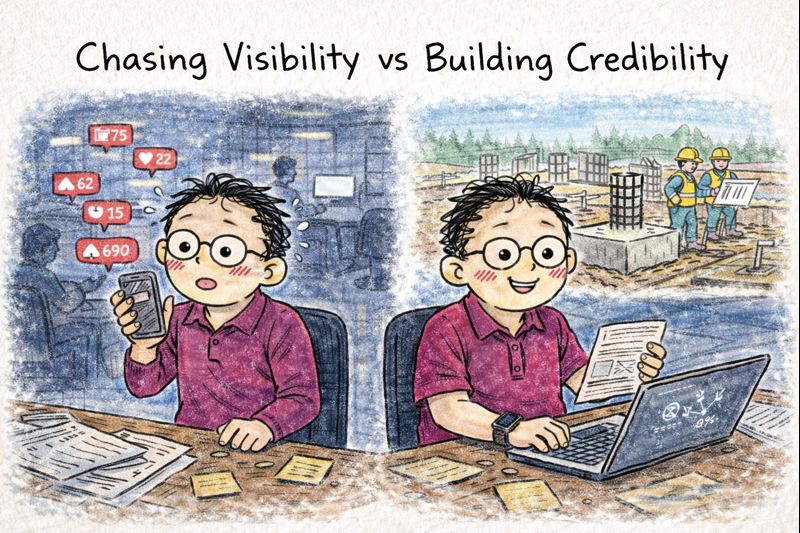
We Gave Our Favoriot IoT Platform Away for Free—Here’s What Actually Happened Next

A quiet, honest story about how Favoriot found its way

I remember the early days of Favoriot very clearly.
It started with a simple belief. If we make it free and easy, people will come. They will build. They will stay.

So we did exactly that.

We built the platform.
We opened the doors.
We told the world, “Come in. Try it. It’s free.”

And people did come. Students. Lecturers. Curious engineers. Friends I met during talks at universities. I would personally invite them. Sometimes I would even hand out complimentary access codes for a full year of the Beginner Plan.

I thought to myself, this is how adoption works.

But something felt off.

When subscribers were not really users

On paper, the numbers looked comforting.
Subscribers were growing. Accounts were created. Dashboards were viewed.

But deep down, I knew something was missing.

Why are so many accounts quiet?
Why do I see logins, but no devices connected?
Why do dashboards stay empty?

That was my first hard lesson.

A subscriber is not always a user.
And a user is not always a builder.

Many people came just to look around. They clicked. They browsed. Then they left. Some even won vouchers but never built a single IoT project.

It hurt a little. Not because of revenue. But because I wanted Favoriot to be used. I wanted it to matter.

The wrong assumption about behaviour

I used to think users would log in every day, tweak dashboards, run experiments.

Reality taught me otherwise.

A typical IoT builder behaves differently.

Once the device connects and the data flows, they step back. They look at the dashboard occasionally. They only return when something breaks or when the project evolves.

Students behave differently, too.

They come intensely during one semester. Final year project season. Late nights. Panic. Excitement. Then, silence.

And to make it harder, many of them already knew other platforms. Some popular. Some free. Some are recommended by seniors.

Favoriot was often an unfamiliar name.

So ,how do you enter the education space when choice is already wide open?

Teaching before selling

I stopped pushing plans and started focusing on learning.

We introduced public IoT training. Beginner. Advanced. Mastering IoT.
Lecturers started attending. Some became trainers themselves. They went back to their universities and taught students using what they learned.

That felt good.

Then we went a step further.

Professional certificates.
Either embedded into the curriculum or offered as short intensive training. Students could finish the course and receive a certificate, or sit for an exam and earn a more formal credential.

Interest grew. Enquiries came in.

But adoption was still slow.

Universities move carefully. Curriculum changes go through committees, boards, and senate meetings. Nothing moves overnight.

I had to learn patience.

Labs instead of just logins

That’s when we bundled everything.

Not just software.
Not just subscriptions.

We created labs.

An IoT Lab with devices, Beginner subscriptions, training, and ready-to-use kits like indoor air quality monitoring.

An AIoT Lab with more advanced tools. Edge devices. Developer Plan access. Machine learning features. Analytics. A space for research, experimentation, and deeper thinking.

Suddenly, Favoriot was no longer just a platform.
It became an environment.

That changed the conversation.

Why Favoriot stayed a platform, not an app

People sometimes ask me, why not make Favoriot simpler? Why not hide everything?

Because IoT is not simple.

If everything is hidden, nothing is learned.

Favoriot is a Platform-as-a-Service by choice. Builders can see the flow. Devices. Protocols. Data ingestion. Visualisation. Rules. Actions.

When something fails, they learn how to troubleshoot.

When they graduate, they carry understanding, not just button-clicking habits.

That’s the skill that survives in the real world.

The restaurant analogy that finally made sense

One day, while explaining our plans, I caught myself using a food analogy. And suddenly, everything clicked.

The Free Plan is peeking into a restaurant.
You look at the menu. You walk around. Then you leave.

The Lite Plan is tasting the food.
You sit down. You try a dish. You smile.

The Beginner Plan is a full meal.
You are satisfied. You build. You complete your project.

The Developer Plan owns the kitchen.
You cook. You create menus. You serve your own customers.

The Enterprise Plan owns the whole restaurant.
You decide everything. Security. Scale. Who gets served and how.

When I explained it this way, people finally nodded.

Overseas users and a quiet mystery

Here’s something that still amazes me.

Favoriot has users from more than 130 countries.
Yet most revenue comes from Malaysia.

How did they even find us?

Blogs.
E-books.
Social media posts.
YouTube. TikTok. Facebook groups.

They came. They explored. Most stayed free.

And that taught me another lesson.

Free users overseas were often explorers. Platform shoppers. Comparing interfaces. Looking around.

Not every visitor is ready to commit.

And that’s okay.

Personas matter more than pricing

Over the years, I stopped blaming pricing.

Instead, I studied personas.

Browsers.
Tasters.
Builders.
Integrators.
Operators.

Each one needs a different message.

Each one enters the journey at a different door.

And that was the missing piece all along.

Partners instead of long walks alone

I also realised something else.

We cannot do everything ourselves.

We do not have endless arms and legs to reach every market.

So we shifted.

System integrators.
Hardware partners.
Domain experts.
Universities.

They already speak the language of their customers. We just give them the kitchen.

That felt right.

AI as my late-night thinking partner

I will admit this honestly.

AI changed how I think.

When I was in corporate life, clarity came from meetings, workshops, and committees.

Today, clarity comes at night. Quietly. One question at a time.

I talk.
I reflect.
I get challenged.

Not every suggestion is usable. But every session sharpens my thinking.

Sometimes, you just need a friend who listens without ego.

Community as the long game

Lately, I spend more time on LinkedIn.

I see students from India proudly showing their projects. Some use other platforms. Some barely send data to the cloud.

I comment. I encourage. I invite.

“Try Favoriot.”
“Show us your project.”
“We will feature your story.”

Because visibility matters.

When builders are seen, they stay longer.

And when they grow, they remember.

This journey is still unfolding
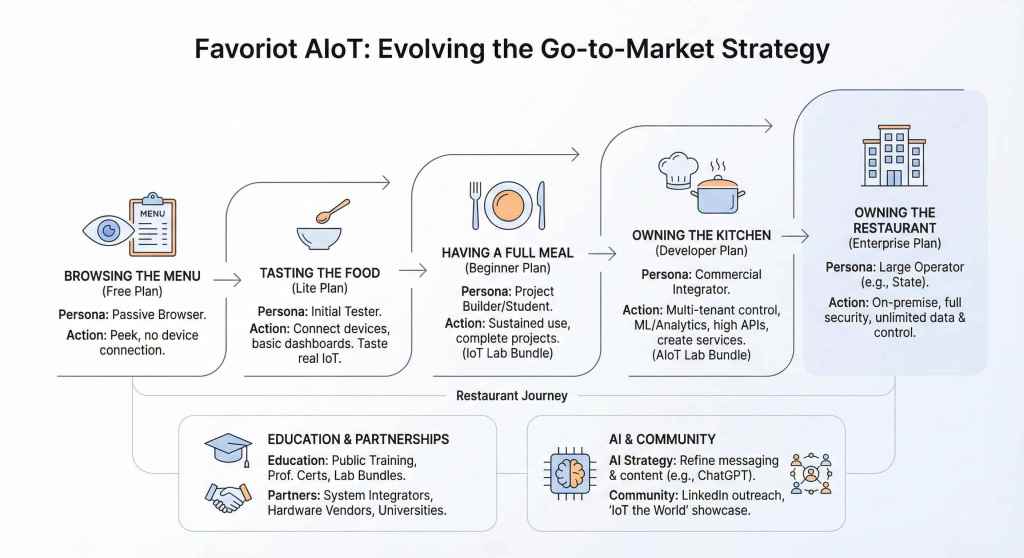
Go-to-market favoriot

Favoriot did not arrive here overnight.
It took years of confusion, wrong assumptions, quiet learning, and small corrections.

But today, the path feels clearer.

Free curiosity has a place.
So does tasting.
So does building.
So does owning the kitchen.

If you are just browsing, welcome.
If you are ready to build, stay.
If you want to serve others, let’s talk.

And if you are a student building your first IoT project somewhere in the world, remember this.

The platform you choose today might become the one you trust tomorrow.

I would love to hear your thoughts.
Where are you in this journey?
Peeking, tasting, cooking, or running the whole place?

Leave a comment. Let’s talk.

I Thought Favoriot Users Were Like Any Other SaaS Users. I Was Wrong.

For a long time, I carried a quiet assumption in my head.

I told myself, “A user is a user. SaaS is SaaS.”

I thought Favoriot users would behave like most consumer SaaS users. Log in daily. Click around. Expect things to feel smooth, friendly, almost playful. If something took too long, they would leave. If a screen felt confusing, they would complain. If onboarding was not instant, they would disappear.

That mental model sat comfortably in my head. Too comfortably.

Then one day, a simple question landed in my lap.

A question that forced me to stop using generic labels and actually picture real humans.

I paused.

Who exactly is using Favoriot?

And once I answered that honestly, everything shifted.

What I Actually See When I Think About Favoriot Users

When I close my eyes and picture a Favoriot user now, I don’t see someone lounging on a couch, scrolling through a polished interface with a coffee in hand.

I see something else.

I see sensors scattered on a desk.
Loose jumper wires tangled like spaghetti.
A laptop open with a dashboard on one screen.
Telegram buzzing on the other.
A multimeter nearby.
Sometimes a soldering iron.
Sometimes panic.
Sometimes excitement.

I see people trying to make something real work.

Ah. This is not a consumer SaaS crowd.

This is a builder crowd.

Builders, Not Browsers

Favoriot users are builders.

They don’t log in to be entertained.
They don’t log in to feel productive.
They log in because something must work.

A lecturer wiring ESP32 boards in a lab late in the evening.
A student is testing temperature data at 2 a.m. before demo day.
An engineer is checking why a sensor stopped reporting right after a rainstorm.

Their first question is almost never about aesthetics.

It’s usually raw and practical.

“Can I connect this device?”
“Is the data coming in?”
“Why did it stop at 3:17 p.m.?”
“Did I configure something wrongly or did the network die?”

They are hands-on by instinct.

And once I accepted this, I had to admit something uncomfortable.

I had been projecting the wrong expectations onto them.

Problem First, Not Feature First

Most consumer SaaS users start with features.

They ask things like:

“Does it have dark mode?”
“Can it sync with my calendar?”
“Is there a mobile app?”
“Can I customise the theme?”

Favoriot users start with a problem.

“I need to monitor the water level.”
“I must prove this concept works before funding.”
“My lecturer wants a dashboard by Friday.”
“My boss wants alerts, not charts.”

Features only matter if they help solve that problem quickly.

If a feature does not move them closer to a working outcome, it may as well not exist.

This was a big wake-up call for me.

I realised that talking about features without anchoring them to real use cases was missing the point entirely.

Learning While Doing Is the Default Mode

Another thing I misunderstood.

I used to think users came prepared. That they would read everything first. That they would know what they were doing.

Reality check.

A large portion of Favoriot users are learning while doing.

Students.
Fresh engineers.
Lecturers experimenting with new lab setups.
SMEs touching IoT for the first time.

They are not experts yet. And they know it.

They expect mistakes.
They expect trial and error.
They expect data that looks wrong at first.
They ask questions like:

“Did I wire this wrongly or configure it wrongly?”
“Why is the payload showing weird values?”
“Is this sensor faulty, or am I misunderstanding the units?”

Consumer SaaS users expect things to just work.

Favoriot users expect to work through things.

That difference matters more than most people realise.

A Bit of Friction Is Not the Enemy

Consumer SaaS products live in fear of friction.

One extra click and users leave.
One confusing screen, and churn happens.
One long form and conversion drops.

Favoriot users are different.

They tolerate friction if it leads somewhere meaningful.

They accept setup steps.
They read tutorials.
They debug payload formats.
They learn what MQTT or HTTP means.
They try again after failing.

As long as the payoff is real data and real insight, they stay.

I remember thinking to myself, “They are not lazy users. They are patient users with a purpose.”

That insight changed how I think about onboarding, documentation, and even UI decisions.

Usage Comes in Bursts, Not Habits

Here’s another mistaken assumption I had.

I assumed success meant daily logins.

That is true for many consumer tools.

It is not true for Favoriot.

Favoriot usage is project-based.

Users may log in intensely for two weeks.
Then disappear.
Then return when deployment starts.
Then vanish again.
Then come back when something breaks.

This is not abandonment.
This is reality.

Favoriot is not a habit-forming app.
It is a project enabling platform.

Once I stopped forcing a consumer SaaS lens onto usage patterns, the data suddenly made sense.

Ah. They didn’t leave. They just finished phase one.

Credibility Matters More Than Vibes

This part surprised me the most.

Favoriot users care deeply about credibility.

They ask questions like:

“Is this used by real organisations?”
“Can I show this to my supervisor?”
“Will this scale if my pilot succeeds?”
“Can I put this in my report or proposal?”

Consumer SaaS users care about brand feeling.
Favoriot users care about trust.

They want to know that what they are building on will not collapse when things get serious.

This is why things like:

Clear documentation.
Real case studies.
Honest limitations.
Professional dashboards.

matter more than flashy design.

They are building something that must stand scrutiny.

A Simple Mental Contrast That Helped Me

Once I framed it this way, everything clicked.

Consumer SaaS user:
Browses.
Seeks convenience.
Is the feature curious?
Hates setup.
Form daily habits.
Is emotion-led?

Favoriot user:
Builds.
Seeks control.
Is problem driven.
Accepts setup if useful.
Works in project bursts.
Is outcome-led.

Two very different humans.

Why This Changed How I Talk About Favoriot

I now remind myself constantly:

Stop comparing Favoriot to Notion, Canva, or Spotify.

Favoriot is closer to:

A lab bench.
A toolbox.
A test rig.
A learning environment.

This is why certain decisions suddenly felt obvious.

Why Lite plans for students matter.
Why simple dashboards matter.
Why examples matter more than slogans.
Why tutorials matter more than polish.
Why honesty beats hype.

Favoriot users don’t want magic.

They want clarity.

They want to understand what is happening.
They want to know what to do next.
They want confidence that they are not wasting time.

And when they succeed, something interesting happens.

They stay.
They recommend.
They come back with bigger ideas.

The Real Lesson I Had to Learn

The biggest mistake I made was not technical.

It was mental.

I assumed the wrong persona.
So I used the wrong language.
So I emphasised the wrong things.
So I measured the wrong signals.

Once I corrected that, everything else became easier.

Marketing messages became clearer.
Product decisions felt grounded.
User feedback made sense.

I remember thinking, “This is not about making things simpler for the sake of simplicity. It is about making things understandable for builders.”

That distinction matters.

Where This Leaves Me Now

Today, when I write, design, or explain Favoriot, I imagine a real person.

Someone with wires on the table.
Someone racing against a deadline.
Someone is trying to prove that an idea works.

If my message helps that person move forward, then it is doing its job.

If not, it needs rewriting.

And maybe that is the real takeaway.

Before we talk about growth, conversion, or positioning, we must first answer one honest question.

Who is actually on the other side of the screen?

If you are building, teaching, or learning with Favoriot, I would love to hear your story.

Drop a comment.

How Lecturer Feedback Inspired the Favoriot Lite Plan

Why a University Lecturer’s Feedback Changed Everything and Led to the Favoriot Lite Plan

This story did not start in a boardroom.

It did not start with pricing spreadsheets or growth charts.

It started with a simple, honest conversation with a university lecturer.

A conversation that stayed with me longer than expected.

“Dr. Mazlan, the Beginner plan is good. But for teaching and students, it feels a bit too expensive. And honestly, we do not need all the features. We just need a few dashboards that work well.”

I remember pausing for a moment.

Not because I disagreed.
But because I knew they were right.

That Moment of Realisation

I have spent years working closely with universities. I have seen how students learn best. I have stood in labs where excitement fades the moment tools feel heavy or out of reach.

When that lecturer shared their concern, I did not hear a complaint.

I heard care.

Care for students.
Care for learning.
Care for making sure curiosity does not die because of cost or complexity.

I thought to myself…

If a lecturer is already trying to stretch budgets just to give students real exposure, are we truly helping if we keep things as they are?

That question would not leave me alone.

The Truth About Teaching IoT

Teaching IoT is not about showing everything.

It is about showing enough.

Students do not need ten dashboards.
They need one or two that make sense.

They do not need advanced workflows on day one.
They need to see data move from a device to the cloud and onto a screen they understand.

Most importantly, they need confidence.

And confidence comes from simplicity.

The lecturer was clear.
Less features.
Lower cost.
Focused dashboards.
Real experience.

That feedback mattered.

Why the Lite Plan Had to Be Created

The Favoriot Lite Plan exists because of that conversation.

It exists because education should not feel like a compromise.

The goal was never to strip things down until nothing meaningful remained. The goal was focus.

Lite uses the same core platform that powers real projects on the Favoriot platform.

What we changed was intent.

Lite focuses on a small number of dashboards that matter for teaching and learning. Clean. Clear. Purposeful.

No unnecessary features.
No distractions.
No pressure on budgets.

Just what students and lecturers actually asked for.

Designing Lite With Students in Mind

I kept picturing a classroom.

A lecturer standing in front.
Students are opening their laptops.
Devices blinking on the table.

What do they really need at that moment?

They need to connect.
They need to see data.
They need to understand what just happened.

Lite delivers exactly that.

Students can focus on learning instead of navigating menus. Lecturers can focus on teaching instead of explaining why certain features will not be used this semester.

That was the win.

Why Fewer Dashboards Can Mean Better Learning

This might sound counterintuitive to some.

More features do not always mean more value.

In teaching, fewer dashboards often lead to deeper understanding. When students can concentrate on one or two views, patterns become clearer. Questions become sharper.

Why is the data changing?
What caused that spike?
How does the sensor behave over time?

Those questions matter more than fancy configurations.

Lite gives room for those conversations.

About Cost and Respect

I want to say this clearly.

Lowering the entry cost was not about discounts or promotions. It was about respect.

Respect for students who are still learning.
Respect for lecturers who fight for better tools within tight budgets.
Respect for institutions that want real exposure without overcommitting.

Education should never feel excluded from real platforms.

Lite is our way of saying, you are welcome here.

Not a Step Back, Just a Better First Step

Lite is not a lesser plan.

It is a thoughtful one.

When students finish their projects and want more, moving up feels natural. When lecturers want to expand labs or pilots, the path is clear.

Nothing is lost.
Nothing needs to be rebuilt.

You simply grow from where you started.

What This Means to Me Personally

That lecturer probably does not realise how much their feedback meant.

But it reminded me why Favoriot exists.

Not just to build technology.
But to remove barriers.

I asked myself…

If our platform cannot support learning at its earliest stage, what are we really building?

The Lite Plan is my answer to that question.

An Invitation to Lecturers, Students, and Builders

If you are a lecturer looking for a practical way to teach IoT without overwhelming students, Lite was built with you in mind.

If you are a student who wants hands-on experience without worrying about cost or complexity, this is your starting point.

If you are building something small and want clarity before commitment, Lite is enough.

You can explore the plans here
https://www.favoriot.com/iotplatform/pricing/

I would genuinely love to hear your thoughts.

What do you need in the classroom?
What feels too much today?
What would make learning easier?

Leave a comment. Share your experience. Start a conversation.

Sometimes, the most meaningful changes come from one honest piece of feedback.

When Writing Free eBooks Still Feels Like Shouting Into the Void

I did not expect this feeling to arrive so quietly.

No dramatic moment.
No emotional breakdown.
Just a soft question that kept returning while I stared at my screen.

Should I stop writing eBooks about IoT, startups, and entrepreneurship?

I have written several eBooks over the years. Some came from years of experience building platforms. Some from scars earned while running a startup. Some from observing founders struggle with the same blind spots again and again.

I made them free.
No paywall.
No upsell tricks.
Just knowledge, stories, and lessons shared openly.

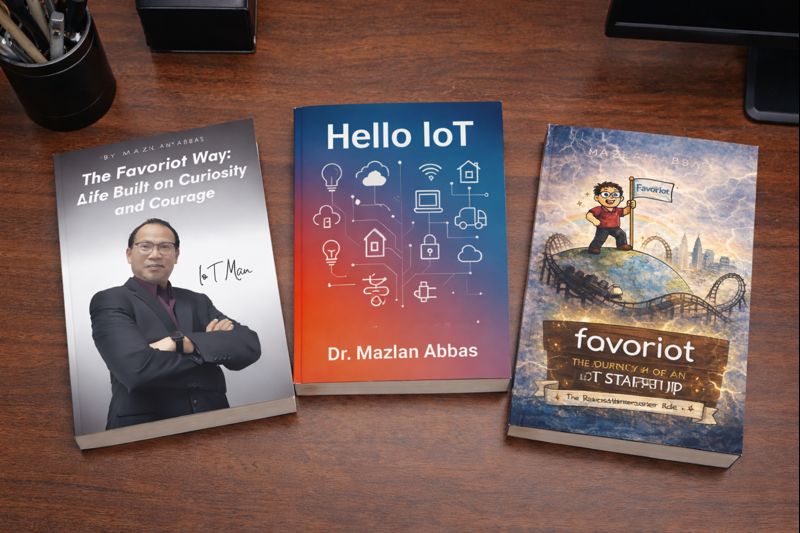
Yet after my last three books (Hello IoT, The Favoriot Way: A Life Built on Curiosity and Courage, Favoriot : The Journey of an IoT Startup), something felt off.

Downloads slowed.
Shares dropped.
The quiet became louder.

At first, I blamed myself.

Maybe the topics are stale.
Maybe I am repeating myself.
Maybe people are tired of hearing from me.

Then another thought crept in.

Or maybe the world has changed.

The Moment I Could No Longer Ignore

I noticed something about my own habits before blaming anyone else.

I no longer Google as much.
I open ChatGPT.
I type a question.
I get an answer.

Direct.
Fast.
Clean.

And here is the uncomfortable truth.

I am guilty too.

I ask AI to summarise books.
I ask for key takeaways.
I skim instead of sitting with pages.

Who am I to complain when I do the same thing?

That realisation stung.

Because I used to love reading slowly. Highlighting sentences. Rereading paragraphs. Letting ideas sit for days.

Now, time feels compressed. Attention feels borrowed. Everything competes for mental space.

The Silent Shift No One Talks About

This is not about AI replacing writers.

It is about AI changing readers.

People no longer want to search.
They want answers.

They no longer want ten blog posts.
They want one response.

They no longer want to explore.
They want to arrive.

Why buy a book when a prompt gives you a clean summary?

Why spend hours reading when minutes feel enough?

That question hurts writers, but it is not wrong.

Books were once a journey.
Now they are treated like databases.

Tell me what matters. Skip the rest.

Short Attention Is Not a Moral Failure

I hear people complain about attention spans all the time.

But I do not think it is laziness.
I think it is survival.

We are flooded with inputs. Messages. Alerts. Updates. Noise.

Reading a 150-page eBook feels heavy when your mind is already full.

The new generation did not lose patience.
They adapted to overload.

They want clarity, not volume.
Direction, not depth.

At least not by default.

When Free Still Feels Expensive

Making my eBooks free was supposed to remove friction.

Yet free does not mean easy.

Reading still costs time.
Thinking still costs energy.

AI removed that cost.

One prompt feels cheaper than one chapter.

So why am I surprised?

The Hard Question I Keep Avoiding

I keep asking myself something uncomfortable.

Am I writing for impact, or am I writing out of habit?

In the past, writing eBooks felt like leaving a trail behind. Something lasting. Something searchable. Something meaningful.

Now it feels like throwing paper planes into a sky full of drones.

They fly faster.
They reach further.
They respond instantly.

Paper planes still matter.
But fewer people look up.

Books Versus Conversations

AI feels like a conversation.

Books feel like a lecture.

That difference matters.

People want interaction. They want follow-up questions. They want context tailored to their situation.

A book cannot ask back.

AI can.

And that changes expectations.

What Writing Used to Give Me

I did not write eBooks just for readers.

I wrote to think.

Writing forced clarity.
It slowed my thoughts.
It made experiences visible.

If I stop writing books, what replaces that?

Blogs?
Short posts?
Conversations?
Voice notes?

I do not know yet.

That uncertainty is unsettling.

Maybe Books Are No Longer the First Door

Here is a thought I am still wrestling with.

Books may no longer be entry points.
They may become reference points.

Not where people start, but where they return when they want depth.

AI gives direction.
Books give texture.

AI answers questions.
Books explain why the questions matter.

But fewer people reach that stage.

The Ego Check I Needed

Another truth I had to face.

I assumed free meant valuable.
I assumed experience meant relevance.

Neither guarantees attention.

The world does not owe writers readers.

Attention is earned every day.

Even by those who have written before.

Am I Really Stopping?

When I say I feel like stopping, I am not quitting writing.

I am questioning the format.

Maybe eBooks are not where my thoughts want to live anymore.

Maybe ideas want to breathe in smaller spaces.
Or in stories.
Or in conversations.

Or maybe fewer books, written slower, with deeper intent.

I am not sure yet.

What I Do Know

AI has changed how we read.
AI has changed why we read.
AI has changed when we read.

That shift is real. It is not a phase.

Fighting it feels pointless.

Understanding it feels necessary.

The Choice In Front of Me

I can keep writing eBooks and accept fewer readers.

I can stop writing books and find new ways to share ideas.

Or I can redefine what a book means in a world that no longer reads the same way.

Right now, I am sitting with the discomfort.

No dramatic announcement.
No final decision.

Just honesty.

A Quiet Ending With an Open Question

I still believe ideas matter.
I still believe stories shape thinking.
I still believe writing is worth doing.

But I no longer believe format guarantees relevance.

Maybe the real question is not whether I stop writing eBooks.

Maybe it is whether I am brave enough to write differently.

If you are a writer, a reader, or someone who quietly stopped reading books, I would love to hear your thoughts.

Have you felt this shift too?

Book Review by a Young Founder: How The Favoriot Way Sparked New Fire in Me

I picked up The Favoriot Way: A Life Built on Curiosity and Courage by Mazlan Abbas at a time when I felt stuck between ambition and uncertainty. The title alone sounded like something a seasoned founder might write after years of success. What I didn’t expect was how personal, honest, and relatable this book would feel from the very first page.

Right away, I could sense this wasn’t a typical business book full of polished charts and bright promises about overnight success. It felt like sitting down with someone a few steps ahead of me on a road I’m still trying to map out. I could almost hear his voice explaining how curiosity pushed him forward in ways no strategy ever could.

Curiosity as a Compass

What hit me first was how Mazlan traced his journey back to childhood curiosity, fiddling with broken radios, wanting to know how things worked. It made me reflect on my own early curiosities. For me, it was taking apart gadgets as a kid, even though I rarely put them back together. Reading that made me laugh and nod at the same time.

As a young entrepreneur, it’s easy to look at seasoned founders and assume they had some secret formula from the start. This book reminded me that the real engine behind growth is simple curiosity showing up with questions and staying with them even when answers aren’t obvious.

Real Talk About Real Challenges

The book moves through Mazlan’s life from student days to corporate leadership and into entrepreneurship with Favoriot. But it doesn’t boast or brag. What stood out most were the honest moments where he wasn’t sure what came next. That was refreshing. I often worry that not knowing the next step means I’m failing. Reading about someone I respect being uncertain and still moving forward felt like a permission slip.

There was one part where he talked about choosing entrepreneurship at an age when many people are thinking about stability. That hit me hard. I’ve always wondered if my dreams make sense in the real world. His reflections made me rethink that fear and see it as part of the journey, not a detour.

Lessons That Feel Personal

What I appreciated most about this book is that it doesn’t give you a checklist of things to do. There are no fluff headlines about “10 steps to success.” Instead, Mazlan shares what he learned about being patient, thinking clearly, and trusting that consistent effort compounds over time. As someone building something from scratch, that perspective felt grounding.

I highlighted lines about:

  • Taking time to think clearly
  • Putting curiosity ahead of shortcuts
  • Treating failure not as a dead end but as data

Every time I paused on a passage, I found myself thinking “Yes, that’s exactly how it feels.” It was like someone had put into words things I’d been feeling but couldn’t articulate.

Accessible and Encouraging

The writing style is simple but powerful. Some moments felt like candid conversations instead of formal text. If you’re like me, juggling ideas and doubts, this tone makes the content feel accessible and encouraging rather than intimidating.

I’ve read business books that left me motivated for a day, only to be forgotten. This one stayed with me at the end of each chapter. It made me reflect on why I’m building what I’m building and how I want to show up for it.

Why This Book Matters for Young Founders

As someone forging my own path, I didn’t need another blueprint. What I needed was perspective. Someone to remind me that uncertainty isn’t a flaw, but part of the startup journey. Someone to say that curiosity will keep me going long after hype fades.

The Favoriot Way gave me that.

It’s short, easy to read, and packed with real insights that feel like they came from lived experience. Whether you are just starting a venture or trying to find clarity in your direction, this book gives you something many other business books don’t: emotional resonance with your struggles.

Final Thoughts

Reading this book felt like a conversation with a mentor who doesn’t sugarcoat but still believes in your potential. For young entrepreneurs like me who sometimes doubt whether we’re on the right track, this was precisely the kind of perspective we need.

It doesn’t tell you what your next move should be. It gives you the confidence to make that move yourself.

If you’re chasing ideas, navigating doubt, or building something that matters to you, The Favoriot Way deserves a spot in your reading list.

Rating: 4.5 out of 5 stars

And if you’ve read it too, I’d love to hear which part spoke to you most. Drop a comment and let’s talk about it.

[Book review: A Young Entrepreneur in the Making]

Download eBooks from Mazlan Abbas

  1. Favoriot – The Journey of an IoT Startup
  2. The Favoriot Way – Life of Curiosity and Courage
  3. Hello IoT
  4. Mastering IoT with Favoriot: A Comprehensive Guide for Business and Educational Institutions
  5. Internet of Things (IoT): A Beginner’s Guide
  6. Startup Survival: The Journey of a Tech Entrepreneur
  7. Your IoT Journey
  8. IoT Notes

Favoriot’s Journey: Lessons from Lord of the Rings

The journey of Favoriot, from its earliest days to where it stands today, mirrors The Lord of the Rings Trilogy in a way that feels less like fantasy and more like lived experience.

Not because of epic battles or dramatic villains, but because both stories are really about endurance, pivots, and choosing to continue when the original plan no longer fits the road ahead.

A Journey That Did Not Start With a Grand Map

When Frodo left the Shire, there was no detailed map to Mount Doom. Gandalf did not hand him a ten-year plan. The mission evolved as dangers revealed themselves.

Favoriot began the same way.

The early vision was simple. Build an IoT platform that works. One that local engineers, researchers, and institutions could rely on. What came next was not a straight line. The platform did not arrive fully formed. It grew through experiments, false starts, and product decisions that looked right at the time but later needed rethinking.

Like Middle-earth, the terrain kept changing.

Products as Paths, Not Destinations

In The Lord of the Rings, the Fellowship does not walk a single road. They split. They detour. Some paths fail. Others reveal their purpose much later.

Favoriot’s products followed the same rhythm.

Early versions focused heavily on basic device connectivity and dashboards. That was the Shire phase. Simple. Familiar. Necessary.

As real customers arrived, the needs shifted. Monitoring alone was not enough. Scale introduced complexity. Rules became more complicated to manage. Alerts became noisy. What worked for a pilot did not hold up in production.

That forced pivots.

  • From simple dashboards to structured data models
  • From manual rules to more intelligent behaviour detection
  • From pure IoT to AI-assisted decision support
  • From cloud-only thinking to edge-aware architectures

Each pivot felt like leaving a known path and stepping into uncertainty. Some features were retired quietly. Others were reshaped instead of discarded. Just as characters outgrow their early roles, products evolve because the journey demands it.

The Cost of Carrying Too Much

Frodo’s burden was not the distance. It was the Ring.

For Favoriot, the “Ring” often took the form of technical debt, early assumptions, and customer expectations set too soon. Decisions made for speed later demanded patience to untangle. Features built for one market created friction in another. Supporting early users while reworking the core tested both systems and people.

Letting go was hard.

Just as Frodo struggled to release the Ring, teams struggle to let go of products they worked hard to build. Yet progress required accepting that not everything belongs in the final version.

Splitting the Fellowship to Survive

The Fellowship did not stay together because it looked nice. It split because survival required it.

Favoriot’s journey did the same. Engineering focused on stability, while product teams listened closely to users. Business teams dealt with timing, cash flow, and long sales cycles. Partnerships opened doors while internal teams strengthened the foundation.

At times, it felt fragmented. In reality, it was a focus.

Each group carried a different part of the burden. No single team saw the whole picture at all times. Trust became the glue.

Long Stretches Without Applause

Middle-earth did not pause to celebrate milestones. Neither did the market.

There were long periods where progress was invisible from the outside. No launches. No announcements. Just refactoring, rewriting, rebuilding. Customers rarely see this phase, yet it defines whether a platform survives.

Favoriot lived in this space for years.

Quiet work. Fewer shortcuts. Many trade-offs. The kind of progress that feels slow until one day it becomes evident that the platform is stronger, calmer, and more reliable than before.

When the Mission Changes the People

By the end of the trilogy, Frodo was not chasing adventure. He was carrying wisdom earned through pain and persistence.

Favoriot’s journey shaped its people the same way.

Engineers learned restraint, not just speed. Product teams learned when to say no. Leaders learned that timing matters as much as vision. The company knew that building trust outlasts chasing trends.

The platform today is not just more capable; it is also more capable. It is more deliberate.

Not Glory, But Completion

Destroying the Ring was not a victory parade. It was relief. Completion.

Favoriot’s goal has never been to build everything or to shout the loudest. It has been to finish what was started. A platform that can grow with its users. A system that learns instead of overwhelming. A foundation that can support the next chapter without collapsing under its own weight.

That goal shaped every pivot.

The Quiet Parallel

Frodo was not the strongest.
Favoriot did not have the most significant budget.
Neither took the shortest route.

Yet both stories prove the same point.

Lasting impact rarely comes from perfect plans. It comes from adjusting without losing purpose, letting go without giving up, and continuing to walk when turning back feels easier.

That is the shared truth between Middle-earth and Favoriot’s journey.
A long road.
Many pivots.
One mission that refused to be abandoned.

Favoriot: AI Agents Not Needed Now

Do Favoriot need to develop an AI Agent feature?

Short answer? No, Favoriot does not need full AI Agent automation right now.

And yes, what you have today is more than enough for the market you are serving.

Let me explain this the way I usually reason with myself.

I asked myself this quietly

“Do customers really want systems that act on their own…

or do they want systems they can trust?”

When I sit with city operators, facility managers, engineers, or even researchers, one thing keeps coming up.

They are not asking for autonomy.

They are asking for clarity.

They want fewer surprises.

They want earlier signals.

They want confidence before taking action.

That matters.

What Favoriot already does well

Right now, Favoriot Intelligence does something very important and very rare.

It learns patterns from real operational data

It surfaces what looks unusual

It feeds those insights into a Rule Engine

And then… it stops

That stopping point is not a weakness.

It is a design choice.

The system says,

“Here is what changed.

Here is why it matters.

You decide what to do next.”

That is precisely where trust is built.

Rule Engine + ML is not a compromise

Some people frame this as:

“Rule Engine now, AI Agents later.”

I don’t see it that way.

I see it as:

ML decides what deserves attention

Rules decide what action is allowed

This separation is powerful.

Why?

Because rules are:

  • Auditable
  • Explainable
  • Governable
  • Aligned with SOPs and regulations

And ML is:

  • Adaptive
  • Pattern-driven
  • Good at spotting drift and anomalies

Together, they form a human-in-the-loop intelligence system, not a black box.

That is exactly what enterprises and public sector teams are comfortable with today.

Do customers actually want AI Agents?

Here’s the uncomfortable truth.

Most organisations say they want AI to “automate everything”.

But when you ask one more question…

“Are you okay if the system shuts down equipment on its own?”

“Are you okay if it triggers evacuation automatically?”

“Are you okay if it changes operating parameters without approval?”

The room goes quiet.

What they really want is:

  • Earlier warnings
  • Better recommendations
  • Fewer false alarms
  • Less manual rule tuning

Favoriot Intelligence already delivers that.

Where AI Agents actually make sense later

I’m not against AI Agents. Not at all.

But their place is conditional, not universal.

AI Agents make sense when:

  • Policies are mature
  • Actions are reversible
  • Risk is low
  • Trust has been earned over time

For example:

  • Automated report generation
  • Recommendation ranking
  • Suggesting rule adjustments
  • Proposing actions for approval

Notice the word: suggesting, not executing.

That is a natural evolution path.

Not a starting point.

Strategically, Favoriot is in the right place.

By keeping:

  • ML for learning and insight
  • Rules for control and action

Favoriot positions itself as:

  • Reliable
  • Safe
  • Deployable today
  • Acceptable to conservative sectors

Smart cities.

Utilities.

Campuses.

Critical infrastructure.

These sectors do not reward “full autonomy” first.

They reward predictability and confidence.

My honest conclusion

If I had to answer this as simply as possible:

Favoriot does not need AI Agents to be valuable.

Favoriot Intelligence with ML-driven rules is already the right solution for today.

AI Agents can come later, carefully, selectively, and with guardrails.

Right now, Favoriot is doing something more important than automation.

It is helping people think earlier, not react later.

And that, in my book, is real intelligence.

Favoriot – The Journey of an IoT Startup: A Free eBook for Thoughtful Makers, Thinkers, and Doers by Mazlan Abbas

Today (1 January 2026), I’m thrilled to share something that’s been quietly taking shape over the past year. My latest eBook titled “Favoriot – The Journey of an IoT Startup” is now officially released and available for free download. You can get your copy right here: https://payhip.com/b/GbOyo

Writing this book was not a sprint. It was more like those slow early mornings when you sit with a cup of coffee before the world wakes up and try to make sense of what you’ve learned, what you’ve unlearned, and what still puzzles you.

“What if I just write this down now before I forget how it felt?” I asked myself more times than I can count.

That question became this book.

Why This eBook Exists

I didn’t set out to write an eBook that checks all the “how to succeed” boxes. I wrote something more honest. More personal. More reflective of real work and real life.

This is a piece of writing that came from:

  • Conversations I had with founders and students
  • Moments when I wasn’t sure if something would work
  • Times when a quiet insight changed my view more than any big announcement ever could

Some parts feel calm and clear. Some parts feel messy and uncertain. In all of them, you’ll find reflections that resonate with the kinds of questions we all silently carry with us.

If you’ve ever asked yourself, “Am I doing this right?” or “What truly matters here?” then this book was written with you in mind.

What You’ll Find Inside

This eBook isn’t a step-by-step guide or a list of formulas that promise success. You won’t find shortcuts here. What you will find are reflections rooted in real experience:

  • How clarity often arrives slowly
  • Why patience matters more than speed
  • What it really takes to think long term
  • Why credibility beats noise
  • How do you navigate uncertainty when the path ahead isn’t clear

These are not theories. They came from living through questions that didn’t have neat answers.

“Oh… so this is what that moment was really teaching me,” I found myself saying as I shaped these chapters.

A Free Book for the Curious Mind

You might wonder why this eBook is free. There are reasons.

Most books you see are behind paywalls. You sign up. You subscribe. You unlock. All of that has its place.

But I wanted this one to be different.

I wanted it to be reachable by anyone who might benefit from it — no barriers. No barriers, no hoops, no strings attached.

Just download it, read it at your pace, and keep what matters to you.

Who Should Read This

This is a book for people who:

  • Are you building something without a clear path
  • I’m thinking about the next step, but don’t know exactly what it is
  • Feel the tension between urgency and patience
  • Need space to reflect instead of being told what to do

If you’re looking for hype or fast answers, this may not be a perfect match.

If you’re looking for thoughtful reflections that support your own thinking, then this book might feel like a companion for that journey.

Grab Your Copy

Here’s the link again:

👉 https://payhip.com/b/GbOyo

Download it, read it, and then take a moment to reflect on one question:

Which part stayed with me the longest after I closed it?

If you feel like sharing what that was, I’d really like to hear it. Drop a comment. Send a message. Pass the link to someone else who might need it.

Because sometimes the meaning of a book only shows up after you’ve walked a few steps beyond the last page.

Thank you for being here. I’d love to hear your thoughts.

Let’s continue the conversation.

When Saying “Not Yet” Is Better Than Saying “Yes”

There was a time when I thought saying “yes” was the mark of progress.

Yes to meetings.
Yes to collaborations.
Yes to pilot projects.
Yes to opportunities that sounded exciting on paper.

I told myself this is how momentum works. You say yes, doors open, things move.

Then one quiet evening, after another long day, I stared at my notebook. It was full. Pages packed with ideas, arrows, half plans. And yet, nothing felt complete.

Why does being busy feel so hollow right now? I asked myself.

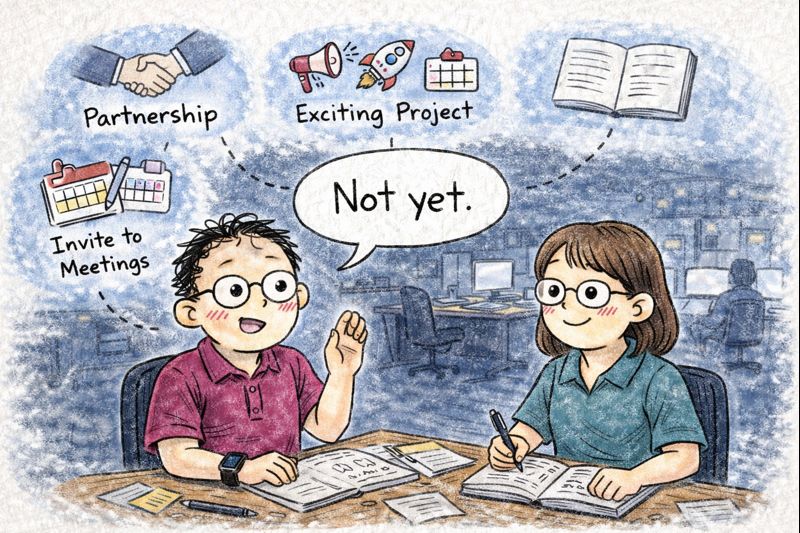
That was the moment I began to respect the power of “not yet”.

Not no.
Not rejection.
Just not yet.

The Hidden Cost of Saying Yes Too Quickly

Early in my career, and even during the early years of building Favoriot, I treated every opportunity like a rare train that might never come back. If I missed it, I feared regret.

So I boarded many trains.

Some took me forward.
Some took me sideways.
A few quietly took me backwards.

Each “yes” came with invisible baggage. Time. Energy. Attention. Emotional load. Once you say yes, you owe something. A reply. A follow-up. A delivery. A meeting. Another meeting.

One day I caught myself replying to emails at midnight, agreeing to things I barely remembered discussing.

This isn’t growth, I muttered. This is drift.

Saying yes too fast often means borrowing time from the future. And the interest rate is brutal.

Why “Not Yet” Is Not a Weak Answer

Many people hear “not yet” and assume hesitation or fear.

That couldn’t be further from the truth.

“Not yet” is clarity without arrogance.
It is patience without laziness.
It is confidence that does not need applause.

When I say “not yet” today, it usually means one of three things.

I have not thought this through deeply enough.
My current priorities would suffer.
The timing is wrong even if the idea is right.

Why rush something that deserves care? I often ask myself.

In a world addicted to speed, restraint feels radical.

Timing Is a Strategy, Not an Excuse

I have seen great ideas fail not because they were flawed, but because they arrived at the wrong time.

Too early and the ecosystem is not ready.
Too late and the window has closed.

I learned this the hard way.

There were moments when partnerships looked perfect. Strong names. Good intentions. Big promises. On paper, it all made sense.

But something inside me hesitated.

Can we execute this properly right now?
Do we have the mental space to do this well?

When I ignored that inner voice and said yes anyway, the result was often messy. Delays. Frustration. Quiet disappointment on both sides.

Now I treat timing as a first-class decision variable.

A good idea at the wrong time is still the wrong move.

The Discipline of Protecting Focus

Focus is fragile.

Once broken, it takes far longer to restore than we admit.

Every “yes” competes with what you are already building. It steals attention in small, almost polite ways. One extra call. One more document. One more thread to keep in your head.

I used to pride myself on juggling many things. Then I realised juggling means nothing ever truly rests in your hands.

What if fewer things, appropriately done, are the real advantage?

Saying “not yet” protects the work that matters most. It keeps the main thing the main thing.

Relationships Respect Honest Timing

Here is something I learned with age and a few scars.

Serious people respect honesty more than enthusiasm.

When you say yes too quickly and later underdeliver, trust erodes quietly. No drama. No argument. Just a subtle shift.

When you say “not yet” with clarity and respect, something else happens.

People listen.

They know you are not chasing noise. They sense you are playing a longer game.

I have had conversations where a simple “not yet, let me come back to this in a few months” led to stronger partnerships later.

Good relationships survive patience. Weak ones do not.

Saying “Not Yet” to Protect Your Future Self

There is a version of you six months from now who will inherit today’s decisions.

That future self will deal with the consequences. The deadlines. The stress. The regret.

I try to picture him often.

Tired? Calm? Proud? Frustrated?

When I say yes impulsively, I am often being unfair to that future version of myself.

“Not yet” is a gift to him.

It buys space.
It buys clarity.
It buys better decisions.

When “Yes” Becomes a Reflex

Reflexive yes is dangerous.

It feels polite. Productive. Cooperative.

But reflexes bypass thinking.

I noticed this pattern during periods of pressure. When things feel uncertain, the instinct is to grab everything. To say yes to feel safe.

Ironically, that is when restraint matters most.

What am I trying to compensate for? I ask myself now.

Scarcity mindset whispers lies. It tells you this is your last chance. Those opportunities are rare.

Experience teaches otherwise.

The right opportunities return. Often better prepared. Often clearer.

The Confidence to Wait

Waiting is uncomfortable.

Silence feels awkward.
Unanswered emails create tension.
Pauses invite doubt.

Yet waiting is where conviction forms.

Some of my best decisions were made slowly. They survived weeks of thinking, rewriting, second-guessing, and walking away before returning.

The bad decisions? They were fast. Exciting. Urgent.

Confidence is not loud. Sometimes it looks like waiting calmly while the world rushes.

What “Not Yet” Sounds Like in Practice

It does not need drama.

It can be simple.

“Let me revisit this after we complete our current milestone.”
“This deserves more thought. Can we talk again later?”
“I like the direction, but the timing isn’t right for us now.”

Clear. Respectful. Honest.

No long explanations. No guilt.

You do not owe the world your exhaustion.

Building Things That Last Requires Patience

Startups. Products. Careers. Even personal growth.

They all punish haste.

I have come to believe that longevity favours those who can delay gratification. Those who can sit with incomplete answers. Those who can say “not yet” without anxiety.

Am I building momentum or just motion? That question guides me now.

Motion looks busy. Momentum compounds quietly.

The Quiet Strength of Saying “Not Yet”

There is a strange calm that comes with this shift.

Fewer meetings.
Clearer priorities.
Deeper work.

And when I finally say yes, it means something.

It means I am ready.
It means I can commit fully.
It means the answer has weight.

Not yet creates space for better, yes.

A Question for You

Where in your life are you saying yes out of habit rather than intention?

What would happen if you replaced one of those yeses with a calm, honest “not yet”?

You might find that nothing collapses.
You might find respect grows.
You might find your focus returning.

I am curious to hear your thoughts.

Have you ever said “not yet” and later realised it was the right move?

Share your story in the comments.

Download eBooks from Mazlan Abbas

  1. Favoriot – The Journey of an IoT Startup
  2. The Favoriot Way – Life of Curiosity and Courage
  3. Hello IoT
  4. Mastering IoT with Favoriot: A Comprehensive Guide for Business and Educational Institutions
  5. Internet of Things (IoT): A Beginner’s Guide
  6. Startup Survival: The Journey of a Tech Entrepreneur
  7. Your IoT Journey
  8. IoT Notes

Why I Stopped Chasing Visibility and Focused on Credibility

There was a time when I thought visibility was the game.

More views.
More likes.
More stages.
More mentions.

I watched founders celebrate follower counts like revenue. I saw announcements dressed up as progress. I saw loud success everywhere.

And quietly, I asked myself a question I did not say out loud.

“Is this what winning looks like?”

That question stayed with me longer than I expected.

I come from a background where results mattered more than noise. Engineering. Telecommunications. Research. Systems that break if you get one assumption wrong. You cannot bluff physics. You cannot sweet-talk a network into stability. Either it works, or it fails. Publicly. Painfully.

When I stepped into entrepreneurship and started building FAVORIOT, I carried that same mindset with me, though I did not realise how rare it would feel in a world obsessed with attention.

At the beginning, I tried to play both games.

Build quietly, but also stay visible.
Ship code and post updates.
Solve problems, but also explain myself repeatedly.

It was exhausting.

Not because visibility is bad. But because chasing it changes how you think.

The Seduction of Being Seen

Visibility feels productive. That is the danger.

You post something.
People react.
The numbers move.
Your brain rewards you instantly.

I felt it too.

A speaking invitation arrives.
A panel slot opens up.
A logo appears on a slide.

“This must mean we are doing well,” I told myself.

But late at night, when the office lights were off, and the dashboards were still open, another voice appeared.

“Would this platform survive if nobody mentioned it tomorrow?”

That question became my compass.

Because visibility without substance is fragile. The moment the spotlight shifts, so does the relevance.

I had seen this pattern before, long before startups.

In telco projects.
In smart city pilots.
In technology programs with beautiful launches and quiet endings.

Everyone remembers the launch. Few recognise the maintenance.

Credibility works the opposite way.

It grows slowly.
It compounds quietly.
It shows up when no one is clapping.

When I Noticed the Shift

The shift did not happen because I decided to be noble or disciplined.

It happened because of a simple pattern.

People started finding us without us having to chase them.

An email would come in.
A message from overseas.
A partner inquiry that started with, “We’ve been reading your work.”

And every time, I asked the same question.

“How did you hear about us?”

The answers were almost boring.

They searched.
They read.
They compared.
They waited.

No viral post.
No paid campaign.
No dramatic announcement.

Just years of writing, building, fixing, and explaining the same things again and again.

That was when it hit me.

Credibility travels further than visibility, but it moves on its own timeline.

The Cost of Chasing the Wrong Metric

Here is the uncomfortable truth.

Visibility rewards what looks good today.
Credibility rewards what holds up tomorrow.

When you chase visibility, you optimise for speed.
When you build credibility, you optimise for truth.

Speed loves shortcuts.
Truth does not forgive them.

I learned this the hard way in IoT.

You can demo anything.
You can mock data.
You can polish dashboards.

But real deployments are unforgiving.

Sensors fail.
Connectivity drops.
Edge devices behave badly.
Security holes appear where nobody looked.

If your system only works when everything is perfect, it is not a system. It is a slide deck.

So I made a quiet decision.

I stopped asking, “How do we look?”
I started asking, “Would I trust this if I were the customer?”

That question shaped everything.

The way the platform was designed.
The way documentation was written.
The way training was structured.
The way we said no to shortcuts that looked tempting.

No announcement could replace that.

Writing Without Chasing Applause

My writing changed, too.

I used to wonder why some posts did not perform.
Why do some articles feel invisible?
Why did the numbers look flat?

Then I realised something.

I was writing to be understood, not to be shared.

Those are two different goals.

Writing for shares means simplifying until nothing is left to challenge.
Writing for understanding means explaining until clarity replaces confusion.

Clarity takes time.
Understanding takes patience.

And patience does not trend.

But credibility remembers.

Months later, someone would quote an old article.
A student would reference a post I barely remembered writing.
A partner would say, “This helped us avoid a mistake.”

That mattered more than any spike.

Credibility Is Built When Nobody Is Watching

Here is the part nobody glamorises.

Credibility is built in moments that feel invisible.

Fixing a bug nobody will thank you for.
Rewriting documentation for the third time.
Saying no to a deal that feels wrong.
Admitting uncertainty instead of pretending confidence.

These moments never trend.

But they stack.

I spent years in environments where mistakes had consequences. Networks go down. Cities stall. Systems fail publicly. That background wired me to respect fundamentals.

So when trends shifted, buzzwords changed, and hype cycles rotated, I anchored myself to a simple principle.

If this disappears from the internet tomorrow, would the work still stand?

That question saved me from many distractions.

Panels, Stages, and the Quiet Filter

I still speak.
I still write.
I still show up.

But the filter is different now.

I no longer ask, “Will this increase my visibility?”
I ask, “Does this reflect what I actually believe?”

If it does not, I pass.

That choice costs opportunities.
It also protects credibility.

When I sat on panels discussing AI, IoT, and cybersecurity, I was not there because I was loud. I was there because of years of consistent work connecting systems, understanding risks, and dealing with consequences.

That is the kind of visibility credibility earns on its own.

The Long Game: Most People Quit

Here is something I wish more foundershad heard earlier.

Visibility is rented.
Credibility is owned.

Visibility disappears when platforms change.
Credibility stays when people remember.

Visibility flatters.
Credibility humbles.

One feeds the ego.
The other feeds trust.

Trust is slower to build.
It is also harder to destroy.

I chose the long game because I have seen what happens when shortcuts collapse. I have seen systems that looked impressive but could not survive reality.

I did not want to build that.

What I Focus On Now

Today, my priorities are boring in the best way.

Does the platform work when things go wrong?
Can a student learn without being overwhelmed?
Can a partner deploy without calling us every hour?
Can the system explain itself clearly?

These questions do not trend.
They endure.

I still share stories.
I still write reflections.
I still show the work.

But I no longer chase the spotlight.

If it comes, it comes.
If it does not, the work continues.

Because credibility has a strange habit.

It introduces you when you are not in the room.

A Quiet Invitation

If you are building something today and feeling invisible, let me say this gently.

You might not be behind.
You might be early.

Keep building things that last.
Keep explaining things clearly.
Keep choosing substance over speed.

The world is loud.
Credibility whispers.

And whispers travel further than we think.

I would love to hear your thoughts.

Have you felt this tension between being seen and being trusted?
Where are you placing your energy right now?

Share your reflections in the comments.