If I Could Be a Character from a Book or Film, I Would Be Professor Charles Xavier — Here’s Why

“Mazlan, of all the characters in the literary and cinematic universe, why would you choose someone in a wheelchair?”

That’s the first question that popped into my head. And honestly, it’s the kind of self-interrogation I often indulge in when I stumble upon a simple question with unexpectedly deep layers.

Yes. If I could be a character from a book or film, I would be Professor Charles Xavier — the founder of the X-Men, the brilliant mind behind the Cerebro machine, and the one who saw potential in those whom the world feared. Not Iron Man with his billions. Not Batman with his vengeance. Not even the charming Sherlock Holmes. But Charles Xavier, the bald telepath who sat in a wheelchair and built a school that became a sanctuary.

Let me tell you why.

The Power to Influence Minds — Not Control, But Guide

Professor X didn’t just read minds. He empathized. He understood. And he used his powers not to dominate but to educate and elevate others.

Isn’t that what I’ve been doing all my life?

When I was lecturing in universities, building IoT platforms, or even writing these articles, I was not here to force ideas. I’m here to plant seeds. Maybe even open doors that others didn’t realize existed. Much like Charles Xavier did for hiding, scared, or rejected mutants.

He never wanted them to suppress their uniqueness — he wanted them to harness it.

I thought this sounded a bit like how I feel when someone discovers the magic of IoT for the first time.

The Leader Who Built Others to Lead

Something about Charles Xavier’s leadership style has always resonated with me. He wasn’t the one on the front lines throwing punches. He was the strategist, the mentor, and the visionary who built an environment where others could thrive.

When I started FAVORIOT, I didn’t want to build a business myself. I wanted to build a platform—literally and metaphorically—a place where startups, students, and developers could create, innovate, and solve real-world problems using IoT.

That dream wasn’t just about tech. It was about empowerment.

Like the Xavier Institute for Gifted Youngsters, FAVORIOT became a space for hidden talents to shine. Not everyone sees themselves as a hero, but with the proper guidance, they could become one.

Yes, Xavier didn’t fight every battle but enabled others to win wars.

Living with Limitations, Thriving Despite Them

Let’s talk about the wheelchair. It’s not a weakness. It’s a symbol. Of resilience. Of a man who, despite his physical limitations, carried the weight of the world’s rejected children on his shoulders.

“Would you really choose a character who’s paralyzed?”

Yes. Because strength isn’t in the limbs — it’s in the will.

I’ve also faced moments where I felt limited. Whether by corporate bureaucracy, academic red tape, or just plain disbelief from others who didn’t see the future I saw, there were many days when it felt like I was rolling uphill. But I kept moving forward.

I learned to surround myself with others who believed in the mission — just like Xavier did.

The Struggle Between Hope and Realism

What makes Xavier compelling is his constant moral dilemma. He believes in peaceful coexistence between mutants and humans. But he also knows that the world isn’t always ready to change. His long-time friend-turned-nemesis, Magneto, is a living reminder of what happens when hope turns into cynicism.

Have I ever been Magneto? I ask myself.

Maybe. In the moments when I felt the system failed us—when smart city projects were abandoned halfway or when innovation was stifled by bureaucracy—I felt rage, but I always pulled myself back.

Because I still believe in dialogue over domination and in partnerships over power plays.

Xavier always believed people could change. And so do I.

The Legacy of a Teacher

If there’s one thing that makes Xavier immortal, it’s not his telepathy. It’s his students. Cyclops. Jean Grey. Storm. Wolverine. Nightcrawler. Every one of them carried a piece of him, not just in their tactics, but in their principles.

I remember my students, too—the ones who now work in top tech firms, the ones who built startups, and the ones who still message me to say, “Dr. Mazlan, your IoT class changed my life.”

Isn’t that what every teacher lives for?

A legacy not built with bricks or code but with minds inspired and hearts ignited.

Why Not Someone Else?

I could’ve picked Tony Stark — he’s got the gadgets and flair. Or maybe Bruce Wayne — the detective with a moral code. Or even Gandalf, with his wisdom and beard.

But they didn’t build people. They didn’t create platforms that empowered others to grow beyond their shadows.

Charles Xavier did.

And that’s what I want to be remembered for.

A Fictional Character with a Real-World Impact

Do you know what’s funny? Charles Xavier might be fictional, but his spirit lives in every mentor, every teacher, every visionary who sees beyond the surface.

He lives in school principals who believe in troubled students, leaders who nurture instead of command, engineers who share knowledge freely, and writers who plant thoughts like time bombs in the reader’s mind.

Maybe even in me.

Final Thoughts from the Cerebro Room

If I had Cerebro, I wouldn’t use it to invade minds. I’d use it to listen.

I want to find the girl in Penang who wants to solve traffic with smart sensors but doesn’t know where to start.

I want to find the boy in Johor who thinks coding is challenging but could build the next big IoT solution with a little nudge.

To amplify the unheard and guide the uncertain.

That’s the Professor X I admire.

That’s the character I’d choose to be.

Not because he’s the most powerful.

But because he made others powerful.

Transform Your Day: The Power of Early Morning Habits

Every morning at 5:30 a.m., without fail, my eyes flutter open—not to an alarm, but to an internal clock that has been fine-tuned through decades of habit, discipline, and a desire to live each day intentionally.

“Let’s go. Time to wake the soul before the world does.”

That’s the first self-reminder that echoes in my mind.

As a 63-year-old who has gone through the different chapters of life—academia, government service, the corporate world, and now the startup scene with FAVORIOT—I’ve come to learn that how I start my morning sets the tone for everything that follows. You don’t command a smart city, build an IoT platform, or inspire others without conquering the first hour of your day.

5.30 AM: The Awakening

I rise from my bed with quiet intention. The world outside is still cloaked in darkness, and it’s in that serenity that I find my strength. The first thing I do is perform wudhu’ (ablution). It’s a spiritual reset button. A symbolic and literal cleansing — not just of the body, but of the mind and soul.

Then, I perform the Subuh prayers. These early morning prayers are more than just a ritual for me. They’re my grounding force.

“Ya Allah, guide me today to inspire, write, build, and serve.”

Some mornings, I sit in reflection a bit longer, especially when I feel the weight of a decision coming. Running a startup like FAVORIOT and juggling multiple commitments as an adjunct professor and speaker means my days can get chaotic. But those few moments after Subuh are sacred. They keep me anchored.

6.00 AM – 7.00 AM: My Creative Hour

The house is quiet. No distractions. No emails. No phone calls. Just me and my thoughts.

This is when I do something that surprises many people — I write.

Yes, every day, I try to write for at least an hour — whether it’s a blog article on mazlanabbas.com, an update on IoT for the FAVORIOT community, or even just scribbles for future social media posts.

Don’t get me wrong — there are days when I sit in front of the laptop and…

“Nothing. Not a single idea. Writer’s block? Again?”

On days like these, I don’t force it. Instead, I use Jetpack’s Prompts from WordPress. They’re like sparks that ignite the dormant corners of my mind. Sometimes, a simple question like, “What is one lesson you’ve learned the hard way?” leads me to unearth a memory from my early days at MIMOS or CELCOM or a lesson learned from building FAVORIOT with limited resources.

These prompts aren’t just writing cues. They’re invitations to reflect, connect, and document a life of learning and leadership.

6.45 AM: Engaging with My Digital Circle

Once the writing juices slow, I turn to my social media platforms, especially Facebook.

This might sound like the opposite of focus, but for me, it’s strategic. Over the years, I’ve built a strong and engaged community — professionals, students, fellow entrepreneurs, and tech enthusiasts. These aren’t just followers. They’re part of my extended family.

I check comments, reply to messages, and share new thoughts. Sometimes, I post a new blog entry, and sometimes, I respond to an interesting article someone tagged me in.

“Should I post this now? Or will it do better later?”

Sometimes, I overthink it. But more often than not, I remind myself — just share. Be real. Be consistent. It’s not about chasing likes. It’s about building trust and leaving digital footprints that matter.

Social media, for me, isn’t entertainment. It’s a way to educate, inspire, and connect. And it’s the perfect way to warm up before I switch into business mode.

7.00 AM Onwards: Preparing for the Day’s Battles

By this time, my mind is vigilant. I feel like I’ve already accomplished something — prayed, reflected, created, engaged.

Now it’s time to get ready for the workday.

Depending on the day, I might be:

  • Reviewing IoT platform updates with the tech team at FAVORIOT
  • Preparing slides for a keynote at an IoT or Smart Cities conference
  • Conducting an online training session via FAVORIOT Academy
  • Planning strategic calls with our global partners from the FAVORIOT Partner Network

Before I leave the house, I double-check my notebook (yes, I still use a physical one)—a habit from my CELCOM and MIMOS days. I jot down key priorities for the day—three things max.

“Mazlan, don’t try to do everything. Just do these three things really well.”

And with that, I’m ready.

Why My Morning Rituals Matter

Over the years, I’ve learned that rituals are more powerful than motivation. Motivation comes and goes, but habits—especially morning habits—are what carry us through uncertainty.

There was a time when my days were filled with back-to-back meetings, long commutes, and firefighting urgent issues. But even back then, I protected my mornings. That first hour is mine — no matter where I am.

It’s the hour when I’m not CEO Mazlan, Professor Mazlan, or even the guy people tag in IoT discussions. I’m just me—a man with thoughts, reflections, faith, and words to share.

My Advice to You?

Build your morning around what truly matters.

  • Maybe it’s prayer.
  • Maybe it’s writing.
  • Maybe it’s exercise, journaling, or reading.
  • Maybe it’s just sitting in silence with your coffee.

But own that hour. Make it yours. Protect it like your most valuable asset — because it is.

You don’t need a 15-step productivity routine. Just a small, consistent rhythm that aligns with your purpose.

For me? Subuh. Writing. Connecting.

That’s more than enough.

“Let’s begin the day. The world awaits. But I’ve already won the morning.”

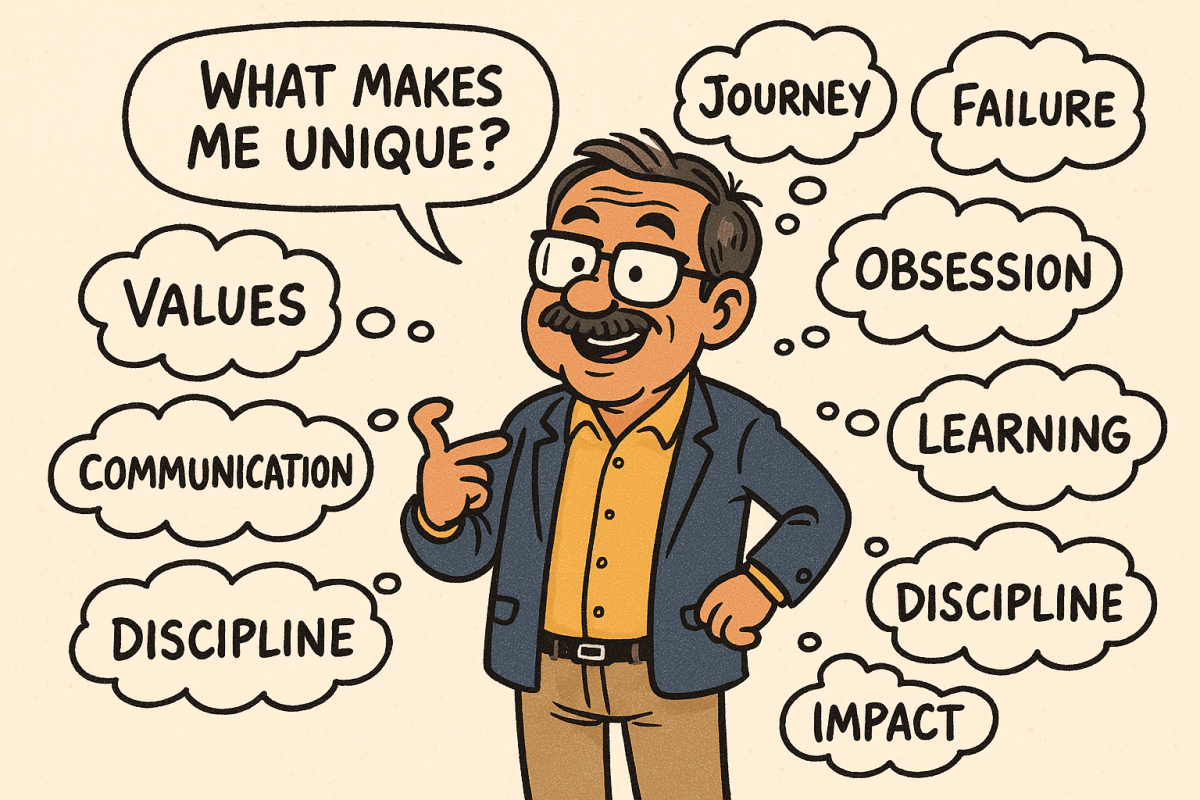
What Makes a Person Truly Unique?

As someone who has spent decades navigating the academic world, corporate boardrooms, government agencies, and startup trenches, I’ve come to realise that what makes a person truly unique is not just one defining trait but a combination of mindset, experience, and passion.

It’s the signature blend of your past, values, and vision for the future.

Let me break it down through my own lens—through personal stories, reflections, and the questions I’ve asked myself.

1. The Journey You Choose (or Endure)

“Why did I move from academia to government, then to corporate, and finally to building my startup?”

Many thought I was indecisive. But I saw it differently. Each step gave me a new superpower.

  • In academia, I learned how to think deeply and teach simply.
  • In government, I saw how policy can impact innovation nationally.
  • In corporate, I experienced the pace of execution and the demand for ROI.
  • In startup life, I learned humility, agility, and how to survive with little but dream big.

Not everyone chooses this “multiverse” path, but embracing it made me unique. I carried lessons from each world into the next.

2. How You React to Failure

“Mazlan, you left a comfortable job to start something uncertain?”

Yes—and I failed more times than I can count. But here’s the thing: I never let failure define me. Instead, I documented, reflected, and shared.

Every rejection, every “no,” became fuel for the next attempt.

What’s unique is not that you fail but how you rise from it—with clarity, grace, and a story others can learn from.

3. Your Obsession

“You’re still talking about IoT after all these years?”

Absolutely. I eat, sleep, and breathe IoT—not because it’s trendy but because I believe it can change lives. Even now, I run FAVORIOT to democratise IoT and make it accessible for students, startups, and governments.

Obsession—when combined with purpose—is what sets someone apart. It’s the thing you can’t shut off. You read about it, dream about it, and keep pushing the boundaries.

That’s the heartbeat of uniqueness.

4. The Way You Communicate

I once blogged about gadgets. Then, I pivoted to writing about technology, leadership, and storytelling. Today, I use WordPress, LinkedIn, podcasts, and even TikTok to reach different audiences.

Why?

I realised that what makes my voice unique isn’t just my technical knowledge but how I simplify it, narrate it, and humanise it.

People don’t remember jargon. They remember stories, analogies, and emotions. If you can make someone say, “Now I get it,” you’ve done something special.

5. The Values You Don’t Compromise

I’ve had opportunities that promised more famemoney, or power throughout my career. But I always asked myself:

“Is this aligned with what I believe?”

I don’t play politics. I don’t sell out. I don’t cut corners. I treat my team like family, and I lead with empathy.

In a world of copy-paste personalities, your principles become your fingerprint.

6. What You Do When No One’s Watching

In my quiet moments, I read articles from new writers, reply to comments, and refine my writing. I write even when no one reads because consistency builds credibility.

“But no one reads your articles.”

I kept writing anyway. Until one day—people did.

Your uniqueness is often born in the shadows, when no one claps, shares, or notices.

And still—you show up.

7. How You Inspire Others

I don’t just want to build a business. I want to develop people.

That’s why I mentor students, share my lessons, and give talks—even to small audiences. That’s why I created FAVORIOT Academy—to train the next generation of IoT professionals.

You become unique by climbing the ladder and extending your hand to those below you.

8. Your Curiosity and Lifelong Learning

Even today, I explore new platforms, write new articles, and learn from people much younger than me.

“Why are you still experimenting?”

Curiosity is a fire that never retires. The moment you stop learning, you become static. I choose to evolve—even at 64.

Uniqueness comes from the courage to keep updating yourself and stay relevant not by age but by adaptability.

9. Your Ability to Connect Across Generations

I often speak to university students, young engineers, and even teenagers on TikTok. Some are surprised—“Dr. Mazlan, you’re on TikTok?”

Yes, and I love it.

If you can speak every generation’s language, whether through blog posts or memes, you become a bridge. That connection—not just knowledge—is what makes someone unforgettable.

10. How You Turn Passion Into Impact

I don’t work on IoT just to build cool gadgets. I do it to solve real problems, from smart agriculture to healthcare, education, and even energy management.

Passion becomes power when you channel it into something greater than yourself.

When your work serves others, your uniqueness becomes your legacy.

A Personal Formula

If you ask me to define what makes a person unique, I’d say:

Uniqueness = (Journey + Failure + Obsession + Voice + Values + Discipline + Impact + Curiosity + Communication + Empathy) x Authenticity

You don’t need to be the smartest or the loudest in the room.
You just need to be the most you.

So, find your intersection.
Share your scars.
Own your quirks.
Speak your truth.

The world doesn’t need another replica.
It needs your story—told your way.

“Mazlan, what makes you unique?”

I’d say it’s because I’m still learning, experimenting, and daring to dream… even after all these years.

What Would I Want Named After Me? I Never Asked for a Title, But They Gave Me One Anyway

“Do you want something named after you, Dr. Mazlan?”

That question caught me off guard.

Not because it was unexpected — people love giving names to legacies, buildings, awards, even algorithms. But because deep inside, I never asked for any of it.

You see, I’m just a man who fell in love with technology. Not for fame. Not for glory. But because I truly believed it could make lives better.

Yet, along the way… names started sticking.

From “Dial-a-Coke” to Global Conferences

Let me rewind to the early 2000s.

I worked in the telecommunications industry back then—CELCOM Axiata, to be specific. This was long before the word “IoT” entered mainstream vocabulary. Yet even then, we were already experimenting with early machine-to-machine (M2M) communication forms.

One of our most exciting innovations at the time was a Coke vending machine that could be triggered by SMS.

“Wait… you mean you can buy a drink just by texting a number?”

Yes, precisely that. The concept was called “Dial-a-Coke.” You send a text, and it deducts the amount from your mobile credit. Voila, a cold can drop out of the machine.

Was it revolutionary? For that time — absolutely.

But to me, it wasn’t about being revolutionary. It was about solving problems in simple ways using connectivity. That mindset never left me.

IoT: A Journey of Passion, Not Titles

Fast-forward to 2013. That’s when I began immersing myself even more seriously into IoT—this time not just as a technologist but also as a speaker, writer, researcher, and eventually, entrepreneur.

Everywhere I went, I would talk about IoT.

At conferences. In classrooms. On stage. Off stage. At coffee shops. In boardrooms.

The energy never ran out. In fact, it grew stronger every time I saw someone’s eyes light up with an “Aha!” when they understood what IoT could do for their lives or business.

Radio interviews followed, then television. Podcasts. Newspapers. Magazines. Even my children rolled their eyes when I’d go into another “IoT monologue” during dinner.

Then came the birth of FAVORIOT — a company built to democratise IoT for developers, enterprises, and even students.

It wasn’t just business. It was my passion translated into a platform.

And Then, They Started Calling Me…

One day after a seminar, someone walked up to me and said,

“Dr. Mazlan, you’re like the Father of IoT in Malaysia.”

I laughed. A little awkwardly, I must admit.

Because if anyone deserves that title globally, it’s Kevin Ashton — the man who coined the term the “Internet of Things. I’ve always credited him for that.

But the person insisted,

“You’ve been advocating this in Malaysia longer than anyone I know. You make people understand IoT in a simple, practical way. That’s a gift.”

And slowly… it started spreading.

Father of IoT Malaysia.

Was it official? No.
Was it universally agreed? Probably not.
Was it something I asked for? Never.

But I accepted it—not for the ego—but for what it represents: a shared belief that maybe, just maybe, I had helped lay some of the digital foundations in this country’s IoT journey.

TikTok, Branding, and a Name That Stuck

In 2022, I did something unexpected — I joined TikTok.

Yup, at the age when most people would be watching TikTok videos, I started making them.

My handle? @iotman2030.

Why 2030? People often ask.

Simple. Because I wanted the technology I championed to be relevant by then.

“What if you just used @iotman2022 or 2023?”

Well, that would age too quickly, wouldn’t it? Who wants to be known by a handle that feels like it expired with last year’s tech trends?

Since then, “IoT Man” has become another name people have started calling me. Some jokingly, some with admiration, but it stuck.

I never corrected anyone. Because, in a way, it perfectly captured who I was and what I stood for.

So, If I Could Name Something After Me…

Honestly? I wouldn’t.

I believe names should be earned by impact, not intent.

But if someone else names something after me—maybe a scholarship, an award, or a lab—I just hope it’s for the right reasons.

That it inspires young minds to build the next generation of connected solutions.
That it reminds people how persistence, curiosity, and belief can shape an entire career.
That it stands for passion without ego.

And maybe it helps a few dreamers realize that technology isn’t just about wires and sensors. It’s about people.

A Legacy Beyond the Name

I never started this journey wanting to be known as anything.

Not the Father of IoT.
Not IoT Man.
Not even Dr. Mazlan the Technologist.

But I did want to make a difference.

And if making a difference earns me a name, then so be it.

Let it not be a pedestal but a platform.
Let it not be a brand but a bridge.

Because names will fade, but impact — that lingers.

So, if you ever hear someone call me Father of IoT Malaysia or IoT Man, just know —
It’s not about me.
It’s about the mission.

And that mission? Still going strong.

Even in 2030.

Everyone Wants the Spotlight. Few Are Willing to Wait for It

What’s Something Most People Don’t Understand?

Most people don’t understand how long it takes to build something meaningful.

Even after all these years, people still think things happen overnight.
They see the highlight reels. They see the LinkedIn success stories. They see the awards, the recognition, the partnerships. And they say— “Wow, you’re lucky.”

But they don’t see what happens behind the scenes.

When I co-founded FAVORIOT, I wasn’t stepping into a shiny, ready-made startup with capital pouring in and clients lining up at the door. No, it was the opposite. I entered a tiny room with big dreams, minimal funding, and zero guarantees.

I had to reset my ego.
After holding senior positions at MIMOS and CELCOM, I was now doing everything—research, customer support, marketing, writing blog posts, uploading YouTube videos, conducting training, chasing potential clients, and even troubleshooting hardware late at night. I was a CEO, but I was also the janitor.

That’s what most people don’t understand.

They think success is linear.
They think you just launch a product and are suddenly on a TED stage.
They don’t see the years of trial and error, the failed pitches, the near-burnouts, and the countless self-doubts.

I still remember attending an international Smart Cities conference years ago. Delegates were surprised when I told them we were a small team from Malaysia, building our own IoT platform. Some of them didn’t even believe it. They asked, “But how did you build it? Don’t you need a huge team? Venture capital?” I smiled and said, “No. We built it because we believed we could.”

Belief is underrated. And persistence—even more so.

People underestimate how long you must persist when nothing seems to work.

I wrote blog after blog when no one was reading.
I spoke at conferences when no one knew my name.
I kept talking about IoT and Smart Cities when the market didn’t understand IoT.

Even on Medium, when I started writing actively in 2023, I wasn’t writing for an audience. I was writing because I had something to say, something to teach, something to reflect on.

Some articles flopped. Others resonated deeply. But most people only see the few that succeeded—they don’t see the hundred others that didn’t.

They don’t understand the patience it takes to outlast the silence.

Let’s talk about time.
People think one or two years is enough time to build a company, an audience, or a movement.

But FAVORIOT has been around since 2017.
We didn’t become known overnight.
We had to win trust, prove our value, build case studies, make mistakes, recover from them, and try again. Again. And again.

It’s like planting a seed. You don’t dig it up every week to check if it’s growing. You water it, give it sunlight, and trust that one day it will break through the soil. But that trust? That takes faith. That’s the part most people struggle with.

“Why isn’t it growing yet?”
“Why is no one noticing me?”
“Maybe I’m not good enough.”

Believe me—I’ve had those thoughts, too.
I’ve looked at competitors with massive followings and felt small.
I doubted whether I was too old to do this startup thing.
I’ve wondered if people even cared about what I was trying to build.

But each time, I returned to the same answer:
Because I care.

I care about helping people learn about IoT.
I care about giving Malaysians a home-grown IoT platform.
I care about empowering universities, cities, and entrepreneurs with technology that works.

I realized that most people don’t need motivation. They need understanding.
Understanding that the journey will be extended.
It’s okay to feel invisible at first.
That mastery takes years.
Most “overnight successes” are 10 years in the making.

So here’s what I want you to remember:

  • You don’t need everyone to understand your journey.
  • You just need to understand it yourself.
  • And you need to commit to showing up, even when no one’s clapping.

Because one day, someone will ask you, “How did you do it?”
And you’ll smile, knowing they won’t really understand until they walk the same path.

But maybe, just maybe, they’ll listen a little closer.
And perhaps that will inspire them to start their own long, messy, beautiful journey.

And that’s enough.

Now, back to work. The journey continues.

The Power of Saying “No” to Protect Your Goals

I used to struggle with saying “no.” Opportunities, invitations, and requests would pile up, and I was constantly stretched thin. Every time I turned down something, it felt like I was missing out on an experience, a potential collaboration, or a chance to prove myself.

But over time, I learned something crucial—saying “yes” to everything meant saying “no” to my own priorities. That realization changed everything.

The Illusion of Opportunity

It’s easy to believe that more opportunities equal more success. Early in my career, I had this mindset. I accepted every speaking engagement, every meeting, every project—thinking that the more I did, the faster I’d reach my goals.

But something felt off. My time was constantly divided, and I wasn’t making meaningful progress on what truly mattered. My passion for IoT, my vision for FAVORIOT, and even my writing—everything was diluted because I wasn’t focused.

Was I really advancing, or was I just keeping busy?

It was a tricky question, but I knew I had to answer it honestly. And the answer was clear: I was busy, but I wasn’t productive.

The Turning Point: Learning to Say “No”

One of my mentors once told me, “Every time you say yes to something, you are saying no to something else.” That hit me hard.

I looked at my commitments and realized how many were distractions in disguise. They seemed valuable, but were they truly aligned with my long-term goals? Most of them weren’t.

That’s when I started consciously trying to say “no.”

  • No to meetings without a clear purpose.
  • No to projects that didn’t align with my expertise or vision.
  • No to social events that drained my energy.
  • No to collaborations that felt forced.

At first, it felt uncomfortable. Would people think I was rude? Would I miss out on something valuable? But then something surprising happened—I felt relieved.

For the first time in a long while, I had the mental clarity to focus on what truly mattered.

The Freedom of a Focused “Yes”

Saying “no” isn’t about shutting doors—it’s about opening the right ones. When I started protecting my time, my work improved. I had more energy to dedicate to building FAVORIOT. I could write with a deeper focus. I had space to think creatively, to strategize, to innovate.

Instead of chasing every opportunity, I started choosing the right opportunities. And that made all the difference.

When I said “yes” to something, it was a focused yes that truly aligned with my goals.

  • Yes to speaking engagements that positioned me as a thought leader in IoT.
  • Yes to partnerships that had long-term potential.
  • Yes to writing consistently and sharing insights with my audience.
  • Yes to mentoring people who truly valued my guidance.

By filtering my commitments, I became more valuable, not less. People respected my time more. My work had a more significant impact. And most importantly, I felt fulfilled.

The Discipline of Saying “No”

Saying “no” is a skill that requires practice. It’s easy to slip back into the habit of overcommitting. But I remind myself of a simple rule:

If it doesn’t move me closer to my goals, it’s not a priority.

Now, before I agree to anything, I ask myself:

  • Does this align with my long-term vision?
  • Will this add significant value to my mission?
  • Am I doing this out of obligation or genuine interest?

If the answer is “no,” then my response is clear.

The Cost of Saying “Yes” Too Often

Many people fear saying “no” because they don’t want to disappoint others. But the real danger is saying “yes” too often and disappointing yourself.

Saying “yes” to unnecessary things leads to:

  • Burnout – Overcommitting drains your energy.
  • Lack of progress – You stay busy but don’t move forward.
  • Resentment – You start feeling frustrated because your time is no longer yours.

I’ve been there. I’ve learned that protecting my time isn’t selfish—it’s necessary.

The Impact on My Life

Since adopting this mindset, I’ve achieved things I never thought possible. FAVORIOT has grown, my writing has reached thousands, and I’ve had the chance to collaborate with impactful people.

Not because I did everything—but because I did the right things.

Saying “no” is one of the most powerful tools for success. It allows you to protect your goals, stay focused, and make meaningful progress.

So, how often do I say “no” to things that interfere with my goals?

As often as necessary.

The Secret Skill That Helped Me Build FAVORIOT

I have often been asked about my entrepreneurial journey—how I transitioned from corporate life to building FAVORIOT from scratch. People assume that technical knowledge and business acumen are the key ingredients, but there’s something else—something that I rarely talk about but has been my secret weapon all along.

What’s this secret skill?

Adaptability.

It’s not flashy, and people don’t usually admire adaptability in the same way they admire confidence or leadership. But let me tell you, adaptability is the difference between thriving and fading into obscurity.

The Shift from Corporate to Startup Life

When I left the structured corporate job environment to venture into entrepreneurship, I was stepping into unknown territory. For years, I had worked in environments where resources were plentiful, teams were in place, and projects had budgets and timelines that made sense.

Now, I had none of that.

I had to build everything from scratch. There was no IT team to help me set up emails, no HR to handle hiring, and no marketing department to promote the company.

I became all of those things overnight.

I had to learn to wear multiple hats and switch between them at a moment’s notice. One day, I was designing IoT solutions; the next, I negotiated with clients or handled company registration paperwork.

That’s when I realized—my ability to adapt was my biggest strength.

Learning to Navigate the Startup Chaos

Unlike corporate life, where things follow a set rhythm, startup life is unpredictable. Some days, I feel on top of the world because we closed a big deal. Other days, I wonder if FAVORIOT can survive another month.

This is where adaptability became crucial.

I had to quickly analyze problems, adjust my approach, and keep moving forward. Here are some of the ways adaptability helped me:

1. Pivoting When Necessary

I initially thought that smart city solutions would be FAVORIOT’s main market. But after months of trying to gain traction, I realized that local councils weren’t ready for IoT adoption at scale.

Should I have waited for the market to be ready?

No. I adapted.

I shifted my focus to IoT training and education—something universities and professionals were eager to explore. This move helped us generate revenue and positioned FAVORIOT as an authority in the IoT space.

If I had been rigid, FAVORIOT might not have survived.

2. Embracing Digital Marketing

Before starting FAVORIOT, I had never focused on social media marketing or personal branding. But as a startup founder, I quickly realized that visibility is everything.

I began writing blog posts, creating LinkedIn content, and engaging with the IoT community online. I even started making educational TikTok videos—something I would have never imagined doing in my corporate days.

Was it uncomfortable at first? Absolutely.

But again, adaptability helped me push through that discomfort and build a strong online presence that drives business to FAVORIOT.

3. Listening and Adjusting

I thought I knew what the market wanted, given my decades of experience in the industry. But the reality was different.

Many times, my assumptions were proven wrong.

Instead of resisting, I adapted by listening more—talking to customers, understanding their real problems, and refining our solutions. This ability to adjust based on feedback greatly impacted how we positioned our products and services.

4. Surviving Financial Uncertainty

Running a startup means facing financial ups and downs. There were months when revenue was strong and months when it felt like we were running on fumes.

In a corporate job, salaries are stable. In a startup, nothing is guaranteed.

I had to constantly adapt our financial strategy—cutting unnecessary costs, finding alternative revenue streams, and making tough decisions to keep the company afloat.

Adaptability is a Survival Skill

Looking back, I realize that adaptability is not just a skill; it’s a survival mechanism. In entrepreneurship, things will go wrong, plans will fail, and markets will shift.

But those who adapt don’t just survive—they thrive.

Many people get stuck because they expect success to come in a straight line. They refuse to change course even when things aren’t working, which is why so many businesses fail.

I have always believed in my vision for FAVORIOT but have never been too proud to adjust my approach when needed. That’s the secret skill that has kept me going.

Final Thoughts

People often ask me what skills are necessary to succeed in entrepreneurship. They expect me to say technical expertise, business knowledge, or leadership. But the truth is, adaptability is the real superpower.

The ability to embrace change, learn new things, and shift strategies when needed can make or break a startup.

If you’re on your own entrepreneurial journey, ask yourself—how adaptable are you?

In the world of business, it’s not the strongest who survive but those who can adapt the fastest.

The Hard Truth About IoT Startups: Lessons from My Failures

I Failed at Building an IoT Business Before Succeeding. Here’s What I Learned.

“This is it. This idea will work. I can see it changing the world.”

That was my mindset years ago when I first stepped into the world of IoT entrepreneurship. I was confident—too confident, perhaps. With decades of experience in the industry, I thought I had the perfect combination of knowledge, network, and credibility to launch a successful IoT business.

I believed that if I built the right solution, the market would naturally embrace it. After all, IoT was the buzzword at every tech conference, and businesses were talking about the potential of connected devices.

But reality? It had a very different lesson in store for me.

The First Failure: Overestimating Market Readiness

I started FAVORIOT with the assumption that businesses and government agencies were fully prepared to adopt IoT solutions. The Smart City vision was gaining traction, and industry leaders were excited about automation, data-driven decision-making, and real-time monitoring.

So, with high hopes, I built my first IoT solution. I expected clients to immediately recognize its value. But when I went out to pitch my idea, I was met with hesitation, skepticism, and endless bureaucratic challenges.

“Why aren’t they jumping at this? Can’t they see how valuable this technology is?”

The problem wasn’t the technology—it was the mindset. Many organizations were still unsure about IoT. They didn’t fully understand how it worked, they feared implementation risks, and most importantly, they didn’t have dedicated budgets for IoT initiatives. To them, IoT was still an experimental concept, not a necessity.

This was my first painful realization: Just because something is revolutionary doesn’t mean people are ready for it. I had to find a way to bridge the gap between technological potential and real-world adoption.

The Second Failure: Underestimating the Sales Process

“If the product is good, it will sell itself.”

That was a dangerous assumption. I thought that once people saw my IoT solution in action, they would be convinced. After all, logic and data should win, right? But I quickly realized that people don’t just buy technology—they buy trust, relationships, and clear return on investment.

I spent months refining my IoT platform, making sure it was technically superior. But I wasn’t spending nearly enough time understanding the actual pain points of my potential customers. I was offering a futuristic solution to people who weren’t even sure they had a problem that needed solving.

When I approached businesses, they weren’t asking, “How advanced is your platform?” They were asking, “How will this help us save money?”

That’s when it hit me. I was speaking the wrong language.

I had to shift my focus from selling technology to selling solutions. Instead of talking about sensors, APIs, and cloud computing, I had to show how IoT could reduce operational costs, improve efficiency, and generate new revenue streams.

Once I made this adjustment, I noticed a change. Conversations became easier, and decision-makers started seeing the value. It wasn’t just about technology anymore—it was about business outcomes.

The Third Failure: Learning Through Building Partnerships

At first, I thought I needed to build everything on my own. But as I encountered more roadblocks, I realized something crucial: IoT is not a one-man show. It requires an ecosystem.

When I started reaching out to potential partners, I discovered that the IoT adoption challenge wasn’t just mine alone—others were facing similar struggles. System integrators, software developers, and even hardware manufacturers were all trying to navigate the complexities of IoT implementation.

That’s when I started building strategic partnerships.

Instead of trying to convince companies to adopt IoT on my own, I worked with system integrators who already had trusted relationships with businesses. They understood their clients’ operational challenges far better than I did, and they could position our IoT solutions as part of a broader digital transformation strategy.

I also realized that collaborating with universities and research institutions could help us educate the next generation of IoT professionals. Through partnerships, we could develop case studies, provide training programs, and increase awareness about real-world IoT applications.

This was a game-changer. By leveraging partnerships, we accelerated adoption and expanded our market reach much faster than I ever could have done alone.

What I Learned from These Failures

Looking back, these failures were painful, but they were necessary. They forced me to adapt, rethink my strategy, and ultimately build a stronger business.

Here are the key lessons I took away:

1. Timing matters. Just because a technology is exciting doesn’t mean the market is ready for it.

2. Selling is about solving problems, not just promoting features. Speak the language of business impact, not just technology.

3. You can’t build an IoT business alone. Success comes from building partnerships and working within an ecosystem.

4. Resilience is everything. If I had given up after my first failure, I wouldn’t be here today.

Where We Are Today

Today, FAVORIOT is working with partners across multiple countries. We’ve built an IoT platform that helps businesses adopt smart solutions in a practical, scalable way. We’ve collaborated with system integrators, universities, and corporations to drive IoT adoption.

But none of this would have happened if I hadn’t learned from my early failures.

Would I go back and change my struggles? Absolutely not.

Because those failures weren’t the end of my journey—they were the foundation of my success.

The Fourth Industrial Revolution: The Future is Already Here!

“Are we ready for this transformation?”

I still remember the first time I heard the term “Fourth Industrial Revolution” or more commonly known as Industry 4.0. It sounded futuristic, like something straight out of a sci-fi movie—where robots rule the world, artificial intelligence (AI) makes all decisions, and automation is everywhere.

But the reality? We are already living in that era!

Before we panic and imagine ourselves being chased by rogue robots, let’s take a step back and understand how industrial revolutions have shaped the world.

From the First to the Fourth: The Evolution That Changed the World

History has witnessed four major industrial revolutions, each transforming human life in unimaginable ways:

  1. First Industrial Revolution (18th – 19th Century)
    • The invention of the steam engine changed everything. Factories replaced manual labor, and transportation improved dramatically. It was the birth of modern industry.
  2. Second Industrial Revolution (Late 19th – Early 20th Century)
    • Electricity became the new king. Assembly lines and mass production made goods cheaper and more accessible. Henry Ford’s automobile factories were the poster children of this era.
  3. Third Industrial Revolution (Mid-20th Century – Early 21st Century)
    • Computers, automation, and the internet revolutionized the workplace. Suddenly, information was just a click away, and digital transformation began.
  4. Fourth Industrial Revolution (Now!)
    • AI, the Internet of Things (IoT), 5G, blockchain, quantum computing—you name it. Machines are getting smarter, and decision-making is shifting from humans to algorithms.

Wait… Does This Mean Robots Will Take Over My Job?

This is the million-dollar question. The short answer: Yes and No.

Yes, because many repetitive manual tasks will be automated. If a machine can do it faster and better, why pay a human to do it?

No, because new jobs will emerge—roles we never imagined before. Who would have thought that “TikTok Content Strategist” or “Metaverse Architect” would be actual job titles?

The key here is adaptability. Those who embrace technology will thrive, while those who resist will struggle. It’s like complaining that smartphones are ruining society while using one to rant on social media.

How Industry 4.0 Affects Our Daily Lives

If you think Industry 4.0 only affects tech companies, think again. It’s already changing our everyday lives:

  • Smart Homes: Your fridge tells you when you’re out of milk, and your lights turn on when you enter the room. It’s like living in a sci-fi movie!
  • Healthcare – AI can detect diseases earlier than doctors, and robotic surgeries are becoming more common. Imagine getting medical advice from a chatbot instead of waiting hours in a clinic.
  • Education – Online learning, AI tutors, and personalized lessons replace traditional classrooms. No more boring lectures (hopefully).
  • Shopping—AI-driven recommendations make your online shopping ads feel creepily accurate. “How does it know I was thinking about buying a new phone?!

The Funny Side of Industry 4.0

Despite all the advancements, some things about Industry 4.0 are just plain hilarious.

  1. The Smart Home Fiasco
    • Me: “Hey Alexa, turn off the lights.”
    • Alexa: “Turning off all the lights.”
    • Me: “Wait, not the WiFi—” (Everything shuts down, including my will to live.)
  2. AI Assistants That Are Not So Smart
    • Me: “Siri, what’s the weather like today?”
    • Siri: “I found some information about dinosaurs.”
    • Me: “…”

Are We Ready for This Future?

Industry 4.0 is not coming—it’s already here. The question is, how do we prepare for it?

  1. Learn New Skills – Coding, AI, data analytics, cybersecurity. The more you know, the better.
  2. Embrace Change – Don’t resist technology. Learn how to use it to your advantage.
  3. Be Creative – Machines can replace repetitive jobs but can’t replace human creativity.

Remember, the future belongs to those willing to adapt and evolve. So, are you ready?

Or are you still waiting for your smart fridge to stop judging your midnight snacks?

The Activities That Make Me Lose Track of Time

Have you ever been so deeply immersed in something that time slips away? One moment, it’s morning, and the next, the sun has set, and you wonder where the hours have gone. That happens to me a lot. It’s both fascinating and dangerous because it shows how much I love what I do, and it’s dangerous because I often forget to eat or even take a break. But that’s the beauty of passion, isn’t it?

Writing – My Deepest Escape

If there’s one thing that consistently makes me lose track of time, it’s writing. Not just any kind of writing, but the kind where I pour my thoughts, experiences, and reflections onto the page. The kind where I engage in self-dialogue, asking myself questions, debating perspectives, and exploring ideas in a way that feels as natural as breathing.

When I sit down to write, I enter a different world. The cursor blinks, waiting for my thoughts to flow, and I’m suddenly conversing with myself. Does this make sense? Will people relate to this? Should I add more storytelling? The words come in waves—sometimes a flood, sometimes a trickle—but it’s hard to stop once I start.

It’s in these moments that I feel the most alive. Writing isn’t just about putting words on a page; it’s about expression, connection, and discovery. I often write about IoT, smart cities, and technology, but sometimes, I delve into entrepreneurship, personal development, and even poetry. The topic doesn’t matter—as long as I’m writing, I’m in my element.

IoT and Smart Cities – The Intellectual Adventure

Another realm where I lose myself completely is in discussions about IoT and smart cities. This isn’t just a job for me—it’s a mission, a vision, and an endless source of curiosity.

I can spend hours analyzing the latest trends, researching new use cases, and discussing the future of connected technology. Whether I’m preparing for a keynote speech, mentoring startups, or brainstorming ideas for the FAVORIOT platform, I get absorbed in the possibilities.

The more I think about it, the more I realize IoT is an ever-expanding puzzle. Every city, every business, and every individual has different needs, and IoT provides the tools to create smarter, more efficient solutions. The challenge of making technology work for real-world problems is what keeps me hooked.

How can we make smart cities more inclusive? What’s stopping IoT adoption in developing nations? How do we ensure data security while enabling innovation? These questions excite me, and before I know it, I’ve spent an entire day buried in research, discussions, and problem-solving.

Reading – A Gateway to New Worlds

Reading is another activity where I lose myself, often without realizing how much time has passed. Reading opens doors to new perspectives, whether it’s articles on Medium, books on entrepreneurship, or science fiction novels.

There’s something magical about immersing yourself in a well-written piece. It could be a thought-provoking article that challenges my assumptions or a book that takes me through time and space. The written word has the power to transport me, to make me feel as if I’m living a hundred different lives all at once.

I remember reading about the early pioneers of technology—the visionaries who built the foundations of the digital age. Their stories inspire me because they remind me that innovation isn’t just about having a great idea; it’s about persistence, resilience, and an unshakable belief in the future.

Deep Conversations – The Art of Meaningful Exchange

I love conversations that challenge me and make me pause and rethink my assumptions. Whether it’s discussing the impact of AI on society, debating business strategies, or exploring philosophical ideas, I can get completely lost in the dialogue.

Some of the best discussions happen over coffee with like-minded individuals—entrepreneurs, researchers, students, or anyone with a curiosity for the world. I find that talking about ideas, sharing experiences, and learning from others keeps my mind sharp and my perspectives fresh.

One of my favorite aspects of mentoring young entrepreneurs is seeing the spark in their eyes when they realize a new possibility. It reminds me of my own journey, of the moments when someone’s advice changed my trajectory. These interactions fuel my passion and make me forget about time.

Creating and Building – Turning Ideas into Reality

There’s nothing quite like the thrill of creating something new. Whether it’s developing a new feature for the FAVORIOT platform, designing a training module, or working on a business strategy, I get completely absorbed in the process.

It’s one thing to talk about ideas but another to bring them to life. I truly excites myself when I see the process of building—from concept to execution—go from an abstract thought to a tangible reality.

Some nights, I self-brainstorm solutions long after the workday has ended. The challenge of problem-solving and figuring out how to improve something keeps me engaged. It’s in these moments that I realize this isn’t just work for me—it’s a passion.

Final Thoughts

It’s interesting to reflect on what makes us lose track of time. They reveal what truly matters to us, what excites us, and what gives us a sense of purpose.

For me, it’s writing, IoT, reading, deep conversations, and building new things. These aren’t just activities; they’re the fabric of my life, which keeps me energized and driven.

What about you? What activities make you forget the world around you?