A Letter to My Younger Self

JOURNEY OF MY LIFE

What advice would I give? What warnings, insights, or words of encouragement would I offer?

Photo by Scott Graham on Unsplash

This story is inspired by Lamberton Conservatory/Jessie’s article “Love Letter from My Younger Self.”

I’ve often wondered what I would say if I could write a letter to my younger self. What advice would I give? What warnings, insights, or words of encouragement would I offer?

As I sit down to pen this “love letter,” I imagine a dialogue between the person I am today—Dr. Mazlan Abbas, with years of experience in IoT and telecommunications—and the young man I once was, full of dreams and uncertainties.

Photo by Mediamodifier on Unsplash

Dear Young Mazlan,

As I sit down to write this letter, memories of our younger days flood back with affectionate clarity. It’s a peculiar feeling — writing to oneself across the expanse of years. Each word I pen is infused with the wisdom of experiences you have yet to encounter, and each pause is filled with the echo of lessons learned.

Follow Your Curiosity

You have always been driven by a deep-seated curiosity about the world, how it works, and how you can contribute to its mechanics. Never lose that. Let your curiosity be the compass that guides you through the complexities of life and career. Each interest and question you pursue will open new doors—some will lead to dead ends, but others will open up vast realms of opportunity and knowledge. Our path into the world of technology and innovation was paved by this very curiosity.

Embrace Change and Challenges

I know you worry about failure, about paths not taken or dreams not realized. Let me ease your mind: you will fail, more than once. But with each failure, you will learn and grow. These are not endpoints but part of a larger journey. Each setback and each challenge is an opportunity to learn and to recalibrate. Embrace them. They are invaluable teachers.

Value Your Relationships

In the pursuit of your dreams, do not overlook the people who walk beside you. The support of family, the camaraderie of friends, and the alliances with colleagues will be your greatest treasures. Make time for them. When shared, the successes will feel sweeter, and the failures less bitter. Remember, no achievement is worth the neglect of those you love.

Stay Humble and Keep Learning

The world of technology and telecommunications, the arenas of your professional battles, evolve rapidly. To stay relevant, you must remain a perpetual student. Attend seminars, engage with your peers, read voraciously, and always be prepared to admit that there is more to learn. Complacency is the enemy of innovation. Keep your mind open and your knowledge base ever-expanding.

Give Back to the Community

You often wonder about the mark you’ll leave on the world. Remember that every small contribution counts. Whether mentoring young professionals, speaking at industry conferences, or contributing to technological innovations, each effort contributes to a larger good. Our work is not just about personal success but about improving lives and empowering communities.

Enjoy the Journey

Lastly, I want you to savor each moment of this journey. The late nights, the breakthroughs, even the uncertainties — they are all the jigsaw puzzles that you need to solve. Do not be so focused on the destination that you forget to enjoy the path you are traveling.

Young Mazlan, as you stand on the edge of many adventures and achievements, know that the journey is worth every challenge. Love each part of it, even the struggles, for they will shape you into the person you are destined to become.

With all the love and wisdom I can offer,

Dr. Mazlan Abbas

The Story Behind Favoriot – Part 17: How I Learned to Share Favoriot’s Story Without Overdoing It

The Fine Line Between Inspiration and Bragging

Should I share, or should I stay silent?

This question has haunted me since the early days of Favoriot.

Building a startup isn’t just about technology, funding, or business strategy—it’s also about storytelling. But where do we draw the line between sharing our journey to inspire others and coming across as boastful?

I’ve wrestled with this dilemma more times than I can count. Some people say, “Just let your work speak for itself.” Others insist, “People need to see your progress. They want to learn from your story.”

So, which one is it?

Let’s dive into the delicate balance of sharing our startup journey—without overdoing it.

The Early Days: A Team Fueled by Passion and Uncertainty

When we first started Favoriot, we were a small team with big dreams. We believed IoT had the power to change industries, improve lives, and create new opportunities.

But passion alone wasn’t enough.

We faced countless obstacles, including funding challenges, product-market fit struggles, and the ever-present fear of failure. We worked tirelessly behind the scenes, developing our platform and engaging with potential customers.

Then came the big question:

Should we share our struggles and milestones with the world or keep everything under wraps until we have something massive to announce?

I was torn.

“Maybe we should just stay quiet and let the results speak for themselves,” I thought. “What if we share too much, and it backfires?”

At the same time, I knew that people don’t just buy products—they buy into stories. They connect with a brand that feels human.

That’s when I realized the power of storytelling.

The Power of Storytelling in Startups

I’ve always believed that stories are what bring people together. They make businesses feel real, not just faceless corporations.

I started to ask myself:

“Wouldn’t sharing our small wins show others we’re genuine and making real progress?”

Momentum is everything in a startup. People want to know your journey—not just the polished version, but the raw and real struggles.

A few trusted advisors encouraged me:

“Mazlan, people want to see how a company grows. They want to learn from your experience, the ups and downs. Your story can inspire them.”

That made sense. After all, I’ve been inspired by others who openly shared their startup journeys. So why not do the same?

That was the moment I decided—we would share Favoriot’s story.

But little did I know that decision came with its own challenges.

The Doubts: Criticism and the Fear of Overexposure

The moment we started sharing our journey, the doubts crept in.

What if people thought we were just showing off?

What if our small wins were misinterpreted as arrogance?

I knew that no matter how genuine our intent was, some people would see it differently. Not everyone would cheer for our progress. Some might even root for us to fail.

That fear of inviting negativity was real.

A friend cautioned me, “Mazlan if you keep celebrating every little milestone, people might think you’re just making noise. Be careful.”

That struck a chord. I didn’t want Favoriot to be seen as all talk with no substance.

I had to find the right balance—sharing enough to inspire but not so much that it felt forced or unnecessary.

Finding the Right Balance: Authenticity Over Hype

I came to a realization:

It’s not about choosing between complete silence or constant broadcasting. The key is authenticity.

People can tell when a story is real. They can sense when you share because it’s meaningful, not because you want attention.

So, instead of treating every minor update as a big achievement, we focused on:

  1. Telling the whole story – Not just the victories but the challenges, failures, and lessons learned.
  2. Showing our human side – The sleepless nights, the difficult decisions, and the little moments that keep us going.
  3. Engaging, not boasting – Encouraging discussions rather than just making announcements.

The goal wasn’t to impress but to connect.

Emotion vs. Success Stories: Striking the Right Mix

So, how do we balance sharing emotions with business success?

I realized that while people love to hear about wins, they also appreciate honesty.

It wouldn’t be relatable if all we did was talk about how great we were doing. But if we only focused on struggles, it might seem like we were always in crisis mode.

We had to share both our progress and the hard lessons we were learning along the way.

A startup journey isn’t just about achievements. It’s about persistence, the small breakthroughs that lead to bigger ones, and the human experience behind the business.

Dealing with Criticism: Staying True to Our Mission

No matter how carefully we shared our story, there would always be critics.

Some would call it bragging. Others would question our decisions.

At first, this got to me. I second-guessed whether we should continue sharing at all.

But then I reminded myself:

Not everyone will root for you, and that’s okay.

The key is how you share. If you want to genuinely document your journey and help others, the right people will appreciate it.

It’s not about boasting—it’s about showing what it takes to build something from the ground up.

If someone sees that as bragging, that’s their perspective. But that shouldn’t stop us from telling our story.

Lessons Learned from Sharing the FAVORIOT Journey

Looking back, I’m glad we shared parts of our journey.

It helped us:

✅ Build a community that believes in our mission.
✅ Establish trust with partners and customers.
✅ Inspire other entrepreneurs who are going through the same struggles.

But we also learned to be mindful of how we share.

We don’t need to post every minor update. We don’t need to be overly polished. But we also don’t need to stay silent.

It’s all about balance—giving people a window into our world while staying true to our values.

The Importance of Authenticity in Business

At the end of the day, what matters most is staying authentic.

Favoriot isn’t just a company—we’re a team with a vision.

And that vision isn’t just about technology. It’s about building relationships, creating impact, and helping others understand the potential of IoT.

That’s why we continue sharing our story—not to show off but to invite others to share in our journey.

If there’s one lesson I’ve learned, it’s this:

People don’t connect with success. They connect with the story behind it.

And as long as we stay true to that, we’ll always have something meaningful to share.

Favoriot Entrepreneurship Stories

  1. The Story Behind Favoriot – Part 16: Why Favoriot Must Look Beyond Malaysia for Success
  2. The Story Behind Favoriot – Part 15: From Lecture Halls to Investor Pitches
  3. The Story Behind Favoriot – Part 14: To Exit or Not to Exit?
  4. The Story Behind Favoriot – Part 13: Does Winning Awards Help a Startup Succeed?
  5. The Story Behind Favoriot – Part 12: The Dream of M&A Exit
  6. The Story Behind Favoriot – Part 11: The Rocky Road of Smart Cities
  7. The Story Behind Favoriot — Part 10: Age Does Not Matter in Business
  8. The Story Behind Favoriot — Part 9: Leaving the Comfort Zone
  9. The Story Behind Favoriot – Part 8: The Frustration of Unanswered Emails and Missed Opportunities
  10. The Story Behind Favoriot – Part 7: The Task of Finding Favoriot’s First 10 Customers
  11. The Story Behind Favoriot – Part 6: Expanding The Business Models
  12. The Story Behind Favoriot – Part 5: Finding the Right Fit
  13. The Story Behind Favoriot – Part 4: How Favoriot Became More Than Just an IoT Platform
  14. The Story Behind Favoriot – Part 3: Why No One Wanted Our IoT Platform—And How We Turned It Around
  15. The Story Behind Favoriot – Part 2: Turning Failures into Milestones
  16. The Story Behind Favoriot – Part I: The Humble Beginnings of Favoriot

Understanding Data Ownership and Big Data

Today, we’ll discuss two critical topics in the digital age: data ownership and the 4 V’s of Big Data.

This diagram simplifies these concepts, so let’s break them down for better understanding.

Based on eBook — IoT Notes by Mazlan Abbas

1. Data Ownership

Data ownership refers to who has the rights and responsibilities over data. There are four main categories:

1. Personal/Household

  • This includes data generated from your personal devices, like your smartphone, fitness tracker, or smart home systems.
  • Example: Steps tracked by your smartwatch, or usage data from your smart TV.
  • You, as the owner of the device, own this data and can decide how it is used or shared.

2. Private

  • This is data collected and owned by companies or enterprises.
  • Example: A company’s internal data about its operations, such as sales performance or employee attendance.
  • Organisations use this data to improve their services, products, or strategies.

3. Public

  • Public data is owned by the government and shared for the benefit of society.
  • Example: Data from weather sensors, air quality monitors, or river level gauges.
  • This data is often accessible to the public for research, awareness, or planning purposes.

4. Commercial Sensor Provider

  • These are entities that deploy, own, and sell data collected from their sensors.
  • Example: A telecommunications company selling location data collected from its network.
  • They monetise the data by providing it to third parties, such as businesses or governments.

2. The 4 V’s of Big Data

Big Data refers to the massive volumes of data generated by digital devices and systems. It is characterised by the 4 V’s:

Volume

  • This is the amount of data, which can be massive in scale.
  • Example: Social media platforms generate terabytes of data every day from user interactions.

Velocity

  • This refers to how fast or slow data is generated and processed.
  • Example: Real-time data from stock markets or traffic monitoring systems must be processed quickly to be useful.

Variety

  • Data comes in different formats, such as text, audio, video, or images.
  • Example: An IoT platform may process data from sensors (numeric values), surveillance cameras (video), and voice commands (audio).

Veracity

  • This addresses the uncertainty or trustworthiness of the data.
  • Example: Ensuring the accuracy of user-generated reviews on e-commerce platforms can be challenging.

Why is This Important?

Understanding data ownership and the nature of Big Data is essential for:

  • Privacy and Security: Knowing who owns and controls your data helps protect your rights.
  • Decision-Making: Leveraging the 4 V’s effectively enables organisations to make informed decisions.
  • Innovation: Big Data drives advancements in fields like healthcare, transportation, and smart cities.

Final Thoughts

Data is the fuel of the digital economy, but with it comes the responsibility to manage it ethically and effectively. Whether it’s your personal data or public data shared by governments, understanding ownership and the dynamics of Big Data is crucial.

Let’s discuss: How can individuals and organisations ensure ethical data usage while maximising its potential? Share your thoughts!

[Note: Download the full eBook IoT Notes by Mazlan Abbas]

Climbing the Wisdom Pyramid: Mastering the Stages of Data Transformation (DIKIW)

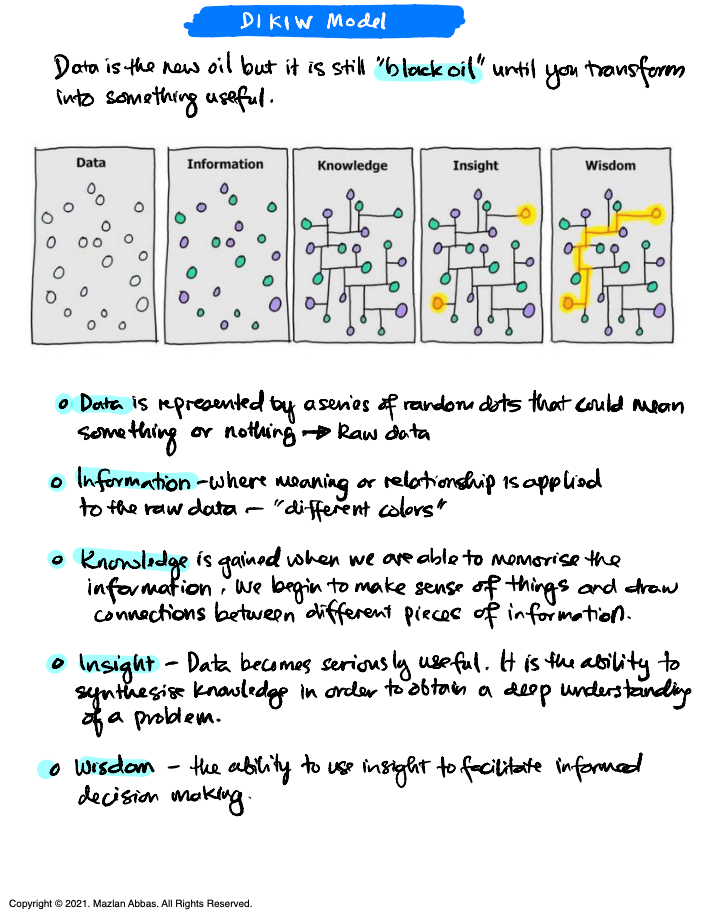
Today, we’re going to explore a framework called the DIKIW Model. It helps us understand how raw data transforms into valuable wisdom.

The diagram here breaks this journey into five stages: Data, Information, Knowledge, Insight, and Wisdom (DIKIW). Let’s dive into each stage step by step.

1. Data

Data is at the base of the model.

  • Data is like raw material — a series of random dots or unprocessed facts.
  • By itself, it has no meaning. It’s just numbers, words, or measurements.
  • Example: Imagine you have a list of temperatures recorded throughout the day. Without context, it doesn’t tell you much.

Data is “block oil” — it’s valuable, but only when refined.

2. Information

When meaning or relationships are applied to raw data, it becomes information.

  • At this stage, we start to see patterns or groupings.
  • Example: If you organise the temperature readings by time, you’ll see when it’s hottest and coolest during the day.
  • Information provides context and is often visualised using charts, tables, or colour coding.

This is like colouring the dots in the diagram to highlight differences or relationships.

3. Knowledge

Knowledge comes when we make sense of the information and see connections.

  • At this stage, we begin to understand why things happen.
  • Example: Analysing the temperature data might reveal that it’s hottest at noon and coolest at dawn.
  • Knowledge connects the dots and helps us understand patterns or causes.

This is where we start to see the bigger picture, as the diagram shows interconnected lines.

4. Insight

Insight is where things get seriously useful.

  • It’s synthesising knowledge and gaining a deeper understanding of a problem.
  • Example: From the temperature data, you might infer that noon is the best time for solar energy collection, while early morning is ideal for outdoor activities.
  • Insights are actionable. They guide decisions and strategies.

In the diagram, the highlighted paths represent key insights that stand out from the broader connections.

5. Wisdom

At the top of the model is wisdom, the most refined stage.

  • Wisdom is using insights to make informed decisions and act purposefully.
  • Example: Based on your insights, you decide to schedule outdoor activities early in the morning and optimise solar panels to maximise energy collection at noon.
  • Wisdom combines all the previous stages to guide strategic, long-term thinking.

In the diagram, wisdom is depicted as a clear path that guides decision-making.

Why is This Important?

  • In today’s world, data is everywhere, but it’s useless unless transformed into actionable wisdom.
  • The DIKW model helps us understand step-by-step how to extract value from data.

Final Thoughts

Data is the new oil, but it’s only valuable when refined into wisdom. Following the DIKW model, we can move from collecting raw data to making intelligent, informed decisions.

Let’s discuss: How can you apply this model in your work or personal life? Share an example of how you’ve turned data into actionable insights!

[Download eBook IoT Notes to complement these lecture notes]