The Fourth Industrial Revolution: The Future is Already Here!

“Are we ready for this transformation?”

I still remember the first time I heard the term “Fourth Industrial Revolution” or more commonly known as Industry 4.0. It sounded futuristic, like something straight out of a sci-fi movie—where robots rule the world, artificial intelligence (AI) makes all decisions, and automation is everywhere.

But the reality? We are already living in that era!

Before we panic and imagine ourselves being chased by rogue robots, let’s take a step back and understand how industrial revolutions have shaped the world.

From the First to the Fourth: The Evolution That Changed the World

History has witnessed four major industrial revolutions, each transforming human life in unimaginable ways:

  1. First Industrial Revolution (18th – 19th Century)
    • The invention of the steam engine changed everything. Factories replaced manual labor, and transportation improved dramatically. It was the birth of modern industry.
  2. Second Industrial Revolution (Late 19th – Early 20th Century)
    • Electricity became the new king. Assembly lines and mass production made goods cheaper and more accessible. Henry Ford’s automobile factories were the poster children of this era.
  3. Third Industrial Revolution (Mid-20th Century – Early 21st Century)
    • Computers, automation, and the internet revolutionized the workplace. Suddenly, information was just a click away, and digital transformation began.
  4. Fourth Industrial Revolution (Now!)
    • AI, the Internet of Things (IoT), 5G, blockchain, quantum computing—you name it. Machines are getting smarter, and decision-making is shifting from humans to algorithms.

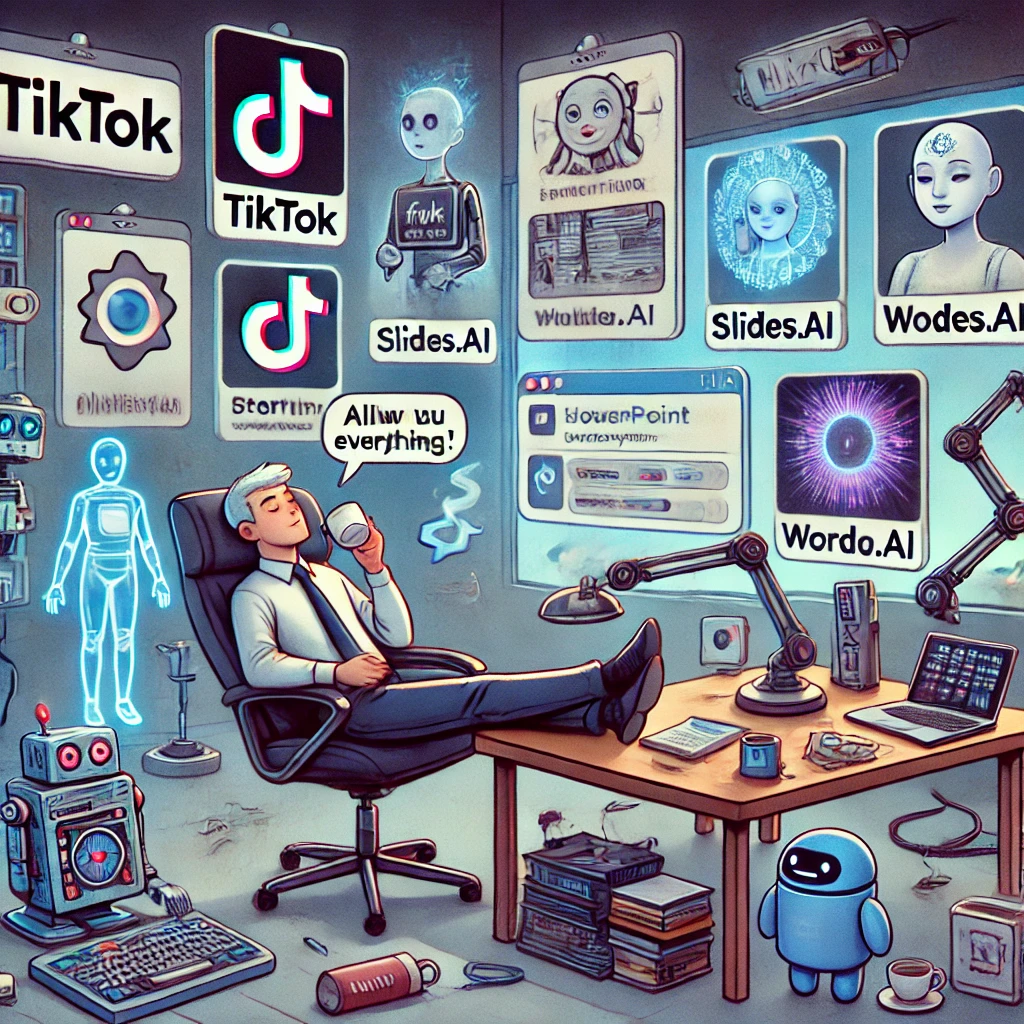
Wait… Does This Mean Robots Will Take Over My Job?

This is the million-dollar question. The short answer: Yes and No.

Yes, because many repetitive manual tasks will be automated. If a machine can do it faster and better, why pay a human to do it?

No, because new jobs will emerge—roles we never imagined before. Who would have thought that “TikTok Content Strategist” or “Metaverse Architect” would be actual job titles?

The key here is adaptability. Those who embrace technology will thrive, while those who resist will struggle. It’s like complaining that smartphones are ruining society while using one to rant on social media.

How Industry 4.0 Affects Our Daily Lives

If you think Industry 4.0 only affects tech companies, think again. It’s already changing our everyday lives:

  • Smart Homes: Your fridge tells you when you’re out of milk, and your lights turn on when you enter the room. It’s like living in a sci-fi movie!
  • Healthcare – AI can detect diseases earlier than doctors, and robotic surgeries are becoming more common. Imagine getting medical advice from a chatbot instead of waiting hours in a clinic.
  • Education – Online learning, AI tutors, and personalized lessons replace traditional classrooms. No more boring lectures (hopefully).
  • Shopping—AI-driven recommendations make your online shopping ads feel creepily accurate. “How does it know I was thinking about buying a new phone?!

The Funny Side of Industry 4.0

Despite all the advancements, some things about Industry 4.0 are just plain hilarious.

  1. The Smart Home Fiasco
    • Me: “Hey Alexa, turn off the lights.”
    • Alexa: “Turning off all the lights.”
    • Me: “Wait, not the WiFi—” (Everything shuts down, including my will to live.)
  2. AI Assistants That Are Not So Smart
    • Me: “Siri, what’s the weather like today?”
    • Siri: “I found some information about dinosaurs.”
    • Me: “…”

Are We Ready for This Future?

Industry 4.0 is not coming—it’s already here. The question is, how do we prepare for it?

  1. Learn New Skills – Coding, AI, data analytics, cybersecurity. The more you know, the better.
  2. Embrace Change – Don’t resist technology. Learn how to use it to your advantage.
  3. Be Creative – Machines can replace repetitive jobs but can’t replace human creativity.

Remember, the future belongs to those willing to adapt and evolve. So, are you ready?

Or are you still waiting for your smart fridge to stop judging your midnight snacks?
A Letter to My 100-Year-Old Self

Dear Mazlan,

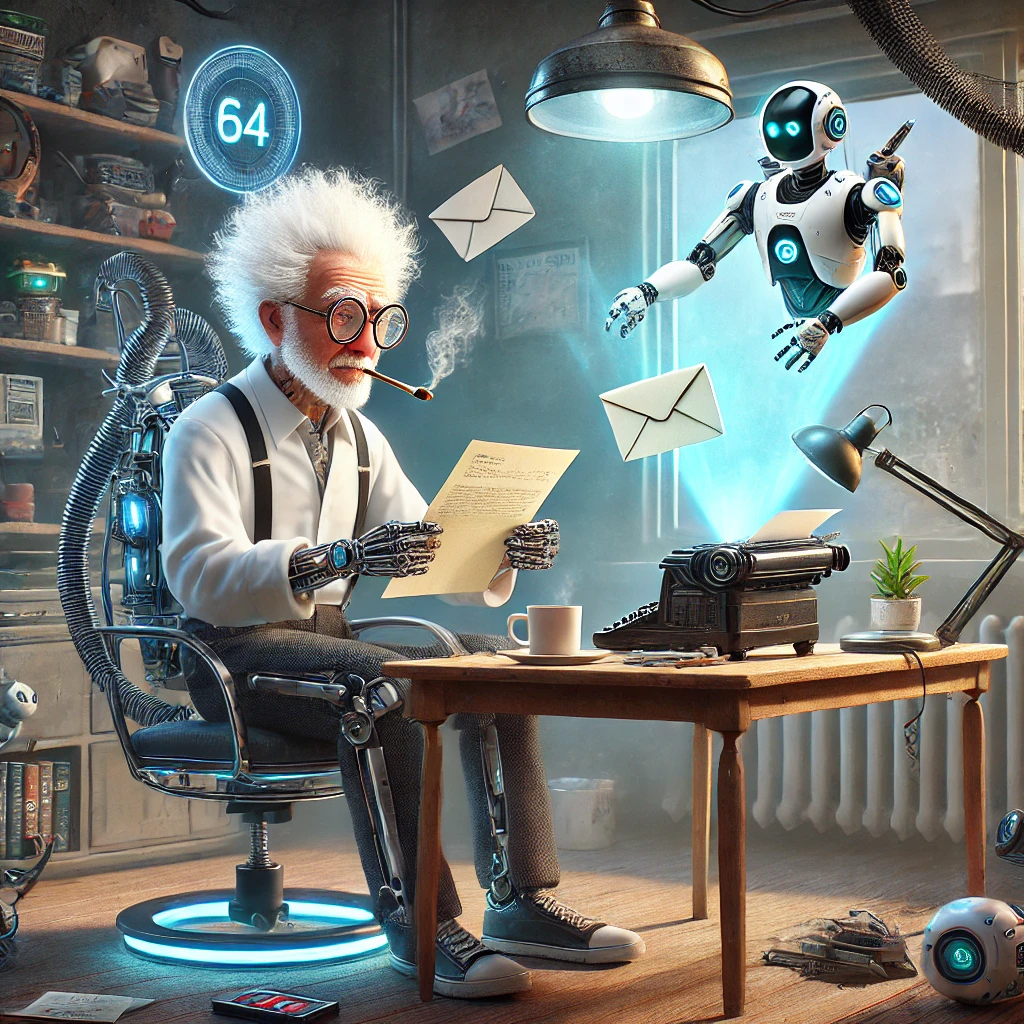
I hope this letter finds you in good health—though, at 100, I imagine your definition of “good health” is quite different from what I know now at 64. Have you finally achieved the balance of wisdom, patience, and acceptance that I am still working on? Or are you still chasing new ideas, thinking about the next innovation, the next disruption, the next frontier?

I sit here today, reflecting on the years that have passed, and I wonder—what has changed?

Did You Finally Slow Down?

Let’s be honest, slowing down was never in your nature. Even now, people tell me to “take it easy,” to “relax,” but that’s just not who I am. You were always restless, always looking for something to build, something to improve. You loved the feeling of being in the middle of things—whether it was pioneering IoT solutions, pushing smart city initiatives, or mentoring young entrepreneurs.

Did you ever truly retire? Or did you redefine retirement in your own way, turning it into just another phase of productivity? Did you ever stop writing, stop speaking at conferences, stop brainstorming new projects? I doubt it. The fire to create has been in you since childhood—remember those early days when you imagined futuristic worlds after watching The Jetsons? Did you ever outgrow that curiosity?

I sincerely hope not.

Did FAVORIOT Become the Legacy You Dreamed Of?

I need to ask—what happened to FAVORIOT? In my time, it is still growing, still making an impact in the world of IoT. We have expanded to multiple countries, partnered with great companies, and empowered countless developers, businesses, and cities to leverage IoT for a better future. But where is it now, at 100?

Did it grow beyond expectations? Did it become an industry leader, a force to be reckoned with in the global IoT landscape? Or did it evolve into something unexpected, something I can’t yet imagine?

I hope you nurtured it well. I hope you surrounded yourself with the right people—the kind who believe in the vision as much as you do. Because ideas are nothing without the right execution, and a company is nothing without the right people.

Did you finally see Malaysia fully embrace smart cities, powered by IoT in ways we once dreamed about? Or are we still lagging behind, still dealing with bureaucracy, still convincing people of the importance of innovation? I wonder if you are reading this with a knowing smile, shaking your head at how impatient I was.

What Lessons Did You Learn?

If you could talk to me now, what would you tell me? What mistakes should I avoid in the years ahead? What regrets did you accumulate along the way? I know myself—I will always be driven by ambition, always thinking of what’s next. But did I ever pause enough to appreciate the now?

Did I spend enough time with family? Did I express my gratitude to those who helped me along the way? Did I leave behind a legacy of knowledge, inspiration, and kindness, or did I get too caught up in the chase for success?

I hope you learned to let go of unnecessary worries. Right now, I stress over things that perhaps, in the grand scheme of life, don’t really matter. Did all those small worries fade into irrelevance with time?

Did the World Change the Way You Hoped?

Technology is moving fast—AI, IoT, robotics, quantum computing. At 64, I see the world changing, but at 100, how much more has it evolved? Did humanity finally master AI in a way that benefits all of society, or did we lose ourselves in our creations?

Is technology still something we control, or did it end up controlling us?

And what about space exploration? Have humans finally set foot on Mars? Did Elon Musk’s vision become a reality? Or did the world get too distracted with its own problems to look beyond Earth?

More importantly, did people become kinder? Did society learn from its mistakes? Did we finally find a way to balance progress with humanity, innovation with ethics? Or are we still making the same mistakes, just with more advanced technology?

I hope we got it right.

Are You at Peace?

At 100, what do you think about when you wake up? Do you still carry the same fire in your heart, or have you finally learned the art of contentment? Do you smile more often, laugh more freely, appreciate the simple things more deeply?

I hope you’ve come to terms with the things you couldn’t change, the dreams that didn’t materialize, and the roads you didn’t take. I hope you have no regrets about the things you did pursue, the risks you took, and the people you chose to keep close.

I hope you’ve forgiven yourself for the mistakes of the past and have found joy in the memories that remain.

Final Thoughts

Mazlan, if there’s one thing I want you to remember, even at 100, it’s this—life was never just about achievements, numbers, or titles. It was always about the people you touched, the lessons you shared, and the passion you lived with every day.

So, if you’re reading this with tired eyes but a heart full of stories, then I know you lived well.

And if by some miracle you still have the energy to pick up a pen, write back to me. Tell me what I got right. Tell me what I was wrong about. But most importantly—tell me that you’re happy.

With admiration,

Mazlan (the 64-year-old version of you)

12 AI Tools You Need to Try in 2025

  1. Fliki.ai (generates TikTok)
  2. Starry.ai (generates avatars)
  3. SlidesAI.io (generates PPTs)
  4. Remini.ai (edit pictures)
  5. Pictory.ai (edit videos)
  6. Wordtune.com (summarize notes)
  7. ChatGPT.com (solves anything)
  8. Writesonic.com (writes anything)
  9. MidJourney.com (generates art)
  10. Replit.com (generates code)
  11. Synthesia.ai (generates video)
  12. Soundraw.io (generates music)

Steal This Ultimate DeepSeek + SEO Cheatsheet

How “The Jetsons” Sparked My Lifelong Passion for Technology

“Can you imagine living in a world where cars fly, robots prepare your breakfast, and your boss talks to you through a giant video screen? Wait a minute…that sounds oddly familiar!”

As a young boy in the 1960s, glued to our old family television, watching The Jetsons was more than entertainment—it was my window into the future. Back then, it was nothing short of magical. A futuristic family living in Orbit City, navigating daily life with technologies that, to me, seemed pure fantasy. Fast-forward to today, and I realize how incredibly prophetic this cartoon actually was.

My First Encounter with the Future

“Eh, takkan lah manusia boleh cipta robot yang pandai masak sarapan?” I often asked myself skeptically.

In my childhood, my weekend routine revolved around television shows and comic books. Among the Batman comics and Superman TV series, The Jetsons stood out for a specific reason: it painted the future as something exciting, fun, and incredibly convenient. Unlike many dystopian or overly complicated portrayals of technology, The Jetsons gave me hope and wonder.

I would sit cross-legged in front of our bulky black-and-white TV set, amazed by flying cars, robots like Rosie, and video conversations that seemed impossibly futuristic. I remember vividly telling my mother:

“Mak, suatu hari nanti, orang mesti ada telefon yang boleh nampak muka orang lain!” She just laughed, probably thinking it was an impossible dream. Yet, here we are today, with video calls as common as a glass of water.

Predicting Technologies That Didn’t Yet Exist

“Biar betul? Cartoonists ni boleh ramal masa depan ke?”

What fascinated me most about The Jetsons wasn’t just the sleek aesthetics or the witty dialogues but how eerily accurate their predictions were. The cartoon first aired in 1962—decades before the internet, smartphones, or even personal computers became mainstream. Yet, astonishingly, they showcased technologies that closely mirror today’s innovations:

1. Drones and Autonomous Vehicles

I distinctly remember the excitement of seeing George Jetson commute to work in a flying autonomous vehicle. It seemed impossibly futuristic—no steering wheels, no pilots, just smooth automated flights. Fast-forward to now, and autonomous vehicles and drones are rapidly becoming mainstream. Companies like Tesla, Waymo, and countless drone startups are turning the once-cartoonish concept into reality.

2. Video Conferencing and Teleworking

Who could forget George Jetson’s daily arguments with his boss, Mr. Spacely, via a giant video screen? Even as a child, I wondered how amazing it would be to talk to someone face-to-face from afar. Decades later, platforms like Zoom, Microsoft Teams, and Google Meet have made this our everyday reality.

3. Smartwatches and Wearable Tech

One of my favorite gadgets from the cartoon was the smartwatch. George Jetson regularly spoke into his wristwatch, something I emulated with a toy watch. Today, devices like the Apple Watch enable voice communication and monitor health, provide notifications, and manage daily activities effortlessly. It feels surreal, like I’ve stepped straight into George Jetson’s life.

Robots in Daily Life: From Rosie to Reality

“Wow, imagine having a Rosie at home… I’d never have to clean my room again!”

Perhaps one of the most beloved elements of The Jetsons was Rosie, their family robot. Rosie wasn’t just a tool; she was part of the family, intelligent, helpful, and capable of conversation. Today, we see early glimpses of Rosie through voice assistants like Siri, Alexa, and Google Assistant. Companies like Boston Dynamics and Samsung are pushing boundaries even further, creating humanoid robots capable of performing household chores, providing care, and interacting with humans meaningfully.

I distinctly remember asking my mother, “Mak, one day kita boleh cakap dengan robot macam ni tak?” Again, it seemed impossible, but now, conversational AI is an integral part of our lives.

How The Jetsons Influenced My Career Path

“Mazlan, tengok cartoon je dah nak jadi saintis?” my parents chuckled when I expressed dreams of a technology-driven future.

Looking back, I realize how significantly this cartoon shaped my path. The whimsical portrayal of technology in The Jetsons not only inspired my interest in science fiction but also subtly guided me toward my career in telecommunications, IoT, and smart cities. I pursued electrical engineering and telecommunications and eventually became deeply involved in building smart cities—environments not unlike Orbit City, where IoT devices, smart transportation, and digital assistants simplify life.

When I founded FAVORIOT, a platform designed to empower IoT applications, the spirit of innovation and imagination instilled by The Jetsons was always at the forefront. I saw clearly how dreams from animated fiction could fuel real-world technological advancements.

A Visionary Cartoon That Still Inspires Today

“Tak sangka, cartoon yang aku tonton masa kecil dulu betul-betul jadi kenyataan hari ni.”

Revisiting the show today makes me marvel at its creators’ visionary minds. How did they manage to foresee so accurately? Was it pure creativity or a deeper understanding of technological trajectories?

In my opinion, The Jetsons succeeded because it tapped into universal human desires: convenience, connectivity, and curiosity. These remain consistent through decades, guiding technologists, innovators, and entrepreneurs alike. The show taught us to dream boldly and envision beyond current limitations.

Imagining Tomorrow’s Technologies Today

“Apakah lagi teknologi yang kita belum capai? Apa lagi yang boleh aku wujudkan?”

As a technologist deeply involved in IoT and smart cities, I often reflect on how fiction shapes reality. Today, when developing smart city initiatives or mentoring young innovators, I remind them how important imagination is. Every groundbreaking technology begins as a seemingly impossible idea.

What about the technologies from The Jetsons that we haven’t fully realized yet? The cartoon showed cities elevated above the clouds due to environmental challenges on Earth. Given the increasing urgency of climate change, such imaginative solutions might not remain fictional forever. Maybe vertical, sustainable cities aren’t as far-fetched as we once believed.

Encouraging the Next Generation to Dream Big

“Kalau cartoon pun boleh predict future, kenapa kita tak boleh cipta teknologi baru lagi hebat?”

To inspire today’s youth—just as The Jetsons inspired me—I constantly share this simple message: imagination has no limits. I challenge them to envision solutions for future problems because what is imagined today is tomorrow’s reality. My journey, from a fascinated kid sitting on the living room floor watching George Jetson to an IoT entrepreneur and technologist, is proof of this.

Now, every time I make a video call, glance at my smartwatch, or see news about autonomous vehicles, I smile silently.

It all started with a cartoon.

Who knew? Maybe Hanna-Barbera creators were the real visionaries.

What futuristic cartoon today will become the blueprint for tomorrow’s innovations? Until then, I’ll continue watching, imagining, and building the future inspired by The Jetsons.

Elon Musk’s xAI Unveils Grok-3: A Leap in AI Capabilities

February 2025 – Elon Musk’s artificial intelligence venture, xAI, has launched Grok-3, a significant upgrade to its predecessor, Grok-2. The latest iteration promises improved reasoning abilities, expanded processing power, and advanced search functionalities, positioning it as a formidable competitor in the AI industry.

Major Advancements in Grok-3

Grok-3 substantially increases computational efficiency, processing capabilities, and feature enhancements. Key differences between Grok-2 and Grok-3 include:

FeatureGrok-2Grok-3
Computational PowerStandard AI processing.10–15x more powerful, trained on xAI’s Memphis supercomputer with 200,000 Nvidia H100 GPUs.
Context WindowUp to 128,000 tokens.Extended to 1,000,000 tokens for improved comprehension.
Reasoning AbilitiesBasic reasoning capabilities.Advanced reasoning, self-correction, and complex problem-solving.
DeepSearch FeatureNot available.Allows AI to analyze multiple sources and articulate reasoning in real-time.
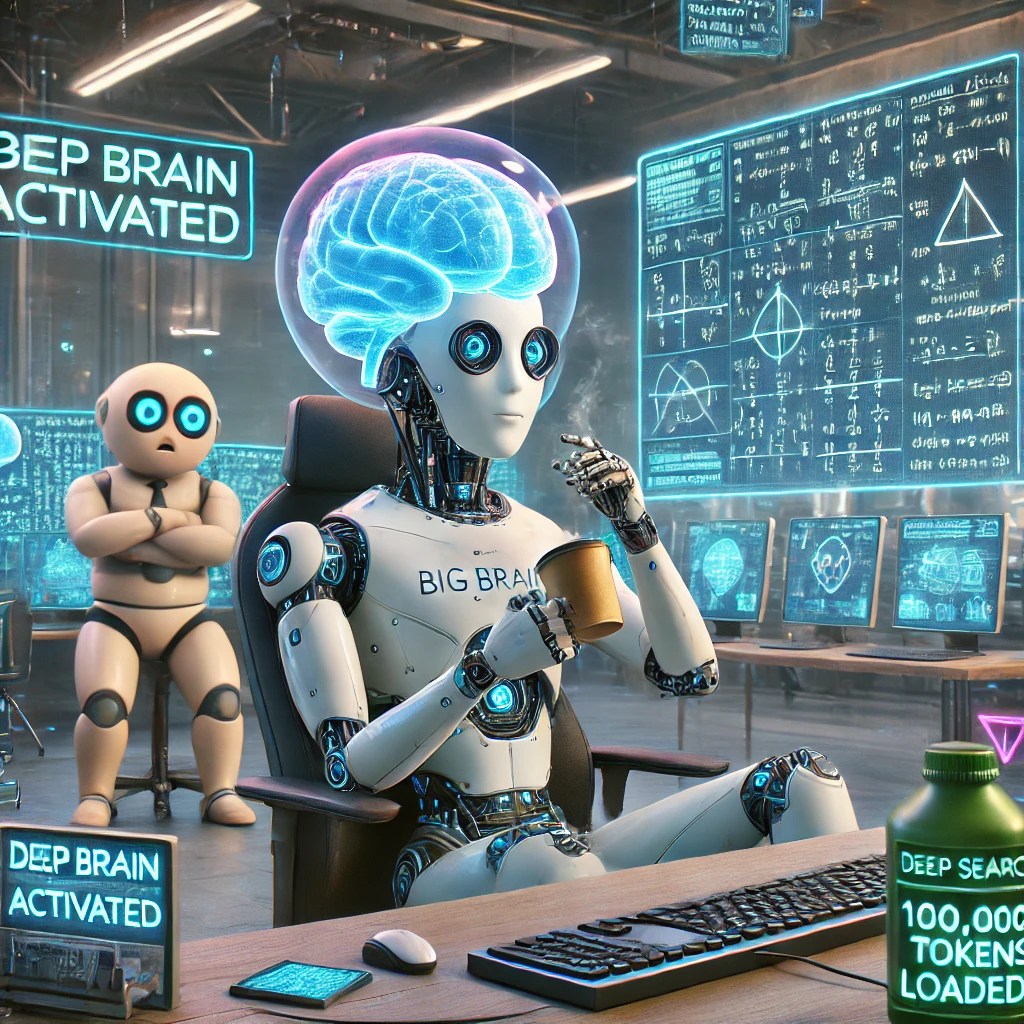
Big Brain ModeNot available.Allocates additional processing resources for intricate tasks, improving accuracy.
Supported ModalitiesText processing.Expanded support for both text and video.
Release DateAugust 2024.February 2025.
Open SourceNo.No.
Knowledge Cut-off DateUnknown.February 2025.

What Makes Grok-3 Stand Out?

One of Grok-3’s most significant features is its DeepSearch capability, which enables it to analyze vast amounts of real-time information, including sources across the Internet and social media platforms such as X (formerly Twitter). This feature makes it particularly effective for summarizing breaking news, analyzing trends, and responding to queries with up-to-date insights.

Another notable upgrade is Big Brain Mode, which allows the AI to dedicate additional processing resources for more complex computations, resulting in more precise and insightful responses.

Grok-2 Goes Open Source

While Grok-3 is being positioned as xAI’s flagship model, Musk has confirmed that Grok-2 will be made open-source, allowing developers and researchers worldwide to access and modify the code. This move is expected to drive innovation and foster community-driven enhancements in AI development.

The Future of xAI’s Grok Models

The introduction of Grok-3 signals xAI’s ambition to challenge industry leaders like OpenAI’s GPT-4o. With its increased computational power, deeper reasoning capabilities, and real-time search functionalities, Grok-3 is shaping up to be a major player in AI-driven business automation, data analysis, and research.

As AI continues to evolve, xAI’s latest release highlights the rapid advancements in machine learning and natural language processing, raising the bar for future developments in the industry.

Understanding Data Ownership and Big Data

Today, we’ll discuss two critical topics in the digital age: data ownership and the 4 V’s of Big Data.

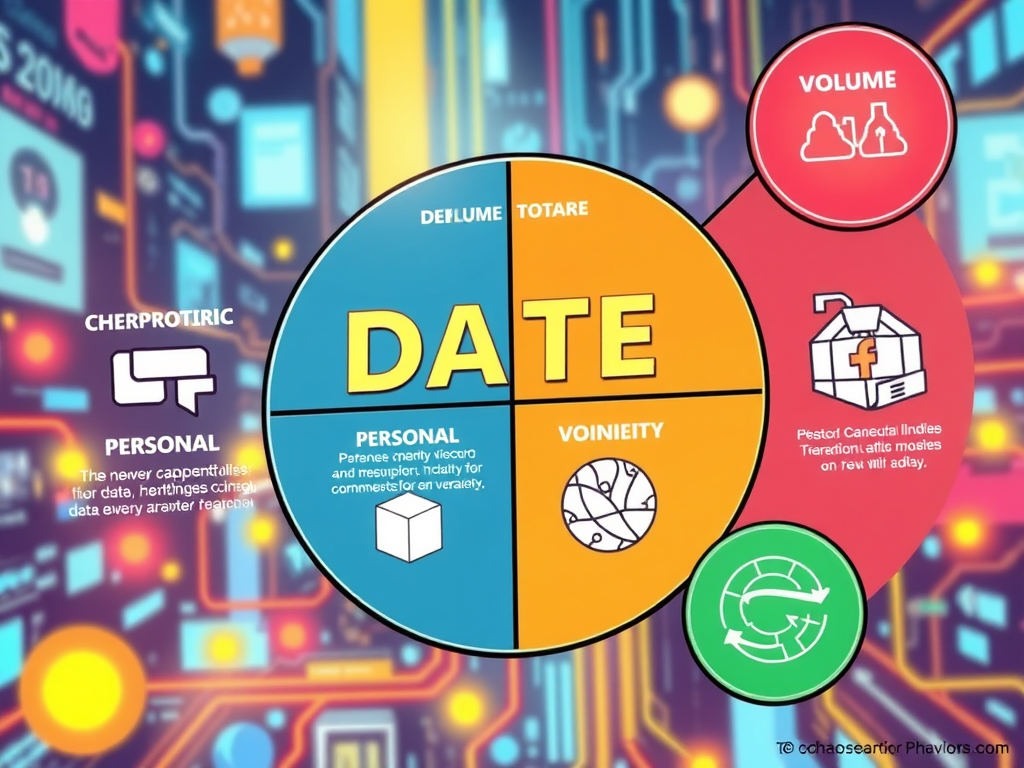
This diagram simplifies these concepts, so let’s break them down for better understanding.

Based on eBook — IoT Notes by Mazlan Abbas

1. Data Ownership

Data ownership refers to who has the rights and responsibilities over data. There are four main categories:

1. Personal/Household

  • This includes data generated from your personal devices, like your smartphone, fitness tracker, or smart home systems.
  • Example: Steps tracked by your smartwatch, or usage data from your smart TV.
  • You, as the owner of the device, own this data and can decide how it is used or shared.

2. Private

  • This is data collected and owned by companies or enterprises.
  • Example: A company’s internal data about its operations, such as sales performance or employee attendance.
  • Organisations use this data to improve their services, products, or strategies.

3. Public

  • Public data is owned by the government and shared for the benefit of society.
  • Example: Data from weather sensors, air quality monitors, or river level gauges.
  • This data is often accessible to the public for research, awareness, or planning purposes.

4. Commercial Sensor Provider

  • These are entities that deploy, own, and sell data collected from their sensors.
  • Example: A telecommunications company selling location data collected from its network.
  • They monetise the data by providing it to third parties, such as businesses or governments.

2. The 4 V’s of Big Data

Big Data refers to the massive volumes of data generated by digital devices and systems. It is characterised by the 4 V’s:

Volume

  • This is the amount of data, which can be massive in scale.
  • Example: Social media platforms generate terabytes of data every day from user interactions.

Velocity

  • This refers to how fast or slow data is generated and processed.
  • Example: Real-time data from stock markets or traffic monitoring systems must be processed quickly to be useful.

Variety

  • Data comes in different formats, such as text, audio, video, or images.
  • Example: An IoT platform may process data from sensors (numeric values), surveillance cameras (video), and voice commands (audio).

Veracity

  • This addresses the uncertainty or trustworthiness of the data.
  • Example: Ensuring the accuracy of user-generated reviews on e-commerce platforms can be challenging.

Why is This Important?

Understanding data ownership and the nature of Big Data is essential for:

  • Privacy and Security: Knowing who owns and controls your data helps protect your rights.
  • Decision-Making: Leveraging the 4 V’s effectively enables organisations to make informed decisions.
  • Innovation: Big Data drives advancements in fields like healthcare, transportation, and smart cities.

Final Thoughts

Data is the fuel of the digital economy, but with it comes the responsibility to manage it ethically and effectively. Whether it’s your personal data or public data shared by governments, understanding ownership and the dynamics of Big Data is crucial.

Let’s discuss: How can individuals and organisations ensure ethical data usage while maximising its potential? Share your thoughts!

[Note: Download the full eBook IoT Notes by Mazlan Abbas]

Climbing the Wisdom Pyramid: Mastering the Stages of Data Transformation (DIKIW)

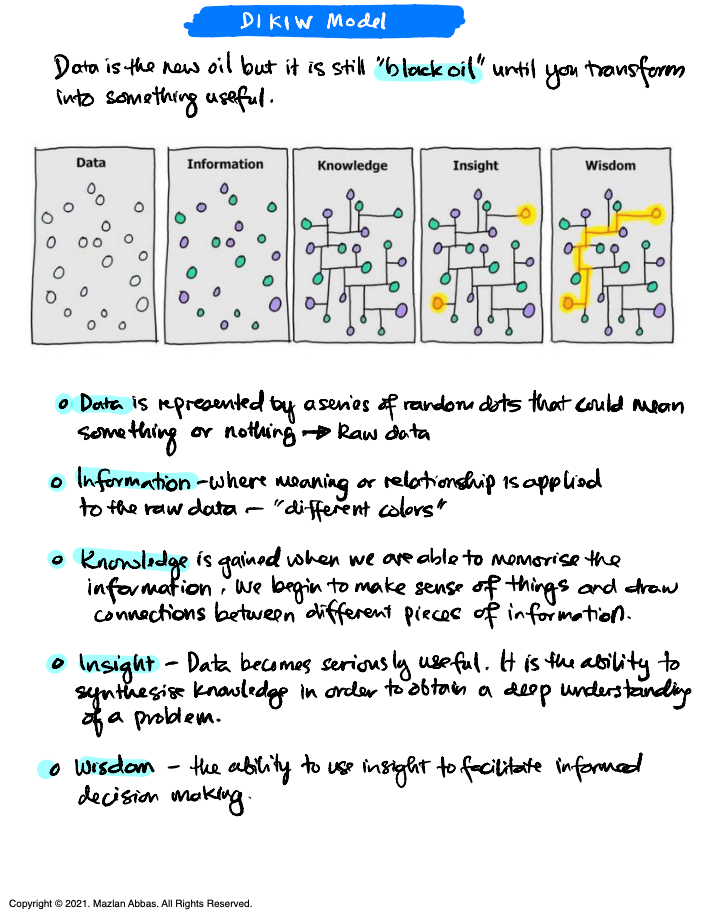
Today, we’re going to explore a framework called the DIKIW Model. It helps us understand how raw data transforms into valuable wisdom.

The diagram here breaks this journey into five stages: Data, Information, Knowledge, Insight, and Wisdom (DIKIW). Let’s dive into each stage step by step.

1. Data

Data is at the base of the model.

  • Data is like raw material — a series of random dots or unprocessed facts.
  • By itself, it has no meaning. It’s just numbers, words, or measurements.
  • Example: Imagine you have a list of temperatures recorded throughout the day. Without context, it doesn’t tell you much.

Data is “block oil” — it’s valuable, but only when refined.

2. Information

When meaning or relationships are applied to raw data, it becomes information.

  • At this stage, we start to see patterns or groupings.
  • Example: If you organise the temperature readings by time, you’ll see when it’s hottest and coolest during the day.
  • Information provides context and is often visualised using charts, tables, or colour coding.

This is like colouring the dots in the diagram to highlight differences or relationships.

3. Knowledge

Knowledge comes when we make sense of the information and see connections.

  • At this stage, we begin to understand why things happen.
  • Example: Analysing the temperature data might reveal that it’s hottest at noon and coolest at dawn.
  • Knowledge connects the dots and helps us understand patterns or causes.

This is where we start to see the bigger picture, as the diagram shows interconnected lines.

4. Insight

Insight is where things get seriously useful.

  • It’s synthesising knowledge and gaining a deeper understanding of a problem.
  • Example: From the temperature data, you might infer that noon is the best time for solar energy collection, while early morning is ideal for outdoor activities.
  • Insights are actionable. They guide decisions and strategies.

In the diagram, the highlighted paths represent key insights that stand out from the broader connections.

5. Wisdom

At the top of the model is wisdom, the most refined stage.

  • Wisdom is using insights to make informed decisions and act purposefully.
  • Example: Based on your insights, you decide to schedule outdoor activities early in the morning and optimise solar panels to maximise energy collection at noon.
  • Wisdom combines all the previous stages to guide strategic, long-term thinking.

In the diagram, wisdom is depicted as a clear path that guides decision-making.

Why is This Important?

  • In today’s world, data is everywhere, but it’s useless unless transformed into actionable wisdom.
  • The DIKW model helps us understand step-by-step how to extract value from data.

Final Thoughts

Data is the new oil, but it’s only valuable when refined into wisdom. Following the DIKW model, we can move from collecting raw data to making intelligent, informed decisions.

Let’s discuss: How can you apply this model in your work or personal life? Share an example of how you’ve turned data into actionable insights!

[Download eBook IoT Notes to complement these lecture notes]

My Dream Home: Where Innovation Meets Nature

I often dream about my perfect home. It’s more than just four walls and a roof. For someone like me who has always been passionate about technology and smart cities, my dream home isn’t just a physical structure; it reflects my lifelong experiences, love for science fiction, and continuous pursuit of innovation. My dream home is a seamless blend of futuristic technology, smart living, and peaceful nature. In this sanctuary, IoT, AI, and sustainability combine to create the perfect balance between modernity and tranquillity.

I wonder how it would feel to wake up in this house… Maybe it’s time I walk you through it.

A Home That Blends with Nature

Imagine a home on a hillside, surrounded by lush greenery, with large glass walls overlooking the horizon. The house doesn’t fight with nature but coexists with it. Solar panels cover the roof, blending into the design seamlessly. A small stream flows nearby, adding a soothing soundtrack of trickling water throughout the day. This home is self-sustainable, harvesting rainwater and solar energy while being designed to reduce its environmental footprint—a true embodiment of the circular economy I often talk about.

Every room is filled with natural light. The living spaces open to nature through sliding glass doors leading to a large deck. I imagine myself sitting on the deck in the early mornings, sipping my coffee while the birds chirp in the background.

But nature isn’t just about the view; it’s part of the home itself. The walls are lined with vertical gardens—living, breathing walls that regulate the air quality and create a serene environment. There’s also a small indoor garden where I can grow herbs and vegetables, reminding me that technology and nature can coexist harmoniously.

The IoT-Powered Core

Being deeply involved in the IoT industry, separating my dream home from smart technology is impossible. My home would be powered by a central IoT platform, much like FAVORIOT, designed to integrate every system—from security and lighting to climate control and appliances. The house is essentially alive, learning and adapting to my habits.

How cool would it be if the house could predict my mood?

If I’ve had a long day, the house will know. The lights dim to a warm, relaxing hue, the temperature adjusts to my preference, and soft, calming music fills the room. My personal AI assistant would greet me at the door, summarise my schedule, read the latest IoT news, and ask if I wanted to listen to one of my favourite podcasts.

Every room is equipped with sensors that adjust based on who’s inside. If I move to the study, the lighting changes to a focus mode, and the desk automatically adjusts to the right height. The smart fridge keeps track of the kitchen’s inventory, suggesting recipes based on what’s available and even ordering groceries when supplies run low.

A Connected Workspace

I’ve always believed that a house should inspire you, and my dream home would have a dedicated space for creativity and innovation. This is not just a typical home office but a futuristic command centre—a space filled with interactive screens, real-time data dashboards, and digital whiteboards. This is where ideas flow. It’s where I would record my podcasts and create TikTok content about IoT, write my articles, and even connect with global partners.

The workspace is also connected to my home’s IoT system, allowing me to monitor and control every aspect of the house from a single dashboard. I can check energy consumption, air quality, and even the health of my indoor garden at a glance.

Spaces for Family and Friends

Of course, my dream home isn’t just for me. It’s a space where family and friends can gather, share meals, and create lasting memories. The living area is designed for comfort and warmth, with a large fireplace as the focal point. I imagine a cosy reading corner filled with my favourite science fiction books—some DC comics, too, just for nostalgia.

There’s a home theatre where I can watch my favourite movies with my family—“The Jetsons” would be a must-watch on lazy Sunday afternoons. Outside, there’s a small badminton court where we can play together, a reminder of my younger days when sports were an essential part of my life.

A Space for Music and Reflection

Music has always been close to my heart. A dedicated music room in one corner of the house—a place to unwind and get lost in melodies. It’s where my guitar rests, waiting for me to strum Bee Gees classics. I envision this room as a space for creativity and relaxation, where music fills the air, bringing calmness after a hectic day.

The house also includes a meditation room—a quiet retreat for reflection. It’s a simple space with minimal design, facing the morning sun. Here, I can practice mindfulness and regain focus, a necessary escape from my fast-paced world.

Sustainability at Its Core

Sustainability is not just an afterthought in this home; it’s a guiding principle. The house uses green building materials and is designed to be energy-efficient. Solar panels generate power, and a battery storage system ensures the home can operate off-grid when needed.

Water conservation is another key aspect. Rainwater is harvested and filtered for use, while greywater is recycled for irrigation. Waste is minimized through smart waste management systems—recyclable materials are sorted and composted automatically.

The Future at My Doorstep

The future doesn’t just live inside my home; it extends to the surrounding area. Autonomous vehicles pull up to the driveway, and drones deliver packages directly to my doorstep. The neighbourhood is a smart community where homes communicate with each other, sharing energy resources and optimizing consumption.

Even the security system is futuristic—facial recognition for entry, AI-driven monitoring for unusual activity, and a virtual assistant that alerts me when something needs attention.

It’s funny how much this home reflects my personality. Everything is connected, always learning and improving.

Why This Dream Home Matters

For me, this home is more than just a physical space. It’s a manifestation of everything I’ve worked for—a culmination of my journey in technology, my passion for sustainability, and my belief that technology can enhance our lives without compromising nature.

It’s a home that inspires innovation and creativity, a place to share with loved ones, and a sanctuary for personal growth.

Of course, dreams evolve. As technology advances, so will the vision of my dream home. But one thing will always remain constant—it will be a place where the past, present, and future come together.

Who knows? Maybe one day I’ll build it. Until then, I’ll keep dreaming.

Understanding the Difference Between AI Agents and Agentic AI: My Take with Real-World Examples

When I first came across the term Agentic AI, I instinctively brushed it off as just another buzzword. Isn’t this just another AI agent with a fancy name? After all, we’ve been living with AI agents for quite some time—chatbots, virtual assistants, and recommendation engines—all working tirelessly behind the scenes. But the more I read about it, the more I realised that Agentic AI is not just an incremental improvement; it’s a whole new level of intelligence and autonomy.

Let me start by explaining the basics: What is an AI agent, and what makes Agentic AI so different?

AI Agents: The Reliable Taskmasters

Think of an AI agent as your dependable assistant. It performs specific tasks based on well-defined rules and algorithms. It doesn’t think beyond its programmed scope, and it certainly doesn’t surprise you with any independent decisions. In fact, you could say it’s like a diligent clerk who follows instructions to the letter without question. It gets the job done—no more, no less.

Here are a few examples of AI agents that you’ve probably interacted with:

  1. Customer Support Chatbots:
    Imagine you’re on a website trying to reset your password. You type your question into a chat window, and the bot quickly provides a step-by-step guide. You’ll get your answer in seconds if your question falls within its programmed scope. But if you ask something more complex about a unique error message, it politely directs you to a human representative.
    That’s a classic AI agent. Efficient for routine tasks but limited in scope.
  2. E-commerce Product Recommendation Engines:
    You browse for a new smartphone on your favourite online store. The AI behind the scenes tracks your clicks, analyses your preferences, and suggests related products like phone cases or screen protectors. It works based on data patterns, but it doesn’t truly understand why you want a particular product. It just knows how to push related items your way.
  3. Virtual Personal Assistants (to a Limited Extent):
    AI assistants like Siri or Google Assistant can tell you the weather, set reminders, or give directions. But try asking them to solve a complex, multi-step problem, and they’ll quickly hit their limits. They’re programmed to help with specific tasks—not to independently pursue a goal or adapt in real time.

In short, AI agents are practical tools. They’re predictable, reliable, and perfect for repetitive or straightforward tasks. But they cannot go beyond what they’ve been programmed to do.

Agentic AI: The Autonomous Strategist

Now, here’s where things get exciting. Agentic AI is not just about following instructions—it’s about adapting, learning, and making independent decisions based on broader goals.

If an AI agent is a clerk, then Agentic AI is more like an experienced project manager who understands the bigger picture. It doesn’t wait for step-by-step instructions. Instead, it analyses the situation, sets its own goals, and figures out how to achieve them—all while adapting to changing circumstances.

Let me give you some real-world examples to illustrate how Agentic AI stands apart:

  1. Autonomous Financial Analysts:
    Imagine an AI system that monitors the stock market in real time, identifies investment opportunities, and makes decisions without human intervention. Unlike traditional AI agents, which might only send alerts or generate reports, Agentic AI can buy and sell stocks, adjust its strategy based on market trends, and learn from past mistakes.
    This isn’t just automation; it’s a new level of autonomy and adaptability.
  2. Drug Discovery in Pharmaceutical Research:
    In the field of drug discovery, Agentic AI systems can predict how molecules will behave, propose new compounds, and optimise chemical synthesis processes—all without human guidance. These systems reduce the time it takes to develop new drugs from years to months.
    Think about that for a second—AI independently proposing and testing new drugs! That’s Agentic AI in action.
  3. Autonomous Vehicles (Beyond Self-Driving Cars):
    When people hear about autonomous vehicles, most think of self-driving cars. But Agentic AI goes further. Imagine an AI managing an entire fleet of autonomous delivery drones. It not only plans optimal delivery routes but also adapts to changing weather, traffic conditions, and customer demands without a single human intervention.

My Take: Why This Difference Matters

When I first tried to wrap my head around the difference between AI agents and Agentic AI, I struggled. I thought, Does this really matter in the grand scheme of things? Aren’t they both just AI doing what AI does best—helping us?

But the more I thought about it, the more significant this distinction was. AI agents are like tools that extend our abilities. At the same time, Agentic AI represents an entirely new collaborative partner that can take the initiative, learn, and adapt in ways we never thought possible.

Imagine the potential:

  • Businesses could rely on Agentic AI to autonomously manage entire operations, reducing human workload and enabling employees to focus on creative, high-level tasks.
  • In healthcare, Agentic AI can monitor patients, adjust treatments in real-time, and even predict potential complications before they arise.
  • Governments could use Agentic AI to manage smart city infrastructures, balancing energy consumption, traffic flow, and public safety without human intervention.

What Could Go Wrong?

Of course, this kind of autonomy comes with risks. We’re entering uncharted territory. What happens when Agentic AI makes decisions that conflict with human values or priorities? How do we ensure it remains aligned with our goals?

We need to grapple with these questions as we embrace this new wave of AI technology. It’s exciting, but it’s also a bit intimidating. How do we strike the right balance between autonomy and control?

Final Thoughts

Understanding the difference between AI agents and Agentic AI isn’t just an academic exercise—it’s essential for anyone working with technology today. AI agents will continue to play an important role in handling routine tasks, but the future belongs to Agentic AI.

The next time you interact with a chatbot or an AI-powered system, think about where it falls on this spectrum. Is it an AI agent, just following a script? Or is it something more—an independent strategist capable of adapting, learning, and making decisions on its own?

Personally, I can’t wait to see how Agentic AI evolves.

It’s not just about making life easier but redefining what’s possible.