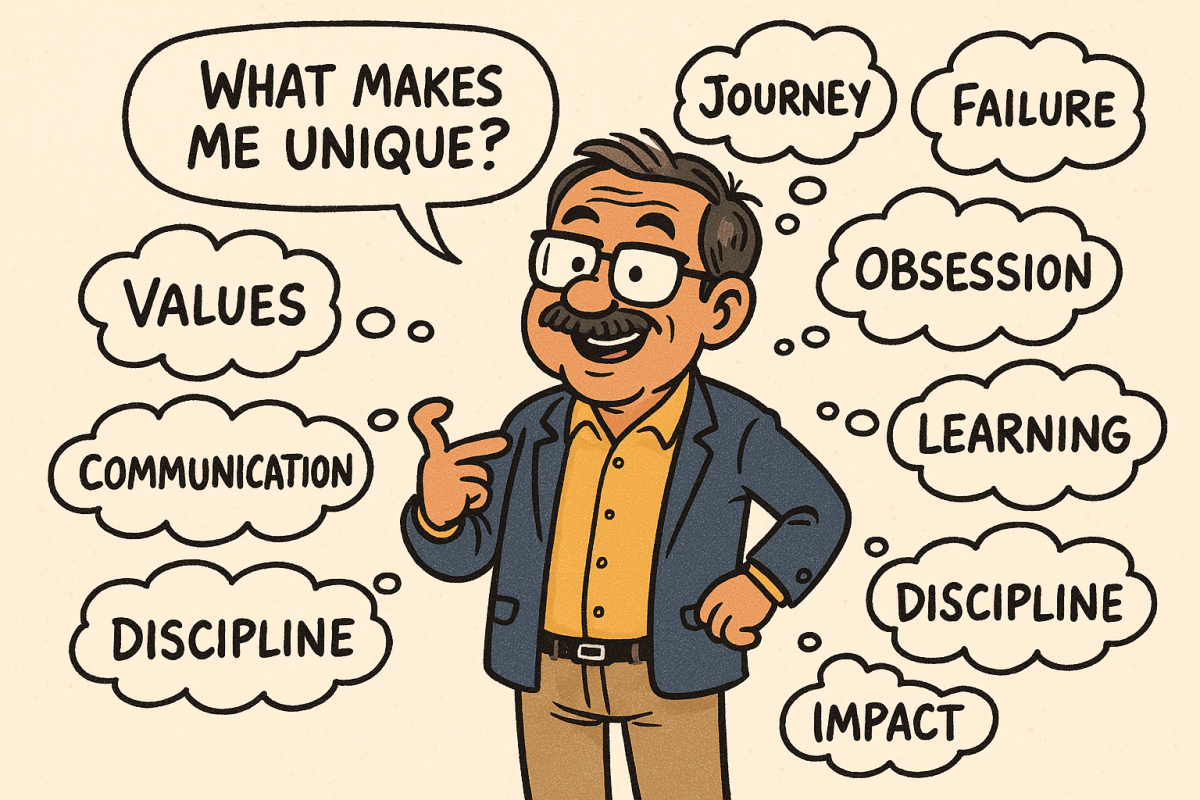
What Makes a Person Truly Unique?

As someone who has spent decades navigating the academic world, corporate boardrooms, government agencies, and startup trenches, I’ve come to realise that what makes a person truly unique is not just one defining trait but a combination of mindset, experience, and passion.

It’s the signature blend of your past, values, and vision for the future.

Let me break it down through my own lens—through personal stories, reflections, and the questions I’ve asked myself.

1. The Journey You Choose (or Endure)

“Why did I move from academia to government, then to corporate, and finally to building my startup?”

Many thought I was indecisive. But I saw it differently. Each step gave me a new superpower.

  • In academia, I learned how to think deeply and teach simply.
  • In government, I saw how policy can impact innovation nationally.
  • In corporate, I experienced the pace of execution and the demand for ROI.
  • In startup life, I learned humility, agility, and how to survive with little but dream big.

Not everyone chooses this “multiverse” path, but embracing it made me unique. I carried lessons from each world into the next.

2. How You React to Failure

“Mazlan, you left a comfortable job to start something uncertain?”

Yes—and I failed more times than I can count. But here’s the thing: I never let failure define me. Instead, I documented, reflected, and shared.

Every rejection, every “no,” became fuel for the next attempt.

What’s unique is not that you fail but how you rise from it—with clarity, grace, and a story others can learn from.

3. Your Obsession

“You’re still talking about IoT after all these years?”

Absolutely. I eat, sleep, and breathe IoT—not because it’s trendy but because I believe it can change lives. Even now, I run FAVORIOT to democratise IoT and make it accessible for students, startups, and governments.

Obsession—when combined with purpose—is what sets someone apart. It’s the thing you can’t shut off. You read about it, dream about it, and keep pushing the boundaries.

That’s the heartbeat of uniqueness.

4. The Way You Communicate

I once blogged about gadgets. Then, I pivoted to writing about technology, leadership, and storytelling. Today, I use WordPress, LinkedIn, podcasts, and even TikTok to reach different audiences.

Why?

I realised that what makes my voice unique isn’t just my technical knowledge but how I simplify it, narrate it, and humanise it.

People don’t remember jargon. They remember stories, analogies, and emotions. If you can make someone say, “Now I get it,” you’ve done something special.

5. The Values You Don’t Compromise

I’ve had opportunities that promised more famemoney, or power throughout my career. But I always asked myself:

“Is this aligned with what I believe?”

I don’t play politics. I don’t sell out. I don’t cut corners. I treat my team like family, and I lead with empathy.

In a world of copy-paste personalities, your principles become your fingerprint.

6. What You Do When No One’s Watching

In my quiet moments, I read articles from new writers, reply to comments, and refine my writing. I write even when no one reads because consistency builds credibility.

“But no one reads your articles.”

I kept writing anyway. Until one day—people did.

Your uniqueness is often born in the shadows, when no one claps, shares, or notices.

And still—you show up.

7. How You Inspire Others

I don’t just want to build a business. I want to develop people.

That’s why I mentor students, share my lessons, and give talks—even to small audiences. That’s why I created FAVORIOT Academy—to train the next generation of IoT professionals.

You become unique by climbing the ladder and extending your hand to those below you.

8. Your Curiosity and Lifelong Learning

Even today, I explore new platforms, write new articles, and learn from people much younger than me.

“Why are you still experimenting?”

Curiosity is a fire that never retires. The moment you stop learning, you become static. I choose to evolve—even at 64.

Uniqueness comes from the courage to keep updating yourself and stay relevant not by age but by adaptability.

9. Your Ability to Connect Across Generations

I often speak to university students, young engineers, and even teenagers on TikTok. Some are surprised—“Dr. Mazlan, you’re on TikTok?”

Yes, and I love it.

If you can speak every generation’s language, whether through blog posts or memes, you become a bridge. That connection—not just knowledge—is what makes someone unforgettable.

10. How You Turn Passion Into Impact

I don’t work on IoT just to build cool gadgets. I do it to solve real problems, from smart agriculture to healthcare, education, and even energy management.

Passion becomes power when you channel it into something greater than yourself.

When your work serves others, your uniqueness becomes your legacy.

A Personal Formula

If you ask me to define what makes a person unique, I’d say:

Uniqueness = (Journey + Failure + Obsession + Voice + Values + Discipline + Impact + Curiosity + Communication + Empathy) x Authenticity

You don’t need to be the smartest or the loudest in the room.
You just need to be the most you.

So, find your intersection.
Share your scars.
Own your quirks.
Speak your truth.

The world doesn’t need another replica.
It needs your story—told your way.

“Mazlan, what makes you unique?”

I’d say it’s because I’m still learning, experimenting, and daring to dream… even after all these years.


5 Lessons I Learned About Writing (The Hard Way)

When I started writing, I was like an overexcited kid given the keys to a candy store—brimming with enthusiasm but absolutely clueless about what I was doing. I devoured every piece of writing advice I could find, hoping to fast-track my journey to becoming a better writer.

Some tips helped, sure, but a lot of it? Pure noise.

Looking back, I realize I could’ve saved myself from much frustration if I had learned these lessons sooner. But that’s the beauty of growth—you stumble, fall, and eventually figure things out.

I discovered five hard-earned lessons through trial and error and a fair share of facepalms.

1. Write Often, But Fix Your Mistakes

When I first dipped my toes into the writing world, I kept hearing this mantra: “Just write as much as you can. Quantity over quality.” So, I did precisely that. I wrote. A lot. Blog posts, social media updates, random thoughts jotted in the middle of the night—you name it.

But here’s the catch: I wasn’t getting any better.

“Why isn’t this working? I’m writing so much, but nothing feels right.”

One day, curiosity (or maybe self-torture) made me reread my older pieces. I cringed. I mean, really cringed. My sentences felt awkward, and my ideas scattered like puzzle pieces from different boxes. That’s when the lightbulb flickered on. Writing isn’t just about pouring words onto a page; it’s about learning from those words.

Now, I treat writing like a conversation with my past self. I write, but I also pause, reread, and reflect. I ask, “What was I trying to say here? Could I say it better?” Mistakes? Oh, they’re inevitable. But fixing them? That’s where growth lives.

2. Read What Interests You, Not Just to Impress Others

There was a phase when I believed that I needed to read everything under the sun to be a great writer. Self-help books I didn’t care for? Check. Academic articles that felt like decoding alien scripts? Double-check.

But guess what? None of it stuck.

“Am I even absorbing any of this? Or just pretending to?”

I was reading to tick boxes, not to learn. I’d skim through articles, drop a “Great piece!” comment, and move on—thinking I was building connections. Spoiler alert: I wasn’t.

Eventually, I realized that meaningful reading comes from genuine curiosity. Now, I read what sparks my interest. Whether it’s a thought-provoking essay, an IoT case study, or even a quirky poem, I take my time. I underline sentences, jot down notes, and let the words marinate.

Reading this way doesn’t just fill my brain; it fuels my writing.

3. Comment Like You Mean It

Ah, the “comment-for-engagement” strategy. Been there, done that.

In the early days, I thought leaving many comments would make me visible. So, I plastered generic lines like, “Nice post!” or “Interesting thoughts!” across articles.

But here’s the thing—writers can smell insincerity from a mile away.

“Why isn’t anyone responding to my comments? Aren’t I engaging enough?”

One day, I received a heartfelt comment on one of my posts. It wasn’t long, but it was thoughtful. The reader shared how my words resonated with their experience. That comment? It stayed with me.

I realized genuine connections aren’t built on autopilot responses. Now, when I comment, I pause. “Did something in the article make me think differently? Did it remind me of a personal story?” I share that. Authenticity might not flood your notifications, but it builds lasting bridges.

4. Don’t Play the Follow-for-Follow Game

Ah, the seductive trap of the “follow-for-follow” game. In my eagerness to grow my audience, I followed anyone and everyone, thinking they’d return the favour. For a while, it worked. My follower count climbed, but my engagement? Crickets.

“Why do I have so many followers but no real interactions?”

I had an audience, but not a community.

One day, it hit me: “Why am I following people whose work doesn’t inspire me? Why am I chasing numbers instead of connections?”

So, I hit the reset button. I started following writers whose words I genuinely enjoyed and whose thoughts challenged me. The growth became slower, but it felt real. When someone follows me today, I know it’s because they value my voice, not because of an unspoken social contract.

5. Write When You Have Something to Say

“Write every day, no matter what.”

I took that advice to heart. Even on days when inspiration was as dry as the Sahara, I forced myself to write. The result? Words that felt forced, soulless, and frankly, forgettable.

“Why does my writing feel empty even though I’m consistent?”

Then I had an epiphany: Writing isn’t just about writing. It’s about sharing—sharing an idea, a lesson, or a story that matters—even if it’s just for you.

Now, I write when something stirs within me. It could be a fleeting thought, a conversation, or an article that sparked an idea. Writing from that place? It flows. It feels alive. And more often than not, it resonates with readers.

Final Thoughts

Writing isn’t a race. It’s a journey filled with detours, pit stops, and occasional breakdowns.

I’ve stumbled, cringed at my past mistakes, and learned lessons the hard way, but each misstep has shaped my growth.

If you’re starting your writing journey, here’s my two cents: Don’t chase perfection. “Chase authenticity.” Write, reflect, connect genuinely, and let your voice evolve.

After all, the most powerful stories aren’t the ones polished to perfection—they’re the ones that come from the heart.

How AI Sees My Writing Style – And What It Means for 2025

“Do I really have a writing style?”

That question kept bouncing in my head as I stared at the AI analysis of my articles. I’ve always written instinctively—pouring out thoughts, reflecting on experiences, and hoping they resonate with someone out there. But now, with a year’s worth of writing analyzed, I can’t help but smile.

The verdict?

I’m a storyteller at heart. I thrive on conversations. Most importantly, I write for impact.

So, let’s break it down. What makes my writing style uniquely mine?

1. Storytelling is My Foundation

“You should start with a story.”

I remember hearing that advice long ago. At first, it felt unnecessary—why not just get straight to the point? But over time, I realized that stories bridge the gap between knowledge and understanding.

When I write about IoT, I don’t just list facts. I take readers on a journey, whether they’re entrepreneurs struggling to deploy smart city solutions or university students trying to commercialize an IoT project.

Take “Why Writing Is Like Running a Marathon” or “The Silent Struggles of Researchers”—I don’t just talk about endurance and challenges. I live through them in my writing.

Why it matters: Stories stick. They make abstract ideas tangible and personal.

2. Conversational and Relatable Tone

“Write as if you’re talking to a friend over coffee.”

That’s how I approach my articles. No stiff, robotic sentences. No excessive jargon. Just me, having a conversation with you.

Whether I’m sharing “How Medium Shaped My Voice” or “Why You Should Write From the Heart,” my goal is simple: I want you to feel like we’re just sitting together, chatting about life and ideas.

Why it matters: Readers don’t want to be lectured. They want a dialogue.

3. First-Person Perspective Brings Depth

“Why do you always write in first person?”

Because it’s real. Because it’s personal. Because I believe the best way to inspire is by showing—not just telling.

If I write about IoT projects in universities or my journey in the corporate world, I’m not giving a third-person analysis. I’m sharing my experiences, lessons, and mistakes.

Why it matters: It builds trust. Readers connect with people, not abstract ideas.

4. Structure Matters – A Lot

“Make it easy to read.”

Long, unbroken paragraphs? No thanks. My articles are structured with clear sections, subheadings, and logical flow.

If I’m explaining “5 Lessons I Learned About Writing” or “How Favoriot Empowers IoT System Integrators”, I want you to get value fast.

Why it matters: Clarity keeps people reading. A good article doesn’t feel like work—it flows effortlessly.

5. Motivation and Inspiration Are My Hidden Ingredients

“People don’t just read for information. They read for inspiration.”

When I wrote “Why Persistence in Writing Matters” or “Every Failure Was a Step Toward Success”, I wasn’t just telling stories. I was giving hope.

I know what it’s like to feel stuck. To feel like no one is listening. To wonder if your efforts are even worth it. But every challenge I’ve faced has led me somewhere better. That’s the message I want to leave behind.

Why it matters: Inspiration fuels action.

6. Versatility Without Losing Identity

“Do you only write about IoT?”

No. And I never will.

My interests are broad—entrepreneurship, technology, personal growth, writing—but my voice remains the same. Whether discussing IoT’s future or writing a letter to my future self, it still feels like me.

Why it matters: A consistent voice makes a writer memorable.

7. Emotion and Logic Go Hand in Hand

“Facts alone don’t convince people. Emotions do.”

When I wrote “How Responding to Comments Boosted My Writing Output,” I didn’t just provide statistics. I also shared how engaging with readers felt —the excitement, the connections, the motivation.

Then, I supported my argument with logic—why engagement matters, how it impacts visibility, and what writers can do to grow.

Why it matters: The best articles engage both heart and mind.

8. Analogies and Metaphors Make Everything Click

“Explain it like they’re five.”

If I say, “Writing is like running a marathon,” you immediately understand endurance is key. If I say, “A Medium writer is like a badminton player,” you get that consistency and technique matter.

I use analogies because they simplify complexity. IoT, AI, writing—whatever the topic, if I can compare it to something familiar, it becomes easier to grasp.

Why it matters: Analogies make learning fun and effortless.

9. Audience-Centric Writing

“Who am I writing for?”

Every article I write answers a question or solves a problem.

Whether it’s “Why You Should Not Give Up Writing” or “How Favoriot Empowers IoT System Integrators”, my focus is always: How can this help the reader?

Why it matters: Readers stay loyal when they feel seen and understood.

10. Learning and Growing Through Writing

“Writing is my best teacher.”

I reflect a lot in my articles.

From “Lessons Learned in My 13-Year Telco Career” to “My Journey of Writing 550 Articles on Medium”, I use my past as a learning tool. I talk about mistakes, breakthroughs, and the evolution of my thoughts.

Why it matters: Growth is relatable. Readers appreciate honesty.

What This Means for 2025

Seeing this breakdown made me realize one thing—I love writing.

And in 2025, I’ll write even more.

✔ More stories that resonate.
✔ More conversations that connect.
✔ More insights that inspire.

If AI says my writing has an impact, I owe it to myself (and my readers) to keep going.

Because at the end of the day, writing isn’t just about putting words on a page.

It’s about sharing experiences, shaping perspectives, and leaving a legacy.

Here’s to another year of storytelling.

5 Lessons I Learned About Writing (The Hard Way)

Photo by Angelina Litvin on Unsplash

When I started writing, I was excited but clueless.

I followed every advice I could find, thinking it would fast-track my growth.

Some of it helped, but a lot of it wasted my time.

Looking back, I realise many of my mistakes could’ve been avoided.

Here are five simple lessons I learned through trial and error.

1. Write Often, But Fix Your Mistakes

When I was new to writing, I kept hearing, “Just write as much as you can. It doesn’t matter if it’s bad.” So, I wrote and wrote, but I wasn’t getting better.

Why? Because I wasn’t learning from my mistakes.

One day, I took a step back and reread my older pieces. I cringed.

That’s when I realised that writing isn’t just about pouring out words — it’s about learning how to improve them.

Now, every time I write, I also edit and reflect. Mistakes are okay, but fixing them is what makes you improve.

2. Read What Interests You, Not Just to Impress Others

People kept telling me to read a lot to improve my writing.

So, I went overboard. I read anything and everything, but often, I wasn’t paying attention.

I skimmed articles, left a quick “great piece!” comment, and moved on. I thought that’s how you built connections.

But over time, I realised I was fooling myself.

Reading like that didn’t help me write better or connect with anyone.

Now, I only read what genuinely interests me. When I find something good, I take my time to understand it.

This way, I learn and respect the effort the writer put into their work.

3. Comment Like You Mean It

I used to think leaving lots of comments on people’s articles would get me noticed.

So, I’d quickly type things like, “Nice work!” or “Great read!” and move on.

It felt like I was doing something productive, but those comments were shallow.

Writers can tell when your comment is just filler.

They stop engaging with you because you didn’t read their work.

Now, I only comment when I have something meaningful to say.

If I like a piece, I’ll share what stood out or what I learned from it. A good comment goes a long way in building authentic connections.

4. Don’t Play the Follow-for-Follow Game

At first, I thought the secret to growing my audience was simple: follow everyone, and they’ll follow you back.

My follower count grew for a while, but it didn’t feel right.

Most of these “followers” weren’t interested in my writing, and I wasn’t interested in their work either. It felt empty.

Now, I follow people whose work I enjoy or can learn from.

Sure, my growth is slower, but it’s real.

The people who follow me now actually read and engage with my work, and that’s far more rewarding.

5. Write When You Have Something to Say

One piece of advice I used to follow was, “Just keep writing no matter what.” So, I wrote even when I had no ideas, energy, or passion for what I was doing.

The results? My writing felt forced, and I wasn’t proud of it.

Then I realised something: Writing isn’t just about putting words on a page.

It’s about having something to share, an idea, a story, or a lesson.

Now, I write when inspired or strongly about a topic. Writing this way makes the process enjoyable, and the results are much better.

Final Thoughts

Writing is a journey; like any journey, it’s easy to get lost if you follow the wrong map.

I made plenty of mistakes, but each one taught me something valuable.

If you’re starting, take your time to find what works for you.

Write, learn, and connect with people authentically.

It’s not about shortcuts — building something meaningful, one step at a time.

The Journey of Writing 550 Articles on Medium

WRITER’S STORIES

The Power of Consistency

Five hundred and fifty articles,” I said to myself, a mix of pride and disbelief in my voice. That number is only on Medium, not counting one other blog I was originally active on. It felt surreal to think I had written so much, shared many ideas, and connected with countless readers over the years. But one thing made this journey possible: consistency.

The Beginning

I remember the early days vividly. My passion for writing began with a simple blog about gadgets on Blogspot. “Those were simpler times,” I often tell myself.

My love for technology and innovation drove me to share my thoughts with the world.

However, maintaining a regular writing schedule was challenging.

There were days when inspiration flowed effortlessly and others when I struggled to write a single sentence.

What keeps you going?” I frequently asked myself during those tough days.

The answer was always the same: a deep-seated passion for sharing knowledge and making a difference.

Discovering the Power of Routine

Photo by Alex Antoniadis on Unsplash

It wasn’t until I transitioned to writing about the Internet of Things (IoT) and smart cities that I truly understood the power of consistency.

If I want to make an impact, I need to show up regularly,” I reminded myself.

So, I set a goal: write at least one article every week.

It sounded simple, but the commitment required discipline.

Establishing a routine was my first step.

Every morning, I would sit down to write after a cup of tea either at my home or office.

Some days were easier than others, but I made it a non-negotiable part of my day. “It’s like going to the gym,” I mused. “The more you do it, the stronger you get.

Finding My Voice

Photo by Stephen Harlan on Unsplash

One of the most significant challenges I faced was finding my unique voice.

How can I stand out in a sea of content?” I often wondered.

The answer came through trial and error.

I experimented with different styles, tones, and formats until I found what resonated with me and my audience.

Writing in the first person and incorporating self-dialogues became my signature style.

It allowed me to connect with my readers on a personal level. “This feels more authentic,” I thought.

Sharing my experiences, struggles, and triumphs made my articles relatable and engaging.

Staying Inspired

Maintaining consistency required more than just discipline; it required a steady stream of inspiration.

Where do you find new ideas?” I would ask myself during moments of writer’s block.

The answer was everywhere.

My interactions with readers, the latest developments in IoT, and even everyday experiences became sources of inspiration.

One particular instance stands out.

I received a comment on one of my articles about the potential of IoT in agriculture.

The reader shared their experiences and challenges, sparking a new idea.

This could be a great topic for my next article,” I realized. I never ran out of ideas by staying engaged with my audience and open to new perspectives.

Embracing Feedback

Photo by Jon Tyson on Unsplash

Another critical aspect of my journey was embracing feedback.

Not all comments were positive, and some critiques were hard to swallow.

Is this really constructive?” I would sometimes think.

However, I learned to view every piece of feedback as an opportunity for growth. Constructive criticism helped me refine my ideas and improve my writing.

One memorable feedback came from a fellow writer who pointed out that my articles could benefit from more structured arguments.

How can I make my points clearer?” I pondered.

This led me to adopt a more organized approach to presenting my ideas, making my articles more impactful and easier to follow.

The Role of Community

Building a community around my writing was an unexpected but invaluable part of my journey.

How can I foster a sense of belonging?” I often wondered.

Engaging with my readers through comments, social media, and even webinars created a loyal following.

These interactions provided motivation and accountability, pushing me to keep writing.

I recall hosting a webinar on smart cities, during which a participant asked a thought-provoking question about data privacy.

This deserves an in-depth article,” I thought. My sense of responsibility to my community inspired me to explore new topics and perspectives.

Measuring Progress

Photo by charlesdeluvio on Unsplash

Tracking my progress was another key to maintaining consistency.

How far have you come?” I would periodically ask myself.

I kept a record of my articles, noting the publication dates, topics, and reader engagement.

This provided a sense of accomplishment and helped identify patterns and trends in my writing.

One of my favorite tools was a simple spreadsheet.

It’s amazing to see the journey laid out,” I often marveled.

Seeing the steady accumulation of articles over weeks, months, and years reinforced the importance of showing up consistently.

Overcoming Obstacles

The path to 550 articles was not without obstacles.

There were times when I questioned my abilities and faced external pressures.

Can you really keep this up?” I doubted myself during particularly stressful periods. Balancing my role as CEO of FAVORIOT, speaking engagements, and writing was challenging.

In those moments, I reminded myself of why I started.

Your voice matters,” I would reaffirm. Setting realistic goals and being kind to myself during setbacks helped me persevere.

Writing, I realized, was not just about quantity but also quality and authenticity.

Reflecting on the Journey

Photo by Clemens van Lay on Unsplash

Looking back, I see a growth, learning, and connection journey.

Writing 550 articles taught me the value of persistence and the power of routine.

It showed me that consistency is not about perfection but commitment and progress.

You’ve come a long way,” I remind myself, grateful for every step of the journey.

To aspiring writers, I offer this piece of advice: embrace consistency.

Show up every day, even when it’s hard.

Find your voice, stay inspired, and engage with your community. Writing is a marathon, not a sprint. Each article is a milestone, a testament to your dedication and passion.

As I prepare to write my next article, I carry these lessons with me.

The journey continues, with it, the promise of new ideas, connections, and growth.

Here’s to the following 550 articles and beyond!

How Medium Shaped My Voice

WRITER’S JOURNEY

I’ve found not just my way but also my heart and my resonance.

Photo by Giu Vicente on Unsplash

The Novice on a Vast Stage

I must confessed, I was a novice, standing timidly at the edge of an immense, unexplored stage. “English isn’t my first language,” I would often mutter to myself, seeing it as a formidable barrier. Despite this, I had an intense yearning to express my burgeoning passion for writing. Initially, my words stumbled and fell flat, unrefined and tentative as the steps of a child learning to walk.

Will anyone even notice?” I often wondered. My early articles were brief and shallow, lacking the depth and flair I admired in the works of others. They felt like echoes in an empty square, hardly noticed, quickly forgotten.

Photo by Soundtrap on Unsplash

A Lone Voice in the Digital Wind

In those early days, my digital presence was akin to a lone voice caught in the wind—no readers lingered on my page, and no followers eagerly awaited my next post. “Is anyone out there?” The silence was disheartening. The much-coveted signs of engagement, such as comments and claps, were conspicuously absent. I was an invisible entity in Medium’s vast writers’ world, yet to spark any noticeable interest or impact.

But I must keep going,” I told myself. Within me, a resilient spark refused to be extinguished. I was determined not to let my initial failures define my capabilities. Thus began my arduous journey against the currents of doubt and linguistic challenges.

Chipping Away Doubts

I noticed a gradual improvement with each new article and every line I penned. “This is getting better,” I’d think, feeling a small surge of pride. It was as if I was sculpting my statue from a rough block of marble, chipping away the excess until my true potential emerged.

The community of writers on Medium, with their open arms and open minds, played a crucial role in this transformative journey. “Welcome, we’re glad you’re here!” they said. They welcomed me into their fold, generously sharing their knowledge, art, and souls.

From them, I learned not just the mechanics of writing but also its artistry. I knew the importance of crafting captivating headlines, the skill of weaving words that could engage readers, and the ability to purify my voice to resonate clearly through my prose.

Photo by Soundtrap on Unsplash

Embracing Shakespeare’s Language

I immersed myself in “Shakespeare’s language,” which was both a challenge and a revelation. “To be or not to be,” I would joke during moments of frustration with my grammar, which strengthened over time, as did my vocabulary.

Slowly but surely, my followers began to increase, and claps—the Medium community’s show of appreciation—started to rain upon my work. “They like it!” I realized one day that my writing was no longer a vain pursuit; I was finally making my mark.

From Timidity to Confidence

This newfound confidence and recognition were exhilarating. With each new piece, my spirit roared louder, and my voice grew more assertive. I had moved from being a timid, uncertain writer to one who could claim his space confidently within the community. Medium had become more than just a platform; it was a nurturing ground where I could grow and contribute.

Look how far you’ve come,” I often reflect, amazed at my journey. It is a testament to perseverance and the transformative power of community support and self-belief. My narrative is no longer just about overcoming the language barrier; it’s about embracing it as a powerful tool for expression and connection.

Photo by Kenny Eliason on Unsplash

A Home Among Words

I have found my place in this vibrant crowd of writers and readers. “I belong here,” I say with certainty, in this community that values every voice, including those that start as mere whispers in the wind. Each word I write now paints part of my dream, a vivid splash on the vast canvas of Medium.

I write not just to express but to connect and to resonate with others across this digital expanse. Let this account of my journey be my song of gratitude, a tribute to every stumble that taught me to rise and every fellow writer who helped me find my footing.

Here to Stay

In the heart of Medium, amidst its diverse voices and stories, I have found more than just my footing – I have discovered a home. In this confluence of ideas and inspirations, I continue to write, share, and dream.

Here, on this vast and endless stage, I have learned that my voice, once unsure and faltering, can now sing clearly and firmly. “This is where I was meant to be,” I often think, filled with a sense of belonging and purpose.

And here, I will stay, for in this space, I’ve found not just my way, but also my heart and my resonance.


Remember to Subscribe to receive email updates on every post I publish.

How These Tips Pay for My 2.5 Years of Medium Subscription Within 4 Months

Follow the Five Tips

Image created using Midjourney by Author

There are two reasons why I chose to upgrade to the Medium Partner Program (MPP) with a $50 annual subscription:

1 — Read the excellent articles written by many authors behind the paywall.

2 — To become a writer myself and ensure that the earnings from my articles can cover the annual subscription costs.

For the next four months, I have been continuously writing many articles that cover various topics, such as — IoT, Startup, Thought Leadership, and Writing.

Below is the outcome — a total of $130.23! If we divide by $50, it will cover almost 2.5 years of MPP subscription.

Below are five tips that I followed:

1 — Publish Regularly

Consistency Attracts Readers

Regular publishing is a cornerstone of successful blogging.

Maintaining a consistent posting schedule establishes a rhythm that your audience can depend on and adapt to.

This consistency helps build a loyal readership, as readers are more likely to return to your blog anticipating new content. Regular updates signal to search engines that your blog is active, potentially improving its ranking.

The key is to find a balance that works for you and your audience — daily, weekly, or bi-weekly posts — and stick to it.

This habitual engagement not only helps retain existing readers but also attracts new ones who appreciate the reliability of your content updates.

2 — Quality Content

Focus on Creating Valuable, Informative Posts

The importance of quality content cannot be overstated in the blogging world.

High-quality, informative posts are the bedrock of a successful blog. This involves well-written articles and content that is valuable and relevant to your audience.

Investing time and effort into researching and understanding what your readers are interested in and what problems they are trying to solve is essential.

You ensure that your content resonates with your audience by providing solutions, insights, or valuable information.

Quality content also increases the likelihood of your posts being shared, which can help attract a wider audience and establish your blog as a go-to resource in your niche.

3 — Engaging Headlines

Craft Titles That Draw Readers In

Headlines are the first point of contact between your content and potential readers, making them a critical element of your posts. An engaging, compelling headline can make the difference between a post that is widely read and one that is overlooked.

Good headlines should be clear, intriguing, and reflective of the content within the article.

They should spark curiosity or offer a clear benefit to the reader, encouraging them to click through and read the entire post.

Crafting the correct headline requires a balance between creativity and clarity, ensuring it is attention-grabbing and accurately represents the article’s content.

4 — Use Tags Wisely

Tags Increase Discoverability

Tags are a powerful tool for increasing the discoverability of your blog posts. When used wisely, they help categorize your content, making it easier for readers to find related posts and navigate your blog.

Tags also significantly improve your blog’s visibility on search engines, as they help index your content more effectively.

It’s essential to use relevant and specific tags that accurately describe the content of your post.

Overusing or misusing tags can be counterproductive, as it may lead to poor user experience and negatively impact your blog’s search engine ranking.

The key is to use a consistent and thoughtful approach to tagging that enhances the overall accessibility and organization of your content.

5 — Eye-Catching Images

Visuals Make Your Posts More Appealing

Incorporating eye-catching images into your blog posts significantly enhances their appeal and effectiveness.

Visual elements like photos, graphics, or infographics can break up large blocks of text, making your posts more readable and engaging.

They also provide an opportunity to visually represent or complement your written content, making it more understandable and memorable.

Additionally, images can make your content more shareable on social media, as posts with visuals attract more attention and engagement.

Choosing images that are relevant to your content and of high quality is essential.

Properly formatted and optimized images can also contribute positively to your blog’s SEO, further increasing the visibility of your posts.


View at Medium.comView at Medium.com

The Day My Daily Views Jumped From 60 to 3,400 (Here’s What Happened)

Image created using Canva by Author.

I started the month of January with only 30 to 60 views daily.

Of course, I envy other writers getting 100s or 1000s of views daily.

I don’t know what their secret is. But most probably, they are top writers on Medium and have many followers, or simply that their articles get boosted from Medium.

But I never gave up. On January 11, 2024, I did two things differently.

Suddenly, it jumped to 2.1K views on January 11 and peaked on January 16, 2024, with 3.4K views.

Stats in January 2024

Here’s what I did differently:

Firstly, I migrated my domain ( http://mazlanabbas.com ) to Medium.

View at Medium.com

The main reasons for moving to Medium are because (1) I don’t have enough time and resources to manage Medium and my other blogs. Furthermore, it is comprised of almost the same contents. (2) I love the simple interface of Medium. It’s easier to write here. (3) Best community as compared to WordPress. I have better engagement with the Medium community. They are very friendly and always give good comments and advice.

Secondly, I shared and published a non-paywall to my mailing list. More than 9,000 people have followed me from various social media channels and blogs. It’s now easier to use this platform to share my articles. I have created multiple Medium publications, but I have the one on IoT World Publication open for all readers (non-paywall, Medium Partner, or Non-Medium Partner can read this).

View at Medium.com

I don’t know much about Medium’s algorithm, but maybe the readers can help me to solve this “mystery.”

The second reason is the one that changed the number of the game — that’s my feeling. But if you have other thoughts, kindly leave some comments below.

What do you think?


However, if you asked me whether my earnings will jump multiple times — the answer is … no … unfortunately. It remained the same as before.

On the other hand, I can satisfy my followers, especially with the articles I previously made behind the paywall, and now it’s open.

Thanks all!


Publications That I Created (Behind the Paywall) — Follow This

View at Medium.comView at Medium.comView at Medium.com

My Top 5 out of 289 Published Medium Articles: Lessons Learned

The image was created using Midjourney by the Author of Startup Journey

I have written articles in Medium since July 2016.

It was a very long time ago, and compared to others, 289 articles are many when you average for the last eight years.

I had a different mood during those years, and only last year I started to write more rigorously and consistently.

Medium stats are suitable to analyze and reflect on what works and what doesn’t.

Below are screenshots comparing the top of my highest earnings, most viewed, and most read.

Screenshot of top 5 earnings
Screenshot of top 5 views
Screenshot of top 5 reads.

These are my findings:

  1. Common Themes in Top Earning Articles: The five highest-earning articles on Medium in 2024 predominantly focus on writing on the platform. These include discussions on improving writing skills, personal experiences, and practical tips for success:
    Avoid These 10 Mistakes and Become a Better Writer in 2024
    Tripling My Medium December Earnings: When I Implement These Amazing Things
    Why You Should Not Give Up Writing When No One is Reading Your Articles
    Lessons Learned Before and After Joining Medium Partner
    No Wonder My Articles Don’t Get Boosted Because I am Using AI to Help Me
  2. High Views on Free Articles: Articles without a paywall, particularly those published in the “IoT World” publication, tend to attract more views. This is attributed to their public accessibility and broader reach.
  3. Articles that resonate with the broader Medium writing community, especially those offering experiences and tips on improving reach, earnings, and engagement, are more likely to be monetized effectively.

This article best shows how you want to get excellent traction and earnings:

View at Medium.com


Remember to Subscribe to receive email updates on every post I publish.


Join me on Buy Me a Coffee and buy me a coffee (or two). Your support fuels my creativity, and we’ll continue this incredible adventure together! Just click here:https://buymeacoffee.com/mazlan.