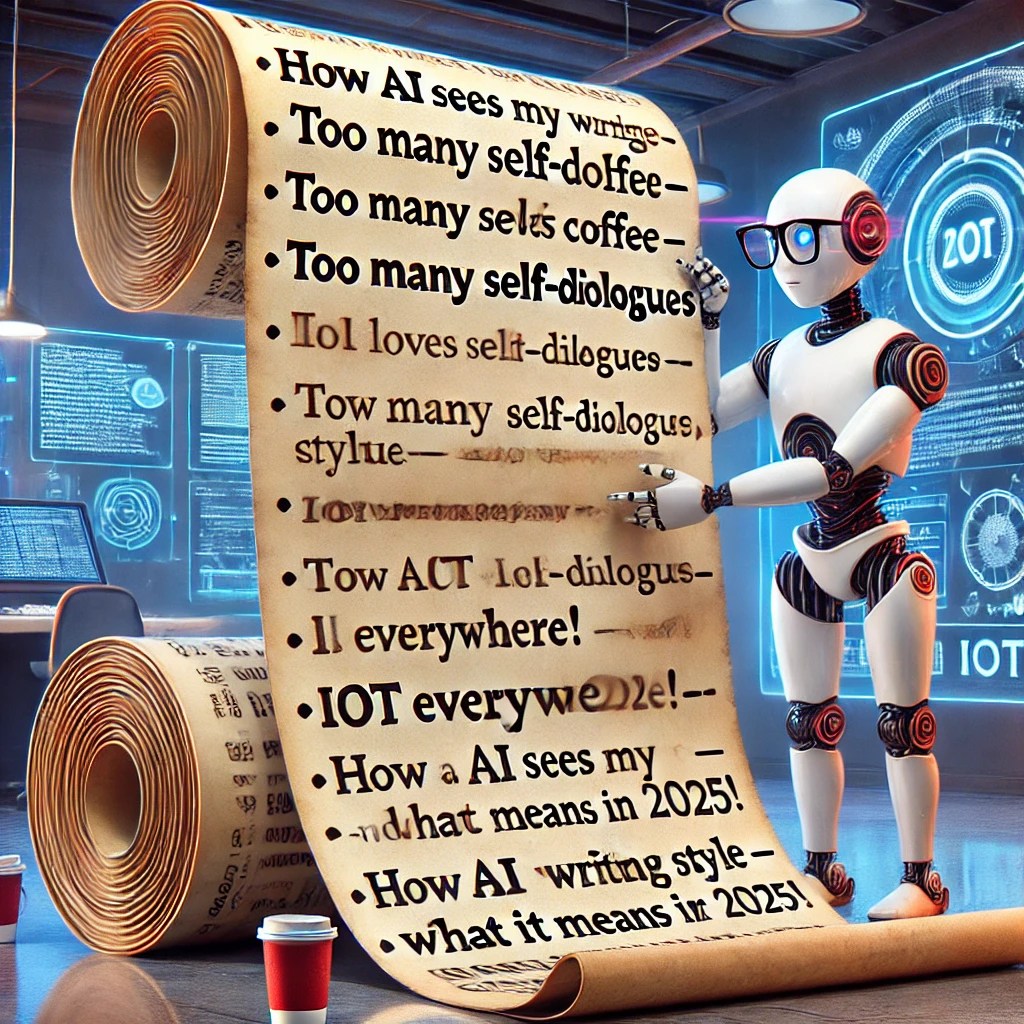
How AI Sees My Writing Style – And What It Means for 2025

“Do I really have a writing style?”

That question kept bouncing in my head as I stared at the AI analysis of my articles. I’ve always written instinctively—pouring out thoughts, reflecting on experiences, and hoping they resonate with someone out there. But now, with a year’s worth of writing analyzed, I can’t help but smile.

The verdict?

I’m a storyteller at heart. I thrive on conversations. Most importantly, I write for impact.

So, let’s break it down. What makes my writing style uniquely mine?

1. Storytelling is My Foundation

“You should start with a story.”

I remember hearing that advice long ago. At first, it felt unnecessary—why not just get straight to the point? But over time, I realized that stories bridge the gap between knowledge and understanding.

When I write about IoT, I don’t just list facts. I take readers on a journey, whether they’re entrepreneurs struggling to deploy smart city solutions or university students trying to commercialize an IoT project.

Take “Why Writing Is Like Running a Marathon” or “The Silent Struggles of Researchers”—I don’t just talk about endurance and challenges. I live through them in my writing.

Why it matters: Stories stick. They make abstract ideas tangible and personal.

2. Conversational and Relatable Tone

“Write as if you’re talking to a friend over coffee.”

That’s how I approach my articles. No stiff, robotic sentences. No excessive jargon. Just me, having a conversation with you.

Whether I’m sharing “How Medium Shaped My Voice” or “Why You Should Write From the Heart,” my goal is simple: I want you to feel like we’re just sitting together, chatting about life and ideas.

Why it matters: Readers don’t want to be lectured. They want a dialogue.

3. First-Person Perspective Brings Depth

“Why do you always write in first person?”

Because it’s real. Because it’s personal. Because I believe the best way to inspire is by showing—not just telling.

If I write about IoT projects in universities or my journey in the corporate world, I’m not giving a third-person analysis. I’m sharing my experiences, lessons, and mistakes.

Why it matters: It builds trust. Readers connect with people, not abstract ideas.

4. Structure Matters – A Lot

“Make it easy to read.”

Long, unbroken paragraphs? No thanks. My articles are structured with clear sections, subheadings, and logical flow.

If I’m explaining “5 Lessons I Learned About Writing” or “How Favoriot Empowers IoT System Integrators”, I want you to get value fast.

Why it matters: Clarity keeps people reading. A good article doesn’t feel like work—it flows effortlessly.

5. Motivation and Inspiration Are My Hidden Ingredients

“People don’t just read for information. They read for inspiration.”

When I wrote “Why Persistence in Writing Matters” or “Every Failure Was a Step Toward Success”, I wasn’t just telling stories. I was giving hope.

I know what it’s like to feel stuck. To feel like no one is listening. To wonder if your efforts are even worth it. But every challenge I’ve faced has led me somewhere better. That’s the message I want to leave behind.

Why it matters: Inspiration fuels action.

6. Versatility Without Losing Identity

“Do you only write about IoT?”

No. And I never will.

My interests are broad—entrepreneurship, technology, personal growth, writing—but my voice remains the same. Whether discussing IoT’s future or writing a letter to my future self, it still feels like me.

Why it matters: A consistent voice makes a writer memorable.

7. Emotion and Logic Go Hand in Hand

“Facts alone don’t convince people. Emotions do.”

When I wrote “How Responding to Comments Boosted My Writing Output,” I didn’t just provide statistics. I also shared how engaging with readers felt —the excitement, the connections, the motivation.

Then, I supported my argument with logic—why engagement matters, how it impacts visibility, and what writers can do to grow.

Why it matters: The best articles engage both heart and mind.

8. Analogies and Metaphors Make Everything Click

“Explain it like they’re five.”

If I say, “Writing is like running a marathon,” you immediately understand endurance is key. If I say, “A Medium writer is like a badminton player,” you get that consistency and technique matter.

I use analogies because they simplify complexity. IoT, AI, writing—whatever the topic, if I can compare it to something familiar, it becomes easier to grasp.

Why it matters: Analogies make learning fun and effortless.

9. Audience-Centric Writing

“Who am I writing for?”

Every article I write answers a question or solves a problem.

Whether it’s “Why You Should Not Give Up Writing” or “How Favoriot Empowers IoT System Integrators”, my focus is always: How can this help the reader?

Why it matters: Readers stay loyal when they feel seen and understood.

10. Learning and Growing Through Writing

“Writing is my best teacher.”

I reflect a lot in my articles.

From “Lessons Learned in My 13-Year Telco Career” to “My Journey of Writing 550 Articles on Medium”, I use my past as a learning tool. I talk about mistakes, breakthroughs, and the evolution of my thoughts.

Why it matters: Growth is relatable. Readers appreciate honesty.

What This Means for 2025

Seeing this breakdown made me realize one thing—I love writing.

And in 2025, I’ll write even more.

✔ More stories that resonate.
✔ More conversations that connect.
✔ More insights that inspire.

If AI says my writing has an impact, I owe it to myself (and my readers) to keep going.

Because at the end of the day, writing isn’t just about putting words on a page.

It’s about sharing experiences, shaping perspectives, and leaving a legacy.

Here’s to another year of storytelling.

The Story Behind Favoriot – Part 4: How Favoriot Became More Than Just an IoT Platform

I never planned for Favoriot to be more than just an internal tool.

Back when we first started developing the platform, it was purely out of necessity. We weren’t thinking about commercializing it. We just needed a reliable way to manage IoT data, and the existing platforms? They just didn’t cut it. Too rigid, too limited, and definitely not built with our specific needs in mind.

So, we decided to build our own.

I still remember that moment vividly—one of those late-night discussions with my team, fueled by frustration and too much coffee.

“Why are we wasting time forcing a square peg into a round hole?” I said. “Let’s just create something that actually works for us.”

And just like that, Favoriot was born.

At first, it was just for us—a solution to our own headaches. We never imagined it would one day be used by universities, students, or businesses. That wasn’t even on our radar. But then, something kept bothering me.

The Eye-Opener: Why Are We Using Foreign Platforms?

Every time I gave an IoT lecture at a university, I saw the same thing. Students were using foreign platforms like ThingSpeak and Blynk.

At first, I brushed it off. But then, it hit me—why were we relying so much on platforms from outside Malaysia? Didn’t we have something just as good, if not better?

That thought gnawed at me for weeks.

“We have this amazing platform,” I told my team. “Why aren’t we making it available to students and researchers here?”

The more I thought about it, the more sense it made. If we could offer Favoriot as a local alternative, students wouldn’t have to rely on foreign tools. So, I started introducing it in my lectures, offering free access to encourage students to use it in their projects.

I was optimistic. Maybe a little too optimistic.

The Harsh Reality: No One Was Interested

Despite our efforts, students weren’t biting. They continued using ThingSpeak and Blynk. I couldn’t figure it out.

“What are we doing wrong?” I asked myself.

Then it hit me—content.

Those platforms had an overwhelming amount of learning resources. Tutorials, YouTube videos, step-by-step guides. Everything a beginner needed was right at their fingertips.

Favoriot? Not so much.

It wasn’t that students didn’t want to use our platform; they just didn’t know how. Without accessible tutorials, they naturally gravitated toward platforms with a smoother learning curve.

That realization stung.

Taking Matters Into My Own Hands

At first, I thought, Maybe I can get students to create tutorial videos.

Wrong.

Most weren’t comfortable putting themselves out there as content creators. And honestly, I understood. It’s not easy to create educational content, especially when you’re just starting.

So, I made a decision.

“If no one else is going to do it, then I will.”

We started producing our own YouTube tutorials, pushing Favoriot on TikTok, and making the platform more accessible. It wasn’t easy, and it took time, but I knew it was the only way forward.

At first, progress was slow.

I had my doubts.

Is this even worth it? Are we just shouting into the void?

But I held on. If I’ve learned anything from this journey, it’s that persistence pays off.

The Turning Point: From Struggle to Recognition

Bit by bit, Favoriot started gaining traction. More students began using it, and word started to spread. But the real breakthrough? That came when external organizations started noticing us.

Suddenly, Favoriot wasn’t just an educational tool—it was being used in agriculture, industry, smart cities, and security systems.

I remember watching it all unfold, feeling both humbled and proud.

“Alhamdulillah,” I whispered. But deep down, I knew—this was just the beginning.

We didn’t stop there. We worked on differentiating Favoriot, adding unique features that platforms like ThingSpeak and Blynk didn’t offer. We weren’t just another IoT platform anymore. We were a better IoT platform.

What’s Next?

The journey hasn’t been easy. We’ve faced rejection, setbacks, and moments of self-doubt. But every challenge has taught us something valuable.

And this story? It’s far from over.

In Part 5, I’ll dive deeper into the specific challenges we faced, the roadblocks we overcame, and the key moments that shaped Favoriot into what it is today.

The best is yet to come.

More Stories About Entrepreneurship

  1. The Story Behind Favoriot – Part 6: Expanding The Business Models
  2. The Story Behind Favoriot – Part 5: Finding the Right Fit
  3. The Story Behind Favoriot – Part 4: How Favoriot Became More Than Just an IoT Platform
  4. The Story Behind Favoriot – Part 3: Why No One Wanted Our IoT Platform—And How We Turned It Around
  5. The Story Behind Favoriot – Part 2: Turning Failures into Milestones
  6. The Story Behind Favoriot – Part I: The Humble Beginnings of Favoriot
  7. Building My Personal Brand: The Stepping Stone to Favoriot’s Success
  8. From Research Lab Critiques to Startup Pitches: My Slide Story
  9. The Illusion of RFPs in the IoT World: Managing Expectations as a Startup
  10. Favoriot’s Odyssey: Navigating the Rough Waters of Early Revenue

Are You a Digital Immigrant? Who Are They?

Do you remember when we used a typewriter to prepare a document, or did listening to music mean carefully rewinding a cassette tape?

I do. Those were simpler times, but they were also incredibly different from the fast-paced, tech-driven world we live in now. People like me, born in an era before the internet and smartphones, are often called digital immigrants—individuals who grew up in the analogue world and had to adapt to the digital age.

Let’s explore what it means to be a digital immigrant and why this generation holds a unique place in today’s technology-driven society.

What Does It Mean to Be a Digital Immigrant?

A digital immigrant wasn’t born into a world filled with digital gadgets but has learned to navigate and adapt to these tools as they became part of everyday life. I’ve lived through this shift, and let me tell you—it wasn’t always easy, but it was fascinating.

We grew up with analogue technology: rotary phones, VHS tapes, handwritten letters, and physical maps. Then, one day, the internet arrived. Email replaced letters, mobile phones replaced landlines, and everything started going online. It felt like entering a new world.

The Traits of Digital Immigrants

So, what defines us as digital immigrants? Let me share a few observations:

1. Adapting to New Technology

When computers became the norm, I had to learn how to use them from scratch.

I still remember how intimidating it was to figure out the commands on MS-DOS or how exciting it was when Windows introduced a graphical interface. Today, I can confidently use all kinds of tech tools, but the learning process was gradual and required patience.

2. Fondness for Analog Methods

Despite embracing the digital world, many of us still feel a sense of nostalgia for analogue methods. For instance, I still prefer jotting notes in a physical notebook rather than typing them on my phone.

There’s something satisfying about the tactile experience that digital just can’t replace.

3. Bridging Two Generations

We’re in a unique position—we can relate to both the older generation that struggles with technology and the younger generation that seems to know how to use a smartphone before they can even talk.

This makes us valuable in workplaces and communities because we can act as a bridge between these two worlds.

4. The Constant Learner

Learning never stops. Every new app, software, or device is an opportunity to grow. Sure, it can be frustrating at times, but adapting to change is what keeps us relevant and connected.

Challenges Along the Way

Being a digital immigrant isn’t always easy. I’ve faced my share of challenges, and I’m sure many others have, too.

1. Keeping Up with Rapid Advancements

Technology evolves so quickly. By the time you master one tool, another one is released. I’ve spent countless hours figuring out how to use new platforms like social media, cloud storage, or even AI tools like ChatGPT.

2. Initial Resistance

There’s always that initial hesitation when encountering something unfamiliar. I remember when smartphones first became popular—I thought, “Do I really need a phone that’s more than just a phone?” Fast forward to today, and I can’t imagine life without one.

3. Generational Divide

Sometimes, interacting with younger generations can feel like they’re speaking a different language. They grew up with technology, so they took things for granted that I had to work hard to learn. But instead of feeling left out, I’ve found that collaboration is key. They teach me about new trends, and I share my perspective with them.

Why Digital Immigrants Matter

Despite these challenges, digital immigrants are incredibly valuable in today’s world. We bring a unique blend of experiences that no other generation can replicate.

Adaptability

Having grown up in one era and learned to thrive in another, we’re proof that people can adapt to change at any age.

Appreciation for Both Worlds

We’ve experienced the best of both analogue and digital. We know the value of a handwritten letter and the convenience of an email. We cherish the past but embrace the future.

Wisdom and Perspective

Our life experiences allow us to approach technology thoughtfully. We don’t adopt trends just for the sake of it; we think about how they can truly make a difference.

The Future of Digital Immigrants

As I continue to learn and grow in this digital era, I’ve realised that being a digital immigrant isn’t about competing with younger, tech-savvy generations. It’s about finding your place in a world where change is constant. It’s about being curious, open-minded, and willing to adapt.

To my fellow digital immigrants: don’t let technology intimidate you.

Take your time, ask questions, and keep exploring. Remember, we’re living proof that it’s never too late to learn something new.

The journey from analogue to digital has been a wild ride, but it’s one I wouldn’t trade for anything.

What about you? How has your experience as a digital immigrant shaped your view of the world today?

Share your thoughts—I’d love to hear them!

Examples of IoT Applications and Their Benefits

Today, look at some real-world examples of IoT applications and their benefits.

This diagram focuses on two industries—transportation and logistics and Oil and gas —to illustrate how IoT solutions can reduce costs and improve efficiency. Let’s examine each example in detail.

Based on the eBook — IoT Notes by Mazlan Abbas

1. Transportation & Logistics

In this industry, IoT solutions are used to improve the management of vehicles and delivery systems.

IoT Solution:

  • Sensors are installed in vehicles to provide real-time data on their state and performance.
  • These sensors report on engine health, location, and delivery progress.

Benefits (Payback):

Cost Savings:

  • Reduces truck operation and delivery costs by identifying and addressing maintenance issues early.
  • Minimises fuel consumption by optimising delivery routes.

Improved Efficiency:

  • Reduces delivery disruptions and delays.
  • Ensures on-time deliveries and improves overall logistics system performance.

Example in Action: A logistics company uses IoT-enabled fleet management to track delivery vehicles and proactively schedule maintenance, avoiding breakdowns and saving costs.

2. Oil & Gas

The Oil & Gas industry faces unique challenges that IoT can address by enhancing safety and efficiency.

IoT Solution:

  • Sensors are deployed throughout an oil rig to monitor critical components.
  • These sensors detect potential issues and provide operators with real-time alerts.

Benefits (Payback):

Cost Savings:

  • Increases safety by providing early and reliable warnings of potential equipment failures.
  • Prevents costly shutdowns by identifying problems before they escalate.

Improved Efficiency:

  • Real-time alerts enable quicker responses, reducing downtime and improving time-to-revenue.
  • Enhances asset utilisation by ensuring equipment operates optimally (4x improvement).
  • Complete data analysis allows for near real-time decision-making and operational adjustments.

Example in Action: An oil rig uses IoT sensors to monitor drill performance and prevent malfunctions, ensuring smoother operations and faster oil extraction.

Key Takeaways

IoT in Transportation & Logistics:

  • Reduces costs and enhances delivery efficiency through real-time monitoring of vehicles.

IoT in Oil & Gas:

  • Improves safety, reduces downtime, and maximises asset utilisation with real-time alerts and analysis.

Final Thought:
IoT transforms industries by providing actionable data that saves money and improves efficiency. These examples show how IoT can adapt to specific industry needs and bring measurable benefits.

Discussion Question: Which other industries do you think can benefit from similar IoT solutions? Let’s brainstorm together!

[Download IoT Notes eBook for FREE]

Reasons to Consider IoT

IOT NOTES

Lecture Notes

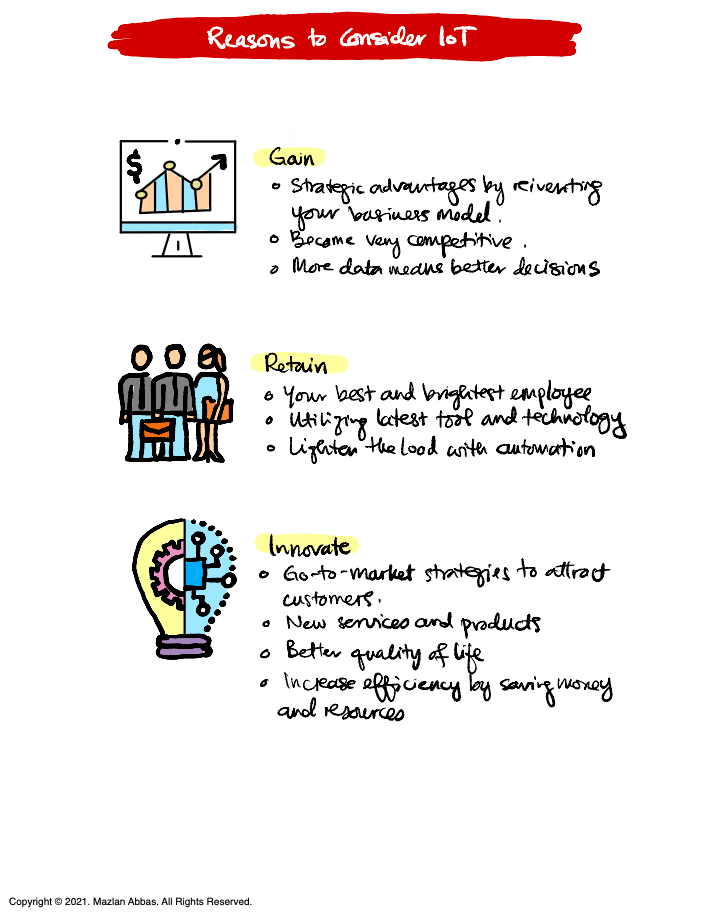
Today, we’re going to discuss the key reasons why organisations should consider adopting IoT (Internet of Things).

The diagram highlights three main benefits: Gain, Retain, and Innovate. Let’s go through each of these in a simple and structured way.

1. Gain

The first reason to consider IoT is the opportunity to gain strategic advantages and stay competitive in the market.

Strategic Advantages: IoT allows businesses to reinvent their business models, offering smarter, data-driven services.

  • Example: A retail store using IoT to track customer preferences and improve in-store experiences.

Become Competitive: By adopting IoT, businesses can stay ahead of competitors who are slow to embrace technology.

  • Example: A logistics company using IoT sensors to optimise delivery routes.

Data-Driven Decisions: IoT provides real-time data, which helps in making better decisions faster.

  • Example: A manufacturer monitoring equipment performance to reduce downtime.

2. Retain

The second reason is about retaining the best employees and maintaining operational efficiency.

Attract and Retain Talent: Employees prefer organisations that use the latest tools and technology to make their work easier and more efficient.

  • Example: Providing engineers with IoT-enabled tools to monitor and control operations remotely.

Ease Workloads with Automation: IoT automates repetitive tasks, allowing employees to focus on higher-value activities.

  • Example: Smart systems in a factory automatically managing inventory levels.

When employees feel supported by modern technology, they are more likely to stay with the organisation.

3. Innovate

The third and perhaps most exciting reason is the ability to innovate with IoT.

Go-to-Market Strategies: IoT enables businesses to develop new strategies to attract and retain customers.

  • Example: A car rental company using IoT for keyless entry and real-time vehicle tracking.

New Products and Services: IoT opens doors to create entirely new offerings that improve the customer experience.

  • Example: Wearable health trackers offering personalised fitness insights.

Better Quality of Life: For individuals and society, IoT can enhance convenience, safety, and overall well-being.

  • Example: Smart homes with automated lighting and security systems.

Efficiency and Savings: IoT reduces costs by optimising resources and processes.

  • Example: Smart irrigation systems saving water in agriculture.

Key Takeaway

The main takeaway is simple: IoT is not just about adopting technology — it’s about creating value by:

  1. Gaining a competitive edge.
  2. Retaining top talent and improving efficiency.
  3. Innovating to improve products, services, and quality of life.

IoT is the key to staying relevant in today’s fast-changing world.


Let’s discuss: Which of these reasons resonates most with your business or personal goals? How can IoT help you achieve them? Let’s explore together!

[Download the FREE eBook— IoT Notes by Mazlan Abbas]

Building IoT Using the 3-Question Approach

Today, we will explore a structured way to implement IoT projects called the 3-Question Approach (W-W-H). This approach revolves around asking three key questions: What? Why? How?

Let’s review each step to understand how this framework ensures clarity and direction for IoT solutions.

Based on the eBook — IoT Notes by Mazlan Abbas

1. What? (Problem Statement)

The first question is What? which helps us identify the problem we’re trying to solve.

Purpose: To uncover the actual pain points or gaps in current processes.

Steps:

  • Look for inefficiencies or challenges in operations.
  • Identify areas where IoT can provide value.

Examples:

  • Low production rates in a factory.
  • Increasing operational costs.
  • Poor quality control leads to defects.
  • Safety incidents in a workplace.
  • Intermittent services in logistics or delivery.

Understanding the problem is the foundation of any successful IoT project.

2. Why? (Objective & End Goal)

Next, we ask Why?, which focuses on the objective and the end goal of the IoT implementation.

Purpose: Clearly define what you want to achieve and align everyone toward that goal.

Steps:

  • Get buy-in from stakeholders by explaining the benefits.
  • Ensure the outcome can be monitored and measured effectively.

Examples of Objectives:

  • Improve logistics and delivery efficiency.
  • Reduce operational costs.
  • Enhance asset utilisation and reduce errors.
  • Boost overall safety and performance.

Defining the “why” ensures a clear purpose behind the IoT deployment.

3. How? (Solutions)

The final question is How? which focuses on the solutions to address the problem and achieve the goals.

Steps:

Use the DNA approach:

  • D — Device: Identify the right sensors to collect the required data.
  • N — Network: Choose a suitable network for connectivity (e.g., Wi-Fi, LoRa, 5G).
  • A — Applications: Develop platforms (mobile or web) to process and display the data.
  • Decide on an implementation strategy:
  • Build in-house.
  • Operate internally.
  • Outsource to a third party.
  • Collaborate with partners.

Examples of Solutions:

  • Install sensors to monitor production lines in real time.
  • Ensure the network has sufficient coverage and can handle the amount of data.
  • Develop mobile or web applications to provide actionable insights.

The “how” ensures the project is feasible and actionable.

Key Takeaway

The 3-Question Approach provides a clear path for implementing IoT solutions:

  1. What? — Define the problem.
  2. Why? — Establish the objective.
  3. How? — Develop the solution.

This framework ensures every IoT project is focused, aligned, and effective. Think big, but start small.


Let’s discuss: Can you think of an example where this approach could be applied in your industry or daily life? What “What-Why-How” steps would you take? Share your thoughts!

[Download FREE IoT Notes by Mazlan Abbas]

Building IoT with the 3-Step Approach

Lecture Notes

Today, we will explore a simple and practical framework for implementing IoT projects: the 3-Step Approach.

This method ensures a smooth and effective rollout by focusing on small steps, integration, and innovation. Let’s break it down step by step.

Step 1: Think Big, Start Small

The first step is to start with a clear vision (think big) but begin with a small, focused project to gain momentum.

Develop a Small Application: Identify one specific problem and build a targeted solution.

  • Example: A smart thermostat to monitor energy usage in one building rather than an entire campus.

Deliver Immediate Impact: The solution should show quick results to build confidence in IoT’s value.

Mindset Transformation: This small success shifts how people perceive IoT and its potential.

Get Buy-In from Leadership: Demonstrating early results helps secure support from decision-makers like the C-suite executives for future projects.

Step 2: Integrate

Once the initial IoT solution proves its value, it is integrated into the broader system.

Connect to Legacy Systems: Ensure the new IoT solution works seamlessly with existing infrastructure, such as ERP systems or older databases.

  • Example: Integrating smart sensors into a factory’s traditional production line.

Seamless Workflow: Avoid disrupting operations by designing smooth processes between old and new systems.

Break Silos: Encourage collaboration between departments to maximise the benefits of IoT across the organisation.

This step ensures that IoT doesn’t operate in isolation but becomes a part of the larger ecosystem.

Step 3: Innovate

The final step is to use IoT to drive innovation and create new opportunities.

Create New Workflows: Leverage IoT to optimise or redesign how work is done.

  • Example: Using real-time data from IoT sensors to automate maintenance schedules.

Test New Business Models: Experiment with different ways to generate revenue using IoT solutions.

  • Example: Offering predictive maintenance as a subscription service for customers.

Better Analytics and AI: Use advanced analytics and AI to unlock deeper insights from IoT data and automate decision-making.

This stage transforms IoT from a problem-solving tool into a driver for long-term growth and innovation.

Key Takeaway: Think Big, Start Small

The overall lesson is simple:

  1. Start with a big vision, but focus on small, impactful projects to get started.
  2. Build on early successes by integrating solutions into larger systems.
  3. Use IoT to innovate and create new opportunities.

This approach minimises risk, builds momentum, and ensures sustainable growth.


Let’s discuss: What small IoT applications can you think of to start with? How would you scale and integrate them into a more extensive system? Let’s brainstorm together!

[FREE IoT Notes to Download]

Simplest Reasons Why We Need IoT

Lecture Notes

Today, we’ll discuss why the Internet of Things (IoT) is becoming essential in our daily lives.

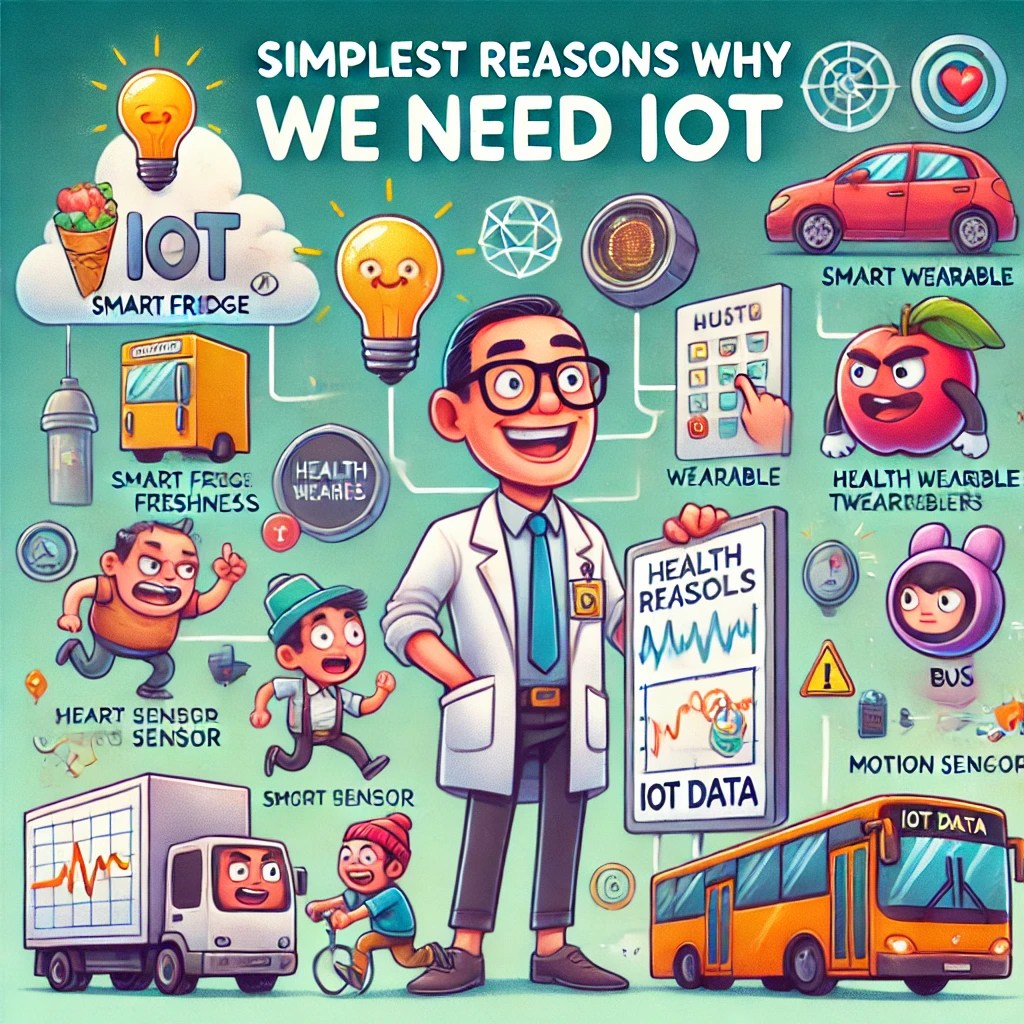
The diagram simplifies this concept by focusing on assets, how we connect them, and why sensing the environment is so important. Let’s break it down step by step.

1. What Are Assets?

Let’s start with a question: What do you consider as assets?
We value and want to monitor, track, or protect assets. These could include:

Goods:

  • We would like to know their location (e.g., where is my delivery?)
  • Or their quality (e.g., is the food shipment fresh?)

Health:

  • Monitoring our condition and ensuring safety are critical.
  • Example: A health wearable that tracks your heart rate and connects to a mobile app.

Transport:

  • Vehicles and public transportation must be tracked for location, routes, and utilisation.
  • Example: A bus fleet monitored for efficient route planning.

House Security:

  • Ensuring homes are safe by monitoring for intrusions or emergencies.
  • Example: A motion sensor that alerts you if there’s unusual activity.

2. The Core Need: Connecting Assets and Sensing the Environment

Why do we need IoT for these assets?
The key lies in sensing and connecting the environment around these assets.

  • In the past, we relied on manual monitoring and human input.
  • Today, we use sensors and applications to gather real-time data and automate processes.

3. How IoT Works

Sensors: Devices attached to assets to sense environmental factors like temperature or humidity.

  • Example: A sensor measuring the humidity in a storage facility for sensitive goods.

Communication: Sensors send this data to an IoT platform for processing and action.

  • Example: A sensor alerts the homeowner if the temperature inside the house drops below a certain threshold.

4. Examples of Other Assets

IoT can be applied to monitor a wide variety of assets, such as:

  • Machines: For predictive maintenance in factories.
  • Plants: To ensure optimal growth conditions in agriculture.
  • Water and Rivers: These are used to monitor pollution or water levels.
  • Environment: For tracking air quality and weather changes.
  • Buildings and Tunnels: For structural safety and efficiency.

5. Why IoT Is Essential

IoT provides us with the ability to:

  • Monitor assets in real time without human intervention.
  • Ensure safety and quality by automating alerts and responses.
  • Improve efficiency by making data-driven decisions.

Final Thoughts

The most straightforward reason we need IoT is to connect our assets and sense the environment effectively.

By doing so, we make life easier and ensure safety, efficiency, and better decision-making.

Let’s discuss: What assets in your life or work could benefit from IoT? How would you use sensors to improve them? Share your thoughts!

[FREE Download IoT Notes]

How IoT Impacts the 7 M’s of Business

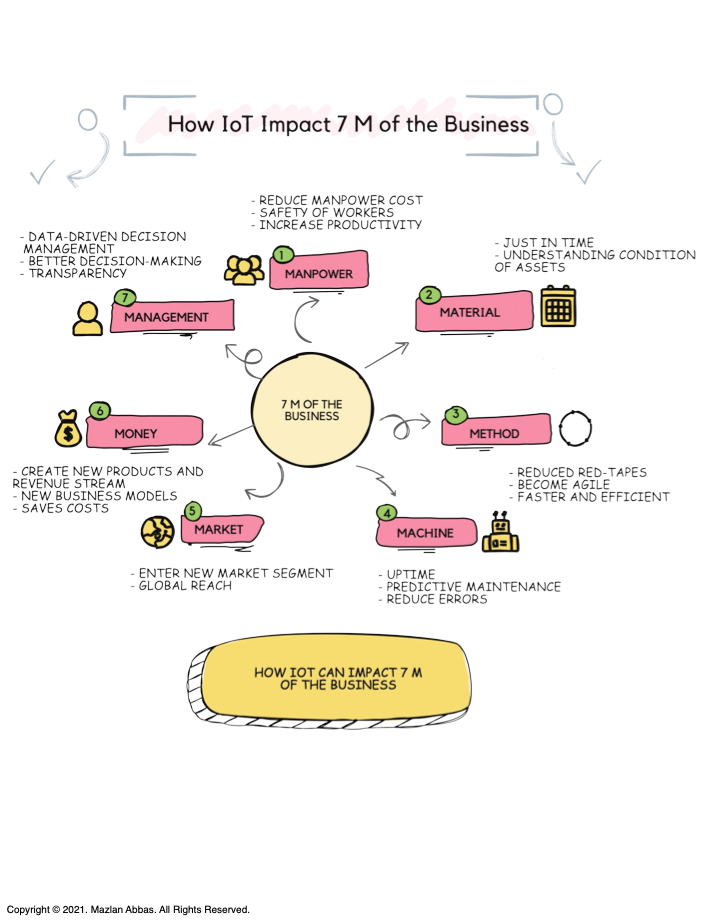
Today, we’ll explore how the Internet of Things (IoT) transforms the 7 M’s of business — key elements that drive an organisation’s operations and strategy.

These 7 M’s are Manpower, Material, Method, Machine, Market, Money, and Management. Let’s break down each one and see how IoT impacts them.

Based on the eBook — IoT Notes by Mazlan Abbas

1. Manpower

IoT helps businesses optimise human resources by reducing costs, improving safety, and increasing productivity.

Impact of IoT:

  • Cost Reduction: Automating repetitive tasks reduces the need for manual labour.
  • Worker Safety: IoT devices, such as wearables, can monitor health and alert workers to potential hazards.
  • Productivity: By enabling remote work and real-time communication, IoT allows employees to focus on high-value tasks.

Example: A construction company using wearables to monitor worker fatigue and ensure safety.

2. Material

IoT ensures better management of materials, improving supply chain efficiency and reducing waste.

Impact of IoT:

  • Just-In-Time Delivery: Sensors track inventory levels and automatically reorder materials when needed.
  • Asset Condition Monitoring: IoT devices monitor the condition of materials, ensuring quality and preventing spoilage.

Example: A warehouse using IoT sensors to track stock levels and ensure optimal storage conditions.

3. Method

IoT makes business processes more agile and efficient by simplifying methods.

Impact of IoT:

  • Reduce Red Tape: Automating workflows eliminates unnecessary administrative steps.
  • Agility: IoT enables businesses to respond quickly to changing conditions.
  • Efficiency: Processes become faster and more streamlined with IoT integration.

Example: A manufacturing plant automating quality checks with IoT sensors to speed up production.

4. Machine

IoT maximises the performance of machines, ensuring reliability and reducing downtime.

Impact of IoT:

  • Uptime: Predictive maintenance ensures machines are operational when needed.
  • Predictive Maintenance: IoT sensors detect issues before they become critical, preventing failures.
  • Error Reduction: Machines can self-correct or alert operators when errors occur.

Example: A factory using IoT-enabled machinery to monitor performance and schedule maintenance.

5. Market

IoT helps businesses expand into new markets and improve their customer reach.

Impact of IoT:

  • New Market Segments: IoT enables innovative products and services, opening new revenue streams.
  • Global Reach: Businesses can monitor and manage operations worldwide through IoT platforms.

Example: An IoT-enabled home security company entering international markets with smart security systems.

6. Money

IoT creates new revenue opportunities and reduces costs.

Impact of IoT:

  • New Revenue Streams: IoT drives innovation, leading to new services and products.
  • Cost Savings: Automating processes and improving efficiency reduces expenses.

Example: A logistics company saving fuel costs by using IoT to optimise delivery routes.

7. Management

IoT improves decision-making through data-driven insights.

  • Impact of IoT:
  • Data-Driven Decisions: Real-time data helps managers make informed choices.
  • Transparency: IoT provides visibility into all areas of the business.
  • Better Decision-Making: Analytics from IoT systems offer actionable insights.

Example: A retail chain using IoT to monitor sales trends and optimise inventory.

Key Takeaways

IoT has a transformative impact on the 7 M’s of business:

  1. Manpower: Reduces costs and improves safety.
  2. Material: Ensures quality and efficiency.
  3. Method: Simplifies workflows and increases agility.
  4. Machine: Enhances reliability and performance.
  5. Market: Expands opportunities globally.
  6. Money: Generates new revenue and reduces costs.
  7. Management: Improves decisions with real-time insights.

Discussion Question: Which of the 7 M’s most benefits from IoT in your industry? Let’s share ideas and examples!

{You can download the FREE eBook IoT Notes by Mazlan Abbas]

Types of Analytics

Today, we’ll discuss types of analytics and their importance in turning raw data into actionable insights.

This diagram shows four types of analytics, ranked by their difficulty level and the value they provide. Let’s go through them step by step.

Based on the eBook — IoT Notes by Mazlan Abbas

1. Descriptive Analytics: What Happened?

At the base of the analytics hierarchy is descriptive analytics. This is the simplest form of analytics and helps us understand what happened by interpreting historical data.

  • Purpose: To summarise past events and identify patterns.
  • Example: A smart thermostat that shows last week’s energy usage patterns.
  • Methods: Charts, graphs, and dashboards that clearly show past performance.

This type of analytics is great for reviewing the past, but it doesn’t tell us why something happened or what will happen next.

2. Diagnostic Analytics: Why Did It Happen?

Moving up, we have diagnostic analytics, which looks at why something happened. It’s more complex than descriptive analytics because it requires diving deeper into the data.

  • Purpose: To discover relationships and identify the causes behind past events.
  • Example: Analysing why a specific day’s energy usage was higher than average by correlating data with external factors like weather.
  • Methods: Data discovery, drill-down techniques, and correlation analysis.

This stage helps us make sense of the past by understanding the root causes of trends and anomalies.

3. Predictive Analytics: What Will Happen?

Next is predictive analytics, which focuses on forecasting future outcomes. This is where analytics becomes proactive rather than reactive.

  • Purpose: To predict what might happen based on current and historical data.
  • Example: A smart thermostat forecasting energy usage for the upcoming week based on weather patterns and past behaviour.
  • Methods: Statistical modelling and simulations.

By identifying trends and patterns, predictive analytics helps us make informed predictions.

4. Prescriptive Analytics: How Can We Make It Happen?

At the top is prescriptive analytics, the most advanced type. This involves predicting outcomes and recommending actions to achieve desired results.

  • Purpose: To decide the best course of action based on predictions.
  • Example: A smart thermostat automatically adjusting settings to save energy while maintaining comfort.
  • Methods: Machine learning and AI to analyse probabilities and make decisions.

Prescriptive analytics provides the highest value by enabling automated and data-driven decisions.

IoT and Analytics

This diagram also highlights how analytics works in an IoT platform:

  1. Sensors: Collect data from various sources like temperature, humidity, or movement.
  2. IoT Platform: Acts as a central hub to process and store the data.
  3. Analytics Engine: Applies these four types of analytics to generate insights and drive decisions.

Final Thoughts

Each type of analytics builds on the previous one, moving from simple data interpretation to actionable decisions. The value increases as we move up the hierarchy, as does the complexity.

Question to consider: Which type of analytics is most valuable in your industry, and how can you implement it effectively? Let’s discuss it!

[Note: Download IoT Notes by Mazlan Abbas ]