We Gave Our Favoriot IoT Platform Away for Free—Here’s What Actually Happened Next

A quiet, honest story about how Favoriot found its way

I remember the early days of Favoriot very clearly.
It started with a simple belief. If we make it free and easy, people will come. They will build. They will stay.

So we did exactly that.

We built the platform.
We opened the doors.
We told the world, “Come in. Try it. It’s free.”

And people did come. Students. Lecturers. Curious engineers. Friends I met during talks at universities. I would personally invite them. Sometimes I would even hand out complimentary access codes for a full year of the Beginner Plan.

I thought to myself, this is how adoption works.

But something felt off.

When subscribers were not really users

On paper, the numbers looked comforting.
Subscribers were growing. Accounts were created. Dashboards were viewed.

But deep down, I knew something was missing.

Why are so many accounts quiet?
Why do I see logins, but no devices connected?
Why do dashboards stay empty?

That was my first hard lesson.

A subscriber is not always a user.
And a user is not always a builder.

Many people came just to look around. They clicked. They browsed. Then they left. Some even won vouchers but never built a single IoT project.

It hurt a little. Not because of revenue. But because I wanted Favoriot to be used. I wanted it to matter.

The wrong assumption about behaviour

I used to think users would log in every day, tweak dashboards, run experiments.

Reality taught me otherwise.

A typical IoT builder behaves differently.

Once the device connects and the data flows, they step back. They look at the dashboard occasionally. They only return when something breaks or when the project evolves.

Students behave differently, too.

They come intensely during one semester. Final year project season. Late nights. Panic. Excitement. Then, silence.

And to make it harder, many of them already knew other platforms. Some popular. Some free. Some are recommended by seniors.

Favoriot was often an unfamiliar name.

So ,how do you enter the education space when choice is already wide open?

Teaching before selling

I stopped pushing plans and started focusing on learning.

We introduced public IoT training. Beginner. Advanced. Mastering IoT.
Lecturers started attending. Some became trainers themselves. They went back to their universities and taught students using what they learned.

That felt good.

Then we went a step further.

Professional certificates.
Either embedded into the curriculum or offered as short intensive training. Students could finish the course and receive a certificate, or sit for an exam and earn a more formal credential.

Interest grew. Enquiries came in.

But adoption was still slow.

Universities move carefully. Curriculum changes go through committees, boards, and senate meetings. Nothing moves overnight.

I had to learn patience.

Labs instead of just logins

That’s when we bundled everything.

Not just software.
Not just subscriptions.

We created labs.

An IoT Lab with devices, Beginner subscriptions, training, and ready-to-use kits like indoor air quality monitoring.

An AIoT Lab with more advanced tools. Edge devices. Developer Plan access. Machine learning features. Analytics. A space for research, experimentation, and deeper thinking.

Suddenly, Favoriot was no longer just a platform.
It became an environment.

That changed the conversation.

Why Favoriot stayed a platform, not an app

People sometimes ask me, why not make Favoriot simpler? Why not hide everything?

Because IoT is not simple.

If everything is hidden, nothing is learned.

Favoriot is a Platform-as-a-Service by choice. Builders can see the flow. Devices. Protocols. Data ingestion. Visualisation. Rules. Actions.

When something fails, they learn how to troubleshoot.

When they graduate, they carry understanding, not just button-clicking habits.

That’s the skill that survives in the real world.

The restaurant analogy that finally made sense

One day, while explaining our plans, I caught myself using a food analogy. And suddenly, everything clicked.

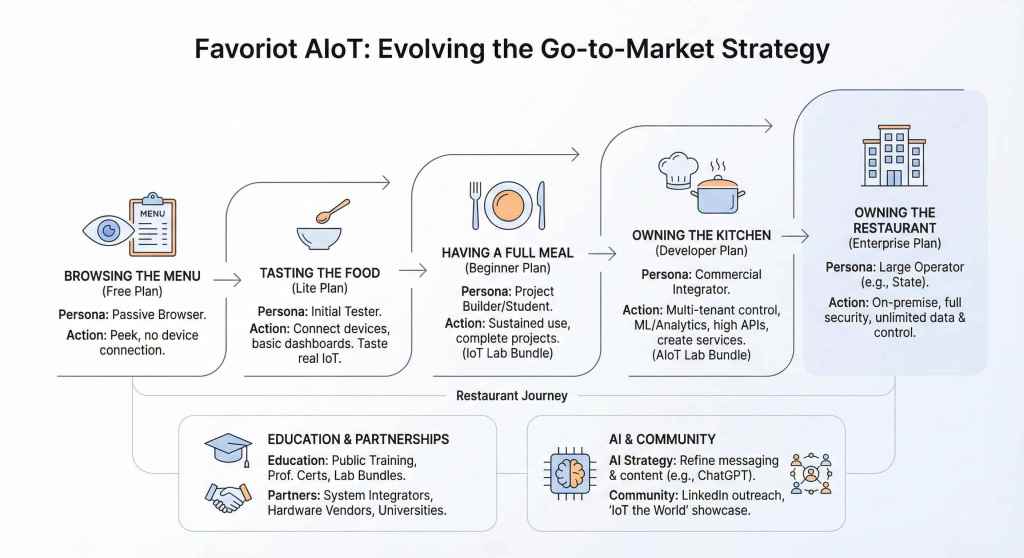
The Free Plan is peeking into a restaurant.
You look at the menu. You walk around. Then you leave.

The Lite Plan is tasting the food.
You sit down. You try a dish. You smile.

The Beginner Plan is a full meal.
You are satisfied. You build. You complete your project.

The Developer Plan owns the kitchen.
You cook. You create menus. You serve your own customers.

The Enterprise Plan owns the whole restaurant.
You decide everything. Security. Scale. Who gets served and how.

When I explained it this way, people finally nodded.

Overseas users and a quiet mystery

Here’s something that still amazes me.

Favoriot has users from more than 130 countries.
Yet most revenue comes from Malaysia.

How did they even find us?

Blogs.
E-books.
Social media posts.
YouTube. TikTok. Facebook groups.

They came. They explored. Most stayed free.

And that taught me another lesson.

Free users overseas were often explorers. Platform shoppers. Comparing interfaces. Looking around.

Not every visitor is ready to commit.

And that’s okay.

Personas matter more than pricing

Over the years, I stopped blaming pricing.

Instead, I studied personas.

Browsers.
Tasters.
Builders.
Integrators.
Operators.

Each one needs a different message.

Each one enters the journey at a different door.

And that was the missing piece all along.

Partners instead of long walks alone

I also realised something else.

We cannot do everything ourselves.

We do not have endless arms and legs to reach every market.

So we shifted.

System integrators.
Hardware partners.
Domain experts.
Universities.

They already speak the language of their customers. We just give them the kitchen.

That felt right.

AI as my late-night thinking partner

I will admit this honestly.

AI changed how I think.

When I was in corporate life, clarity came from meetings, workshops, and committees.

Today, clarity comes at night. Quietly. One question at a time.

I talk.
I reflect.
I get challenged.

Not every suggestion is usable. But every session sharpens my thinking.

Sometimes, you just need a friend who listens without ego.

Community as the long game

Lately, I spend more time on LinkedIn.

I see students from India proudly showing their projects. Some use other platforms. Some barely send data to the cloud.

I comment. I encourage. I invite.

“Try Favoriot.”
“Show us your project.”
“We will feature your story.”

Because visibility matters.

When builders are seen, they stay longer.

And when they grow, they remember.

This journey is still unfolding
Go-to-market favoriot

Favoriot did not arrive here overnight.
It took years of confusion, wrong assumptions, quiet learning, and small corrections.

But today, the path feels clearer.

Free curiosity has a place.
So does tasting.
So does building.
So does owning the kitchen.

If you are just browsing, welcome.
If you are ready to build, stay.
If you want to serve others, let’s talk.

And if you are a student building your first IoT project somewhere in the world, remember this.

The platform you choose today might become the one you trust tomorrow.

I would love to hear your thoughts.
Where are you in this journey?
Peeking, tasting, cooking, or running the whole place?

Leave a comment. Let’s talk.

Favoriot’s Journey: Lessons from Lord of the Rings

The journey of Favoriot, from its earliest days to where it stands today, mirrors The Lord of the Rings Trilogy in a way that feels less like fantasy and more like lived experience.

Not because of epic battles or dramatic villains, but because both stories are really about endurance, pivots, and choosing to continue when the original plan no longer fits the road ahead.

A Journey That Did Not Start With a Grand Map

When Frodo left the Shire, there was no detailed map to Mount Doom. Gandalf did not hand him a ten-year plan. The mission evolved as dangers revealed themselves.

Favoriot began the same way.

The early vision was simple. Build an IoT platform that works. One that local engineers, researchers, and institutions could rely on. What came next was not a straight line. The platform did not arrive fully formed. It grew through experiments, false starts, and product decisions that looked right at the time but later needed rethinking.

Like Middle-earth, the terrain kept changing.

Products as Paths, Not Destinations

In The Lord of the Rings, the Fellowship does not walk a single road. They split. They detour. Some paths fail. Others reveal their purpose much later.

Favoriot’s products followed the same rhythm.

Early versions focused heavily on basic device connectivity and dashboards. That was the Shire phase. Simple. Familiar. Necessary.

As real customers arrived, the needs shifted. Monitoring alone was not enough. Scale introduced complexity. Rules became more complicated to manage. Alerts became noisy. What worked for a pilot did not hold up in production.

That forced pivots.

  • From simple dashboards to structured data models
  • From manual rules to more intelligent behaviour detection
  • From pure IoT to AI-assisted decision support
  • From cloud-only thinking to edge-aware architectures

Each pivot felt like leaving a known path and stepping into uncertainty. Some features were retired quietly. Others were reshaped instead of discarded. Just as characters outgrow their early roles, products evolve because the journey demands it.

The Cost of Carrying Too Much

Frodo’s burden was not the distance. It was the Ring.

For Favoriot, the “Ring” often took the form of technical debt, early assumptions, and customer expectations set too soon. Decisions made for speed later demanded patience to untangle. Features built for one market created friction in another. Supporting early users while reworking the core tested both systems and people.

Letting go was hard.

Just as Frodo struggled to release the Ring, teams struggle to let go of products they worked hard to build. Yet progress required accepting that not everything belongs in the final version.

Splitting the Fellowship to Survive

The Fellowship did not stay together because it looked nice. It split because survival required it.

Favoriot’s journey did the same. Engineering focused on stability, while product teams listened closely to users. Business teams dealt with timing, cash flow, and long sales cycles. Partnerships opened doors while internal teams strengthened the foundation.

At times, it felt fragmented. In reality, it was a focus.

Each group carried a different part of the burden. No single team saw the whole picture at all times. Trust became the glue.

Long Stretches Without Applause

Middle-earth did not pause to celebrate milestones. Neither did the market.

There were long periods where progress was invisible from the outside. No launches. No announcements. Just refactoring, rewriting, rebuilding. Customers rarely see this phase, yet it defines whether a platform survives.

Favoriot lived in this space for years.

Quiet work. Fewer shortcuts. Many trade-offs. The kind of progress that feels slow until one day it becomes evident that the platform is stronger, calmer, and more reliable than before.

When the Mission Changes the People

By the end of the trilogy, Frodo was not chasing adventure. He was carrying wisdom earned through pain and persistence.

Favoriot’s journey shaped its people the same way.

Engineers learned restraint, not just speed. Product teams learned when to say no. Leaders learned that timing matters as much as vision. The company knew that building trust outlasts chasing trends.

The platform today is not just more capable; it is also more capable. It is more deliberate.

Not Glory, But Completion

Destroying the Ring was not a victory parade. It was relief. Completion.

Favoriot’s goal has never been to build everything or to shout the loudest. It has been to finish what was started. A platform that can grow with its users. A system that learns instead of overwhelming. A foundation that can support the next chapter without collapsing under its own weight.

That goal shaped every pivot.

The Quiet Parallel

Frodo was not the strongest.
Favoriot did not have the most significant budget.
Neither took the shortest route.

Yet both stories prove the same point.

Lasting impact rarely comes from perfect plans. It comes from adjusting without losing purpose, letting go without giving up, and continuing to walk when turning back feels easier.

That is the shared truth between Middle-earth and Favoriot’s journey.
A long road.
Many pivots.
One mission that refused to be abandoned.

Favoriot: AI Agents Not Needed Now

Do Favoriot need to develop an AI Agent feature?

Short answer? No, Favoriot does not need full AI Agent automation right now.

And yes, what you have today is more than enough for the market you are serving.

Let me explain this the way I usually reason with myself.

I asked myself this quietly

“Do customers really want systems that act on their own…

or do they want systems they can trust?”

When I sit with city operators, facility managers, engineers, or even researchers, one thing keeps coming up.

They are not asking for autonomy.

They are asking for clarity.

They want fewer surprises.

They want earlier signals.

They want confidence before taking action.

That matters.

What Favoriot already does well

Right now, Favoriot Intelligence does something very important and very rare.

It learns patterns from real operational data

It surfaces what looks unusual

It feeds those insights into a Rule Engine

And then… it stops

That stopping point is not a weakness.

It is a design choice.

The system says,

“Here is what changed.

Here is why it matters.

You decide what to do next.”

That is precisely where trust is built.

Rule Engine + ML is not a compromise

Some people frame this as:

“Rule Engine now, AI Agents later.”

I don’t see it that way.

I see it as:

ML decides what deserves attention

Rules decide what action is allowed

This separation is powerful.

Why?

Because rules are:

  • Auditable
  • Explainable
  • Governable
  • Aligned with SOPs and regulations

And ML is:

  • Adaptive
  • Pattern-driven
  • Good at spotting drift and anomalies

Together, they form a human-in-the-loop intelligence system, not a black box.

That is exactly what enterprises and public sector teams are comfortable with today.

Do customers actually want AI Agents?

Here’s the uncomfortable truth.

Most organisations say they want AI to “automate everything”.

But when you ask one more question…

“Are you okay if the system shuts down equipment on its own?”

“Are you okay if it triggers evacuation automatically?”

“Are you okay if it changes operating parameters without approval?”

The room goes quiet.

What they really want is:

  • Earlier warnings
  • Better recommendations
  • Fewer false alarms
  • Less manual rule tuning

Favoriot Intelligence already delivers that.

Where AI Agents actually make sense later

I’m not against AI Agents. Not at all.

But their place is conditional, not universal.

AI Agents make sense when:

  • Policies are mature
  • Actions are reversible
  • Risk is low
  • Trust has been earned over time

For example:

  • Automated report generation
  • Recommendation ranking
  • Suggesting rule adjustments
  • Proposing actions for approval

Notice the word: suggesting, not executing.

That is a natural evolution path.

Not a starting point.

Strategically, Favoriot is in the right place.

By keeping:

  • ML for learning and insight
  • Rules for control and action

Favoriot positions itself as:

  • Reliable
  • Safe
  • Deployable today
  • Acceptable to conservative sectors

Smart cities.

Utilities.

Campuses.

Critical infrastructure.

These sectors do not reward “full autonomy” first.

They reward predictability and confidence.

My honest conclusion

If I had to answer this as simply as possible:

Favoriot does not need AI Agents to be valuable.

Favoriot Intelligence with ML-driven rules is already the right solution for today.

AI Agents can come later, carefully, selectively, and with guardrails.

Right now, Favoriot is doing something more important than automation.

It is helping people think earlier, not react later.

And that, in my book, is real intelligence.

Reflecting on a Grounded 2025: Lessons from Favoriot’s Journey

I am writing this ten days before 2025 comes to an end.

When I look back at the year, it does not feel loud. It does not feel dramatic. It feels focused. Demanding. Grounded. A year where most of my time, energy, and thinking revolved around one thing only: Favoriot.

If I am being honest, 2025 was not a year of balance. It was a year of commitment.

Most of my days were spent at the office. And when I was not physically there, my mind was still working on Favoriot. Nights. Weekends. Quiet moments that could have been rest often turned into planning or problem-solving. I did not spend much time on myself personally. There were no real holidays. The only breaks I had were during overseas business trips, and even then, work followed me closely.

I told myself more than once, This is not a sacrifice. This is a choice.

And I am at peace with that choice.

Fewer Invitations and a Shift in How We Connect

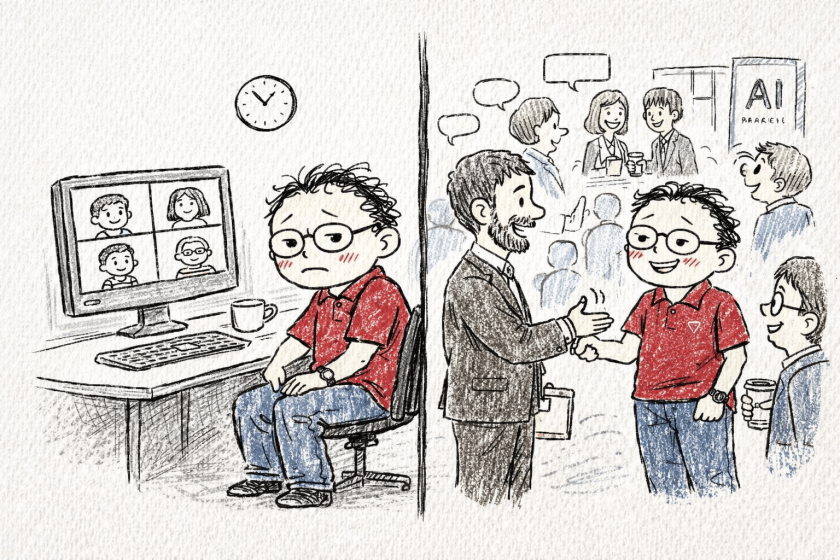
One noticeable change in 2025 was the drop in invitations from universities and public conferences. Many engagements that used to be physical moved online. Meetings became links. Conversations became scheduled time slots on screens.

I realised something about myself quite clearly this year.

I do not enjoy online meetings anymore.

They are convenient, but they remove the human layer. The casual chats before meetings start. The spontaneous conversations after sessions end. The subtle signals that build trust faster than formal presentations ever can.

I still prefer face-to-face meetings. They feel more honest. Better for networking. Better for understanding people beyond their titles.

Public conferences were fewer as well. Part of it could be the current spotlight on AI. IoT felt quieter this year, almost like it had stepped back from centre stage. I was not bothered by it. I was observant.

Trends move quickly. Real work moves steadily.

Why Panel Sessions Still Matter to Me

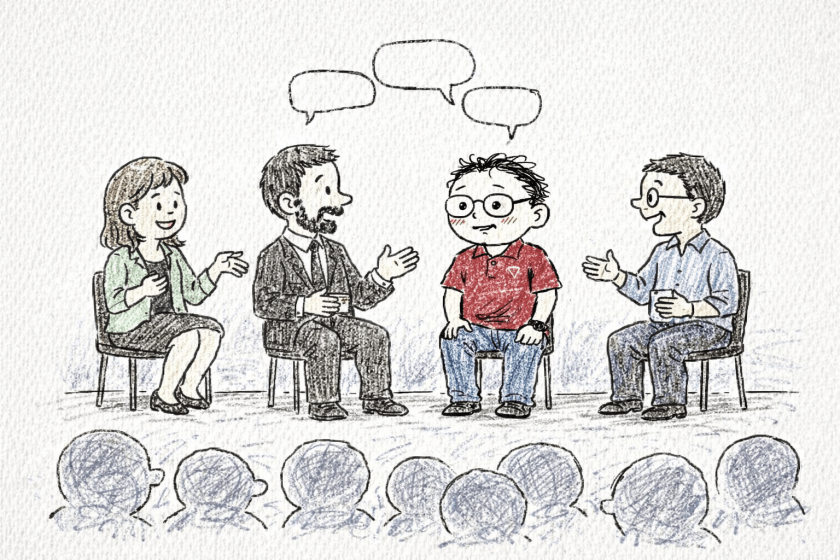
While formal speaking invitations slowed, one format still felt right to me: panel sessions.

No slides. No heavy preparation. Just conversations.

Sitting on stage, exchanging views, listening, responding, sometimes disagreeing politely. That feels closer to how decisions are made in real life.

I often think that insight shows up better in dialogue than in bullet points.

That belief stayed strong in 2025.

A Year Focused on Partnerships

Behind the scenes, 2025 was anything but quiet.

We spent a significant amount of time building partnerships. By the end of the year, we had signed MOUs with more than 40 partners across 15 countries. Our original target was 25 countries, so on paper, we fell short geographically.

But numbers do not tell the whole story.

I have learned that more partners do not automatically mean more revenue or more projects. Partnerships only matter when they are actively engaged, aligned, and nurtured.

Signing is easy. Building trust takes time.

Some partnerships moved faster. Some are still warming up. Some will likely take longer to show results. That is the nature of building across borders.

This year reminded me that ecosystems are built patiently, not collected quickly.

When People Find You on Their Own

One encouraging pattern this year was how people and companies started approaching us unexpectedly.

Each time, I asked the same question. “How did you find us?”

The answer was often simple. They searched online. They did their own research. They were surprised to discover an IoT platform company operating from this region.

That always made me pause.

Years of writing, sharing, and building quietly compound over time. Visibility does not always arrive with announcements. Sometimes it comes as an unexpected email or message.

That is when you realise the work has travelled further than you thought.

Fewer Projects, Fewer Trainings, a Cautious Market

Not everything grew this year.

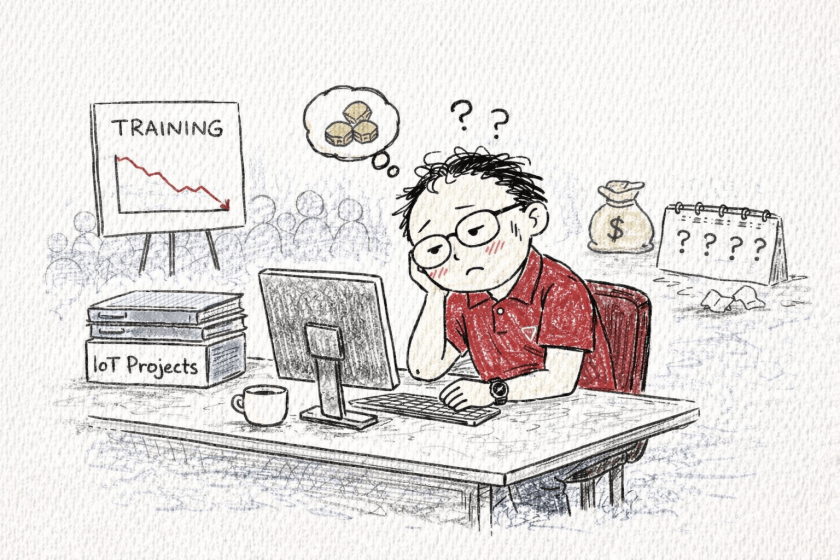
Real IoT projects were fewer compared to previous years. IoT training numbers dropped as well. In-house training, which used to scale better, became harder to secure. We relied more on public training sessions, which are always challenging when it comes to attendance.

The market felt cautious.

Budgets were tighter. Decisions took longer. Interest was still there, but commitment required more patience.

There were moments when I questioned the pace. Is this a temporary slowdown, or is the market resetting itself?

Perhaps it is both.

Shifting My Focus Between Industry Associations

This year, I was less active in the Malaysia Smart City Alliance Association.

At the same time, I became more involved with the Malaysia IoT Association, partly due to my role as Vice-Chairman.

More importantly, MyIoTA’s Smart City Nexus activities align closely with the reasons I joined the association. The Nexus focuses on bringing members’ solutions directly to local councils. It creates a practical space for business matching, not just discussion.

That matters to me, and I plan to be more active there moving into 2026.

Favoriot Sembang Santai Podcast: Keeping Conversations Human

Another meaningful chapter in 2025 was the start of the Favoriot Sembang Santai.

We started the podcast in February 2025, and by December, we had reached Episode 38.

The reason was simple. I wanted a space for honest conversations. No scripts. No slides. No pressure to sound formal. Just honest discussions about Favoriot’s journey and what we were seeing in the IoT space.

The primary host is Zura Huzali, and I serve as the primary guest and speaker. The chemistry works because it feels natural. Curious questions. Straight answers. Occasional debates. Plenty of laughter.

The topics evolved naturally from Favoriot’s story into broader themes such as AI, robotics, satellite IoT, and Ambient IoT. Not as buzzwords, but as technologies we were trying to make practical sense of.

Anyone who misses the live sessions can catch the recordings on YouTube, Spotify, and Amazon Music.

The podcast will continue throughout 2026. For me, it is a long conversation, not a series.

TikTok Live on IoT Man: Ask Me Anything

Alongside the podcast, we also started doing casual TikTok Live sessions on the IoT Man channel.

The central theme is simple. “Ask Me Anything.”

No agenda. No slides. Just live questions and real-time answers. What excites me about these sessions is that they capture a different segment of listeners. Shorter attention spans. Younger audiences. People who may not sit through a long podcast but are curious enough to drop in and ask.

It feels raw. Immediate. Human.

Sometimes the most honest questions come without preparation.

Working With AI to Prepare for 2026

As 2025 draws to a close, one personal highlight has been working with my AI companion.

Not to replace thinking, but to sharpen it.

I spent many late nights shaping 2026 playbooks. How we approach the market. How we engage customers. How we manage partners. New business models. New IoT solution ideas.

The picture ahead feels clearer now.

Looking Forward

2025 was not flashy. It did not come with loud milestones.

But it mattered.

It tested focus. It strengthened conviction. It prepared the ground.

I am genuinely excited about 2026. The plans are clearer. The energy feels different. I hope the long-standing plans around IoT certifications with universities will finally become a reality.

Here is to a better, steadier, and more rewarding year ahead.

I would love to hear how your 2025 has been. Share your reflections in the comments.

Why Some Startup “Failures” Are Actually Training

Failing Forward… Startup Mistakes I’d Make Again

Here’s a truth most founders won’t say out loud.

Some mistakes are not regrets.
They are training.

I’ve made decisions that looked wrong on paper.
Moves that confused people.
Choices that invited questions, doubts, raised eyebrows.

And yet…
I’d make many of them again.

Because those moments shaped how I think today.

I learned what spreadsheets never show.
I learned how people behave when pressure enters the room.
I learned how fast confidence disappears when certainty is gone.

There were launches that came too early.
Partnerships that felt right but weren’t.
Features built with hope instead of evidence.

Painful? Yes.
Pointless? No.

Those moments sharpened my judgement.
They taught me what signals matter.
They taught me what noise to ignore.

Growth rarely comes from getting everything right.
It comes from staying awake while things go wrong.

From asking better questions next time.
From spotting patterns sooner.
From knowing when to push… and when to pause.

Founders don’t grow by avoiding mistakes.
We grow by surviving them with our eyes open.

So if you’re replaying a decision in your head tonight…
Wondering if it set you back…

Take a breath.

Some steps only make sense later.
Some lessons only arrive through friction.
Some mistakes are simply tuition fees for better judgement.

Failing forward is not weakness.
It’s how builders are made.

And some mistakes?
They’re worth every step they gave you.

We’re Teaching IoT Wrong … And Industry Is Paying the Price

We don’t have an IoT talent shortage.

We have a relevance problem.

I’ve seen too many IoT syllabuses that look good on paper…
but fall apart the moment students touch the real world.

Slides are polished.
Exams are passed.
Graduates are confident.

Then industry asks a simple question.

“Can they deploy this?”

Silence.

Building an IoT curriculum is not about chasing buzzwords.
It’s about closing the gap between classrooms and construction sites.
Between theory and messy reality.

Students don’t need more definitions.
They need exposure.

To sensors that fail.
To networks that drop.
To dashboards that confuse users.
To data that refuses to behave.

Industry doesn’t need perfect graduates.
It needs graduates who can think, troubleshoot, adapt.

Who understand why edge matters.
Who know when cloud makes sense.
Who can justify costs, not just architectures.
Who see security as responsibility, not a chapter at the end.

TVET schools and universities hold a powerful lever.
They shape how the next generation thinks about building systems that people rely on.

If we teach IoT as a subject, we produce students.
If we teach IoT as a practice, we produce builders.

The future skills gap is not about technology.
It’s about judgement.

And that starts with how we design what we teach.

Books Written by Dr. Mazlan Abbas

Hi. I’m the Guy Behind FAVORIOT

And this isn’t another tech pitch.
It’s a confession… and a promise.

FAVORIOT didn’t appear out of thin air.
It was born from years of watching brilliant Malaysians fight battles they shouldn’t have to fight.

I’ve been in telco rooms where engineers looked exhausted after stitching ten different systems together.
I’ve sat with lecturers who said their students had the passion but no real platform to grow on.
I’ve listened to system integrators torn between pleasing clients and staying sane.
I’ve seen founders pour their hearts into pilots that never scaled because every new project felt like starting from scratch.

I saw all of it up close.
I asked questions.
I listened carefully.
I heard the frustration that people rarely say out loud.

One lecturer confided, “My students can build anything… but we have no common place to make it real.”

A hardware partner admitted, “We’re drowning in dashboard customisations. It’s slowing us down.”

A founder whispered what many felt, “Every pilot feels like a science experiment that no one wants to repeat.”

The pattern was unmistakable.
The problem wasn’t talent.
It wasn’t ideas.
It wasn’t ambition.

It was the weight of chaos…
devices speaking ten different languages, dashboards built for every new customer, integrations that kept breaking, and projects that died because the foundations were never steady.

Everyone was building islands.
No bridges.
No unity.
No momentum.

And it hurt to see so many capable Malaysians struggling not because of skill… but because the ecosystem never gave them a proper foundation.

So I decided to build one.

Not a platform for show.
Not a platform for slides.
But a platform shaped by every frustration I witnessed.

A platform that starts you at 60 percent instead of zero.
A platform that speaks to every device, every protocol, every idea.
A platform that lets students learn without drowning.
A platform that lets partners grow without rebuilding the same thing endlessly.
A platform that lets enterprises keep their data close and their confidence intact.

FAVORIOT wasn’t built to impress you.
It was built to lighten your load.

Because I’ve seen the late nights.
The soldering iron on the table at 2am.
The dashboards rebuilt for the fifteenth time.
The excitement in students fading because nothing works the way it should.
The startups who gave up not because their idea was bad, but because everything around their idea was too messy.

I built FAVORIOT so that your talent doesn’t get buried under problems that shouldn’t exist.

I’m not saying it will fix bureaucracy.
I’m not saying it will make everyone tech-ready overnight.
And I’m not saying it will solve every problem under the Malaysian sun.

But I am saying this:

The struggles that slow you down the most are solvable.

The confusion.
The repeated work.
The endless customisation.
The feeling of always starting over.
The platforms that fight you instead of helping you.

Those problems shouldn’t be your burden anymore.

You were meant to build solutions.
To teach.
To innovate.
To create impact.
To push Malaysia forward.

Your tools should support that… not get in the way.

So try it.
Connect a single sensor.
Send one stream of data.
Build one dashboard.

And see if something inside you says…
“This is how it should have been all along.”

My belief?
You’ll finally feel the freedom to build without fighting the foundations.

FAVORIOT exists because Malaysia deserves that freedom.
Innovators deserve that clarity.
And you deserve a platform that works with you.

No hype.
No fireworks.
Just the foundation you’ve been asking for… quietly waiting for you to take the next step.

— The guy who built Favoriot because too many Malaysians were struggling in silence.

Overview of FAVORIOT C0mplete Brand

💡 Brand Strategy

Brand Substance

Purpose:
To empower nations, universities, and innovators to build their own IoT ecosystems — achieving technological sovereignty and nurturing the next generation of IoT creators.

Vision:
To make FAVORIOT the world’s most trusted IoT platform that helps nations become producers, not just consumers, of technology.

Mission:
To simplify IoT adoption through education, local partnerships, and accessible platforms — enabling anyone, from students to enterprises, to build impactful smart solutions.

Values:

  • Empowerment: We lift others to build.
  • Collaboration: We grow together through partnerships.
  • Integrity: We stand for transparency and trust in every connection.
  • Curiosity: We explore, learn, and innovate with heart.
  • Resilience: We pivot, persevere, and keep moving forward.

Positioning Strategy

Audience:
Universities, startups, system integrators, and governments seeking IoT independence and real-world learning platforms.

Competition:
Global IoT hyperscalers (AWS IoT, Azure IoT, ThingsBoard) — but FAVORIOT differentiates by offering a local, sovereign, and education-driven ecosystem that’s made by Malaysians, for the world.

Difference:
FAVORIOT bridges education and enterprise — combining IoT training, certification, and deployment in one platform. It’s not just about data; it’s about developing people, institutions, and nations.

Brand Expression

Brand Persona

Brand Voice:
Warm, insightful, humble yet confident. Speaks like a mentor or friend who believes in your potential to create something great.

Brand Communication

Core Messaging:
“Let’s build the IoT world together.”
(Reflects collaboration, empowerment, and shared growth.)

Storytelling Framework:
Stories center around:

  • Empowering students and educators.
  • Real IoT impact on communities and industries.
  • Favoriot’s journey — from survival to global partnerships.
  • The vision of a Producer Nation and the rise of the Fayverse.

Brand Taglines:

  • “Empowering Nations to Build Their Own IoT Ecosystem.”
  • “Let’s Build the IoT World Together.”
  • “From Learners to Leaders in IoT.”

Visual Expression

Brand Identity:

  • Logo: Stylized “F” circuit path on magenta circle
  • Color: Official magenta #B90083 (symbolizing creativity, boldness, and human warmth)
  • Typography: Rounded sans-serif — modern yet approachable
  • Mascot: Faybee (symbol of teamwork and energy)
  • Personas: IoT Man and IoT Queen

Brand Presence:

  • Platforms: favoriot.com, Medium, LinkedIn, YouTube, Spotify podcasts
  • Ecosystem: Universities, startups, and global partners in 10+ countries
  • Tone: Storytelling-driven, people-first, optimistic, and visionary

❤️ Summary

FAVORIOT is more than an IoT platform — it’s a movement.
A story about how local innovation can grow into a global ecosystem.
It represents Malaysia’s dream of becoming a Producer Nation, built on collaboration, purpose, and belief in our own capabilities.

The Origin of Fayverse

When we first built FAVORIOT, it was never just about connecting devices. It was about connecting people — the students, the dreamers, the engineers who believed that a local platform could change the world.

One afternoon, Zura and I were deep in discussion about how the ecosystem had begun to bloom. Universities were adopting the platform, partners from other countries were joining, and we could feel this vibrant network of minds expanding beyond anything we’d imagined.

Zura looked at me and said, almost casually,

“It’s becoming like a Favoriot Universe.”

The phrase lingered in the air. Favoriot Universe. It captured exactly what we were building — not just a company, but a living cosmos of innovators.

Later that night, as I replayed those words in my mind, I thought: Universe… verse… and smiled. That’s it. Fayverse.

“Fay,” drawn from the heart of Favoriot — the warmth, the kindness, the human connection behind every innovation.
And “verse,” a world of endless stories and possibilities.

From that moment, the Fayverse wasn’t just an idea. It became our philosophy. A universe where creativity meets connectivity, where every person can be both a learner and a creator.

Today, when I see students exploring IoT projects, entrepreneurs building solutions, and educators nurturing future technologists — I see the Fayverse alive and thriving.

Because what started as a simple comment during one conversation between Zura and me has now grown into something far bigger — a world powered by Favoriot, built by people who believe that technology should always have a heart.