From Hardware to Insights: Why Universities Should Prioritise Data Analytics and AI Over IoT Hardware

A Change in Our Universities Focus Areas
Artificial Intelligence (AI) and Big Data Analytics have become the talk of the town.

Everywhere I go, someone discusses how these technologies are transforming industries and reshaping how organisations work.

But let me tell you, all of this innovation boils down to one thing: data. AI can’t learn without data, and analytics can’t deliver insights.

This realisation has enormous implications for how universities prepare students and educators for the future.

Over the years, many universities have focused on teaching students to build their Internet of Things (IoT) hardware.

Don’t get me wrong, it’s a great way to learn the technical basics, but I’ve always felt it’s not the best use of resources or time.

The truth is that the hardware is just a means to an end.

The real value is in the data these devices collect and what you do with that data. That’s where I think universities should shift their focus: data analytics and AI.

Why Data is the Real Hero in AI and Big Data Analytics

Here’s the thing about AI: it’s only as good as the data you feed.

Whether you’re predicting customer behaviour, analysing health trends, or optimising supply chains, the first step is always about collecting, cleaning, and understanding data.

And guess what generates a lot of that data? IoT devices.

From smart sensors to wearables, these devices are constantly collecting information streams. But the value isn’t in the device; it’s in the insights you can extract from the data.

Take smart cities, for example. IoT sensors might monitor traffic flow, air quality, or energy usage.

That’s impressive, but more amazing is how AI models and analytics make sense of all that data to improve city living.

Building the hardware for these sensors is straightforward; developing the AI and analytics platforms behind them is the real challenge.

Why Universities Need to Prioritise Data Analytics

1. Meeting Industry Needs

Let me be honest — the industry doesn’t need more people building IoT hardware.

They’re hungry for data analysts, AI developers, and data scientists. Companies are about insights that drive decisions, not the physical gadgets that generate the data.

Shifting the focus to data analytics would better prepare students for what’s waiting for them in the real world.

2. Endless Applications

Consider this: data analytics and AI can be applied across many industries. Whether it’s healthcare, agriculture, manufacturing, or retail, the possibilities are endless.

With skills in data analytics, students can work on anything from predicting machinery maintenance to forecasting disease outbreaks or personalising customer experiences.

Meanwhile, hardware skills are mostly limited to niche engineering roles.

3. Lowering Barriers to Entry

Let’s face it: building IoT hardware isn’t cheap. You need tools, components, and a workshop.

That’s a big ask, especially for students or universities with limited budgets.

In contrast, data analytics only requires access to software tools, cloud platforms, and datasets, which are much more accessible.

4. Using What’s Already Available

These days, you don’t even have to build IoT devices from scratch.

There are ready-made solutions, like FAVORIOT, AWS IoT, and Azure IoT.

These platforms make collecting, storing, and managing IoT data easy. So why reinvent the wheel? Use these tools and focus on creating value through analytics and application development.

How Universities Can Make the Shift

1. Rethink the Curriculum

If I were designing a university course, I’d ensure it included data analytics, AI, and IoT platforms. Students should learn how to:

  • Collect and preprocess IoT data.
  • Use tools like Python or MATLAB to analyse data.
  • Build machine learning models and deploy them in real-world scenarios.
  • Understand cloud computing and work with IoT platforms to manage data.

2. Partner with Industry

One of the smartest moves universities can make is partnering with companies. Industry collaboration gives access to real-world datasets, tools, and expertise.

Plus, internships and collaborative projects can give students the hands-on experience they need to hit the ground running.

3. Focus on Real-World Problems

When I was a student, I always enjoyed projects that felt meaningful.

Educators should design projects that challenge students to solve actual problems.

For example, they could predict energy usage patterns on campus or analyse traffic data to improve transportation systems.

4. Train the Trainers

Let’s not forget the educators.

They need to stay ahead of the curve, too.

Universities should invest in training programmes for lecturers, helping them stay updated on the latest AI and data analytics trends.

5. Provide the Right Tools

Students can’t learn data analytics without the right tools.

Universities should give them access to software, cloud-based platforms, and open-source datasets. This doesn’t have to break the bank — many affordable or even free options exist.

Imagine the Applications Students Can Build

By focusing on data analytics, students can work on exciting applications like:

  • Smart Agriculture: Analysing soil and weather data to optimise irrigation and fertilisation.
  • Healthcare: Using wearable data to predict health trends.
  • Retail: Analysing customer behaviour to personalise shopping experiences.
  • Manufacturing: Implementing predictive maintenance to cut costs and downtime.

These examples show how data analytics can drive innovation across industries.

Isn’t that more impactful than soldering circuit boards?

My Advice to Universities

The world is changing fast, and universities need to keep up.

It’s time to move away from DIY IoT hardware and focus on the bigger picture: data analytics.

By doing this, universities can prepare their students for a future where data is king.

As educators, it’s our job to help students see the actual value of IoT — not the gadgets but the insights they enable.

And for students, my advice is simple: dive into data analytics and AI. These skills will open doors and help you make a real difference.

The future is all about harnessing the power of data.

Let’s make sure our universities are ready to lead the way.

Building IoT with the 3-Step Approach

Lecture Notes

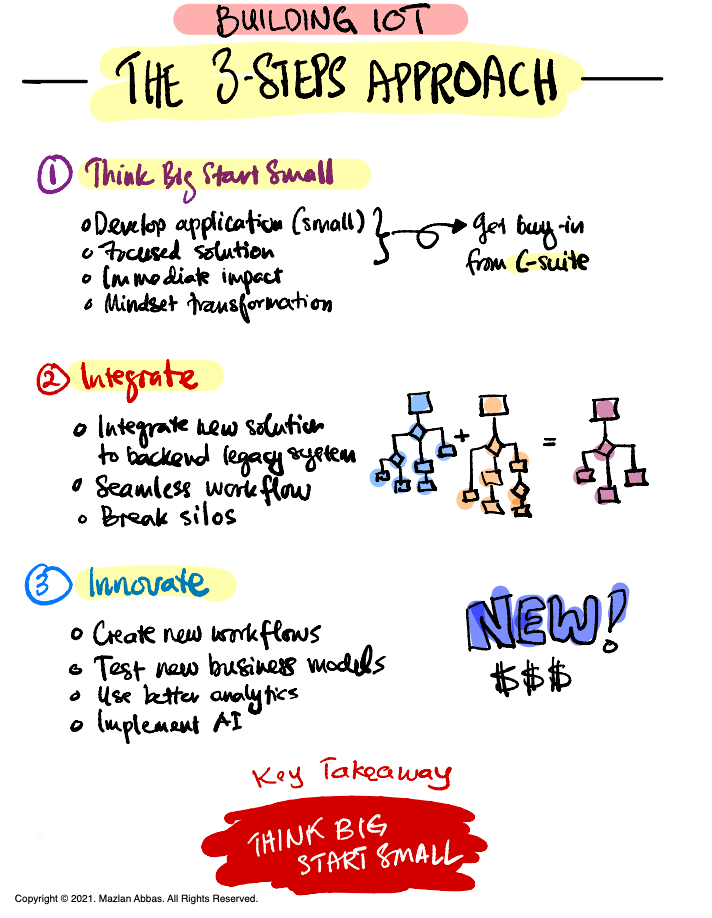
Today, we will explore a simple and practical framework for implementing IoT projects: the 3-Step Approach.

This method ensures a smooth and effective rollout by focusing on small steps, integration, and innovation. Let’s break it down step by step.

Step 1: Think Big, Start Small

The first step is to start with a clear vision (think big) but begin with a small, focused project to gain momentum.

Develop a Small Application: Identify one specific problem and build a targeted solution.

  • Example: A smart thermostat to monitor energy usage in one building rather than an entire campus.

Deliver Immediate Impact: The solution should show quick results to build confidence in IoT’s value.

Mindset Transformation: This small success shifts how people perceive IoT and its potential.

Get Buy-In from Leadership: Demonstrating early results helps secure support from decision-makers like the C-suite executives for future projects.

Step 2: Integrate

Once the initial IoT solution proves its value, it is integrated into the broader system.

Connect to Legacy Systems: Ensure the new IoT solution works seamlessly with existing infrastructure, such as ERP systems or older databases.

  • Example: Integrating smart sensors into a factory’s traditional production line.

Seamless Workflow: Avoid disrupting operations by designing smooth processes between old and new systems.

Break Silos: Encourage collaboration between departments to maximise the benefits of IoT across the organisation.

This step ensures that IoT doesn’t operate in isolation but becomes a part of the larger ecosystem.

Step 3: Innovate

The final step is to use IoT to drive innovation and create new opportunities.

Create New Workflows: Leverage IoT to optimise or redesign how work is done.

  • Example: Using real-time data from IoT sensors to automate maintenance schedules.

Test New Business Models: Experiment with different ways to generate revenue using IoT solutions.

  • Example: Offering predictive maintenance as a subscription service for customers.

Better Analytics and AI: Use advanced analytics and AI to unlock deeper insights from IoT data and automate decision-making.

This stage transforms IoT from a problem-solving tool into a driver for long-term growth and innovation.

Key Takeaway: Think Big, Start Small

The overall lesson is simple:

  1. Start with a big vision, but focus on small, impactful projects to get started.
  2. Build on early successes by integrating solutions into larger systems.
  3. Use IoT to innovate and create new opportunities.

This approach minimises risk, builds momentum, and ensures sustainable growth.


Let’s discuss: What small IoT applications can you think of to start with? How would you scale and integrate them into a more extensive system? Let’s brainstorm together!

[FREE IoT Notes to Download]

Simplest Reasons Why We Need IoT

Lecture Notes

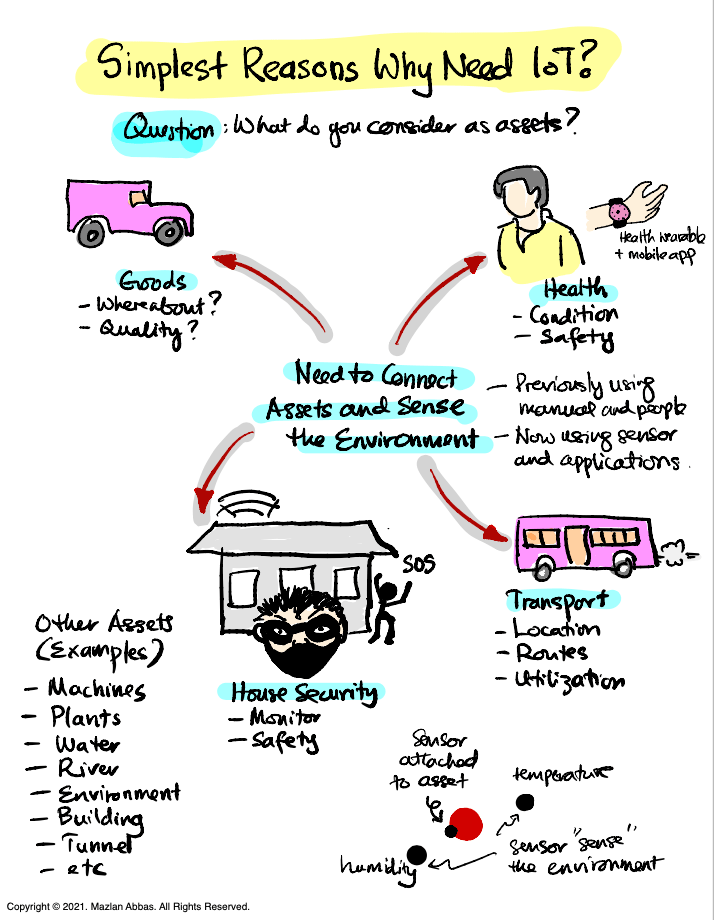
Today, we’ll discuss why the Internet of Things (IoT) is becoming essential in our daily lives.

The diagram simplifies this concept by focusing on assets, how we connect them, and why sensing the environment is so important. Let’s break it down step by step.

1. What Are Assets?

Let’s start with a question: What do you consider as assets?
We value and want to monitor, track, or protect assets. These could include:

Goods:

  • We would like to know their location (e.g., where is my delivery?)
  • Or their quality (e.g., is the food shipment fresh?)

Health:

  • Monitoring our condition and ensuring safety are critical.
  • Example: A health wearable that tracks your heart rate and connects to a mobile app.

Transport:

  • Vehicles and public transportation must be tracked for location, routes, and utilisation.
  • Example: A bus fleet monitored for efficient route planning.

House Security:

  • Ensuring homes are safe by monitoring for intrusions or emergencies.
  • Example: A motion sensor that alerts you if there’s unusual activity.

2. The Core Need: Connecting Assets and Sensing the Environment

Why do we need IoT for these assets?
The key lies in sensing and connecting the environment around these assets.

  • In the past, we relied on manual monitoring and human input.
  • Today, we use sensors and applications to gather real-time data and automate processes.

3. How IoT Works

Sensors: Devices attached to assets to sense environmental factors like temperature or humidity.

  • Example: A sensor measuring the humidity in a storage facility for sensitive goods.

Communication: Sensors send this data to an IoT platform for processing and action.

  • Example: A sensor alerts the homeowner if the temperature inside the house drops below a certain threshold.

4. Examples of Other Assets

IoT can be applied to monitor a wide variety of assets, such as:

  • Machines: For predictive maintenance in factories.
  • Plants: To ensure optimal growth conditions in agriculture.
  • Water and Rivers: These are used to monitor pollution or water levels.
  • Environment: For tracking air quality and weather changes.
  • Buildings and Tunnels: For structural safety and efficiency.

5. Why IoT Is Essential

IoT provides us with the ability to:

  • Monitor assets in real time without human intervention.
  • Ensure safety and quality by automating alerts and responses.
  • Improve efficiency by making data-driven decisions.

Final Thoughts

The most straightforward reason we need IoT is to connect our assets and sense the environment effectively.

By doing so, we make life easier and ensure safety, efficiency, and better decision-making.

Let’s discuss: What assets in your life or work could benefit from IoT? How would you use sensors to improve them? Share your thoughts!

[FREE Download IoT Notes]

Types of Analytics

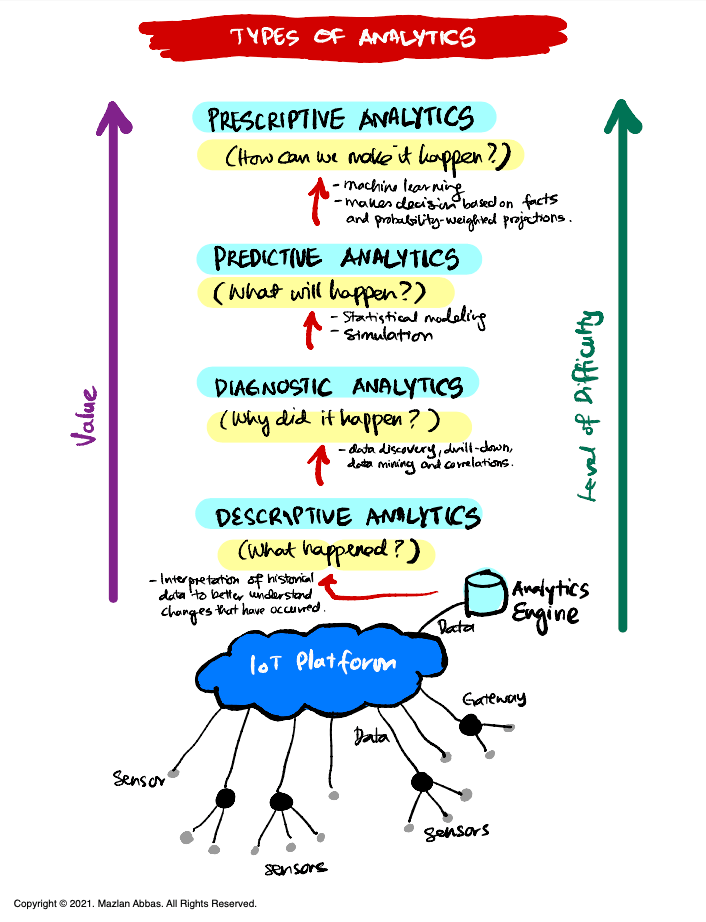
Today, we’ll discuss types of analytics and their importance in turning raw data into actionable insights.

This diagram shows four types of analytics, ranked by their difficulty level and the value they provide. Let’s go through them step by step.

Based on the eBook — IoT Notes by Mazlan Abbas

1. Descriptive Analytics: What Happened?

At the base of the analytics hierarchy is descriptive analytics. This is the simplest form of analytics and helps us understand what happened by interpreting historical data.

  • Purpose: To summarise past events and identify patterns.
  • Example: A smart thermostat that shows last week’s energy usage patterns.
  • Methods: Charts, graphs, and dashboards that clearly show past performance.

This type of analytics is great for reviewing the past, but it doesn’t tell us why something happened or what will happen next.

2. Diagnostic Analytics: Why Did It Happen?

Moving up, we have diagnostic analytics, which looks at why something happened. It’s more complex than descriptive analytics because it requires diving deeper into the data.

  • Purpose: To discover relationships and identify the causes behind past events.
  • Example: Analysing why a specific day’s energy usage was higher than average by correlating data with external factors like weather.
  • Methods: Data discovery, drill-down techniques, and correlation analysis.

This stage helps us make sense of the past by understanding the root causes of trends and anomalies.

3. Predictive Analytics: What Will Happen?

Next is predictive analytics, which focuses on forecasting future outcomes. This is where analytics becomes proactive rather than reactive.

  • Purpose: To predict what might happen based on current and historical data.
  • Example: A smart thermostat forecasting energy usage for the upcoming week based on weather patterns and past behaviour.
  • Methods: Statistical modelling and simulations.

By identifying trends and patterns, predictive analytics helps us make informed predictions.

4. Prescriptive Analytics: How Can We Make It Happen?

At the top is prescriptive analytics, the most advanced type. This involves predicting outcomes and recommending actions to achieve desired results.

  • Purpose: To decide the best course of action based on predictions.
  • Example: A smart thermostat automatically adjusting settings to save energy while maintaining comfort.
  • Methods: Machine learning and AI to analyse probabilities and make decisions.

Prescriptive analytics provides the highest value by enabling automated and data-driven decisions.

IoT and Analytics

This diagram also highlights how analytics works in an IoT platform:

  1. Sensors: Collect data from various sources like temperature, humidity, or movement.
  2. IoT Platform: Acts as a central hub to process and store the data.
  3. Analytics Engine: Applies these four types of analytics to generate insights and drive decisions.

Final Thoughts

Each type of analytics builds on the previous one, moving from simple data interpretation to actionable decisions. The value increases as we move up the hierarchy, as does the complexity.

Question to consider: Which type of analytics is most valuable in your industry, and how can you implement it effectively? Let’s discuss it!

[Note: Download IoT Notes by Mazlan Abbas ]

What is the Fourth Industrial Revolution?

IOT NOTES

Lecture Notes

Based on the eBook — IoT Notes by Mazlan Abbas

Today, we’ll explore the Fourth Industrial Revolution (IR 4.0) and its significance. This diagram breaks it down into easy-to-understand sections, so let’s walk through it step by step.

1. The Differences Between Revolution and Evolution

Let’s first clarify why it’s called a revolution and not an evolution.

Revolution:

  • Sudden and drastic changes that transform industries and societies.
  • Think of it as a dramatic leap forward in technology and processes.

Evolution:

  • Gradual and slow progress over time.

IR 4.0 is a revolution because it represents rapid and significant advancements in how we live and work.

2. The Bigger Picture: Industry 4.0 vs IR 4.0

It’s important to understand that Industry 4.0 is just a subset of IR 4.0.

  • Industry 4.0 focuses on manufacturing and improving industrial processes using automation, IoT, and robotics.
  • IR 4.0, however, encompasses much more:
  • It impacts various sectors, such as education, healthcare, shopping, and agriculture.
  • It’s a broad transformation, not limited to factories or industries.

3. The Lifestyle Through Industrial Revolutions

Let’s now look at how each industrial revolution shaped our lifestyle:

IR 1.0 — The Age of Manual Tools:

  • People relied on physical and manual tools for work.
  • Example: Ploughing fields with hand tools.

IR 2.0 — The Power of Electricity:

  • Electricity revolutionised industries, enabling mass production.
  • Example: Electric machines replaced manual labour.

IR 3.0 — The Digital Era:

  • The rise of electronics and the internet connected the world.
  • Example: Computers, email, and early e-commerce.

IR 4.0 — The Intelligence Revolution:

  • We’re now using intelligence through AI, robotics, and advanced technologies.
  • Example: Autonomous robots, augmented reality (AR), and virtual reality (VR).

4. Example: How Shopping Evolved

Let’s take shopping as an example of how each industrial revolution changed this activity:

  • IR 1.0: People used cash for transactions.
  • IR 2.0: The cash register was introduced, improving the checkout process.
  • IR 3.0: Credit cards and online shopping emerged with the internet.
  • IR 4.0: We see robotics and AR/VR enhancing the shopping experience, like virtual try-ons or automated warehouses.

Why is IR 4.0 Important?

IR 4.0 is transforming every aspect of our lives, from how we work and learn to how we interact with technology. It’s about leveraging intelligence to solve problems, improve efficiency, and create new possibilities.

[Note: You can download the full eBook — IoT Notes by Mazlan Abbas]

Understanding Industry 4.0 and Industrial Revolution 4.0

IOT NOTES

Lecture Notes

Based on the eBook — IoT Notes by Mazlan Abbas

Today, we’ll explore two closely related but distinct concepts: Industry 4.0 and the Fourth Industrial Revolution (IR 4.0).

These terms are often used interchangeably but have specific differences, as highlighted in the diagram. Let’s dive in step by step.

1. Revolution vs Evolution

The first thing we need to clarify is the difference between revolution and evolution:

  • Revolution refers to sudden and drastic change. Think of it as a leap forward that quickly transforms industries and societies.
  • Evolution, on the other hand, is slow and gradual progress. Changes happen incrementally over time.

Key question: Are we adopting Industry 4.0 technologies suddenly (revolution) or gradually (evolution)? This can vary depending on the industry and region.

2. What is Industry 4.0?

Industry 4.0 focuses on manufacturing and improving industrial processes through advanced technologies like IoT, AI, and robotics. It is the fourth stage in the progression of industrial advancements:

Industry 1.0 (1784):

  • Introduction of mechanisation and steam power.
  • Example: Steam engines powering factories.

Industry 2.0 (1870):

  • Electrical power enabled mass production.
  • Example: Assembly lines in factories.

Industry 3.0 (1969):

  • Use of computers, electronics, and automation.
  • Example: Robots performing repetitive tasks on manufacturing floors.

Industry 4.0 (Today):

  • Cyber-physical systems integrating IoT, AI, VR, and robotics.
  • Example: Smart factories where machines communicate and operate autonomously.

3. What is Industrial Revolution 4.0 (IR 4.0)?

The Fourth Industrial Revolution goes beyond manufacturing. It’s about integrating these technologies across all industries and even societies. While Industry 4.0 focuses on production, IR 4.0 impacts healthcare, education, agriculture, and more.

A key question: Are we adopting these 4.0 technologies evenly across all sectors, or is there a focus on specific areas like manufacturing?

4. The Connection Between Industry 4.0 and IR 4.0

Think of Industry 4.0 as a subset of the broader IR 4.0. Industry 4.0 is about the transformation of manufacturing, whereas IR 4.0 encompasses societal changes.

Here’s an example:

  • Industry 4.0: A factory using IoT sensors to monitor equipment health and reduce downtime.
  • IR 4.0: IoT sensors used in agriculture to monitor soil moisture for precision farming.

5. Societal Progression Through Industrial Revolutions

The diagram also highlights how societies have evolved alongside industrial advancements:

  1. Society 1.0: Hunting society — Humans relied on nature and survival skills.
  2. Society 2.0: Agriculture society- farming practices transformed societies.
  3. Society 3.0: Industrial society — industries became the backbone of economies.
  4. Society 4.0: Information society – driven by computers and the internet.
  5. Society 5.0 (Japan’s Vision):
  • A super-smart society where technology integrates seamlessly to improve quality of life.
  • Focus on AI, robotics, and IoT to solve societal challenges.

6. Why is This Important?

Understanding these concepts helps us prepare for the future:

  • For businesses: Knowing the difference between Industry 4.0 and IR 4.0 helps align strategies.
  • For individuals: Skills like AI, IoT, and data analytics are becoming essential.
  • For society: IR 4.0 encourages us to consider how technology can address global challenges like sustainability and healthcare.

Final Thoughts: Industry 4.0 is revolutionising manufacturing, while IR 4.0 is shaping the future of entire societies.

As we move forward, we aim to embrace these technologies for efficiency and to build a more intelligent, inclusive world.

[You can download the IoT Notes here]

The Art of Growing on X

INFLUENCER’S STORIES

My Journey

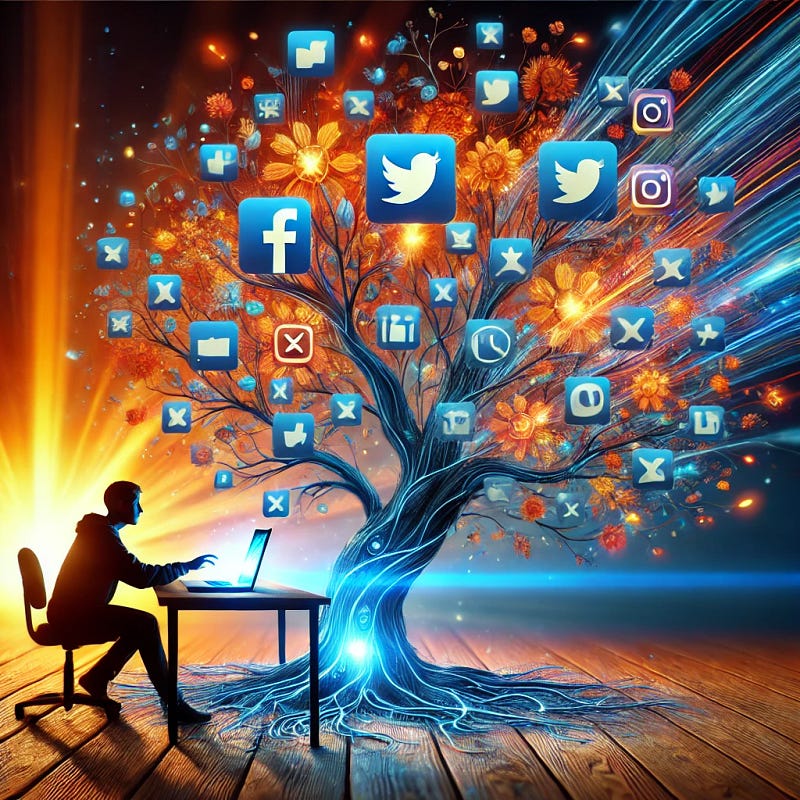
Image created by ChatGPT

When I began navigating the world of X (formerly known as Twitter), I was captivated by its potential.

A platform with millions of active users, all engaged in conversations about ideas, technology, and everything in between, was the perfect space for someone like me, passionate about IoT, smart cities, and entrepreneurship.

But let me be honest: figuring out how to grow my presence wasn’t a straightforward journey.

It required persistence, experimentation, and, most importantly, understanding what my audience valued.

Let me take you through my journey of discovering the best practices for growing on X, peppered with a bit of self-dialogue.

Step 1: Crafting a Magnetic Profile

Photo by Ben Sweet on Unsplash

Why should anyone follow me?” I remember asking myself this question while staring at my barren X profile years ago.

The first step to drawing people in was to communicate my value.

I began with my profile banner. It needed to tell a story – my story.

A simple image highlighting my work with FAVORIOT and my role as an IoT advocate made an immediate impact.

Next, the bio. “What do I stand for? What can I offer?

To attract the right audience, I crafted a concise description of my expertise, including key terms like IoT, smart cities, and entrepreneurship.

The final touch? A pinned post.

This became my digital billboard.

Whenever I had a significant announcement – whether about a new IoT project, an insightful article, or even a speaking engagement – it went there.

Step 2: Engaging with the Giants

Photo by Andrea Huls Pareja on Unsplash

Why waste time commenting on posts by big names? They won’t notice me,” I thought initially.

But I was wrong.

I decided to step out of my comfort zone.

I began following influential figures in IoT and technology. Whenever they posted, I didn’t just ‘like’ or retweet; I added value.

If someone tweeted about IoT’s role in agriculture, I’d share my perspective or a relevant case study.

To my surprise, my comments started gaining traction.

Other followers noticed my contributions, and occasionally, the original poster replied.

I learned a simple truth: the more visible you are in meaningful conversations, the more likely you attract followers who resonate with your insights.

Step 3: Creating Value-Driven Content

Photo by Carl Heyerdahl on Unsplash

What do people want to see from me?” This question guided my content creation.

I realised that my audience wasn’t just interested in IoT – they wanted to learn, be inspired, and sometimes entertained.

I started experimenting with different content formats:

How-To Guides: People loved practical advice. I shared tips like “How to Start Your IoT Journey” or “Three Ways IoT Can Transform Small Businesses.

Personal Stories: Sharing my struggles and triumphs – like the challenges of penetrating the smart cities market – resonated deeply.

Lists: I posted quick, digestible tips, such as “5 Tools Every IoT Developer Needs.

Contrarian Takes: Occasionally, I’d challenge popular narratives, sparking thought-provoking discussions.

Case Studies: Breaking down real-world examples of IoT applications showcased my expertise while providing value.

Every post was an opportunity to build trust and credibility.

I reminded myself that consistency was key.

Some posts didn’t perform well, but others exceeded expectations.

It was a learning process, and I embraced it.

Step 4: Embracing Video Content

Photo by KAL VISUALS on Unsplash

Do I need to be on camera?” I asked myself.

However, I realised that videos were becoming the future of content consumption. People wanted to see faces, hear voices, and connect more deeply.

I began creating short videos – sharing IoT tips, discussing trends, and answering common questions.

My initial attempts were far from perfect, but the engagement was undeniable.

Videos kept people on my posts longer, which boosted their reach.

Step 5: Riding the Wave of Trends

Photo by Silas Baisch on Unsplash

Why should I care about trends? My niche is IoT,” I initially thought.

But then it hit me – trending topics were an opportunity to align my expertise with what people were already discussing.

For example, when a conversation about AI’s impact on the environment was trending, I joined in with my insights on how IoT complements green initiatives.

The result? More engagement and new followers who shared my interests.

Step 6: Leveraging Templates That Work

Photo by Daria Nepriakhina 🇺🇦 on Unsplash

Over time, I noticed specific post structures performed better than others. These weren’t just random observations; they were patterns worth replicating:

Predictions: Forecasting trends like the future of smart cities got people talking.

Challenges: Asking my audience to share their IoT success stories increased interaction.

Each format served a purpose, keeping my content fresh and engaging.

The Takeaway

Photo by Clem Onojeghuo on Unsplash

Growing on X isn’t about chasing followers.

It’s about building a community of like-minded individuals who share your passion and value your insights.

My journey on X has taught me that authenticity, consistency, and adaptability are the keys to success.

I often remind myself of a question I initially asked: “Why should anyone follow me?

Every piece of content I create, every interaction I engage in, and every trend I ride is guided by the answer to that question.

And as long as I stay true to my purpose, I know the journey will continue to be rewarding.

IoT Combating COVID-19

IOT NOTES

Lecture Notes

Based on the eBook — IoT Notes by Mazlan Abbas

Today, we’ll look at how the Internet of Things (IoT) played a critical role in combating the challenges brought by the COVID-19 pandemic.

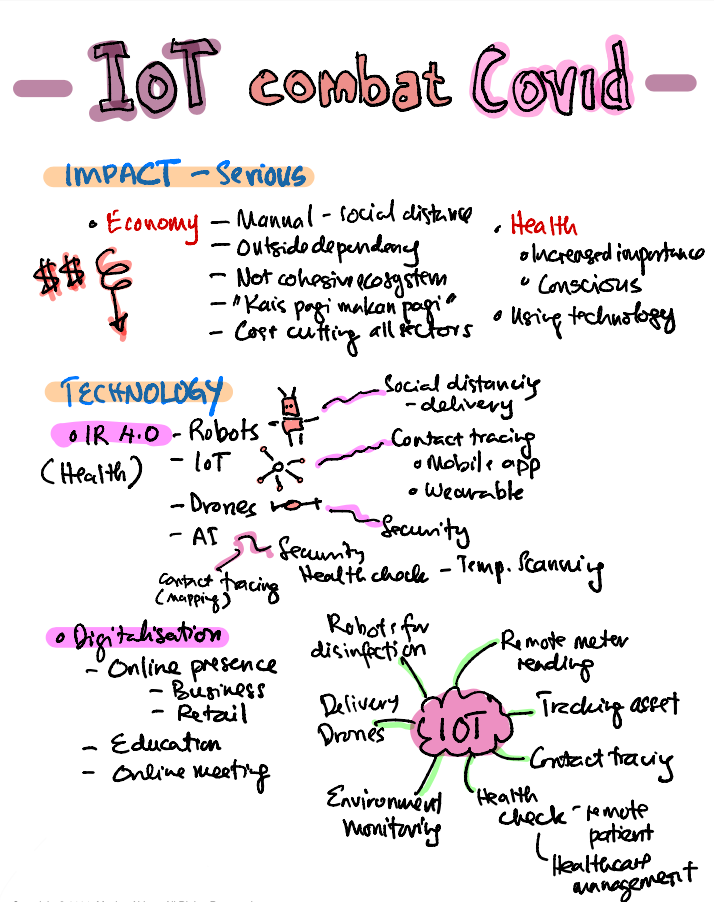
The diagram gives us a clear picture of the impacts, technologies, and solutions IoT provided during this global crisis.

1. The Serious Impact of COVID-19

COVID-19 affected every corner of our lives, especially in two major areas:

Economy

  • Social distancing disrupted manual jobs and heavily impacted daily income earners (“kais pagi makan pagi” — hand-to-mouth living).
  • Businesses relying on outside dependency suffered due to travel and supply chain restrictions.
  • Cost-cutting became essential across all sectors.
  • The lack of a cohesive ecosystem made economic recovery slower.

Health

  • Health became a top priority.
  • Awareness and consciousness about hygiene, social distancing, and health monitoring increased.
  • Technology began to take centre stage in health-related solutions.

2. IoT Technologies Used

IoT, combined with IR 4.0 technologies (Industry 4.0), came into action to address these challenges. Let’s explore the tools and methods:

Robots

  • Used for tasks like disinfection and delivery, especially in hospitals and public spaces, reducing human contact.

IoT

  • Enabled real-time data collection and monitoring for applications like health checks and remote patient management.

Drones

  • Delivered essential items to maintain social distancing and were used for surveillance in lockdown areas.

Artificial Intelligence (AI)

  • Enhanced contact tracing, temperature scanning, and predictive analytics to track the virus’s spread.

3. Practical Applications of IoT

IoT was at the heart of the pandemic response, enabling innovative applications:

Contact Tracing

  • Mobile apps and wearable devices tracked individuals’ interactions, helping to identify and isolate potential cases.

Health Monitoring

  • Remote patient monitoring systems allowed hospitals to track patients’ vital signs without physical visits.
  • Temperature scanning systems were widely deployed in public places.

Environmental Monitoring

  • IoT sensors monitored air quality and other environmental factors to maintain healthy surroundings.

Remote Operations

  • IoT made it possible to manage utilities like remote meter reading and asset tracking.

Delivery Drones

  • Delivered medicines, food, and other essentials, reducing human-to-human interaction.

4. The Role of Digitalisation

With physical interactions limited, digitalisation became a key enabler:

Online Presence

  • Businesses and retail shifted online to continue operations.
  • Education moved to online platforms, and virtual meetings became the norm.

Robots and Automation

  • Robots handled repetitive tasks, like disinfection, to maintain hygiene standards.

Conclusion

IoT proved to be a game-changer during COVID-19. It connected people, devices, and systems, enabling effective solutions for healthcare, economic recovery, and safety.

The pandemic highlighted the importance of leveraging IoT for crisis management and showed us how technology can adapt to save lives and sustain economies.

[Full IoT Notes can be downloaded HERE]

Why I Felt Writing is Like Running a Marathon

WRITER’S JOURNEY

My Journey on Medium

Photo by Pietro Rampazzo on Unsplash

I received a comment from Muhammad Ahtisham stating that writing on Medium is a marathon, not a sprint. This tempted me to write the analogy of writing on Medium and running a marathon.

I often find myself drawing analogies between life and the activities we undertake.

Writing on Medium, for instance, is much like running a marathon.

At first glance, the two may seem worlds apart, but the parallels become strikingly clear once you embark on the journey.

Photo by Mārtiņš Zemlickis on Unsplash

Both require endurance, consistency, and, most importantly, a deep-seated purpose. Let me take you through my experience, where these two seemingly different pursuits intertwine.

I remember the day I decided to write on Medium. It wasn’t a grand decision or a well-thought-out plan.

It started as an itch to share my thoughts on IoT and smart cities, which have consumed my professional life. “Will anyone even read this?” I asked myself.

Photo by Tong Su on Unsplash

It was a daunting thought, akin to standing at the starting line of a marathon, surrounded by seasoned runners. Their confidence and experience dwarfed my timid resolve.

Why am I doing this?” That was the question I often asked myself.

The same question nags at you around the fifth kilometre of a marathon. The initial adrenaline fades, and you’re left grappling with your commitment.

For me, the answer lay in a simple yet powerful truth: I wanted to inspire. I wanted to share not just knowledge but the stories behind that knowledge – the challenges, the triumphs, and the lessons learned.

Writing on Medium was never about instant success.

Just like a marathon, it’s a long game.

Photo by Miguel A Amutio on Unsplash

In the beginning, my articles barely got any views. I would refresh the stats page obsessively, hoping for a miracle. “Why aren’t they reading?” I’d wonder, the frustration bubbling up.

But then, I reminded myself of a lesson I’d learned from running: The first few kilometres are for finding your rhythm, not for speed.

Writing, like running, requires patience. Each article was a step forward, a chance to refine my voice and connect with the audience who truly needed my insights.

One day, after posting an article on IoT applications in agriculture, I received a comment: “This is exactly what I was looking for. Thank you!” It was a small win, but it felt like crossing the first checkpoint in a marathon.

Someone was reading. Someone found value in my words.

“Keep going,” I told myself.

That moment shifted my mindset. I stopped obsessing over views and started focusing on writing for the sake of writing.

Photo by Capstone Events on Unsplash

It was liberating.

Instead of sprinting towards elusive metrics, I settled into a comfortable pace, one that allowed me to enjoy the process.

There’s another parallel I discovered: preparation.

A marathon runner doesn’t just wake up and decide to run 42 kilometres. They train, plan their nutrition, and test their limits. Writing is no different. I had to build a routine, carving out daily time to write, read, and think.

Do I really have to do this every day?” I’d groan, especially on days when the words refused to flow.

But I knew skipping a day would make it easier to skip the next.

Consistency was the key, even if it meant writing subpar drafts. Those drafts were like training runs – they weren’t pretty, but they built endurance.

I also learned the importance of pacing.

Going too fast too early in a marathon can leave you exhausted before the finish line. Similarly, I realized that churning out articles daily wasn’t sustainable. Quality mattered more than quantity.

Take your time,” I’d remind myself as I stared at an article draft, unsure if it was good enough.

Instead of rushing to publish, I allowed myself to revisit and refine. Each edit felt like perfecting my stride, making the journey smoother.

Photo by Quino Al on Unsplash

Then there’s the matter of support. No marathoner runs alone.

There are fellow runners, spectators, and coaches cheering you on.

For me, that support came from the Medium community. Fellow writers, readers, and even the occasional critic all played a role in my growth.

One day, after publishing a piece on entrepreneurship, I received a direct message from another writer: “Your story inspired me to start my own business. Thank you for sharing.” That message was like the crowd at a marathon, their cheers pushing me forward.

See? This is why you write,” I told myself.

Of course, there were setbacks. Every marathon has its wall – when exhaustion hits, and you question everything.

For me, it came during a period of writer’s block: no ideas, no motivation, just a gnawing sense of failure.

Why am I even doing this?” I’d mutter, tempted to give up.

But then I remembered the finish line.

In a marathon, you don’t stop because you’re tired; you stop when you’ve crossed the line. Writing had its finish lines – completing an article, reaching a new reader, or simply expressing an idea I’d been mulling over.

Photo by Capstone Events on Unsplash

Looking back, I realise that writing and running a marathon are deeply personal journeys.

They test your limits, reveal your strengths, and force you to confront your weaknesses. But they also offer immense rewards.

Today, as I continue to write on Medium, I see each article as another kilometre in the marathon.

Some are smooth and effortless, while others are gruelling uphill battles. But with each step – or word – I grow stronger.

Would you do it all over again?” someone once asked me about my writing journey. Without hesitation, I said, “Absolutely.

Writing has given me more than just an outlet for my thoughts.

It has taught me resilience, discipline, and the joy of sharing.

It has connected me with people I would never have met otherwise.

Most importantly, it has reminded me that real victory lies not in the destination but in the journey itself.

So here I am, still running this marathon, one article at a time.

And just like every marathoner knows, the finish line isn’t the end – it’s just a new beginning.

Components of IoT

IoT Lecture

Based on IoT Notes

Based on the eBook — IoT Notes by Mazlan Abbas

Let’s discuss an essential concept in IoT — its key components. The diagram breaks IoT into four main building blocks, which we’ll explore step by step.

1. Sensors: The Eyes and Ears of IoT

The first layer is the sensors. These devices are at the heart of IoT; their job is to sense the environment.

  • They generate data by measuring things like temperature, humidity, or motion.
  • Think of them as the “end-nodes” in IoT — they are where the process begins.

Examples include:

  • A digital thermometer sensing room temperature.
  • A motion detector in a security system.

Without sensors, IoT wouldn’t have any information to work with!

2. Connectivity: The Communication Bridge

Once sensors collect data, it needs to be transferred somewhere for processing. That’s where connectivity comes in.

  • IoT uses different communication technologies:
  • Wireless options like Wi-Fi, Bluetooth, and LPWAN (LoRa or Sigfox).
  • Fixed methods like Ethernet.
  • Connectivity ensures the data travels from the sensors to the next stage over the internet or private networks.

Imagine this as a digital highway connecting the physical world to the virtual one.

3. IoT Platform and Middleware: The Brain

The third component is the IoT platform or middleware. This is where all the raw data comes together and is processed.

  • It acts as a central hub to aggregate data from multiple sensors.
  • Middleware handles:
  • Device management.
  • Data storage and formatting using standard protocols.
  • Providing APIs (Application Programming Interfaces) so apps can access the data.

Think of this as the “brain” that processes everything and makes sense of the data.

4. Applications and Analytics: Deriving Insights

Finally, all the processed data is used in applications and analytics to deliver value. This is where IoT makes an impact.

Applications:

  • Use the data to create useful solutions, like apps that track fitness or control smart homes.
  • Analytics and AI:
  • Analyse the data using Artificial Intelligence or Big Data techniques.
  • Generate insights to help make decisions or automate processes.

For example:

  • A smart farming app could use soil moisture data to trigger irrigation.
  • An AI system could predict machine failure in a factory.

Bringing It All Together

So, to summarise:

  1. Sensors collect the data.
  2. Connectivity transmits the data.
  3. IoT Platform processes and stores the data.
  4. Applications and Analytics use the data to create actionable insights.

IoT is a powerful combination of hardware, communication, and software working together to solve real-world problems.