FAVORIOT: 8 Years of Dreams, Struggles, and Triumphs

Eight years. It feels like a blink of an eye, yet when I reflect on the journey, every moment is etched in my memory like a battle scar.

It all started with an idea that many dismissed as too ambitious for a small startup in Malaysia. The Internet of Things (IoT) was gaining traction globally, but here? People barely understood its potential. I remember sitting with early team members, sketching out what would eventually become the blueprint of FAVORIOT.

“Will this work?” I asked myself.

“Will people even care?”

Doubt is a funny thing. It whispers in your ear, making you question every step. But the fire inside me was more substantial. I had spent decades in telecommunications and technology, seeing trends come and go. But IoT? It wasn’t just a trend—it was the future. And I wanted to be part of shaping that future.

The Birth of FAVORIOT (2017-2018): A Leap of Faith

In 2017, FAVORIOT was officially born. The name carried a mission—a combination of “Favour” (or “Favor”) and “IoT.” But it was pronounced like “Favourite”. Our vision was to help businesses and cities adopt IoT with ease. We weren’t just another tech company; we were a company built on the belief that technology should serve people, not the other way around.

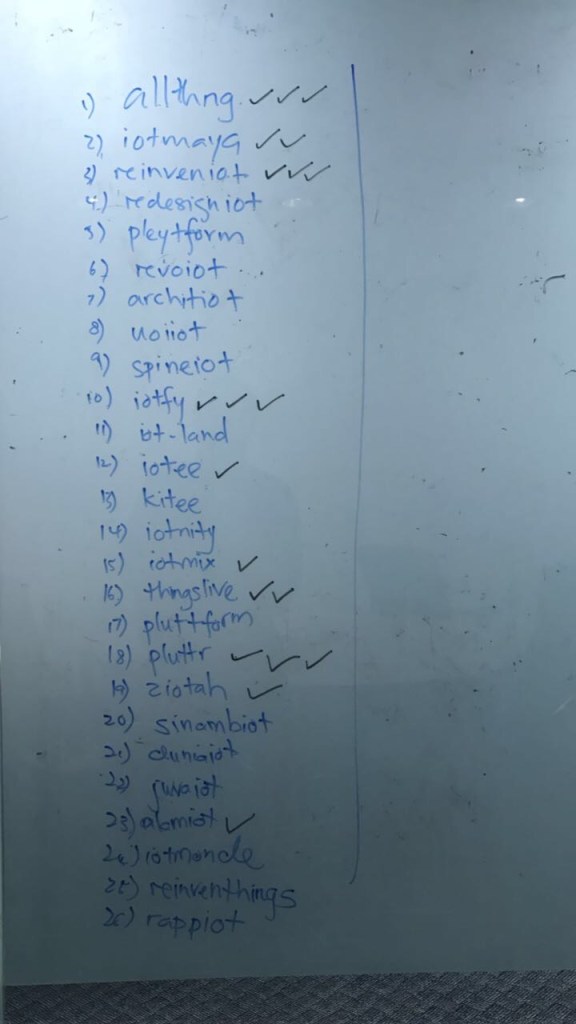
I still kept the list of suggested names for the company and we insist to have the word “IoT” in it. It was funny to look back at the way we come out with the names

“Let’s build something that matters.” That was the mantra.

But building something from scratch? That was no walk in the park.

The early days were filled with sleepless nights, countless meetings, and an uphill battle convincing clients that IoT was more than just a buzzword. We had to prove ourselves. The first version of the FAVORIOT platform was launched, allowing businesses to connect and manage IoT devices seamlessly. The first product that used the FAVORIOT platform is “Raqib,” a senior care IoT solution.

The Struggle for Recognition (2019-2021): A Fight Against the Odds

If I said everything went smoothly, I’d be lying.

We faced rejections. So many rejections.

“We’re not ready for IoT.”

“We’ll consider it in the future.”

“Maybe if you were a bigger company, we’d trust your solution.”

Every “no” felt like a dagger. I had seen this before—how innovation is often met with resistance. But I also knew that persistence was key.

2019 was a turning point. We secured our first major clients, IoT developers started using FAVORIOT to build their IoT projects, and universities integrated our platform into their curricula. The momentum was building.

Then, 2020 happened. The world shut down.

The pandemic tested every business, including ours, for resilience. Projects were delayed, budgets were cut, and people were uncertain.

“Is this the end?” I wondered.

But if there’s one thing I’ve learned, crises often lead to opportunities. The demand for remote monitoring solutions skyrocketed. Suddenly, IoT wasn’t a luxury—it was a necessity. Businesses needed to track assets, monitor environments, and ensure safety without physical presence.

FAVORIOT became more relevant than ever.

Scaling Up (2022-2023): The Rise of the Global Partner Program

By 2022, we knew we had something special. Our IoT platform had matured. Companies across different industries—smart cities, agriculture, healthcare—were integrating our technology.

But one question remained: How do we scale?

The answer? Partnerships.

We launched the FAVORIOT Global Partner Program in 2024. Instead of knocking on doors one by one, we empowered system integrators worldwide to bring FAVORIOT into their markets. We started building an international presence from Canada to the Philippines, Indonesia to India.

Each new partner wasn’t just a business deal but a validation that what we built mattered beyond Malaysia.

2024-2025: A Vision for the Future

And now, here we are. Eight years in.

I look back and realize how far we’ve come—from a tiny startup with big dreams to an IoT platform trusted worldwide. But this is just the beginning.

The future of IoT is evolving, and so are we. AI-driven automation, advanced analytics, and even more seamless integrations are on the horizon.

FAVORIOT’s vision remains To make IoT accessible, scalable, and impactful.

Lessons from 8 Years of Favoriot

Eight years in business teaches you a lot. Some lessons were painful. Some were enlightening. But all were necessary.

1. Innovation Alone Isn’t Enough—You Need Grit

Having a great product means nothing if you give up too soon. The world doesn’t hand you success on a silver platter. You fight for it.

2. Relationships Matter More Than Sales

A business isn’t just about transactions. It’s about trust. Every client, partner, and investor who believed in us contributed to our success.

3. Adapt or Die

The pandemic taught us this the hard way. If we had been rigid in our approach, FAVORIOT wouldn’t have survived. Being flexible and embracing change is non-negotiable.

4. The Right Team Makes the Difference

A startup isn’t just about the founder. It’s about the people who share the vision and push through the most challenging days. I’m grateful for every team member who’s been part of this journey.

A Heartfelt Thank You

FAVORIOT’s journey isn’t just my story—it’s ours.

To the team, thank you for believing in this vision.

To our clients, thank you for trusting us.

To our partners, thank you for helping us expand.

To those who doubted us, thank you for pushing us to be better.

This anniversary isn’t just about celebrating the past—it’s about gearing up for the future. FAVORIOT is here to stay, and the best is yet to come.

Here’s to the next 8 years. And beyond.

A Recognition That Reflects the Journey: Named Among Thinkers360’s Top 100 B2B Thought Leaders in 2025

I stared at my screen, re-reading the email. Was this real? Thinkers360 had just named me one of the Top 100 B2B Thought Leaders, Analysts & Influencers to Work With in 2025 (APAC).

I leaned back in my chair, letting the weight of those words sink in. A flood of memories rushed through my mind—moments of self-doubt, nights spent refining ideas, countless speaking engagements, and articles written with the hope that someone, somewhere, would find them valuable.

This wasn’t just about me. It was about the power of consistency, the impact of sharing knowledge, and the importance of staying true to a vision.

The Journey to This Moment

When I co-founded FAVORIOT, I had one missionto make IoT accessible, understandable, and impactful for businesses and societies. I wasn’t just building a company but creating an ecosystem, a movement, and a voice for IoT adoption.

It wasn’t always easy.

  • Sometimes, IoT felt like an uphill battle, trying to convince organizations of its potential.
  • There were moments when my writings, podcasts, and speeches seemed to go unnoticed.
  • There were days when I wondered if my efforts were making any real impact.

Yet, I kept going.

I wrote articles when I felt uninspired.
I delivered speeches when I was exhausted from travelling.
I mentored startups when I barely had time for myself.

Because I believed in the power of sharing knowledge.

Beyond Social Media Influence: Thought Leadership with Purpose

What makes this recognition by Thinkers360 truly meaningful is its holistic approach to thought leadership. Unlike many influencer lists focusing purely on social media metrics, Thinkers360 looks deeper—at the ideas shared, the conversations sparked, and the tangible impact created.

Thought leadership isn’t just about posting viral tweets or LinkedIn updates. It’s about:

  • Writing articles that challenge conventional thinking.
  • Delivering keynotes that shift perspectives.
  • Mentoring the next generation of innovators.
  • Contributing to industry policies that shape the future.

And that’s what I’ve strived to do, not just as an IoT advocate but as someone who believes in building smarter cities, empowering businesses, and fostering innovation.

Why This Matters for the IoT & Smart City Ecosystem

This recognition isn’t just a personal milestone—it’s a signal that IoT and digital transformation are no longer just buzzwords.

They are critical forces shaping the future of industries, economies, and societies.

From smart agriculture to intelligent traffic management, from AI-driven automation to predictive analytics—IoT is no longer a “nice-to-have” but a necessity.

This award reminds me that our work—whether through FAVORIOT, industry collaborations, or global partnerships—is making a difference.

It also reaffirms my belief that sharing knowledge is the most powerful way to accelerate innovation.

What’s Next? The Mission Continues

Recognition is a moment.
Impact is a lifetime journey.

This award doesn’t end my thought leadership journey—it fuels the next chapter.

I’m more committed than ever to:

  • Bringing IoT education to more businesses and policymakers
  • Expanding the FAVORIOT ecosystem through strategic global partnerships
  • Mentoring and inspiring young professionals to enter the tech industry
  • Driving real, measurable impact in smart city development

Thank you to everyone who has followed my journey, read my articles, attended my talks, or engaged with my content. Your support, feedback, and discussions have been invaluable.

This recognition belongs to everyone working tirelessly in the IoT and digital transformation.

Let’s continue building the future—one idea, one conversation, and one innovation at a time.

Final Thoughts

As I close my laptop, I take a deep breath. This recognition was unexpected, but perhaps it was always on the horizon. When you consistently show up, share your knowledge, and contribute with genuine passion, the world eventually takes notice.

For more on my journey, visit mazlanabbas.com and favoriot.com.

The Story of Favoriot and the Chinese Bamboo Tree: A Lesson in Patience and Growth

“Why is this taking so long?”

That thought echoed in my mind many times during the early days of Favoriot. When we first launched our IoT platform, the excitement was immense. We envisioned businesses lining up to integrate IoT solutions into their operations. We saw a future where smart cities would flourish with our technology.

But reality?

Reality hit us like a storm.

For years, it felt like we were speaking to an audience that wasn’t ready to listen. Meetings after meetings, presentations after presentations, yet the market response was lukewarm. Are we doing something wrong? Is the world just not ready for IoT? Should we pivot?

Then, I stumbled upon the story of the Chinese bamboo tree.

And everything made sense.

The Chinese Bamboo Tree and Favoriot’s Journey

The Chinese bamboo tree is an extraordinary plant. When the seed is planted, nothing happens for the first year. Nothing.

The second year? Still nothing.

Third year? No growth.

By the fourth year, frustration sets in. Is the seed even alive? But the farmer keeps watering and nurturing it.

Then, in the fifth year, something incredible happens.

Within just six weeks, the bamboo tree grows nearly 90 feet!

From seemingly invisible growth to towering above the rest. But did it really grow in just six weeks? No. It was growing beneath the surface, building a strong root system that would support its rapid ascent.

Favoriot’s journey was precisely like that bamboo seed.

The First Few Years: Watering the Seed

When we started Favoriot, we knew IoT was the future. However, the industry in Malaysia and many other regions was still catching up.

Our first challenge? Convincing businesses why they needed IoT.

The problem wasn’t our technology. The problem was market readiness. Companies had legacy systems, decision-makers were sceptical, and budgets were tight. We were trying to sell a future that many couldn’t yet envision.

We knocked on doors, spoke at conferences, and educated the market, but it often felt like we were talking to an empty room. Was all this effort going to waste?

But just like the bamboo tree, we kept nurturing our roots.

  • We kept building the Favoriot platform, refining it, and making it more user-friendly.
  • We engaged with universities because we knew students would become the future IoT leaders.
  • We formed partnerships, even if immediate returns were unclear.

For the longest time, we saw no “visible” growth. But under the surface, Favoriot was taking root.

The Year of Growth: The Bamboo Shoots Appear

Then, suddenly, things started shifting.

Companies that ignored IoT years ago began calling us. Universities started incorporating Favoriot into their courses. The ecosystem matured, and governments began pushing for digital transformation.

After all those years of patience and groundwork, we finally saw the results.

When people saw Favoriot’s success, many thought it happened “overnight.”

They saw the bamboo tree but not the years spent watering an empty patch of soil.

Lessons from the Bamboo Tree for Entrepreneurs

Looking back, the parallels between the Chinese bamboo tree and Favoriot’s journey are undeniable. And if you’re an entrepreneur, a startup founder, or someone chasing a vision, here’s what this story teaches us:

1. Growth Happens Beneath the Surface

Just because you don’t see immediate results doesn’t mean progress isn’t happening. The most crucial work—building systems, forming relationships, learning—happens before success becomes visible.

Favoriot didn’t become an IoT leader overnight. It took years of unseen work.

2. Patience and Consistency Are Everything

Imagine if the farmer gave up watering the bamboo tree in year four. The seed would never grow.

How many startups give up just before their breakthrough?

We were tempted to quit many times. The market was slow to respond, funding was challenging, and doubts crept in. But patience and consistency kept us going.

3. Build the Right Foundation

A bamboo tree grows 90 feet fast, but only because it developed strong roots first.

Startups must do the same. Too many rush into scaling before they are ready. Favoriot spent years refining our platform, understanding the market, and nurturing relationships before our exponential growth phase.

4. Trust the Process

Success isn’t always logical or linear. It doesn’t happen step by step in predictable ways. Sometimes, you work for years with little to show—until suddenly, everything aligns.

If you believe in your vision, keep going.

Favoriot’s Future: Reaching New Heights

Now that Favoriot’s bamboo tree has sprouted, does that mean the work is over?

Not at all.

If anything, this is just the beginning.

A 90-foot-tall bamboo tree also faces strong winds and storms. Our challenge now is to sustain our growth, expand internationally, and continue innovating.

But one thing is sure—our roots are strong.

We’ve weathered the most challenging years. We’ve proven our resilience. And just like the bamboo tree, Favoriot will keep rising, stronger than ever.

Final Thoughts: Water Your Own Bamboo Tree

Whatever you’re building—whether it’s a business, a career, or a dream—remember the Chinese bamboo tree.

Growth takes time. Patience is a must.

Water your vision every day. Even when you see no results. Even when doubts creep in.

Because one day, when the time is right, your bamboo tree will rise. And the world will wonder how you grew so fast.

They won’t see the years of struggle.

But you will know.

And you will know it was worth it.

Persistence: The Key to Turning Vision into Reality

I have always believed that success is just around the corner.

It’s that one step forward, that extra push, that final moment when everything you’ve been working on clicks into place.

But what keeps me going? Why am I still here after eight long years, grinding every day to pursue my vision while others give up after a year or two?

These questions had haunted me during the darkest nights, especially when the road seemed endless, and the weight of my dreams felt too heavy to bear.

Let me share why I’ve been persistent, how I’ve managed to hold on when it felt impossible, and why you should.

The Illusion of Overnight Success

I’ve met many entrepreneurs who started their journeys with hope and energy. For the first six months, they were unstoppable. New ideas flowed like water, and optimism painted every conversation.

But then reality hit—a product that didn’t sell, a funding round that fell apart, or a partnership that didn’t materialize.

Slowly, that fire dimmed. After a year or two, they packed up their dreams and moved on.

It’s heartbreaking.

I often wonder how many gave up when they were just inches from success. Success rarely happens overnight, but many expect it to come quickly.

If you’ve ever heard the analogy of the Chinese bamboo tree, you’ll know that it has shown no visible growth above the ground for five years. But in the fifth year, it suddenly grows 80 feet in six weeks. Did it grow in six weeks? No, it grew in five years.

The same goes for entrepreneurship—most growth is invisible until that breakthrough.

Climbing the Mountain: Almost at the Top

Building a startup feels like climbing a steep mountain. At the bottom, you’re full of energy. The climb feels manageable initially, and every step forward brings you closer to the peak.

But the higher you go, the thinner the air becomes. Your muscles scream in pain, your lungs beg for oxygen, and your mind whispers, Why are you doing this to yourself?

There were moments I thought about giving up. My legs were wobbly, and I questioned my decisions. Is this worth it? Should I stop here? But every time I looked up and saw how close I was to the summit, I found a little more strength. I reminded myself that turning back would mean losing all my progress.

This is where many give up—right before the breakthrough.

Success is often waiting at the next step, just beyond the horizon.

I’ve learned that pushing through the most challenging part is what separates the dreamers from the achievers.

The One-Inch-to-Gold Moment

Another powerful analogy is digging for gold. Imagine you’ve been digging for months, tirelessly breaking rocks and sifting through dirt, convinced there’s gold beneath the surface.

After a while, frustration kicks in. You start doubting yourself. Maybe there’s nothing here. Perhaps I’m wasting my time.

Many give up and walk away, not knowing they are just one inch away from striking gold. I’ve always feared being the person who quits one inch too soon. That fear pushes me to dig, even when exhaustion and doubt take over.

The Power of Belief: Why I Never Gave Up

What drives me to persist? Honestly, it’s this unshakable belief that my vision is worth pursuing. I’ve always felt that success is achievable if I work hard and remain consistent.

I see my journey as a marathon, and every mile brings me closer to the finish line. There’s a strange beauty in endurance—the longer you persist, the more resilient you become.

Of course, there were moments when I almost gave up. My bank account was dangerously low, potential investors said “no” repeatedly, and I felt utterly alone in my struggles. Why am I doing this? I asked myself. Is it even worth it?

But deep down, I knew that the only way to fail was to give up.

Holding on for Dear Life: Waiting for the Breakthrough

I often describe the entrepreneurial journey as holding on to a branch while dangling off a cliff, waiting for someone to save you.

Sometimes I felt like I was barely hanging on, hoping for that big break—a major client, a game-changing investment, or an opportunity that would change everything.

But here’s the thing: that breakthrough never comes if you let go too soon. Sometimes, you have to hold on longer than you thought possible.

That moment when you’re at your weakest might be when someone finally extends your hand and pulls you back up.

Why Persistence Matters: Real-Life Examples

  • Thomas Edison failed thousands of times before inventing the light bulb. He famously said, “I have not failed. I’ve just found 10,000 ways that won’t work.”
  • J.K. Rowling was rejected by 12 publishers before Harry Potter became a global phenomenon.
  • Colonel Sanders had his fried chicken recipe rejected over 1,000 times before, at the age of 65, building the KFC empire.

These stories are not exceptions—they prove that persistence is the secret ingredient to success.

The Breakthrough is Closer Than You Think

In my eighth year of pursuing my vision, I can confidently say that persistence pays off. There’s a moment when everything clicks into place—the partnerships start aligning, the customers show up, and the momentum builds.

You look back and realize that every painful step, every rejection, and every sleepless night was worth it.

Success doesn’t come to the smartest or the most talented; it comes to those who refuse to give up. It’s about pushing through when things get tough and trusting that your hard work will eventually pay off.

Keep Climbing, Keep Digging

If you’re on the brink of giving up, remember this: you might be one inch away from gold. You might be one step from the summit. You might be at the final mile of your marathon.

Yes, it’s hard. Yes, it’s exhausting. But success is closer than you think.

I’ve held on for eight years, and I can tell you from experience that persistence is the key. It’s what turns dreams into reality. So, keep going. Keep digging. Keep climbing. You never know—you might just be one inch away from your breakthrough.

Success is waiting. Don’t stop now.

The Story Behind Favoriot – Part 13: Does Winning Awards Help a Startup Succeed?

A Founder’s Perspective on What Truly Matters

It’s an incredible feeling when your hard work is recognized. I still remember when Favoriot was named Malaysia’s Best IoT Startup in 2019. The news brought a surge of pride and validation. Finally, we’re getting the recognition we deserve, I thought. This felt like a pivotal moment for a startup struggling to make its mark in a competitive landscape. I imagined the doors it would open — new customers, investor interest, and big projects.

But reality had a different plan.

Let me explain what happened next. Spoiler alert: It was not the fairy-tale ending I had envisioned.

The Early Days: Riding the Wave of Recognition

When Favoriot received its first big award, it felt like a turning point. Invitations started pouring in — podcasts, TV shows, radio interviews. Suddenly, we were everywhere.

This is the exposure we’ve been waiting for!

Being featured in the media was a game-changer. Every interview felt like an opportunity to tell the world our story, to let them know how Favoriot was building solutions to empower smart cities and businesses with IoT. My calendar filled up with media appearances and speaking engagements.

At that moment, it felt like the award had delivered its promise. We’re on the map now.

The Sobering Reality: Do Awards Bring Customers?

But once the initial excitement faded, the hard questions began creeping in.

“Did the award translate into more customers?”

The short answer: No.

Despite the massive exposure, we didn’t see a surge of clients knocking on our doors. I kept thinking, Surely people have heard of us by now? But recognition doesn’t automatically lead to sales.

Building trust takes more than a shiny trophy or a few headlines. Customers want proof — tangible results, real value, and solutions that solve their pain points. An award doesn’t give them that assurance.

Winning an award is like an introduction at a networking event — worthwhile, but it won’t close the deal for you.

Investors: The Harsh Reality Check

What about investors? Surely, they’d take notice. Wouldn’t an award boost their confidence in Favoriot’s potential?

Again, the answer was disappointing: No.

I found myself asking, How can they not see the potential in us? But investors are pragmatic. They’re not impressed by accolades alone. They want a solid business model, proof of scalability, and a clear path to profitability.

No matter how prestigious, an award isn’t enough to unlock an investor’s wallet. They want to see traction — growing customer numbers, revenue, and a sustainable strategy.

Big Contracts: Still Out of Reach

And then there were the big projects we had been dreaming about. Would winning an award finally help us land those elusive large-scale contracts?

The answer was another sobering “No.”

Despite our growing reputation, big opportunities remained just out of reach. I wondered, What’s the point of all this recognition if it doesn’t open real doors?

The reality hit hard: Awards are nice but not magic keys to success.

The Award Industry: Merit or Marketing?

Another thing I learned along the way is that not all awards are created equal.

I’ve seen awards handed out based on who could afford to buy an expensive table at a gala dinner or secure a full-page editorial. Where’s the value in that?

At Favoriot, we’ve always believed recognition should be earned, not bought. If we’re going to win something, it must reflect our genuine achievements. We never wanted to be part of an ecosystem where awards are another marketing tool.

Shifting Our Focus: What Really Matters

It took a while, but we eventually realized that awards weren’t the goal. They’re a nice bonus, but they shouldn’t define our journey. What matters most is our customers.

“What’s more important,” I remind myself often, “is attracting customers who believe in our product and are willing to pay for it.”

Ultimately, a startup’s true measure of success isn’t a trophy on the shelf — it’s the customers who return, the partners who trust us, and the impact we make.

Aiming for Global Impact

With that in mind, we’ve shifted our focus to a bigger stage: the global market.

“Let the world see what we can do,” I told my team. Our mission is no longer to chase awards but to deliver real results that speak for themselves.

We want to be known for our value to the IoT space, not for the number of awards we’ve won. If recognition comes, it’s a bonus. But it’s no longer our primary pursuit.

The Journey Ahead: Challenges and Lessons

Of course, the road ahead is still filled with challenges. Running a startup is a marathon, not a sprint. There are setbacks, doubts, and tough decisions. But there’s hope, resilience, and a deep belief in what we’re building.

I’ve learned to embrace these moments — even the tough ones. They’re part of the process.

“May our journey be made easier with the prayers and support of our friends,” I often reflect. I can only say thank you to those who have stood by us, cheered us on, and believed in us.

Your belief in us means more than any award ever could.

The True Measure of Success

So, does winning awards help a startup succeed?

Here’s the truth: Awards are just that — awards.

They’re a pat on the back, recognising your hard work. But they don’t guarantee success.

Success is built on consistent effort, customer trust, and genuine impact. It’s about solving real problems, creating value, and building a business that will endure.

That’s the legacy we want to leave behind at Favoriot.

Not a shelf full of trophies but a better world because of the solutions we’ve built.

One step at a time. One customer at a time. That’s what success looks like to me.

How I’m Improving My Blog Writing in 2025

Lessons from My 2024 Mistakes

As I sit back and reflect on my blogging journey throughout 2024, I realize it’s been a mixed bag. There were moments of triumph where I felt proud of my work and other times where I couldn’t shake off the feeling that I could’ve done better. Isn’t that how it always is with personal projects? You start with high hopes and grand plans, only to learn some hard lessons along the way.

2024 has been a year full of such lessons for me. After analyzing my blog posts and feedback, I’ve identified five key mistakes that held me back. In 2025, I’m determined to turn things around. It’s time for a fresh start and a more thoughtful strategy. Here’s my plan to improve my writing and connect more meaningfully with my readers.

1. Cutting Out the Complicated Stuff

Where I Went Wrong in 2024

I have a confession: I fell into the trap of using too much jargon in my blog. Being in the IoT industry for so long, getting carried away with technical terms and buzzwords is easy. In my head, it sounded impressive, but I probably ended up confusing—or worse—boring my readers. Words like “data ingestion” and “end-to-end connectivity” may roll off my tongue effortlessly, but they can feel like stumbling blocks for someone outside my field.

What I’m Doing Differently in 2025

This year, I’m embracing simplicity. If I don’t say a term in a casual conversation, it won’t show up in my blog. Instead of “data ingestion,” I’ll simply say “how data is processed.” It’s all about being reader-friendly. Before hitting publish, I’ll ask myself: Would this make sense to someone who knows nothing about IoT? If not, I’ll rewrite it.
My new mantra: Every post should feel like a friendly chat over coffee, not a technical lecture.

2. Giving My Articles a Clear Path

Where I Went Wrong in 2024

Some of my blog posts felt like wandering through a maze without a map. I’d start with a big idea, but somewhere along the way, I’d get sidetracked. Before I knew it, the article would lose focus, and the conclusion didn’t even tie back to the opening idea.

What I’m Doing Differently in 2025

This year, outlines will be my best friends. Before writing, I’ll map out the structure of each post. A solid introduction to hook the reader, clear subheadings to guide them through the article, and a concise conclusion to tie everything together. No more messy articles that feel like a random stream of thoughts.

I’ll also check if someone can skim my article and understand the main points. If it feels confusing or jumps around too much, it’s time to rework it. A well-structured article should feel effortless, like a story unfolding naturally.

3. Putting Readers First

Where I Went Wrong in 2024

I love sharing personal stories—it’s one of the reasons I started blogging. But last year, I got too focused on my experiences without always connecting them back to something useful for my readers. Storytelling is powerful, but without a takeaway, it can feel self-indulgent.

What I’m Doing Differently in 2025

This year, I’ll make sure every personal story is tied to a lesson or takeaway for the reader. If I’m writing about my IoT journey, I’ll include tips for others—like how they can start their own IoT project or solve a real-life problem with technology. It’s all about balance.


I also plan to engage more with my audience. Responding to comments and understanding what my readers want will help me create content that matters to them. Writing isn’t just about what I want to say—it’s about what they want to read.

4. Nailing Headlines and Adding Visual Appeal

Where I Went Wrong in 2024

I’ll admit—some of my headlines were dull. They didn’t grab attention or give a clear idea of what the article was about. Worse, a few posts lacked visuals altogether. A wall of text without any visual relief? Even I wouldn’t want to read that!

What I’m Doing Differently in 2025

I will focus on headlines this year. Instead of vague titles, I’ll aim for clear, intriguing ones. For example, “How IoT Can Help Businesses” will become “5 Practical Ways IoT Can Transform Your Business in 2025.” It’s more specific and promises real value.

Visuals will also play a more significant role. Whether it’s a chart, an infographic, or a relevant photo, every post will have something to break up the text and make it more engaging. I’ll use tools like Canva to create custom graphics that complement my content.

5. Engaging with Readers More

Where I Went Wrong in 2024

One of my biggest regrets from last year is not engaging enough with my readers. I didn’t spend enough time replying to comments or interacting with the people who read my work. It felt like a missed opportunity to build connections and learn from their feedback.

What I’m Doing Differently in 2025

Engagement is a top priority this year. If someone leaves a comment, I’ll reply thoughtfully. I want my blog to feel like a conversation, not a monologue.

I also plan to write more based on readers’ questions or suggestions. For example, if someone asks how IoT can be applied in agriculture, I’ll turn that into a complete article. The more interactive my blog feels, the more valuable it will be for everyone involved.

Looking Ahead

2025 is going to be the year I write with purpose. I’m leaving behind the jargon, messy structures, and one-sided stories. Instead, I’ll create clear, engaging, and reader-centric content.

The beauty of blogging is that it’s a continuous journey. There’s always something new to learn and room to grow. By reflecting on my mistakes in 2024, I’m excited to see how far I can take my writing in 2025.

Will it be perfect? No. But it’ll be better. And that’s what matters.

Let’s make 2025 a great year for writing!

My Experience Being Ghosted in Business – When Silence Speaks Louder Than Words

Ah, the dreaded silence. You’ll know what I mean if you’ve been in business long enough. You meet a potential client, present your best proposal, feel like you’ve hit it off, and then… nothing. No reply, no feedback, no decision. Just radio silence. It’s as if they’ve vanished into thin air. You check your email, refresh your inbox, and even wonder if your messages got lost somewhere in the digital abyss.

“Maybe they’re busy,” I’d tell myself. “Maybe they need more time to decide.” But deep down, I knew the truth – I was being ghosted. And trust me, being ghosted in business stings just as much as it does in personal relationships.

The Frustration of Waiting

The first few days after sending a proposal are always filled with hope. You replay the meeting in your head, analyzing every word and gesture. “They seemed interested,” you think. “They asked all the right questions. Surely, they’ll get back to me soon.”

But then a week passes—two weeks, a month. The silence becomes deafening. You send a follow-up email—polite, professional, maybe even a bit optimistic. Still, nothing.

Is it something I said? Did I price it too high? Were they just pretending to be interested? The self-doubt creeps in. You feel stuck in limbo, unable to move forward or close the chapter.

And this is where the real danger lies – in the waiting. There is endless waiting for a response that may never come. It drains your energy, consumes your thoughts, and, worst of all, wastes your time.

How Long Should You Wait?

Here’s the million-dollar question: How long should you wait for a response before moving on?

In the early days of my startup journey, I used to wait far too long. I’d give potential clients the benefit of the doubt, thinking they needed more time. “Give it another week,” I’d say to myself. Weeks turned into months; before I knew it, I was stuck in a cycle of endless follow-ups.

But I’ve learned that waiting too long is a trap. The longer you wait, the more power you give the other party over your time and emotions. You become reactive, always hoping for a response instead of being proactive and focusing on other opportunities.

I now follow a simple rule: Three follow-ups, and then I move on.

  • The first follow-up after one week is a gentle reminder.
  • The second follow-up after two weeks was more direct but still polite.
  • Final follow-up after one month – firm and clear that this will be the last message unless they respond.

If they don’t respond after the third follow-up, I cut my losses and move on.

No hard feelings, just a mental note that this is not the kind of client I want to work with.

Why Do Customers Ghost?

Understanding why customers ghost can help ease the frustration, though it doesn’t make it any less annoying. Here are some common reasons I’ve encountered:

  1. They’re Not Ready to Decide
    Sometimes, the timing just isn’t right. They might have other priorities or are waiting for budget approval.
  2. They Don’t Know How to Say No
    Let’s face it – rejecting someone is hard. Some people avoid confrontation at all costs, even in business. Rather than saying no, they choose to disappear.
  3. They’re Fishing for Better Deals
    This one hurts. Some clients string you along while they shop around for a better offer.
  4. Internal Politics
    The person you spoke to might love your proposal, but the decision-making process involves multiple layers of approval, and somewhere along the way, things get stuck.
  5. They’ve Lost Interest
    It’s possible they were genuinely interested at first but later changed their minds. Instead of updating you, they simply go silent.

When Persistence Becomes a Waste of Time

There’s a fine line between persistence and desperation. In the early days of Favoriot, I believed persistence was the key to success. And to some extent, it is. But when persistence turns into chasing uninterested clients, it becomes a huge drain on your time and energy.

I’ve learned to recognize the signs early. If a client shows repeated patterns of delay, vague responses, or constant rescheduling, it’s a red flag. Instead of chasing after them, I shift my focus to clients who are ready and eager to work with us.

Why waste time knocking on a locked door when there are plenty of open doors waiting for you?

The Power of Letting Go

Letting go isn’t easy, primarily when you’ve invested time and effort into a proposal. But sometimes, it’s the best decision you can make.

One of the hardest lessons I’ve learned is that not every opportunity is meant to be yours. And that’s okay. Business is full of ups and downs, wins and losses. The key is to learn from each experience and keep moving forward.

How to Handle Ghosting Like a Pro

So, what should you do when you’re being ghosted in business? Here’s my approach:

  1. Stay Professional
    Resist the urge to send angry or passive-aggressive messages. Always maintain professionalism and leave the door open for future opportunities.
  2. Set a Follow-Up Limit
    As I mentioned, stick to a follow-up schedule and know when to leave.
  3. Focus on New Opportunities
    Don’t let one unresponsive client consume your energy. Keep building your pipeline and exploring new opportunities.
  4. Reflect and Learn
    Every experience is a chance to learn. Reflect on what went wrong and how to improve your approach next time.
  5. Trust Your Instincts
    If something feels off, trust your gut. Not every client is worth the chase.

Moving On with Confidence

It’s easy to take ghosting personally, but remember – it does not reflect your worth or business.

In most cases, it’s more about them than you.

In the world of business, you’ll encounter all kinds of people. Some will appreciate your work and respond promptly. Others will ghost you without a second thought. The key is to stay resilient, keep your standards high, and focus on clients who value your time and expertise.

And who knows? Sometimes, the ones who ghost you today may return months later, ready to do business. When that happens, you’ll have the upper hand.

Until then, keep moving forward. There are plenty of doors waiting to be opened.

My Dream Home: Where Innovation Meets Nature

I often dream about my perfect home. It’s more than just four walls and a roof. For someone like me who has always been passionate about technology and smart cities, my dream home isn’t just a physical structure; it reflects my lifelong experiences, love for science fiction, and continuous pursuit of innovation. My dream home is a seamless blend of futuristic technology, smart living, and peaceful nature. In this sanctuary, IoT, AI, and sustainability combine to create the perfect balance between modernity and tranquillity.

I wonder how it would feel to wake up in this house… Maybe it’s time I walk you through it.

A Home That Blends with Nature

Imagine a home on a hillside, surrounded by lush greenery, with large glass walls overlooking the horizon. The house doesn’t fight with nature but coexists with it. Solar panels cover the roof, blending into the design seamlessly. A small stream flows nearby, adding a soothing soundtrack of trickling water throughout the day. This home is self-sustainable, harvesting rainwater and solar energy while being designed to reduce its environmental footprint—a true embodiment of the circular economy I often talk about.

Every room is filled with natural light. The living spaces open to nature through sliding glass doors leading to a large deck. I imagine myself sitting on the deck in the early mornings, sipping my coffee while the birds chirp in the background.

But nature isn’t just about the view; it’s part of the home itself. The walls are lined with vertical gardens—living, breathing walls that regulate the air quality and create a serene environment. There’s also a small indoor garden where I can grow herbs and vegetables, reminding me that technology and nature can coexist harmoniously.

The IoT-Powered Core

Being deeply involved in the IoT industry, separating my dream home from smart technology is impossible. My home would be powered by a central IoT platform, much like FAVORIOT, designed to integrate every system—from security and lighting to climate control and appliances. The house is essentially alive, learning and adapting to my habits.

How cool would it be if the house could predict my mood?

If I’ve had a long day, the house will know. The lights dim to a warm, relaxing hue, the temperature adjusts to my preference, and soft, calming music fills the room. My personal AI assistant would greet me at the door, summarise my schedule, read the latest IoT news, and ask if I wanted to listen to one of my favourite podcasts.

Every room is equipped with sensors that adjust based on who’s inside. If I move to the study, the lighting changes to a focus mode, and the desk automatically adjusts to the right height. The smart fridge keeps track of the kitchen’s inventory, suggesting recipes based on what’s available and even ordering groceries when supplies run low.

A Connected Workspace

I’ve always believed that a house should inspire you, and my dream home would have a dedicated space for creativity and innovation. This is not just a typical home office but a futuristic command centre—a space filled with interactive screens, real-time data dashboards, and digital whiteboards. This is where ideas flow. It’s where I would record my podcasts and create TikTok content about IoT, write my articles, and even connect with global partners.

The workspace is also connected to my home’s IoT system, allowing me to monitor and control every aspect of the house from a single dashboard. I can check energy consumption, air quality, and even the health of my indoor garden at a glance.

Spaces for Family and Friends

Of course, my dream home isn’t just for me. It’s a space where family and friends can gather, share meals, and create lasting memories. The living area is designed for comfort and warmth, with a large fireplace as the focal point. I imagine a cosy reading corner filled with my favourite science fiction books—some DC comics, too, just for nostalgia.

There’s a home theatre where I can watch my favourite movies with my family—“The Jetsons” would be a must-watch on lazy Sunday afternoons. Outside, there’s a small badminton court where we can play together, a reminder of my younger days when sports were an essential part of my life.

A Space for Music and Reflection

Music has always been close to my heart. A dedicated music room in one corner of the house—a place to unwind and get lost in melodies. It’s where my guitar rests, waiting for me to strum Bee Gees classics. I envision this room as a space for creativity and relaxation, where music fills the air, bringing calmness after a hectic day.

The house also includes a meditation room—a quiet retreat for reflection. It’s a simple space with minimal design, facing the morning sun. Here, I can practice mindfulness and regain focus, a necessary escape from my fast-paced world.

Sustainability at Its Core

Sustainability is not just an afterthought in this home; it’s a guiding principle. The house uses green building materials and is designed to be energy-efficient. Solar panels generate power, and a battery storage system ensures the home can operate off-grid when needed.

Water conservation is another key aspect. Rainwater is harvested and filtered for use, while greywater is recycled for irrigation. Waste is minimized through smart waste management systems—recyclable materials are sorted and composted automatically.

The Future at My Doorstep

The future doesn’t just live inside my home; it extends to the surrounding area. Autonomous vehicles pull up to the driveway, and drones deliver packages directly to my doorstep. The neighbourhood is a smart community where homes communicate with each other, sharing energy resources and optimizing consumption.

Even the security system is futuristic—facial recognition for entry, AI-driven monitoring for unusual activity, and a virtual assistant that alerts me when something needs attention.

It’s funny how much this home reflects my personality. Everything is connected, always learning and improving.

Why This Dream Home Matters

For me, this home is more than just a physical space. It’s a manifestation of everything I’ve worked for—a culmination of my journey in technology, my passion for sustainability, and my belief that technology can enhance our lives without compromising nature.

It’s a home that inspires innovation and creativity, a place to share with loved ones, and a sanctuary for personal growth.

Of course, dreams evolve. As technology advances, so will the vision of my dream home. But one thing will always remain constant—it will be a place where the past, present, and future come together.

Who knows? Maybe one day I’ll build it. Until then, I’ll keep dreaming.

Life as a CEO: A Small Startup vs. a Big Conglomerate

The journey of a CEO is rarely a straight road. It’s a rollercoaster of challenges, decisions, and balancing acts. But there’s a world of difference between being the CEO of a small startup and leading a massive conglomerate. I’ve been on the startup side, and I’ve also witnessed how corporate giants operate. It’s like comparing running a speedboat to steering a cruise ship.

In this article, I’ll share how their daily lives differ and why their challenges are unique. Let’s start with the morning routines — that’s where everything begins.

The Morning Hustle

The Startup CEO:

5:30 AM — The alarm buzzes, but there’s no such thing as a leisurely morning. My head is already filled with thoughts about the next product release, an upcoming investor pitch, or the latest software update bug that refuses to go away.

I brew coffee while reading emails and scrolling through the latest tech news. There’s no PR team to summarize market trends for me, so I gather my intel. I quickly jot down a to-do list:

  • Prepare the investor deck
  • Follow up with our developer on the IoT dashboard issue
  • Post something on social media to keep our followers engaged

It’s a constant juggle of priorities. No two mornings are the same.

The Conglomerate CEO:

6:00 AM — The morning is calm, well-orchestrated, and efficient. A team has already prepared a briefing report summarizing key developments in the business world.

After a healthy breakfast, I glance through the latest business updates and reports while my assistant texts reminders for the day’s meetings:

  • 9:00 AM — Meeting with the board of directors
  • 11:00 AM — Media interview about the company’s latest sustainability initiative
  • 2:00 PM — Conference call with the regional heads

Unlike a startup CEO, my mornings are predictable, structured, and focused on high-level decision-making. There’s no need to check social media metrics or worry about customer support issues — those are already handled by various departments.

The Office Experience

The Startup CEO:

By 8:00 AM, I’m already in the office — a shared co-working space or a modest office with mismatched furniture. The vibe is casual, even chaotic at times. I greet the small team, and we immediately jump into problem-solving mode.

Every day feels like a battlefield. One moment, I’m reviewing code with the tech team, and the next, I’m on the phone with a potential client, trying to convince them why they should trust our tiny company over bigger competitors.

We work shoulder to shoulder, and no one is exempt from menial tasks. Need to arrange chairs for a meeting? I’ll do it. Startup life is hands-on, personal, and fast-paced. I wear multiple hats—CEO, marketer, fundraiser, and sometimes even janitor.

The Conglomerate CEO:

By 9:00 AM, I walk into a towering glass building with my name on the parking spot. The elevator ride to the top floor feels almost symbolic. My day begins with a briefing from key department heads. Each report is polished and filled with data and recommendations.

The office is sleek and well-organized. The energy is different — it’s calm but intense. Every decision I make here affects thousands of employees and shareholders. I’m not worried about cash flow daily — my focus is on strategy, acquisitions, and global market expansion.

The scale is massive, and my role is to steer the ship, ensuring we stay on course while navigating corporate politics and external pressures.

The Decision-Making Process

The Startup CEO:

Decisions are made quickly, often on the fly. There’s no time for endless meetings or layers of approval. I do it within hours, not weeks when I need to pivot.

But that speed comes with risks. There’s always a chance that a decision might backfire. Should we focus on product development or marketing this month? Should we take on that new project even though we’re already stretched thin? These are tough calls. Every decision feels personal because the company’s survival depends on it.

Sometimes, I make decisions based on instinct, especially when data is limited. It’s scary but also exhilarating.

The Conglomerate CEO:

In contrast, decisions here take time. There’s a process — meetings, discussions, and risk assessments. We have teams to analyze data, provide forecasts, and anticipate outcomes.

It’s less about survival and more about sustainability. I rarely make decisions alone; I rely on advisors, consultants, and senior managers to offer different perspectives. The stakes are higher, but the impact is spread out.

While a startup CEO’s decision could sink the company in weeks, a conglomerate CEO’s wrong move might take years to show its full effect.

Financial Worries

The Startup CEO:

Cash flow is king. Every cent matters. I constantly think about runway, burn rate, and when we’ll need to raise our next round of funding. Sleepless nights are worrying about whether we can pay our team next month.

Fundraising feels like a full-time job. Every meeting with an investor can be a turning point for the company. Rejection is part of the game—I’ve learned not to take it personally, though it’s hard sometimes.

The Conglomerate CEO:

Financial concerns are on a different scale. I’m not worried about payroll; I’m more concerned about quarterly earnings and how they’ll be perceived by investors and analysts.

I spend time with the CFO discussing mergers, acquisitions, and new market opportunities. We deal with billion-dollar decisions, not just survival tactics. The pressure is immense, but it’s more about growth than survival.

Personal Life and Work-Life Balance

The Startup CEO:

What is work-life balance?
My work is my life. There’s no clear boundary between the two. I’m constantly on call, responding to emails at midnight or brainstorming new ideas during dinner.

Weekends? Forget it. If I’m not at a networking event or reading the latest tech trends, I’m troubleshooting problems. It’s exhausting but deeply fulfilling. Every milestone, no matter how small, feels like a victory.

The Conglomerate CEO:

It’s easier to draw a line between work and personal life. I have a strong support system—assistants, advisors, and teams—that allows me to take a step back when needed.

That doesn’t mean there’s no stress. The pressure is constant, and the stakes are higher. But I’ve learned to delegate effectively, something a startup CEO often struggles with.

Vacations are possible, though they come with a phone full of notifications. Still, it’s a different stress — more about reputation and legacy than immediate survival.

Final Thoughts

Being a CEO, whether of a startup or a conglomerate, is a unique experience with challenges and rewards.

A startup CEO is like a gladiator in the arena, fighting daily for survival and growth. Meanwhile, a conglomerate CEO is a general commanding an army, focusing on strategy, long-term vision, and sustainable success.

If you ask me which life is better? Well, it depends on what excites you. Do you love the adrenaline rush of building something from nothing? Or do you prefer the thrill of leading a global giant toward its next significant conquest?

In the end, both paths are challenging. But one thing’s certain — neither is easy and requires resilience, adaptability, and a strong sense of purpose.

And who knows, maybe one day that small startup CEO will be the conglomerate CEO — but they’ll never forget where they started.

Understanding the Difference Between AI Agents and Agentic AI: My Take with Real-World Examples

When I first came across the term Agentic AI, I instinctively brushed it off as just another buzzword. Isn’t this just another AI agent with a fancy name? After all, we’ve been living with AI agents for quite some time—chatbots, virtual assistants, and recommendation engines—all working tirelessly behind the scenes. But the more I read about it, the more I realised that Agentic AI is not just an incremental improvement; it’s a whole new level of intelligence and autonomy.

Let me start by explaining the basics: What is an AI agent, and what makes Agentic AI so different?

AI Agents: The Reliable Taskmasters

Think of an AI agent as your dependable assistant. It performs specific tasks based on well-defined rules and algorithms. It doesn’t think beyond its programmed scope, and it certainly doesn’t surprise you with any independent decisions. In fact, you could say it’s like a diligent clerk who follows instructions to the letter without question. It gets the job done—no more, no less.

Here are a few examples of AI agents that you’ve probably interacted with:

  1. Customer Support Chatbots:
    Imagine you’re on a website trying to reset your password. You type your question into a chat window, and the bot quickly provides a step-by-step guide. You’ll get your answer in seconds if your question falls within its programmed scope. But if you ask something more complex about a unique error message, it politely directs you to a human representative.
    That’s a classic AI agent. Efficient for routine tasks but limited in scope.
  2. E-commerce Product Recommendation Engines:
    You browse for a new smartphone on your favourite online store. The AI behind the scenes tracks your clicks, analyses your preferences, and suggests related products like phone cases or screen protectors. It works based on data patterns, but it doesn’t truly understand why you want a particular product. It just knows how to push related items your way.
  3. Virtual Personal Assistants (to a Limited Extent):
    AI assistants like Siri or Google Assistant can tell you the weather, set reminders, or give directions. But try asking them to solve a complex, multi-step problem, and they’ll quickly hit their limits. They’re programmed to help with specific tasks—not to independently pursue a goal or adapt in real time.

In short, AI agents are practical tools. They’re predictable, reliable, and perfect for repetitive or straightforward tasks. But they cannot go beyond what they’ve been programmed to do.

Agentic AI: The Autonomous Strategist

Now, here’s where things get exciting. Agentic AI is not just about following instructions—it’s about adapting, learning, and making independent decisions based on broader goals.

If an AI agent is a clerk, then Agentic AI is more like an experienced project manager who understands the bigger picture. It doesn’t wait for step-by-step instructions. Instead, it analyses the situation, sets its own goals, and figures out how to achieve them—all while adapting to changing circumstances.

Let me give you some real-world examples to illustrate how Agentic AI stands apart:

  1. Autonomous Financial Analysts:
    Imagine an AI system that monitors the stock market in real time, identifies investment opportunities, and makes decisions without human intervention. Unlike traditional AI agents, which might only send alerts or generate reports, Agentic AI can buy and sell stocks, adjust its strategy based on market trends, and learn from past mistakes.
    This isn’t just automation; it’s a new level of autonomy and adaptability.
  2. Drug Discovery in Pharmaceutical Research:
    In the field of drug discovery, Agentic AI systems can predict how molecules will behave, propose new compounds, and optimise chemical synthesis processes—all without human guidance. These systems reduce the time it takes to develop new drugs from years to months.
    Think about that for a second—AI independently proposing and testing new drugs! That’s Agentic AI in action.
  3. Autonomous Vehicles (Beyond Self-Driving Cars):
    When people hear about autonomous vehicles, most think of self-driving cars. But Agentic AI goes further. Imagine an AI managing an entire fleet of autonomous delivery drones. It not only plans optimal delivery routes but also adapts to changing weather, traffic conditions, and customer demands without a single human intervention.

My Take: Why This Difference Matters

When I first tried to wrap my head around the difference between AI agents and Agentic AI, I struggled. I thought, Does this really matter in the grand scheme of things? Aren’t they both just AI doing what AI does best—helping us?

But the more I thought about it, the more significant this distinction was. AI agents are like tools that extend our abilities. At the same time, Agentic AI represents an entirely new collaborative partner that can take the initiative, learn, and adapt in ways we never thought possible.

Imagine the potential:

  • Businesses could rely on Agentic AI to autonomously manage entire operations, reducing human workload and enabling employees to focus on creative, high-level tasks.
  • In healthcare, Agentic AI can monitor patients, adjust treatments in real-time, and even predict potential complications before they arise.
  • Governments could use Agentic AI to manage smart city infrastructures, balancing energy consumption, traffic flow, and public safety without human intervention.

What Could Go Wrong?

Of course, this kind of autonomy comes with risks. We’re entering uncharted territory. What happens when Agentic AI makes decisions that conflict with human values or priorities? How do we ensure it remains aligned with our goals?

We need to grapple with these questions as we embrace this new wave of AI technology. It’s exciting, but it’s also a bit intimidating. How do we strike the right balance between autonomy and control?

Final Thoughts

Understanding the difference between AI agents and Agentic AI isn’t just an academic exercise—it’s essential for anyone working with technology today. AI agents will continue to play an important role in handling routine tasks, but the future belongs to Agentic AI.

The next time you interact with a chatbot or an AI-powered system, think about where it falls on this spectrum. Is it an AI agent, just following a script? Or is it something more—an independent strategist capable of adapting, learning, and making decisions on its own?

Personally, I can’t wait to see how Agentic AI evolves.

It’s not just about making life easier but redefining what’s possible.