The Startup Smash: How Building a Startup is Like Playing Badminton

“Am I crazy to compare startups with badminton?” I asked myself.

“Maybe. But the more I think about it, the more it makes sense. Every serve, every rally, every drop shot—it’s like reliving every pitch, every pivot, every sleepless night.”

Let me take you into the world of birdies and business, of rackets and risk. Because I believe if you understand how badminton is played—not casually in your backyard, but in intense, sweaty tournaments—you’ll understand the spirit it takes to build a startup.

1. The First Serve: The Idea

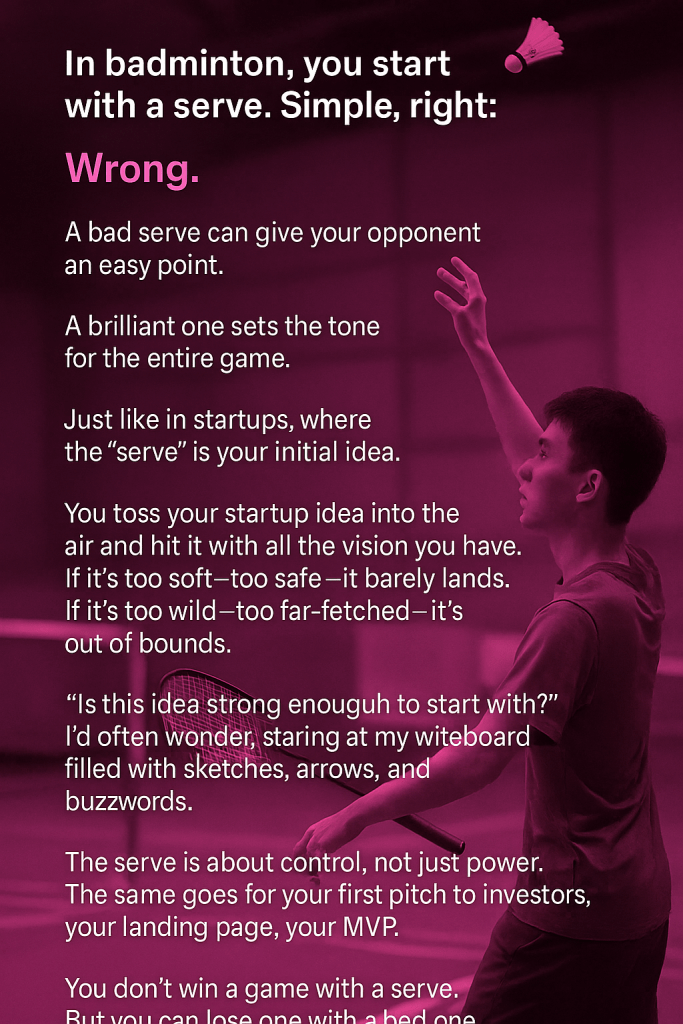
In badminton, you start with a serve. Simple, right?

Wrong.

A bad serve can give your opponent an easy point. A brilliant one sets the tone for the entire game.

Just like in startups, where the “serve” is your initial idea. You toss your startup idea into the air and hit it with all the vision you have. If it’s too soft—too safe—it barely lands. If it’s too wild—too far-fetched—it’s out of bounds.

“Is this idea strong enough to start with?” I’d often wonder, staring at my whiteboard filled with sketches, arrows, and buzzwords.

The serve is about control, not just power. The same goes for your first pitch to investors, your landing page, your MVP. You don’t win a game with a serve. But you can lose one with a bad one.

2. The Rallies: Execution and Iteration

Now comes the rally—the heart-pounding exchanges where you and your opponent hit the birdie back and forth across the net. This is execution.

This is where your startup lives most of its life.

Every shot you take is like a new feature you launch, a customer you onboard, or a bug you fix. You think fast. You move faster. You anticipate your opponent—your competitor.

You see, in badminton, you don’t always smash. You drop, you lob, you defend. You read your opponent’s stance and respond accordingly.

Likewise, building a startup isn’t about brute force. It’s about strategy. You have to adjust to the market, respond to feedback, outmaneuver bigger players. And sometimes, just sometimes, you make that perfect shot—a feature your customers absolutely love. The crowd (or at least your team) goes wild.

“Is this the moment? Should I smash it now or keep playing safe?”

Just like in rallies, timing is everything. Wait too long to act and the market changes. Act too soon and you burn out. The best founders, like the best players, read the game as they play.

3. The Smashes: Big Moves and Big Risks

Ah, the smash.

That glorious, thunderous, aggressive shot. It’s risky. But when it lands—it’s unforgettable.

In startups, your smash is your bold move. Maybe it’s raising a million-dollar round. Maybe it’s launching internationally. Maybe it’s pivoting entirely.

When you go for it, you’re saying: “I’m all in.”

But here’s the thing about smashes: if you mistime it, you fall flat. You open yourself up. You give your opponent (or the market) a chance to counterattack.

“I’ve missed a few of those smashes,” I admit. “Overhired. Overpromised. Underestimated the cost of scaling. It hurt.”

Yet you don’t stop smashing. Because if you only play defensively, you’ll be forever stuck reacting. Great players—and great founders—know when to go big.

4. Footwork: The Often Overlooked Key

Your ability to move across the court, to balance, to recover after each shot.

Talk to any coach, and they’ll tell you the secret to winning isn’t just about arm strength or racket skills. It’s footwork.

In startups, footwork is your discipline. Your routines. Your processes. Your adaptability.

“Was I flexible enough when things didn’t go as planned? Did I position my team in the right direction?”

Without good footwork, you’re always a step too late.

Without startup discipline—clear goals, consistent communication, product-market fit—you’ll always feel like you’re chasing, not leading.

The startup world celebrates flashy launches and viral growth, but real longevity comes from founders who know how to move, not just shoot.

5. Endurance: The Mental and Physical Game

Badminton looks easy—until you play a full set.

You’re sweating, your legs are on fire, your lungs are screaming, but the game isn’t over. You’re only halfway through.

Building a startup is no different. It looks glamorous—until you’re in it. Burnout, loneliness, imposter syndrome—these aren’t bugs; they’re features of the founder journey.

“Why does this feel harder than expected?” I’ve asked myself during the 3 a.m. coding marathons and the ‘no replies’ to important emails.

That’s when you dig deep. Just like athletes. You focus on recovery, resilience, routines.

Your team becomes your doubles partner—they catch what you can’t reach, they motivate you when your shoulders droop, and sometimes, they even push you back into the game when you feel like quitting.

6. The Coach and the Crowd: Mentors and Supporters

Behind every great player is a coach. Behind every startup is a mentor, advisor, or investor who believes when the scoreboard looks bleak.

You need people who tell you the brutal truth—“Your strategy is off.” Or, “You’re focusing on the wrong customer segment.”

And then there’s the crowd. The people cheering for you. Your early adopters, your friends who share your launch post, your parents who still ask what exactly it is you’re building.

“Do they really get what I’m trying to do?” Maybe not. But their belief… it carries you.

7. Match Point: The Exit or the Next Game

Eventually, there comes the match point. You’re either about to win—or lose.

Sometimes, your startup succeeds. You find product-market fit. You scale. You get acquired or go public. That’s your championship point.

But sometimes, the startup ends. Not with a smash, but a whisper. And it’s OK.

Because like in badminton, there’s always another game. Another tournament. Another idea.

You’ve trained. You’ve learned. You’re better than you were before.

Final Thoughts: Play to Win, But Love the Game

Here’s the truth: You don’t always control the outcome in badminton. A lucky net cord, a bad call, a slippery court—anything can happen.

Same with startups. Timing, trends, luck—they all play a part.

But what you can control is how you play. With heart. With hunger. With humility.

And when you love the game, win or lose, you walk off the court knowing…

“I gave it everything.”

Just like I did when I built FAVORIOT.

And just like I’ll do again for my next game. My next serve. My next smash.

Are you ready to pick up your racket and build your startup like a champion?

Because the court is waiting.

I Almost Quit—Until This One Question Reignited Everything

There was a morning I’ll never forget.

I sat in front of my laptop, staring at the screen. No emails. No new sign-ups. No traction.
Nothing.
Just silence.

“What am I even doing this for?” I whispered to myself.

I had poured years into this vision—this crazy dream of building something that could help others. And yet, there I was, running on fumes, trying to convince the world that IoT could actually change lives.

The doubt crept in like a fog.
I questioned everything—my choices, my career, my sanity.

But then, like a stubborn heartbeat, a question echoed back:

“Why did you start?”

It hit me harder than any investor rejection or platform bug.

I didn’t start for money. I didn’t start for fame.
I started because I believed in purpose-driven tech. Because I saw students struggling with theory and no tools. Because I saw cities disconnected, businesses stuck, and potential wasted.

I started because I knew I could help.

That’s what gives me direction—purpose. Not some fluffy motivational poster, but a raw, burning clarity that says, “Even if no one claps today, build anyway.”

Direction isn’t something you stumble upon in a fortune cookie.
It’s something you forge—through trial, reflection, and doing the work even when it’s hard.

It’s your “why” that pulls you forward when everything else tries to drag you down.

And now, whenever I hit a rough patch, I don’t panic.

I pause.

I ask again: Why did I start?

And the answer—every single time—points me exactly where I need to go.

Now your turn.
What question brings you back to your direction when you feel lost?

Why Customers Always Chase Freebies and Discounts (And Seem to Forget the Hard Work Behind)

“Why are people like this? Don’t they realize how much blood, sweat, and tears went into building this thing?”

I caught myself thinking that one night, staring blankly at the computer screen, after yet another customer asked for a discount. Or worse — asked if they could get it for free.

I sighed. Come on, Mazlan. Think deeper. Try to understand them, not judge them.

And so began my exploration into the psychology of why people love free stuff and discounts — and why they seem to have little empathy for the hard work poured into products.

The “Free” Mentality is Hardwired into Us

First, let’s be honest: we all love free things.

Free samples at the supermarket?

Limited-time free downloads?

“Buy one, free one” promotions?

Sign me up!

There’s actually a psychological term for this: zero price effect. Studies show that when something is offered for free, we assign it disproportionately high value. Rationally, a $1 chocolate bar and a $0 chocolate bar shouldn’t feel that different, but emotionally, free triggers excitement, joy, and a fear of missing out (FOMO).

It’s almost as if the word free lights up a part of our brain that says, “This is too good to pass up!” — overriding logical thought.

But still… do they have to ignore all the effort behind it?

I shook my head, feeling the familiar sting.

Why Discounts Become an Expectation

Discount culture didn’t come out of nowhere. Businesses themselves — in a bid to outdo each other — trained customers to expect discounts.

Sales. Coupons. Festive offers. Black Friday madness. 11.11 crazy deals.

It’s a never-ending cycle:

If your competitor offers 10% off, you feel pressured to offer 15%. Customers, seeing this pattern, naturally think: “Never buy at full price. Just wait a little, there’ll be a discount.”

And so it goes.

Over time, people don’t just hope for discounts. They demand them. They think, “If this product doesn’t come with a discount or free trial, something must be wrong.”

In their minds, it’s just business. They don’t see the late nights you pulled, the months spent perfecting the code, or the number of rejections you swallowed before even launching. They only see the price tag.

It’s not personal, I told myself. It’s conditioning.

The Disconnect: Makers vs. Buyers

Here’s where the real hurt happens.

As creators, we live the product.

Every feature added was a mini-victory. Every bug fixed was a tiny battle won. Every negative feedback was a dagger straight to the heart.

We remember every painful step.

They only see the final polished result.

Imagine spending three years painting a masterpiece, only for someone to say,

“Can I get it cheaper? Or free? After all, you enjoy painting, right?”

Ouch.

Ouch again.

The problem isn’t that people are cruel.

It’s that there’s a huge empathy gap between creation and consumption.

Consumers don’t experience the creation journey. They don’t feel the sacrifices, the sleepless nights, the financial risks.

They just see a product on a shelf — and instinctively behave like bargain hunters.

They don’t mean to devalue your work.

They just don’t see the invisible story behind it.

Entitlement in the Age of Abundance

Let’s be real — we live in a time of too much choice.

If you don’t offer it for free, someone else will.

If you don’t lower your price, they can find a dozen alternatives online.

This abundance fuels a sense of entitlement:

“Why should I pay full price when I know I can get something similar for free?”

The internet didn’t just make access easier — it made everything feel disposable.

Music. Movies. Software. Apps.

So, even if your work took years to craft, the modern consumer mindset often treats it like a Netflix subscription:

“Next!”

It’s brutal. But it’s reality.

So… Are Customers Just Ungrateful?

I wanted to scream yes.

But deep down, I realized… no.

Most customers aren’t consciously trying to insult developers or devalue companies.

They are simply operating within an environment they didn’t create:

An environment where free trials, freemiums, and 90%-off deals are the norm. An environment where “value” is determined by instant gratification, not by the depth of effort. An environment where how something was made is invisible.

If they knew the story, maybe they would appreciate it more.

If they knew the struggle, maybe they would feel differently.

But because they don’t, it falls on us, the makers, to tell that story. Again. And again. And again.

How Makers Can Respond (Without Losing Their Soul)

Here’s the truth:

You can’t undo decades of consumer behavior overnight.

But you can:

Educate your customers. Share your journey. Tell them about your process. (Behind-the-scenes videos, blogs, founder’s notes — they help bridge the empathy gap.) Stand firm with your value. If you know your work deserves a certain price, don’t cheapen it with desperate discounts. (Offer value, not just lower prices.) Offer entry points without devaluing your work. (Example: free trials with clear boundaries. “Experience it first — then support us by subscribing.” It’s a different psychology than “always free.”) Connect emotionally, not just commercially. (Brands that succeed today are those that have meaning. Customers support stories more than they support products.)

And maybe, just maybe…

Over time…

More people will say:

“I see the heart behind this. I want to pay full price — and even tip you extra.”

Is it naive to hope for this?

Maybe.

But I’d rather build with hope than surrender to cynicism.

Final Reflection: Freebies, Discounts… and Respect

At the end of the day, customers will always love free stuff and discounts.

It’s human nature.

It’s the market reality.

But respect?

Appreciation?

Understanding the work behind a product?

That has to be earned — not begged for.

It happens when we, as creators, step out from behind the curtain and invite them into our world.

When we make them feel the journey, not just see the result.

Maybe then, getting a “free trial” won’t feel like getting something for nothing —

It will feel like being gifted a piece of someone’s dream.

And maybe, just maybe, that will change everything.

I close my laptop with a small smile.

Tomorrow, I’ll tell the story again. And maybe someone will listen.

The Most Expensive, Yet Most Valuable Decision: When I Left Comfort to Create Meaning

“Are you sure you want to let go of all this?”

That question wasn’t just about salary, status, or position. It was actually a much deeper dilemma: Do I keep living in a system… or start building my own?

And my decision at the time—although it seemed like just a career move—was in fact a personal geopolitical shift. I didn’t leave because I was disappointed. I left because I saw a map no one else had drawn yet.

When the Comfort Zone Becomes a Cage

Many believe that the comfort zone is a reward after years of struggle. But few realize—stay too long, and it becomes a silent prison.

I was in a well-established organization, with a stable salary and a high-ranking position. But quietly, I became an actor in a script I didn’t write. The world was moving forward—IoT, AI, data economy—but we kept repeating old templates.

I saw young Malaysians becoming increasingly tech-savvy, yet there was no local platform to be their launchpad. We were still consumers, not creators. Still dependent on foreign digital infrastructure, without control or data sovereignty.

“If not us, then who?”

And that’s when the decision was born—not from courage, but from a sense of historical responsibility.

Leaving Power to Create Direction

I left my position. With no guarantees.

No office. No big team. No funding. Just an idea, conviction, and one burning resolve:

To build Favoriot as Malaysia’s true digital infrastructure.

Not just a platform. But a symbol. That we can be self-reliant. That innovation isn’t exclusive to Silicon Valley. That locals too can build world-class solutions.

But I knew the world doesn’t offer space just because of noble intentions.

The credibility I once had didn’t carry into the startup world. Emails that once received quick replies now fell silent. I was no longer a “Senior Director”—just an unproven founder.

But that’s the real cost of walking away from the old system—you lose short-term influence to build long-term strength.

Becoming an Architect in an Unbuilt World

Starting from zero is a spiritual exercise.

I had to become the thinker, the marketer, the engineer, the writer, the salesman—and sometimes… the coffee maker for guests who might not even become clients.

But in that process, I saw something I never did in the corporate world.

I saw how one IoT dashboard could change how a city council manages their city and provide information to their citizens.

How students using Favoriot got hired before graduation.

How universities started incorporating IoT into their syllabus not because the Ministry told them to—but because they saw the future.

And I began to understand—sometimes, real impact doesn’t come from applause. But from quiet change in the system.

This Decision Was Never Just About Me

Looking back, I realized this decision was never just personal.

It was about building an alternative.

In a world increasingly dependent on technology, those who control data, control the future.

If Malaysia continues to rely solely on foreign platforms, we will always be spectators in a drama written by others.

Favoriot is not the ultimate answer.

But it’s an attempt to carve a new lane.

So that Malaysia doesn’t remain on the sidelines.

So we have a choice. So we are not forever users—but creators.

What I Learned

We can’t wait for national change to trickle from above. Sometimes, true change begins when someone chooses to exit the system… and starts building a new one.

And yes, it hurts. It’s lonely. It’s full of failure.

But in that silence, I found my voice again.

And in those failures, I found strength I never knew I had.

The Question We Must Ask

Malaysia today is also standing at a similar crossroads.

Do we keep waiting for outside directives?

Or do we start writing our own script?

As I’ve learned from my own decision—what seems small, can ignite something far bigger.

The real question is:

Do we dare to leave our national comfort zone… to become a nation of builders?

Or will we remain a stepping stone in someone else’s grand agenda?


Because history won’t wait. And the future… belongs only to those bold enough to write it.


A New Chapter Begins: My Heartfelt Mission for Malaysia’s IoT Future

Alhamdulillah.
There are moments in life that make you pause. Not because you’re unsure—but because you feel the weight of something bigger than yourself. Being appointed as the Deputy Chairman of the Malaysia IoT Association is one of those moments for me.

I didn’t chase this title. It found me after years of walking the path—failing, building, sharing, writing, and dreaming about how technology could transform our nation. And now, I’ve been entrusted with a greater purpose: to carry the hopes of a growing community of changemakers and to help shape a future that belongs to every Malaysian.

This isn’t just a new role. It’s a calling.

This Land is Full of Potential

Malaysia is not short of talent. We are not short of ideas. But for far too long, we’ve been stuck in wait mode—waiting for foreign platforms, waiting for permission, waiting for funding. We must break that cycle. We must choose action.

Because Malaysia doesn’t need to follow trends anymore.
We have what it takes to create them.

The Role of IoT in Our Nation’s Story

Let’s get one thing straight—IoT is no longer about devices.

It’s about connecting hearts and systems.
It’s about bridging rural and urban, old and new, human and machine.
It’s about giving our nation eyes that can see in real time and ears that can listen before disaster strikes.

From the farms of FELDA to the traffic lights of KL…
From lecture halls to factory floors…
IoT is not just a tool. It’s a lifeline.

And what many don’t realise is—AI needs data.
But not just any data. It needs real-world, real-time, reliable data.
And IoT is the only way we can feed that intelligence.

A Personal Mission, A National Cause

So what do I see ahead?

I see a Malaysia that no longer depends on imported systems we don’t control.
I see homegrown platforms like FAVORIOT becoming the national backbone.
I see students graduating not with theoretical knowledge—but with hands-on IoT skills, certified and industry-ready.
Every Majlis Perbandaran has its own IoT dashboard, managing waste, lighting, traffic, and water in real-time.
I see SMEs embracing smart automation—not fearing it.

But more than anything…

I see people—living safer, healthier, and more connected lives.

The Time is Now

Some say we’re not ready yet.
But if we keep waiting for perfect conditions, we’ll never move.
Neither was Korea ready in the 1980s. Or China in the 1990s. But they moved.
And now the world watches them.

It’s our turn.
Let’s start messy. Let’s start small.
But most importantly—let’s start now.

To the Silent Fighters

To every young innovator quietly coding in a dorm room.
To every lecturer who buys sensors out of pocket to teach their students.
To every entrepreneur who builds despite rejection after rejection.

I see you.
And in this new role, I carry your hopes with me.

Let us walk this path together—not because it’s easy. But because it matters.

A Final Word from the Heart

This journey is no longer mine alone. It belongs to all of us who believe in a better digital Malaysia.

To those who built the foundation before me—thank you.
To my peers in MyIoTA and the wider tech community—I’m ready to stand with you.
And to the next generation—we’re building this for you.

Let’s make IoT not just a technology—but a legacy.
Let’s make Malaysia not just relevant—but revolutionary.

The future doesn’t wait.
And neither should we.

Bismillah. We begin.

Where Do I See Myself in 10 Years?

Where Do I See Myself in 10 Years?Reflections of a 64-Year-Old Dreamer Who Still Believes

“Ten years from now? That’s 74… You sure you want to think that far ahead?”
That was the first voice in my head when I read the question.
“Come on, Mazlan. You’re 64. Isn’t it time to slow down?”

But that voice didn’t last long.

Another voice — louder, bolder, more familiar — gently whispered,
“Slow down? You’ve just started walking your true path.”

That, my friend, is the voice I’ve listened to all my life.

The Clock Doesn’t Define Me

I’ve always seen age as numbers, not limits. The world might call me a “senior,” but my dreams don’t carry wrinkles, and my purpose doesn’t need walking sticks.

Yes, the body is slower — I’ll admit that. Knees creak more than they used to, and climbing stairs feels like a mini leg day. But the fire in me? It burns as fiercely as it did when I was 24, maybe even brighter now.

If anything, I’ve become more dangerous — not because of youth, but because of clarity. I know what matters. I know what I can ignore. I know who I am. That took decades to earn.

In 10 Years, I See…

1. Myself Still Creating
I don’t want to retire into silence. I want to retire into purpose.
“But Mazlan, what will you still be creating?”
Stories. Ideas. Opportunities. A legacy.

I see myself writing more — maybe a book that finally captures the full arc of my journey. Maybe I’ll title it “The IoT Man Who Never Gave Up.”
I want to write not just for entrepreneurs or engineers… but for anyone standing at the edge of doubt, wondering if it’s too late to start. I want them to know — it’s never too late. I’m proof.

And beyond writing? I’ll still be creating ecosystems. Platforms. Programs. Things that last longer than I do.

2. A Nation of Young Dreamers Trained by My Hands
I dream of walking into a university lab and seeing students working on real-world IoT systems — not because they were told to, but because they were inspired to.

Some of those students might call me “Professor,” or maybe just “Sifu.”
Some of them will know my name from stories their lecturers told.
Some might even come up and say,
“Dr. Mazlan, it was your video, your talk, your comic that made me believe I could do this.”

That… That would mean everything.

3. Favoriot Becoming a Global Force
In 10 years, I want Favoriot to stand not just as a Malaysian platform, but as the ASEAN reference for democratizing IoT.

Not because we had the biggest investors. Not because we built the fanciest dashboards.
But because we stayed consistent. Because we believed in building from within.

I want to see partners from 25, 30, 40 countries — each with their own IoT academies, each training their youth through Favoriot’s platform.

I want the world to know:
“This came from Malaysia.”

4. My Grandchildren Teaching Me New Tricks
Yes, I see myself as a grandfather of ideas and technology. But also — hopefully — a real grandfather.

I imagine a small hand tugging at mine,
“Tok Bak, how did you build all this?”
I’ll smile. “With time, failure, and this old stubborn heart.”

They’ll be digital natives, perhaps building with AI, robotics, or tools I can’t even imagine now. But I want to remain curious.
To listen.
To learn.
To laugh with them when I get it wrong.
To beam with pride when they surpass me.

Because the only thing better than building your dream… is seeing the next generation build bigger ones.

My Days Will Be Quieter, But My Impact Louder

In 10 years, I won’t be racing from meeting to meeting.
But I might still wake up at 5:30 AM. Sit by the window with my mug of kopi o, pen in one hand, thoughts in another.

I’ll be reflecting more than running.
Speaking less, but with more weight.
I might appear less on stage, but more in hearts.

I’ll write more love letters to this beautiful world that gave me chances.
Letters disguised as blog posts, talks, podcasts, maybe even a comic strip here and there.
One titled “The Last Adventure of IoT Man.”
(But don’t worry, he always comes back for a sequel.)

If I’m Lucky… I’ll Still Have Time

“Mazlan, do you think you’ll still have the energy?”

That question used to scare me.

But I’ve learned — energy doesn’t come from the body.
It comes from the heart. From purpose. From waking up with something worth fighting for.

If I still have the energy to smile at the sunrise,
to mentor a young founder,
to write one more idea that outlives me,
then yes — I’ll still be in the arena.

My Final Decade of Legacy

The next 10 years may be my most meaningful yet.

Not the flashiest.
Not the fastest.
But the most authentic.
The most connected.
The most fulfilled.

I won’t measure success by income charts or social media stats.
I’ll measure it by how many lives I’ve helped ignite.
By how many students I’ve believed in.
By how many said, “Because of you, I didn’t quit.”

So where do I see myself in 10 years?

Right where I need to be.
Still serving.
Still dreaming.
Still building.

And perhaps, finally, resting — but only after I’ve passed the torch.
With a smile. With peace. And with the unshakable belief that I’ve done what I was born to do.

“I see a 74-year-old man… not slowing down, but rising. A man who looks back with pride and forward with grace. A man who lives not in the shadow of his youth, but in the light of his impact.”

Yes, that’s where I’ll be.

InshaaAllah.

Why Do Students Hire Outsiders to Do Their Projects?

A Response from an Educator, Entrepreneur, and Tech Education Advocate

“Why are students willing to pay outsiders to do their projects? What’s the root cause? Where did we go wrong?”

This question isn’t new. It has been raised many times in discussions between academics, industry players, and the tech maker community. But this time, it was addressed with raw honesty by a trainer who truly understands students — someone who has taught students, trained lecturers, and now works with industry professionals. I found the four points he raised very insightful, and I’d like to unpack them — not to dispute, but to build on the conversation with my own experience.

1. University Syllabi Don’t Offer Enough Hands-On Experience?

“Is this really true, or are we not seeing the bigger picture?”

I’ll admit — there’s some truth to this. Many students who’ve come to me for consultation, especially on IoT or Favoriot training, often complain that their final year projects had to rely on self-learning via YouTube because they lacked deep technical guidance.

“But… surely not all universities are like that?”

Exactly. Some universities have moved towards hands-on learning, especially polytechnics, vocational colleges, and certain engineering faculties that actively collaborate with industry. The real problem is inconsistency. Some still rely heavily on simulation — and in fields like IoT, AI, or robotics, learning without touching hardware is like trying to learn swimming on dry land.

When I trained university lecturers through our Train the Trainers program for IoT, I saw firsthand how much they wanted to shift to practical methods — but were sometimes constrained by equipment, budget, or institutional policies. That’s reality.

This is why platforms like Favoriot are designed to break those barriers — offering affordable, easy-to-access platforms that can be embedded into courses, enabling students and lecturers to work from basic projects to advanced real-time data integration.

2. Lecturers Can’t Identify Student Talents?

“Are we too busy to notice the potential blooming right in front of us?”

As a former lecturer, I understand the pressure — full lecture schedules, endless meetings, research deadlines, and admin tasks. It becomes almost impossible to personally assess each student’s potential — unless they step forward.

But that’s not an excuse.

I’ve learned something through running smaller classes. “When the group is small, it’s easier to spot who’s struggling, who’s excelling. But in a lecture hall with 100 students?” We need a system.

Some suggestions:

  • Use mini-projects at the beginning of the semester to diagnose technical aptitude.
  • Bring in industry mentors (like us at Favoriot) to support project work.
  • Offer microlearning platforms like IoT Academy as supplements, not just stick to lecture notes.

Talent has to be discovered — not waited on.

3. Students Chase Paper Qualifications Only?

“Grades matter. But is that the ultimate goal?”

Many students believe excellent CGPAs equal great jobs. But times have changed. Employers now care more about your portfolio than your transcript.

I’ve met students with perfect grades who can’t troubleshoot a sensor. But I’ve also seen average students who build working temperature-monitoring systems with Telegram alerts using Favoriot — and are now working with real IoT startups.

This isn’t about who’s smarter, it’s about who’s brave enough to learn on their own.

That’s why we always encourage students to start with mini-projects early in the semester. Better to fail early and learn fast. We must build a culture of “learn by doing, fail fast, recover faster.”

4. Universities Are Slow to Update the Syllabus?

I fully agree here. Technology evolves every six months — yet syllabi may only change every six years. Changing a curriculum isn’t easy — it requires senate approvals, academic committees, MQA validation, and more.

But I applaud technical institutions like TVET, polytechnics, and certain private colleges that quickly adopt new tech. Some don’t just teach “how to use,” but also “how to think.”

However, we can’t just create skilled workers. We need thinkers, problem-solvers, and future tech leaders — those who can build solutions, not just follow instructions.

That’s why Favoriot is more than just a data platform. It’s a thinking tool. A place where students ask:

  • How can I solve a real-world problem?
  • How does data help decision-making?
  • How can tech integration impact communities?

So… Is It Wrong for Students to Hire Outsiders?

I asked myself the same thing — is it the students’ fault or the system’s?

I don’t fully blame the students. Sometimes they panic, lack support, and just want to pass. I also don’t blame those who offer project services — sometimes that’s the only indirect way a student learns something.

“But… if a student pays and learns nothing — that’s the real problem.”

We need to change the narrative:

  • From “doing it just to pass” to “doing it to learn.”
  • From “copying projects” to “creating value.”

From Training Students to Training Lecturers to Training Industry

I understand what the original author meant when he said:

“I used to train students, then lecturers, and now industry staff…”

That’s the cycle. When students and lecturers reach a certain capability, they don’t need you anymore. And that’s not a loss — that’s a win.

I’ve experienced the same. When IoT becomes embedded in campus life, when the Favoriot dashboard becomes an official teaching tool — I know my mission is progressing. Even if I’m no longer invited, I quietly smile inside.

“Opportunities will always come — maybe not from the same place, but from the impact you’ve already planted.”

To close:

  • Students need more hands-on guidance.
  • Lecturers need time and tools to identify talent.
  • Universities need the courage to match industry demands.
  • And all of us must see education as more than just passing — it’s about living, contributing, and growing.

For those who help students — do it with the heart to teach, not just to earn. Let them learn — even if it’s through you.

One day, they will thank you — not for finishing their project, but for making them someone who can stand on their own and create value.

“That’s the real purpose of education. And that’s the legacy we should all strive to leave behind.”

Transform Your Day: The Power of Early Morning Habits

Every morning at 5:30 a.m., without fail, my eyes flutter open—not to an alarm, but to an internal clock that has been fine-tuned through decades of habit, discipline, and a desire to live each day intentionally.

“Let’s go. Time to wake the soul before the world does.”

That’s the first self-reminder that echoes in my mind.

As a 63-year-old who has gone through the different chapters of life—academia, government service, the corporate world, and now the startup scene with FAVORIOT—I’ve come to learn that how I start my morning sets the tone for everything that follows. You don’t command a smart city, build an IoT platform, or inspire others without conquering the first hour of your day.

5.30 AM: The Awakening

I rise from my bed with quiet intention. The world outside is still cloaked in darkness, and it’s in that serenity that I find my strength. The first thing I do is perform wudhu’ (ablution). It’s a spiritual reset button. A symbolic and literal cleansing — not just of the body, but of the mind and soul.

Then, I perform the Subuh prayers. These early morning prayers are more than just a ritual for me. They’re my grounding force.

“Ya Allah, guide me today to inspire, write, build, and serve.”

Some mornings, I sit in reflection a bit longer, especially when I feel the weight of a decision coming. Running a startup like FAVORIOT and juggling multiple commitments as an adjunct professor and speaker means my days can get chaotic. But those few moments after Subuh are sacred. They keep me anchored.

6.00 AM – 7.00 AM: My Creative Hour

The house is quiet. No distractions. No emails. No phone calls. Just me and my thoughts.

This is when I do something that surprises many people — I write.

Yes, every day, I try to write for at least an hour — whether it’s a blog article on mazlanabbas.com, an update on IoT for the FAVORIOT community, or even just scribbles for future social media posts.

Don’t get me wrong — there are days when I sit in front of the laptop and…

“Nothing. Not a single idea. Writer’s block? Again?”

On days like these, I don’t force it. Instead, I use Jetpack’s Prompts from WordPress. They’re like sparks that ignite the dormant corners of my mind. Sometimes, a simple question like, “What is one lesson you’ve learned the hard way?” leads me to unearth a memory from my early days at MIMOS or CELCOM or a lesson learned from building FAVORIOT with limited resources.

These prompts aren’t just writing cues. They’re invitations to reflect, connect, and document a life of learning and leadership.

6.45 AM: Engaging with My Digital Circle

Once the writing juices slow, I turn to my social media platforms, especially Facebook.

This might sound like the opposite of focus, but for me, it’s strategic. Over the years, I’ve built a strong and engaged community — professionals, students, fellow entrepreneurs, and tech enthusiasts. These aren’t just followers. They’re part of my extended family.

I check comments, reply to messages, and share new thoughts. Sometimes, I post a new blog entry, and sometimes, I respond to an interesting article someone tagged me in.

“Should I post this now? Or will it do better later?”

Sometimes, I overthink it. But more often than not, I remind myself — just share. Be real. Be consistent. It’s not about chasing likes. It’s about building trust and leaving digital footprints that matter.

Social media, for me, isn’t entertainment. It’s a way to educate, inspire, and connect. And it’s the perfect way to warm up before I switch into business mode.

7.00 AM Onwards: Preparing for the Day’s Battles

By this time, my mind is vigilant. I feel like I’ve already accomplished something — prayed, reflected, created, engaged.

Now it’s time to get ready for the workday.

Depending on the day, I might be:

  • Reviewing IoT platform updates with the tech team at FAVORIOT
  • Preparing slides for a keynote at an IoT or Smart Cities conference
  • Conducting an online training session via FAVORIOT Academy
  • Planning strategic calls with our global partners from the FAVORIOT Partner Network

Before I leave the house, I double-check my notebook (yes, I still use a physical one)—a habit from my CELCOM and MIMOS days. I jot down key priorities for the day—three things max.

“Mazlan, don’t try to do everything. Just do these three things really well.”

And with that, I’m ready.

Why My Morning Rituals Matter

Over the years, I’ve learned that rituals are more powerful than motivation. Motivation comes and goes, but habits—especially morning habits—are what carry us through uncertainty.

There was a time when my days were filled with back-to-back meetings, long commutes, and firefighting urgent issues. But even back then, I protected my mornings. That first hour is mine — no matter where I am.

It’s the hour when I’m not CEO Mazlan, Professor Mazlan, or even the guy people tag in IoT discussions. I’m just me—a man with thoughts, reflections, faith, and words to share.

My Advice to You?

Build your morning around what truly matters.

  • Maybe it’s prayer.
  • Maybe it’s writing.
  • Maybe it’s exercise, journaling, or reading.
  • Maybe it’s just sitting in silence with your coffee.

But own that hour. Make it yours. Protect it like your most valuable asset — because it is.

You don’t need a 15-step productivity routine. Just a small, consistent rhythm that aligns with your purpose.

For me? Subuh. Writing. Connecting.

That’s more than enough.

“Let’s begin the day. The world awaits. But I’ve already won the morning.”

Everyone Wants the Spotlight. Few Are Willing to Wait for It

What’s Something Most People Don’t Understand?

Most people don’t understand how long it takes to build something meaningful.

Even after all these years, people still think things happen overnight.
They see the highlight reels. They see the LinkedIn success stories. They see the awards, the recognition, the partnerships. And they say— “Wow, you’re lucky.”

But they don’t see what happens behind the scenes.

When I co-founded FAVORIOT, I wasn’t stepping into a shiny, ready-made startup with capital pouring in and clients lining up at the door. No, it was the opposite. I entered a tiny room with big dreams, minimal funding, and zero guarantees.

I had to reset my ego.
After holding senior positions at MIMOS and CELCOM, I was now doing everything—research, customer support, marketing, writing blog posts, uploading YouTube videos, conducting training, chasing potential clients, and even troubleshooting hardware late at night. I was a CEO, but I was also the janitor.

That’s what most people don’t understand.

They think success is linear.
They think you just launch a product and are suddenly on a TED stage.
They don’t see the years of trial and error, the failed pitches, the near-burnouts, and the countless self-doubts.

I still remember attending an international Smart Cities conference years ago. Delegates were surprised when I told them we were a small team from Malaysia, building our own IoT platform. Some of them didn’t even believe it. They asked, “But how did you build it? Don’t you need a huge team? Venture capital?” I smiled and said, “No. We built it because we believed we could.”

Belief is underrated. And persistence—even more so.

People underestimate how long you must persist when nothing seems to work.

I wrote blog after blog when no one was reading.
I spoke at conferences when no one knew my name.
I kept talking about IoT and Smart Cities when the market didn’t understand IoT.

Even on Medium, when I started writing actively in 2023, I wasn’t writing for an audience. I was writing because I had something to say, something to teach, something to reflect on.

Some articles flopped. Others resonated deeply. But most people only see the few that succeeded—they don’t see the hundred others that didn’t.

They don’t understand the patience it takes to outlast the silence.

Let’s talk about time.
People think one or two years is enough time to build a company, an audience, or a movement.

But FAVORIOT has been around since 2017.
We didn’t become known overnight.
We had to win trust, prove our value, build case studies, make mistakes, recover from them, and try again. Again. And again.

It’s like planting a seed. You don’t dig it up every week to check if it’s growing. You water it, give it sunlight, and trust that one day it will break through the soil. But that trust? That takes faith. That’s the part most people struggle with.

“Why isn’t it growing yet?”
“Why is no one noticing me?”
“Maybe I’m not good enough.”

Believe me—I’ve had those thoughts, too.
I’ve looked at competitors with massive followings and felt small.
I doubted whether I was too old to do this startup thing.
I’ve wondered if people even cared about what I was trying to build.

But each time, I returned to the same answer:
Because I care.

I care about helping people learn about IoT.
I care about giving Malaysians a home-grown IoT platform.
I care about empowering universities, cities, and entrepreneurs with technology that works.

I realized that most people don’t need motivation. They need understanding.
Understanding that the journey will be extended.
It’s okay to feel invisible at first.
That mastery takes years.
Most “overnight successes” are 10 years in the making.

So here’s what I want you to remember:

  • You don’t need everyone to understand your journey.
  • You just need to understand it yourself.
  • And you need to commit to showing up, even when no one’s clapping.

Because one day, someone will ask you, “How did you do it?”
And you’ll smile, knowing they won’t really understand until they walk the same path.

But maybe, just maybe, they’ll listen a little closer.
And perhaps that will inspire them to start their own long, messy, beautiful journey.

And that’s enough.

Now, back to work. The journey continues.