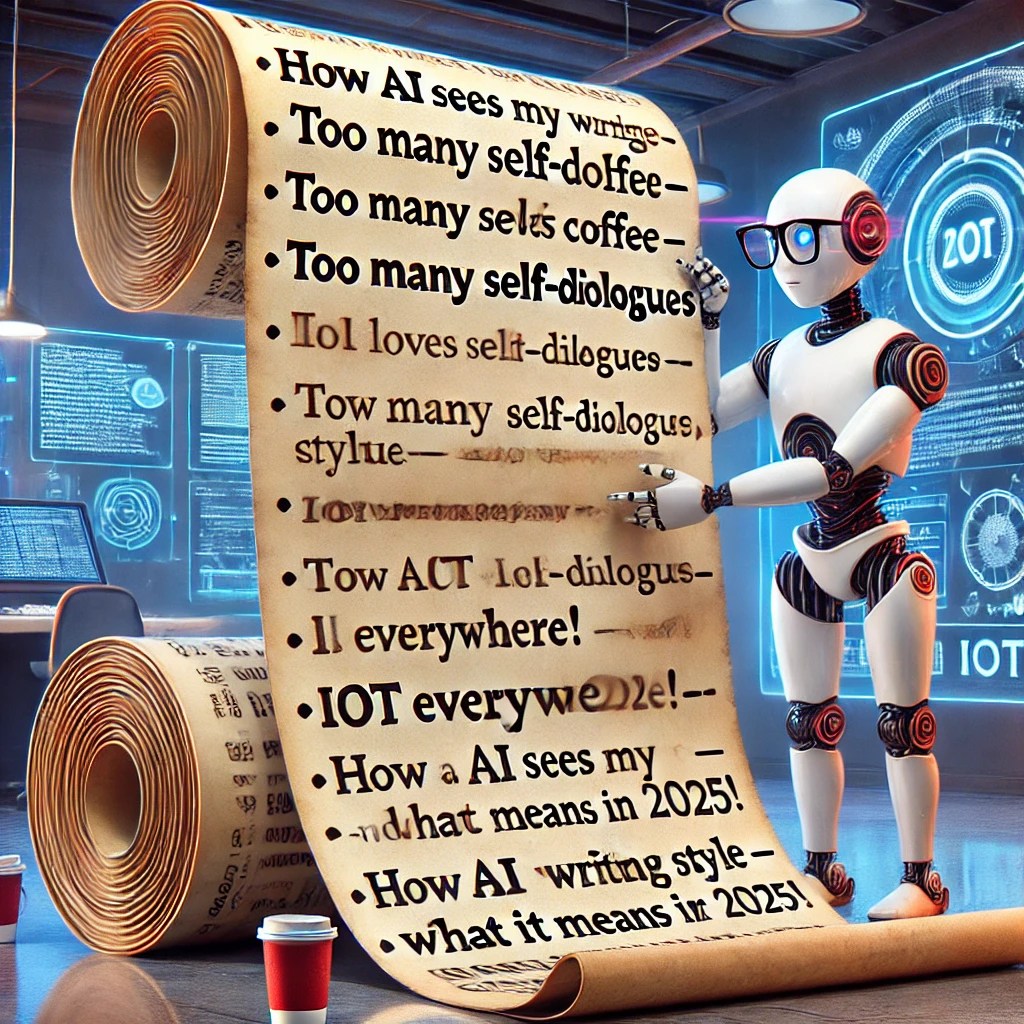
How AI Sees My Writing Style – And What It Means for 2025

“Do I really have a writing style?”

That question kept bouncing in my head as I stared at the AI analysis of my articles. I’ve always written instinctively—pouring out thoughts, reflecting on experiences, and hoping they resonate with someone out there. But now, with a year’s worth of writing analyzed, I can’t help but smile.

The verdict?

I’m a storyteller at heart. I thrive on conversations. Most importantly, I write for impact.

So, let’s break it down. What makes my writing style uniquely mine?

1. Storytelling is My Foundation

“You should start with a story.”

I remember hearing that advice long ago. At first, it felt unnecessary—why not just get straight to the point? But over time, I realized that stories bridge the gap between knowledge and understanding.

When I write about IoT, I don’t just list facts. I take readers on a journey, whether they’re entrepreneurs struggling to deploy smart city solutions or university students trying to commercialize an IoT project.

Take “Why Writing Is Like Running a Marathon” or “The Silent Struggles of Researchers”—I don’t just talk about endurance and challenges. I live through them in my writing.

Why it matters: Stories stick. They make abstract ideas tangible and personal.

2. Conversational and Relatable Tone

“Write as if you’re talking to a friend over coffee.”

That’s how I approach my articles. No stiff, robotic sentences. No excessive jargon. Just me, having a conversation with you.

Whether I’m sharing “How Medium Shaped My Voice” or “Why You Should Write From the Heart,” my goal is simple: I want you to feel like we’re just sitting together, chatting about life and ideas.

Why it matters: Readers don’t want to be lectured. They want a dialogue.

3. First-Person Perspective Brings Depth

“Why do you always write in first person?”

Because it’s real. Because it’s personal. Because I believe the best way to inspire is by showing—not just telling.

If I write about IoT projects in universities or my journey in the corporate world, I’m not giving a third-person analysis. I’m sharing my experiences, lessons, and mistakes.

Why it matters: It builds trust. Readers connect with people, not abstract ideas.

4. Structure Matters – A Lot

“Make it easy to read.”

Long, unbroken paragraphs? No thanks. My articles are structured with clear sections, subheadings, and logical flow.

If I’m explaining “5 Lessons I Learned About Writing” or “How Favoriot Empowers IoT System Integrators”, I want you to get value fast.

Why it matters: Clarity keeps people reading. A good article doesn’t feel like work—it flows effortlessly.

5. Motivation and Inspiration Are My Hidden Ingredients

“People don’t just read for information. They read for inspiration.”

When I wrote “Why Persistence in Writing Matters” or “Every Failure Was a Step Toward Success”, I wasn’t just telling stories. I was giving hope.

I know what it’s like to feel stuck. To feel like no one is listening. To wonder if your efforts are even worth it. But every challenge I’ve faced has led me somewhere better. That’s the message I want to leave behind.

Why it matters: Inspiration fuels action.

6. Versatility Without Losing Identity

“Do you only write about IoT?”

No. And I never will.

My interests are broad—entrepreneurship, technology, personal growth, writing—but my voice remains the same. Whether discussing IoT’s future or writing a letter to my future self, it still feels like me.

Why it matters: A consistent voice makes a writer memorable.

7. Emotion and Logic Go Hand in Hand

“Facts alone don’t convince people. Emotions do.”

When I wrote “How Responding to Comments Boosted My Writing Output,” I didn’t just provide statistics. I also shared how engaging with readers felt —the excitement, the connections, the motivation.

Then, I supported my argument with logic—why engagement matters, how it impacts visibility, and what writers can do to grow.

Why it matters: The best articles engage both heart and mind.

8. Analogies and Metaphors Make Everything Click

“Explain it like they’re five.”

If I say, “Writing is like running a marathon,” you immediately understand endurance is key. If I say, “A Medium writer is like a badminton player,” you get that consistency and technique matter.

I use analogies because they simplify complexity. IoT, AI, writing—whatever the topic, if I can compare it to something familiar, it becomes easier to grasp.

Why it matters: Analogies make learning fun and effortless.

9. Audience-Centric Writing

“Who am I writing for?”

Every article I write answers a question or solves a problem.

Whether it’s “Why You Should Not Give Up Writing” or “How Favoriot Empowers IoT System Integrators”, my focus is always: How can this help the reader?

Why it matters: Readers stay loyal when they feel seen and understood.

10. Learning and Growing Through Writing

“Writing is my best teacher.”

I reflect a lot in my articles.

From “Lessons Learned in My 13-Year Telco Career” to “My Journey of Writing 550 Articles on Medium”, I use my past as a learning tool. I talk about mistakes, breakthroughs, and the evolution of my thoughts.

Why it matters: Growth is relatable. Readers appreciate honesty.

What This Means for 2025

Seeing this breakdown made me realize one thing—I love writing.

And in 2025, I’ll write even more.

✔ More stories that resonate.
✔ More conversations that connect.
✔ More insights that inspire.

If AI says my writing has an impact, I owe it to myself (and my readers) to keep going.

Because at the end of the day, writing isn’t just about putting words on a page.

It’s about sharing experiences, shaping perspectives, and leaving a legacy.

Here’s to another year of storytelling.

Who Will Lead the AI Race? Alibaba, DeepSeek, or OpenAI?

For years, the AI industry was dominated by Western tech giants like OpenAI, Google, and Microsoft. If you wanted access to the most powerful AI models, you either had to pay a premium or rely on whatever limited open-source alternatives were available. But in the past year, China has emerged as a serious contender, with Alibaba’s Qwen 2.5-Max and DeepSeek’s AI models challenging OpenAI’s dominance.

With three major players now in the spotlight—OpenAI, Alibaba, and DeepSeek—the big question is: Who will have the biggest impact?

Alibaba’s Qwen 2.5-Max: The Biggest Game-Changer?

1. Open-Source Availability: AI for Everyone, Not Just Big Tech

Unlike OpenAI and DeepSeek, which still maintain some level of exclusivity, Alibaba has taken a bold approach—releasing over 100 models from the Qwen 2.5 family as open-source.

This move is significant because:

  • It allows smaller businesses, researchers, and developers to build AI-powered applications without massive budgets
  • It accelerates global AI innovation, reducing reliance on Western AI monopolies
  • It levels the playing field, as anyone can access and customize Qwen’s models

Meanwhile, OpenAI’s GPT-4 and GPT-4o remain closed-source, limiting their accessibility. DeepSeek has released open-source models, but their reach is still largely within China and research communities.

If Alibaba continues to expand its open-source offerings, it could fundamentally shift the AI industry, much like how Linux transformed software development.

2. Performance vs. Cost: Who’s Winning the AI Benchmark Battle?

Performance benchmarks suggest that Qwen 2.5-Max is outperforming both DeepSeek-V3 and OpenAI’s GPT-4 in various AI tasks—from handling complex queries to multilingual processing.

But cost-effectiveness matters just as much as raw power. DeepSeek’s AI models are designed to be highly efficient, making them cheaper to run. This could attract businesses looking for powerful AI solutions without excessive computational costs.

OpenAI remains the leader in brand recognition and market presence, but its pricing model remains a concern for many. If Alibaba or DeepSeek can offer similar capabilities at a lower price point, OpenAI may need to rethink its strategy.

3. Multilingual AI: Qwen 2.5-Max Breaks Language Barriers

Most AI models are English-centric, which limits accessibility for non-English speakers.

  • Qwen 2.5-Max supports 29 languages, making it one of the most globally accessible AI models.
  • DeepSeek’s reach outside China is still uncertain, though it has strong backing domestically.
  • OpenAI’s ChatGPT is still largely optimized for English, with limited performance improvements in non-English languages.

For businesses and governments in Asia, Africa, and Latin America, Alibaba’s multilingual AI could be a game-changer. The more localized an AI model is, the more valuable it becomes for regional markets.

4. Enterprise Adoption: Who’s Getting Integrated Faster?

It’s one thing to build a powerful AI model—it’s another thing to get real businesses to use it.

Alibaba’s Qwen AI models are already being adopted in industries like:

  • Automotive (for AI-powered driving assistants)
  • Banking (for financial analysis and chatbots)
  • Retail (for customer service and product recommendations)

DeepSeek, while innovative, lacks major enterprise partnerships outside research institutions. Meanwhile, OpenAI’s models are widely used in Western markets, but its expansion into Asia and emerging economies remains slower compared to Alibaba.

If Alibaba can secure more industry adoption, it could become the go-to AI provider in non-Western markets.

5. Competitive Pressure on OpenAI: A Wake-Up Call?

For the longest time, OpenAI had no real competition. But with Qwen and DeepSeek gaining traction, the AI race has become a lot more unpredictable.

  • OpenAI is now rushing to release GPT-4.5 or “O3” sooner than expected, likely in response to competition.
  • If OpenAI doesn’t adjust its pricing, accessibility, or model capabilities, it risks losing users to cheaper and more open alternatives.

This is a critical moment for OpenAI—does it continue with a closed, premium AI model, or does it shift towards more affordability and openness?

Final Verdict: Who Will Have the Biggest Impact?

Biggest Short-Term Impact → Alibaba’s Qwen 2.5-Max

Why? Open-source availability, multilingual AI, and real enterprise adoption make it the most widely accessible AI model right now.

Biggest Long-Term Disruptor → DeepSeek

Why? Its cost-effective, research-driven approach makes it a dark horse in this race. If it expands globally, it could seriously challenge OpenAI and Alibaba.

Most Stable Market Leader → OpenAI

Why? It still holds the largest brand recognition, but will need to adapt quickly to remain competitive in a rapidly evolving AI landscape.

What’s Next?

  • Will OpenAI lower its pricing to compete with Alibaba and DeepSeek?
  • Can DeepSeek expand beyond China and into global markets?
  • Will Alibaba continue its open-source strategy, or will it tighten access in the future?

No matter what happens, one thing is clear: The AI market is no longer dominated by just one company. And that’s good news for everyone.

How AI Democratization by Alibaba is Changing the World—And Why It Matters to You

Artificial intelligence felt like it belonged only to big tech companies for years—something out of reach for the average developer, startup, or business. If you didn’t have millions in funding, good luck getting access to advanced AI models. But that’s starting to change, and one of the most significant moves in AI democratization is coming from an unexpected player: Alibaba.

AI for Everyone, Not Just the Tech Giants

Recently, Alibaba’s Qwen 2.5-Max has been making waves. This AI model has been outperforming DeepSeek-V3, which was once seen as one of the strongest players in the field. While DeepSeek is struggling with issues like cost-cutting and sustainability, Alibaba is doubling down on AI, and investors are taking notice.

But the real story here isn’t just about market competition—it’s about who gets access to AI. Instead of keeping Qwen locked up behind a paywall, Alibaba did something bold: they made it open-source. That means anyone—from solo developers to small businesses—can use, modify, and build on top of Qwen’s technology for free.

This is a big deal.

Why Open AI Matters to You

Imagine trying to build a house, but the best tools and materials are only available to a few rich contractors. That’s what AI has felt like for a long time—unless you were Google, Microsoft, or OpenAI, you were stuck using whatever basic tools were available.

Alibaba is changing that. They’ve released over 100 models from the Qwen 2.5 family, allowing people all over the world to build AI-powered applications. Whether you’re working on a smart farming system, a chatbot for customer service, or an AI-driven medical assistant, you now have access to tools that were once only available to billion-dollar companies.

AI That Speaks Your Language

Here’s something even more impressive: Qwen supports 29 languages.

Most AI models are designed with English speakers in mind. If your native language is Malay, Tamil, Arabic, or Swahili, you often have to struggle with AI that doesn’t understand cultural nuances or local dialects.

Alibaba is breaking down that barrier by ensuring AI works for more people, in more parts of the world. This is especially important for businesses and communities that have been left behind in the AI boom. Now, a small startup in Malaysia or a research team in Nigeria can build AI-powered solutions tailored to their own markets—without being forced to work in English.

The Real Meaning of AI Democratization

So, what does AI democratization actually mean? It means leveling the playing field. It means that AI isn’t just a tool for the rich and powerful—it’s something everyone can use.

Alibaba’s move with Qwen is a clear sign that we’re entering a new era. No longer is AI something that’s locked away in Silicon Valley. Instead, it’s becoming a tool that developers, businesses, and creators from all over the world can use to solve real problems.

What’s Next?

The question now is: Will other big tech companies follow Alibaba’s lead?

Will they keep their AI models behind closed doors, available only to those who can afford them? Or will they embrace the idea that AI should be accessible to all?

Whatever happens next, one thing is clear: AI is no longer just for the elite. It’s for you, me, and everyone who dares to dream big and build something new.

And that’s a future worth getting excited.

More AI Stories

  1. Who Will Lead the AI Race? Alibaba, DeepSeek, or OpenAI?
  2. How AI Democratization by Alibaba is Changing the World—And Why It Matters to You
  3. ChatGPT, CoPilot, Gemini, Grok, Perplexity, Claude & DeepSeek: Which One Should You Choose?
  4. Why Building AI and IoT Products Locally Can Save a Country
  5. Why IoT and AI Are the Backbone of a Nation’s Technological Sovereignty
  6. Top AI Tools for 2025: Boosting Efficiency Across Various Domains
  7. DeepSeek vs NVDIA: How China Build Their AI Sovereignty

ChatGPT, CoPilot, Gemini, Grok, Perplexity, Claude & DeepSeek: Which One Should You Choose?

Here’s a breakdown of the main features to help you decide which AI tool suits your needs:

1️⃣ ChatGPT (OpenAI)

✅ Versatile and reliable: Perfect for writing tasks, explaining technical concepts, and generating or debugging code.

✅ Supports multiple languages: Works well even in non-English languages, including Malay.

✅ Developer-friendly: Offers a stable API, making it ideal for building applications with AI capabilities.

❌ Paid plans for heavy use: A subscription is required to unlock more advanced features or handle large-scale tasks.

2️⃣ Gemini (Google, formerly Bard)

✅ Live search integration: It’s directly connected to Google Search, making it great for delivering the most up-to-date information.

✅ Fact-focused: Excels at answering general knowledge questions and providing factual details.

❌ Context sensitivity can be inconsistent: Sometimes, struggles to grasp complex or nuanced questions fully.

3️⃣ CoPilot (Microsoft, powered by GPT-4 Turbo)

✅ Productivity-focused: Fully integrated with Microsoft Office tools like Word and Excel, making it a powerful assistant for work-related tasks.

✅ Seamless Windows integration: An excellent choice for Windows users who need AI within their workflow.

❌ Access requirements: You’ll need a Microsoft account; in some cases, access may be restricted to specific users or organisations.

4️⃣ Grok (X, by Elon Musk)

✅ Social media-savvy: Specially designed for users of X (formerly Twitter), offering features to analyse and follow social media trends.

✅ Trend-aware: Focuses on staying current with the latest online conversations.

❌ Still evolving: As a relatively new tool, it lacks the maturity and extensive testing of more established platforms.

5️⃣ DeepSeek AI

✅ Specialist in technical fields: Excellent for research, coding, and solving complex mathematical problems.

✅ Completely free: A budget-friendly option for students, researchers, or anyone exploring technical AI applications.

❌ Limited advanced features: Compared to tools like ChatGPT or Gemini, it doesn’t offer comprehensive capabilities or integrations yet.

6️⃣ Perplexity AI

✅ Great for fact-checking: It can reference the internet in real-time, making it highly effective for quick research or verifying information.

✅ Focused research tool: Handy for researching specific topics and finding credible sources.

❌ Can lack deeper understanding: Tends to compile data rather than analyse or interpret it meaningfully.

7️⃣ Claude (Anthropic)

✅ Contextually intelligent: Known for its ability to generate high-quality text and clearly understand the context in conversations.

✅ Safe and ethical: Less prone to producing harmful, biased, or inaccurate content, making it a reliable option.

❌ Less recognition locally: Not as widely known or used in Malaysia, though its features are robust and competitive.

How to Choose the Right AI for Your Needs

  •  For writing, coding, or creative projects, → Go for ChatGPT or Claude for their depth and versatility.
  •  If you need real-time information or up-to-date research, → Consider Gemini or Perplexity.
  •  To boost productivity at work with office tools, → Use CoPilot, which works seamlessly with Microsoft applications.
  •  Social media enthusiasts → Try Grok, designed to help navigate trends on X (Twitter).
  •  For technical problem-solving or coding on a budget, → Choose DeepSeek AI.

Each tool has unique strengths, so the choice depends on your specific use case and preferences.

Why Building AI and IoT Products Locally Can Save a Country

The appearance of DeepSeek, which shook the world, taught us an important lesson — technology sovereignty.

Have you ever wondered why some countries have more control over their technology and future? It’s not magic.

They’ve invested time and effort in developing their technologies, especially in Artificial Intelligence (AI) and the Internet of Things (IoT).

These two areas are no longer just fancy buzzwords – they are the backbone of modern nations.

Let me explain why building these technologies locally is essential and could be a real game-changer for any country.

Keeping Our Data Safe

Think about how much data is collected daily – from your smartwatches, smartphones, traffic cameras, and building sensors. All of this data tells a story about us, about our country.

If this data goes to foreign companies, they control it, not us. That’s scary, right?

When we build AI and IoT products locally, we keep our data within our borders. We don’t have to rely on someone else to store or protect it.

This means we reduce the chances of our information falling into the wrong hands. It’s like having your valuables locked in your safe rather than someone else’s.

Protecting Our Security

Imagine if someone could hack into your country’s power grid or water supply.

What happens then? Chaos.

That’s why it’s essential to have secure technologies. When we depend on foreign-made systems, we give our critical infrastructure to them.

Local AI and IoT solutions can protect public transportation, hospitals, and defence systems. It’s like building a strong fortress – we control who gets in and out.

Creating Jobs and Boosting the Economy

Here’s the fun part – when we make our own AI and IoT products, we create jobs.

Think about all the engineers, researchers, factory workers, and even marketers involved in these projects.

Big companies like Google invest billions in countries like Malaysia to help build these technologies locally.

Google’s recent investment is expected to create over 26,000 jobs in Malaysia alone. Imagine what we can do if we take the lead ourselves!

Making Technology That Fits Us

Sometimes imported technology doesn’t work well for us because it wasn’t designed with our needs in mind.

For example, an IoT system designed for a cold country might not work perfectly in Malaysia’s tropical climate, or an AI chatbot might not understand our local languages or culture.

When we create our products, we can ensure they are right for us. We can design innovative farming tools for our crops, smart city systems for our traffic, and AI systems that understand Malay and other local languages.

Staying Strong During Global Tensions

Let’s be honest – the world is full of political tensions. Trade wars and sanctions can disrupt access to foreign technologies. I

f we rely too much on others, what happens when they suddenly pull the plug?

By building our own AI and IoT, we ensure that our systems continue running no matter what happens in the rest of the world. It’s like growing your food instead of relying on someone else’s farm.

Saving Money in the Long Run

When we use foreign technologies, we often have to pay licensing fees or deal with high costs.

Local solutions cut out the middleman, making things cheaper for businesses and citizens.

Plus, the money stays in the country, helping our economy grow further.

Empowering Our People

One of the most inspiring parts of building local technologies is how they empower our people. It gives our youth opportunities to work on cutting-edge projects without having to leave the country.

It also encourages entrepreneurship, where anyone with a good idea can start their own business.

We’ve seen how tech-savvy countries like China and India are building their systems and becoming global leaders.

Why can’t we do the same? We have the talent; we need the vision and support.

Keeping Control Over Our Culture

AI and IoT shape how we live, work, and even think. If these technologies come from other countries, they might not reflect our values and culture.

Building our systems means ensuring they align with what’s important to us as a nation.

For example, we can develop AI systems that promote our local heritage, preserve our languages, and respect our cultural norms.

It’s about staying true to who we are while moving forward.

A Future We Control

Building AI and IoT products locally is about one thing – control. It’s about taking charge of our future rather than leaving it in someone else’s hands. It’s about ensuring that our technology serves us and not vice versa.

Countries like Malaysia are already taking steps in this direction with investments in AI parks and national AI offices. But this is just the beginning. With the right mindset, resources, and determination, we can become leaders in this space.

So, the next time someone asks why local AI and IoT matter, remember – it’s not just about technology.

It’s about independence, security, and building a future we can be proud of.

Why IoT and AI Are the Backbone of a Nation’s Technological Sovereignty

I often wonder what truly defines a nation’s strength in today’s digital world. Is it the size of its economy, its military prowess, or the natural resources it possesses? While all these play a role, I believe that a country’s real power lies in its ability to control and innovate its own technology. At the heart of this technological sovereignty are two game-changing forces: the Internet of Things (IoT) and Artificial Intelligence (AI).

We are entering an era where data is the new oil and intelligence is the new currency. Nations that fail to embrace AI and IoT risk becoming mere consumers rather than leaders in the global tech race. The question is: Will we take charge of our technological destiny, or will we remain dependent on foreign players for our critical infrastructure? Let’s explore why IoT and AI are not just smart devices and automation but also securing our future.

1. The Battle for Data Control and National Security

Technology is no longer just about convenience; it’s about sovereignty. The more we rely on foreign AI models and IoT infrastructures, the more we expose our data, businesses, and government operations to external threats.

Owning Our Data: The First Step to Sovereignty

I’ve always believed that data is a nation’s most valuable resource. Just like oil fueled the Industrial Revolution, data is fueling the digital revolution. But imagine if a country had to depend on foreign companies to extract, refine, and distribute its oil. It would be at the mercy of external forces. The same applies to data.

With AI and IoT, we can take charge of our data. Local data centres, secure cloud computing infrastructures, and homegrown AI models ensure that our national data stays within our borders and is protected from cyber threats and foreign surveillance.

Preventing Foreign Surveillance and Cyber Threats

Cybersecurity threats are real. We risk exposing sensitive information to external parties whenever we use a foreign AI-powered application or cloud-based IoT system. Governments, businesses, and even individuals can become targets of cyber espionage. Malaysia’s Cyber Security Act 2024 is a step in the right direction, ensuring our digital assets remain protected. But laws alone are insufficient—we need the technological infrastructure to support these policies.

Investing in sovereign AI and IoT solutions ensures that our government, military, and critical industries are shielded from external interference.

2. Economic Growth and Global Competitiveness

Technological sovereignty is not just about security—it’s about economic independence. The nations that control their AI and IoT ecosystems will shape the future of global industries.

Job Creation and Economic Empowerment

One of the most inspiring developments in Malaysia has been the influx of tech investments to build local AI and IoT capabilities. Companies like Google and Oracle are pumping billions into Malaysia’s digital economy. Google’s $2 billion investment in a new cloud and AI region will create over 26,500 jobs and contribute $3.2 billion to the country’s GDP by 2030. On the other hand, Oracle is investing $6.5 billion to establish its cloud region in Malaysia.

These aren’t just numbers. They represent real opportunities—high-paying jobs for our youth, local innovation hubs, and a digital economy that doesn’t rely on foreign tech dominance.

Building Our Own Technology Ecosystem

Relying on foreign technologies means giving control of our economic future to external entities. But when we develop our AI-powered IoT systems, we create an ecosystem that is resilient, self-sustaining, and globally competitive.

Take the example of Malaysia’s AI Park—a $1 billion investment by India’s Eros Investments. It’s not just about developing AI models; it’s about setting up an entire industry that will support local entrepreneurs, researchers, and businesses in the AI and IoT space.

3. AI-Driven National Decision-Making

AI isn’t just about robots and automation—it’s about making intelligent decisions at a national level. From predicting economic trends to managing city infrastructures, AI allows governments to plan with precision.

Smart Governance and Public Services

Imagine a government where AI can predict and manage traffic congestion, optimize public transport, and even analyze healthcare trends to prevent disease outbreaks before they happen. With IoT sensors collecting real-time data and AI models processing it, governments can make data-driven, efficient, and responsive policies.

Malaysia’s National AI Office is a significant step in this direction. By creating an AI-first policy framework, we are moving towards an intelligent, proactive, and future-ready governance model.

4. Strategic Autonomy in Emerging Technologies

AI and IoT in Smart Cities and Agriculture

One of the most exciting applications of IoT and AI is in smart cities and agriculture. A self-reliant nation must feed itself, sustain itself, and protect itself. IoT-driven precision farming can help Malaysia ensure food security by monitoring soil quality, automating irrigation, and predicting weather patterns to maximize crop yields.

Smart city projects powered by AI can reduce energy consumption, improve waste management, and even prevent crime through intelligent surveillance systems. The less we depend on foreign companies to build these infrastructures, the more control we have over our cities and resources.

5. Resilience Against Geopolitical Risks

Avoiding Foreign Tech Restrictions

What happens when a country suddenly loses access to a critical technology because of geopolitical tensions? We’ve seen how trade restrictions can cripple industries overnight. Countries that are overly dependent on foreign technologies risk sudden disruptions in essential services and infrastructure.

Take AI chips, for example. The US-China tech war has shown us how a simple export restriction can paralyze entire industries. If Malaysia or any other country wants to future-proof its technological capabilities, it must invest in developing its own AI chips, cloud services, and IoT ecosystems.

A Self-Reliant Digital Economy

A nation’s strength is measured by its ability to stand independently. AI and IoT empower countries to build a self-reliant digital economy not easily shaken by external forces. By controlling our own cloud platforms, AI models, and IoT networks, we reduce our vulnerability to external trade wars and policy shifts.

Final Thoughts: The Road to True Digital Independence

The future belongs to those who control their own technology. AI and IoT are not just tools but the foundation of a nation’s economic, security, and governance infrastructure.

If Malaysia continues on this path—investing in local AI research, securing its IoT infrastructure, and building sovereign digital policies—we will not only compete in the global tech race but also lead it.

We are at a crossroads. Should we take charge of our future or allow others to dictate our technological destiny? The choice is ours.

Top AI Tools for 2025: Boosting Efficiency Across Various Domains

AI tools have become essential to personal and professional workflows, helping automate tasks, enhance creativity, and improve productivity. Here’s a breakdown of some of the most valuable AI tools for 2025 across different categories and why they matter:

[Credit to Pradeep]

1. YouTube Tools

Tools like Steve AI, TubeBuddy, and Eighthify assist content creators with video editing, optimisation, and analytics. These are crucial for streamlining content production and boosting audience engagement on YouTube.

2. Sales Tools

Platforms such as Lavendar, Twain, and Simplified make sales outreach more personalised and efficient. They provide insights and automation to close deals faster and enhance customer relationships.

3. Productivity Tools

Apps like Bardeen AI, ChartGPT, and Scholarly help manage tasks, conduct research, and increase overall efficiency. These tools are essential for individuals juggling multiple responsibilities.

4. Music Tools

AI tools like Amper, Jukedeck, and Boomy enable music creation and editing, making them valuable for artists, content creators, and marketers looking for custom soundtracks.

5. Writing Tools

Jasper AI, Writesonic, and Quillbot simplify content creation with grammar corrections, paraphrasing, and idea generation, making them indispensable for writers and bloggers.

6. Coding Tools

Platforms such as GitHub Copilot, Deepcode, and Replit help developers write and debug code efficiently. These tools save time and improve code quality for software engineers.

7. Chatbot Tools

Tools like Cohere, Yatterplus, and GPTBuddy enable businesses to create intelligent chatbots for improved customer service and engagement.

8. Daily Life Tools

Apps like Notion AI and Taskade simplify task management and daily organisation, helping individuals stay on top of their schedules and projects.

9. Content Creation Tools

Tools like Tome AI and Beautiful AI aid in creating visually appealing presentations and multimedia content, which is crucial for marketing and storytelling.

10. Twitter Tools

Platforms such as Postwise, Tweet Hunter, and TribeScaler are designed to optimise Twitter engagement, making them perfect for influencers and marketers.

11. Image Tools

Tools like StockIMG, MidJourney, and Microsoft Designer offer quick and creative solutions for generating and editing images, perfect for designers and marketers.

12. Chrome Extensions

Extensions, like Compose AIVoila AI, and FinalScout, add functionalities like email drafting and lead generation, directly improving browser productivity.

Why These Tools Matter

AI tools transform our work by automating repetitive tasks, offering creative assistance, and optimising productivity. Whether you’re a content creator, developer, or entrepreneur, integrating these tools into your workflow can save time, enhance quality, and give you a competitive edge.

These tools showcase how AI continues to bridge the gap between manual effort and technological innovation, making 2025 a promising year for leveraging AI-driven solutions.

DeepSeek vs NVDIA: How China Build Their AI Sovereignty

The recent developments in the global technology landscape highlight a pressing need for countries and organisations to rethink their dependency on external technologies. NVIDIA’s staggering loss of $432 billion in market value in just a single day, driven by the rise of the Chinese AI startup DeepSeek, serves as a cautionary tale. DeepSeek’s disruptive advancements have shaken the foundations of major American tech companies and caused ripples across the global market, wiping out over $2 trillion in value.

But what does this mean for us as a society? These events are not just numbers—they are lessons that underline the importance of building our own technology capabilities.

The Reality of Dependency

When nations or industries heavily rely on external technologies, they place themselves vulnerable. The case of NVIDIA illustrates how a single external factor—a competitor with disruptive innovations—can lead to catastrophic consequences.

DeepSeek’s ability to replicate advanced AI technologies like ChatGPT with just a fraction of the cost and resources is a prime example of what can happen when a new player enters the game.

The dominance of companies like OpenAI, which spends over $100 million to train an AI model, has been disrupted by DeepSeek’s efficient model, built for just $6 million.

This highlights a glaring issue: while reliance on established tech giants may seem convenient, it can be detrimental in the long term if alternatives arise or access is restricted.

The Geopolitical Factor

Geopolitics often plays a significant role in accessing technology. Restrictions, sanctions, and bans are too common in the tech industry as countries compete to maintain dominance.

Relying solely on foreign technology means being at the mercy of these geopolitical dynamics. A single ban can halt progress, cripple industries, and leave entire sectors scrambling for alternatives.

The Lesson from DeepSeek

DeepSeek’s rise is an excellent example of how investing in local talent and resources can lead to groundbreaking achievements. By developing their technology independently, they have challenged global leaders and shown the world that innovation does not require exorbitant budgets.

This should inspire others to invest in homegrown talent and create ecosystems that encourage innovation.

The Role of Governments and Businesses

To avoid over-reliance on external technologies, governments and businesses must:

  1. Invest in R&D: Encourage research and development in cutting-edge technologies, providing grants and incentives to innovators.
  2. Build Talent Pipelines: Develop educational programmes focusing on future technologies like AI, IoT, and robotics.
  3. Collaborate Locally: Foster collaborations between universities, startups, and industries to drive innovation.
  4. Strengthen Infrastructure: Create an ecosystem that supports tech development, from affordable cloud services to secure data centres.

A Call for Technological Sovereignty

Technological sovereignty is not about isolating oneself from global advancements but about ensuring resilience and independence.

By reducing dependency on external technologies, we can safeguard against disruptions caused by bans, restrictions, or competitive threats.

Conclusion

The world is changing rapidly, and the recent events surrounding NVIDIA, DeepSeek, and the broader tech market highlight an essential truth: relying solely on external technologies is a risk we cannot afford to take.

The solution lies in fostering a culture of innovation, investing in local talent, and building resilient ecosystems that can withstand global disruptions.

The future belongs to those who can adapt, innovate, and lead.

It’s time to take control of our technological destiny.

The question is: are we ready?

The Exciting Fusion of IoT, AI, and Robotics: A Vision of A Smarter Future

What are you most excited about for the future?

For the tech enthusiasts among us, the question, “What am I most excited about for the future?” is answered without missing a beat – it is the promise of technologies that make our world smarter and our lives simpler. Indeed, the future we eagerly anticipate is one where technologies such as Internet of Things (IoT), Artificial Intelligence (AI), and robotics are seamlessly integrated into our everyday life. This futuristic world isn’t merely about shiny new gadgets; it is about enhancing human life, augmenting our capabilities, and solving complex problems with precision and efficiency.

But, how exactly will these three transformative technologies change our lives? Let’s venture into a future where IoT, AI, and robotics meld together to create a smarter, simpler world.

Our Personal Lives: Smarter Homes and Healthier Lifestyles

Imagine waking up to a house that’s already anticipated your morning routine. The IoT-enabled coffee machine has brewed your coffee just in time for when you step out of the AI-powered shower that has adapted the water temperature to your preference. As you get ready, your smart mirror analyzes your health metrics, tracking any anomalies and providing updates on your overall well-being.

With the help of wearable IoT devices that monitor your vital signs and physical activities, preventive healthcare becomes the norm, and AI-powered applications can suggest personalized fitness routines and nutritional plans. Care for the elderly will be revolutionized with robots equipped with AI and IoT technologies offering assistance, companionship, and even medical aid.

Our Work: Increasing Efficiency and Productivity

In our workplaces, these technologies will work in synergy to streamline operations and enhance productivity. Imagine a smart office where your arrival triggers your preferred lighting and temperature settings. AI-powered tools could automate scheduling, organize your tasks based on your productivity patterns, and streamline communication between teams.

Collaborative robots, or ‘cobots,’ equipped with IoT sensors and AI capabilities, will work side by side with human employees. They will perform repetitive or dangerous tasks, leaving humans to focus on more creative and strategic aspects of their jobs. This not only increases safety but also boosts overall productivity.

Our Society: Smarter Cities and Improved Quality of Life

On a grander scale, the combination of IoT, AI, and robotics will facilitate the development of smarter, more efficient cities. IoT sensors could monitor everything from traffic patterns to air quality, helping to optimize urban planning and make cities more sustainable. AI could analyze the data to predict and manage any issues, such as traffic congestion, waste management, or energy use.

In disaster management, AI-powered robots could carry out rescue missions in hazardous environments where it is too dangerous for humans. They can help in search operations, deliver supplies, and even assist in medical procedures, potentially saving countless lives.

Our World: Environmental Conservation and Sustainability

As we grapple with climate change and environmental degradation, these technologies could provide innovative solutions for conservation and sustainability. IoT sensors can track environmental changes, providing valuable data to predict and mitigate the impact of climate change. AI can analyze this data to predict trends, while robots can be deployed for tasks like planting trees or cleaning up waste in hard-to-reach areas.

In conclusion, the fusion of IoT, AI, and robotics promises an exciting future where technology simplifies our lives, augments our abilities, and tackles global challenges. While we need to navigate issues around data privacy, security, and the digital divide, the benefits and potential of these technologies are undeniable. The future is not just about living in a high-tech world; it’s about living in a world where technology enhances human life, making us smarter, safer, healthier, and happier. As we stride into this exciting future, one can only wonder at the transformative changes we’ll see in the coming years.

Panic – The Movie

In the chilling echoes of a not-so-distant future, “Panic” weaves the harrowing tale of a dystopian Earth, gasping for the last remnants of oxygen. The once thriving planet is now a desolate landscape, its lifeblood controlled by an unscrupulous scientist with no regard for the pleas of his desperate subjects.

A group of young survivors, the last vestiges of humanity, bear the weight of an inhospitable world on their shoulders. They are the remnants of a better past, trapped in a body that combines their human spirit with bionic enhancements, a tribute to the desperate experiments of their ancestors. Their minds, gifted with superhuman intelligence, shine brightly amidst the bleak horizon, their hope a stark contrast against the backdrop of despair.

In the wake of a cataclysmic battle that left the Earth’s last oxygen source in ruins, a new kind of fear begins to spread, more potent than the terror they’ve known. The oxygen slowly dissipates, leaving behind an earth that’s but a hollow shell of its former self. Yet, amidst the growing panic, the flame of resistance sparks to life.

“Panic” is a poignant journey of struggle and survival, a testament to human resilience. Our bionic youngsters, armed with their enhanced intellect and indomitable spirit, seek to reverse the catastrophic fate of mankind. Their mission becomes a desperate race against time, each breath drawing them closer to their end, yet pushing them further in their resolve to save humanity.

As the world teeters on the brink of extinction, the youngsters find themselves grappling not only with their external reality but also the internal conundrums of their own existence. Their tale paints a profound portrait of desperation and courage, embodying the human spirit’s refusal to surrender even in the face of overwhelming odds.

In this dystopian nightmare, “Panic” delivers a stark warning, a reminder of our fragile existence, and the delicate balance that sustains life on our planet. It echoes a cry for change, illuminating the extraordinary lengths to which humanity can go to preserve life, and the world as we know it. The movie also offers a glimmer of hope, a testament to the resilience of the human spirit and the enduring power of courage and determination in the face of calamity.

Panic – The Movie