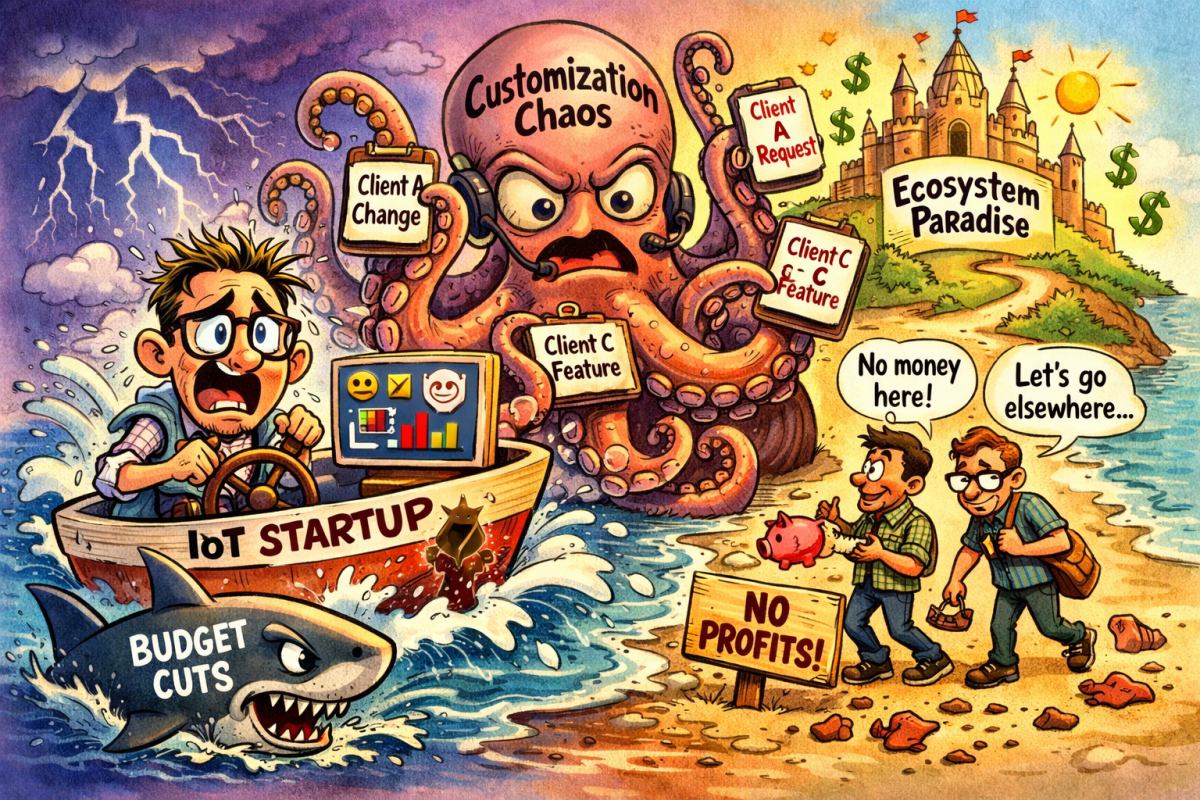
The Hidden Trap Destroying IoT Platforms: 3 Silent Mistakes Founders Don’t See Until It’s Too Late

Many IoT platforms began their journey with strong foundations. They had capable engineering teams, promising technology, and even early customer traction. In the early stages, everything appeared to be moving in the right direction.

Yet over time, many of these platforms quietly stalled. Some remained small niche products. Others slowly faded from the market.

The collapse rarely happened suddenly. It emerged gradually, almost invisibly.

From observing the evolution of many IoT platforms over the years, three recurring patterns often appear. These are what I refer to as the three silent killers of IoT platforms.
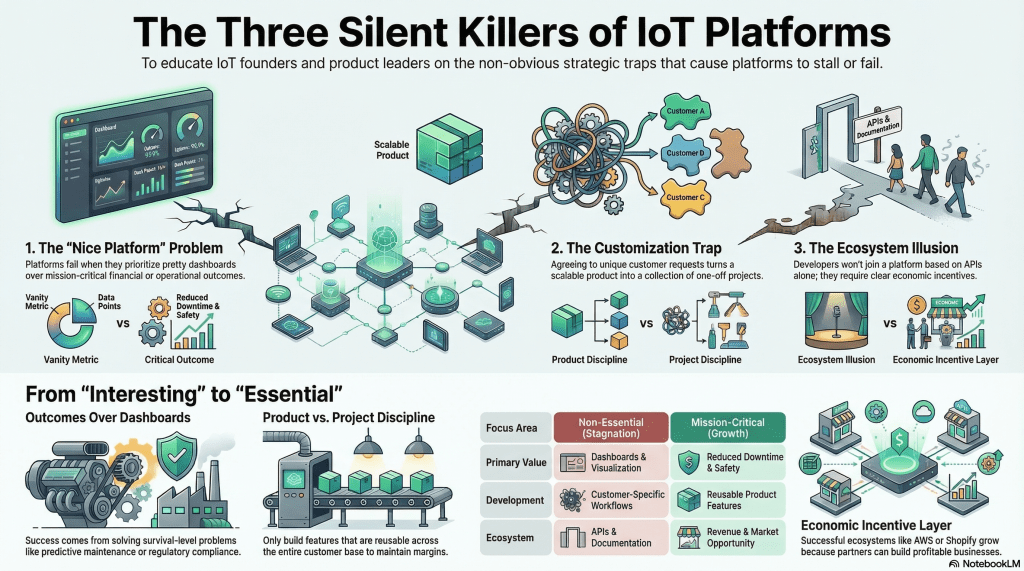
1. The “Nice Platform” Problem

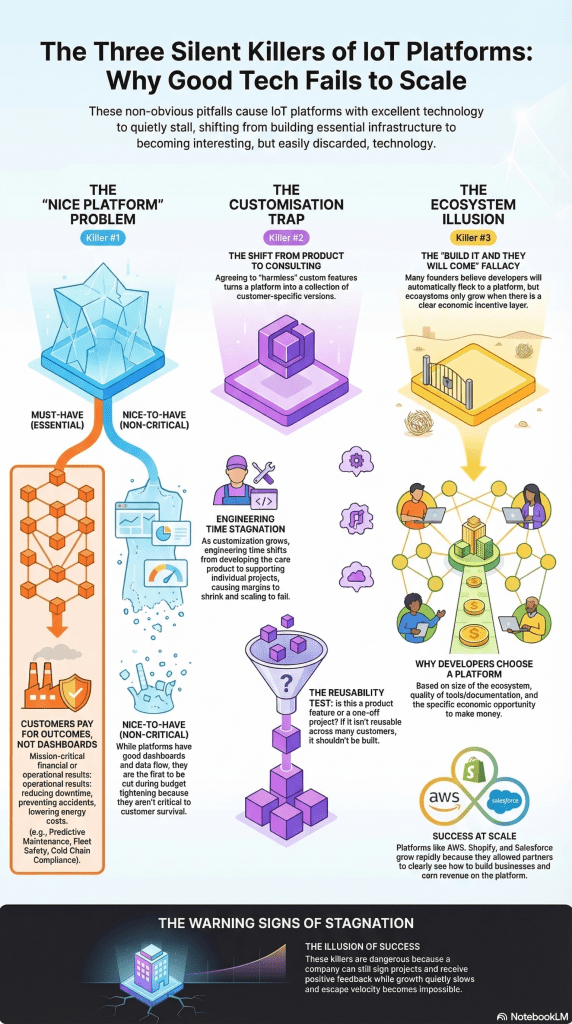
The first and most common challenge is what I call the “Nice Platform” problem.

Technically, everything works as expected. Sensors transmit data. Dashboards display attractive charts. Connectivity is stable. Demonstrations during presentations look impressive.

Customers often respond with comments like, “This is very interesting.”

But the real question is much deeper than whether the technology works.

Is the platform essential to the customer’s operations?

Many IoT platforms unintentionally position themselves as helpful tools rather than critical systems. They focus heavily on features such as:

• dashboards
• device connectivity
• data visualisation

These capabilities are useful. They demonstrate the power of connected systems.

But organisations rarely allocate long-term budgets for visualisation tools alone.

Businesses invest in solutions that directly influence outcomes. What they are truly paying for are measurable results such as:

• reducing equipment downtime
• preventing operational accidents
• lowering energy consumption
• avoiding regulatory penalties
• increasing workforce productivity

When a platform is tightly connected to these outcomes, it becomes embedded in the customer’s daily operations. It becomes part of their operational backbone.

But when the platform only provides visibility without directly influencing decisions or actions, it remains optional.

And optional systems are the first to disappear when budgets tighten.

This explains why the most successful IoT deployments focus on mission-critical problems. Examples include:

• predictive maintenance in industrial environments
• fleet safety monitoring for logistics operations
• cold chain compliance for pharmaceutical distribution
• energy optimisation for large buildings

These systems cannot simply be turned off without significant operational consequences.

That is the difference between interesting technology and essential infrastructure.

2. The Customisation Trap

The second silent killer appears much later in the journey, often after the platform begins acquiring its first paying customers.

Early adopters frequently request modifications. They ask for specific dashboards, specialised workflows, or integrations with legacy enterprise systems.

At the beginning, these requests appear reasonable.

A startup needs revenue. The team wants to satisfy its customers. Agreeing to customise the platform seems like a practical decision.

However, a hidden risk gradually emerges.

Over time, the platform begins to fragment.

Instead of maintaining a single scalable product, the engineering team finds itself supporting multiple customer-specific versions:

• one version tailored for customer A
• another variation for customer B
• a different configuration for customer C

The product gradually shifts from a platform to a collection of bespoke solutions.

Engineering resources originally intended to improve the core platform are redirected to meet project-specific requirements.

At this stage, the business begins to resemble a consulting company rather than a product company.

The consequences are predictable:

• development cycles slow down
• engineering teams become stretched
• product direction becomes unclear
• operating margins shrink

Scaling becomes increasingly difficult because each new customer introduces new complexity.

Many IoT startups unintentionally move into this trap. They begin with a platform vision but gradually become project delivery organisations.

The strongest platform companies remain disciplined about this boundary.

They continuously ask a simple but critical question:

Is this a reusable product feature or a one-off project request?

If the capability cannot benefit many customers across different industries, it may not belong in the core platform.

Maintaining this discipline is difficult in the early stages when revenue pressure is high. Yet it is often the difference between building a scalable platform and building a services business.

3. The Ecosystem Illusion

The third silent killer relates to ecosystem development.

Many platform founders assume that once the platform is launched, developers and partners will naturally begin building solutions on top of it.

The belief is simple: build the platform first, and the ecosystem will follow.

In practice, ecosystems rarely grow automatically.

Developers and partners choose platforms based on several practical considerations:

• the size and activity of the ecosystem
• the availability of development tools and documentation
• the potential economic opportunity

The economic factor is frequently underestimated.

Developers invest their time where they can build sustainable businesses. If there is no clear revenue path, most will quickly move to other platforms.

This is one of the key reasons large ecosystems expanded rapidly. Platforms such as:

Amazon Web Services
Shopify
Salesforce
Apple

created strong developer communities by building clear economic incentives.

Developers could launch products, attract customers, and generate revenue through these platforms.

In many IoT platforms, the ecosystem layer is incomplete. APIs and SDKs are available, but the economic model is unclear.

For an ecosystem to grow meaningfully, partners must clearly understand:

• how they can generate revenue
• how easy it is to build solutions on the platform
• how large the addressable market is

Without these signals, the ecosystem remains limited.

Developers may experiment with the platform, but long-term commitment rarely materialises.

Why These Killers Are Difficult to Detect

One of the most dangerous aspects of these challenges is their subtle nature.

None of them produces immediate crises.

The company may still:

• secure new pilot projects
• receive industry recognition
• release new product features
• attract positive feedback from users

From the outside, everything appears healthy.

But internally, warning signs slowly emerge. Growth begins to plateau. Profit margins tighten. The product roadmap becomes fragmented.

Eventually, the platform struggles to reach the scale necessary to compete globally.

This pattern explains why many IoT platforms remain respectable but small companies rather than evolving into global infrastructure providers.

The difference between the two often lies not in technological capability but in strategic discipline.

For IoT platforms to achieve long term impact, they must move beyond attractive dashboards and connectivity features. They must anchor themselves in mission-critical outcomes, protect the integrity of their core product, and build ecosystems where partners can thrive economically.

Only then can a platform move from being an interesting technology to becoming part of the digital infrastructure that organisations truly depend on.

These lessons continue to shape how many leaders in connected systems approach platform strategy today, especially as IoT, AI, and edge computing converge to redefine how digital infrastructure is built and secured.

The Day I Realised I Was Becoming a Human FAQ

There was a time when I actually felt proud every time someone asked me about Favoriot.

Each question felt like a small victory.

It meant people were noticing.
It meant the story was spreading.
It meant our work was reaching somewhere beyond our small team.

Someone would message me.

“What exactly is Favoriot?”
“Is it just a dashboard?”
“Can it connect to this device?”
“How is it different from AWS IoT or ThingsBoard?”
“Do you support AI?”
“Can students use it?”
“Is it for smart cities, or factories, or farms?”

And every time, I replied.

Patiently.

Sometimes through WhatsApp.
Sometimes through LinkedIn messages.
Sometimes through emails that arrived late at night.

Okay, Mazlan… this is good, I told myself.
It means people are interested.

So I kept answering.

Again.

And again.

And again.

Until one day, after probably the hundredth explanation, I suddenly paused.

I stared at my laptop.

Then I asked myself a question that hit me harder than I expected.

Wait… am I building a technology platform… or am I becoming a human FAQ?

That was the moment something clicked.

A small but powerful realisation.

This was not really about repeating answers.

It was about something deeper.

Energy.

Focus.

And scale.

Because if the story of Favoriot only lives inside my head, then every explanation will depend on me personally.

And that is not scalable.

That night, I realised something important.

When people keep asking the same question, it is not a problem.

It is a signal.

A signal that your story is not documented clearly enough.

A signal that your knowledge is trapped inside conversations.

A signal that your platform needs a voice that can speak even when you are asleep.

That was my first aha moment.

The Emotional Side of Repeating Yourself

Let me be honest.

There were moments when I felt tired.

Not angry.

Not irritated.

Just mentally drained.

Imagine explaining the same thing dozens of times.

Sometimes, even after giving a talk or presentation.

For example, after speaking at events like The Star Cybersecurity Summit, where I was invited to share thoughts about IoT systems, AI, and the future of connected technologies, people would still approach me afterwards and ask the exact same question.

“So… what exactly does Favoriot do?”

Part of me almost laughed.

Did I not just explain that on stage for half an hour?

Then another voice in my head replied.

Relax Mazlan. Every audience is new.

Every listener hears things differently.

Every person arrives with a different level of understanding.

Some are engineers.

Some are students.

Some are policymakers.

Some are just curious.

And none of them is wrong for asking.

That was my second realisation.

Repetition is not the enemy.

Confusion is.

If people keep asking the same question, it simply means the explanation has not reached them in a form they can digest.

And that responsibility sits on my shoulders.

The Turning Point

One evening, while replying to yet another email asking the familiar question, I suddenly stopped typing.

I leaned back in my chair.

Why am I answering this privately again?

Then another thought appeared.

Why not answer it publicly once… and let it help hundreds of people instead of one?

That thought changed everything.

Instead of seeing repeated questions as interruptions, I began seeing them as content ideas.

Every repeated question was actually a signal about what people wanted to understand.

If five people ask the same thing, it deserves an article.

If ten people misunderstand a feature, it deserves a tutorial.

If customers keep comparing Favoriot with other platforms, it deserves a structured explanation.

That was the moment I started writing more seriously on IoT World.

Not random thoughts.

Not marketing slogans.

But clear explanations.

What exactly is the Favoriot Insight Framework?

How Favoriot moves from raw data to meaningful decisions.

Why IoT is not just about dashboards.

How universities can build AIoT labs.

Why local councils struggle with smart city projects.

How system integrators can deploy IoT faster.

Each question became an article.

Each doubt became a story.

Each confusion became clarity.

And slowly, something magical happened.

Instead of repeating myself endlessly, I started sending links.

“You might want to read this article.”
“This explains the architecture clearly.”
“This post shows the use case.”

The conversation immediately became deeper.

People no longer start from zero.

They started with understanding.

Building Something Bigger Than Myself

But something else happened, too.

After publishing several articles, people began asking another question.

“Is there one place where we can read everything about Favoriot?”

I smiled when I heard that.

Alright, Mazlan… now the next step is obvious.

That was when the idea of a Favoriot Resources Page was born.

Not a marketing page.

Not a product brochure.

But a knowledge hub.

A place where people can explore the ecosystem properly.

A place where they can learn at their own pace.

On that page, anyone can now explore:

What Favoriot really is
Tutorials and technical guides
Real IoT project challenges
Case studies and architecture explanations
The Favoriot Insight Framework
AI and IoT integration concepts
Videos and learning materials

I wanted it to feel like a digital campus.

Because Favoriot is not just software.

It is an ecosystem.

And ecosystems require structure.

They require stories.

They require documentation.

Without those elements, people only see fragments.

With them, people see the full picture.

The Hidden Lesson for Founders

Many startups face this same challenge.

We assume people understand our product.

We assume our website is clear.

We assume our explanation is good enough.

Most of the time, it is not.

People are busy.

They skim.

They scan.

They make assumptions.

And sometimes those assumptions are completely wrong.

So when people keep asking the same question, the worst reaction is frustration.

The better reaction is curiosity.

Ask yourself:

Why is this still confusing?

Which part of my explanation is missing?

How can I make this easier to understand?

Repeated questions are feedback.

Free feedback.

Valuable feedback.

And if you listen carefully, they tell you exactly what your audience needs.

When the Story Finally Clicked

After writing consistently and building the Resource page, I noticed something interesting.

My explanations became sharper.

Writing forces you to think clearly.

When you write publicly, your ideas become structured.

And suddenly the narrative becomes easier to communicate.

People begin to see the bigger picture.

They understand that Favoriot is not just a tool.

It is a framework.

It is an ecosystem.

It is a learning platform.

It is an AIoT foundation.

Without structure, that sounds confusing.

With structure, it becomes powerful.

The Resource page helped me connect the dots.

From devices to cloud ingestion.

From data streams to analytics.

From rule engines to AI insights.

From dashboards to decision intelligence.

That clarity changed everything.

The Unexpected Reward

Today, people still ask questions.

Of course they do.

And I welcome them.

But the feeling is different now.

Instead of feeling drained, I feel grateful.

Because each question tells me that someone is curious.

Someone is exploring.

Someone wants to understand.

And now I have something meaningful to share.

Not just an answer.

A pathway.

When someone tells me,

“I read your Resource page, and now I understand what Favoriot is.”

That feels incredibly satisfying.

More satisfying than closing a sale.

Because understanding builds trust.

Trust builds relationships.

And relationships build ecosystems.

The Aha Moment

Looking back, I now see that the repeated questions were never the problem.

They were actually guiding me.

They were telling me exactly what needed to be documented.

Exactly what was needed was clarity.

Exactly what was needed was storytelling.

And once I finally organised all that knowledge into structured content, something powerful happened.

The pressure disappeared.

The message became scalable.

And the story of Favoriot could travel further than my own voice.

That was my real aha moment.

When people stop depending on your explanation and start learning from your ideas, you know something meaningful has been built.

Favoriot is not just about connecting devices.

It is about connecting understanding.

And that journey started with a simple realisation.

Sometimes, the most annoying repeated questions are actually the best teachers.

Now I am curious.

Have you ever experienced the same situation in your own journey?

People asking the same question again and again?

What did you do about it?

Did it frustrate you, or did it push you to build something better?

FAVORIOT Resources

The Moment the Smart City Dashboards Stopped Impressing Me

There was a time when I was impressed by command centres.

Rows of screens.
Maps glowing in neon colours.
Charts are moving in real time.
Operators are pointing at dashboards like air traffic controllers.

It looked powerful.
It looked serious.
It looked… convincing.

But one day, standing quietly at the back of the room, I caught myself thinking something uncomfortable.

If one screen goes dark, who notices?
If the data contradicts another system, who decides?
If something breaks at 2 a.m., who actually understands what is happening?

That was the moment the screens stopped impressing me.

Because cities are not run by visuals.
Cities are run by clarity.

And clarity does not come from dashboards alone.

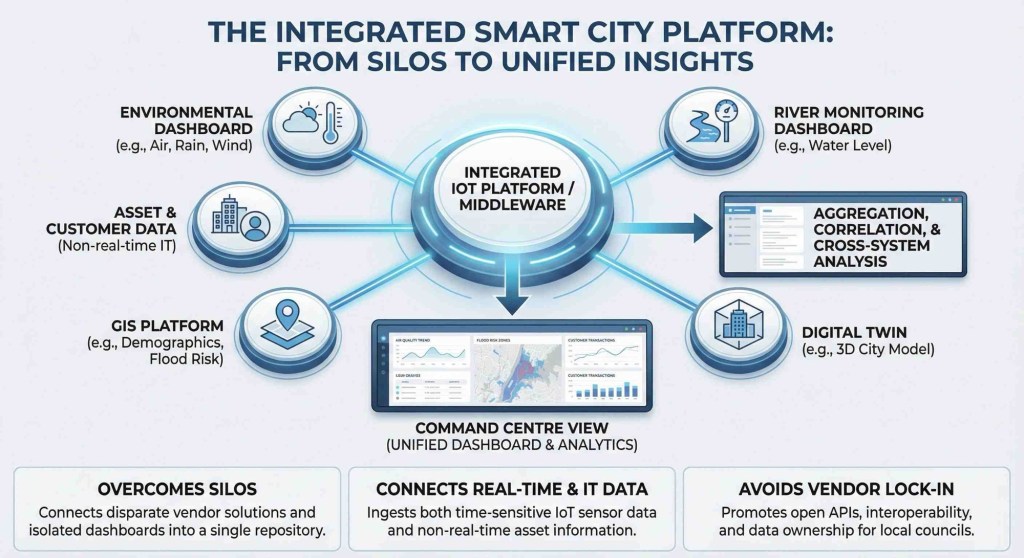
How Cities Slowly Accumulate Silos Without Realising It

Most local councils chose not to fragment.

Fragmentation happened to them.

Projects arrived one by one.
Budgets were approved year by year.
Each initiative solved a real problem at the time.

Flood monitoring came first.
Then air quality.
Then lakes.
Then traffic.
Then parking.

Each project was justified.
Each vendor delivered.
Each system worked.

Individually.

What nobody planned for was the moment when all these systems would need to speak to each other.

So the command centre slowly became a collection of disconnected truths.

Each dashboard told its own story.
None of them told the whole truth.

When a Dashboard Is Mistaken for a Platform

I often hear this sentence.

“Yes, we already have a smart city platform.”

Then I look closer.

What I see is usually a visual layer.
A presentation surface.
A beautifully designed window.

But behind it, there is no device management.
No rule engine.
No action triggers.
No real-time orchestration.

Just data being shown.

And showing data is not the same as running a city.

A true platform does not just display.
It listens.
It reacts.
It remembers.
It connects.

Two Types of Data That Rarely Shake Hands

Cities live in two data worlds.

The first world is structured, administrative, and familiar.

Assets.
Licences.
Collections.
Population data.
Facilities.

This data is critical. It reveals the city’s shape. It is refreshed periodically and often lives inside systems branded as urban observatories.

The second world is restless.

Sensor data.
Live streams.
Alarms.
Failures.
Spikes.
Drops.

This is IoT data.
It does not wait politely.
It arrives when it wants.
It demands attention.

The mistake happens when we treat both worlds as if they behave the same way.

They do not.

GIS and Digital Twins Without Real-Time Truth

Many councils have strong GIS platforms.

Layers upon layers of insight.
Maps that tell stories about people, land, and risk.

Some go even further with digital twins.
Virtual representations of buildings, roads, and infrastructure.

I admire these efforts.

But without live sensor input, these systems are frozen in time.

They show structure.
Not behaviour.

A city is not just where things are.
It is how things change.

Without IoT data, even the most beautiful digital twin is only a photograph, not a mirror.

Why an Integrated IoT Platform Is Not Optional Anymore

At some point, cities reach a tipping point.

They stop asking for new dashboards.
They start asking better questions.

Why did flooding worsen after that traffic upgrade?
Why does air quality dip only in specific zones?
Why do alarms trigger too late?

These questions cannot be answered inside silos.

They require correlation.

This is where an integrated IoT platform matters.

Not to replace everything.
But to connect everything.

A layer where data from rivers, rain, air, traffic, parking, and buildings can coexist.
A place where patterns emerge.
A place where decisions are supported, not guessed.

This is the role of IoT middleware.
This is where platforms like FAVORIOT were designed to sit.

The Fantasy of One Platform to Rule Them All

Every city dreams of simplicity.
Every vendor dreams of being central.

The idea of one master platform controlling everything is seductive.

But reality is less romantic.

Platforms are built with different goals.
Vendors protect their niches.
Legacy systems do not disappear quietly.

Trying to force everything into one system usually creates resistance, delays, and disappointment.

Cities do not need domination.
They need coordination.

The Quiet Risk Nobody Likes to Talk About

There is a dangerous sentence I hear too often.

“We don’t mind. Let the vendor manage everything.”

It sounds efficient.
It sounds hands-off.

Until the day the council asks for raw data.
Or integration rights.
Or historical access.

And discovers they cannot.

No API.
No export.
No control.

That is vendor lock-in.
And by then, it is too late to complain.

A smart city without data ownership is not smart.
It is dependent.

Procurement Is the Real Smart City Strategy

Smart cities are not won in control rooms.

They are won in procurement documents.

When councils specify openness.
When they demand interoperability.
When they insist on owning their data.

That is when cities protect their future.

Technology can always be upgraded.
Contracts are harder to undo.

Integration Is an Act of Maturity

I no longer believe in replacing everything.

I believe in respecting what already works.
Connecting what matters.
Opening what was once closed.

Legacy platforms should remain.
Specialised systems should continue.
But data must flow.

Sometimes that means managing two or three core platforms instead of one.

That is not failure.
That is realism.

Why I Keep Writing About This

I am not chasing trends.
I am chasing calm.

Calm operators.
Calm decision-makers.
Calm cities that respond instead of react.

When systems are integrated, nights are quieter.
When data is shared, trust grows.
When platforms cooperate, leaders sleep better.

If you are building a smart city, pause before asking for another screen.

Ask instead:
Can this system talk?
Can it share?
Can it last?

If this reflection sounds familiar, I would love to hear from you.

What have you seen in your city?
Where did silos slow you down?
What worked when integration finally happened?

Drop your thoughts in the comments.
Let us learn from each other and build cities that truly understand themselves.

Why Universities Need a Real IoT Lab, Not Just Another Embedded Lab

I still remember a meeting with a group of lecturers, where I asked a simple question.

“Why do we really need an IoT Lab in universities?”

I paused for a moment.
Because deep down, I already knew the answer.

Most universities already have something they proudly call an IoT lab. Rows of ESP32 boards. Arduino kits. LEDs are blinking happily. LCD screens displaying temperature values. Students smile because something lights up.

And yet, something feels incomplete.

This is not IoT. This is just the beginning.

This blog is not meant to criticise universities. I have spent years inside them. I was once a lecturer designing syllabuses, labs, and assessments. This comes from care. From concern. From watching students graduate with confidence in embedded programming but struggle the moment systems become real, connected, and dependent upon.

This reflection is based on a recent lecture I delivered on the need to establish a proper IoT Lab in universities, one that reflects how systems are actually built, deployed, and trusted today.

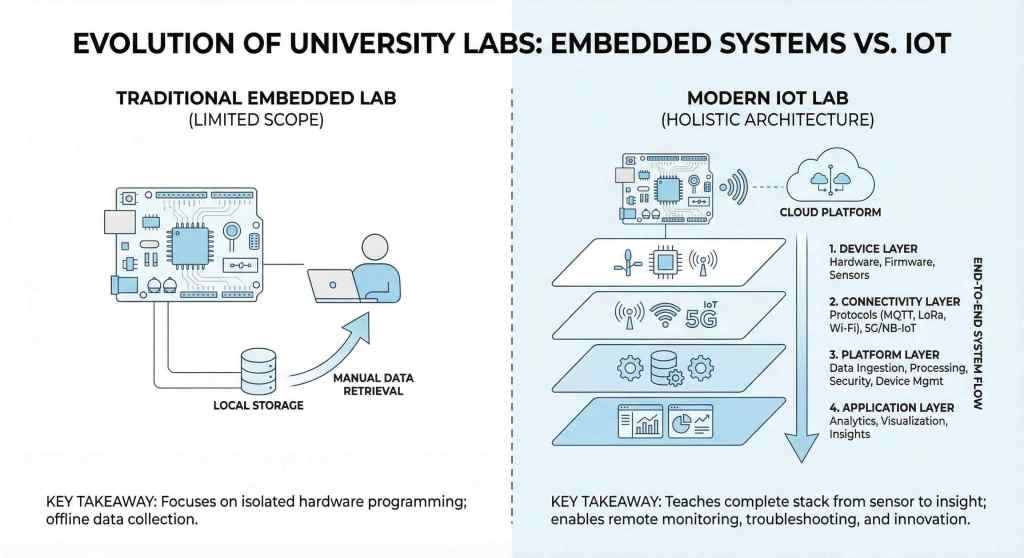
Embedded Systems Taught Us How to Build Devices

Let me be very clear.

Embedded systems are important. They are foundational.

Students need to learn how to program microcontrollers. They need to understand sensors, actuators, interrupts, memory, and power consumption. All of that matters.

An embedded system is usually a standalone device. It senses something. It controls something. It logs data into local storage.

There is nothing wrong with that.

In fact, embedded systems are still used today in places with no connectivity. Remote areas. Harsh environments. Offline conditions.

But here is the problem.

Once the data is captured, someone has to physically go to the site, connect a laptop, download the data, return with it, and process it manually.

I have seen this happen too many times.

Two technicians. One vehicle. Hours of work. Just to retrieve data that could have been transmitted automatically.

I always ask myself… why are we still doing this in 2026?

Connectivity Changes Everything

The moment a device is connected to the internet, everything changes.

Data no longer waits for humans to come and collect it.
It flows.
It moves.
It becomes alive.

This is the moment embedded systems evolve into the Internet of Things.

Now we can monitor systems remotely.
Now we can detect failures early.
Now we can see battery levels dropping before devices die silently.
Now we can act before complaints arrive.

And yet, most university labs stop just before this moment.

Students are taught how to blink LEDs, but not how to send data reliably.
They learn how to display values, but not how to secure data in transit.
They build devices, but not systems.

And systems are what the real world depends on.

A Real IoT Lab Must Teach Technology Layers

IoT is not a single skill. It is a stack.

In my lecture, I stressed that a proper IoT Lab must expose students to multiple technology layers, not in theory, but through hands-on work.

Layer 1: Hardware and Firmware

This is where universities are already strong.

Sensors. Controllers. Actuators. Firmware logic. Power management.

Students should continue learning this well.

But they must also understand that this is just one layer.

Layer 2: Connectivity and Protocols

This is where gaps start to appear.

Students must learn how data travels.

Wi-Fi. Cellular. LPWAN.
Bluetooth. ZigBee. RFID.
MQTT. CoAP. REST. HTTP.
LoRa. NB-IoT. Sigfox.

Not as a list to memorise.
But as choices with consequences.

Which protocol suits low power?
Which network works for long range?
What happens when connectivity drops?

Without this understanding, troubleshooting becomes guesswork.

Layer 3: Platform and Middleware

This is the heart of IoT.

Devices do not talk directly to dashboards. They talk to platforms.

An IoT platform manages devices.
Authenticates them.
Stores data.
Provides APIs.
Handles scale.

This is where students should learn about device identities, data ingestion, databases, and analytics pipelines.

This is also where they start to understand why platforms like FAVORIOT exist in the first place.

Not to replace learning.
But to enable it.

Layer 4: Analytics and Visualisation

Dashboards are not the end goal.

They are the beginning of understanding.

Students should learn how data evolves from descriptive charts to deeper insights.
They should see patterns.
Spot anomalies.
Ask better questions.

This prepares them for real projects, not demos.

Security Must Exist Across All Layers

Security cannot be an afterthought.

Devices must be authenticated.
Data must be encrypted.
Platforms must be protected.
Applications must be hardened.

Most labs barely touch this.

And yet, this is where real systems fail.

When Systems Break, Knowledge Is Tested

I often tell students this.

The real test of IoT knowledge is not when everything works.

It is when something breaks.

Data stops arriving.
Dashboards go blank.
Alerts do not trigger.

At that moment, students panic if they only know how to code LEDs.

But students who understand layers start asking better questions.

Is it the device?
Is it the network?
Is it the platform?
Is it the visualisation?

This is the mindset a real IoT Lab must build.

Research, AI, and the Future of IoT Labs

Universities are not just about projects. They are about research.

To do meaningful research, students need data. Lots of it. Clean data. Continuous data.

IoT Labs enable this.

Once data flows reliably, students can apply machine learning.
They can explore pattern recognition.
They can experiment with predictive models.

Today, this also means understanding edge AI.

Inference running on devices.
Decisions made locally.
Latency reduced.
Systems are becoming smarter as they operate.

This is where IoT Labs naturally evolve into AIoT Labs.

And this is where universities must go.

This Is a Call to Universities, Lecturers, and Policymakers

If we want graduates who can build real systems, not just academic projects, we must change how we teach IoT.

IoT Labs must move beyond embedded programming.
They must teach architecture, trade-offs, and responsibility.
They must reflect how systems are deployed outside campus walls.

I believe universities can do this.
I believe lecturers want this.
I believe students deserve this.

But it requires intention.

It requires investment.
It requires collaboration with the industry.
It requires courage to redesign labs that have been unchanged for years.

If you are a lecturer, start asking what your lab is missing.
If you are a dean, ask whether your graduates can troubleshoot real systems.
If you are a policymaker, ask whether our talent pipeline matches national ambitions.

And if you are a student reading this, ask yourself one question.

Am I learning how to build a device… or how to build a system people can trust?

I would love to hear your thoughts, experiences, and struggles in building or teaching IoT.
Drop a comment. Let’s talk.

Smart Cities in Malaysia – Between Beautiful Documents and Real Implementation

There is a kind of silence I remember very clearly.

Not the silence of an empty room.
But the silence appears when too many slides are shown, too many big words are used, and too few honest questions are asked.

I was sitting in yet another Smart City presentation. Everyone was talking about master plans, KPIs, ISO standards, indicators, and rankings. The slides looked polished. The diagrams were neat. The language sounded confident.

Yet inside, a quiet question kept repeating.

Who will take care of this after the launch?
Who will wake up when the system fails?
Who will face the public when citizens are angry?

Those questions rarely appear on slides.

And that, for me, is where the real Smart City problem in Malaysia begins.

Why We Talk About Smart Cities at All

Smart Cities are not about technology.

They are about people.

They are about parents stuck in traffic every morning.
Children breathe unhealthy air.
Small business owners suffer when flash floods arrive without warning.

I often say this, and I truly believe it.

The final goal of a Smart City is very simple.

People can live healthier lives.
People can live happier lives.
Cities can run without constant chaos.

That’s it.

Not rankings.
Not awards.
Not plaques on office walls.

Yet somewhere along the way, we lost that simplicity.

When Everyone Wants to Be “Smart”

Today, almost everyone wants the Smart City label. Some go further and call themselves “AI Cities”.

I usually smile when I hear that.

Which AI?
Where is the intelligence?
Or is it just a new signboard?

Many systems branded as AI are simply basic automation. This is not a technology problem. It is a misunderstanding.

What troubles me more is this.

Some cities work quietly, building systems that actually function, yet receive no recognition because they never submitted an application. Others receive recognition early simply because they know how to fill out forms.

That’s when we learn a hard truth.

Recognition does not always reflect maturity.

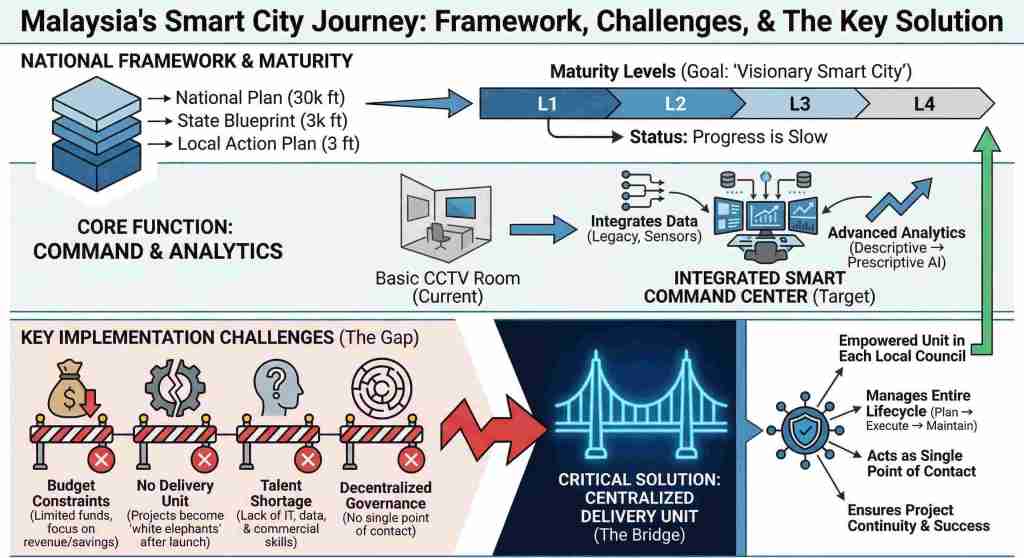
From 30,000 Feet to 3 Feet

To be fair, Malaysia does have a solid Smart City framework.

On paper, it makes sense.

At 30,000 feet, there is the national master plan.
At 3,000 feet, there are state-level blueprints.
At ground level, around 3 feet, there should be detailed action plans for local councils.

Everything looks structured.

But in reality, many councils are stuck somewhere in between.

Some are still writing plans.
Some are experimenting with pilot projects.
Very few are running systems consistently, day after day.

Not because they don’t care.
Not because they are lazy.

But because something fundamental is missing.

Delivery structure.

Command Centres That Feel Empty

I have visited many command centres.

The name sounds powerful. Command centre. It feels important.

But once inside, the scene is often the same.

CCTV screens.
Live video feeds.
A few officers are watching.

That’s all.

I quietly ask myself.

Where is the data integration?
Where is the analysis?
Where are the decisions driven by this data?

A command centre should be the brain of the city.

Not just its eyes.

Imagine traffic data, air quality, noise levels, parking systems, citizen complaints, legacy databases, all connected and analysed together.

First, we know what has happened.
Then, we understand why it happened.
Next, we anticipate what might happen.
Finally, we know what action to take.

This is where technology truly matters. Not to impress, but to guide decisions.

The Challenges We Rarely Admit

Since around 2015, I have seen the same issues repeat.

Budget That Is Never Enough

Local councils are not money-making machines.

They rely on limited revenue sources. Assessment taxes. Parking fees. Licenses.

With limited funds, choices become limited too.

Projects that generate revenue or reduce costs often get priority. Long-term social impact projects struggle to survive.

Risk-heavy concession models usually favour large companies with deep pockets. Smaller local players, often full of ideas and energy, get pushed aside.

Sometimes I ask myself quietly.

Do we really want local ecosystems to grow?
Or are we just choosing the easiest path?

Projects Without Guardians

This one hurts the most.

Many Smart City projects are launched with excitement. Press conferences. Posters. Promotional videos.

A year later, the system is silent.

No maintenance.
No monitoring.
No clear ownership.

The project becomes a white elephant.

Not because the technology failed.
But because no one was assigned to take care of it.

Skills Gap Is Real

Smart Cities demand new skills.

Data management.
IT infrastructure.
Commercial thinking.
Long-term contract handling.

Many council officers come from strong urban planning backgrounds. They are good at what they do.

But we cannot expect them to suddenly manage complex digital systems without proper support.

This is not an individual failure. It is a structural one.

Fragmented Governance

For solution providers, one simple question often becomes complicated.

Who should we speak to?

Without a clear focal point, discussions lose direction. Time is wasted. Trust slowly fades.

One Answer I Strongly Believe In

If there is one thing that matters most, it is not technology.

It is a Delivery Unit.

A dedicated team.
Given authority.
Given responsibility.
Given continuity.

This unit becomes the caretaker of the entire Smart City lifecycle.

From strategy.
To execution.
To daily operations.
For long-term maintenance.

When this unit exists, everything changes.

Communication becomes clear.
Ownership becomes visible.
Projects do not get abandoned.
Citizens start feeling real benefits.

Smart City stops being a document.
It becomes a service.

Why I Still Have Hope

I am not writing this out of frustration.

I am writing because I still believe.

I believe our local councils are capable.
I believe our local talent is strong.
I believe technology is just a tool, not the answer.

What we need is the courage to admit weaknesses and the wisdom to build the right structure.

Smart City is not a race.
It is a responsibility.

If we want public trust, we must start taking care of what we build.

And it begins with one honest question.

Who will make sure this city still works tomorrow morning?

If this piece made you pause and think, I would love to hear your thoughts.
Leave a comment. Let’s talk.

When Data Leaves the Country, Control Leaves With It

A personal reflection on why I insisted on an Enterprise IoT Platform with on-premise deployment

There are moments in a founder’s life when you stop talking about features.

You stop talking about dashboards.
You stop talking about protocols.
You even stop talking about scale.

And you start talking about control.

This was one of those moments.

I remember sitting quietly after one of our internal briefings, staring at the whiteboard filled with arrows, boxes, and deployment diagrams. Everyone had left the room. The air was still.

Why am I pushing so hard for this Enterprise Plan?
Why does this feel heavier than just another pricing tier or feature release?

Then it hit me.

This was not about software.
This was about sovereignty.

And once you see it that way, you can never unsee it.

From owning a kitchen to owning the whole restaurant

For years, I used a simple analogy when explaining IoT platforms.

If you are on a shared cloud platform, you are like a chef renting a kitchen. You can cook. You can serve. But you do not own the space. You follow house rules. You live with limits.

The Enterprise Plan is different.

It is not about owning the kitchen anymore.
It is about owning the whole restaurant.

The building.
The keys.
The doors.
The data flows.
The servers are sitting quietly in your own premises.

When you own the restaurant, no one tells you when to close. No one caps how many customers you can serve. No one decides where your ingredients come from.

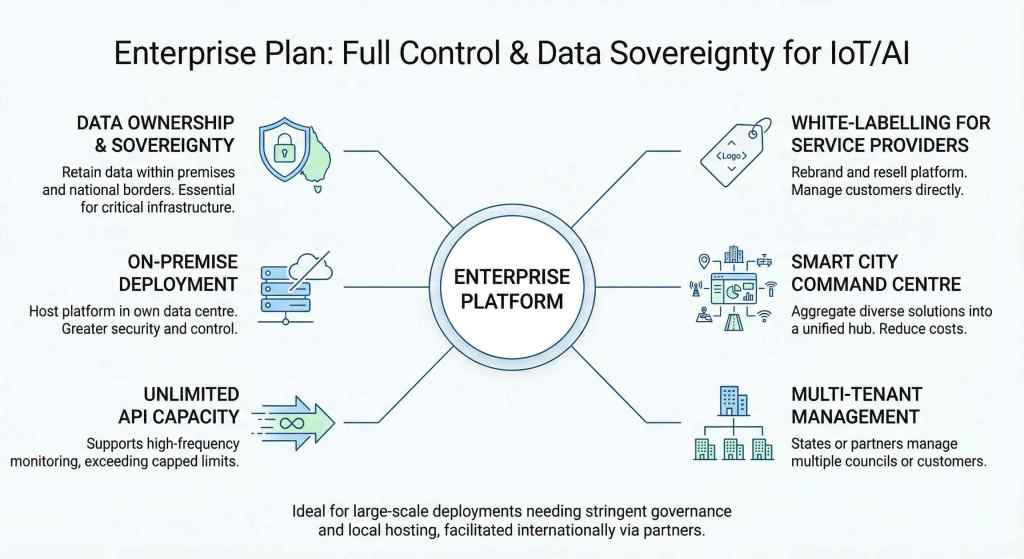
That is the mindset behind the Enterprise IoT Platform.

The moment I realised cloud is not always the answer

For a long time, cloud felt like the default answer to everything.

Fast.
Flexible.
Convenient.

I believed in it. I still do, for the right use cases.

But over the years, as I spoke to large organisations, city operators, government agencies, and critical infrastructure owners, a pattern kept repeating itself.

“We don’t want our data outside the country.”
“We need to know exactly where the servers are.”
“We cannot afford external dependencies for this system.”
“This data is too sensitive.”

At first, some people dismissed these concerns as paranoia.

I did not.

Because when you are dealing with traffic lights, water systems, energy grids, and public safety sensors, paranoia is just another word for responsibility.

What happens if the platform is outside the country and something goes wrong?
Who takes control when connectivity is lost?
Who answers when an entire city goes dark?

These are not theoretical questions. These are operational nightmares waiting to happen.

Data sovereignty is not a buzzword when infrastructure is involved

Data sovereignty sounds abstract until you put real consequences next to it.

Imagine a critical infrastructure monitoring system managed by a platform hosted overseas. One day, there is a major failure.

Power outage.
Network disruption.
Access blocked.

The local operators are standing there, staring at blank screens, unable to take control because the system that runs their infrastructure is not physically within reach.

That is unacceptable.

This is why on-premise deployment matters.

Not because it sounds serious.
Not because it looks impressive in a proposal.

But because control must stay with those who are accountable.

This thinking shaped every part of the Enterprise IoT Platform plan.

AI made the stakes even higher

If IoT data is sensitive, AI makes it explosive.

AI models learn from data.
Patterns.
Behaviours.
Weak points.

When AI touches critical infrastructure data, the question is no longer just “where is my data?”

It becomes “who understands my system better than I do?”

That was the turning point for me.

If AI is going to sit on top of IoT data, then the data must never leave the country.

This is not about fear.
This is about governance.

Every country I speak to says the same thing, whether it is Malaysia, Indonesia, the Middle East, or Europe.

“We want AI. But we want our data at home.”

The Enterprise Plan was designed to respect that reality.

Unlimited API is not a luxury; it is a survival

One detail that often gets overlooked is API limits.

People ask me, “Why unlimited API? Isn’t that excessive?”

Let me paint you a picture.

A manufacturing line monitors machines every second.
One sensor. One data point per second.
Multiply that by hundreds of machines.
Multiply again by shifts, days, months.

Suddenly, 500,000 API calls per day is not generous. It is restrictive.

The Developer Plan has limits because it should. It is built for builders, experimentation, and controlled scaling.

But enterprise environments do not experiment. They operate.

If you throttle data in an industrial environment, you are not saving costs. You are introducing blind spots.

Unlimited API is not about indulgence.
It is about continuous visibility.

Two very different enterprise realities

As I refined this plan, two clear deployment models kept emerging.

1. The white-label service provider model

Some organisations do not want to sell hardware.
They want to sell managed IoT services.

They do not want to build a platform from scratch. That path is expensive, slow, and painful.

So they white-label the Enterprise IoT Platform.

Their brand.
Their customers.
Their business logic.

They plug in their agricultural sensors, industrial devices, and vertical solutions, and run everything on their own enterprise platform.

Thousands of customers.
One controlled system.

I have seen how powerful this model can be when done right.

2. The smart city and government deployment model

Then there are cities.

Cities are different.

They already have many solutions. Parking. Flood sensors. Air quality. Lighting. Waste.

The problem is not a lack of data.
The problem is fragmentation.

Every system has its own dashboard. Its own vendor. Its own silo.

Local councils want a single platform, deployed on-premises, where everything comes together.

In some cases, councils cannot do this alone.

That is where state-level deployment makes sense.

One enterprise platform owned by the state.
Local councils connect their data.
Data stays within the country.
Visibility scales across regions.

It is pragmatic. It is cost-aware. It respects sovereignty.

This is bigger than one platform

As I reflect on this journey, I realise something.

The Enterprise IoT Platform is not just a product decision.
It is a philosophical stance.

It says:

You should own your data.
You should control your infrastructure.
You should not outsource accountability.

In a world rushing towards convenience, this is a reminder that responsibility still matters.

A quiet call to builders, cities, and leaders

If you are building systems that people depend on, ask yourself one simple question.

When things go wrong, who truly has control?

If the answer is unclear, it might be time to rethink how your platform is deployed.

I did.
And that rethink led us here.

I would love to hear your thoughts.
Where do you draw the line between convenience and control?
Share your reflections in the comments.

Why We Want Students to Struggle a Little When Learning IoT

I want to be honest with you.

Every time I walk into a university or polytechnic to talk about IoT, I already know the answer before I ask the question.

“What platform are you using for your final year project?”

The answers come fast. Almost automatic.

One particular platform. That has …
A mobile app.
Lots of YouTube tutorials.
GitHub samples.
Forums everywhere.

I nod. I smile.

I’ve heard this story many times.

And then comes the follow-up question.

“Why that platform?”

The answer is almost always the same.

“Because it’s easy.”
“Because there’s a mobile app.”
“Because seniors used it.”
“Because everything is already there.”

At that moment, a quiet thought always crosses my mind.

Easy today, but are you ready for tomorrow?

This blog is not about criticising students. Far from it.

It is about explaining why I believe students need to struggle a little when learning IoT. And why Favoriot was built the way it is.

The Comfort Trap Students Fall Into

I understand why students choose platforms that feel comfortable.

You connect a sensor.
Data appears on your phone.
You show it to your supervisor.
Demo done.

No need to build dashboards.
No need to understand protocols.
No need to worry about servers or data pipelines.

It feels good.

But comfort can be deceptive.

I asked myself, are we training students to build IoT systems, or are we training them to click buttons?

In many universities, IoT projects are still treated as extended embedded-system exercises.

Arduino.
ESP32.
Blink an LED.
Trigger a relay.

Nothing wrong with that.

But IoT is not just about making something move.

IoT is about data travelling.

From sensors.
Through networks.
Into platforms.
Across dashboards.
Into decisions.

If students never see that journey, they never really understand IoT.

The Chicken and Egg Problem Nobody Talks About

Let me share a frustration I rarely say out loud.

Favoriot is still new compared to global platforms.

Students don’t know us because there are fewer tutorials.
There are fewer projects online.
There are fewer YouTube videos.

And because of that, students don’t choose us.

Then I stop and think, how do you ever break this loop?

No users means no content.
No content means no discovery.
No discovery means no users.

Classic chicken and egg.

This is why I spend time going to universities.
Why I accept invitations to serve on industry advisory panels.
Why I keep introducing Favoriot in syllabus discussions.

Not because I want students to use Favoriot blindly.

But because someone has to be the first builder.

“But, Sir, Favoriot Has No Mobile App”

I hear this a lot.

And yes, for a long time, Favoriot did not have its own mobile app.

But here’s something many students don’t know.

There are MQTT mobile clients on Android and iOS.
They already have dashboards.
You configure them.
Connect to Favoriot.
And instantly see live data on your phone.

When I explain this, I see faces change.

“Oh… we didn’t know that.”

That sentence tells me everything.

Sometimes adoption is not about missing features.
It is about missing awareness.

And that is on us.
We need to explain better.
Show better.
Document better.

The Part Students Rarely See: The Full IoT Stack

This is where I get passionate.

IoT is not one skill.
It is many skills stacked together.

When students use platforms that hide everything, they only learn the top layer.

Here’s what real IoT demands.

Hardware
Sensors. Microcontrollers. Power. Battery life.

Connectivity
MQTT. CoAP. REST. WiFi. Cellular. LPWAN.

Platform
Device management. Ingestion. APIs. Storage.

Visualisation
Dashboards. Alerts. Rules.

Analytics
Understanding what happened. Why did it happen? What might happen next? What action to take?

Security
From device firmware to cloud access.

I sometimes ask myself, how can someone troubleshoot what they never learned existed?

Why I Don’t Believe in “No-Code IoT”

This may sound unpopular.

But I don’t believe IoT can be fully no-code.

IoT is physical.
It touches hardware.
It touches networks.
It touches real environments.

You need to understand flows.
You need to debug failures.
You need to trace where the data stops.

If there is no data on the dashboard, is it the platform’s fault?

Or is the sensor dead?
Is the firmware corrupted?
Is the network unstable?
Is the battery empty?

If everything is hidden, you don’t know where to look.

That’s dangerous.

PaaS Is Harder, and That’s the Point

Favoriot is closer to a platform than an app.

Some people say it’s harder.
They are right.

But difficulty is not a flaw.
It is a teacher.

When students use a platform that requires them to configure devices, protocols, dashboards, and rules, they are forced to think.

Why did I choose MQTT here?
Why is my data not arriving?
Why does this alert trigger late?

Those questions build engineers.
Not button-clickers.

Analytics Is Where IoT Becomes Meaningful

I always remind students.

Collecting data is not the goal.
Understanding data is.

IoT analytics moves in stages.

First, you look back.
What happened?

Then you ask why.
What caused it?

Then you look ahead.
What might happen next?

Finally, you decide.
What should I do about it?

This is why we built Favoriot Intelligence inside the platform.

Not as a separate system.
Not as an external tool.

One pipeline.
End-to-end.

Data comes in.
Insights come out.
Actions happen.

This is where IoT starts to feel alive.

AIoT and the Future Students Will Walk Into

Things are shifting fast.

AI is no longer optional.
Edge intelligence is becoming real.

Models trained in the cloud.
Inference pushed to devices.
Decisions made closer to reality.

Students who only learned drag-and-drop dashboards will struggle here.

Students who understand flows, stacks, and constraints will adapt.

That difference matters.

Why I Care So Much About This

People sometimes ask why I spend so much time with universities.

The answer is simple.

I have seen graduates enter the industry confused.
Overwhelmed.
Afraid of real systems.

I don’t want that.

I want students who can walk into a telco, a factory, a startup, or a smart city project and say,

“I don’t know this tool yet, but I understand how IoT works.”

That confidence changes careers.

Practical Tips for Students Learning IoT

Let me leave you with a few honest tips.

Learn beyond your demo
A working demo is not the finish line. Ask what breaks when conditions change.

Trace data end-to-end
Always ask where data starts and where it stops.

Understand at least one protocol deeply
MQTT, CoAP, or REST. Know how it behaves when networks fail.

Build dashboards yourself
Dragging widgets teaches more than screenshots.

Make something fail on purpose
Turn off WiFi. Drain the battery. Observe what happens.

Learn one platform properly
Not ten platforms shallowly.

Document your struggle
Others learn from your mistakes.

A Quiet Invitation

If you are a student reading this and you feel slightly uncomfortable right now, that’s good.

It means you are growing.

If you are a lecturer, consider whether your students are learning embedded systems or IoT.

And if you are one of the early builders willing to share your Favoriot project, you are not just building a system.

You are building a community.

Someone has to be first.

I hope you’ll be one of them.

I would love to hear your thoughts, your struggles, or your stories.
Leave a comment. Let’s talk.

We Gave Our Favoriot IoT Platform Away for Free—Here’s What Actually Happened Next

A quiet, honest story about how Favoriot found its way

I remember the early days of Favoriot very clearly.
It started with a simple belief. If we make it free and easy, people will come. They will build. They will stay.

So we did exactly that.

We built the platform.
We opened the doors.
We told the world, “Come in. Try it. It’s free.”

And people did come. Students. Lecturers. Curious engineers. Friends I met during talks at universities. I would personally invite them. Sometimes I would even hand out complimentary access codes for a full year of the Beginner Plan.

I thought to myself, this is how adoption works.

But something felt off.

When subscribers were not really users

On paper, the numbers looked comforting.
Subscribers were growing. Accounts were created. Dashboards were viewed.

But deep down, I knew something was missing.

Why are so many accounts quiet?
Why do I see logins, but no devices connected?
Why do dashboards stay empty?

That was my first hard lesson.

A subscriber is not always a user.
And a user is not always a builder.

Many people came just to look around. They clicked. They browsed. Then they left. Some even won vouchers but never built a single IoT project.

It hurt a little. Not because of revenue. But because I wanted Favoriot to be used. I wanted it to matter.

The wrong assumption about behaviour

I used to think users would log in every day, tweak dashboards, run experiments.

Reality taught me otherwise.

A typical IoT builder behaves differently.

Once the device connects and the data flows, they step back. They look at the dashboard occasionally. They only return when something breaks or when the project evolves.

Students behave differently, too.

They come intensely during one semester. Final year project season. Late nights. Panic. Excitement. Then, silence.

And to make it harder, many of them already knew other platforms. Some popular. Some free. Some are recommended by seniors.

Favoriot was often an unfamiliar name.

So ,how do you enter the education space when choice is already wide open?

Teaching before selling

I stopped pushing plans and started focusing on learning.

We introduced public IoT training. Beginner. Advanced. Mastering IoT.
Lecturers started attending. Some became trainers themselves. They went back to their universities and taught students using what they learned.

That felt good.

Then we went a step further.

Professional certificates.
Either embedded into the curriculum or offered as short intensive training. Students could finish the course and receive a certificate, or sit for an exam and earn a more formal credential.

Interest grew. Enquiries came in.

But adoption was still slow.

Universities move carefully. Curriculum changes go through committees, boards, and senate meetings. Nothing moves overnight.

I had to learn patience.

Labs instead of just logins

That’s when we bundled everything.

Not just software.
Not just subscriptions.

We created labs.

An IoT Lab with devices, Beginner subscriptions, training, and ready-to-use kits like indoor air quality monitoring.

An AIoT Lab with more advanced tools. Edge devices. Developer Plan access. Machine learning features. Analytics. A space for research, experimentation, and deeper thinking.

Suddenly, Favoriot was no longer just a platform.
It became an environment.

That changed the conversation.

Why Favoriot stayed a platform, not an app

People sometimes ask me, why not make Favoriot simpler? Why not hide everything?

Because IoT is not simple.

If everything is hidden, nothing is learned.

Favoriot is a Platform-as-a-Service by choice. Builders can see the flow. Devices. Protocols. Data ingestion. Visualisation. Rules. Actions.

When something fails, they learn how to troubleshoot.

When they graduate, they carry understanding, not just button-clicking habits.

That’s the skill that survives in the real world.

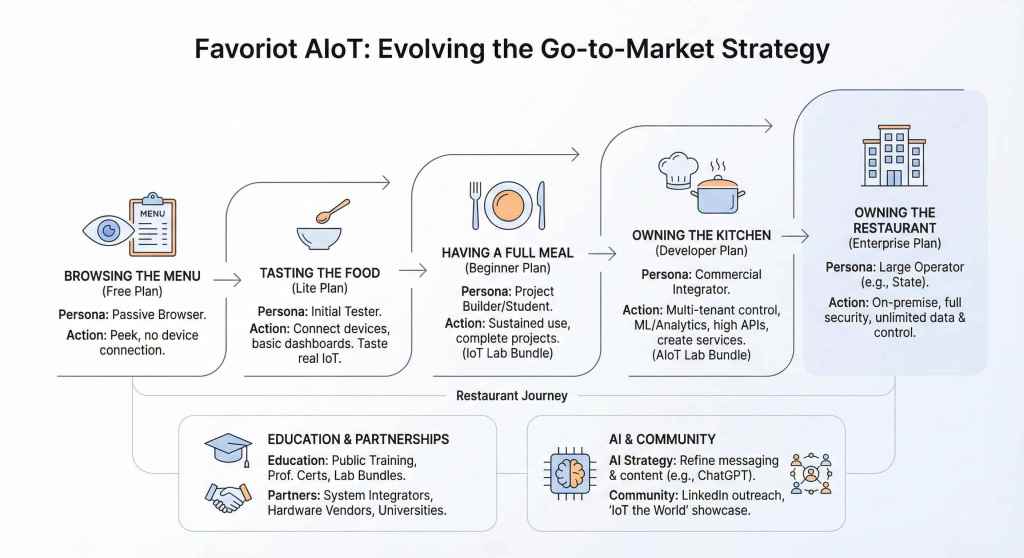
The restaurant analogy that finally made sense

One day, while explaining our plans, I caught myself using a food analogy. And suddenly, everything clicked.

The Free Plan is peeking into a restaurant.
You look at the menu. You walk around. Then you leave.

The Lite Plan is tasting the food.
You sit down. You try a dish. You smile.

The Beginner Plan is a full meal.
You are satisfied. You build. You complete your project.

The Developer Plan owns the kitchen.
You cook. You create menus. You serve your own customers.

The Enterprise Plan owns the whole restaurant.
You decide everything. Security. Scale. Who gets served and how.

When I explained it this way, people finally nodded.

Overseas users and a quiet mystery

Here’s something that still amazes me.

Favoriot has users from more than 130 countries.
Yet most revenue comes from Malaysia.

How did they even find us?

Blogs.
E-books.
Social media posts.
YouTube. TikTok. Facebook groups.

They came. They explored. Most stayed free.

And that taught me another lesson.

Free users overseas were often explorers. Platform shoppers. Comparing interfaces. Looking around.

Not every visitor is ready to commit.

And that’s okay.

Personas matter more than pricing

Over the years, I stopped blaming pricing.

Instead, I studied personas.

Browsers.
Tasters.
Builders.
Integrators.
Operators.

Each one needs a different message.

Each one enters the journey at a different door.

And that was the missing piece all along.

Partners instead of long walks alone

I also realised something else.

We cannot do everything ourselves.

We do not have endless arms and legs to reach every market.

So we shifted.

System integrators.
Hardware partners.
Domain experts.
Universities.

They already speak the language of their customers. We just give them the kitchen.

That felt right.

AI as my late-night thinking partner

I will admit this honestly.

AI changed how I think.

When I was in corporate life, clarity came from meetings, workshops, and committees.

Today, clarity comes at night. Quietly. One question at a time.

I talk.
I reflect.
I get challenged.

Not every suggestion is usable. But every session sharpens my thinking.

Sometimes, you just need a friend who listens without ego.

Community as the long game

Lately, I spend more time on LinkedIn.

I see students from India proudly showing their projects. Some use other platforms. Some barely send data to the cloud.

I comment. I encourage. I invite.

“Try Favoriot.”
“Show us your project.”
“We will feature your story.”

Because visibility matters.

When builders are seen, they stay longer.

And when they grow, they remember.

This journey is still unfolding

Go-to-market favoriot

Favoriot did not arrive here overnight.
It took years of confusion, wrong assumptions, quiet learning, and small corrections.

But today, the path feels clearer.

Free curiosity has a place.
So does tasting.
So does building.
So does owning the kitchen.

If you are just browsing, welcome.
If you are ready to build, stay.
If you want to serve others, let’s talk.

And if you are a student building your first IoT project somewhere in the world, remember this.

The platform you choose today might become the one you trust tomorrow.

I would love to hear your thoughts.
Where are you in this journey?
Peeking, tasting, cooking, or running the whole place?

Leave a comment. Let’s talk.

Favoriot: AI Agents Not Needed Now

Do Favoriot need to develop an AI Agent feature?

Short answer? No, Favoriot does not need full AI Agent automation right now.

And yes, what you have today is more than enough for the market you are serving.

Let me explain this the way I usually reason with myself.

I asked myself this quietly

“Do customers really want systems that act on their own…

or do they want systems they can trust?”

When I sit with city operators, facility managers, engineers, or even researchers, one thing keeps coming up.

They are not asking for autonomy.

They are asking for clarity.

They want fewer surprises.

They want earlier signals.

They want confidence before taking action.

That matters.

What Favoriot already does well

Right now, Favoriot Intelligence does something very important and very rare.

It learns patterns from real operational data

It surfaces what looks unusual

It feeds those insights into a Rule Engine

And then… it stops

That stopping point is not a weakness.

It is a design choice.

The system says,

“Here is what changed.

Here is why it matters.

You decide what to do next.”

That is precisely where trust is built.

Rule Engine + ML is not a compromise

Some people frame this as:

“Rule Engine now, AI Agents later.”

I don’t see it that way.

I see it as:

ML decides what deserves attention

Rules decide what action is allowed

This separation is powerful.

Why?

Because rules are:

  • Auditable
  • Explainable
  • Governable
  • Aligned with SOPs and regulations

And ML is:

  • Adaptive
  • Pattern-driven
  • Good at spotting drift and anomalies

Together, they form a human-in-the-loop intelligence system, not a black box.

That is exactly what enterprises and public sector teams are comfortable with today.

Do customers actually want AI Agents?

Here’s the uncomfortable truth.

Most organisations say they want AI to “automate everything”.

But when you ask one more question…

“Are you okay if the system shuts down equipment on its own?”

“Are you okay if it triggers evacuation automatically?”

“Are you okay if it changes operating parameters without approval?”

The room goes quiet.

What they really want is:

  • Earlier warnings
  • Better recommendations
  • Fewer false alarms
  • Less manual rule tuning

Favoriot Intelligence already delivers that.

Where AI Agents actually make sense later

I’m not against AI Agents. Not at all.

But their place is conditional, not universal.

AI Agents make sense when:

  • Policies are mature
  • Actions are reversible
  • Risk is low
  • Trust has been earned over time

For example:

  • Automated report generation
  • Recommendation ranking
  • Suggesting rule adjustments
  • Proposing actions for approval

Notice the word: suggesting, not executing.

That is a natural evolution path.

Not a starting point.

Strategically, Favoriot is in the right place.

By keeping:

  • ML for learning and insight
  • Rules for control and action

Favoriot positions itself as:

  • Reliable
  • Safe
  • Deployable today
  • Acceptable to conservative sectors

Smart cities.

Utilities.

Campuses.

Critical infrastructure.

These sectors do not reward “full autonomy” first.

They reward predictability and confidence.

My honest conclusion

If I had to answer this as simply as possible:

Favoriot does not need AI Agents to be valuable.

Favoriot Intelligence with ML-driven rules is already the right solution for today.

AI Agents can come later, carefully, selectively, and with guardrails.

Right now, Favoriot is doing something more important than automation.

It is helping people think earlier, not react later.

And that, in my book, is real intelligence.

Reflecting on a Grounded 2025: Lessons from Favoriot’s Journey

I am writing this ten days before 2025 comes to an end.

When I look back at the year, it does not feel loud. It does not feel dramatic. It feels focused. Demanding. Grounded. A year where most of my time, energy, and thinking revolved around one thing only: Favoriot.

If I am being honest, 2025 was not a year of balance. It was a year of commitment.

Most of my days were spent at the office. And when I was not physically there, my mind was still working on Favoriot. Nights. Weekends. Quiet moments that could have been rest often turned into planning or problem-solving. I did not spend much time on myself personally. There were no real holidays. The only breaks I had were during overseas business trips, and even then, work followed me closely.

I told myself more than once, This is not a sacrifice. This is a choice.

And I am at peace with that choice.

Fewer Invitations and a Shift in How We Connect

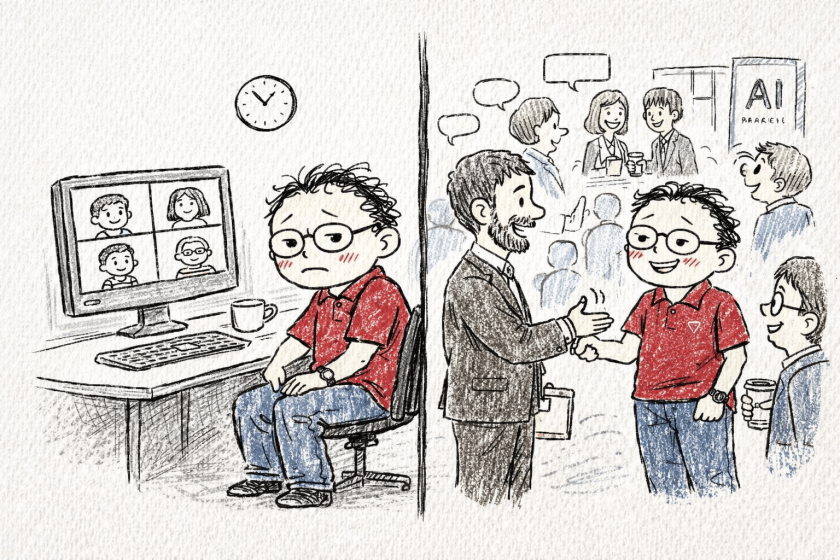
One noticeable change in 2025 was the drop in invitations from universities and public conferences. Many engagements that used to be physical moved online. Meetings became links. Conversations became scheduled time slots on screens.

I realised something about myself quite clearly this year.

I do not enjoy online meetings anymore.

They are convenient, but they remove the human layer. The casual chats before meetings start. The spontaneous conversations after sessions end. The subtle signals that build trust faster than formal presentations ever can.

I still prefer face-to-face meetings. They feel more honest. Better for networking. Better for understanding people beyond their titles.

Public conferences were fewer as well. Part of it could be the current spotlight on AI. IoT felt quieter this year, almost like it had stepped back from centre stage. I was not bothered by it. I was observant.

Trends move quickly. Real work moves steadily.

Why Panel Sessions Still Matter to Me

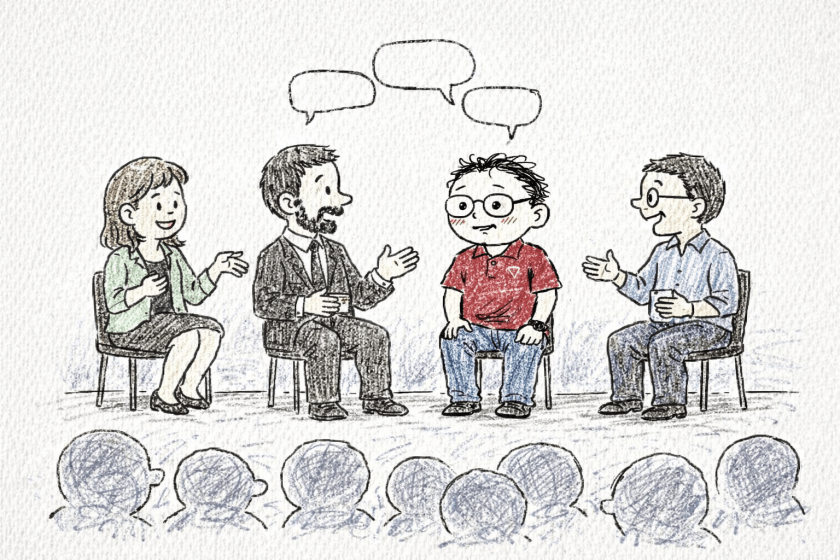
While formal speaking invitations slowed, one format still felt right to me: panel sessions.

No slides. No heavy preparation. Just conversations.

Sitting on stage, exchanging views, listening, responding, sometimes disagreeing politely. That feels closer to how decisions are made in real life.

I often think that insight shows up better in dialogue than in bullet points.

That belief stayed strong in 2025.

A Year Focused on Partnerships

Behind the scenes, 2025 was anything but quiet.

We spent a significant amount of time building partnerships. By the end of the year, we had signed MOUs with more than 40 partners across 15 countries. Our original target was 25 countries, so on paper, we fell short geographically.

But numbers do not tell the whole story.

I have learned that more partners do not automatically mean more revenue or more projects. Partnerships only matter when they are actively engaged, aligned, and nurtured.

Signing is easy. Building trust takes time.

Some partnerships moved faster. Some are still warming up. Some will likely take longer to show results. That is the nature of building across borders.

This year reminded me that ecosystems are built patiently, not collected quickly.

When People Find You on Their Own

One encouraging pattern this year was how people and companies started approaching us unexpectedly.

Each time, I asked the same question. “How did you find us?”

The answer was often simple. They searched online. They did their own research. They were surprised to discover an IoT platform company operating from this region.

That always made me pause.

Years of writing, sharing, and building quietly compound over time. Visibility does not always arrive with announcements. Sometimes it comes as an unexpected email or message.

That is when you realise the work has travelled further than you thought.

Fewer Projects, Fewer Trainings, a Cautious Market

Not everything grew this year.

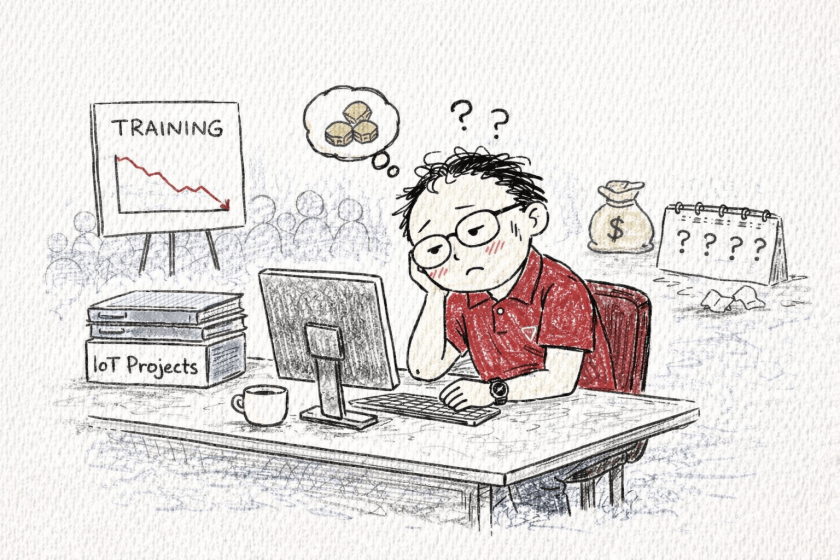
Real IoT projects were fewer compared to previous years. IoT training numbers dropped as well. In-house training, which used to scale better, became harder to secure. We relied more on public training sessions, which are always challenging when it comes to attendance.

The market felt cautious.

Budgets were tighter. Decisions took longer. Interest was still there, but commitment required more patience.

There were moments when I questioned the pace. Is this a temporary slowdown, or is the market resetting itself?

Perhaps it is both.

Shifting My Focus Between Industry Associations

This year, I was less active in the Malaysia Smart City Alliance Association.

At the same time, I became more involved with the Malaysia IoT Association, partly due to my role as Vice-Chairman.

More importantly, MyIoTA’s Smart City Nexus activities align closely with the reasons I joined the association. The Nexus focuses on bringing members’ solutions directly to local councils. It creates a practical space for business matching, not just discussion.

That matters to me, and I plan to be more active there moving into 2026.

Favoriot Sembang Santai Podcast: Keeping Conversations Human

Another meaningful chapter in 2025 was the start of the Favoriot Sembang Santai.

We started the podcast in February 2025, and by December, we had reached Episode 38.

The reason was simple. I wanted a space for honest conversations. No scripts. No slides. No pressure to sound formal. Just honest discussions about Favoriot’s journey and what we were seeing in the IoT space.

The primary host is Zura Huzali, and I serve as the primary guest and speaker. The chemistry works because it feels natural. Curious questions. Straight answers. Occasional debates. Plenty of laughter.

The topics evolved naturally from Favoriot’s story into broader themes such as AI, robotics, satellite IoT, and Ambient IoT. Not as buzzwords, but as technologies we were trying to make practical sense of.

Anyone who misses the live sessions can catch the recordings on YouTube, Spotify, and Amazon Music.

The podcast will continue throughout 2026. For me, it is a long conversation, not a series.

TikTok Live on IoT Man: Ask Me Anything

Alongside the podcast, we also started doing casual TikTok Live sessions on the IoT Man channel.

The central theme is simple. “Ask Me Anything.”

No agenda. No slides. Just live questions and real-time answers. What excites me about these sessions is that they capture a different segment of listeners. Shorter attention spans. Younger audiences. People who may not sit through a long podcast but are curious enough to drop in and ask.

It feels raw. Immediate. Human.

Sometimes the most honest questions come without preparation.

Working With AI to Prepare for 2026

As 2025 draws to a close, one personal highlight has been working with my AI companion.

Not to replace thinking, but to sharpen it.

I spent many late nights shaping 2026 playbooks. How we approach the market. How we engage customers. How we manage partners. New business models. New IoT solution ideas.

The picture ahead feels clearer now.

Looking Forward

2025 was not flashy. It did not come with loud milestones.

But it mattered.

It tested focus. It strengthened conviction. It prepared the ground.

I am genuinely excited about 2026. The plans are clearer. The energy feels different. I hope the long-standing plans around IoT certifications with universities will finally become a reality.

Here is to a better, steadier, and more rewarding year ahead.

I would love to hear how your 2025 has been. Share your reflections in the comments.