Why Renting the Digital Future Is Costing Malaysia More Than We Think

We don’t need more apps.

We need ownership.

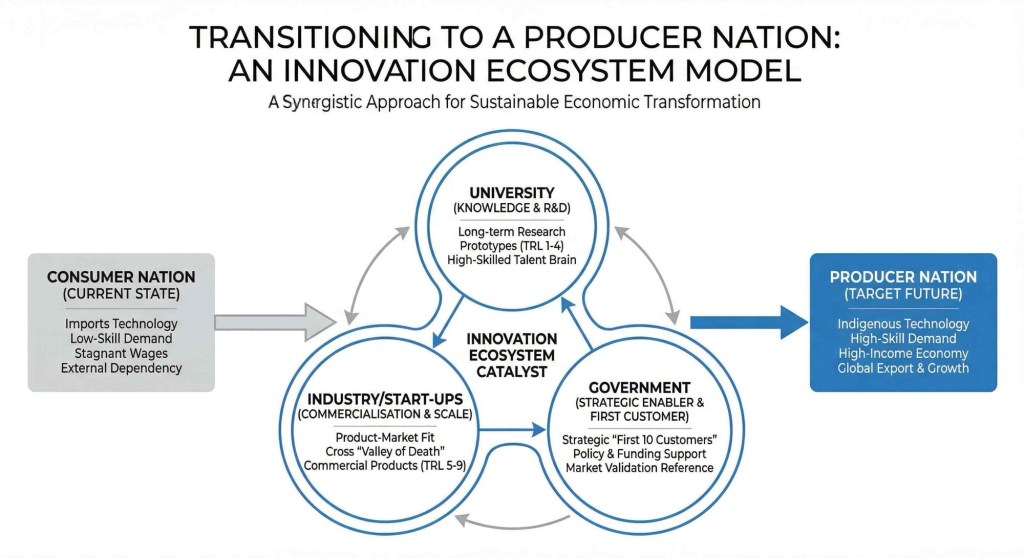
Every day, Malaysia uses digital platforms built somewhere else.
We rent the tools.
We follow the rules.
We pay the toll.

And we call that progress.

But here’s the uncomfortable truth.

A nation that doesn’t build its own digital ecosystems will always stand on borrowed ground.

When the platform is not ours,
the data is not ours.
the roadmap is not ours.
the future is not ours.

Digital ecosystems are not just about technology.
They are about control.
Capability.
Confidence.

They decide who sets standards.
Who shapes talent.
Who captures value when the economy moves online.

This is bigger than startups.
Bigger than funding rounds.
Bigger than slogans.

It is about national muscle.

When crises hit, platforms matter.
When policies shift, platforms decide speed.
When talent grows, platforms anchor skills at home.

If we keep importing everything,
we train users.
not builders.

If we keep outsourcing thinking,
we grow dependency.
not strength.

Malaysia has engineers.
Builders.
Problem solvers.
We always did.

What we lack is belief at scale.
The courage to back our own platforms.
The patience to grow them.
The discipline to protect them.

Digital ecosystems take time.
They stumble.
They mature.
They compound.

But once built,
they become unfair advantages.

This is the moment to choose.

Do we want to remain excellent adopters?
Or do we want to become confident creators?

A strong nation does not just consume the digital world.
It shapes it.

Build local.
Back capability.
Protect the long game.

Our future should not live on someone else’s servers.

Why Some Startup “Failures” Are Actually Training

Failing Forward… Startup Mistakes I’d Make Again

Here’s a truth most founders won’t say out loud.

Some mistakes are not regrets.
They are training.

I’ve made decisions that looked wrong on paper.
Moves that confused people.
Choices that invited questions, doubts, raised eyebrows.

And yet…
I’d make many of them again.

Because those moments shaped how I think today.

I learned what spreadsheets never show.
I learned how people behave when pressure enters the room.
I learned how fast confidence disappears when certainty is gone.

There were launches that came too early.
Partnerships that felt right but weren’t.
Features built with hope instead of evidence.

Painful? Yes.
Pointless? No.

Those moments sharpened my judgement.
They taught me what signals matter.
They taught me what noise to ignore.

Growth rarely comes from getting everything right.
It comes from staying awake while things go wrong.

From asking better questions next time.
From spotting patterns sooner.
From knowing when to push… and when to pause.

Founders don’t grow by avoiding mistakes.
We grow by surviving them with our eyes open.

So if you’re replaying a decision in your head tonight…
Wondering if it set you back…

Take a breath.

Some steps only make sense later.
Some lessons only arrive through friction.
Some mistakes are simply tuition fees for better judgement.

Failing forward is not weakness.
It’s how builders are made.

And some mistakes?
They’re worth every step they gave you.

How I Made Decisions Without Enough Data

Early in my entrepreneurial life, I believed good decisions came from clarity.

Clear numbers. Clear projections. Clear signals from the market.

I waited for them.

They rarely arrived.

Over time, I learned something uncomfortable. Most meaningful decisions are made when the picture is incomplete, the data is noisy, and the consequences are real. Not because founders are reckless, but because waiting for certainty often means missing the moment entirely.

I did not realise this at first. Like many engineers, I trusted data. Like many professionals, I believed preparation would eventually remove doubt. It took years to accept that uncertainty is not a phase to pass through. It is the operating environment.

The question was no longer how to eliminate uncertainty, but how to decide inside it.

I remember sitting in front of options that all felt wrong in different ways. One path carried financial risk. Another risked credibility. A third preserved comfort but quietly stalled progress. None came with assurance. None came with full information.

So I asked myself a different question.

Not “Which choice is safest?”

But “Which risk am I willing to live with?”

That shift changed how I decided.

Most founders frame decisions as binary. Right or wrong. Success or failure. But reality is more layered. Every decision trades one set of risks for another. The mistake is believing that waiting reduces risk. Often, it only changes the type of risk you inherit.

There were moments when I had only partial signals. Early interest that had not converted. Partnerships that sounded promising but lacked commitment. Technologies that worked in controlled settings but had not yet proven scale.

I could have waited.

Many do.

But waiting carries its own cost. Teams lose momentum. Windows close quietly. Confidence erodes without a visible reason. Nothing looks broken, yet nothing moves forward.

I learned to accept decisions made at 60 percent confidence.

Not because I was comfortable with uncertainty, but because I understood the cost of hesitation.

This did not mean ignoring data. It meant recognising when data had done all it could. Beyond a point, more analysis stopped being insight and started becoming delay.

There is a difference.

When I look back, the decisions that mattered most were not the ones backed by the strongest numbers. They were the ones guided by judgement shaped over time. Judgement built from pattern recognition, not prediction. From experience, not certainty.

I learned to listen for quieter signals.

How people behaved when no one was watching.

How partners responded when timelines slipped.

How customers reacted when something went wrong, not when it worked.

These signals rarely appear in dashboards.

They live in conversations. In tone. In follow-through.

One of the hardest lessons was accepting that some decisions would never feel resolved. Even after choosing, doubt lingers. Results take time. Feedback arrives unevenly. You move forward without emotional closure.

That is normal.

Founders who wait to feel confident before acting often confuse confidence with comfort. Confidence grows after movement, not before it. Clarity is frequently the reward for action, not the prerequisite.

Over the years, I stopped asking if a decision was perfect.

I started asking:

Does this move us forward?

Does this preserve our integrity?

Does this keep future options open?

If the answers leaned yes, I moved.

Not quickly. Not carelessly. But deliberately.

There is a quiet discipline in making decisions without full data. It requires humility to accept what you do not know, and courage to act anyway. It also requires restraint. Knowing when a decision is reversible and when it is not.

Reversible decisions can be tested. Irreversible ones deserve more thought, not more data. More judgement.

This is something no spreadsheet teaches.

Today, I no longer chase clarity as a prerequisite. I respect it when it appears, but I do not depend on it. Entrepreneurship, at its core, is not about perfect information. It is about responsibility under uncertainty.

If there is one thing I wish younger founders understood earlier, it is this.

Uncertainty is not your enemy.

Indecision is.

The goal is not to eliminate doubt.

The goal is to build the ability to decide while carrying it.

That is where real leadership begins.

Books Written by Dr. Mazlan Abbas

Small Beginnings. Big Futures.

Some dreams look small at the start.
Almost invisible. Almost forgettable.
Just like seeds sitting quietly in the soil.

But silence never means failure.
It means preparation.
It means something is gathering strength out of sight.

Your dream isn’t late.
Your moment just hasn’t arrived yet.

Keep planting.
Keep watering.
Keep showing up.

When the season is right, the world will finally see what you’ve been building in the dark.

Your time will come.

When Life Feels Full of Rocks, Be the River That Keeps Moving

The river never wastes its breath arguing with the rocks.
It doesn’t complain.
It doesn’t pause to question why the obstacles are there.
It just keeps moving… finding its path one curve at a time.

Life works the same way.
Challenges appear without warning.
People disappoint us.
Doors close right when we’re ready to step through them.
Some days, it feels like every direction is blocked.

But if a river can keep flowing… so can you.

You don’t need a perfect path.
You just need the courage to keep moving, even when the pace feels slow.
Forward is forward, no matter how small the step.

And with enough persistence, even the hardest rocks begin to shift.

Start Before You Feel Ready

Some people wait for the perfect moment.
I learned that the moment never comes.

Most goals fail not because they are impossible, but because we whisper to ourselves, “When I’m ready, I’ll start.”

I used to wait too.

Wait for the right timing.
Wait for the right support.
Wait for fear to disappear.

But fear never disappears.
It only shrinks when you walk toward it.

One small step at a time.

Write the first paragraph even if it feels awkward.
Record the first video even if your voice shakes.
Launch the project even if you are still figuring things out.

Progress grows when you stop negotiating with doubt.

The world rewards people who start before they feel ready.
The world remembers the ones who dared to begin.

So if your heart keeps pulling you toward something, listen.

Move.
Try.
Begin.

Your future self is waiting for you on the other side of courage.

My Journey Through Academia, Telco, and Startup Mayhem — And Why I’d Do It Again

From Signals to Sensing: The Early Spark

Every time I look back at where this whole adventure began, I’m reminded of how simple the starting point was. I was just a young engineer obsessed with how things connected. My academic path shaped the first chapter — electrical engineering, telematics, and finally a doctoral dive into telecommunications.

Those years were filled with long nights, dense textbooks, and moments where I quietly wondered, “Is this really the road I want to stay on?” But something about networks — the way invisible signals could connect lives — kept pulling me forward.

My early years in academia gave me a grounding that I still rely on today. Teaching forced me to explain ideas clearly, question assumptions, and stay curious. It was the first real test of whether I understood the world of connectivity or was just reciting formulas.

Into the Telco Trenches

Eventually, the classroom walls felt too small. I wanted to see how these theories behaved under real pressure. That shift took me deep into the telecommunications industry.

Those years were intense: real customers, real failures, real deadlines. It wasn’t just about making a system work; it was about keeping it alive when the world depended on it.

Later, I moved to a national research agency, where I led teams working on early broadband, wireless sensor networks, and technologies that today fall neatly under the label of IoT. Back then, it felt like tinkering with the future. Testing prototypes in rural villages, deploying sensors in unfamiliar places, experimenting with wireless technologies that many considered too early or too ambitious.

Yet I couldn’t shake the thought: “What if this tech leaves the labs and enters daily life?” That question lingered for years.

The Entrepreneurial Leap

Eventually, that question grew too loud to ignore. I left the comfort of corporate structures and returned to the raw, unknown world of startup life.

First came a role in shaping a national IoT initiative. Then came the big leap: building a company from scratch.

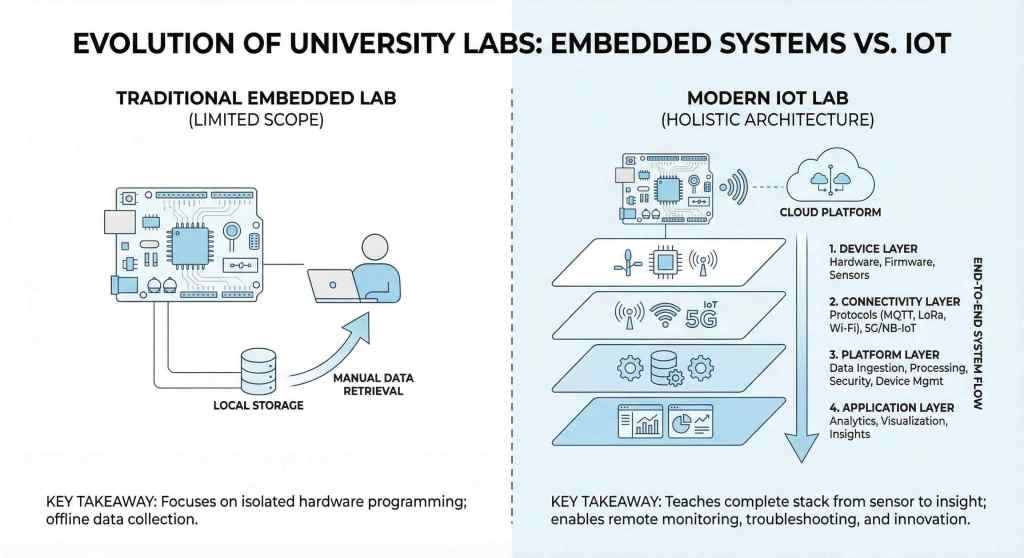
That company was REDtone IoT. Running it taught me one of the toughest lessons — great tech means nothing if people can’t use it easily. Every client wanted IoT, but most didn’t know where to start. They struggled with device integration, cloud setups, dashboards, maintenance, and the countless hidden complexities that IoT quietly hides behind its shiny promise.

That frustration became the seed for something bigger.

The Birth of FAVORIOT

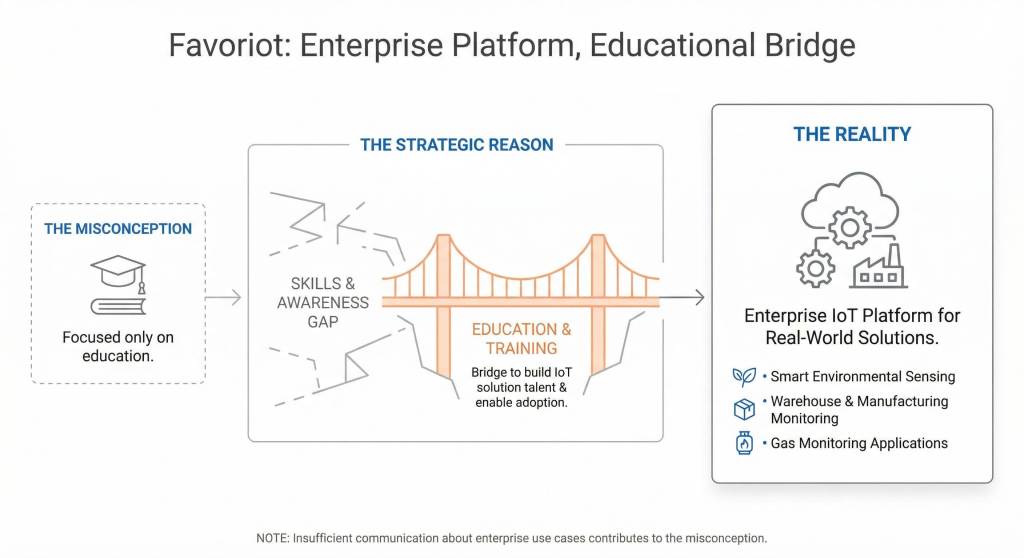
By 2017, the vision crystallised: create a platform that removes the chaos and gives everyone — students, SMEs, city councils, engineers — a simple way to bring IoT ideas to life.

FAVORIOT wasn’t built to be fancy. It was built to be practical.

I wanted a platform where a lecturer could run a complete IoT project without having to manage 10 different systems. Where a hardware company didn’t need to customise dashboards endlessly. Where a city council could monitor sensors without drowning in integration nightmares.

FAVORIOT was designed for inclusion. For accessibility. For the everyday builder, not just the big spender.

And every year since, that vision has deepened.

Wearing Many Hats

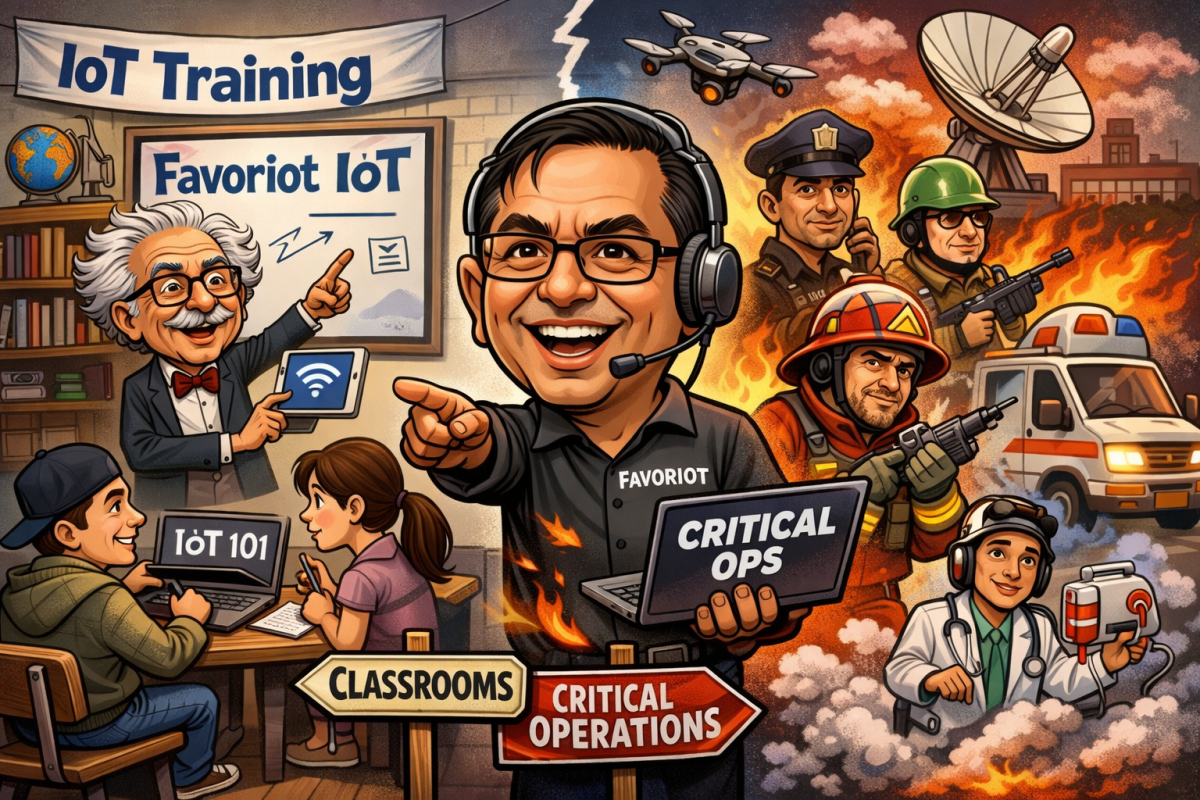
Even as FAVORIOT was growing, I continued teaching and speaking. These weren’t side gigs. They kept me grounded. They reminded me why I started.

Standing in front of students made me rethink complexity. Speaking to industry leaders challenged my ideas. Engaging with smart city stakeholders, founders, and device makers kept me aware of the real obstacles people face.

Sometimes I’d walk out of a lecture hall thinking, “This feedback is better than any consultancy report.”

Sometimes a conversation with a frustrated engineer made me go back and tweak the platform design.

Those experiences shaped FAVORIOT as much as any technology roadmap ever did.

Recognition and Reality Checks

Over time, things began to click. FAVORIOT earned recognition. My own work in IoT and smart cities gained global visibility. Industry groups listed me among the top influencers. Conferences kept inviting me to speak.

But none of that ever felt like a trophy finish. If anything, it reminded me that the journey had only just reached a new checkpoint.

“Alright, Mazlan, now don’t get comfortable,” I’d quietly tell myself.

The pressure increased. Expectations rose. The work became heavier… but also more meaningful.

Why the Story Still Matters

When I piece the chapters together, it becomes clear that every phase — the student, the professor, the telco engineer, the researcher, the entrepreneur — served a purpose.

  • Academia taught discipline.
  • Telco taught scale.
  • Research taught imagination.
  • Entrepreneurship taught resilience.
  • Teaching and speaking taught clarity.

FAVORIOT stands today as more than a platform. It’s a symbol of what happens when technology is shaped around people — their pains, their limitations, their hopes.

I’ve always believed IoT should be accessible. Not something locked behind expensive teams or giant corporations. Not something only “experts” can touch.

If we can empower everyday builders, we’re doing something right.

A Note to My Younger Self

If I could sit with the younger version of me — the one carrying textbooks thicker than his arm — I’d probably smile and say:

“Every jump you make will make sense one day. Every detour, every frustration, every late night… you’re collecting tools. Don’t rush the process.”

And maybe I’d add:

“When you build for people, not systems, that’s when the real magic happens.”

If you’ve read this far, I’m curious — which part of this journey speaks to you the most? Drop your thoughts. Let’s connect through stories.

Hi. I’m the Guy Behind FAVORIOT

And this isn’t another tech pitch.
It’s a confession… and a promise.

FAVORIOT didn’t appear out of thin air.
It was born from years of watching brilliant Malaysians fight battles they shouldn’t have to fight.

I’ve been in telco rooms where engineers looked exhausted after stitching ten different systems together.
I’ve sat with lecturers who said their students had the passion but no real platform to grow on.
I’ve listened to system integrators torn between pleasing clients and staying sane.
I’ve seen founders pour their hearts into pilots that never scaled because every new project felt like starting from scratch.

I saw all of it up close.
I asked questions.
I listened carefully.
I heard the frustration that people rarely say out loud.

One lecturer confided, “My students can build anything… but we have no common place to make it real.”

A hardware partner admitted, “We’re drowning in dashboard customisations. It’s slowing us down.”

A founder whispered what many felt, “Every pilot feels like a science experiment that no one wants to repeat.”

The pattern was unmistakable.
The problem wasn’t talent.
It wasn’t ideas.
It wasn’t ambition.

It was the weight of chaos…
devices speaking ten different languages, dashboards built for every new customer, integrations that kept breaking, and projects that died because the foundations were never steady.

Everyone was building islands.
No bridges.
No unity.
No momentum.

And it hurt to see so many capable Malaysians struggling not because of skill… but because the ecosystem never gave them a proper foundation.

So I decided to build one.

Not a platform for show.
Not a platform for slides.
But a platform shaped by every frustration I witnessed.

A platform that starts you at 60 percent instead of zero.
A platform that speaks to every device, every protocol, every idea.
A platform that lets students learn without drowning.
A platform that lets partners grow without rebuilding the same thing endlessly.
A platform that lets enterprises keep their data close and their confidence intact.

FAVORIOT wasn’t built to impress you.
It was built to lighten your load.

Because I’ve seen the late nights.
The soldering iron on the table at 2am.
The dashboards rebuilt for the fifteenth time.
The excitement in students fading because nothing works the way it should.
The startups who gave up not because their idea was bad, but because everything around their idea was too messy.

I built FAVORIOT so that your talent doesn’t get buried under problems that shouldn’t exist.

I’m not saying it will fix bureaucracy.
I’m not saying it will make everyone tech-ready overnight.
And I’m not saying it will solve every problem under the Malaysian sun.

But I am saying this:

The struggles that slow you down the most are solvable.

The confusion.
The repeated work.
The endless customisation.
The feeling of always starting over.
The platforms that fight you instead of helping you.

Those problems shouldn’t be your burden anymore.

You were meant to build solutions.
To teach.
To innovate.
To create impact.
To push Malaysia forward.

Your tools should support that… not get in the way.

So try it.
Connect a single sensor.
Send one stream of data.
Build one dashboard.

And see if something inside you says…
“This is how it should have been all along.”

My belief?
You’ll finally feel the freedom to build without fighting the foundations.

FAVORIOT exists because Malaysia deserves that freedom.
Innovators deserve that clarity.
And you deserve a platform that works with you.

No hype.
No fireworks.
Just the foundation you’ve been asking for… quietly waiting for you to take the next step.

— The guy who built Favoriot because too many Malaysians were struggling in silence.

Success is a Decision: My CEO Journey

SUCCESS IS A DECISION, NOT A MIRACLE.

I still remember standing at my own “two doors” moment.

On one side was comfort — a stable career, predictable days, and a familiar path.
On the other was uncertainty — risk, sleepless nights, and the weight of leading something that didn’t even exist yet… FAVORIOT.

Becoming a CEO wasn’t something that happened overnight. It was a choice.

A choice to leave behind the safety of titles and the illusion of stability.
A choice to start from zero when people around me thought I’d already “made it.”
A choice to believe in an idea when others only saw obstacles.

That first day as CEO, there was no red carpet waiting. No big office. No team of hundreds. Just a laptop, a vision, and an endless staircase marked by courage, patience, discipline, and focus.

Every step demanded something.
Courage to face rejection.
Routine to build momentum.
Focus to silence the noise.
Discipline to show up — even when no one was watching.
And patience… the hardest of all.

Because success wasn’t a miracle waiting to happen. It was a series of small, stubborn decisions.

Each time I faced a setback — a failed pitch, a cancelled project, a delayed payment — I reminded myself why I opened that “new life” door in the first place.

Years later, FAVORIOT stands not just as a company, but as proof that choosing the harder door can change everything.

If you’re standing between comfort and courage right now…
remember this — your new life begins the moment you decide to walk through that door.