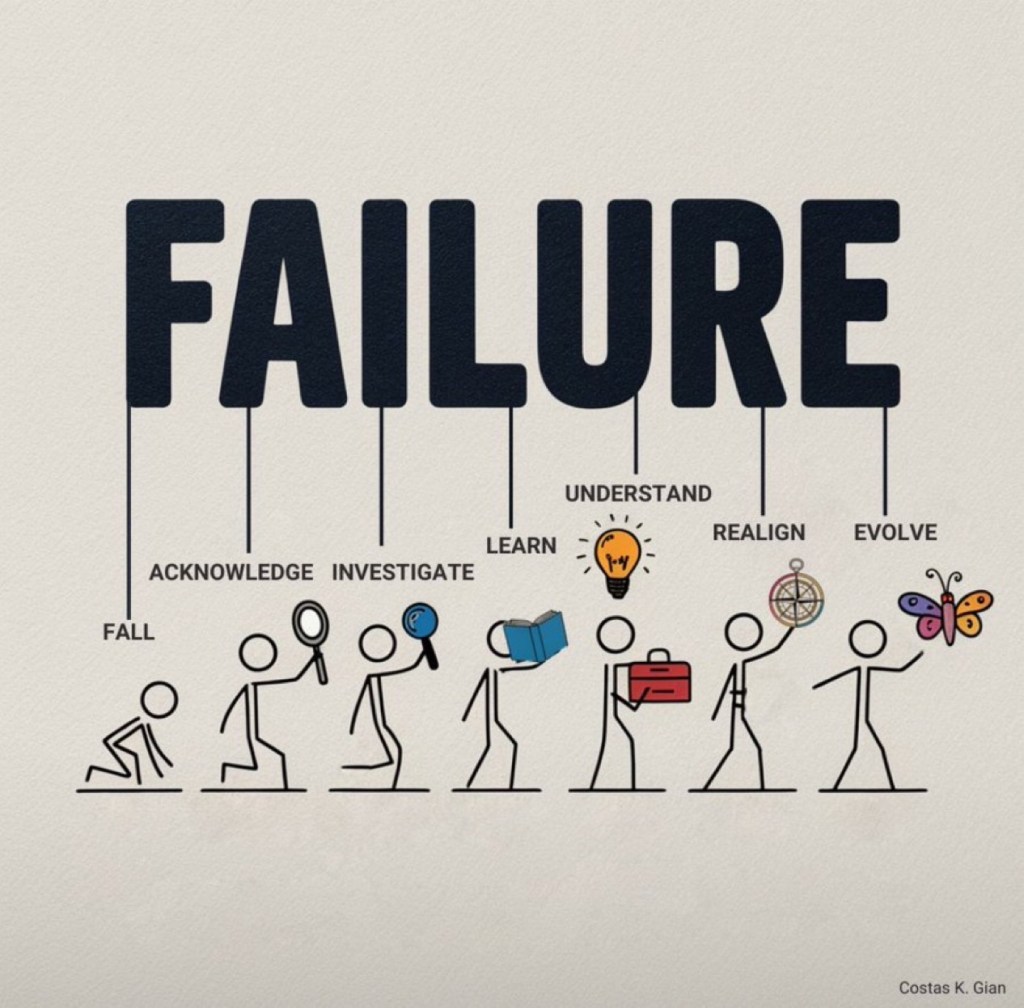
Nobody Is Thinking About You.

That may sound brutal, but for a founder, it’s the greatest relief you can carry.

You’re not really afraid of failure.

You’re afraid of the judgment that follows.

The investors’ raised eyebrows.

The market’s whispers.

The silent verdicts from peers.

But here’s the truth every founder needs to hear:

Nobody is thinking about you.

They’re too busy fighting their own fires.

That pitch you bombed?

They’ve already moved on to the next deck.

That product launch that flopped?

The market barely blinked—it’s already chasing the next shiny thing.

That mistake you obsess over late at night?

It doesn’t even make it to their memory bank.

Founders often chain themselves to ghosts of imagined critics.

But the reality is, no one is holding those chains. You are.

So build the damn thing.

Ship the MVP.

Knock on doors.

Send the cold emails.

Ask for the sale.

The world doesn’t measure you by how many times you stumbled.

It remembers you for the times you had the audacity to rise again.

As a founder, liberation begins when you realize this:

No one is thinking about you.

So stop waiting for validation.

Stop waiting for permission.

And start building the company only you can build.

Do you want me to also create the Malay “santai” founder version so it hits closer to the local entrepreneurial community?

Every New Chapter Demands a Different You

The hardest truth I’ve learned is this:

Growth doesn’t come without transformation.

Every time life hands you a new chapter, it quietly demands that you rewrite yourself.

The student version of you won’t survive in the workplace.

The young executive version of you won’t succeed as a founder.

The founder version of you won’t thrive as a leader of teams.

At first, I resisted.

I thought I could hold on to the same habits, the same mindset, the same playbook.

But then reality hit me.

What carried me here… won’t carry me forward.

To step into the next level, I had to let go.

Let go of old fears.

Let go of outdated skills.

Let go of the identity that once made me feel safe.

And that’s the paradox of progress.

We want change, but we fear losing the version of ourselves we’ve already mastered.

But the truth is, mastery is temporary.

Life keeps testing whether you’re ready to evolve.

If you’re entering a new season right now, don’t ask, “How do I hold on?”

Ask instead, “Who must I become to win here?”

Every challenge you face is not just about solving the problem.

It’s about shaping the person who solves it.

The next chapter won’t wait for the old you.

It’s already calling for the new one.

So here’s the question for you:

Which version of yourself are you willing to shed so you can step into the one you’re meant to be?

Founders, Stop Hiding. Start Selling.

You need to be selling.

Not next month. Not when you “feel ready.” Not when you finally hire a VP of Sales.
Now.

Whether you like it or not, you are the best salesperson your company will ever have.

You may not have a sales background. You may not even like selling.
But no one will ever carry the conviction you do.

You know the product inside out.
You live the vision every single day.
You bleed the mission in a way no outsider ever could.

And here’s the truth most founders don’t want to hear:
Great VPs of Sales don’t join companies at your stage.
They want predictable revenue, established playbooks, and budgets to spend.

So, waiting for that magical hire? It’s a fantasy.

If you try to outsource this part of the journey, you’re setting yourself up for disappointment.
Because in the early days, selling isn’t about process.
It’s about passion.
It’s about credibility.
It’s about trust.

And no one will sell belief better than the person who dreamed the impossible and built it anyway.

Founders, your first role is not CEO.
It’s not Visionary.
It’s not even Product Builder.

It’s Chief Salesperson.

Step into that role.
Get out of the office.
Shake hands. Pitch hard. Close deals.

Because until you sell, your company is just an idea.
And when you sell, your company becomes a reality.

The future of your startup depends on your ability to embrace the one job you cannot delegate.

What’s your story of the first deal you personally closed as a founder?

The Friends Who Make the World Less Heavy

Some friendships don’t make sense to the outside world.

But to you, they make life worth living.

They’re the ones who laugh at the same ridiculous things.

Who turn ordinary moments into unforgettable memories.

Who find joy in the silly, the random, the nonsense.

Because it’s not about being “normal.”

It’s about finding someone who matches your kind of crazy.

Someone who reminds you that life isn’t just about deadlines and achievements it’s about connection, laughter, and freedom to be unapologetically yourself.

In leadership, in business, in life having people like this matters more than we admit.

The colleagues who stay late with you not because they have to, but because they want to.

The friends who brainstorm wild ideas that sound impossible, but somehow light a spark.

The partners who understand your quirks and don’t try to fix them.

Shared values keep teams together.

Shared dreams keep communities alive.

But shared “craziness”? That’s what keeps us human.

The truth is life will throw challenges, stress, and expectations.

But if you have even one friend who laughs with you in front of the metaphorical fan… you’re rich.

So here’s to those friends, colleagues, and partners who don’t just walk with us in logic, but dance with us in madness.

Because in a world that often feels heavy, they remind us to stay light.

What’s one silly thing you and your closest friend or colleague do that no one else would understand?

Stop Complaining. Start Taking Back Your Power.

Some truths sting.

But here’s one worth holding onto:

Complaining never changes a thing.

Every excuse, every regret, every ounce of negativity you let slip out—it doesn’t fix the problem.

It only feeds it.

If something is within your control, act.

If it isn’t, let it go.

Complaining gives away your power.

Action reclaims it.

The next time you feel the urge to complain, ask yourself:

“Am I willing to waste energy on this, or will I use that energy to move forward?”

Because life rewards doers, not complainers.

What’s one complaint you’ve decided to replace with action?

Waiting Almost Killed My Startup

When I first became a founder, I thought success would come after someone else gave me the nod.

I waited for validation.

For investors to say yes.

For partners to recognize our value.

For the market to tell me it was the right time.

But waiting almost killed the dream.

Here’s what I learned: no one is going to hand you permission to build the life or the company you want.

The turning point came when I stopped asking, “Am I ready?”

And started saying, “Let’s build anyway.”

We didn’t have all the resources.

We didn’t have the perfect timing.

But we had the courage to act.

Every milestone we’ve hit since then came because we stepped forward without waiting for approval.

Good things didn’t come while waiting.

They came when we dared to move.

To every founder out there: the gate is open. The opportunity is on the other side of the permission you give yourself.

What’s the bold step you’ve been holding back from taking?

The Silent Test of Friendship

Some truths hurt more than lies.

Most of your friends aren’t really your friends.

They show up when it’s fun.

When you’re winning.

When you’re useful.

But when the music stops, and the room goes quiet, you suddenly see how empty it really is.

Real friends are not measured by convenience.

They’re measured by sacrifice.

By the calls they make when you’ve gone silent.

By the seat they pull up when everyone else has walked away.

I’ve learned this the hard way.

You can lose status, money, health, or direction—and watch the crowd scatter.

But the few who remain, those are your people.

Find them.

Hold onto them.

Be that kind of friend to someone else.

Because in a world full of masks, true friendship is the rarest kind of wealth.

What’s the hardest lesson you’ve learned about friendship?

The Founder Truth No One Tells You

When I co-founded FAVORIOT, I thought the most significant milestones would define me.
The first product launch.
The first government pitch.
The first international partnership.

But what I didn’t expect was how much the mistakes would shape me.

We once lost a tender even though our platform was MySTI certified.
We thought the badge would speak for itself.
It didn’t.
That mistake taught me that credibility means nothing without persistence.

We built features no one used.
We learned that listening to customers is more valuable than perfecting technology in isolation.

We expanded too fast into areas we weren’t ready for.
It humbled us to narrow focus, to build depth before breadth.

Every scar carried a lesson.
Every stumble forced me to shed arrogance and grow resilience.

Achievements bring applause.
But mistakes bring wisdom.
And in the long run, wisdom is what keeps a startup alive.

FAVORIOT isn’t standing today because of my victories.
It’s standing because the mistakes taught me how to rebuild stronger.

A mistake that humbles a founder will always be worth more than an achievement that blinds him with arrogance.

That’s the truth I carry as IoT Man.

What was the one mistake that humbled you but transformed your journey?

Why Favoriot’s Vision to Democratize IoT Matters

What if the future of technology wasn’t just controlled by a handful of giants, but built by thousands of creators everywhere?

That’s the vision we carry at Favoriot. Not a future where IoT is locked away in labs, hidden behind paywalls, or restricted to enterprises with deep pockets. But a world where every student, every startup, every dreamer with an idea can create, test, and scale their own IoT solutions.

I often ask myself, why should the power of IoT belong to only a few?

The truth is that IoT has the potential to transform every aspect of our lives, from smart cities that breathe with data, to farms that thrive with precision, to factories that learn and improve with every machine cycle. However, the doors to building IoT are often closed by complexity, cost, and exclusivity.

That’s why Favoriot exists.

IoT Shouldn’t Be an Exclusive Club

I’ve been in the tech industry long enough to know this: many brilliant ideas die before they even take their first breath. Why? Because the entry barrier is too high.

I’ve seen students with incredible IoT project ideas get stuck because they couldn’t afford expensive platforms. I’ve watched startups burn months trying to stitch together incompatible systems, only to give up before their product reached the market.

I thought to myself, what if we could change that narrative? What if we could open the gate wider?

Favoriot’s vision is simple yet powerful — to democratize IoT. To build a platform that doesn’t intimidate but empowers. One that invites creators instead of scaring them off.

Building More Creators, Not Just More Users

Most platforms are designed to create more users. But Favoriot is designed to generate more creators.

That difference matters.

Being a user means consuming what someone else has built. Being a creator means shaping the future, solving your own problems, and building solutions that matter to your community.

At Favoriot, we want a high school student in Johor to build a smart agriculture project that could feed her village. We want a startup in Manila to prototype a healthcare monitoring device without relying on investors for funding. We want universities in Africa to launch IoT labs that not only teach theory but also create real projects that positively impact lives.

This is not about numbers. This is about empowerment.

The Favoriot Platform: More Than Just Tech

Yes, Favoriot is a platform. It’s a cloud-based IoT engine that connects devices, collects data, and helps you make sense of it. But to me, it’s more than that.

It’s a bridge.

A bridge between ideas and reality. Between imagination and execution. Between a world where IoT is for the privileged few and a future where IoT belongs to everyone.

When we built Favoriot, we made a conscious choice: simplicity, openness, and accessibility. No vendor lock-ins. No hidden traps. Just a space where your IoT journey can grow from blinking an LED to managing a smart city.

I smiled when one of our users once told me, “Favoriot is like training wheels for IoT — it helps us ride until we’re ready to pedal on our own.”

That’s exactly how I see it.

A Vision Rooted in Humanity

For me, democratising IoT is not just about technology; it’s also about empowering people. It’s about humanity.

Imagine if every farmer could monitor their crops in real time. Imagine if every doctor in rural areas had access to patient data at their fingertips. Imagine if every student, regardless of their location, could create something that addresses real-world problems.

That’s the kind of future I want to see.

I know it won’t be easy. Change never is. There will always be resistance from those who benefit from keeping technology closed, complicated, and expensive. But I also know this — the world has always moved forward when ordinary people were given extraordinary tools.

Why Now?

Because the world cannot wait.

IoT is no longer a buzzword; it’s the nervous system of modern life. From the cars we drive to the homes we live in, from the energy grids that power us to the health systems that save us, IoT is everywhere.

But here’s the catch: if only a few can create, then only a few will shape that future. And that, to me, is unacceptable.

We need diversity. We need creativity. We need more voices, more perspectives, more hands building solutions. And that only happens when IoT is democratized.

Closing the Gap Between Dream and Reality

Every time I see a young innovator upload their first data stream into Favoriot, I feel a surge of hope. It’s not just data flowing into the cloud — it’s dreams taking shape.

Every time a small business uses Favoriot to track their machines and reduce downtime, I see a glimpse of the future economy.

Every time a teacher tells me their students used Favoriot to complete a project that once felt impossible, I’m reminded of why we started this journey.

The gap between dream and reality doesn’t have to be wide. Favoriot is here to close it.

The Future We Want to Build

I don’t just want to build a successful company. I want to create an ecosystem. A movement. A community of creators who believe that IoT is not just for the rich, the powerful, or the technically elite.

I want Favoriot to be remembered not just as a platform, but as a turning point. The moment when IoT stopped being a privilege and began to become a right.

I thought to myself, maybe the true legacy of Favoriot isn’t the platform we built — but the creators we inspired.

And that’s a future worth fighting for.

Leading LLMs of August 2025: Who’s Winning the AI Race?

If AI progress felt like a sprint in 2023, by 2025, it looks more like a rocket launch. Models aren’t just improving year by year—they’re leaping ahead month by month. What we thought was “cutting edge” last quarter is already yesterday’s news.

Here’s the reality: the global LLM market is surging toward $105.5 billion in North America by 2030. That’s not a forecast—it’s a signal. AI is no longer a novelty; it’s infrastructure.

But with so many options, which models actually matter right now? Which ones are shaping the way businesses, developers, and researchers use AI today?

I’ve rounded up the 10 large language models making the most significant impact in August 2025. Each one has its own unique personality, strengths, and trade-offs.

1. OpenAI – GPT-5

ChatGPT 5 is the next step in OpenAI’s journey, moving beyond GPT-4.5’s strengths to deliver a model that feels sharper, more adaptive, and more transparent in its reasoning. Where GPT-4.5 leaned heavily on pattern recognition, ChatGPT 5 combines that fluency with stronger deliberate reasoning, giving it the ability to break down problems with more structure and clarity.

It is also built to integrate more smoothly into real workflows. From handling long-form context with greater accuracy to providing clearer explanations of its answers, ChatGPT 5 is less about simply generating text and more about acting as a reliable partner. The model handles multimodal input—text, images, audio, and video—with greater fluidity, making it useful across industries from education to enterprise automation.

Like its predecessor, ChatGPT 5 remains proprietary, available through subscriptions or enterprise licensing. But for teams that want both conversational polish and deeper reasoning ability in one package, ChatGPT 5 has quickly become the new reference point.

2. DeepSeek – The Open-Source Challenger

China’s DeepSeek R1 took the AI world by storm with 671B parameters in a Mixture-of-Experts setup. By May 2025, their DeepSeek-V3 was leading the open-source leaderboard, proving that open models can compete head-to-head with proprietary giants.

The magic? 30 times cheaper than OpenAI’s o1 and 5 times faster. It thrives in reasoning-heavy tasks like math, coding, and scientific simulations. And with RAG integration, enterprises can plug it into sensitive datasets while maintaining control.

If you want open-source power with enterprise-level results, DeepSeek is redefining the game.

3. Qwen – Alibaba’s Efficiency Master

Alibaba’s Qwen 3 family is quietly powering industries across Asia. Their standout, QwQ-32B, rivals GPT-4o and DeepSeek in reasoning and coding while requiring far less compute.

With 32K context windows, Apache 2.0 licensing, and a parameter range from 1.8B to 72B, Qwen has become one of the most accessible and widely adopted LLM ecosystems. Already, over 90,000 businesses use it for gaming, consumer electronics, and enterprise workflows.

Qwen proves you don’t need hyperscale resources to compete at the highest level.

4. Grok – Elon Musk’s Conversational Rebel

Built by xAI and integrated into the X platform, Grok 3 feels different. It’s witty, fast, and plugged into real-time information.

With Think, Big Brain, and DeepSearch modes, it breaks down problems and pulls fresh data directly from the web and social feeds. Trained with 10x the compute of Grok 2, it’s designed for speed and trend awareness.

If your world demands live analysis, news tracking, or instant customer interaction, Grok brings something truly unique.

5. Llama – Meta’s Open-Weight Titan

Meta’s Llama 4 arrived in April with two flagship versions: Scout and Maverick. Both are natively multimodal, handling text, images, and short video, and they boast 256K token context windows.

The openness of Llama remains its secret weapon. Businesses and researchers can run it on their own terms, tune it to specific workflows, and avoid vendor lock-in.

If freedom and flexibility matter most, Llama is the open-source heavyweight to trust.

6. Claude – Anthropic’s Reflective Thinker

Anthropic’s Claude 4 Sonnet is like the careful colleague who always double-checks their work. Its extended thinking mode allows the model to pause, reflect, and refine outputs before committing.

With a 200K-token context window, it handles long documents with ease, making it a natural fit for legal analysis, compliance-heavy industries, and coding projects that need extra accuracy.

If reliability is more important than speed, Claude delivers consistency and thoughtfulness.

7. Mistral – Small but Mighty

Sometimes you don’t need a massive model—you need one that’s fast and affordable. Enter Mistral Small 3.

With 24B parameters, Apache 2.0 licensing, and speeds up to 150 tokens per second, it’s optimised for low-latency applications. The kicker? You can run it on a single GPU or even a MacBook.

For startups and lean businesses, Mistral proves that small models can pack a punch.

8. Gemini – Google’s Reasoning Powerhouse

Google’s Gemini 2.5 is pushing boundaries with a 1M-token context window. That means it can process entire books or databases in one shot.

It’s multimodal, handling text, images, and code, and comes with self-fact-checking to reduce hallucinations.

It’s proprietary, so data compliance matters, but if you want enterprise-grade multimodality and serious reasoning, Gemini is one of the most advanced options on the market.

For those preferring open weights, Google’s Gemma 3 (1B–27B) brings much of the same reasoning strength in a lighter package.

9. Command R – Cohere’s Enterprise Specialist

Cohere isn’t trying to win the hype war—it’s focused on enterprise workflows. Their Command R+ offers 128K context windows, built-in citations, multilingual coverage, and retrieval-augmented generation.

It excels at policy manuals, compliance-heavy industries, and multilingual customer service. And for companies needing control, Command A is open-sourced at 111B parameters with 256K context support.

For enterprises where accuracy and compliance come first, Cohere is a trusted partner.

10. Falcon – The Middle Eastern Power Play

From the Technology Innovation Institute (TII) in Abu Dhabi, Falcon has emerged as one of the strongest open-weight LLMs outside the US, China, or Europe.

The latest version, Falcon 2, boasts multilingual capabilities, optimised efficiency, and open-access licensing. It’s trained on a diverse dataset with an emphasis on global inclusivity, making it particularly strong in Arabic and other underrepresented languages.

What makes Falcon stand out is its mission: bringing AI sovereignty to regions that often depend on Western or Chinese tech. By providing a robust open-source model, Falcon gives governments, universities, and enterprises across the Middle East a homegrown alternative.

If AI diversity and regional sovereignty are important to you, Falcon is an LLM worth watching closely.

Closing Thoughts

Ten models. Ten different approaches to the future of AI.

  • OpenAI and Gemini lead with polished, proprietary power.
  • DeepSeek, Qwen, Llama, and Falcon prove open-source can compete and even outpace.
  • Claude and Cohere focus on reliability and compliance.
  • Mistral and Grok carve out niches in speed, agility, and personality.

The bigger question isn’t “Which is the best?” but “Which one is the best fit for you?”

AI in 2025 is not a single path—it’s a crossroads with ten directions. And whichever road you choose, the destination is changing how we work, build, and think.

Now I’d love to hear from you. Which of these ten models do you think will dominate the AI race by 2030—and why? Share your thoughts in the comments.