Today, we’ll explore the Fourth Industrial Revolution (IR 4.0) and its significance. This diagram breaks it down into easy-to-understand sections, so let’s walk through it step by step.
1. The Differences Between Revolution and Evolution
Let’s first clarify why it’s called a revolution and not an evolution.
Revolution:
Sudden and drastic changes that transform industries and societies.
Think of it as a dramatic leap forward in technology and processes.
Evolution:
Gradual and slow progress over time.
IR 4.0 is a revolution because it represents rapid and significant advancements in how we live and work.
2. The Bigger Picture: Industry 4.0 vs IR 4.0
It’s important to understand that Industry 4.0 is just a subset of IR 4.0.
Industry 4.0 focuses on manufacturing and improving industrial processes using automation, IoT, and robotics.
IR 4.0, however, encompasses much more:
It impacts various sectors, such as education, healthcare, shopping, and agriculture.
It’s a broad transformation, not limited to factories or industries.
3. The Lifestyle Through Industrial Revolutions
Let’s now look at how each industrial revolution shaped our lifestyle:
IR 1.0 — The Age of Manual Tools:
People relied on physical and manual tools for work.
Example: Ploughing fields with hand tools.
IR 2.0 — The Power of Electricity:
Electricity revolutionised industries, enabling mass production.
Example: Electric machines replaced manual labour.
IR 3.0 — The Digital Era:
The rise of electronics and the internet connected the world.
Example: Computers, email, and early e-commerce.
IR 4.0 — The Intelligence Revolution:
We’re now using intelligence through AI, robotics, and advanced technologies.
Example: Autonomous robots, augmented reality (AR), and virtual reality (VR).
4. Example: How Shopping Evolved
Let’s take shopping as an example of how each industrial revolution changed this activity:
IR 1.0: People used cash for transactions.
IR 2.0: The cash register was introduced, improving the checkout process.
IR 3.0: Credit cards and online shopping emerged with the internet.
IR 4.0: We see robotics and AR/VR enhancing the shopping experience, like virtual try-ons or automated warehouses.
Why is IR 4.0 Important?
IR 4.0 is transforming every aspect of our lives, from how we work and learn to how we interact with technology. It’s about leveraging intelligence to solve problems, improve efficiency, and create new possibilities.
Today, we’ll explore two closely related but distinct concepts: Industry 4.0 and the Fourth Industrial Revolution (IR 4.0).
These terms are often used interchangeably but have specific differences, as highlighted in the diagram. Let’s dive in step by step.
1. Revolution vs Evolution
The first thing we need to clarify is the difference between revolution and evolution:
Revolution refers to sudden and drastic change. Think of it as a leap forward that quickly transforms industries and societies.
Evolution, on the other hand, is slow and gradual progress. Changes happen incrementally over time.
Key question: Are we adopting Industry 4.0 technologies suddenly (revolution) or gradually (evolution)? This can vary depending on the industry and region.
2. What is Industry 4.0?
Industry 4.0 focuses on manufacturing and improving industrial processes through advanced technologies like IoT, AI, and robotics. It is the fourth stage in the progression of industrial advancements:
Industry 1.0 (1784):
Introduction of mechanisation and steam power.
Example: Steam engines powering factories.
Industry 2.0 (1870):
Electrical power enabled mass production.
Example: Assembly lines in factories.
Industry 3.0 (1969):
Use of computers, electronics, and automation.
Example: Robots performing repetitive tasks on manufacturing floors.
Industry 4.0 (Today):
Cyber-physical systems integrating IoT, AI, VR, and robotics.
Example: Smart factories where machines communicate and operate autonomously.
3. What is Industrial Revolution 4.0 (IR 4.0)?
The Fourth Industrial Revolution goes beyond manufacturing. It’s about integrating these technologies across all industries and even societies. While Industry 4.0 focuses on production, IR 4.0 impacts healthcare, education, agriculture, and more.
A key question: Are we adopting these 4.0 technologies evenly across all sectors, or is there a focus on specific areas like manufacturing?
4. The Connection Between Industry 4.0 and IR 4.0
Think of Industry 4.0 as a subset of the broader IR 4.0. Industry 4.0 is about the transformation of manufacturing, whereas IR 4.0 encompasses societal changes.
Here’s an example:
Industry 4.0: A factory using IoT sensors to monitor equipment health and reduce downtime.
IR 4.0: IoT sensors used in agriculture to monitor soil moisture for precision farming.
5. Societal Progression Through Industrial Revolutions
The diagram also highlights how societies have evolved alongside industrial advancements:
Society 1.0: Hunting society — Humans relied on nature and survival skills.
Society 2.0: Agriculture society- farming practices transformed societies.
Society 3.0: Industrial society — industries became the backbone of economies.
Society 4.0: Information society – driven by computers and the internet.
Society 5.0 (Japan’s Vision):
A super-smart society where technology integrates seamlessly to improve quality of life.
Focus on AI, robotics, and IoT to solve societal challenges.
6. Why is This Important?
Understanding these concepts helps us prepare for the future:
For businesses: Knowing the difference between Industry 4.0 and IR 4.0 helps align strategies.
For individuals: Skills like AI, IoT, and data analytics are becoming essential.
For society: IR 4.0 encourages us to consider how technology can address global challenges like sustainability and healthcare.
Final Thoughts: Industry 4.0 is revolutionising manufacturing, while IR 4.0 is shaping the future of entire societies.
As we move forward, we aim to embrace these technologies for efficiency and to build a more intelligent, inclusive world.
When I began navigating the world of X (formerly known as Twitter), I was captivated by its potential.
A platform with millions of active users, all engaged in conversations about ideas, technology, and everything in between, was the perfect space for someone like me, passionate about IoT, smart cities, and entrepreneurship.
But let me be honest: figuring out how to grow my presence wasn’t a straightforward journey.
It required persistence, experimentation, and, most importantly, understanding what my audience valued.
Let me take you through my journey of discovering the best practices for growing on X, peppered with a bit of self-dialogue.
“Why should I care about trends? My niche is IoT,” I initially thought.
But then it hit me – trending topics were an opportunity to align my expertise with what people were already discussing.
For example, when a conversation about AI’s impact on the environment was trending, I joined in with my insights on how IoT complements green initiatives.
The result? More engagement and new followers who shared my interests.
Over time, I noticed specific post structures performed better than others. These weren’t just random observations; they were patterns worth replicating:
• Predictions: Forecasting trends like the future of smart cities got people talking.
• Challenges: Asking my audience to share their IoT success stories increased interaction.
Each format served a purpose, keeping my content fresh and engaging.
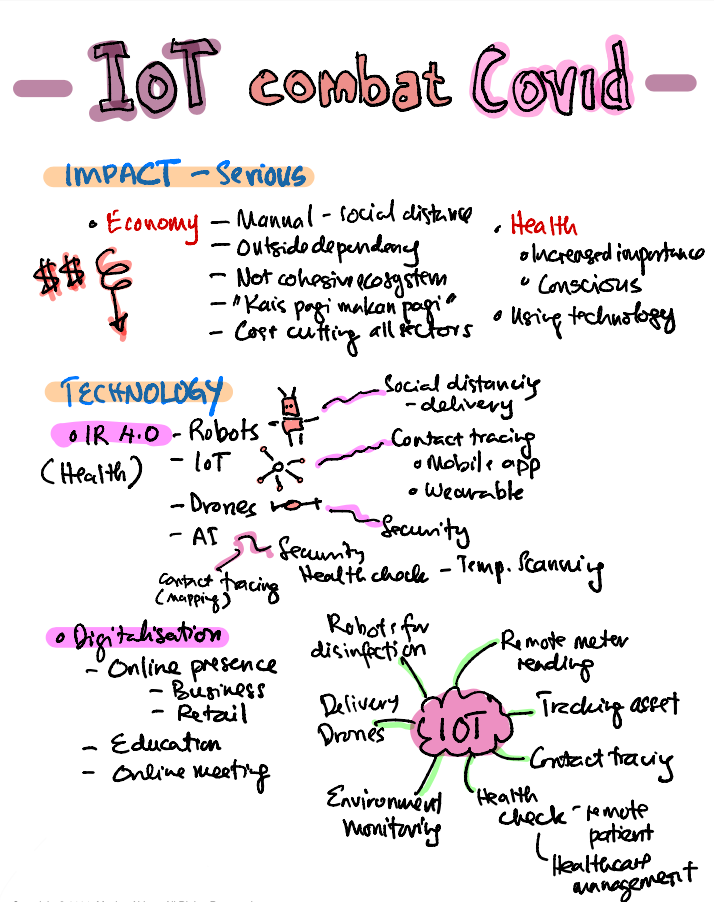
Today, we’ll look at how the Internet of Things (IoT) played a critical role in combating the challenges brought by the COVID-19 pandemic.
The diagram gives us a clear picture of the impacts, technologies, and solutions IoT provided during this global crisis.
1. The Serious Impact of COVID-19
COVID-19 affected every corner of our lives, especially in two major areas:
Economy
Social distancing disrupted manual jobs and heavily impacted daily income earners (“kais pagi makan pagi” — hand-to-mouth living).
Businesses relying on outside dependency suffered due to travel and supply chain restrictions.
Cost-cutting became essential across all sectors.
The lack of a cohesive ecosystem made economic recovery slower.
Health
Health became a top priority.
Awareness and consciousness about hygiene, social distancing, and health monitoring increased.
Technology began to take centre stage in health-related solutions.
2. IoT Technologies Used
IoT, combined with IR 4.0 technologies (Industry 4.0), came into action to address these challenges. Let’s explore the tools and methods:
Robots
Used for tasks like disinfection and delivery, especially in hospitals and public spaces, reducing human contact.
IoT
Enabled real-time data collection and monitoring for applications like health checks and remote patient management.
Drones
Delivered essential items to maintain social distancing and were used for surveillance in lockdown areas.
Artificial Intelligence (AI)
Enhanced contact tracing, temperature scanning, and predictive analytics to track the virus’s spread.
3. Practical Applications of IoT
IoT was at the heart of the pandemic response, enabling innovative applications:
Contact Tracing
Mobile apps and wearable devices tracked individuals’ interactions, helping to identify and isolate potential cases.
Health Monitoring
Remote patient monitoring systems allowed hospitals to track patients’ vital signs without physical visits.
Temperature scanning systems were widely deployed in public places.
Environmental Monitoring
IoT sensors monitored air quality and other environmental factors to maintain healthy surroundings.
Remote Operations
IoT made it possible to manage utilities like remote meter reading and asset tracking.
Delivery Drones
Delivered medicines, food, and other essentials, reducing human-to-human interaction.
4. The Role of Digitalisation
With physical interactions limited, digitalisation became a key enabler:
Online Presence
Businesses and retail shifted online to continue operations.
Education moved to online platforms, and virtual meetings became the norm.
Robots and Automation
Robots handled repetitive tasks, like disinfection, to maintain hygiene standards.
Conclusion
IoT proved to be a game-changer during COVID-19. It connected people, devices, and systems, enabling effective solutions for healthcare, economic recovery, and safety.
The pandemic highlighted the importance of leveraging IoT for crisis management and showed us how technology can adapt to save lives and sustain economies.
Let’s discuss an essential concept in IoT — its key components. The diagram breaks IoT into four main building blocks, which we’ll explore step by step.
1. Sensors: The Eyes and Ears of IoT
The first layer is the sensors. These devices are at the heart of IoT; their job is to sense the environment.
They generate data by measuring things like temperature, humidity, or motion.
Think of them as the “end-nodes” in IoT — they are where the process begins.
Examples include:
A digital thermometer sensing room temperature.
A motion detector in a security system.
Without sensors, IoT wouldn’t have any information to work with!
2. Connectivity: The Communication Bridge
Once sensors collect data, it needs to be transferred somewhere for processing. That’s where connectivity comes in.
IoT uses different communication technologies:
Wireless options like Wi-Fi, Bluetooth, and LPWAN (LoRa or Sigfox).
Fixed methods like Ethernet.
Connectivity ensures the data travels from the sensors to the next stage over the internet or private networks.
Imagine this as a digital highway connecting the physical world to the virtual one.
3. IoT Platform and Middleware: The Brain
The third component is the IoT platform or middleware. This is where all the raw data comes together and is processed.
It acts as a central hub to aggregate data from multiple sensors.
Middleware handles:
Device management.
Data storage and formatting using standard protocols.
Providing APIs (Application Programming Interfaces) so apps can access the data.
Think of this as the “brain” that processes everything and makes sense of the data.
4. Applications and Analytics: Deriving Insights
Finally, all the processed data is used in applications and analytics to deliver value. This is where IoT makes an impact.
Applications:
Use the data to create useful solutions, like apps that track fitness or control smart homes.
Analytics and AI:
Analyse the data using Artificial Intelligence or Big Data techniques.
Generate insights to help make decisions or automate processes.
For example:
A smart farming app could use soil moisture data to trigger irrigation.
An AI system could predict machine failure in a factory.
Bringing It All Together
So, to summarise:
Sensors collect the data.
Connectivity transmits the data.
IoT Platform processes and stores the data.
Applications and Analytics use the data to create actionable insights.
IoT is a powerful combination of hardware, communication, and software working together to solve real-world problems.
I leaned back in my chair, staring at the slide deck I’d just presented.
It was a topic I had always been passionate about — the challenges faced by researchers as they navigate the often uncharted territory of their work.
But the more I thought about it, the more I realised how much of my own journey was reflected in the slides.
Viewing Research Through Different Layers
I’ve always seen research as a multi-layered process, much like the layers in a network system.
Each layer — from the application to the physical — represents a different challenge.
Some researchers operate at the surface, working on problems that are more visible and easier to connect with real-world applications.
Others, like myself, often find ourselves delving deeper into the less-explored, less-visible aspects of a problem.
“Why do you spend so much time on this layer?” a colleague once asked me. “Does anyone even notice?”
I smiled. “Maybe not right now,” I replied, “but it’s the foundation for everything above it. Without this, the entire structure could crumble.”
That’s the thing about deep research — it’s often thankless in the short term. But I’ve always believed in its long-term value.
The Valley of Appreciation
One of the biggest challenges I’ve faced — and seen others face — is what I call the “Valley of Appreciation.”
It’s that gap between starting your research and seeing its impact.
The journey through this valley is long and often lonely.
I recall a project I worked on years ago.
It was complex, technical, and far removed from the flashy innovations that grabbed headlines.
I poured months into it, only to be met with silence when I presented my findings.
“Why do we do this?” I asked myself late one night, staring at my notes. “Does anyone care?”
But deep down, I knew the answer.
Research isn’t about instant recognition.
It’s about planting seeds, some of which may take years to bear fruit.
That understanding didn’t make the journey easier, but it gave me a sense of purpose.
Breadth vs Depth: The Eternal Dilemma
Another challenge that often keeps researchers awake at night is deciding whether to focus on breadth or depth.
Should we explore a wide range of topics, scratching the surface of many issues?
Or should we dive deep into a single area, risking irrelevance if that area doesn’t pan out?
I’ve wrestled with this question countless times.
In one particularly heated discussion, a team member argued, “We need to stay broad, Mazlan. The more we cover, the more funding opportunities we’ll get.”
“But depth is where breakthroughs happen,” I countered. “Without it, we’re just scratching the surface.”
That conversation ended without a clear resolution, as such discussions often do. But it reminded me of the importance of balance.
While breadth can offer versatility, depth is where true innovation lies.
The Explorer’s Risk
Being a researcher often feels like being a cave explorer.
You venture into the unknown, armed with little more than your knowledge, instincts, and a flickering light of curiosity.
Each step forward is a gamble — you might uncover something groundbreaking, or you might hit a dead end.
I remember a particularly risky project early in my career.
The technology was nascent, the funding was limited, and the expectations were sky-high. Many advised me against it.
“It’s a career risk, Mazlan,” a mentor warned. “What if it doesn’t work out?”
I hesitated but ultimately decided to proceed.
“If we don’t take risks,” I told myself, “we’ll never move forward.”
The project didn’t yield the results I’d hoped for, but it taught me lessons I’ve carried ever since.
In research, even failures can pave the way for future success.
Do We Reward the Explorers?
This brings me to a question that has haunted me throughout my career:
Do we adequately reward researchers who take these risks?
Society celebrates the visible results of research — groundbreaking products, influential papers — but what about the countless hours spent in labs, the sleepless nights, the failed experiments?
I once attended an awards ceremony where a colleague was being recognised for their work.
During their speech, they acknowledged the researchers who had laid the groundwork for their success, many of whom remained unknown.
“They’re the real heroes,” I thought. “But how often do we remember them?”
This realisation has driven me to advocate for better recognition of researchers, especially those who work in the shadows, tackling foundational problems that may not see the light of day for years.
The Need for Platforms
One lesson I’ve learned is that researchers can’t succeed in isolation.
To go deeper into their work, they need platforms — both literal and metaphorical — that support and amplify their efforts.
These platforms could be funding, collaboration opportunities, or simply a culture that values and understands the importance of research.
During my time in leadership roles, I’ve made it a point to provide such platforms.
I’ve encouraged cross-disciplinary collaborations, championed risky projects, and pushed for policies that recognise the contributions of researchers at all levels.
But there’s still much work to be done.
As I often tell my teams, “We need to create an ecosystem where researchers feel supported, not just when they succeed but also when they fail. Because failure is often the first step toward success.”
Moving Forward
As I closed my laptop after revisiting the presentation, I felt a renewed sense of purpose.
The challenges faced by researchers are real and daunting, but they are also surmountable. B
y understanding these challenges and working to address them, we can create an environment where researchers not only survive but thrive.
To my fellow researchers out there, I have this to say: Keep going.
Your work matters, even when it feels like no one notices.
The seeds you plant today may take years to grow, but when they do, they have the power to change the world.
And to those who support researchers — leaders, policymakers, and society at large — remember that innovation doesn’t happen overnight.
It’s the result of countless hours of unseen effort.
Let’s do more to appreciate and reward that effort.
As for me, I’ll continue navigating this journey, both as a researcher (and as an entrepreneur) and as someone who believes deeply in the value of what we do.
Because, in the end, it’s not just about exploring the unknown — it’s about lighting the way for others to follow.
“What if AGI becomes as good as me at writing?” I muttered, half amused and half concerned. The thought lingered, almost taunting me.
Could a machine, no matter how intelligent, truly replicate the art of storytelling?
Writing has always been a deeply personal journey for me.
It’s not just about the words; it’s about weaving experiences, emotions, and lessons into a narrative that connects with readers.
“But what if AGI learns to do that too?” I challenged myself. The question refused to go away.
The Essence of Writing
I often remind myself why I write.
It’s about more than sharing knowledge; it’s about creating connections.
I poured my soul into every word when I wrote about my journey of building FAVORIOT.
Those articles weren’t just facts — my triumphs, frustrations, and dreams in black and white.
“Could AGI ever capture that?” I asked myself aloud.
It could replicate the structure, even the tone, but would it feel the pride I felt when describing our successes?
Would it understand the weight of the sleepless nights behind those stories?
Writing is as much about the process as it is about the product. “Machines don’t have sleepless nights,” I chuckled, though the thought didn’t comfort me.
What Would AGI Need to Learn?
I thought as I sipped my coffee that if AGI wanted to rival human writers, it would have to overcome three major challenges.
“First,” I said, leaning back in my chair, “context and nuance.” Writing isn’t just about stringing words together; it’s about understanding the world in all its complexity.
When I write about IoT, I’m not just describing technology — I’m addressing real-world problems, cultural challenges, and user needs. “Can AGI grasp that kind of complexity?” I wondered.
“Second, empathy,” I continued, almost as if I were explaining it to an invisible audience. Readers connect with stories because they resonate emotionally.
When I write about entrepreneurship, I think about the struggles of young dreamers reading my words.
Would AGI know how to address their hopes and fears, or would it just give generic advice?
“And third,” I paused for effect, “failure.” Every writer knows the pain of scrapping drafts, rewriting paragraphs, and starting over.
Those failures teach us what works and what doesn’t. “Can a machine learn the value of failure? Can it be self-critique like I do?” I mused.
Where AGI Might Excel
I reminded myself that it’s not all doom and gloom. AGI could bring remarkable strengths to the table.
I imagined it working tirelessly, synthesising vast amounts of information in seconds, and crafting perfectly structured articles. “It would be like having a research assistant who never sleeps,” I thought, smiling at the idea.
AGI could adapt its style to suit any audience.
It could shift gears effortlessly, whether writing for IoT experts, poetry lovers, or aspiring entrepreneurs. “Imagine the possibilities,” I said, almost excited now.
But the excitement was tempered by a nagging thought: “Would it feel like cheating to rely on AGI for something so personal?”
Human and Machine: A Collaborative Future
“Maybe we don’t have to compete,” I said, voicing the thought brewing. “Maybe AGI can be a collaborator, not a rival.”
I imagined using AGI to handle the technical aspects of my articles, freeing me to focus on storytelling and emotional resonance.
“It could help me write faster, but the heart of the article would still be mine,” I reasoned.
I’d already seen glimpses of this collaboration.
Tools like Grammarly refine my writing, while AI-driven platforms assist with research and brainstorming. “It’s not replacing me; it’s enhancing me,” I concluded, feeling more optimistic.
The Ethical Dilemma
“But then,” I hesitated, “what happens when AGI starts writing independently?”
If it writes an article that’s indistinguishable from mine, who owns the content? And how do we ensure transparency? “Would readers still value the writer or only care about the content?” I asked, troubled by the implications.
Writing, at its core, is a personal act.
It’s an extension of one’s thoughts, experiences, and beliefs.
If AGI mimics that perfectly, does it diminish the value of human expression? “Or,” I wondered, “does it make human stories even more precious?”
A Hopeful Outlook
I glanced at the clock.
I’d spent over an hour lost in this internal debate, yet I felt no closer to an answer. “Maybe it’s not about finding answers,” I admitted. “Maybe it’s about asking the right questions.”
As I typed these final words, I reminded myself why I write.
It’s not for perfection or applause. It’s for connection.
It’s for the moments when a reader says, “This resonates with me.”
AGI might one-day master writing mechanics, but it will never have my journey—my struggles, triumphs, and voice.
“And that,” I said to myself, a small smile creeping across my face, “is what makes every story I write, including this one, uniquely mine.”
Sitting in my quiet office one evening, I glanced at the stack of notebooks on my desk.
Each was a piece of my journey that led to the creation of FAVORIOT. I leaned back in my chair and thought about how it all began.
How did this dream, once a fleeting idea, become a company now empowering the IoT world?
I realised it wasn’t just the hard work or expertise but the belief. It was the Law of Attraction.
Planting the Seed of Belief
Years ago, I questioned my purpose before FAVORIOT was even an idea.
I have worked in corporate environments, government agencies, and universities. Each role taught me valuable lessons, but something was missing — a sense of fulfilment, the feeling of building something from scratch.
While reading about entrepreneurs who transformed their dreams into reality one evening, a question struck me.
“What if I could build something that truly impacts the world?” I asked myself aloud.
The thought lingered in my mind. I started visualising it.
I pictured a company that would simplify IoT for businesses, a platform that would bring value to the community, and a name that resonated with our mission.
This was the moment FAVORIOT was born — not in reality, but in my mind.
Turning Visualisation into Reality
The Law of Attraction isn’t magic; it requires action.
I knew that merely dreaming about FAVORIOT wouldn’t bring it to life.
But I also knew that every action begins with a belief.
I began writing down ideas, sketching business models, listing potential collaborators, and jotting down challenges I might face.
“Can I do this?” I often asked myself, doubting my abilities.
But each time doubt crept in, I countered it with positivity. “Yes, you can. You have the knowledge, the experience, and most importantly, the passion.”
I repeated these words to myself every day, like a mantra.
The more I believed in FAVORIOT, the more the universe seemed to conspire to make it happen.
Attracting the Right People and Opportunities
As I started laying the groundwork for FAVORIOT, I noticed something remarkable.
Opportunities began presenting themselves, almost as if they were drawn to my vision. I met people who believed in my idea.
Some became mentors, others collaborators.
“Why do these connections feel so effortless?” I asked myself during one of our early meetings.
The answer was clear: my energy was aligning with my goals.
By focusing on what I wanted to achieve, I attracted individuals and circumstances that supported my mission.
It wasn’t a coincidence; it was clarity.
When your vision is sharp, and your belief is unwavering, the right resources find their way to you.
Overcoming Challenges with Positivity
Building FAVORIOT wasn’t without its challenges.
There were days when nothing seemed to go right — delays in development, scepticism from potential partners, and financial hurdles.
On one particularly tough day, I remember sitting at my desk, staring at a rejection email.
“Maybe this isn’t meant to be,” I muttered, feeling the weight of the journey.
But deep down, I knew I couldn’t give up.
I closed my eyes and revisited my vision.
I imagined FAVORIOT thriving, helping businesses, and making an impact. That mental image reignited my determination.
“This is just a small setback,” I told myself. “The universe is testing your resolve.”
True enough, solutions appeared.
A new client came on board, or a delayed project found momentum.
Each challenge reinforced my belief in the Law of Attraction.
It wasn’t about avoiding problems but maintaining a positive outlook to find solutions.
Celebrating Small Wins
One of the most important lessons I’ve learned is to celebrate every milestone, no matter how small.
The first time FAVORIOT onboarded a customer, I remember smiling to myself.
“This is just the beginning,” I said, excited and grateful.
Each achievement was proof that the vision I had nurtured was taking shape.
Gratitude played a considerable role in this journey.
Every morning, I took a moment to thank God—not just for the successes but also for the challenges.
They shaped me, strengthened my resolve, and brought FAVORIOT closer to its purpose.
Manifesting the Future
Today, as I look at FAVORIOT, I see more than just a company.
I see a dream realised.
I know the power of belief, visualisation, and action.
The Law of Attraction isn’t just about thinking positively; it’s about aligning your thoughts, actions, and energy toward your goals.
It’s about turning abstract ideas into tangible outcomes through focus and persistence.
“Where will FAVORIOT go from here?” I often ask myself.
The answer lies in the same principles that brought us this far.
I continue to visualise our growth, the impact we’ll create, and the lives we’ll touch.
The journey is ongoing, and the Law of Attraction remains my guide.
As I close my notebook for the day, I feel grateful.
FAVORIOT is more than a business; it’s a testament to the power of belief.
If there’s one thing I’ve learned, it’s this: when you align your thoughts, actions, and energy, the universe listens. And when the universe hears, anything is possible.
Imagination is often dismissed as a whimsical exercise, yet it’s the spark that ignites progress.
Reflecting on Favoriot’s journey, I realise how important it is to dream about the future we want to create.
Let me take you on a journey through an imagined future where Favoriot’s influence has transcended borders, industries, and expectations.
The IoT Trade Exhibition of Tomorrow
I picture myself walking into a grand IoT Trade Exhibition — something akin to the CES or the World Smart City Expo, but this time, it feels different.
The atmosphere buzzes with innovation, and as I navigate through the aisles, one thing becomes glaringly apparent: the Favoriot logo is everywhere. Booth after booth, exhibitors proudly display their demos powered by the Favoriot IoT platform.
Startups with groundbreaking hardware solutions, companies showcasing futuristic smart city concepts, and even AI-driven IoT applications — all are connected seamlessly through Favoriot.
It’s not just about data collection anymore; it’s about transforming that data into meaningful actions. Seeing this unfold in real-time, I feel an overwhelming sense of pride.
The exhibitors didn’t just choose Favoriot because it’s a platform; they chose it because it has become a trusted backbone for innovation, a name synonymous with reliability and scalability.
I imagine attendees — business leaders, developers, and students — crowding around these booths, asking how the integration works, marvelling at the ease of deployment, and realising the potential it unlocks for their projects.
I dreamt of this when we first built Favoriot: a world where our platform would be the silent enabler of extraordinary solutions.
Universities as IoT Powerhouses
My next stop in this imagined world is a university. Favoriot has become a standard name here—not just a tool but a part of the curriculum.
In lecture halls, professors discuss real-world IoT case studies, and students dive deep into hands-on learning, exploring the potential of IoT using the Favoriot platform.
I peeked into a lab where students were building their final-year projects. A team was working on a smart agriculture solution, leveraging Favoriot to monitor soil conditions and automate irrigation.
Another group is focused on smart health, creating wearable devices for chronic disease management.
They’re using Favoriot’s analytics features to visualise patient data.
It’s exhilarating to see how a tool we created has become the foundation for nurturing the next generation of IoT innovators.
Universities nationwide and even internationally now teach IoT through Favoriot.
IoT labs are equipped with pre-configured dashboards, APIs, and datasets, making it easy for students to start building.
What was once a platform we envisioned for businesses has become an educational cornerstone. Students graduate not only with degrees but also as skilled Favoriot-certified IoT professionals.
Local Councils and Smart Cities
As I step into a local council’s command centre, I see a vibrant dashboard powered by Favoriot.
The screen displays real-time data from various IoT solutions deployed throughout the city: smart streetlights, waste management sensors, flood detection systems, and air quality monitors.
This isn’t just a piecemeal solution; it’s an integrated system that combines everything under one roof.
The mayor stands by, explaining how this has revolutionised the council’s operations. “Favoriot has helped us move from reactive to proactive,” she says. “We no longer wait for complaints; we solve problems before they arise.”
This is what I imagined when we spoke about smart cities years ago—a city where data drives decision-making, not just to improve efficiency but to genuinely enhance the quality of life for its citizens.
Favoriot isn’t just another vendor in this ecosystem—it’s the platform local councils trust to aggregate and analyse IoT data, bridging the gap between diverse solutions and actionable insights.
IoT Product Houses and System Integrators
IoT product companies no longer struggle to create end-to-end solutions in this envisioned future.
Instead, they focus on what they do best — building world-class hardware or cutting-edge AI applications.
Favoriot fills the gap by providing a ready-made, robust platform to manage data collection and analysis.
Imagine a company specialising in healthcare sensors. Instead of spending years developing its own platform, it uses Favoriot to connect its devices.
This shortens its time-to-market, and its customers benefit from a complete solution that’s both scalable and user-friendly.
The same goes for system integrators, who rely on Favoriot to simplify IoT deployments for their clients.
System integrators have taken this even further by offering managed IoT services.
With Favoriot, they can provide their clients with dashboards, analytics, and customised solutions without the technical headache of building everything from scratch.
It’s a win-win: the integrators expand their business offerings, and Favoriot becomes the go-to platform for IoT scalability.
Expanding Globally with Partners
The most exciting part of this imagined future is Favoriot’s global footprint. We’ve partnered with overseas system integrators and distributors, allowing us to enter new markets quickly.
In Indonesia, a partner uses Favoriot to enable advanced agriculture systems. In Europe, we’re powering smart transportation initiatives. In Africa, Favoriot is the backbone of rural healthcare IoT solutions.
These partnerships aren’t just transactional; they’re built on a shared vision of what IoT can achieve.
By empowering local players in each market, Favoriot has become a global name synonymous with IoT excellence.
A Dream Fulfilled
I close my eyes and imagine standing on a stage at a significant IoT event. The lights dim, and a video showcases real-world success stories of Favoriot-powered solutions.
The impact is palpable, from smart cities to healthcare and agriculture to education.
As I speak, I’m reminded of how far we’ve come — not just as a company but as a community of dreamers and doers.
Favoriot’s success wasn’t just about technology but about believing in the power of imagination.
We imagined a world where IoT could truly transform lives when we started. Today, in this imagined future, that world has come alive.
So, is it wrong to imagine? Absolutely not.
Imagination is where dreams take shape and the seeds of innovation are planted.
As I look at Favoriot’s journey — from a small startup to a global IoT leader — I know that it all started with a simple yet powerful idea: to imagine the impossible and make it real.
Will this vision come true? I believe it will.
Because imagination, when paired with hard work, resilience, and the right team, can achieve wonders.
So, let’s keep imagining, dreaming, and building the future — one step at a time.
There are many instances that I will be waiting for inspiration to strike.
It didn’t happen often, and the words felt forced when it did.
Writing was reserved for the gifted few who had mastered the art of storytelling.
But that belief changed when I discovered the power of the law of attraction.
This wasn’t just some mystical concept; it was a mindset shift that turned writing from a struggle into a passion.
Believing in Myself as a Writer
The first step in my journey was believing I could be a great writer.
It sounds simple. But I had my doubts.
Could I, someone who hadn’t considered writing a serious skill, honestly write something resonating with others?
To overcome this, I started using positive affirmations.
Every morning, I would say, “I am a writer. My words inspire and connect with others.”
I wrote these affirmations on sticky notes and placed them around my workspace.
At first, it felt awkward.
But over time, these affirmations became my truth. I began to see myself as a writer, not just someone trying to write.
Visualising My Ideal Writing Life
One of the most powerful techniques I used was visualisation.
I imagined myself a successful writer — my articles being widely shared, my books on shelves, and my words impacting lives.
I would close my eyes and picture myself typing effortlessly, the ideas flowing freely. I imagined the emails and comments from readers thanking me for sharing insights that helped them.
This mental exercise wasn’t just a daydream.
It became a blueprint for my actions.
If I wanted to live that vision, I needed to write every day.
Visualisation motivated me to show up at my desk, even when writing felt like an uphill battle.
Focusing on Gratitude
One of the critical elements of the law of attraction is gratitude.
Instead of lamenting writer’s block or low readership, I started to appreciate the small victories.
When a single reader commented on my post, I celebrated it.
When I wrote 500 words daily, I felt grateful for the progress.
I kept a journal listing three things I was grateful for in my writing journey each day.
This practice shifted my focus from what I lacked to what I had.
It reminded me that every step was part of the journey, no matter how small.
Surrounding Myself with Inspiration
Another technique I embraced was surrounding myself with inspiration. I followed writers on social media who shared their journeys and struggles. Their stories made me realise that even the best writers face challenges. I read books and articles that resonated with me, paying attention to the style, tone, and structure.
I also curated an environment that sparked creativity.
I added plants to my workspace, played soft instrumental music, and lit scented candles during writing sessions.
These small changes made the act of writing something I looked forward to.
Taking Inspired Action
The law of attraction doesn’t mean sitting back and waiting for the universe to deliver your dreams.
It requires action.
I started taking inspired action once I had the mindset, visualisation, and gratitude.
For me, this meant writing consistently.
I set a goal to write 500 words daily, whether for my blog, Medium, or personal journaling.
Some days, the words flowed effortlessly; others were a struggle.
But I showed up. The more I wrote, the easier it became.
I was writing transformed from a chore into a habit.
Attracting Opportunities
As I continued my writing journey, I noticed opportunities began to appear.
My blog posts started gaining traction, and readers shared my work.
Invitations to speak and collaborate with others in the industry came in.
My belief in myself and consistent efforts were aligned with the opportunities I had visualised.
I also embraced feedback as part of this journey. Instead of feeling disheartened by criticism, I saw it as a chance to grow.
The law of attraction doesn’t guarantee perfection but teaches you to see every experience as a stepping stone toward your goals.
Trusting the Process
The most important lesson I learned was to trust the process.
Writing is a journey, and every writer’s path is unique.
I stopped comparing myself to others and focused on my progress.
The law of attraction helped me develop patience.
I realised that the seeds I planted would grow in their own time.
Now, as I look back, I can see how far I’ve come.
Writing has become a joy, not just a task.
I’ve connected with readers, shared my thoughts, and found my voice.
And all of this started with a simple belief: I am a writer.
Your Journey Begins Now
If you’ve ever felt stuck as a writer, try applying the law of attraction.
Start by believing in yourself and visualising your success.
Embrace gratitude and take consistent action.
Surround yourself with inspiration and trust the process.
Writing isn’t about being perfect; it’s about showing up, expressing yourself, and connecting with others.
Every time I write, I remind myself of the power of this mindset.
It has made me a better writer and a more fulfilled individual.
And if it worked for me, it can work for you, too.













 Dr. Mazlan Abbas