If They Don’t Trust You, They’ll Never Buy From You

Why Trust is the Real Product You’re Selling (and How Marketing Builds I

Let’s cut straight to it.

You could have the best solution on the planet. The smartest AI. The most beautiful dashboard. A deal they’d be crazy to ignore.

But if they don’t trust you?

Game over.

That’s the truth most salespeople and founders don’t want to hear. You don’t lose sales because your product lacks features. You lose because your buyer doesn’t feel safe saying “yes.”

Let that sink in.

You’re Not Selling a Product — You’re Selling Trust

Every time someone signs on the dotted line, they’re taking a leap of faith. Into the unknown. Into the hands of your promises.

And that leap?

It only happens when trust is strong.

If you’re struggling to close deals, here’s your wake-up call — it might not be your price. It’s your credibility.

So how do you fix it?

Let’s start by understanding how trust works across the entire sales cycle.

1. Trust Speeds Everything Up

Without trust, every step in your sales process feels like a slow crawl. Every email takes longer to reply to. Every objection drags on. Every meeting ends with “We’ll think about it.”

But with trust?

Things move fast.

Buyers stop nitpicking. They start nodding. They say “yes” before you finish the pitch. Why? Because they’re not just buying what you do — they’re buying who you are.

You’re not just another vendor anymore. You’re the one they believe in.

2. Trust Makes You the Safe Bet

Let’s be real — nobody understands your tech as much as you do. Most buyers don’t get how your backend system works or what your AI algorithm is doing behind the scenes.

They’re not buying your code. They’re buying confidence.

“I don’t fully get what this does… but I trust you’ll make it work for us.”

That right there? That’s the golden ticket.

If you can be the trusted guide — the one who explains things clearly, sets real expectations, and never overpromises — you become the safest decision they’ve ever made.

3. Trust Wins the Long Game

Deals don’t end at the sale.

What happens after is what builds your reputation.

When things go sideways — and they will — your response matters more than your roadmap. When customers trust you, they stay even when things get tough. They refer others. They become evangelists.

And that kind of loyalty?

It’s not bought with discounts. It’s earned with integrity.

So, Where Does Trust Begin?

It doesn’t start in the pitch deck.

It starts way earlier — with your marketing.

Yes, marketing builds trust before sales even says hello.

Here’s how.

4. Marketing Sets the Tone Before You Even Enter the Room

Think about the last time you Googled a company. What made you stay? A clean website? Great reviews? A few helpful blogs?

Or did you bounce the second you saw a clunky layout and an outdated logo?

Exactly.

Your prospects are doing the same.

Marketing is your first handshake — your first “hello.” And it better say:
“We know what we’re doing. We’ve done this before. You’re in good hands.”

That’s not just branding. That’s trust-building.

5. Content Builds Trust at Scale

You don’t need to be everywhere. But you do need to show up where it counts.

Every blog post. Every case study. Every video tutorial. Every helpful LinkedIn post.

They all add bricks to your trust wall.

Even if someone’s not ready to buy today, they’re watching. And when the time comes? They’ll remember you as the one who actually cared to educate them, not just sell to them.

6. Your Personal Brand is a Trust Magnet

People don’t trust logos.

They trust people.

You showing up as a thought leader — on LinkedIn, podcasts, panels — makes all the difference. Share your journey. Your failures. Your honest thoughts about the industry.

Don’t try to be a polished robot.

Be human.

When you do, people will say:
“I don’t just want the product — I want to work with YOU.”

That’s when you’ve won.

7. Great Marketing Shows, Not Tells

Stop saying, “We care about our customers.”

Start proving it.

Give value before you ask for anything:

  • Share insights your competitors gate behind forms
  • Run webinars that teach, not just pitch
  • Respond to DMs with care and speed
  • Celebrate your customers’ success more than your own

Because when your marketing is rooted in generosity, trust becomes your default currency.

Sales and Marketing: One Team, One Mission

If your sales team is hustling but the leads are cold, there’s a disconnect.

Marketing should be paving the road before sales even shows up.

That means:

  • Sharing real customer success stories
  • Addressing objections through blog posts and videos
  • Keeping your message consistent across every touchpoint
  • Making sure your promises match your delivery

When both teams work together to build trust, magic happens.

Your Competitive Advantage? Trust.

At the end of the day, buyers will always ask themselves:

“Can I trust this person with my time, money, and reputation?”

If the answer’s no — they walk.

If the answer’s yes — they buy.

So don’t just optimise your sales funnel.
Don’t just build a smarter chatbot or a flashier website.

Build trust.

And do it in every word you say, every promise you make, every story you share.

Because trust isn’t just part of the sales cycle.

It is the sales cycle.

Now go earn it.
From Manual Logins to a Global Force: This is Favoriot 4.5

“Dr. Mazlan, I didn’t receive my password—boleh email balik?”

I still remember that message. One of our earliest users. Back when onboarding meant me, personally, typing out usernames and passwords… and emailing them. One. By. One.

No dashboard.
No billing.
No automation.
Just a dream—and a lot of copy-pasting.

Was it messy? Yes.
Was it worth it? Absolutely.

That’s where Favoriot was born—not in a boardroom, but in a Gmail inbox at midnight.

We Built It The Hard Way

Every support ticket? A lesson.
Every bug? A wake-up call.
Every confused user? A chance to rethink.

We didn’t have “customer personas.”
We had real people telling us, “This part tak faham…”
And that direct feedback shaped everything.

So we added what mattered:
✅ Visual dashboards
✅ Auto device creation
✅ Better user controls
✅ A real self-service platform

Eventually, we stopped emailing passwords.

And Then… We Grew

By version 3.0, Favoriot wasn’t a scrappy prototype anymore. It was real.

Today?
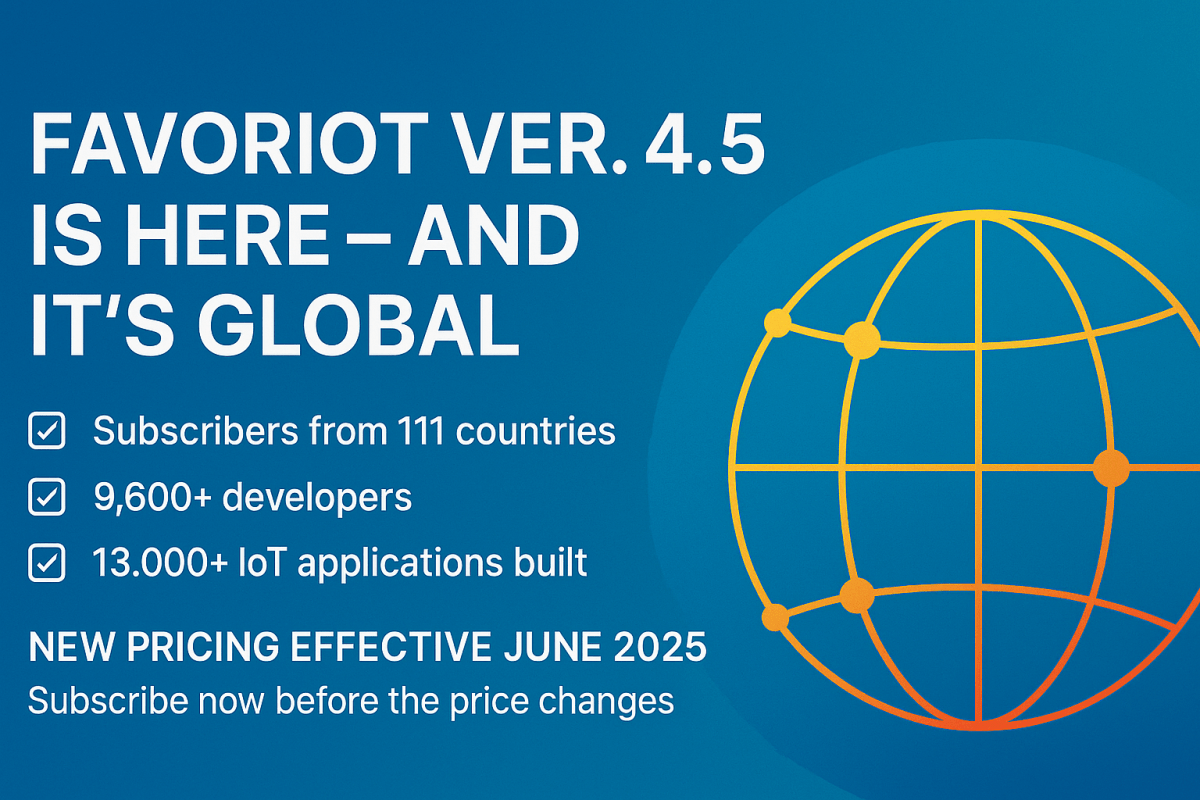
🌍 111 countries
👨‍💻 9,600+ developers
📱 13,000+ IoT apps

What’s wild? We have no idea what most users are building.
And you know what? We love that.

Favoriot is flexible enough for developers to use it their way—without us needing to micromanage or interfere. That’s the magic of a true IoT platform-as-a-service.

We Kept It Cheap—On Purpose

We priced it low. Dirt cheap, some said.

Because back then, IoT wasn’t mainstream.
We wanted students, hobbyists, and young startups to try.
To explore. To fail. To learn.
Without worrying about subscription fees.

That strategy worked.
It built trust. It built momentum.
And it got Favoriot where it is today.

But Let’s Be Real—It’s Time

Favoriot 4.5 isn’t a toy.
It’s a world-class platform.

We’ve benchmarked ourselves against the global giants.
We’ve made it faster, stronger, smarter.
And yes—it’s time the subscription reflects that.

Starting June 2025, our prices will change.

Why?
Because we’ve earned that seat at the table.
And we want to keep delivering the value you deserve.

But Here’s The Deal

If you subscribe before June—
You lock in the current price.
No surprises. No sudden hike.
Your loyalty gets rewarded.

To the Early Believers

If you’ve been with us since the manual days…
If you ever waited for your login in your inbox…
If you clicked “refresh” hoping we’d fix the bug…

Thank you.

Favoriot 4.5 carries your fingerprints.
We wouldn’t be here without you.

And we’re just getting started.

Let’s keep building the future of IoT—together.

Favoriot: A Marathon of Pivots, Perseverance, and Purpose

“This is going to be a game-changer!”

That was the spark that ignited our journey. In 2017, we embarked on a mission to revolutionize the Internet of Things (IoT) landscape in Malaysia. Our first stride? Raqib—a wearable device designed to ensure the safety and health of Umrah and Hajj pilgrims. It was more than just a product; it was a vision to provide peace of mind to individuals and their families during spiritual journeys.

KM 0–5: The Starting Line – Raqib’s Ambitious Launch

Launching Raqib felt like the exhilarating first kilometers of a marathon. The energy was high, the vision clear, and the team motivated. We believed in our product’s potential to make a significant impact. However, as with any long-distance race, the initial excitement soon gave way to unforeseen challenges.

KM 6–10: The First Hurdles – Technical Glitches and Market Realities

As we progressed, technical issues began to surface. The device faced unexpected glitches, and our marketing efforts didn’t yield the anticipated traction. It was a tough pill to swallow. But we weren’t ready to give up. We pivoted and introduced Favorsense, aiming to capture a different segment of the IoT market. Yet, despite our best efforts, it struggled to gain user interest.

“Where did we falter? What could we have done differently?” I often pondered during those challenging times.

KM 11–15: The Turning Point – Recognizing the Core Strength

Amidst these setbacks, a realization dawned upon us. The common thread between Raqib and Favorsense was the underlying platform that powered them. This platform, robust and versatile, had the potential to be more than just a backbone for our products. It could be the very product we needed to focus on.

I told the team, “This platform can be used by anyone who wants to develop their own IoT products. “

With renewed determination, we decided to pivot once more. We introduced the Favoriot IoT Platform to the public, offering it free to attract a broader audience. However, adoption was slower than expected. Despite creating tutorials and sharing resources, many users found it challenging to navigate the platform.

KM 16–20: Bridging the Gap – Introducing IoT Courses

Understanding the need for guidance, we launched IoT courses tailored to help users grasp the platform’s capabilities. These courses weren’t just about theory; they offered hands-on experience, enabling participants to apply their knowledge in real-world scenarios.

The response was overwhelmingly positive. Universities and polytechnics across Malaysia began integrating the Favoriot IoT Platform into their curricula. Students utilised it for their final-year projects, bringing innovative ideas to life.

“This is a significant achievement for us,” I expressed pridefully.

KM 21–30: Expanding Horizons – Building Partnerships

As we continued our journey, we recognised the importance of collaboration. We partnered with system integrators and enterprises, offering our platform’s cloud-based and enterprise-based models. This flexibility allowed clients to choose solutions that best fit their needs, further solidifying Favoriot’s position in the market.

KM 31–40: Gaining Momentum – Recognition and Growth

Our efforts began to bear fruit. Favoriot was no longer an unknown name in the IoT landscape. Out of 9,375 users (as of January 27, 2025), 80% came from our own country—a milestone that filled me with pride.

“We did it,” I told my team with a sense of accomplishment. “We’ve proven that we can compete with global platforms and carve out our own space.”

KM 41–42.195: The Final Stretch – Looking Ahead

Today, the Favoriot IoT Platform is a testament to resilience and adaptability. The journey has been a marathon from its humble beginnings with Raqib to becoming a cornerstone in IoT education and development. We’ve learned that setbacks aren’t failures but opportunities to pivot and grow.

As we look ahead, our vision is to take the Favoriot IoT Platform beyond Malaysia, reaching global audiences and empowering the next generation of IoT innovators.

“This is just the beginning,” I remind the team. The marathon continues, and we’re ready for the next leg of the race.

So, Startup or Marathon?

Startup is a marathon.

But with Favoriot, it’s not just about enduring.

It’s about leading, creating, and building something that lasts beyond the race.

And here’s the truth no one tells you:

The real finish line is when others start running because you did.

The Story Behind Favoriot – Part 18: The Unspoken Truth About Startup Success

The Illusion of Overnight Success

Starting a business is exhilarating. There’s a rush of energy, an overwhelming sense of purpose, and a firm belief that what you’re building will change the world. When we launched FAVORIOT, that excitement fueled us. We poured countless hours into developing our product, refining its features, and dreaming of when it would hit the market and create a ripple effect.

I imagined a scenario where people would immediately recognize our innovation, show us praise, and, most importantly, place orders. It was a beautiful vision.

But reality had other plans.

The product launch was met with an eerie silence. There was no flood of inquiries, no immediate purchase orders—just a deafening void. It was as if we had shouted into an empty room, expecting applause but hearing only echoes of our voices.

I remember sitting in my office, staring at my phone, waiting for it to ring. Did we make the right decision? Was there even a market for what we had built? These questions haunted me. I had read about this phase before—the quiet period after launch where entrepreneurs either push through or give up.

For me, giving up was never an option.

The Harsh Reality: No One Cares Until You Make Them Care

Early on, the biggest lesson I learned was that having a great product isn’t enough. People needed to know about it. Marketing, which I had once seen as a secondary task, suddenly became our lifeline.

I had to shift my mindset from being just a product developer to becoming a marketer, a salesman, and sometimes even a storyteller. I repeatedly asked myself: How do we make people care?

We started reaching out, setting up demos, and pitching to potential clients. Slowly, the response trickled in. Companies showed interest. They asked for presentations. They nodded in agreement, smiled, and said, “This looks promising.”

But promises don’t pay the bills.

For a while, it felt like we were stuck in an endless loop of meetings that never turned into real business. Then came the first request for a quotation. I remember the excitement. Finally! This is it! I thought. We prepared the quotation, sent it over, and waited.

And waited.

Nothing happened.

I had assumed that a quotation would naturally lead to a purchase order. But in reality, sending a quote was just another step in a much longer process. It wasn’t a commitment—it was merely an indication of interest. And interest, I realized, didn’t always translate to action.

The First Purchase Order: A Moment of Validation

Then, one day, it happened. We received our first purchase order (PO).

I still remember the overwhelming sense of relief. It wasn’t just about the money. It was validation. Someone believed in what we had built enough to pay for it.

That moment changed everything. If one customer believed in us, surely more would follow. And they did—slowly but surely.

But business success isn’t just about making a sale. It’s about ensuring that sale turns into cash in your bank account. And that’s where another harsh reality set in.

Chasing Payments: The Least Glamorous Part of Business

You’d think that the hardest part is over once a client agrees to buy. That’s what I believed—until I had to chase down payments.

Sending invoices, following up, reminding, and sometimes even begging for payment became a routine. It was frustrating. We had delivered the product, and the clients were using it. So why were payments delayed?

I quickly learned that delayed payments are part of the business game. Cash flow is king; sometimes, even if you’re owed money, it doesn’t mean you’ll receive it on time.

The Trap of Empty Promises

In the early days, I was easily swayed by big promises. Potential clients would tell me, “This is exactly what we need! We can roll this out across multiple projects.”

It all sounded so promising. Some even asked for discounts or free Proof of Concept (PoC) trials, dangling the possibility of future large-scale deployments.

I wanted to believe them. But more often than not, those promises led nowhere.

Eventually, I learned a simple rule: No purchase order, no deal.

If someone truly values your product, they’ll invest in it. Otherwise, it’s just talk.

Beware of the Middlemen and Brokers

Another lesson came in the form of self-proclaimed “brokers.” These individuals claimed to have the right connections to land us big contracts. “Just trust us,” they would say. “We’ll make sure you get into the right hands.”

It was tempting. They spoke about million-dollar deals, high-profile clients, and game-changing opportunities. But over time, I realized that real business doesn’t work that way.

Genuine clients don’t need middlemen. They buy because they see value in your offer, not because someone else convinced them to.

Success is More Than Just Selling

Looking back, these experiences shaped me as an entrepreneur. Building a business isn’t just about creating a product—it’s about navigating relationships, earning trust, and filtering out distractions.

It’s easy to get caught up in the excitement of what could be. But real success comes when you turn those possibilities into tangible results. And at the end of the day, the only thing that truly matters is this:

Do your customers see value in what you offer? And are they willing to pay for it?

That’s the accurate measure of success.

A Recognition That Reflects the Journey: Named Among Thinkers360’s Top 100 B2B Thought Leaders in 2025

I stared at my screen, re-reading the email. Was this real? Thinkers360 had just named me one of the Top 100 B2B Thought Leaders, Analysts & Influencers to Work With in 2025 (APAC).

I leaned back in my chair, letting the weight of those words sink in. A flood of memories rushed through my mind—moments of self-doubt, nights spent refining ideas, countless speaking engagements, and articles written with the hope that someone, somewhere, would find them valuable.

This wasn’t just about me. It was about the power of consistency, the impact of sharing knowledge, and the importance of staying true to a vision.

The Journey to This Moment

When I co-founded FAVORIOT, I had one missionto make IoT accessible, understandable, and impactful for businesses and societies. I wasn’t just building a company but creating an ecosystem, a movement, and a voice for IoT adoption.

It wasn’t always easy.

  • Sometimes, IoT felt like an uphill battle, trying to convince organizations of its potential.
  • There were moments when my writings, podcasts, and speeches seemed to go unnoticed.
  • There were days when I wondered if my efforts were making any real impact.

Yet, I kept going.

I wrote articles when I felt uninspired.
I delivered speeches when I was exhausted from travelling.
I mentored startups when I barely had time for myself.

Because I believed in the power of sharing knowledge.

Beyond Social Media Influence: Thought Leadership with Purpose

What makes this recognition by Thinkers360 truly meaningful is its holistic approach to thought leadership. Unlike many influencer lists focusing purely on social media metrics, Thinkers360 looks deeper—at the ideas shared, the conversations sparked, and the tangible impact created.

Thought leadership isn’t just about posting viral tweets or LinkedIn updates. It’s about:

  • Writing articles that challenge conventional thinking.
  • Delivering keynotes that shift perspectives.
  • Mentoring the next generation of innovators.
  • Contributing to industry policies that shape the future.

And that’s what I’ve strived to do, not just as an IoT advocate but as someone who believes in building smarter cities, empowering businesses, and fostering innovation.

Why This Matters for the IoT & Smart City Ecosystem

This recognition isn’t just a personal milestone—it’s a signal that IoT and digital transformation are no longer just buzzwords.

They are critical forces shaping the future of industries, economies, and societies.

From smart agriculture to intelligent traffic management, from AI-driven automation to predictive analytics—IoT is no longer a “nice-to-have” but a necessity.

This award reminds me that our work—whether through FAVORIOT, industry collaborations, or global partnerships—is making a difference.

It also reaffirms my belief that sharing knowledge is the most powerful way to accelerate innovation.

What’s Next? The Mission Continues

Recognition is a moment.
Impact is a lifetime journey.

This award doesn’t end my thought leadership journey—it fuels the next chapter.

I’m more committed than ever to:

  • Bringing IoT education to more businesses and policymakers
  • Expanding the FAVORIOT ecosystem through strategic global partnerships
  • Mentoring and inspiring young professionals to enter the tech industry
  • Driving real, measurable impact in smart city development

Thank you to everyone who has followed my journey, read my articles, attended my talks, or engaged with my content. Your support, feedback, and discussions have been invaluable.

This recognition belongs to everyone working tirelessly in the IoT and digital transformation.

Let’s continue building the future—one idea, one conversation, and one innovation at a time.

Final Thoughts

As I close my laptop, I take a deep breath. This recognition was unexpected, but perhaps it was always on the horizon. When you consistently show up, share your knowledge, and contribute with genuine passion, the world eventually takes notice.

For more on my journey, visit mazlanabbas.com and favoriot.com.

The Story Behind Favoriot – Part 6: Expanding The Business Models

The Birth of an Idea: Favoriot’s B2C Beginning

When I first launched the Favoriot IoT platform, I had a simple vision: to create a platform that anyone could use—students, hobbyists, tinkerers—you name it. The idea was to make IoT accessible to the masses, a B2C service that would ignite curiosity and inspire innovation.

I thought, “If we can get people talking about Favoriot, the rest will follow.” That belief fueled our early strategy. We dove headfirst into social media, the digital town square where everyone seemed to gather. Facebook was buzzing, YouTube was the tutorial hub and TikTok? Well, that was the wild frontier—so, of course, I gave it a shot.

The Social Media Experiment

I became the face of our promotions, posting updates on Facebook, creating YouTube videos, writing blog articles, and yes, even attempting TikTok. It was thrilling at first—seeing those likes, shares, and comments roll in. People were curious, intrigued by what Favoriot could do.

But soon, a nagging question crept in: “Why isn’t this translating into actual platform usage?” The buzz was there, but the conversions weren’t. It hit me—generating interest is one thing, but sustaining it requires more than social media posts.

The eBook Revelation

That’s when an old passion of mine resurfaced: writing. “What if I wrote an eBook?” I wondered. It would not be just any technical manual but something that painted the bigger picture—how IoT could transform industries and shape the future, and yes, how Favoriot fits into all of this.

I poured my heart into that eBook. It wasn’t just about IoT protocols or sensor networks; it was a narrative about the power of connected technologies. Subtly, I wove Favoriot into the storyline, highlighting its features and potential. Once it was done, we decided to offer it for free.

The Breakthrough: Global Reach

And guess what? It worked. The eBook spread like wildfire. I remember staring at the download stats, thinking, “This is it. This is the breakthrough.”

But success has a way of revealing new challenges. With global interest came diverse expectations. Users wanted more—advanced features, scalability, and enterprise-grade security. It became clear: our B2C model had hit a ceiling.

Pivoting to B2B: A Bold Decision

Cue the sleepless nights. “Should we pivot to B2B? What if it doesn’t work out?” The questions were relentless. But growth demands evolution. After countless discussions with my team, we made the leap.

We transitioned Favoriot into a B2B platform, offering on-premise and private cloud installations. This shift opened doors to system integrators and organizations who handled complex IoT projects with high data demands. We even introduced a game-changing perpetual license—a one-time purchase granting lifetime access. “This could be a game-changer,” I thought. And it was.

The Impact of the B2B Model

The B2B model didn’t just diversify our revenue; it solidified our market position. We provided a ready-made, scalable IoT solution, eliminating the need for companies to build platforms from scratch.

Since 2017, Favoriot has evolved dramatically from a humble B2C platform to a versatile solution serving both individual developers and large enterprises. A defining moment? MOSTI officially recognized Favoriot as a Malaysian local product by awarding it the MySTI certification. It was more than a certification—it was validation.

Reflecting on the Journey

Looking back, I see a journey marked by resilience, adaptability, and an unwavering belief in our vision. But this isn’t the end. In Part VII, I’ll delve into the challenges we face as we aim to deepen our footprint in Malaysia.

The road ahead is long, but with the lessons we’ve learned and the incredible team by my side, I’m confident Favoriot will continue to thrive.

Stay tuned. Favoriot’s journey is far from over.

More Stories About Entrepreneurship

  1. The Story Behind Favoriot – Part 6: Expanding The Business Models
  2. The Story Behind Favoriot – Part 5: Finding the Right Fit
  3. The Story Behind Favoriot – Part 4: How Favoriot Became More Than Just an IoT Platform
  4. The Story Behind Favoriot – Part 3: Why No One Wanted Our IoT Platform—And How We Turned It Around
  5. The Story Behind Favoriot – Part 2: Turning Failures into Milestones
  6. The Story Behind Favoriot – Part I: The Humble Beginnings of Favoriot
  7. Building My Personal Brand: The Stepping Stone to Favoriot’s Success
  8. From Research Lab Critiques to Startup Pitches: My Slide Story
  9. The Illusion of RFPs in the IoT World: Managing Expectations as a Startup
  10. Favoriot’s Odyssey: Navigating the Rough Waters of Early Revenue

Top AI Tools for 2025: Boosting Efficiency Across Various Domains

AI tools have become essential to personal and professional workflows, helping automate tasks, enhance creativity, and improve productivity. Here’s a breakdown of some of the most valuable AI tools for 2025 across different categories and why they matter:

[Credit to Pradeep]

1. YouTube Tools

Tools like Steve AI, TubeBuddy, and Eighthify assist content creators with video editing, optimisation, and analytics. These are crucial for streamlining content production and boosting audience engagement on YouTube.

2. Sales Tools

Platforms such as Lavendar, Twain, and Simplified make sales outreach more personalised and efficient. They provide insights and automation to close deals faster and enhance customer relationships.

3. Productivity Tools

Apps like Bardeen AI, ChartGPT, and Scholarly help manage tasks, conduct research, and increase overall efficiency. These tools are essential for individuals juggling multiple responsibilities.

4. Music Tools

AI tools like Amper, Jukedeck, and Boomy enable music creation and editing, making them valuable for artists, content creators, and marketers looking for custom soundtracks.

5. Writing Tools

Jasper AI, Writesonic, and Quillbot simplify content creation with grammar corrections, paraphrasing, and idea generation, making them indispensable for writers and bloggers.

6. Coding Tools

Platforms such as GitHub Copilot, Deepcode, and Replit help developers write and debug code efficiently. These tools save time and improve code quality for software engineers.

7. Chatbot Tools

Tools like Cohere, Yatterplus, and GPTBuddy enable businesses to create intelligent chatbots for improved customer service and engagement.

8. Daily Life Tools

Apps like Notion AI and Taskade simplify task management and daily organisation, helping individuals stay on top of their schedules and projects.

9. Content Creation Tools

Tools like Tome AI and Beautiful AI aid in creating visually appealing presentations and multimedia content, which is crucial for marketing and storytelling.

10. Twitter Tools

Platforms such as Postwise, Tweet Hunter, and TribeScaler are designed to optimise Twitter engagement, making them perfect for influencers and marketers.

11. Image Tools

Tools like StockIMG, MidJourney, and Microsoft Designer offer quick and creative solutions for generating and editing images, perfect for designers and marketers.

12. Chrome Extensions

Extensions, like Compose AIVoila AI, and FinalScout, add functionalities like email drafting and lead generation, directly improving browser productivity.

Why These Tools Matter

AI tools transform our work by automating repetitive tasks, offering creative assistance, and optimising productivity. Whether you’re a content creator, developer, or entrepreneur, integrating these tools into your workflow can save time, enhance quality, and give you a competitive edge.

These tools showcase how AI continues to bridge the gap between manual effort and technological innovation, making 2025 a promising year for leveraging AI-driven solutions.

About Favoriot — Part 16: Why Favoriot is Looking Beyond Malaysia for Success

ABOUT FAVORIOT SERIES

Breaking Boundaries for Local Homegrown Products

Image created using ChatGPT

Reflecting on Favoriot’s journey, I can’t help but feel a deep sense of frustration. It’s not that we haven’t done the work. We’ve built a robust Internet of Things (IoT) platform, and our solutions are ready to make a real impact.

But are we getting the buy-in from our domestic market? That’s an entirely different battle.

I remember meeting potential Malaysian clients and pitching the benefits of Favoriot’s IoT platform, which we have crafted meticulously to meet the specific needs of our local industries.

The pitch was solid, but the response was indifference, hesitation, and, more often than not, an inclination toward foreign products.

What’s the problem? I’ve asked myself this countless times. Why do these potential clients prefer foreign-made solutions, even when the local option is just as good, if not better, for their needs?

Lack of Confidence in Local Products

It became clear that there was an underlying issue—a lack of confidence in local products. There’s a perception in the Malaysian market that foreign products are inherently better. Whether it’s a smartphone, a software platform, or an IoT solution, many seem to believe that if made overseas, it must be superior.

It’s not just an isolated incident. This sentiment echoes across various industries. I’ve spoken to other Malaysian entrepreneurs, and they share similar frustrations. We have world-class solutions, but local buyers hesitate.

Why? Because in their eyes, if a big foreign brand does not back it, it’s not good enough.

I understand this mindset to some degree. We’ve grown up seeing foreign brands dominate our market. These global giants, from cars to consumer electronics, have conditioned us to trust familiar names from abroad.

But the world has changed. Malaysian companies like Favoriot are now capable of competing on the global stage. Yet, this old habit of looking overseas remains ingrained.

Branding: A Constant Challenge

Another realization struck me: our brand isn’t as strong as some international players. I’ve spent years building Favoriot, but branding is an area where we struggle, like many other local businesses.

When approaching potential clients, we often face an uphill battle because Favoriot doesn’t have the same brand recognition as some established international companies.

Building a brand takes time, and in a world where first impressions matter, having a well-known logo and a familiar brand name can often make or break a deal. But it’s not that our technology isn’t up to the mark; it’s quite the opposite. Our solutions are ideally suited to local needs and designed specifically for the unique challenges we face here in Malaysia. But when our brand is lesser-known, it sometimes feels like our solutions aren’t given the consideration they deserve.

I hate to admit it, but some of this might be on us. Perhaps our marketing materials aren’t as polished or impressive as they should be, or maybe how we present Favoriot in English isn’t as compelling as it could be.

I’ve always been more comfortable speaking in Malay, but for the global market—and even when pitching to local companies that expect presentations in English—having that fluency and flair in communication is crucial.

I’ve had to learn the hard way that even if the product is good, the delivery of that message must be even better.

The Perception Problem

Interestingly, I’ve noticed that this mindset isn’t unique to Malaysia. When we’ve pitched Favoriot in other countries (where their Nationalism is very high), we often encounter the same skepticism, just in reverse.

I’ve had meetings with potential customers overseas where they preferred local solutions, viewing Favoriot as “foreign” and, therefore, somehow less trustworthy.

It’s a strange irony. Here in Malaysia, people look to overseas solutions as more impressive, while in those countries, people prefer homegrown products. It’s clear that many people, regardless of where they are, tend to believe that something “local” can’t possibly be world-class.

The Struggle for Support

Another factor that makes breaking into the domestic market difficult is the need for solid support systems for local startups. We talk a lot about innovation in Malaysia, but the reality is that support for tech startups, particularly in the IoT space, isn’t as robust as it needs to be.

Sure, there are initiatives and grants, but corporate clients and the government should be more committed to adopting local tech solutions.

When I attend conferences or government forums, there’s always talk about “supporting local businesses.” However, many are still drawn to foreign companies when it comes to actual purchases and long-term partnerships. It’s disheartening because it creates an environment where local businesses struggle to get off the ground.

Should Favoriot Look Beyond Malaysian Shores?

So, where does this leave us? Over the years, I’ve concluded that while Malaysia remains an essential market for Favoriot, we cannot afford to limit ourselves to our domestic borders. The global market beckons; many of the most significant opportunities lie.

I’ve had more success pitching Favoriot to overseas clients than I have in my backyard. These clients are often more open to exploring new solutions and less influenced by brand recognition. If the technology meets their needs, they will take a chance on a company like Favoriot.

Moreover, going international allows us to position Favoriot as a global player, not just a local one. We can return to Malaysia with greater credibility by proving ourselves in other markets.

It’s unfortunate that sometimes, being recognized globally makes you more attractive locally. When local clients see that international companies trust your product, they think, “Maybe we should too.

Overcoming Domestic Challenges

Several factors contribute to the lack of support for local products in Malaysia:

  1. Bias Toward Foreign Brands: As I’ve mentioned, many local clients believe foreign products are inherently better, even when local solutions are just as good or better suited to their needs.
  2. Brand Recognition: Building a solid brand takes time, and Favoriot is still working on achieving the level of recognition that foreign companies enjoy.
  3. Marketing and Presentation: Our marketing materials and pitch presentations must be as compelling as the product. We continue to improve in this area.
  4. Lack of Government and Corporate Support: While there are initiatives to support local businesses, the actual adoption of local tech solutions by the government and corporate clients still needs to be improved.

Despite these challenges, I remain optimistic. Favoriot has already made headway in international markets. By expanding our global reach, I believe we can eventually overcome the biases and hurdles we face at home.

But for now, the path is clear. Favoriot must look beyond Malaysian shores.

We need to position ourselves as global players because the world is waiting, and if we don’t seize these opportunities, someone else will.

As frustrating as facing these domestic challenges is, they strengthen my resolve to push forward and prove that Malaysian-made solutions can compete on the world stage.

Understanding the Dynamics of a Strong Brand Ecosystem

Photo by Austin Chan on Unsplash

What exactly is branding?

Branding is the process of creating a unique identity for your company or product.

It encompasses the process of identifying your brand’s core values, mission, and market positioning, followed by effectively conveying these elements to your intended audience.

This communication is executed across multiple platforms, including your website, promotional materials, and social media channels,

The Importance of a Comprehensive Brand Ecosystem

Photo by Joao Tzanno on Unsplash

A brand ecosystem encompasses more than just visual identity; it includes every aspect of how your audience interacts with your brand.

This means integrating your online presence, offline activities, and personal interactions to create a cohesive experience.

Developing a Strong Customer Experience

At the heart of a brand ecosystem is customer experience.

This includes having a user-friendly and aesthetically pleasing website, producing engaging content, and responding promptly and professionally to customer interactions.

Small gestures of appreciation can also enhance customer loyalty.

Utilizing Micro-Moments Effectively

Micro-moments refer to the brief periods when customers use their devices to find quick answers.

Brands should be present during these moments with relevant and mobile-friendly content to engage effectively with their customers.

Incorporating Data into Storytelling

Photo by Jon Tyson on Unsplash

Using data in storytelling can add depth to your brand’s narrative.

This approach involves telling stories about your brand’s progress, customer achievements, or environmental initiatives, supported by data to enhance credibility and emotional connection.

The Role of Employee Branding

Employees can significantly contribute to a brand’s image.

A positive work environment and encouraging employees to share their experiences can help in building a strong brand reputation.

Building a Community Around Your Brand

Creating a brand community involves more than just selling products or services; it’s about developing lasting relationships.

This can be achieved through various platforms, including events, forums, and face-to-face interactions.

Strategies to Enhance Your Brand Ecosystem

  1. Begin with Self-Discovery: Identify your unique attributes and values that define your brand.
  2. Maintain Consistency: Ensure that your brand’s message remains consistent across all channels.
  3. Foster Authenticity: Authentic interactions are crucial for building genuine connections with your audience.
  4. Engage with Your Audience: Regular communication and feedback from your audience are essential for brand growth.
  5. Exercise Patience: Building a strong brand ecosystem is a gradual process that requires ongoing effort.

By implementing these strategies, you’re not just creating a brand, but an ecosystem where every element collaborates to narrate your unique story.

Begin by understanding your core values, align your messaging across different platforms, engage with your audience, and maintain authenticity.

Embark on this journey with dedication, and over time, you will see your brand ecosystem grow and succeed.

Do Not Neglect The Power of Mailing Lists in Your Startup Journey

Photo by Brett Jordan on Unsplash

Are you so dependent on Social Media?

How effective is your content?

For example, I have been on X (Twitter) right after it was launched but it was never as effective as my mailing list.

In the early days of a startup, the allure of a burgeoning social media following is often irresistible.

It’s true that a strong presence on these platforms is crucial.

However, it’s vital not to overlook a more personal and impactful tool at your disposal: the mailing list.

Navigating the Social Media Maze

Photo by Alexander Shatov on Unsplash

Did you get frustrated when you don’t get many followers?

How many is “many”?

Social media’s reach is undeniably vast, but its nature poses unique challenges.

Your content competes with a deluge of other posts, making it hard to capture and keep your audience’s attention.

For startups, especially, the effort to organically grow this audience demands a significant investment of time and energy in constant posting and engagement.

The Unmatched Benefits of Mailing Lists

Go directly to them!

Get intimate!

Mailing lists carve out a more direct and personal channel to your audience.

When individuals subscribe to your newsletter or download content, they’re showing a real interest in your message.

My startup, Favoriot, experienced firsthand the benefits of this approach.

By sharing free eBooks rich in IoT insights and tips, we not only engaged our audience but also added real value, attracting a global following.

Value Comes First, Sales Later

Don’t hard sell!

The golden rule of successful mailing lists is to provide genuine value before any sales pitch. People recognize and often disapprove of overt selling.

On platforms like LinkedIn, I share not just about Favoriot, but my broader experiences in entrepreneurship and IoT.

This mix of personal insights and professional advice builds trust and credibility, essential for any startup eager to cultivate a devoted customer base.

Independence from Third-Party Platforms

A robust mailing list means less reliance on third-party platforms. You’re free from the constraints of changing algorithms and policies, giving you more control over your reach.

In my journey, reaching this level of independence has been liberating and empowering.

A Global Reach with a Personal Touch

From local to global reach.

Nothing can stop you.

The goal is simple yet ambitious: to expand your follower base, particularly internationally.

The key lies in balancing valuable content with a personal approach, ensuring your audience doesn’t feel like just another sales target.

People want to connect with your brand’s ethos and understand how you can enrich their personal or professional lives.

In Conclusion: Embracing the Mailing List Strategy

Photo by Melanie Deziel on Unsplash

While the temptation to focus solely on social media is strong, the unique advantages of mailing lists can’t be overstated.

They offer a more intimate, direct, and effective means of communication, crucial for customer acquisition, retention, and achieving a global presence.

For startups at any stage, now is the time to harness the potential of mailing lists.

This strategic move is not just about immediate gains; it’s an investment in your long-term relationship with your customers.

Start building that mailing list today, and watch as it becomes a cornerstone of your growing business.