Let’s Make IoT Great Again — The Malaysian Comeback We’ve Been Waiting For

“Malaysia’s not ready yet…”

You’ve heard that line, haven’t you?
I’ve heard it in government meetings, corporate pitches, startup huddles, even in university halls.

“Let’s wait for the right timing.”
“Let’s see if the budget gets approved.”
“Let’s hold until the talent pool matures.”

Enough waiting. Seriously.

Because if we keep hitting pause, someone else is going to press play — and leave us behind in the dust.

South Korea Didn’t Wait. China Didn’t Either.

In the 1980s, South Korea was still recovering and rebuilding.
In the 1990s, China was just finding its footing on the world stage.

They weren’t “ready” either.

But they moved.
They dared.
They started.

And now? The world watches them. Learns from them. Competes with them.

Malaysia, it’s our turn. But only if we dare to move — even if it’s messy.

Whatever Happened to IoT?

I still remember when IoT was the darling of tech conferences.

Smart cities.
Smart farming.
Smart industries.
Smart everything.

IoT was the buzzword. The future.

But slowly, it faded. AI came in with a bang — and now even school kids are doing AI projects. Meanwhile, IoT became the forgotten tech. The backup dancer.

But guess what? IoT never went away. It just stopped trending.

And that’s not fair — because IoT is the foundation.
No IoT, no data.
No data, no AI.
No AI, no “smart” anything.

We’ve been cheering for AI, but forgot where AI gets its brain food — real-world data from IoT devices.

So let’s bring IoT back to the main stage.

Waiting for a Masterplan? Here’s the Truth.

Malaysia loves blueprints. Loves roadmaps. Loves waiting for official green lights.

But progress rarely comes from the top. It starts in the cracks.
In university labs.
In garage workshops.
In kopitiam brainstorms.
In “I-don’t-know-coding-but-I’ll-try” kinda attitude.

You don’t need to be a coding wizard.
You don’t need RM100,000.
You just need the guts to start.

Platforms like FAVORIOT make it ridiculously easy to test, build, and learn. Plug and play. Create a dashboard. Get alerts. It’s not rocket science anymore.

And you don’t need permission to innovate.

Here’s My Challenge to You

I’m not asking you to build Malaysia’s next unicorn startup tomorrow.

I’m asking you to:

  • Build a small IoT project with your kids.
  • Monitor your home’s electricity using sensors.
  • Start a DIY smart farm with friends.
  • Teach students how to send data to the cloud.
  • Connect a temperature sensor to a dashboard just because you can.

Each small project creates momentum.
Each momentum builds confidence.
Each confidence turns into a movement.

Imagine hundreds — no, thousands — of these projects happening across Malaysia. That’s not hype. That’s ecosystem-building.

Start Small. Start Messy. But Please—Start Now.

Let’s stop worrying if it’ll fail. Let’s stop doubting ourselves.

Failure is part of the story.

Every successful nation, every great tech innovation — it all started with people trying, failing, adjusting, and trying again.

If we want Malaysia to lead in IoT, we need to stop talking and start doing.

Because:

  • The technology is already here.
  • The talent is growing.
  • The platforms are local and ready.
  • The excuses are tired.

The Revival Starts Here — and With Us

I’m writing this not just as someone in the IoT industry, but as a Malaysian who’s tired of hearing “We’re not ready.”

What if we stopped asking for permission?
What if we trusted ourselves to build something great from the ground up?
What if our “small” becomes the next big thing in Southeast Asia?

This isn’t a government-only mission. This isn’t a corporate-only opportunity.

This is everyone’s movement.

If we wait for perfect conditions, we’ll never move.

So let’s stop waiting. Let’s start building.

Malaysia, This Is Your IoT Moment

It’s not about who’s ahead now. It’s about who dares to start — and keeps going.

We’ve got what it takes.

Let’s build the sensors.
Let’s write the code.
Let’s run the dashboards.
Let’s fix the bugs.
Let’s train the students.
Let’s test the ideas.
Let’s MAKE MISTAKES.

And let’s make IoT great again — in our own Malaysian way.

Not by following others, but by leading with bold, messy action.

Are you in?

What Is the Legacy You Want to Leave Behind?

“Mazlan, if one day you’re gone… what do you want people to remember you for?”

That question hit me harder than I expected.

Not because I didn’t have an answer — but because I never sat down to ask myself that question. Not seriously. Not honestly.

I’ve chased titles. Built startups. Stood on stages. Collected lanyards from conferences like souvenirs from a battlefield. But when the applause fades, the lights dim, and the LinkedIn likes stop rolling in… what remains?

That’s where the legacy lies.

Legacy Isn’t a Resume. It’s a Ripple.

Most people think legacy is about achievements — the things we list proudly on our CVs, or etch on tombstones.

“Inventor of X.”

“CEO of Y.”

“First person to Z.”

But that’s not legacy. That’s history.

Legacy is the echo. The ripple. The silent change you trigger in someone else’s life — often without even knowing.

For me, legacy isn’t the IoT platform I built. It’s the student who emailed me last week saying, “Dr. Mazlan, because of your workshop, I now believe I can create something valuable.”

That.

That right there — is the real legacy.

You Don’t Have to Be Famous to Leave a Legacy

There’s this myth that legacy is reserved for the Elons, Steves, or Obamas of the world.

Nonsense.

Your legacy could be the way you raise your children to be kind in a world that often isn’t.

It could be the junior colleague you mentored, who now leads a team of 20.

It could be the way you made people feel seen, heard, respected.

The problem is, most people live on autopilot. Wake up. Work. Sleep. Repeat.

“I’ll think about legacy when I retire,” they say.

But legacy isn’t built when you’re 65. It’s built today. With every decision. Every interaction. Every “I believe in you” when someone needed to hear it most.

My Legacy? Favoriot Was Just the Beginning

I didn’t build FAVORIOT because I wanted to be known as the “IoT guy.”

I built it because I saw a future where Malaysia — and other developing nations — could own their digital destiny. Where our innovations weren’t just consumers of Western tech, but creators of solutions.

I wanted a child in Kelantan to learn IoT in their school lab… and dream of solving real problems, not just passing exams.

I wanted local councils to embrace smart cities not because it’s trendy — but because it reduces flooding, saves energy, and improves lives.

And yes — I wanted retirees like me to know it’s never too late to start your final and most meaningful career.

FAVORIOT, to me, was the vehicle. The platform. The megaphone.

But the legacy?

That’s the mindset shift. The empowerment. The belief that we — Malaysians, Southeast Asians, anyone in the so-called “developing” world — can innovate for our own and not just import from others.

What Will You Leave Behind?

If your name disappeared from your company website tomorrow, would the company feel your absence?

If social media vanished, would your voice still resonate somewhere?

If your children, students, friends, or community were asked, “What did this person stand for?” — would they know?

And if you don’t like the answer… maybe it’s time to change the story.

The 3-Legged Stool of Legacy: Impact, Influence, Intention

Here’s how I think about it now:

Impact – What tangible changes have I made? Did I build something useful? Did I fix something broken? Influence – Who have I inspired? Encouraged? Mentored? Intention – Why did I do it? Was it for ego… or for evolution?

You don’t need to tick all three boxes every day. But over a lifetime? They should start to align.

Final Thoughts (But Not the Final Chapter)

When I’m gone, I don’t want people to remember my job titles. I don’t need statues or awards.

I just want someone, somewhere — maybe a young engineer, maybe an entrepreneur on the edge of quitting — to say:

“Because of what he shared, I kept going.”

“Because of what he built, I believed it was possible.”

“Because of how he lived, I dared to do the same.”

That’s enough.

So, I’ll ask you now what I finally asked myself:

What legacy do you want to leave behind?

And more importantly…

Are you building it today?

FAVORIOT’s Journey: Scaling IoT Locally, Shaping Digital Futures Globally

Based on FAVORIOT’s current trajectory, I would position us between the Growth Stage and the Future Stage — with a strong foot still in Growth, but steadily stepping into Future. Let me explain why.

Growth Stage: Where FAVORIOT is firmly rooted

FAVORIOT has already moved past the early Forge Stage — we’ve done the startup showcases, the live pitches, and the “who are you?” introductions. Those were our days in 2017–2019. Back then, we were explaining IoT to people who thought it was just about “smart home gadgets.” We had to educate, advocate, and validate — just to be seen.

Now?

We’re not just being seen — we’re being chosen.

Here’s how FAVORIOT aligns with the Growth Stage characteristics:

  • Fundraising and sustainability: We’ve bootstrapped from day one and survived the startup valley of death. We’re revenue-generating with paying clients in multiple verticals — education, government, smart city integrators.
  • Regional expansion: With partners in Indonesia, Philippines, Canada, and now India, our FAVORIOT Partner Network Program is not theory — it’s in motion. We’re onboarding system integrators who are deploying our platform in their local ecosystems.
  • Scaling education + enterprise: Our university certification programs, IoT labs, and integration-ready platform are helping us scale vertically into academia and horizontally across industries like agriculture, energy, and logistics.
  • Talent and branding: We’re building a real brand — not just a tech stack. From “IoT Man” and “IoT Queen” to our Sembang Santai podcasts and viral blog posts, we’re cultivating a community around a movement, not just a product.

“Okay, so we’re scaling. But are we ‘Future’ enough?”

That’s where the next chapter begins.

Future Stage: Where FAVORIOT is heading (and partially already there)

We’re not merely riding the current wave — we’re looking at what’s next, and in some cases, already building it.

How FAVORIOT aligns with the Future Stage:

  • AI + IoT (AIoT): We’re deeply embedded in conversations about how IoT-generated data powers AI. This isn’t hypothetical. Our clients are integrating analytics, predictive maintenance, and automation using the data we provide.
  • Digital Twin integration: With our new partnership with Future Elements Singapore, we’re pushing FAVORIOT data into 3D Digital Twins to visualize smart cities in real-time. That’s not tomorrow — that’s now.
  • Tech sovereignty: We’re part of the conversation around Malaysia’s digital independence. We’re advocating for national platforms, local data centers, and homegrown solutions to reduce reliance on foreign tech giants.
  • Smart Cities, Sustainable IoT: We’re not just talking devices — we’re talking ecosystem impact. Our collaborations with universities, local councils, and national bodies focus on sustainability, circular economy, and climate resilience powered by IoT.

So, where exactly is FAVORIOT?

Let’s visualise it like this:

We are bridging Growth and Future — like a startup that’s still scrappy, but also visionary. We’re refining our product, growing our partner network, pushing into AIoT, and influencing national digital policy.

“We’re not just building an IoT platform anymore… we’re shaping what Malaysia’s digital future could look like.”

And that’s a stage I’m proud to stand on.

From Manual Logins to a Global Force: This is Favoriot 4.5

“Dr. Mazlan, I didn’t receive my password—boleh email balik?”

I still remember that message. One of our earliest users. Back when onboarding meant me, personally, typing out usernames and passwords… and emailing them. One. By. One.

No dashboard.
No billing.
No automation.
Just a dream—and a lot of copy-pasting.

Was it messy? Yes.
Was it worth it? Absolutely.

That’s where Favoriot was born—not in a boardroom, but in a Gmail inbox at midnight.

We Built It The Hard Way

Every support ticket? A lesson.
Every bug? A wake-up call.
Every confused user? A chance to rethink.

We didn’t have “customer personas.”
We had real people telling us, “This part tak faham…”
And that direct feedback shaped everything.

So we added what mattered:
✅ Visual dashboards
✅ Auto device creation
✅ Better user controls
✅ A real self-service platform

Eventually, we stopped emailing passwords.

And Then… We Grew

By version 3.0, Favoriot wasn’t a scrappy prototype anymore. It was real.

Today?
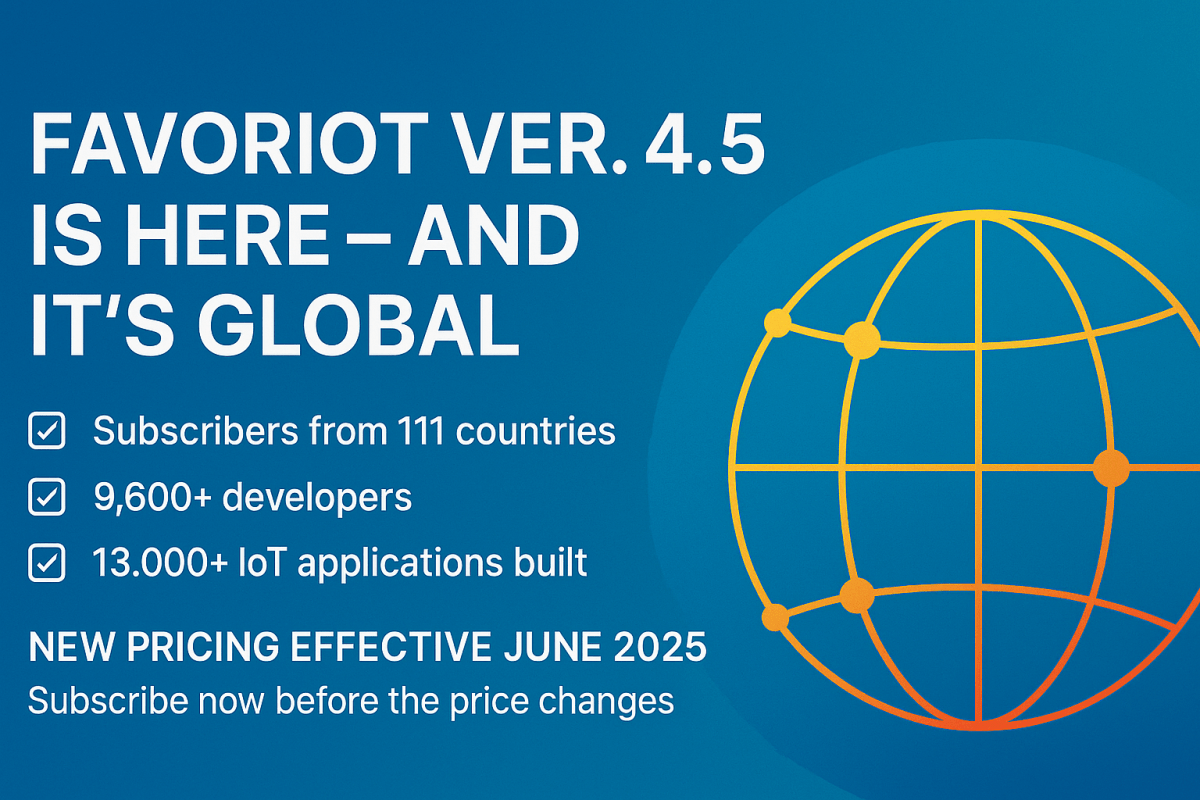
🌍 111 countries
👨‍💻 9,600+ developers
📱 13,000+ IoT apps

What’s wild? We have no idea what most users are building.
And you know what? We love that.

Favoriot is flexible enough for developers to use it their way—without us needing to micromanage or interfere. That’s the magic of a true IoT platform-as-a-service.

We Kept It Cheap—On Purpose

We priced it low. Dirt cheap, some said.

Because back then, IoT wasn’t mainstream.
We wanted students, hobbyists, and young startups to try.
To explore. To fail. To learn.
Without worrying about subscription fees.

That strategy worked.
It built trust. It built momentum.
And it got Favoriot where it is today.

But Let’s Be Real—It’s Time

Favoriot 4.5 isn’t a toy.
It’s a world-class platform.

We’ve benchmarked ourselves against the global giants.
We’ve made it faster, stronger, smarter.
And yes—it’s time the subscription reflects that.

Starting June 2025, our prices will change.

Why?
Because we’ve earned that seat at the table.
And we want to keep delivering the value you deserve.

But Here’s The Deal

If you subscribe before June—
You lock in the current price.
No surprises. No sudden hike.
Your loyalty gets rewarded.

To the Early Believers

If you’ve been with us since the manual days…
If you ever waited for your login in your inbox…
If you clicked “refresh” hoping we’d fix the bug…

Thank you.

Favoriot 4.5 carries your fingerprints.
We wouldn’t be here without you.

And we’re just getting started.

Let’s keep building the future of IoT—together.

Favoriot: A Marathon of Pivots, Perseverance, and Purpose

“This is going to be a game-changer!”

That was the spark that ignited our journey. In 2017, we embarked on a mission to revolutionize the Internet of Things (IoT) landscape in Malaysia. Our first stride? Raqib—a wearable device designed to ensure the safety and health of Umrah and Hajj pilgrims. It was more than just a product; it was a vision to provide peace of mind to individuals and their families during spiritual journeys.

KM 0–5: The Starting Line – Raqib’s Ambitious Launch

Launching Raqib felt like the exhilarating first kilometers of a marathon. The energy was high, the vision clear, and the team motivated. We believed in our product’s potential to make a significant impact. However, as with any long-distance race, the initial excitement soon gave way to unforeseen challenges.

KM 6–10: The First Hurdles – Technical Glitches and Market Realities

As we progressed, technical issues began to surface. The device faced unexpected glitches, and our marketing efforts didn’t yield the anticipated traction. It was a tough pill to swallow. But we weren’t ready to give up. We pivoted and introduced Favorsense, aiming to capture a different segment of the IoT market. Yet, despite our best efforts, it struggled to gain user interest.

“Where did we falter? What could we have done differently?” I often pondered during those challenging times.

KM 11–15: The Turning Point – Recognizing the Core Strength

Amidst these setbacks, a realization dawned upon us. The common thread between Raqib and Favorsense was the underlying platform that powered them. This platform, robust and versatile, had the potential to be more than just a backbone for our products. It could be the very product we needed to focus on.

I told the team, “This platform can be used by anyone who wants to develop their own IoT products. “

With renewed determination, we decided to pivot once more. We introduced the Favoriot IoT Platform to the public, offering it free to attract a broader audience. However, adoption was slower than expected. Despite creating tutorials and sharing resources, many users found it challenging to navigate the platform.

KM 16–20: Bridging the Gap – Introducing IoT Courses

Understanding the need for guidance, we launched IoT courses tailored to help users grasp the platform’s capabilities. These courses weren’t just about theory; they offered hands-on experience, enabling participants to apply their knowledge in real-world scenarios.

The response was overwhelmingly positive. Universities and polytechnics across Malaysia began integrating the Favoriot IoT Platform into their curricula. Students utilised it for their final-year projects, bringing innovative ideas to life.

“This is a significant achievement for us,” I expressed pridefully.

KM 21–30: Expanding Horizons – Building Partnerships

As we continued our journey, we recognised the importance of collaboration. We partnered with system integrators and enterprises, offering our platform’s cloud-based and enterprise-based models. This flexibility allowed clients to choose solutions that best fit their needs, further solidifying Favoriot’s position in the market.

KM 31–40: Gaining Momentum – Recognition and Growth

Our efforts began to bear fruit. Favoriot was no longer an unknown name in the IoT landscape. Out of 9,375 users (as of January 27, 2025), 80% came from our own country—a milestone that filled me with pride.

“We did it,” I told my team with a sense of accomplishment. “We’ve proven that we can compete with global platforms and carve out our own space.”

KM 41–42.195: The Final Stretch – Looking Ahead

Today, the Favoriot IoT Platform is a testament to resilience and adaptability. The journey has been a marathon from its humble beginnings with Raqib to becoming a cornerstone in IoT education and development. We’ve learned that setbacks aren’t failures but opportunities to pivot and grow.

As we look ahead, our vision is to take the Favoriot IoT Platform beyond Malaysia, reaching global audiences and empowering the next generation of IoT innovators.

“This is just the beginning,” I remind the team. The marathon continues, and we’re ready for the next leg of the race.

So, Startup or Marathon?

Startup is a marathon.

But with Favoriot, it’s not just about enduring.

It’s about leading, creating, and building something that lasts beyond the race.

And here’s the truth no one tells you:

The real finish line is when others start running because you did.

Why Do Students Hire Outsiders to Do Their Projects?

A Response from an Educator, Entrepreneur, and Tech Education Advocate

“Why are students willing to pay outsiders to do their projects? What’s the root cause? Where did we go wrong?”

This question isn’t new. It has been raised many times in discussions between academics, industry players, and the tech maker community. But this time, it was addressed with raw honesty by a trainer who truly understands students — someone who has taught students, trained lecturers, and now works with industry professionals. I found the four points he raised very insightful, and I’d like to unpack them — not to dispute, but to build on the conversation with my own experience.

1. University Syllabi Don’t Offer Enough Hands-On Experience?

“Is this really true, or are we not seeing the bigger picture?”

I’ll admit — there’s some truth to this. Many students who’ve come to me for consultation, especially on IoT or Favoriot training, often complain that their final year projects had to rely on self-learning via YouTube because they lacked deep technical guidance.

“But… surely not all universities are like that?”

Exactly. Some universities have moved towards hands-on learning, especially polytechnics, vocational colleges, and certain engineering faculties that actively collaborate with industry. The real problem is inconsistency. Some still rely heavily on simulation — and in fields like IoT, AI, or robotics, learning without touching hardware is like trying to learn swimming on dry land.

When I trained university lecturers through our Train the Trainers program for IoT, I saw firsthand how much they wanted to shift to practical methods — but were sometimes constrained by equipment, budget, or institutional policies. That’s reality.

This is why platforms like Favoriot are designed to break those barriers — offering affordable, easy-to-access platforms that can be embedded into courses, enabling students and lecturers to work from basic projects to advanced real-time data integration.

2. Lecturers Can’t Identify Student Talents?

“Are we too busy to notice the potential blooming right in front of us?”

As a former lecturer, I understand the pressure — full lecture schedules, endless meetings, research deadlines, and admin tasks. It becomes almost impossible to personally assess each student’s potential — unless they step forward.

But that’s not an excuse.

I’ve learned something through running smaller classes. “When the group is small, it’s easier to spot who’s struggling, who’s excelling. But in a lecture hall with 100 students?” We need a system.

Some suggestions:

  • Use mini-projects at the beginning of the semester to diagnose technical aptitude.
  • Bring in industry mentors (like us at Favoriot) to support project work.
  • Offer microlearning platforms like IoT Academy as supplements, not just stick to lecture notes.

Talent has to be discovered — not waited on.

3. Students Chase Paper Qualifications Only?

“Grades matter. But is that the ultimate goal?”

Many students believe excellent CGPAs equal great jobs. But times have changed. Employers now care more about your portfolio than your transcript.

I’ve met students with perfect grades who can’t troubleshoot a sensor. But I’ve also seen average students who build working temperature-monitoring systems with Telegram alerts using Favoriot — and are now working with real IoT startups.

This isn’t about who’s smarter, it’s about who’s brave enough to learn on their own.

That’s why we always encourage students to start with mini-projects early in the semester. Better to fail early and learn fast. We must build a culture of “learn by doing, fail fast, recover faster.”

4. Universities Are Slow to Update the Syllabus?

I fully agree here. Technology evolves every six months — yet syllabi may only change every six years. Changing a curriculum isn’t easy — it requires senate approvals, academic committees, MQA validation, and more.

But I applaud technical institutions like TVET, polytechnics, and certain private colleges that quickly adopt new tech. Some don’t just teach “how to use,” but also “how to think.”

However, we can’t just create skilled workers. We need thinkers, problem-solvers, and future tech leaders — those who can build solutions, not just follow instructions.

That’s why Favoriot is more than just a data platform. It’s a thinking tool. A place where students ask:

  • How can I solve a real-world problem?
  • How does data help decision-making?
  • How can tech integration impact communities?

So… Is It Wrong for Students to Hire Outsiders?

I asked myself the same thing — is it the students’ fault or the system’s?

I don’t fully blame the students. Sometimes they panic, lack support, and just want to pass. I also don’t blame those who offer project services — sometimes that’s the only indirect way a student learns something.

“But… if a student pays and learns nothing — that’s the real problem.”

We need to change the narrative:

  • From “doing it just to pass” to “doing it to learn.”
  • From “copying projects” to “creating value.”

From Training Students to Training Lecturers to Training Industry

I understand what the original author meant when he said:

“I used to train students, then lecturers, and now industry staff…”

That’s the cycle. When students and lecturers reach a certain capability, they don’t need you anymore. And that’s not a loss — that’s a win.

I’ve experienced the same. When IoT becomes embedded in campus life, when the Favoriot dashboard becomes an official teaching tool — I know my mission is progressing. Even if I’m no longer invited, I quietly smile inside.

“Opportunities will always come — maybe not from the same place, but from the impact you’ve already planted.”

To close:

  • Students need more hands-on guidance.
  • Lecturers need time and tools to identify talent.
  • Universities need the courage to match industry demands.
  • And all of us must see education as more than just passing — it’s about living, contributing, and growing.

For those who help students — do it with the heart to teach, not just to earn. Let them learn — even if it’s through you.

One day, they will thank you — not for finishing their project, but for making them someone who can stand on their own and create value.

“That’s the real purpose of education. And that’s the legacy we should all strive to leave behind.”

The Birth of “IoT Man”: Why the Name Means More Than Just a Title

“You can call me IoT Man.”

That was the casual yet defining moment when I embraced the name—not just as a label but as a symbol of everything I’ve poured into it.

But before that nickname ever stuck, before anyone even recognized my face or my voice in the realm of smart cities and connected devices, I was just a curious kampung boy who loved science fiction, obsessed with The Jetsons, and dreamt of a future where machines talked to each other.

I didn’t know it then, but that fantasy would eventually become my destiny.

The Spark That Ignited It All

In the 70s, I grew up with dusty comics, DC superheroes, and futuristic cartoons that seemed out of reach. I was always asking questions: “How does that work?”, “What if buildings could talk?”, “Why can’t my bicycle tell me when its tire is flat?” You know… typical “crazy kid” questions no one took seriously.

But I took them seriously.

Years later, that same boy became an engineer, researcher, and executive, hopping across universities, government agencies, and corporate towers. I had the titles and the recognition—and yet, I felt something was missing.

I wasn’t building the future I dreamed about.

Until I stumbled upon three letters that changed everything: IoT.

To me, the Internet of Things wasn’t just a buzzword. It was the missing puzzle piece. It was like someone finally handed me the blueprint of the world I used to imagine as a child.

I dove headfirst into it. It became an obsession. No, scratch that — it became a mission.

Why the Name “IoT Man” Chose Me

People often ask me, “Did you give yourself that name?” No, I didn’t. It started as a whisper on social media.

I was posting daily. Articles, LinkedIn updates, tweets, TikToks — all about IoT. I shared failures, ideas, insights, and case studies. Some people rolled their eyes. “Dia ni tak habis-habis cerita pasal IoT.”

Others started to notice.

One day, someone tagged me in a post and wrote, “Here comes the IoT Man again.” At first, I chuckled. “Macam superhero pulak.”

But then it stuck. People started calling me that — students, entrepreneurs, CEOs, even strangers at conferences. I would introduce myself, and they’d say, “Oh! You’re the IoT Man!”

And honestly?

It warmed my heart every single time.

Because it meant they saw me, they saw what I stood for, and they recognized the fire I carried.

Why It’s More Than Just a Nickname

You see, “IoT Man” isn’t just a personal brand.

It’s a reminder that in a world flooded with noise, consistency still matters. If you keep showing up, keeping writing, and keeping sharing, people will notice.

It’s a tribute to every sleepless night I spent building FAVORIOT from scratch with a small team and big dreams, to every time I was told, “Malaysia’s not ready for IoT,” or “Smart Cities won’t work here.”

It’s a badge earned through trials, through countless rejections, postponed projects, budget cuts, technical failures, and platform bugs, and through restarting when others gave up.

“But what if this doesn’t work?” I often asked myself during those quiet, lonely moments.

“Then I’ll try again tomorrow,” I’d reply.

The name “IoT Man” represents that spirit.

The Responsibility That Comes With It

Being known as the “IoT Man” also means people expect answers, solutions, and inspiration.

And that’s not something I take lightly.

That’s why I started sharing knowledge for free through podcasts like Jom Pakai IoT, articles, TikTok videos, and books. I also train others, mentor startups, and advise universities.

Because I’m not just building a company. I’m building a movement.

A movement to make IoT accessible. To make Malaysia a global hub of smart innovations. To show the kampung boy in every corner of the country that yes, you can shape the future too.

Legacy Over Popularity

I don’t want to be remembered just as a CEO or engineer.

I want to be remembered as the guy who sparked a generation.

The one who didn’t just talk about the future — but built it.

The one who lifted others along the way, who simplified the complex, who wore the “IoT Man” cape not for show but to carry the hopes of students, makers, entrepreneurs, and dreamers.

Because at the end of the day, all I ever wanted was to make a difference.

Final Reflection: A Name, A Mission

Sometimes, I look in the mirror and ask myself, “Are you still worthy of that name?”

Some days, I feel I’ve done enough, and most days, I feel like I’m just getting started.

So, if you see me online or bump into me at a café or tech event, don’t hesitate to say hi. Just say, “Hey, IoT Man!”

I’ll smile. And I’ll know that the journey — every twist, every fall, every leap — has been worth it.

Because that name is no longer just about me.

It belongs to the mission.

And the mission still burns bright.

Mazlan Abbas, your friendly neighborhood IoT Man. Let’s transform the world together!

What Would I Want Named After Me? I Never Asked for a Title, But They Gave Me One Anyway

“Do you want something named after you, Dr. Mazlan?”

That question caught me off guard.

Not because it was unexpected — people love giving names to legacies, buildings, awards, even algorithms. But because deep inside, I never asked for any of it.

You see, I’m just a man who fell in love with technology. Not for fame. Not for glory. But because I truly believed it could make lives better.

Yet, along the way… names started sticking.

From “Dial-a-Coke” to Global Conferences

Let me rewind to the early 2000s.

I worked in the telecommunications industry back then—CELCOM Axiata, to be specific. This was long before the word “IoT” entered mainstream vocabulary. Yet even then, we were already experimenting with early machine-to-machine (M2M) communication forms.

One of our most exciting innovations at the time was a Coke vending machine that could be triggered by SMS.

“Wait… you mean you can buy a drink just by texting a number?”

Yes, precisely that. The concept was called “Dial-a-Coke.” You send a text, and it deducts the amount from your mobile credit. Voila, a cold can drop out of the machine.

Was it revolutionary? For that time — absolutely.

But to me, it wasn’t about being revolutionary. It was about solving problems in simple ways using connectivity. That mindset never left me.

IoT: A Journey of Passion, Not Titles

Fast-forward to 2013. That’s when I began immersing myself even more seriously into IoT—this time not just as a technologist but also as a speaker, writer, researcher, and eventually, entrepreneur.

Everywhere I went, I would talk about IoT.

At conferences. In classrooms. On stage. Off stage. At coffee shops. In boardrooms.

The energy never ran out. In fact, it grew stronger every time I saw someone’s eyes light up with an “Aha!” when they understood what IoT could do for their lives or business.

Radio interviews followed, then television. Podcasts. Newspapers. Magazines. Even my children rolled their eyes when I’d go into another “IoT monologue” during dinner.

Then came the birth of FAVORIOT — a company built to democratise IoT for developers, enterprises, and even students.

It wasn’t just business. It was my passion translated into a platform.

And Then, They Started Calling Me…

One day after a seminar, someone walked up to me and said,

“Dr. Mazlan, you’re like the Father of IoT in Malaysia.”

I laughed. A little awkwardly, I must admit.

Because if anyone deserves that title globally, it’s Kevin Ashton — the man who coined the term the “Internet of Things. I’ve always credited him for that.

But the person insisted,

“You’ve been advocating this in Malaysia longer than anyone I know. You make people understand IoT in a simple, practical way. That’s a gift.”

And slowly… it started spreading.

Father of IoT Malaysia.

Was it official? No.
Was it universally agreed? Probably not.
Was it something I asked for? Never.

But I accepted it—not for the ego—but for what it represents: a shared belief that maybe, just maybe, I had helped lay some of the digital foundations in this country’s IoT journey.

TikTok, Branding, and a Name That Stuck

In 2022, I did something unexpected — I joined TikTok.

Yup, at the age when most people would be watching TikTok videos, I started making them.

My handle? @iotman2030.

Why 2030? People often ask.

Simple. Because I wanted the technology I championed to be relevant by then.

“What if you just used @iotman2022 or 2023?”

Well, that would age too quickly, wouldn’t it? Who wants to be known by a handle that feels like it expired with last year’s tech trends?

Since then, “IoT Man” has become another name people have started calling me. Some jokingly, some with admiration, but it stuck.

I never corrected anyone. Because, in a way, it perfectly captured who I was and what I stood for.

So, If I Could Name Something After Me…

Honestly? I wouldn’t.

I believe names should be earned by impact, not intent.

But if someone else names something after me—maybe a scholarship, an award, or a lab—I just hope it’s for the right reasons.

That it inspires young minds to build the next generation of connected solutions.
That it reminds people how persistence, curiosity, and belief can shape an entire career.
That it stands for passion without ego.

And maybe it helps a few dreamers realize that technology isn’t just about wires and sensors. It’s about people.

A Legacy Beyond the Name

I never started this journey wanting to be known as anything.

Not the Father of IoT.
Not IoT Man.
Not even Dr. Mazlan the Technologist.

But I did want to make a difference.

And if making a difference earns me a name, then so be it.

Let it not be a pedestal but a platform.
Let it not be a brand but a bridge.

Because names will fade, but impact — that lingers.

So, if you ever hear someone call me Father of IoT Malaysia or IoT Man, just know —
It’s not about me.
It’s about the mission.

And that mission? Still going strong.

Even in 2030.

The Hard Truth About IoT Startups: Lessons from My Failures

I Failed at Building an IoT Business Before Succeeding. Here’s What I Learned.

“This is it. This idea will work. I can see it changing the world.”

That was my mindset years ago when I first stepped into the world of IoT entrepreneurship. I was confident—too confident, perhaps. With decades of experience in the industry, I thought I had the perfect combination of knowledge, network, and credibility to launch a successful IoT business.

I believed that if I built the right solution, the market would naturally embrace it. After all, IoT was the buzzword at every tech conference, and businesses were talking about the potential of connected devices.

But reality? It had a very different lesson in store for me.

The First Failure: Overestimating Market Readiness

I started FAVORIOT with the assumption that businesses and government agencies were fully prepared to adopt IoT solutions. The Smart City vision was gaining traction, and industry leaders were excited about automation, data-driven decision-making, and real-time monitoring.

So, with high hopes, I built my first IoT solution. I expected clients to immediately recognize its value. But when I went out to pitch my idea, I was met with hesitation, skepticism, and endless bureaucratic challenges.

“Why aren’t they jumping at this? Can’t they see how valuable this technology is?”

The problem wasn’t the technology—it was the mindset. Many organizations were still unsure about IoT. They didn’t fully understand how it worked, they feared implementation risks, and most importantly, they didn’t have dedicated budgets for IoT initiatives. To them, IoT was still an experimental concept, not a necessity.

This was my first painful realization: Just because something is revolutionary doesn’t mean people are ready for it. I had to find a way to bridge the gap between technological potential and real-world adoption.

The Second Failure: Underestimating the Sales Process

“If the product is good, it will sell itself.”

That was a dangerous assumption. I thought that once people saw my IoT solution in action, they would be convinced. After all, logic and data should win, right? But I quickly realized that people don’t just buy technology—they buy trust, relationships, and clear return on investment.

I spent months refining my IoT platform, making sure it was technically superior. But I wasn’t spending nearly enough time understanding the actual pain points of my potential customers. I was offering a futuristic solution to people who weren’t even sure they had a problem that needed solving.

When I approached businesses, they weren’t asking, “How advanced is your platform?” They were asking, “How will this help us save money?”

That’s when it hit me. I was speaking the wrong language.

I had to shift my focus from selling technology to selling solutions. Instead of talking about sensors, APIs, and cloud computing, I had to show how IoT could reduce operational costs, improve efficiency, and generate new revenue streams.

Once I made this adjustment, I noticed a change. Conversations became easier, and decision-makers started seeing the value. It wasn’t just about technology anymore—it was about business outcomes.

The Third Failure: Learning Through Building Partnerships

At first, I thought I needed to build everything on my own. But as I encountered more roadblocks, I realized something crucial: IoT is not a one-man show. It requires an ecosystem.

When I started reaching out to potential partners, I discovered that the IoT adoption challenge wasn’t just mine alone—others were facing similar struggles. System integrators, software developers, and even hardware manufacturers were all trying to navigate the complexities of IoT implementation.

That’s when I started building strategic partnerships.

Instead of trying to convince companies to adopt IoT on my own, I worked with system integrators who already had trusted relationships with businesses. They understood their clients’ operational challenges far better than I did, and they could position our IoT solutions as part of a broader digital transformation strategy.

I also realized that collaborating with universities and research institutions could help us educate the next generation of IoT professionals. Through partnerships, we could develop case studies, provide training programs, and increase awareness about real-world IoT applications.

This was a game-changer. By leveraging partnerships, we accelerated adoption and expanded our market reach much faster than I ever could have done alone.

What I Learned from These Failures

Looking back, these failures were painful, but they were necessary. They forced me to adapt, rethink my strategy, and ultimately build a stronger business.

Here are the key lessons I took away:

1. Timing matters. Just because a technology is exciting doesn’t mean the market is ready for it.

2. Selling is about solving problems, not just promoting features. Speak the language of business impact, not just technology.

3. You can’t build an IoT business alone. Success comes from building partnerships and working within an ecosystem.

4. Resilience is everything. If I had given up after my first failure, I wouldn’t be here today.

Where We Are Today

Today, FAVORIOT is working with partners across multiple countries. We’ve built an IoT platform that helps businesses adopt smart solutions in a practical, scalable way. We’ve collaborated with system integrators, universities, and corporations to drive IoT adoption.

But none of this would have happened if I hadn’t learned from my early failures.

Would I go back and change my struggles? Absolutely not.

Because those failures weren’t the end of my journey—they were the foundation of my success.

The Fourth Industrial Revolution: The Future is Already Here!

“Are we ready for this transformation?”

I still remember the first time I heard the term “Fourth Industrial Revolution” or more commonly known as Industry 4.0. It sounded futuristic, like something straight out of a sci-fi movie—where robots rule the world, artificial intelligence (AI) makes all decisions, and automation is everywhere.

But the reality? We are already living in that era!

Before we panic and imagine ourselves being chased by rogue robots, let’s take a step back and understand how industrial revolutions have shaped the world.

From the First to the Fourth: The Evolution That Changed the World

History has witnessed four major industrial revolutions, each transforming human life in unimaginable ways:

  1. First Industrial Revolution (18th – 19th Century)
    • The invention of the steam engine changed everything. Factories replaced manual labor, and transportation improved dramatically. It was the birth of modern industry.
  2. Second Industrial Revolution (Late 19th – Early 20th Century)
    • Electricity became the new king. Assembly lines and mass production made goods cheaper and more accessible. Henry Ford’s automobile factories were the poster children of this era.
  3. Third Industrial Revolution (Mid-20th Century – Early 21st Century)
    • Computers, automation, and the internet revolutionized the workplace. Suddenly, information was just a click away, and digital transformation began.
  4. Fourth Industrial Revolution (Now!)
    • AI, the Internet of Things (IoT), 5G, blockchain, quantum computing—you name it. Machines are getting smarter, and decision-making is shifting from humans to algorithms.

Wait… Does This Mean Robots Will Take Over My Job?

This is the million-dollar question. The short answer: Yes and No.

Yes, because many repetitive manual tasks will be automated. If a machine can do it faster and better, why pay a human to do it?

No, because new jobs will emerge—roles we never imagined before. Who would have thought that “TikTok Content Strategist” or “Metaverse Architect” would be actual job titles?

The key here is adaptability. Those who embrace technology will thrive, while those who resist will struggle. It’s like complaining that smartphones are ruining society while using one to rant on social media.

How Industry 4.0 Affects Our Daily Lives

If you think Industry 4.0 only affects tech companies, think again. It’s already changing our everyday lives:

  • Smart Homes: Your fridge tells you when you’re out of milk, and your lights turn on when you enter the room. It’s like living in a sci-fi movie!
  • Healthcare – AI can detect diseases earlier than doctors, and robotic surgeries are becoming more common. Imagine getting medical advice from a chatbot instead of waiting hours in a clinic.
  • Education – Online learning, AI tutors, and personalized lessons replace traditional classrooms. No more boring lectures (hopefully).
  • Shopping—AI-driven recommendations make your online shopping ads feel creepily accurate. “How does it know I was thinking about buying a new phone?!

The Funny Side of Industry 4.0

Despite all the advancements, some things about Industry 4.0 are just plain hilarious.

  1. The Smart Home Fiasco
    • Me: “Hey Alexa, turn off the lights.”
    • Alexa: “Turning off all the lights.”
    • Me: “Wait, not the WiFi—” (Everything shuts down, including my will to live.)
  2. AI Assistants That Are Not So Smart
    • Me: “Siri, what’s the weather like today?”
    • Siri: “I found some information about dinosaurs.”
    • Me: “…”

Are We Ready for This Future?

Industry 4.0 is not coming—it’s already here. The question is, how do we prepare for it?

  1. Learn New Skills – Coding, AI, data analytics, cybersecurity. The more you know, the better.
  2. Embrace Change – Don’t resist technology. Learn how to use it to your advantage.
  3. Be Creative – Machines can replace repetitive jobs but can’t replace human creativity.

Remember, the future belongs to those willing to adapt and evolve. So, are you ready?

Or are you still waiting for your smart fridge to stop judging your midnight snacks?