Types of Analytics

Today, we’ll discuss types of analytics and their importance in turning raw data into actionable insights.

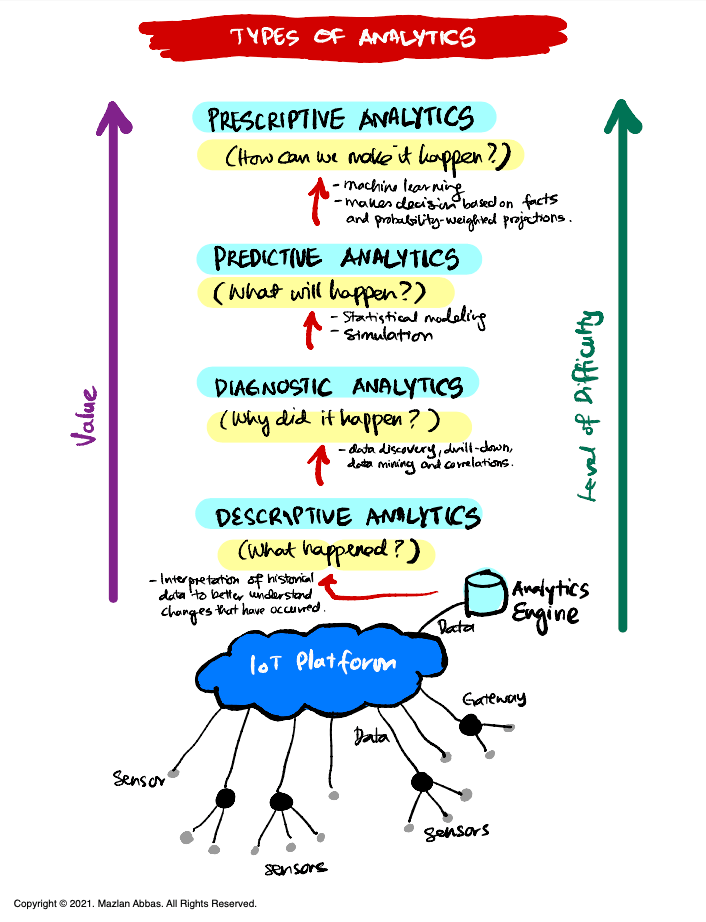
This diagram shows four types of analytics, ranked by their difficulty level and the value they provide. Let’s go through them step by step.
Based on the eBook — IoT Notes by Mazlan Abbas

1. Descriptive Analytics: What Happened?

At the base of the analytics hierarchy is descriptive analytics. This is the simplest form of analytics and helps us understand what happened by interpreting historical data.

  • Purpose: To summarise past events and identify patterns.
  • Example: A smart thermostat that shows last week’s energy usage patterns.
  • Methods: Charts, graphs, and dashboards that clearly show past performance.

This type of analytics is great for reviewing the past, but it doesn’t tell us why something happened or what will happen next.

2. Diagnostic Analytics: Why Did It Happen?

Moving up, we have diagnostic analytics, which looks at why something happened. It’s more complex than descriptive analytics because it requires diving deeper into the data.

  • Purpose: To discover relationships and identify the causes behind past events.
  • Example: Analysing why a specific day’s energy usage was higher than average by correlating data with external factors like weather.
  • Methods: Data discovery, drill-down techniques, and correlation analysis.

This stage helps us make sense of the past by understanding the root causes of trends and anomalies.

3. Predictive Analytics: What Will Happen?

Next is predictive analytics, which focuses on forecasting future outcomes. This is where analytics becomes proactive rather than reactive.

  • Purpose: To predict what might happen based on current and historical data.
  • Example: A smart thermostat forecasting energy usage for the upcoming week based on weather patterns and past behaviour.
  • Methods: Statistical modelling and simulations.

By identifying trends and patterns, predictive analytics helps us make informed predictions.

4. Prescriptive Analytics: How Can We Make It Happen?

At the top is prescriptive analytics, the most advanced type. This involves predicting outcomes and recommending actions to achieve desired results.

  • Purpose: To decide the best course of action based on predictions.
  • Example: A smart thermostat automatically adjusting settings to save energy while maintaining comfort.
  • Methods: Machine learning and AI to analyse probabilities and make decisions.

Prescriptive analytics provides the highest value by enabling automated and data-driven decisions.

IoT and Analytics

This diagram also highlights how analytics works in an IoT platform:

  1. Sensors: Collect data from various sources like temperature, humidity, or movement.
  2. IoT Platform: Acts as a central hub to process and store the data.
  3. Analytics Engine: Applies these four types of analytics to generate insights and drive decisions.

Final Thoughts

Each type of analytics builds on the previous one, moving from simple data interpretation to actionable decisions. The value increases as we move up the hierarchy, as does the complexity.

Question to consider: Which type of analytics is most valuable in your industry, and how can you implement it effectively? Let’s discuss it!

[Note: Download IoT Notes by Mazlan Abbas ]

What is the Fourth Industrial Revolution?

IOT NOTES

Lecture Notes

Based on the eBook — IoT Notes by Mazlan Abbas

Today, we’ll explore the Fourth Industrial Revolution (IR 4.0) and its significance. This diagram breaks it down into easy-to-understand sections, so let’s walk through it step by step.

1. The Differences Between Revolution and Evolution

Let’s first clarify why it’s called a revolution and not an evolution.

Revolution:

  • Sudden and drastic changes that transform industries and societies.
  • Think of it as a dramatic leap forward in technology and processes.

Evolution:

  • Gradual and slow progress over time.

IR 4.0 is a revolution because it represents rapid and significant advancements in how we live and work.

2. The Bigger Picture: Industry 4.0 vs IR 4.0

It’s important to understand that Industry 4.0 is just a subset of IR 4.0.

  • Industry 4.0 focuses on manufacturing and improving industrial processes using automation, IoT, and robotics.
  • IR 4.0, however, encompasses much more:
  • It impacts various sectors, such as education, healthcare, shopping, and agriculture.
  • It’s a broad transformation, not limited to factories or industries.

3. The Lifestyle Through Industrial Revolutions

Let’s now look at how each industrial revolution shaped our lifestyle:

IR 1.0 — The Age of Manual Tools:

  • People relied on physical and manual tools for work.
  • Example: Ploughing fields with hand tools.

IR 2.0 — The Power of Electricity:

  • Electricity revolutionised industries, enabling mass production.
  • Example: Electric machines replaced manual labour.

IR 3.0 — The Digital Era:

  • The rise of electronics and the internet connected the world.
  • Example: Computers, email, and early e-commerce.

IR 4.0 — The Intelligence Revolution:

  • We’re now using intelligence through AI, robotics, and advanced technologies.
  • Example: Autonomous robots, augmented reality (AR), and virtual reality (VR).

4. Example: How Shopping Evolved

Let’s take shopping as an example of how each industrial revolution changed this activity:

  • IR 1.0: People used cash for transactions.
  • IR 2.0: The cash register was introduced, improving the checkout process.
  • IR 3.0: Credit cards and online shopping emerged with the internet.
  • IR 4.0: We see robotics and AR/VR enhancing the shopping experience, like virtual try-ons or automated warehouses.

Why is IR 4.0 Important?

IR 4.0 is transforming every aspect of our lives, from how we work and learn to how we interact with technology. It’s about leveraging intelligence to solve problems, improve efficiency, and create new possibilities.

[Note: You can download the full eBook — IoT Notes by Mazlan Abbas]

Understanding Industry 4.0 and Industrial Revolution 4.0

IOT NOTES

Lecture Notes

Based on the eBook — IoT Notes by Mazlan Abbas

Today, we’ll explore two closely related but distinct concepts: Industry 4.0 and the Fourth Industrial Revolution (IR 4.0).

These terms are often used interchangeably but have specific differences, as highlighted in the diagram. Let’s dive in step by step.

1. Revolution vs Evolution

The first thing we need to clarify is the difference between revolution and evolution:

  • Revolution refers to sudden and drastic change. Think of it as a leap forward that quickly transforms industries and societies.
  • Evolution, on the other hand, is slow and gradual progress. Changes happen incrementally over time.

Key question: Are we adopting Industry 4.0 technologies suddenly (revolution) or gradually (evolution)? This can vary depending on the industry and region.

2. What is Industry 4.0?

Industry 4.0 focuses on manufacturing and improving industrial processes through advanced technologies like IoT, AI, and robotics. It is the fourth stage in the progression of industrial advancements:

Industry 1.0 (1784):

  • Introduction of mechanisation and steam power.
  • Example: Steam engines powering factories.

Industry 2.0 (1870):

  • Electrical power enabled mass production.
  • Example: Assembly lines in factories.

Industry 3.0 (1969):

  • Use of computers, electronics, and automation.
  • Example: Robots performing repetitive tasks on manufacturing floors.

Industry 4.0 (Today):

  • Cyber-physical systems integrating IoT, AI, VR, and robotics.
  • Example: Smart factories where machines communicate and operate autonomously.

3. What is Industrial Revolution 4.0 (IR 4.0)?

The Fourth Industrial Revolution goes beyond manufacturing. It’s about integrating these technologies across all industries and even societies. While Industry 4.0 focuses on production, IR 4.0 impacts healthcare, education, agriculture, and more.

A key question: Are we adopting these 4.0 technologies evenly across all sectors, or is there a focus on specific areas like manufacturing?

4. The Connection Between Industry 4.0 and IR 4.0

Think of Industry 4.0 as a subset of the broader IR 4.0. Industry 4.0 is about the transformation of manufacturing, whereas IR 4.0 encompasses societal changes.

Here’s an example:

  • Industry 4.0: A factory using IoT sensors to monitor equipment health and reduce downtime.
  • IR 4.0: IoT sensors used in agriculture to monitor soil moisture for precision farming.

5. Societal Progression Through Industrial Revolutions

The diagram also highlights how societies have evolved alongside industrial advancements:

  1. Society 1.0: Hunting society — Humans relied on nature and survival skills.
  2. Society 2.0: Agriculture society- farming practices transformed societies.
  3. Society 3.0: Industrial society — industries became the backbone of economies.
  4. Society 4.0: Information society – driven by computers and the internet.
  5. Society 5.0 (Japan’s Vision):
  • A super-smart society where technology integrates seamlessly to improve quality of life.
  • Focus on AI, robotics, and IoT to solve societal challenges.

6. Why is This Important?

Understanding these concepts helps us prepare for the future:

  • For businesses: Knowing the difference between Industry 4.0 and IR 4.0 helps align strategies.
  • For individuals: Skills like AI, IoT, and data analytics are becoming essential.
  • For society: IR 4.0 encourages us to consider how technology can address global challenges like sustainability and healthcare.

Final Thoughts: Industry 4.0 is revolutionising manufacturing, while IR 4.0 is shaping the future of entire societies.

As we move forward, we aim to embrace these technologies for efficiency and to build a more intelligent, inclusive world.

[You can download the IoT Notes here]

IoT Combating COVID-19

IOT NOTES

Lecture Notes

Based on the eBook — IoT Notes by Mazlan Abbas

Today, we’ll look at how the Internet of Things (IoT) played a critical role in combating the challenges brought by the COVID-19 pandemic.

The diagram gives us a clear picture of the impacts, technologies, and solutions IoT provided during this global crisis.

1. The Serious Impact of COVID-19

COVID-19 affected every corner of our lives, especially in two major areas:

Economy

  • Social distancing disrupted manual jobs and heavily impacted daily income earners (“kais pagi makan pagi” — hand-to-mouth living).
  • Businesses relying on outside dependency suffered due to travel and supply chain restrictions.
  • Cost-cutting became essential across all sectors.
  • The lack of a cohesive ecosystem made economic recovery slower.

Health

  • Health became a top priority.
  • Awareness and consciousness about hygiene, social distancing, and health monitoring increased.
  • Technology began to take centre stage in health-related solutions.

2. IoT Technologies Used

IoT, combined with IR 4.0 technologies (Industry 4.0), came into action to address these challenges. Let’s explore the tools and methods:

Robots

  • Used for tasks like disinfection and delivery, especially in hospitals and public spaces, reducing human contact.

IoT

  • Enabled real-time data collection and monitoring for applications like health checks and remote patient management.

Drones

  • Delivered essential items to maintain social distancing and were used for surveillance in lockdown areas.

Artificial Intelligence (AI)

  • Enhanced contact tracing, temperature scanning, and predictive analytics to track the virus’s spread.

3. Practical Applications of IoT

IoT was at the heart of the pandemic response, enabling innovative applications:

Contact Tracing

  • Mobile apps and wearable devices tracked individuals’ interactions, helping to identify and isolate potential cases.

Health Monitoring

  • Remote patient monitoring systems allowed hospitals to track patients’ vital signs without physical visits.
  • Temperature scanning systems were widely deployed in public places.

Environmental Monitoring

  • IoT sensors monitored air quality and other environmental factors to maintain healthy surroundings.

Remote Operations

  • IoT made it possible to manage utilities like remote meter reading and asset tracking.

Delivery Drones

  • Delivered medicines, food, and other essentials, reducing human-to-human interaction.

4. The Role of Digitalisation

With physical interactions limited, digitalisation became a key enabler:

Online Presence

  • Businesses and retail shifted online to continue operations.
  • Education moved to online platforms, and virtual meetings became the norm.

Robots and Automation

  • Robots handled repetitive tasks, like disinfection, to maintain hygiene standards.

Conclusion

IoT proved to be a game-changer during COVID-19. It connected people, devices, and systems, enabling effective solutions for healthcare, economic recovery, and safety.

The pandemic highlighted the importance of leveraging IoT for crisis management and showed us how technology can adapt to save lives and sustain economies.

[Full IoT Notes can be downloaded HERE]

Components of IoT

IoT Lecture

Based on IoT Notes

Based on the eBook — IoT Notes by Mazlan Abbas

Let’s discuss an essential concept in IoT — its key components. The diagram breaks IoT into four main building blocks, which we’ll explore step by step.

1. Sensors: The Eyes and Ears of IoT

The first layer is the sensors. These devices are at the heart of IoT; their job is to sense the environment.

  • They generate data by measuring things like temperature, humidity, or motion.
  • Think of them as the “end-nodes” in IoT — they are where the process begins.

Examples include:

  • A digital thermometer sensing room temperature.
  • A motion detector in a security system.

Without sensors, IoT wouldn’t have any information to work with!

2. Connectivity: The Communication Bridge

Once sensors collect data, it needs to be transferred somewhere for processing. That’s where connectivity comes in.

  • IoT uses different communication technologies:
  • Wireless options like Wi-Fi, Bluetooth, and LPWAN (LoRa or Sigfox).
  • Fixed methods like Ethernet.
  • Connectivity ensures the data travels from the sensors to the next stage over the internet or private networks.

Imagine this as a digital highway connecting the physical world to the virtual one.

3. IoT Platform and Middleware: The Brain

The third component is the IoT platform or middleware. This is where all the raw data comes together and is processed.

  • It acts as a central hub to aggregate data from multiple sensors.
  • Middleware handles:
  • Device management.
  • Data storage and formatting using standard protocols.
  • Providing APIs (Application Programming Interfaces) so apps can access the data.

Think of this as the “brain” that processes everything and makes sense of the data.

4. Applications and Analytics: Deriving Insights

Finally, all the processed data is used in applications and analytics to deliver value. This is where IoT makes an impact.

Applications:

  • Use the data to create useful solutions, like apps that track fitness or control smart homes.
  • Analytics and AI:
  • Analyse the data using Artificial Intelligence or Big Data techniques.
  • Generate insights to help make decisions or automate processes.

For example:

  • A smart farming app could use soil moisture data to trigger irrigation.
  • An AI system could predict machine failure in a factory.

Bringing It All Together

So, to summarise:

  1. Sensors collect the data.
  2. Connectivity transmits the data.
  3. IoT Platform processes and stores the data.
  4. Applications and Analytics use the data to create actionable insights.

IoT is a powerful combination of hardware, communication, and software working together to solve real-world problems.

The Art and Agony of Crafting eBooks

WRITER’S STORIES

Blank screen and cursor blinking — what do you do?

Photo by Adrian Swancar on Unsplash

Not a member? Click here to read the full story for free.

Have you ever felt the frustration of wanting to write but being unable to translate your thoughts into words? It’s as though the blank screen before you is mocking you with its emptiness while the cursor blinks away, reminding you of your creative stagnation.

In such moments, your mind is a whirlwind of conflicting ideas, and you find yourself struggling to put even a single coherent sentence together.

That’s been me more times than I can count.

Today, I want to share my journey of writing and creating eBooks on startups and the Internet of Things (IoT) — a path filled with as much inspiration as frustration.

Writing, they say, clarifies your thoughts.

I beg to differ sometimes; it often makes me want to smash my computer.

Photo by DANIEL BECERRA on Unsplash

Yes, I’m one of those who, despite having successfully published several pieces and stories on startups with technology, often finds the writing process nothing short of torturous.

Yet, here I am, continually drawn back to the keyboard, driven by the impact these writings might have.

Ernest Hemingway once described writing as sitting down at a typewriter and bleeding.

Trust me, it’s not as glamorous as Hollywood makes it out to be with its tales of tortured geniuses finding their muse after a life-changing epiphany.

It’s hard. It’s gritty.

And it’s anything but a flurry of spontaneous brilliance.

Really? Again?” I often mutter to myself when words refuse to flow, a reminder of the countless times I’ve faced the daunting task of translating complex IoT concepts into accessible insights.

Popular culture might have you believe that creativity is a spontaneous burst of brilliance, but the truth is far more mundane.

It’s about persistence.

Photo by Matteo Rimoldi on Unsplash

It’s about sitting down, day after day, and committing to your message, even when self-doubt whispers persistently in your ear.

And that’s why I’m here, blogging for the first time.

Although I’m more at ease expressing ideas verbally, the discipline of writing demands a different kind of rigor.

It’s about structuring thoughts that are otherwise scattered by the relentless onslaught of digital noise — tweets, emails, the endless stream of content that demands our attention.

So bear with me.

As I venture through this digital dialogue, I’m not just trying to share tips on IoT or startup strategies, I’m also navigating my way through personal barriers and doubts, learning to embrace imperfection in my narrative.

You see, writing isn’t just about sharing knowledge — it’s a process of self-discovery.

It forces you to confront your ideas, to refine them, and, perhaps most importantly, to challenge the echo chamber of your own mind.

Am I making sense, or am I just filling pages?” This question often haunts me late at night, a reminder of the ongoing struggle between expressing thoughtfully and simply filling space.

Photo by Spencer on Unsplash

Through my eBooks, I’ve aimed to distill years of experience in the tech industry into practical guides.

From my days at academic tenure to my venture at REDtone IoT, each phase of my career has contributed a chapter to my story.

These writings aren’t just reflections of past achievements; they are a continuation of my dialogue with the world, an attempt to contribute meaningfully to the ever-evolving discourse of technology and innovation.

Writing these books has been a journey of facing my perfectionism head-on — a tendency to overthink that can kill creativity.

But I’ve learned to navigate this, to keep pushing through the self-doubt and the frustration because the reward is the connection made with readers, the sharing of insights that might spark someone else’s breakthrough.

Thank you for joining me on this ride.

It’s not just about the destination but the insights we gather and the stories we tell along the way.

I look forward to your thoughts, your feedback, and yes, even your critiques.

Together, let’s keep the conversation going.

Mastering IoT with Favoriot

Tailored for IoT enthusiasts

[Note: Click here to have FREE access to this member-only story]

This guide, “Mastering IoT with Favoriot,” tailored for enthusiasts eager to explore IoT, mainly through the Favoriot platform, is a treasure trove of knowledge, meticulously organized into four key sections, each shining a light on different aspects of IoT application in business and academia.

This eBook is FREE to download, but your contribution, big or small, helps support creating more valuable content like this eBook.

Here’s What Awaits You:

  • Solid Foundations in IoT: Kick off your adventure with an insightful introduction to IoT platforms. Discover the critical role of on-premise platforms for seamless deployments and the importance of integrating IoT into academic environments.
  • A Deep Dive into IoT Platforms: Navigate through a thorough comparative analysis of leading IoT platforms, including Favoriot, AWS IoT, and Microsoft Azure IoT, among others. This segment is a goldmine for those weighing their options to find the perfect platform match.
  • Exploring the Favoriot IoT Platform: The heart of the book delves into the Favoriot IoT Platform, presenting its array of plans and functionalities. This section primarily benefits businesses and developers keen on maximizing the Favoriot platform for their IoT ventures.
  • Hands-On IoT Solutions: Get practical advice and strategies for crafting and customizing IoT solutions. Learn how to efficiently transition from a general platform to a specialized solution, shortening the development timeline.
  • IoT in Higher Education: An inspiring section dedicated to integrating IoT in higher education, illustrating how IoT can transform educational methods and equip future developers with the necessary skills.
  • Real-World Insights: Enrich your understanding with case studies and applications that bring IoT concepts to life, making the guide informative and engaging.
  • Concluding Reflections: Wrap up your journey with a summary of IoT’s impact across various domains, highlighting the revolutionary potential of the Favoriot platform.

Why This Book Stands Out:

This guide distinguishes itself through its clear, in-depth coverage and structured approach to complex topics.

It is an indispensable resource for business leaders, IoT developers, and educators, offering theoretical insights and practical knowledge.

Its unique focus on the Favoriot platform differentiates it from other IoT resources.

In essence, “Mastering IoT with Favoriot” is an essential read for anyone looking to grasp and exploit the vast opportunities of IoT.

Its combination of foundational knowledge, practical tips, and real-world examples makes it a premier resource in IoT.

Join us in exploring the limitless possibilities of IoT by supporting this invaluable guide. Your journey into the innovative world of IoT starts here.

Download HERE.

https://mazlanabbas.gumroad.com/l/masteringiot

“Mastering IoT with Favoriot” – My Third eBook Within One Month

Never in my wildest dreams did I think I’d become an author of multiple eBooks, let alone publish three in just a month. My latest journey in writing has been nothing short of a whirlwind, and I’m here to tell you how I managed it — and how you can follow suit.

Let me pull back the curtain on my writing process. It’s surprisingly straightforward and something you can replicate. My strategy was simple: I curated the best articles from my blog and transformed them into eBooks. No magic, just a bit of hard work and smart repurposing of content I already had.

The first eBook I launched was “My Startup Survival,” a personal narrative about my foray into entrepreneurship. The cover was a simple Canva creation, but it conveyed the essence of my startup journey. This book was a labor of love, a reflection on the trials and triumphs of building something from the ground up.

The second was “IoT: A Beginner’s Guide,” initially titled “IoT Frontier.” It took me two years to overcome my procrastination and finally get it out there. This eBook was a deep dive into the Internet of Things, written to demystify the field for newcomers.

But the third, “Mastering IoT with Favoriot: A Comprehensive Guide for Businesses and Educational Institutions,” is the one I’m most proud of. I decided to offer it for free, a gesture to share knowledge and empower others.

This book isn’t just a guide; it’s an expedition into the world of IoT platforms. It starts with the basics, explaining why on-premise IoT platforms are critical for deployments. Then, it compares various IoT platforms to help decision-makers choose the right one for their needs.

The heart of the book is the in-depth exploration of the Favoriot IoT Platform. I break down its plans, capabilities, and how businesses and developers can leverage it for their IoT projects. But I don’t stop there. The book also offers practical guidance on crafting IoT solutions, reducing development time, and tailoring platforms to specific verticals.

I delve into the role of IoT in education, arguing for its integration into university curriculums to prepare future developers. Case studies sprinkle the book, bringing the theories to life with real-world applications.

By the end, I hope to leave readers with a clear understanding of IoT’s transformative power across various sectors, championed by platforms like Favoriot.

So, if you’re a business leader, an IoT developer, or an educator, “Mastering IoT with Favoriot” is penned for you. It’s a blend of theoretical insights and actionable advice, all aimed at harnessing the potential of IoT.

And there you have it, the story of how I published three eBooks in a month. If I’ve sparked a curiosity in you about IoT or writing, I invite you to read my guide. It’s more than just a book; it’s a blueprint for innovation in the IoT landscape.

I Changed My Book Title Twice – Here’s Why It Happened

Why I Changed the Title of My eBook: From “IoT Adventure” to “IoT Frontier” and Finally to “IoT: A Beginner’s Guide”?

A Reflection on the Power of SEO and Keywords in Book Titles

When I first launched my eBook on the intriguing world of the Internet of Things (IoT), I titled it “IoT Adventure.”

It seemed fitting at the time, a title that conveyed the excitement and exploration in the burgeoning field of IoT.

However, not long after, I made a decision to rename it to “IoT Frontier.” The shift was subtle yet significant, representing a more pioneering spirit. But then, a crucial realization dawned on me: the power of SEO and the right keywords in a book title.

In the digital age, where eBooks compete in a vast ocean of online content, the right title can be the difference between being discovered or remaining invisible.

This understanding led me to reevaluate my choice. “IoT Adventure” was catchy, and “IoT Frontier” had a ring of innovation, but did they encapsulate the essence of the book in a way that would resonate with potential readers searching online?

It was then that I decided to change the title again, this time to “IoT: A Beginner’s Guide.”

This title wasn’t just a label; it was a strategic choice.

The term “Beginner’s Guide” is widely searched by novices in any field, and incorporating it into the title immediately made the book more discoverable to my target audience.

It was a lesson in SEO – Search Engine Optimization – and the importance of keywords.

Choosing “IoT: A Beginner’s Guide” wasn’t just about tapping into popular search keywords.

It was a deliberate move to align the book’s title with what it truly offers – a comprehensive, accessible introduction to IoT for beginners.

This title clearly defines the book’s target audience and content, making it more likely to reach those seeking a starting point in their IoT journey.

In retrospect, the evolution of my book’s title reflects a deeper understanding of the digital marketplace.

While “IoT Adventure” and “IoT Frontier” were titles I was emotionally attached to, “IoT: A Beginner’s Guide” was a decision driven by pragmatism and a clear vision of my audience’s needs.

This journey in renaming my eBook taught me a vital lesson about digital content strategy.

It’s not just about what you write; it’s also about how you present it to the world.

The right title acts as a beacon, guiding the right readers to your work. It’s a blend of art and science, creativity and analytics.

To other authors and content creators, my advice is this: consider not only what your title says about your content but also how it will perform in the vast, competitive world of online search.

Your title is more than a name; it’s your first, and perhaps most crucial, marketing tool.

[eBook] IoT Frontier: Insights and Innovations in Malaysia and Beyond by Mazlan Abbas

Why You Should Read This eBook

IoT Frontier: Insights and Innovations in Malaysia and Beyond” serves as a seminal exploration of the interplay between technology and daily life, placing special emphasis on the Internet of Things (IoT) — a cornerstone of contemporary innovation reshaping global industries, urban landscapes, and day-to-day living.

Entering the year 2024, the book captures the essence of an ongoing digital renaissance, primarily propelled by IoT advancements. It offers an in-depth look at these developments, particularly highlighting Malaysia’s role in the narrative, which acts as a crucial case study for IoT’s influence in emerging economies.

In the first section, “IoT Foundations and Future Visions,” the book establishes a baseline understanding of IoT’s present status and its expansive future potential. It delves into the skills necessary for capitalizing on IoT and scrutinizes its integral role in the Fourth Industrial Revolution. Furthermore, it addresses the burgeoning ethical considerations in AI, pivotal as we progress towards increasingly intelligent solutions.

The second section provides a comprehensive analysis of Malaysia’s IoT sector, enriched with case studies and broader trend insights. It showcases how IoT solutions have been effectively applied in real-world scenarios, such as managing the Ammonia Gas Leak at the PJ Ice Factory, thereby illustrating IoT’s practical utility.

The third section focuses on the intricacies of IoT platforms, with a particular lens on Favoriot, a leading name in the IoT industry. This part is crafted to aid enthusiasts, developers, and enterprises in making informed choices about IoT platform selection and use.

Sections IV and V take the reader through IoT’s transformative effects in specific fields such as industry, agriculture, and city planning, highlighting the revolution brought about by IoT in these sectors through groundbreaking solutions and smart technologies.

The book then expands its scope in Sections VI to VIII, exploring IoT’s applications in consumer and health markets, confronting the challenges in IoT deployment, and emphasizing the importance of IoT education and training. These chapters underline the versatility of IoT applications and the hurdles encountered in their implementation.

In Sections IX and X, the book delves into the synergy between IoT and AI and offers strategic business insights within the IoT sphere, providing a foresight into a future shaped by these interwoven technologies.

The penultimate section presents exclusive interviews with industry leaders, offering rare insights, while the final section takes a global perspective, examining worldwide IoT initiatives and their implications.

IoT Frontier: Insights and Innovations in Malaysia and Beyond” is not merely a book; it is an extensive expedition through the IoT landscape. It aims to provide a holistic understanding of IoT’s potential, challenges, and future direction, catering to students, professionals, entrepreneurs, and IoT aficionados alike.

You can download the preview/sample ebook – HERE.