The Startup Playbook: 12 Essential Lessons from Favoriot’s Rise in IoT

IOT STARTUP JOURNEY

Building an IoT Dream: What Favoriot Taught Me About Startups and Success

It’s a rollercoaster ride — that’s how it feels.

As a founder, I’ve lived through every peak, valley, triumph, and stumble.

These experiences have taught us invaluable lessons that resonate with many other startup founders navigating their challenges.

I’ll share some of these insights, weaving in our story and the principles that guided us.

Building a Unique Value Proposition

When we started Favoriot, we knew we couldn’t compete head-to-head with giants like AWS and Azure. But that didn’t deter us.

Instead, we asked ourselves: What can we do differently?

We decided to focus on building a niche — a platform specifically tailored for developers, businesses, and educational institutions.

We saw an opportunity to simplify IoT development and make it accessible to a broader audience.

While others were targeting massive enterprise solutions, we aimed at creating something for the everyday innovator.

This focus allowed us to create a unique space in a crowded market.

Lesson: Find your niche and double down on it. Differentiation is not just a strategy; it’s survival in a world dominated by giants.

Global Expansion through Partnerships

Scaling globally was a dream we dared to chase.

But how could a small Malaysian startup make waves internationally?

The answer was partnerships. We launched the Favoriot Global Partner Program with local experts in Canada, Indonesia, the Philippines, and India.

These partnerships were more than business deals; they were collaborations built on trust and shared vision.

Our partners brought invaluable local insights, helping us tailor our offerings to meet market needs.

Lesson: Don’t try to do it all yourself. Collaborate with local partners who understand the nuances of their markets. Their expertise can be your gateway to scaling internationally.

Community Building

One of the most fulfilling parts of this journey has been building the Favoriot developer community.

Early on, we realized that an engaged community isn’t just a nice-to-have; it’s a cornerstone of growth.

We invested time and resources in listening to our developers, organizing webinars, and creating value-added content.

Their feedback not only improved our platform but also fostered loyalty and advocacy.

Lesson: A strong community can amplify your impact. Engage with your users, listen to their needs, and make them part of your journey.

Solving Real-World Problems

RAQIB, our IoT solution for elderly care, is among our proudest achievements.

The idea was born from a personal need — caring for ageing family members.

This wasn’t just about technology; it was about solving a real-world problem that resonated with many others.

The emotional connection to this project fueled our determination.

It reminded us why we started Favoriot in the first place: to use technology to make lives better.

Lesson: Align your product development with real-world challenges. When you solve meaningful problems, your work becomes more than just a business; it becomes a mission.

Overcoming Resource Constraints

Running a startup often feels like a constant juggling act, especially when resources are limited.

Unlike tech giants, we didn’t have deep pockets. But what we lacked in resources, we made up for with creativity and focus.

We prioritized initiatives with the highest ROI, embraced lean methodologies, and made every dollar count. It wasn’t easy, but it taught us to be resourceful and resilient.

Lesson: Constraints can be a blessing in disguise. They force you to innovate and focus on what truly matters.

Leveraging Education and Training

From the beginning, we saw education as a powerful way to drive IoT adoption.

We partnered with universities, offering our platform as a tool for hands-on learning.

The response was overwhelming. Students and educators alike appreciated having access to a real-world IoT platform.

This initiative boosted Favoriot’s visibility and nurtured the next generation of IoT innovators.

Lesson: Educational partnerships can be a win-win. They expand your reach while contributing to the growth of your industry.

Persistence and Long-Term Vision

Competing in a saturated market requires grit.

There were moments of doubt, times when progress felt excruciatingly slow. But we stayed the course, driven by a clear vision: to enable IoT solutions for everyone.

Persistence paid off. Every small win added up, and over time, we built momentum.

Lesson: Success doesn’t happen overnight. Stay committed to your vision and trust the process.

Adapting to Market Feedback

Feedback has been our most excellent teacher.

Developers, businesses, and even critics have shaped the evolution of the Favoriot platform. Listening to their needs and acting on their suggestions helped us stay relevant and competitive.

Lesson: Feedback isn’t a criticism; it’s an opportunity to grow. Embrace it and use it to refine your offerings.

Focus on Localization

When entering international markets, one size doesn’t fit all.

Our partners were crucial in localizing the Favoriot platform, ensuring it met each region’s cultural and regulatory requirements.

Lesson: Understand the local context. Tailor your solutions to align with the specific needs of each market.

Strong Branding and Storytelling

Sharing our journey — the highs, the lows, and everything in between — has been a powerful way to connect with our audience.

Authentic storytelling helped build Favoriot’s brand and credibility.

Lesson: People connect with stories, not just products. Be authentic and share your journey openly.

Strategic Technology Integration

We’ve always strived to stay ahead of the curve, integrating emerging technologies like AI and data analytics into our platform.

This adaptability kept us relevant and opened new opportunities.

Lesson: Don’t just follow trends; integrate them strategically to enhance your offerings.

Importance of Patience in IoT Projects

IoT adoption, especially in industries like smart cities, often takes time.

Long sales cycles and bureaucratic hurdles can be frustrating, but they’re part of the process.

Lesson: Patience is more than a virtue; it’s a necessity. Build strong relationships and stay the course.

Looking back, Favoriot’s journey has been a combination of challenges, lessons, and growth.

Each step taught us something valuable, shaping who we are today.

To my fellow startup founders, I hope these lessons inspire and guide you on your paths.

Remember, the journey is just as important as the destination.

Reasons to Consider IoT

IOT NOTES

Lecture Notes

Today, we’re going to discuss the key reasons why organisations should consider adopting IoT (Internet of Things).

The diagram highlights three main benefits: Gain, Retain, and Innovate. Let’s go through each of these in a simple and structured way.

1. Gain

The first reason to consider IoT is the opportunity to gain strategic advantages and stay competitive in the market.

Strategic Advantages: IoT allows businesses to reinvent their business models, offering smarter, data-driven services.

  • Example: A retail store using IoT to track customer preferences and improve in-store experiences.

Become Competitive: By adopting IoT, businesses can stay ahead of competitors who are slow to embrace technology.

  • Example: A logistics company using IoT sensors to optimise delivery routes.

Data-Driven Decisions: IoT provides real-time data, which helps in making better decisions faster.

  • Example: A manufacturer monitoring equipment performance to reduce downtime.

2. Retain

The second reason is about retaining the best employees and maintaining operational efficiency.

Attract and Retain Talent: Employees prefer organisations that use the latest tools and technology to make their work easier and more efficient.

  • Example: Providing engineers with IoT-enabled tools to monitor and control operations remotely.

Ease Workloads with Automation: IoT automates repetitive tasks, allowing employees to focus on higher-value activities.

  • Example: Smart systems in a factory automatically managing inventory levels.

When employees feel supported by modern technology, they are more likely to stay with the organisation.

3. Innovate

The third and perhaps most exciting reason is the ability to innovate with IoT.

Go-to-Market Strategies: IoT enables businesses to develop new strategies to attract and retain customers.

  • Example: A car rental company using IoT for keyless entry and real-time vehicle tracking.

New Products and Services: IoT opens doors to create entirely new offerings that improve the customer experience.

  • Example: Wearable health trackers offering personalised fitness insights.

Better Quality of Life: For individuals and society, IoT can enhance convenience, safety, and overall well-being.

  • Example: Smart homes with automated lighting and security systems.

Efficiency and Savings: IoT reduces costs by optimising resources and processes.

  • Example: Smart irrigation systems saving water in agriculture.

Key Takeaway

The main takeaway is simple: IoT is not just about adopting technology — it’s about creating value by:

  1. Gaining a competitive edge.
  2. Retaining top talent and improving efficiency.
  3. Innovating to improve products, services, and quality of life.

IoT is the key to staying relevant in today’s fast-changing world.


Let’s discuss: Which of these reasons resonates most with your business or personal goals? How can IoT help you achieve them? Let’s explore together!

[Download the FREE eBook— IoT Notes by Mazlan Abbas]

Here’s Why My Top 5 Articles in 2024 Earned the Most

YEAR 2024 STORIES

Analyse to get better results in 2025

I’ve always been curious about what makes some articles perform better than others.

So, when I looked at my top earners, a few patterns jumped out at me.

Let me walk you through what I noticed.

1. Relevant and Practical Topics

The first article on the list, “Five (5) Best Reasons Why I Chose Gumroad to Sell My eBooks,” wasn’t surprising. It speaks directly to content creators like me who want to sell digital products. It’s straightforward, helpful, and, most importantly, actionable. That’s a formula that works.

Similarly, “Avoid These 10 Mistakes and Become a Better Writer in 2024” was a hit because, let’s face it, who doesn’t want to improve their writing?

Tackling common mistakes is something almost every writer can relate to.

That relatability gave it an edge.


2. Timing is Everything

I realised that timing plays a huge role. Articles like “Avoid These 10 Mistakes…” and “Lessons Learned Before and After Joining Medium Partner” were published around the start of the year.

That’s when people are most motivated to learn, grow, and try new things.

It’s like catching a wave at just the right moment.


3. Actionable Tips Win Hearts

I’ve learned that people love actionable advice — stuff they can use right away.

Writing about practical steps, like optimising writing habits or selling eBooks, clicks with readers.

They see immediate value in it. Articles like “Five (5) Best Reasons Why I Chose Gumroad” stand out because they’re not just informative but useful.


4. Engagement Makes a Difference

This part surprised me.

Some articles didn’t just get views — they got a lot of reads. For example, the Gumroad article had 184 reads out of 349 views.

That’s over 50%! It tells me the people who clicked on it stuck around to read the whole thing.

Compare that to other articles that might have more views but fewer reads — it’s clear which ones connected with people.


5. Storytelling Works Wonders

I’ve always loved weaving personal stories into my writing, and readers seem to enjoy that, too. “A Letter to My Younger Self” is a great example.

It’s reflective and emotional; I think people appreciate that human touch.

It’s not just another “how-to” article — it’s a glimpse into my journey.


6. Short and Sweet Wins

Looking at the data, I noticed the sweet spot for article length is around 3–5 minutes.

These are long enough to deliver value but short enough to fit into a busy reader’s day. Articles like “Avoid These 10 Mistakes…” and “Lessons Learned…” are perfect examples.

They pack a punch without dragging on.


7. Niche Matters

Some articles do well because they speak directly to a specific group.

Take “Lessons Learned Before and After Joining Medium Partner,” for instance. It’s aimed at Medium writers, who are probably searching for that content.

I think finding the right niche is half the battle.


8. Eye-Catching Titles

I’ll admit that titles matter more than I used to think. Something like “Tripling My Medium December Earnings: When I Implement These Amazing Things” immediately grabs attention.

Words like “tripling” and “amazing” spark curiosity, and curiosity gets clicks.


Looking back, it’s clear that the combination of timing, practical value, personal voice, and targeting the right audience made these articles stand out.

And while I can’t always predict which ones will resonate the most, seeing these patterns emerge is fascinating.

Writing is as much about experimenting as it is about connecting with readers; I’m always learning.


Below are the top 5 highest earned articles in 2024.

View at Medium.comView at Medium.comView at Medium.comView at Medium.comView at Medium.com

AI Agents: The Game Changer for 2025 and Beyond

AI Journey

IoT and AI Agents: A Perfect Team

As I get ready to start my day, I think about something I often ask myself: “What exactly is an AI agent?” It’s not just another complicated tech term; it’s an idea changing how we use technology and go about our daily lives.

An AI agent is like a super-smart assistant that can understand its surroundings, make decisions, and take actions to meet specific goals— all without needing constant instructions.

But what does “understand its surroundings” actually mean?

Picture a world where IoT sensors are like the eyes and ears of an AI agent. These sensors are embedded everywhere: in your home, your car, factories, farms, and even in your city.

They collect real-time data about everything — temperature, motion, air quality, energy use, etc.

An AI agent processes this data to get a clear picture of what’s happening and decides what to do next.

For example, a smart thermostat uses temperature sensors to learn when to heat or cool your home based on your habits.

On a larger scale, in a smart city, IoT sensors on traffic lights help an AI agent manage traffic flow, reducing congestion during rush hour.

Why AI Agents Matter

Picture a day when your assistant reminds you about meetings, plans your route to avoid traffic, and even orders your favourite snacks when you’re running low.

It’s not just about making life easier; it’s about being smarter with your time and energy.

Here are some reasons why AI agents are so helpful:

  1. Getting Things Done Faster: AI agents handle repetitive tasks like summarizing emails or making reports, leaving you free to focus on more significant ideas. Imagine never having to waste time on tedious chores again.
  2. Making Life Personal: AI agents learn about you — what you like and need — and give you tailored suggestions. Whether finding a new show to watch or giving health advice, they make things feel just right for you.
  3. Handling Big Loads: AI agents can manage a ton of work without slowing down in businesses. From answering customer questions to keeping track of supplies, they handle it all smoothly.
  4. Getting Smarter Over Time: Unlike regular systems that don’t change, AI agents learn from every interaction and improve continuously. They adapt to new challenges and keep getting better at helping you.

As I think about these benefits, I wonder: “Why is 2025 the year for AI agents?” The answer lies in how technology advances, businesses are ready, and people are trusting AI more.

Why 2025 Will Be the Year for AI Agents

There are several reasons why 2025 is shaping up to be a big year for AI agents:

  1. More Companies Using Them: Businesses realise how helpful AI agents can be. From helping customers to improving healthcare, these agents are becoming a must-have tool.
  2. Better Technology: AI agents are more intelligent than ever, thanks to language understanding and decision-making improvements. They can now handle complex tasks and make real-time choices.
  3. People Trust Them More: More and more people are comfortable using AI tools. For example, in 2024, the number of people using chatbots during the holiday shopping season skyrocketed — a clear sign that consumers are embracing AI.
  4. Industry Innovation: New AI tools designed for specific tasks make it easier for businesses and individuals to adopt these technologies. For example, personal virtual assistants are now more competent and more accessible than ever.

It’s not just about cool gadgets,” I remind myself. “It’s about creating a system that works for everyone.” That’s why things like data security and ethical AI are so important.

IoT and AI Agents: A Perfect Team

As someone who works closely with IoT (Internet of Things), I often think about how it fits with AI agents. IoT connects devices — like your smartwatch, fridge, or car — creating a network that collects loads of data.

But data alone isn’t valuable. AI agents are like the brain that makes sense of everything and acts on it.

Here’s how they work together:

  1. Making Data Useful: IoT devices collect information, but AI agents turn it into insights you can use. For example, a smart home can learn your daily habits and automatically adjust the lights or temperature to save energy.
  2. Deciding on Their Own: IoT sensors check the soil in agriculture, and AI agents choose when and how much to water crops. In healthcare, wearable devices monitor your health, and AI agents alert your doctor if something looks off.
  3. Simple and Easy to Use: Instead of confusing dashboards, you can just ask your AI agent questions like, “How much energy did we save this month?” and get clear answers.
  4. Managing Big Systems: Managing IoT networks can be a headache as they grow. AI agents make it simple by adapting to new devices and managing everything efficiently. In smart cities, they can control traffic lights to ease congestion.
  5. Improving Shopping Experiences: IoT sensors track what’s on the shelves in stores, and AI agents reorder items before they run out. It’s all about making sure customers get what they need without waiting.
  6. Helping the Environment: AI agents and IoT can reduce waste and save energy. Smart grids distribute electricity more efficiently, and AI agents optimize energy use at home and in factories.

Imagine this,” I think, “Your car tells your home’s AI agent you’re on your way. The garage door opens, the lights turn on, and the air conditioning adjusts to your preferred temperature. That’s the future — where everything works together seamlessly.

The Road Ahead

Of course, there are challenges. People worry about privacy and security. “How do we ensure AI agents work for us and not against us?” That’s a question I often come back to.

But the potential is enormous.

AI agents combined with IoT can change industries, simplify life, and solve problems in ways we’ve never seen before.

From improving healthcare to creating smarter cities, the possibilities are endless.

As I wrap up my thoughts, I feel excited about what’s to come. The year 2025 will be a turning point for AI agents and how we live and work.

It’s a year that could redefine everything.

So, let’s get ready to embrace this change. Let’s use AI agents to create a more imaginative, more connected world.

The future isn’t something we wait for — it’s something we build together.

Scaling IoT Globally: Favoriot’s Journey to Connect the World

The Right Time for Favoriot to Go Global with Its Global Partner Program

Since its inception in 2017, Favoriot has tried empowering IoT developers with a seamless and user-friendly platform.

The Favoriot platform, offered as a B2C solution, has steadily gained traction among developers worldwide, enabling individuals from around the globe to subscribe easily.

By the end of December 2024, the platform had reached an impressive milestone — 111 countries and over 9,200 developers actively leveraging its capabilities.

However, as the IoT ecosystem grew and diversified, it became evident that this was only scratching the surface of Favoriot’s potential.

The question was no longer about whether Favoriot could expand globally but how to scale effectively and make a more significant impact.

While the numbers reflect an inspiring reach, the challenge lies in converting these individual users into broader enterprise implementations. This realisation set the stage for a transformative strategy to take Favoriot’s vision to the next level.

Understanding the Challenges of Going Global

Reaching users overseas is no simple task.

It’s not just about having a great product; it’s about ensuring that the product resonates with the specific needs, regulations, and challenges of different markets.

While the Favoriot platform has always been accessible worldwide, making a lasting impact in foreign markets requires a consistent and relentless marketing effort.

Each country has its complexities, ranging from language barriers to cultural differences and even unique technological and regulatory requirements.

For instance, many countries prioritise data sovereignty, insisting that sensitive data remain within their borders to comply with local policies.

This was a significant hurdle for Favoriot’s initial B2C model, which was designed to operate primarily on a global cloud infrastructure.

The Birth of the Favoriot Enterprise Platform

Recognising these challenges, the team began rethinking its approach.

The solution wasn’t just about increasing subscriptions — it was about localising the platform to better cater to the needs of enterprise clients and government institutions.

This was where the Favoriot Enterprise Platform was born.

Introduced in 2024, the Enterprise Platform was a game-changer for Favoriot. Unlike the traditional model, the Enterprise version was designed to support localised implementations, allowing the platform to be hosted within a country’s borders.

This directly addressed concerns about data sovereignty and compliance with customer policies, making it a more attractive option for large-scale deployments in industries like healthcare, transportation, agriculture, and smart cities.

The platform offers unlimited APIs, with no restrictions on the number of devices connected or APIs utilised, bundled with a perpetual license.

This flexibility and scalability made it a compelling choice for enterprises looking to invest in IoT solutions without worrying about a subscription-based model’s hidden costs or constraints.

The Strategic Role of Global Partners

Launching the Favoriot Enterprise Platform opened up new opportunities and brought a new challenge — how to market and deploy this enterprise-grade solution globally.

The solution is forming partnerships with system integrators and distributors in different countries.

In 2024, Favoriot introduced the Favoriot Global Partner Program, which intends to build a network of trusted partners who could act as system integrators and distributors.

These partners would bring invaluable local expertise, enabling the platform to be tailored to the specific needs of their markets.

The idea was simple but powerful: work with partners who share the same IoT vision and empower them to take Favoriot to new heights in their respective regions.

By becoming the face of Favoriot in their countries, these partners could engage directly with customers, implement the platform, and provide ongoing support.

The partnership model is not just about distribution — it’s about collaboration. Partners can leverage each other’s strengths, engage in cross-selling and cross-marketing activities, and grow their businesses alongside Favoriot.

This creates a win-win situation, fostering mutual growth and ensuring the platform’s success in diverse markets.

Setting Ambitious Goals for 2025

The Favoriot Global Partner Program is not just a short-term strategy; it’s a long-term vision.

For 2025, Favoriot has set an ambitious but achievable goal: to establish partnerships in 25 countries. This means onboarding 25 partners to champion the platform, drive its adoption, and integrate it into their local ecosystems.

Why 25 countries?

This number reflects a strategic focus on markets with high growth potential for IoT.

The program can maximise its impact by carefully selecting partners aligned with Favoriot’s vision and with strong local networks and market knowledge.

Through these partnerships, Favoriot can overcome the barriers of entering foreign markets, such as regulatory hurdles and cultural nuances, while expanding its reach and influence.

The program also enables partners to innovate by combining their local expertise with the technical capabilities of the Favoriot platform.

A Win-Win Strategy for a Global IoT Ecosystem

The Global Partner Program is built on the principle of shared success. For partners, it provides an opportunity to offer a proven IoT platform to their clients, backed by Favoriot’s support and expertise.

For Favoriot, it allows the company to scale its operations without being bogged down by the intricacies of directly managing local markets.

By working with partners, Favoriot can focus on its core mission — empowering IoT developers and enterprises to build smarter, more connected solutions — while its partners drive localisation and implementation.

This synergy is key to the program’s success.

Why Now Is the Right Time

Timing is everything in business, and the decision to go global with the Favoriot Global Partner Program in 2024 couldn’t have been more opportune.

The platform’s footprint in 111 countries and over 9,200 developers demonstrates its global appeal.

However, this traction needs to be converted into tangible enterprise adoption, which the Enterprise Platform and the Global Partner Program are uniquely positioned to achieve.

Furthermore, as IoT continues to gain momentum globally, the demand for localised, scalable, and flexible solutions is growing.

Enterprises are looking for partners who can provide technology and the expertise to implement it effectively.

Favoriot, with its platform and partner-centric strategy, is perfectly poised to meet this demand.

The journey ahead is challenging, but Favoriot is ready to make its mark on the global IoT landscape with the right partners and a clear vision.

The time to go global is now, and Favoriot is stepping forward with confidence, determination, and a strategy that promises growth for everyone involved.

Building a Startup and Writing on Medium: An Unlikely Analogy

Writing vs Startup

When I first started writing on Medium, I never imagined that it would remind me of the journey I embarked on when I co-founded FAVORIOT.

At first glance, writing and building a startup seem worlds apart.

One is solitary, often involving long hours in front of a screen, while the other demands collaboration, strategic planning, and execution. Y

et, the more I immersed myself in both, the more I realised how strikingly similar the two are.

Allow me to take you through this journey, using my personal experience as both a writer and an entrepreneur.

The Beginning: An Empty Page and a Blank Canvas

Starting a Medium blog is like looking at a blank page.

It’s intimidating.

You have no audience, no reputation, and no guarantee that your words will resonate with anyone. Similarly, building a startup begins with a blank canvas.

You have an idea – a vision – but no customers, no revenue, and no market presence.

I remember the early days of FAVORIOT.

We had a big dream: to help businesses and cities integrate IoT into their operations.

But dreams are just dreams without action.

Writing my first article on Medium felt the same.

I had thoughts swirling in my mind, but translating them into coherent words that others would find valuable was daunting.

Defining Your “Why”

One of the first lessons I learned was the importance of having a clear purpose.

Why was I building FAVORIOT? Why was I writing on Medium?

For FAVORIOT, the purpose was clear: to simplify IoT adoption and empower organisations with data-driven insights.

For Medium, my goal was to share knowledge, inspire others, and document my journey in IoT and entrepreneurship.

Both endeavours required me to articulate my “why” because this became the guiding light when things got tough.

And believe me, things did get tough.

The MVP (Minimum Viable Product)

Every startup begins with an MVP. It’s not perfect – it’s far from it – but it’s functional enough to solve a specific problem for early adopters.

My early articles on Medium were my MVPs.

They weren’t polished masterpieces.

Some were just 500 words, hastily written but filled with genuine insights.

I wrote about IoT trends, startup life, and even personal reflections.

Just as FAVORIOT’s first IoT platform had limited features but solved a critical problem for a niche audience, my initial articles aimed to deliver value to a small group of readers.

The goal wasn’t perfection but progression.

Building an Audience is Like Acquiring Customers

In the startup world, your product is nothing without customers.

Similarly, in writing, your articles mean little without an audience.

Both require a strategy to attract, engage, and retain people.

At FAVORIOT, we identified our target customers – companies and cities that needed IoT solutions – and worked relentlessly to reach them.

On Medium, I did the same. I identified my niche – IoT, smart cities, and entrepreneurship – and wrote consistently within those themes.

But the journey didn’t stop there. Just as a startup founder needs to pitch, network, and build relationships, I had to engage with my readers.

Responding to comments, sharing articles on social media, and participating in discussions were all crucial in growing my Medium audience.

The Grind: Consistency Over Time

Building a startup and writing regularly both demand one thing above all: consistency.

There were days when it felt like no one cared about what I was building at FAVORIOT.

Months would go by with no significant sales or partnerships.

Similarly, there were weeks when my articles on Medium received little to no views.

It’s disheartening.

But success doesn’t happen overnight. I learned to embrace the grind.

At FAVORIOT, we kept refining our platform, reaching out to potential clients, and showcasing our value proposition.

On Medium, I kept writing, experimenting with different formats and topics, and learning what resonated with my readers.

Consistency builds momentum. And momentum is what drives growth.

Feedback is Gold

In both ventures, feedback is invaluable.

For FAVORIOT, customer feedback shaped our product development.

It told us what features to add, what to fix, and what to prioritise.

For my Medium writing, reader feedback was equally crucial.

When readers left comments or shared my articles, it gave me insights into what worked and what didn’t.

Some feedback was critical, but I welcomed it. Just as a startup must listen to its customers, a writer must listen to their audience.

Scaling Up

Once you’ve found your footing, the next challenge is scaling.

For FAVORIOT, scaling meant expanding our platform’s capabilities, entering new markets, and forming global partnerships.

For my Medium writing, scaling meant increasing my output, diversifying my topics, and reaching a broader audience.

But scaling comes with its own challenges.

In a startup, you risk losing focus as you try to do too much too quickly. The same is true for writing.

At one point, I tried writing about topics outside my expertise, thinking it would attract more readers. It backfired.

I learned that scaling isn’t just about doing more; it’s about doing more of what you do best.

The Role of Passion

Both writing and building a startup require passion.

Without it, you’ll struggle to persevere through the inevitable challenges.

I’m deeply passionate about IoT and its potential to transform industries and improve lives.

This passion drives my work at FAVORIOT. It’s the same passion that fuels my writing on Medium.

When you’re passionate, it shows. Customers sense it. Readers sense it.

Passion isn’t something you can fake – it’s either there, or it isn’t.

The Payoff

After years of hard work, FAVORIOT is now recognised globally, with partners in multiple countries.

Similarly, my writing on Medium has garnered a loyal following, with some articles reaching thousands of readers.

The payoff isn’t just financial or numerical.

It’s the satisfaction of knowing you’ve built something meaningful.

For FAVORIOT, it’s the impact we’ve had on businesses and cities.

For my writing, it’s the messages I receive from readers who say my articles inspired them.

Final Thoughts

Writing on Medium and building a startup are both about creating value.

They require courage, resilience, and a willingness to learn.

If you’re considering starting a blog or launching a business, remember this: start small, be consistent, and never lose sight of your purpose.

The journey may be challenging, but the rewards are worth it.

Looking back, I’m grateful for both experiences.

They’ve taught me invaluable lessons, shaped my perspective, and allowed me to connect with amazing people.

And who knows?

Maybe your journey as a writer or entrepreneur will inspire others, just as mine has inspired me.

From Hardware to Insights: Why Universities Should Prioritise Data Analytics and AI Over IoT Hardware

A Change in Our Universities Focus Areas

Artificial Intelligence (AI) and Big Data Analytics have become the talk of the town.

Everywhere I go, someone discusses how these technologies are transforming industries and reshaping how organisations work.

But let me tell you, all of this innovation boils down to one thing: data. AI can’t learn without data, and analytics can’t deliver insights.

This realisation has enormous implications for how universities prepare students and educators for the future.

Over the years, many universities have focused on teaching students to build their Internet of Things (IoT) hardware.

Don’t get me wrong, it’s a great way to learn the technical basics, but I’ve always felt it’s not the best use of resources or time.

The truth is that the hardware is just a means to an end.

The real value is in the data these devices collect and what you do with that data. That’s where I think universities should shift their focus: data analytics and AI.

Why Data is the Real Hero in AI and Big Data Analytics

Here’s the thing about AI: it’s only as good as the data you feed.

Whether you’re predicting customer behaviour, analysing health trends, or optimising supply chains, the first step is always about collecting, cleaning, and understanding data.

And guess what generates a lot of that data? IoT devices.

From smart sensors to wearables, these devices are constantly collecting information streams. But the value isn’t in the device; it’s in the insights you can extract from the data.

Take smart cities, for example. IoT sensors might monitor traffic flow, air quality, or energy usage.

That’s impressive, but more amazing is how AI models and analytics make sense of all that data to improve city living.

Building the hardware for these sensors is straightforward; developing the AI and analytics platforms behind them is the real challenge.

Why Universities Need to Prioritise Data Analytics

1. Meeting Industry Needs

Let me be honest — the industry doesn’t need more people building IoT hardware.

They’re hungry for data analysts, AI developers, and data scientists. Companies are about insights that drive decisions, not the physical gadgets that generate the data.

Shifting the focus to data analytics would better prepare students for what’s waiting for them in the real world.

2. Endless Applications

Consider this: data analytics and AI can be applied across many industries. Whether it’s healthcare, agriculture, manufacturing, or retail, the possibilities are endless.

With skills in data analytics, students can work on anything from predicting machinery maintenance to forecasting disease outbreaks or personalising customer experiences.

Meanwhile, hardware skills are mostly limited to niche engineering roles.

3. Lowering Barriers to Entry

Let’s face it: building IoT hardware isn’t cheap. You need tools, components, and a workshop.

That’s a big ask, especially for students or universities with limited budgets.

In contrast, data analytics only requires access to software tools, cloud platforms, and datasets, which are much more accessible.

4. Using What’s Already Available

These days, you don’t even have to build IoT devices from scratch.

There are ready-made solutions, like FAVORIOT, AWS IoT, and Azure IoT.

These platforms make collecting, storing, and managing IoT data easy. So why reinvent the wheel? Use these tools and focus on creating value through analytics and application development.

How Universities Can Make the Shift

1. Rethink the Curriculum

If I were designing a university course, I’d ensure it included data analytics, AI, and IoT platforms. Students should learn how to:

  • Collect and preprocess IoT data.
  • Use tools like Python or MATLAB to analyse data.
  • Build machine learning models and deploy them in real-world scenarios.
  • Understand cloud computing and work with IoT platforms to manage data.

2. Partner with Industry

One of the smartest moves universities can make is partnering with companies. Industry collaboration gives access to real-world datasets, tools, and expertise.

Plus, internships and collaborative projects can give students the hands-on experience they need to hit the ground running.

3. Focus on Real-World Problems

When I was a student, I always enjoyed projects that felt meaningful.

Educators should design projects that challenge students to solve actual problems.

For example, they could predict energy usage patterns on campus or analyse traffic data to improve transportation systems.

4. Train the Trainers

Let’s not forget the educators.

They need to stay ahead of the curve, too.

Universities should invest in training programmes for lecturers, helping them stay updated on the latest AI and data analytics trends.

5. Provide the Right Tools

Students can’t learn data analytics without the right tools.

Universities should give them access to software, cloud-based platforms, and open-source datasets. This doesn’t have to break the bank — many affordable or even free options exist.

Imagine the Applications Students Can Build

By focusing on data analytics, students can work on exciting applications like:

  • Smart Agriculture: Analysing soil and weather data to optimise irrigation and fertilisation.
  • Healthcare: Using wearable data to predict health trends.
  • Retail: Analysing customer behaviour to personalise shopping experiences.
  • Manufacturing: Implementing predictive maintenance to cut costs and downtime.

These examples show how data analytics can drive innovation across industries.

Isn’t that more impactful than soldering circuit boards?

My Advice to Universities

The world is changing fast, and universities need to keep up.

It’s time to move away from DIY IoT hardware and focus on the bigger picture: data analytics.

By doing this, universities can prepare their students for a future where data is king.

As educators, it’s our job to help students see the actual value of IoT — not the gadgets but the insights they enable.

And for students, my advice is simple: dive into data analytics and AI. These skills will open doors and help you make a real difference.

The future is all about harnessing the power of data.

Let’s make sure our universities are ready to lead the way.

Building IoT with the 3-Step Approach

Lecture Notes

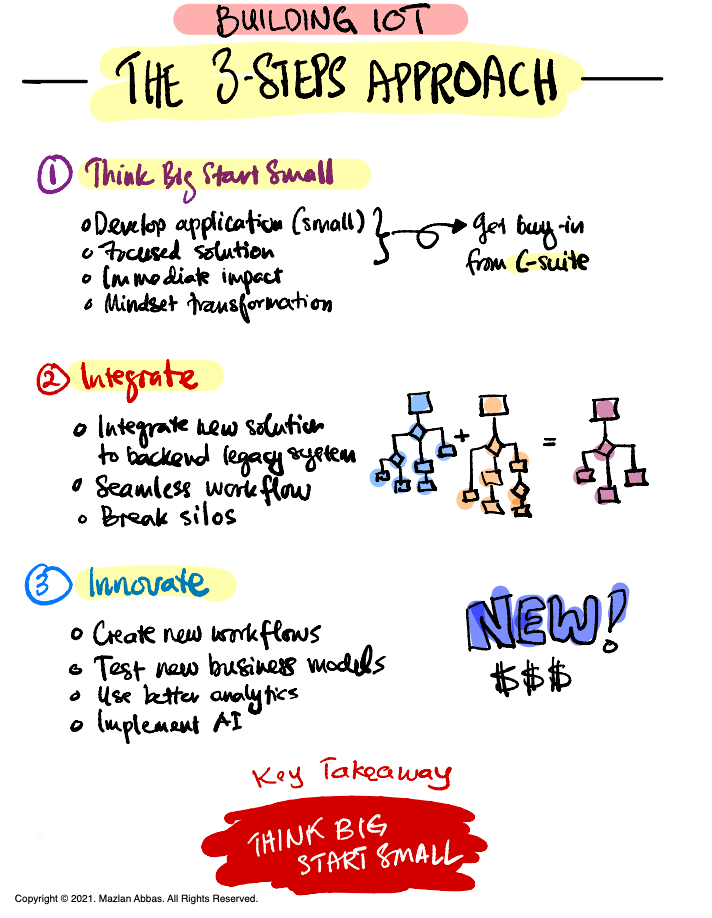
Today, we will explore a simple and practical framework for implementing IoT projects: the 3-Step Approach.

This method ensures a smooth and effective rollout by focusing on small steps, integration, and innovation. Let’s break it down step by step.

Step 1: Think Big, Start Small

The first step is to start with a clear vision (think big) but begin with a small, focused project to gain momentum.

Develop a Small Application: Identify one specific problem and build a targeted solution.

  • Example: A smart thermostat to monitor energy usage in one building rather than an entire campus.

Deliver Immediate Impact: The solution should show quick results to build confidence in IoT’s value.

Mindset Transformation: This small success shifts how people perceive IoT and its potential.

Get Buy-In from Leadership: Demonstrating early results helps secure support from decision-makers like the C-suite executives for future projects.

Step 2: Integrate

Once the initial IoT solution proves its value, it is integrated into the broader system.

Connect to Legacy Systems: Ensure the new IoT solution works seamlessly with existing infrastructure, such as ERP systems or older databases.

  • Example: Integrating smart sensors into a factory’s traditional production line.

Seamless Workflow: Avoid disrupting operations by designing smooth processes between old and new systems.

Break Silos: Encourage collaboration between departments to maximise the benefits of IoT across the organisation.

This step ensures that IoT doesn’t operate in isolation but becomes a part of the larger ecosystem.

Step 3: Innovate

The final step is to use IoT to drive innovation and create new opportunities.

Create New Workflows: Leverage IoT to optimise or redesign how work is done.

  • Example: Using real-time data from IoT sensors to automate maintenance schedules.

Test New Business Models: Experiment with different ways to generate revenue using IoT solutions.

  • Example: Offering predictive maintenance as a subscription service for customers.

Better Analytics and AI: Use advanced analytics and AI to unlock deeper insights from IoT data and automate decision-making.

This stage transforms IoT from a problem-solving tool into a driver for long-term growth and innovation.

Key Takeaway: Think Big, Start Small

The overall lesson is simple:

  1. Start with a big vision, but focus on small, impactful projects to get started.
  2. Build on early successes by integrating solutions into larger systems.
  3. Use IoT to innovate and create new opportunities.

This approach minimises risk, builds momentum, and ensures sustainable growth.


Let’s discuss: What small IoT applications can you think of to start with? How would you scale and integrate them into a more extensive system? Let’s brainstorm together!

[FREE IoT Notes to Download]

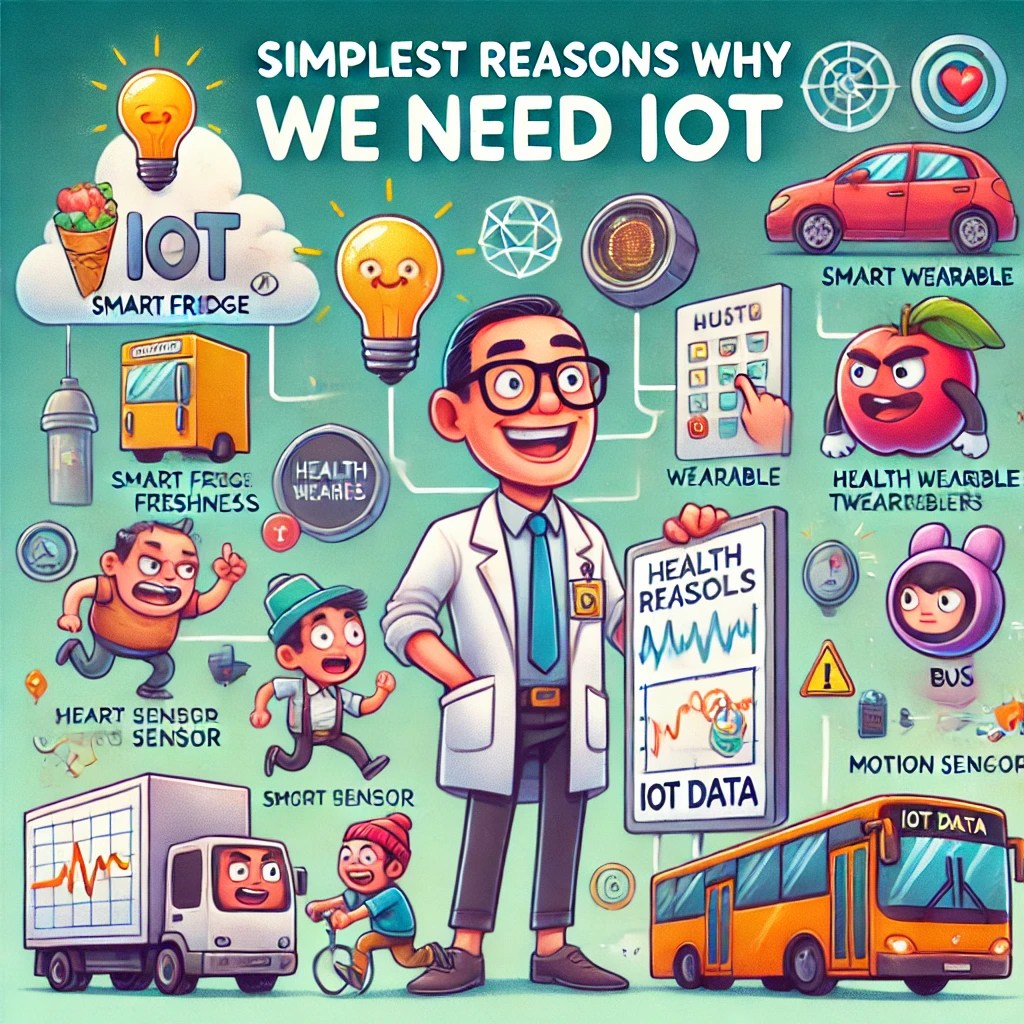
Simplest Reasons Why We Need IoT

Lecture Notes

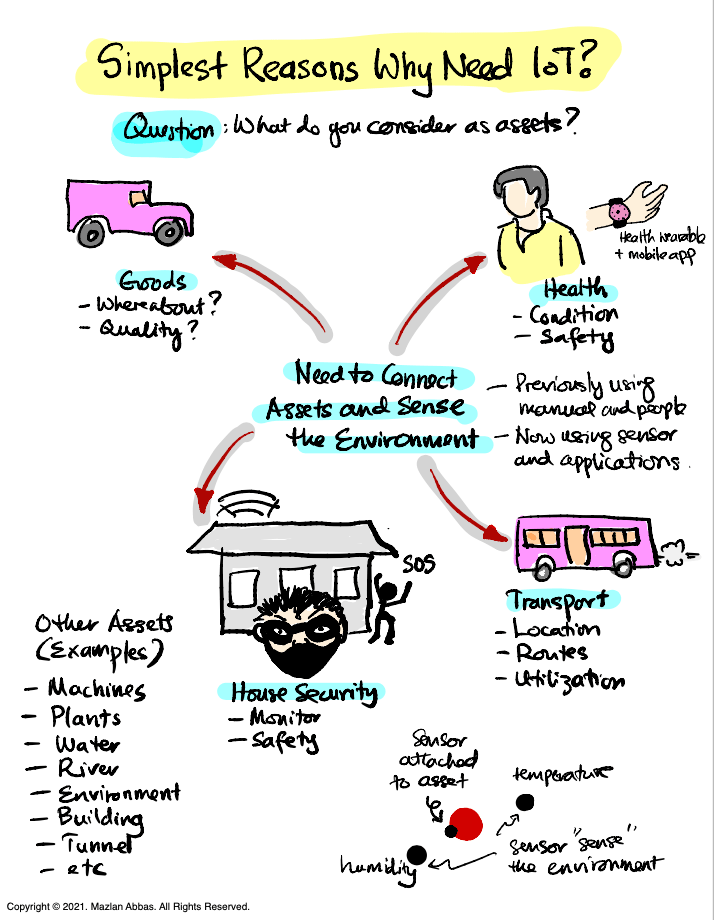
Today, we’ll discuss why the Internet of Things (IoT) is becoming essential in our daily lives.

The diagram simplifies this concept by focusing on assets, how we connect them, and why sensing the environment is so important. Let’s break it down step by step.

1. What Are Assets?

Let’s start with a question: What do you consider as assets?
We value and want to monitor, track, or protect assets. These could include:

Goods:

  • We would like to know their location (e.g., where is my delivery?)
  • Or their quality (e.g., is the food shipment fresh?)

Health:

  • Monitoring our condition and ensuring safety are critical.
  • Example: A health wearable that tracks your heart rate and connects to a mobile app.

Transport:

  • Vehicles and public transportation must be tracked for location, routes, and utilisation.
  • Example: A bus fleet monitored for efficient route planning.

House Security:

  • Ensuring homes are safe by monitoring for intrusions or emergencies.
  • Example: A motion sensor that alerts you if there’s unusual activity.

2. The Core Need: Connecting Assets and Sensing the Environment

Why do we need IoT for these assets?
The key lies in sensing and connecting the environment around these assets.

  • In the past, we relied on manual monitoring and human input.
  • Today, we use sensors and applications to gather real-time data and automate processes.

3. How IoT Works

Sensors: Devices attached to assets to sense environmental factors like temperature or humidity.

  • Example: A sensor measuring the humidity in a storage facility for sensitive goods.

Communication: Sensors send this data to an IoT platform for processing and action.

  • Example: A sensor alerts the homeowner if the temperature inside the house drops below a certain threshold.

4. Examples of Other Assets

IoT can be applied to monitor a wide variety of assets, such as:

  • Machines: For predictive maintenance in factories.
  • Plants: To ensure optimal growth conditions in agriculture.
  • Water and Rivers: These are used to monitor pollution or water levels.
  • Environment: For tracking air quality and weather changes.
  • Buildings and Tunnels: For structural safety and efficiency.

5. Why IoT Is Essential

IoT provides us with the ability to:

  • Monitor assets in real time without human intervention.
  • Ensure safety and quality by automating alerts and responses.
  • Improve efficiency by making data-driven decisions.

Final Thoughts

The most straightforward reason we need IoT is to connect our assets and sense the environment effectively.

By doing so, we make life easier and ensure safety, efficiency, and better decision-making.

Let’s discuss: What assets in your life or work could benefit from IoT? How would you use sensors to improve them? Share your thoughts!

[FREE Download IoT Notes]

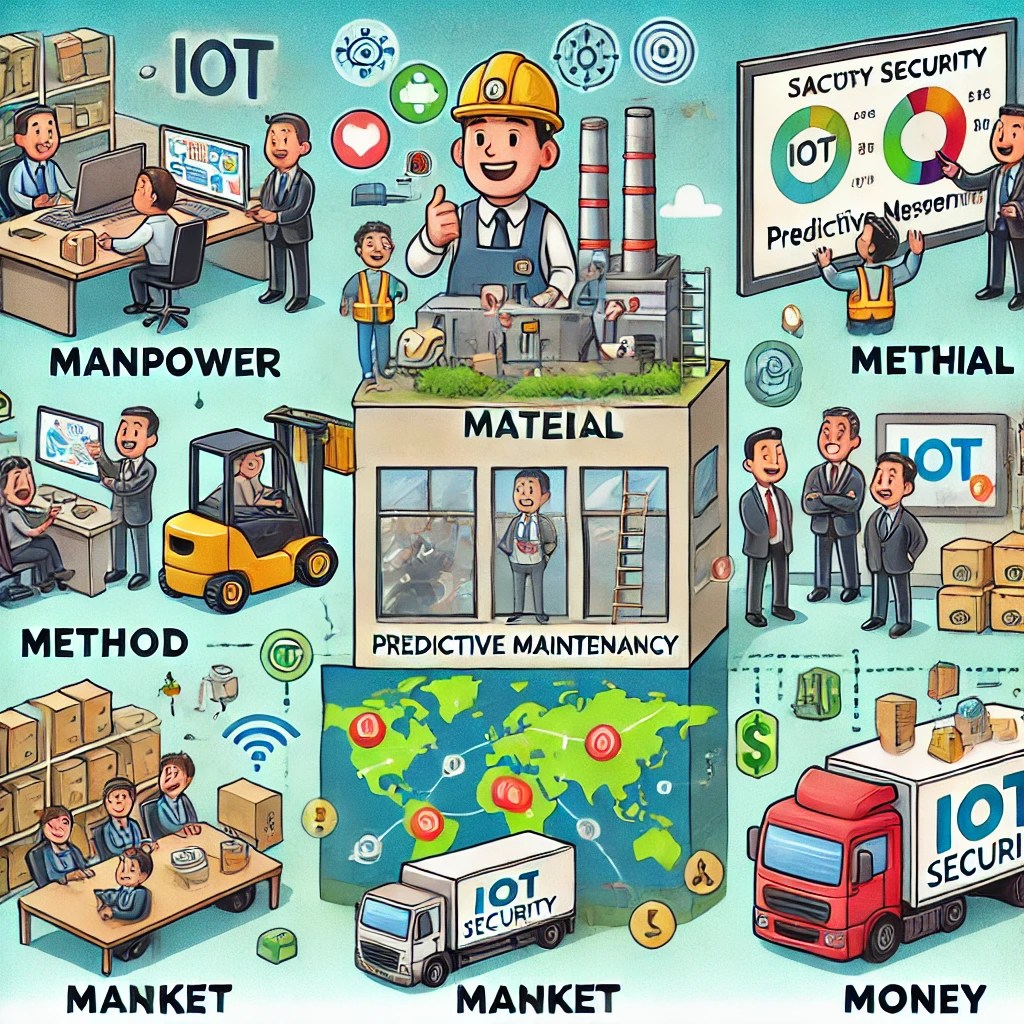
How IoT Impacts the 7 M’s of Business

Today, we’ll explore how the Internet of Things (IoT) transforms the 7 M’s of business — key elements that drive an organisation’s operations and strategy.

These 7 M’s are Manpower, Material, Method, Machine, Market, Money, and Management. Let’s break down each one and see how IoT impacts them.

Based on the eBook — IoT Notes by Mazlan Abbas

1. Manpower

IoT helps businesses optimise human resources by reducing costs, improving safety, and increasing productivity.

Impact of IoT:

  • Cost Reduction: Automating repetitive tasks reduces the need for manual labour.
  • Worker Safety: IoT devices, such as wearables, can monitor health and alert workers to potential hazards.
  • Productivity: By enabling remote work and real-time communication, IoT allows employees to focus on high-value tasks.

Example: A construction company using wearables to monitor worker fatigue and ensure safety.

2. Material

IoT ensures better management of materials, improving supply chain efficiency and reducing waste.

Impact of IoT:

  • Just-In-Time Delivery: Sensors track inventory levels and automatically reorder materials when needed.
  • Asset Condition Monitoring: IoT devices monitor the condition of materials, ensuring quality and preventing spoilage.

Example: A warehouse using IoT sensors to track stock levels and ensure optimal storage conditions.

3. Method

IoT makes business processes more agile and efficient by simplifying methods.

Impact of IoT:

  • Reduce Red Tape: Automating workflows eliminates unnecessary administrative steps.
  • Agility: IoT enables businesses to respond quickly to changing conditions.
  • Efficiency: Processes become faster and more streamlined with IoT integration.

Example: A manufacturing plant automating quality checks with IoT sensors to speed up production.

4. Machine

IoT maximises the performance of machines, ensuring reliability and reducing downtime.

Impact of IoT:

  • Uptime: Predictive maintenance ensures machines are operational when needed.
  • Predictive Maintenance: IoT sensors detect issues before they become critical, preventing failures.
  • Error Reduction: Machines can self-correct or alert operators when errors occur.

Example: A factory using IoT-enabled machinery to monitor performance and schedule maintenance.

5. Market

IoT helps businesses expand into new markets and improve their customer reach.

Impact of IoT:

  • New Market Segments: IoT enables innovative products and services, opening new revenue streams.
  • Global Reach: Businesses can monitor and manage operations worldwide through IoT platforms.

Example: An IoT-enabled home security company entering international markets with smart security systems.

6. Money

IoT creates new revenue opportunities and reduces costs.

Impact of IoT:

  • New Revenue Streams: IoT drives innovation, leading to new services and products.
  • Cost Savings: Automating processes and improving efficiency reduces expenses.

Example: A logistics company saving fuel costs by using IoT to optimise delivery routes.

7. Management

IoT improves decision-making through data-driven insights.

  • Impact of IoT:
  • Data-Driven Decisions: Real-time data helps managers make informed choices.
  • Transparency: IoT provides visibility into all areas of the business.
  • Better Decision-Making: Analytics from IoT systems offer actionable insights.

Example: A retail chain using IoT to monitor sales trends and optimise inventory.

Key Takeaways

IoT has a transformative impact on the 7 M’s of business:

  1. Manpower: Reduces costs and improves safety.
  2. Material: Ensures quality and efficiency.
  3. Method: Simplifies workflows and increases agility.
  4. Machine: Enhances reliability and performance.
  5. Market: Expands opportunities globally.
  6. Money: Generates new revenue and reduces costs.
  7. Management: Improves decisions with real-time insights.

Discussion Question: Which of the 7 M’s most benefits from IoT in your industry? Let’s share ideas and examples!

{You can download the FREE eBook IoT Notes by Mazlan Abbas]