Why Universities Need a Real IoT Lab, Not Just Another Embedded Lab

I still remember a meeting with a group of lecturers, where I asked a simple question.

“Why do we really need an IoT Lab in universities?”

I paused for a moment.
Because deep down, I already knew the answer.

Most universities already have something they proudly call an IoT lab. Rows of ESP32 boards. Arduino kits. LEDs are blinking happily. LCD screens displaying temperature values. Students smile because something lights up.

And yet, something feels incomplete.

This is not IoT. This is just the beginning.

This blog is not meant to criticise universities. I have spent years inside them. I was once a lecturer designing syllabuses, labs, and assessments. This comes from care. From concern. From watching students graduate with confidence in embedded programming but struggle the moment systems become real, connected, and dependent upon.

This reflection is based on a recent lecture I delivered on the need to establish a proper IoT Lab in universities, one that reflects how systems are actually built, deployed, and trusted today.

Embedded Systems Taught Us How to Build Devices

Let me be very clear.

Embedded systems are important. They are foundational.

Students need to learn how to program microcontrollers. They need to understand sensors, actuators, interrupts, memory, and power consumption. All of that matters.

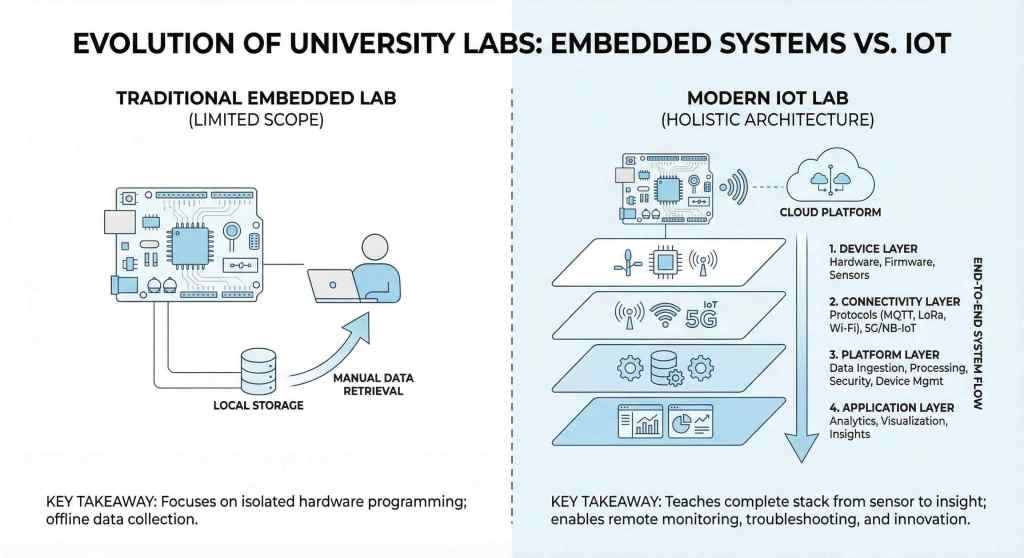
An embedded system is usually a standalone device. It senses something. It controls something. It logs data into local storage.

There is nothing wrong with that.

In fact, embedded systems are still used today in places with no connectivity. Remote areas. Harsh environments. Offline conditions.

But here is the problem.

Once the data is captured, someone has to physically go to the site, connect a laptop, download the data, return with it, and process it manually.

I have seen this happen too many times.

Two technicians. One vehicle. Hours of work. Just to retrieve data that could have been transmitted automatically.

I always ask myself… why are we still doing this in 2026?

Connectivity Changes Everything

The moment a device is connected to the internet, everything changes.

Data no longer waits for humans to come and collect it.
It flows.
It moves.
It becomes alive.

This is the moment embedded systems evolve into the Internet of Things.

Now we can monitor systems remotely.
Now we can detect failures early.
Now we can see battery levels dropping before devices die silently.
Now we can act before complaints arrive.

And yet, most university labs stop just before this moment.

Students are taught how to blink LEDs, but not how to send data reliably.
They learn how to display values, but not how to secure data in transit.
They build devices, but not systems.

And systems are what the real world depends on.

A Real IoT Lab Must Teach Technology Layers

IoT is not a single skill. It is a stack.

In my lecture, I stressed that a proper IoT Lab must expose students to multiple technology layers, not in theory, but through hands-on work.

Layer 1: Hardware and Firmware

This is where universities are already strong.

Sensors. Controllers. Actuators. Firmware logic. Power management.

Students should continue learning this well.

But they must also understand that this is just one layer.

Layer 2: Connectivity and Protocols

This is where gaps start to appear.

Students must learn how data travels.

Wi-Fi. Cellular. LPWAN.
Bluetooth. ZigBee. RFID.
MQTT. CoAP. REST. HTTP.
LoRa. NB-IoT. Sigfox.

Not as a list to memorise.
But as choices with consequences.

Which protocol suits low power?
Which network works for long range?
What happens when connectivity drops?

Without this understanding, troubleshooting becomes guesswork.

Layer 3: Platform and Middleware

This is the heart of IoT.

Devices do not talk directly to dashboards. They talk to platforms.

An IoT platform manages devices.
Authenticates them.
Stores data.
Provides APIs.
Handles scale.

This is where students should learn about device identities, data ingestion, databases, and analytics pipelines.

This is also where they start to understand why platforms like FAVORIOT exist in the first place.

Not to replace learning.
But to enable it.

Layer 4: Analytics and Visualisation

Dashboards are not the end goal.

They are the beginning of understanding.

Students should learn how data evolves from descriptive charts to deeper insights.
They should see patterns.
Spot anomalies.
Ask better questions.

This prepares them for real projects, not demos.

Security Must Exist Across All Layers

Security cannot be an afterthought.

Devices must be authenticated.
Data must be encrypted.
Platforms must be protected.
Applications must be hardened.

Most labs barely touch this.

And yet, this is where real systems fail.

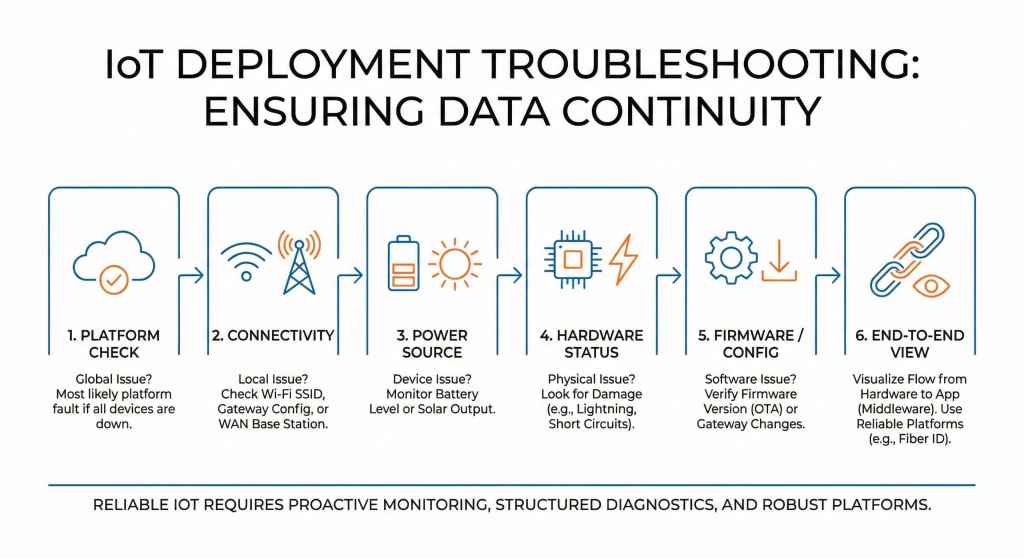
When Systems Break, Knowledge Is Tested

I often tell students this.

The real test of IoT knowledge is not when everything works.

It is when something breaks.

Data stops arriving.
Dashboards go blank.
Alerts do not trigger.

At that moment, students panic if they only know how to code LEDs.

But students who understand layers start asking better questions.

Is it the device?
Is it the network?
Is it the platform?
Is it the visualisation?

This is the mindset a real IoT Lab must build.

Research, AI, and the Future of IoT Labs

Universities are not just about projects. They are about research.

To do meaningful research, students need data. Lots of it. Clean data. Continuous data.

IoT Labs enable this.

Once data flows reliably, students can apply machine learning.
They can explore pattern recognition.
They can experiment with predictive models.

Today, this also means understanding edge AI.

Inference running on devices.
Decisions made locally.
Latency reduced.
Systems are becoming smarter as they operate.

This is where IoT Labs naturally evolve into AIoT Labs.

And this is where universities must go.

This Is a Call to Universities, Lecturers, and Policymakers

If we want graduates who can build real systems, not just academic projects, we must change how we teach IoT.

IoT Labs must move beyond embedded programming.
They must teach architecture, trade-offs, and responsibility.
They must reflect how systems are deployed outside campus walls.

I believe universities can do this.
I believe lecturers want this.
I believe students deserve this.

But it requires intention.

It requires investment.
It requires collaboration with the industry.
It requires courage to redesign labs that have been unchanged for years.

If you are a lecturer, start asking what your lab is missing.
If you are a dean, ask whether your graduates can troubleshoot real systems.
If you are a policymaker, ask whether our talent pipeline matches national ambitions.

And if you are a student reading this, ask yourself one question.

Am I learning how to build a device… or how to build a system people can trust?

I would love to hear your thoughts, experiences, and struggles in building or teaching IoT.
Drop a comment. Let’s talk.

Building IoT Alone vs Building Together: Why Local Platforms Change Everything

I want to share something that has been sitting heavily in my heart for a while.

Every time I speak to engineers, lecturers, startups, or research teams, I ask a simple question.

“What IoT platform are you using?”

The answers came quickly.

From abroad.
From overseas.
From a big global brand.
Or… “We built our own server.”

I nodded. I smiled. But inside, something felt heavy.

Why are we still doing this to ourselves?
Why do we keep believing the best tools must come from somewhere else?

That moment stayed with me long after the talk ended

We Are Obsessed With Dashboards, But Forget the Foundation

Let me be honest.

Many IoT teams I meet are not obsessed with devices. They are obsessed with dashboards.

Big screens.
Live charts.
Green indicators that say “OK”.

Nothing wrong with that. Dashboards matter. Visibility matters.

But when I dig deeper and ask, “Who do you actually work with behind that platform?”
Silence.

They have never met the platform provider.
Never spoken to an engineer there.
Never sat down to plan a market together.

How do you build something meaningful when you do not even know who is behind the engine?

That is the first quiet weakness nobody talks about.

Depending on a Distant Platform Feels Safe. Until It Isn’t.

Using a foreign platform feels comfortable.

It feels established.
It feels global.
It feels like you are standing on something big.

But distance has a price.

No close collaboration.
No shared story.
No joint effort to help your product grow beyond a pilot.

When something breaks, you open a ticket.
When something stalls, you wait.
When you want to commercialise, you are on your own.

I thought to myself, is this really what building an ecosystem looks like?

Local Platforms Are Not “Second Choice”. They Are Strategic Choices.

This is where my heart always leans forward.

When a university, a startup, or a solution provider works with a local IoT platform like Favoriot, something changes.

You do not just get software.

You get people.
You get conversations.
You get arguments on whiteboards.
You get someone who cares because your success is their success, too.

We can sit together.
We can shape the solution together.
We can plan how it reaches the market together.

That closeness is not a luxury. It is a multiplier.

Cross-Marketing Is Not a Buzzword. It Is Survival.

Let me put this simply.

Your market is never big enough on its own.
Neither is mine.

But when we walk into each other’s markets together, something opens up.

Your customers see us.
Our users see you.
Stories start travelling.

If a project uses our platform, we talk about it.
We highlight it.
We share it across our channels.

And no, this is not charity.

It is shared growth.

I remember thinking, why should every company shout alone when we can amplify each other’s voices?

Bundling Is About Completing the Story, Not Selling More Stuff

Here is another truth most people avoid.

Almost nobody builds everything themselves.

You may focus on air quality.
But your hardware comes from overseas.
Your connectivity comes from someone else.
Your cloud might sit on Azure or AWS.

That is normal.

What matters is how these pieces come together for the customer.

A single product often feels incomplete.
A bundled solution feels finished.

Your sensor plus our platform.
Your analytics plus our alerts.
Your service plus our visibility.

The customer does not want components.
They want relief.
They want clarity.
They want answers.

Bundling is not about pushing more.
It is about removing friction.

Ego Is the Silent Killer of IoT Ecosystems

This is the part that makes people uncomfortable.

Ego.

The belief that “we can do everything ourselves.”
The fear that collaboration means losing control.
The worry that sharing space means shrinking your brand.

I have seen this mindset slow down brilliant teams.

I told myself, collaboration is not surrender.

Working with partners does not make you smaller.
It makes you reachable.

It gives you angles you cannot create on your own.

Universities, Startups, Platforms. We Need Each Other.

Universities have ideas.
Startups have hunger.
Platforms have structure.

Separately, we struggle.
Together, we move.

When a university builds a project on a local platform, that project does not end as a report.
It becomes a case study.
A reference.
A stepping stone to something real.

When a startup launches on a local platform, it does not just deploy.
They learn how to sell.
How to explain value.
How to survive their first customers.

I often whisper to myself, this is how ecosystems are supposed to feel.

Why This Matters More Than Ever

We talk about national capability.
We talk about digital sovereignty.
We talk about nurturing local champions.

But these words mean nothing if we keep outsourcing belief.

Supporting local platforms is not about patriotism.
It is about practicality.

Local platforms understand local constraints.
Local regulations.
Local customers who call you at 2 a.m.

And when you grow, they grow with you.

A Quiet Invitation

If you are building IoT solutions today, pause for a moment.

Ask yourself:

Who do I actually collaborate with?
Who knows my product beyond a ticket number?
Who will walk with me to the market?

If the answer feels distant, maybe it is time to rethink.

Not to abandon global tools.
But to anchor your growth closer to home.

I believe ecosystems are built by hands that reach out, not by fingers that point outward.

Let us talk.
Let us partner.
Let us bundle, cross-promote, and craft stories that travel beyond dashboards.

Contact Favoriot and let’s build IoT solutions together.

I would love to hear your thoughts.
Share your experience in the comments.

The Story Behind Favoriot – Part 7: The Task of Finding Favoriot’s First 10 Customers

They say the first real breakthrough for any startup is securing ten paying customers. It sounds simple, doesn’t it? Just ten. But the journey to reach that number felt like climbing Mount Everest—without oxygen.

I still remember the day we got our first paid Favoriot subscription. The notification popped up, and I felt a rush of disbelief. “We did it!” I shouted loud enough to startle a few birds outside the window. My team and I were ecstatic, high-fiving like we’d just won a championship. For a moment, it felt like the floodgates had opened.

But reality had other plans.

Why Is It So Difficult?

Late at night, I found myself lost in thought, asking the universe, “Why is it so hard?” Was our product not good enough? Did it fail to solve real problems? Was our pricing scaring people off? My brain became a broken record, playing these questions on a loop.

We tweaked the product, experimented with pricing models, and added new features. “This has to work,” I thought after every adjustment. But the results? Meh. Crickets.

Then, I started comparing Favoriot with other platforms like ThingSpeak and Blynk. “Why do they have so many users?” We even offered free subscriptions, thinking it would open the floodgates. However, only about 5% of free users converted to paid plans. While that conversion rate wasn’t terrible, it wouldn’t pay the bills either.

A New Strategy

“Maybe we’re looking at this all wrong,” I wondered during our team meetings. That’s when it hit me—what if we bundled Favoriot with something people already wanted?

So, we paired the Favoriot platform with our IoT courses. “Let’s give them value beyond just the platform,” I suggested. And guess what? It worked. Slowly but surely, interest grew. We weren’t just selling software anymore; we offered a learning journey.

But we didn’t stop there. We introduced the Enterprise Favoriot IoT platform with a perpetual license. This was a game-changer. System Integrators loved owning the platform outright without worrying about subscription renewals.

“This feels right,” I thought, cautiously optimistic. And for once, my optimism paid off.

Lessons Learned

This rollercoaster taught me a few things:

  1. Getting the first 10 customers is brutal. It’s like trying to push a car uphill with flat tyres. But every small win counts. “Celebrate the little victories,” I always tell my team.
  2. A great product isn’t enough. You can build the most advanced platform in the world, but if it doesn’t solve a real problem, it’s just digital clutter. “Understand your customers’ pain points,” I remind myself daily.
  3. Pricing is tricky. Too high, and you scare people off. Too low, and you undervalue your product. It’s a balancing act—like seasoning a dish just right.

Moving Forward

With the new Enterprise Favoriot IoT package, our confidence grew. “This is just the beginning,” I told my team. We’d faced countless challenges, but each one taught us something valuable.

Success doesn’t show up overnight with a bow on top. It demands persistence, creativity, and a healthy dose of stubbornness. We’ll keep refining, learning, and evolving. Because that’s what startups do—we adapt.

Hopes for the Future

When I reflect on our journey, pride wells up. “We didn’t give up,” I whisper to myself during quiet moments. Our story is far from over. In fact, it’s just getting interesting.

I dream of Favoriot becoming a leading IoT platform in Malaysia and globally. And I believe we’ll get there—not through luck, but through relentless effort and the unwavering support of people who believe in us.

To everyone who’s been part of our journey—thank you. “Without your support, we wouldn’t be here,” I say from the bottom of my heart.

Favoriot’s story is one of grit, growth, and endless possibilities.

More Entrepreneurship Stories

  1. The Story Behind Favoriot – Part 6: Expanding The Business Models
  2. The Story Behind Favoriot – Part 5: Finding the Right Fit
  3. The Story Behind Favoriot – Part 4: How Favoriot Became More Than Just an IoT Platform
  4. The Story Behind Favoriot – Part 3: Why No One Wanted Our IoT Platform—And How We Turned It Around
  5. The Story Behind Favoriot – Part 2: Turning Failures into Milestones
  6. The Story Behind Favoriot – Part I: The Humble Beginnings of Favoriot
  7. Building My Personal Brand: The Stepping Stone to Favoriot’s Success
  8. From Research Lab Critiques to Startup Pitches: My Slide Story
  9. The Illusion of RFPs in the IoT World: Managing Expectations as a Startup
  10. Favoriot’s Odyssey: Navigating the Rough Waters of Early Revenue