
A reflection on growth, loneliness, and choosing not to build alone
There are moments when I catch myself repeating the same message, again and again, to different audiences.
Students. Founders. Engineers. Startup teams.
And every time, I pause for a second and ask myself quietly, Why does this still matter so much to me?
Then I remember the early days. The long pauses after unanswered emails. The feeling of being technically right, yet institutionally invisible. The realisation that effort alone does not always translate into progress.
That is usually when I say it out loud.
No company grows far on its own.
This piece is not about theory. It is about what I have seen, lived, and learned over the years while working with companies, policymakers, universities, and ecosystems. It is about why industry associations, when done properly, remain one of the most human ways to grow a sector.
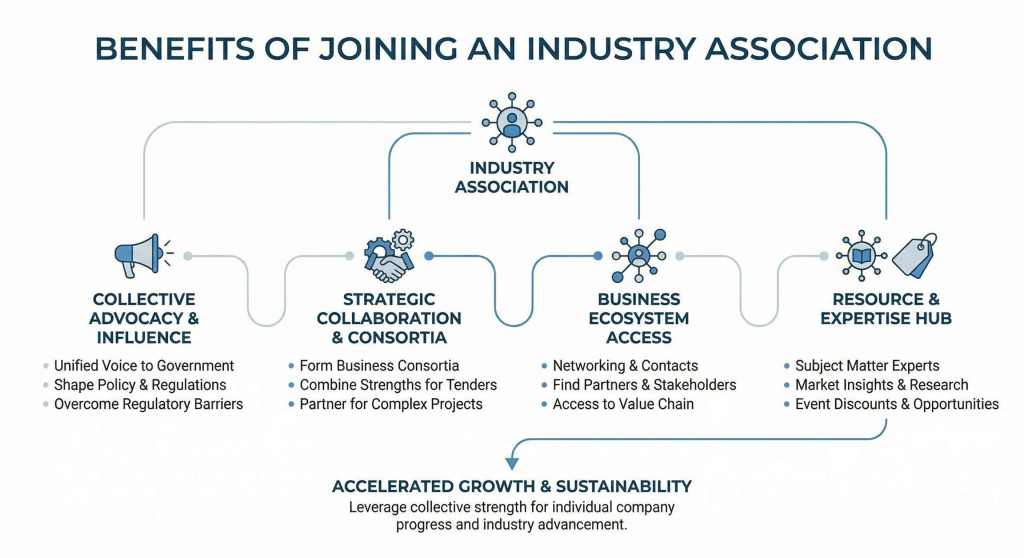
The invisible ceiling of going solo
When you run a company, especially in a regulated or emerging sector, the limits show up sooner than expected.
You feel it when policies are unclear or outdated.
You feel it when rules were written without input from those actually building things.
You feel it when feedback channels exist, but nothing seems to move.
I have watched capable founders hit this ceiling repeatedly.
They write thoughtful letters.
They request meetings.
They try to explain context.
Silence.
Am I wrong? they wonder.
Or am I just too small to be heard?
Most of the time, it is the second.
Public institutions are structured to listen at scale. They are not designed to interpret dozens of fragmented voices. They need consolidation. They need synthesis. They need representation that speaks for more than one balance sheet.
This is where industry associations (like MyIoTA) quietly do their most important work.
A collective voice changes the tone of the conversation
An association does not shout louder. It speaks more clearly.
It gathers input from members with different sizes, strengths, and constraints. It filters emotion from facts. It frames issues in ways that policymakers can engage with responsibly.
Instead of saying, “This is my problem,” the message becomes, “This is what the industry is experiencing.”
That shift matters.
I have seen discussions move from defensive to constructive simply because the message came from an association rather than an individual company.
Not because the idea changed, but because the context did.
Business does not scale on capability alone
Let us talk about the part founders understand best.
Business.
In technology fields like IoT, no single organisation holds all the pieces. One is strong in devices. Another in platforms. Another in deployment. Another in funding and compliance.
Yet customers and tenders often expect a complete answer.
This gap creates frustration.
Small companies feel locked out.
Large companies feel stretched thin.
Associations create the space where these gaps can close naturally.
They do not force partnerships. They simply bring people into the same orbit often enough for trust to form.
I have seen partnerships start from casual chats at association events. No pitch decks. No contracts. Just shared pain points and curiosity.
Months later, those same people show up together in proposals.
That is how ecosystems grow. Quietly. Organically.
Partnerships are built long before tenders appear
One thing I often remind younger founders is this.
You cannot rush trust.
Consortia that work are rarely formed under pressure. They are formed over time, through repeated interactions, shared learning, and mutual respect.
Associations make this possible by creating continuity. You see the same faces. You observe who contributes. You learn who listens.
By the time an opportunity arrives, relationships already exist. There is no scrambling. No forced alignment.
Just readiness.
The underestimated value of presence
Some benefits of associations look small on paper.
Discounted exhibition rates.
Shared booths.
Collective branding.
But for growing companies, these matters are more than they appear.
Beyond cost savings, associations provide presence. They place members in rooms where conversations shape direction, not just execution.
Closed-door briefings. Industry dialogues. Stakeholder meetings.
Being present does not guarantee opportunity. But absence almost guarantees irrelevance.
Associations as connectors, not owners
One role I deeply respect is that of associations, which connect worlds that often struggle to meet.
Industry and universities.
Students and practitioners.
Researchers and real problems.
Universities need access to industry for research, surveys, and placements. Companies need talent that understands reality, not just textbooks.
Associations act as the bridge.
They lower the friction. They create trust. They shorten the distance between ideas and application.
Over time, students gain exposure. Companies gain insight. Research gains relevance.
Everyone benefits, without ownership being forced on anyone.
Leadership defines credibility
This part is uncomfortable, but necessary.
Associations are only as strong as the people leading them.
Titles do not build trust. Actions do.
Members quickly sense whether leaders are serving the sector or just their own organisations. Engagement follows honesty.
Through my work with the Malaysia IoT Association, I have learned that leadership in associations is not about visibility alone.
It is about consistency. Listening. Following through.
When leaders treat the role as stewardship, not status, members respond.
Sustainability without losing soul
Associations need money to function. That is reality.
Membership fees, events, and partnerships all play a role. The challenge is remembering why the association exists in the first place.
The moment it behaves like a profit-first entity, trust erodes.
Members are not customers. They are contributors.
They stay not because of perks, but because they feel movement. They see effort. They feel represented.
What I wish more founders realised earlier
I often hear this sentence.
“I will join when I am ready.”
Usually, that means bigger. More stable. Less busy.
But associations are not emergency services. They are growth environments.
They work best when you grow alongside them, not when you only show up during difficulty.
A few grounded thoughts if you are thinking of joining
Let me leave you with some practical reflections.
Join with curiosity, not expectation.
Participation creates value faster than observation.
Contribute before you ask.
Ecosystems reward generosity in strange but real ways.
Pay attention to leadership.
Active leaders signal healthy associations.
Think long term.
Relationships compound quietly over time.
Remember the purpose.
Associations exist to lift industries, not egos.
We were never meant to build alone
Every time I reflect on this topic, I come back to the same conclusion.
Growth is easier when shared.
Progress is faster when voices unite.
Resilience is stronger when support exists.
We like to celebrate lone heroes. But industries are built by communities.
If you have been part of an association, whether it helped you or disappointed you, I would genuinely like to hear your story. Share your experience in the comments. That is where better ecosystems begin.
Discover more from Dr. Mazlan Abbas
Subscribe to get the latest posts sent to your email.

 Dr. Mazlan Abbas