
There was a moment some time ago when I paused in the middle of a talk and looked around the room. Not because I forgot my slides. Not because I lost my train of thought.
But because something heavier crossed my mind.
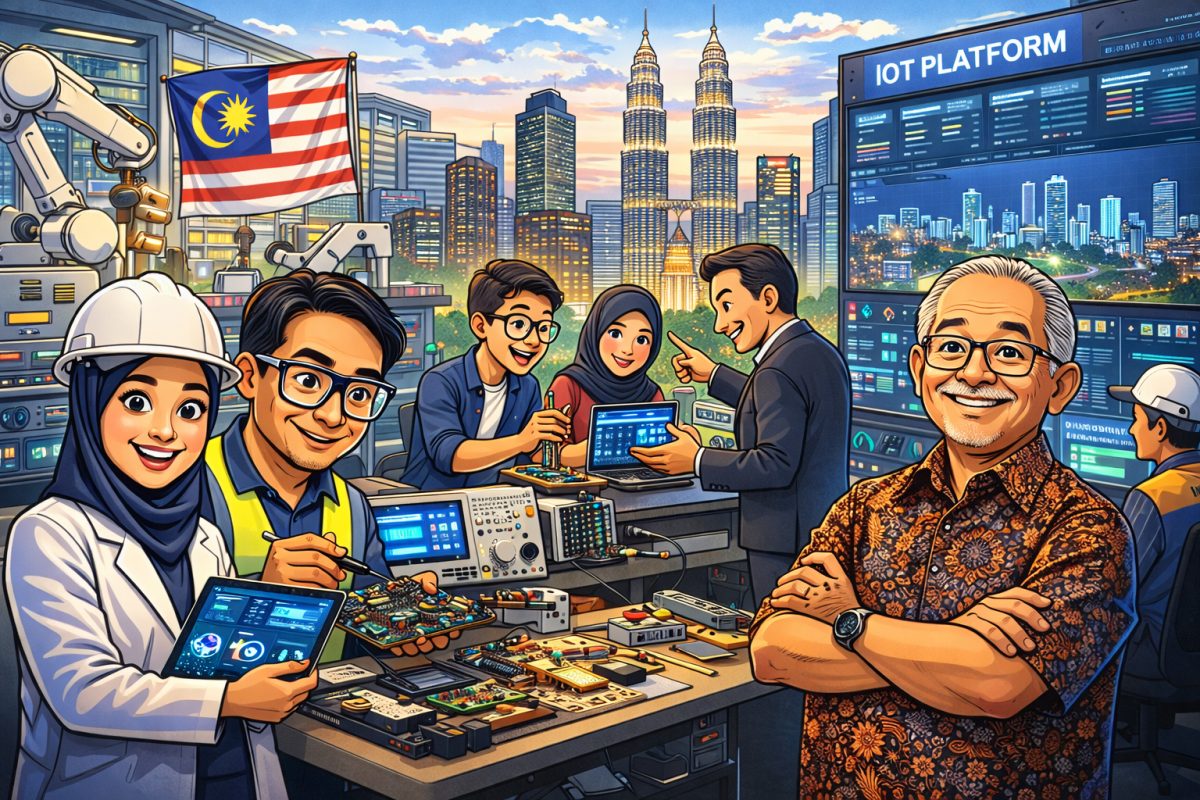
I was surrounded by capable people. Young engineers. Curious technologists. Lecturers who cared. Students who wanted to build something meaningful.
And a question whispered quietly in my head.
What kind of future are we actually preparing them for?
That question refuses to leave me. It follows me into meetings, classrooms, and late-night reflections. It comes back whenever I see another imported system being installed, another local prototype ignored, another talented graduate settling for work that barely scratches their potential.
This is not about blaming anyone.
This is about being honest with ourselves.
The comfort trap we rarely talk about
Let me say this plainly.
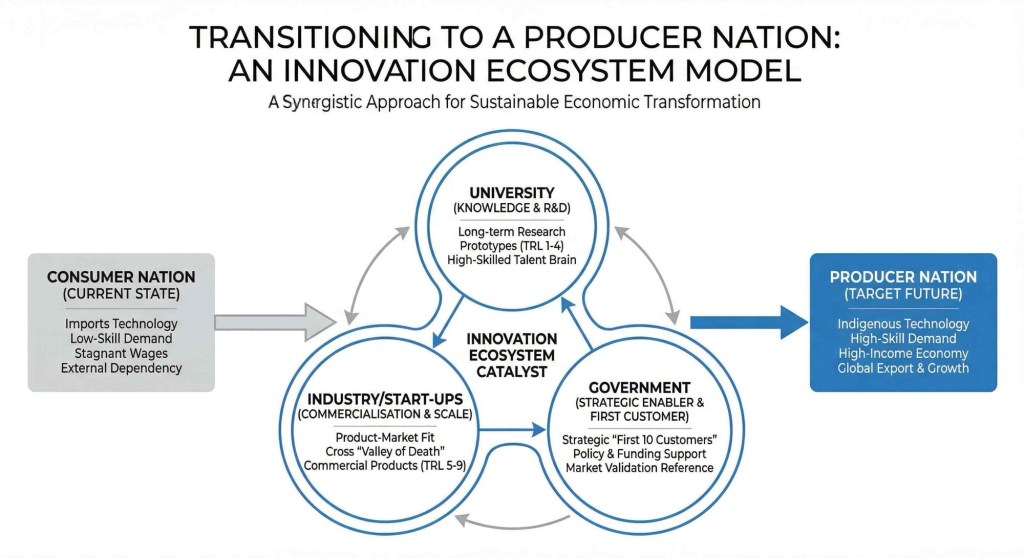
Being a consumer nation feels safe.
You buy what already works.
You rely on someone else’s research.
You avoid the pain of early failure.
There is no embarrassment in using technology built elsewhere. We all do it. I do it too. The problem begins when using becomes the end of the story.
When a country only consumes, it slowly forgets how to create.
Companies no longer need deep technical teams.
Jobs no longer demand strong problem solvers.
Graduates are hired, but not challenged.
And when skills are not demanded, they are not rewarded.
I have watched this cycle quietly repeat itself.
Low demand for advanced skills leads to low salaries.
Low salaries keep household income stuck.
And national ambition stays trapped in speeches instead of results.
I often ask myself, what is the point of producing bright graduates if the economy only needs users?
What changes when a nation chooses to build
A producer nation changes the conversation entirely.
Instead of asking, “What can we buy faster?”
It asks, “What can we build better?”
The moment local companies start developing their own products, something shifts inside the system.
Skills suddenly matter.
Experience becomes valuable.
Talent is no longer replaceable overnight.
Companies compete for people who can design, test, deploy, and maintain real systems. Salaries rise not because someone demands it, but because value is being created on the ground.
This is how strong economies grow. Quietly. Patiently. Through capability, not dependency.
I remind myself often that a producer nation is built by people who are willing to be uncomfortable first.
The painful truth about local innovation
Here is where the story becomes uncomfortable.
Most local startups do not fail because their ideas are bad.
They fail because nobody buys from them early enough.
There is a fragile phase every builder faces.
The search for the first ten customers.
Without those early believers, there is no runway. No learning loop. No chance to improve.
And this is where I sometimes feel uneasy.
We encourage innovation.
We fund research.
We celebrate prototypes.
Yet when it is time to adopt, trust disappears.
I catch myself thinking: why do we support people in building, but hesitate to stand beside them when they are ready?
Without local adoption, many promising efforts fade away. Not loudly. Quietly. One by one.
Universities are not broken. Expectations are.
For years, I have heard the same complaint repeated.
“Universities are not producing commercial products.”
That statement misses the point.
Universities were never meant to be factories.
They are meant to be places where thinking goes deep.
They excel at long-term exploration.
They are strong at building early prototypes.
They train minds, not sales pipelines.
The problem starts when we expect universities to sprint like startups.
I often tell myself, you do not ask a marathon runner to win a 100-meter dash.
When companies bring real, long-term problems to universities, something powerful happens. Research becomes grounded. Students work on issues that matter. And ideas mature with purpose.
The missing bridge between lab and market
There is a wide gap between a working prototype and a product that survives in the field.
Many people underestimate this gap.
A system that works in a lab has not yet faced real users, harsh environments, unreliable networks, or unexpected behaviour. This is where companies must step in.
Universities build understanding.
Companies build resilience.
When they work separately, both struggle.
When they move together, progress accelerates.
This bridge was not built overnight. It takes patience, shared goals, and trust.
Why the first believer matters most
Every global success begins at home.
Before the world trusts you, someone local must.
That is why early adopters matter so much. Especially large organisations and government bodies.
Being the first customer is not charity.
It is leadership.
It gives builders confidence.
It creates reference stories.
It signals belief.
Belief, more than marketing, opens doors beyond borders.
Why I chose to build instead of complain
At some point, reflection was not enough.
I asked myself a harder question.
If I believe in building local capability, what am I personally doing to make it happen?
That question led me to Favoriot.
Favoriot was never about flashy dashboards.
It was about enabling builders.
A place where students move beyond demos.
Where startups test ideas without fear.
Where organisations grow solutions they understand and own.
I wanted a platform that supports responsibility, not just visibility.
A quiet piece of advice I return to often
Do not wait for perfect systems.
Do not wait for perfect policies.
Build anyway.
To students
Choose projects that solve real problems.
To universities
Work with companies that think beyond short grants.
To companies
Invest in local capability, even when it feels slower.
To decision-makers
Adopt local solutions early, not after they succeed elsewhere.
My invitation to you
If you believe our future depends on building, not just buying.
If you believe talent deserves meaningful challenges.
If you believe local solutions deserve real trust.
Then take one step.
Support a local product.
Adopt a local system.
Encourage someone who is trying.
And if you are looking for a place to start building, experimenting, and growing with confidence, explore Favoriot.
Not as software.
But as a choice.
I would love to hear your thoughts.
Are we ready to move from comfort to courage?
Discover more from Dr. Mazlan Abbas
Subscribe to get the latest posts sent to your email.

 Dr. Mazlan Abbas