You’re a Verified Book Author on Medium!

The Blue Badge.

Join the thousands of Verified Book Authors on Medium.

Photo by Fallon Michael on Unsplash

Not a member? Click here to read the full story for free.

When I received the email notification and the blue badge on my profile, I felt I was on top of the world!
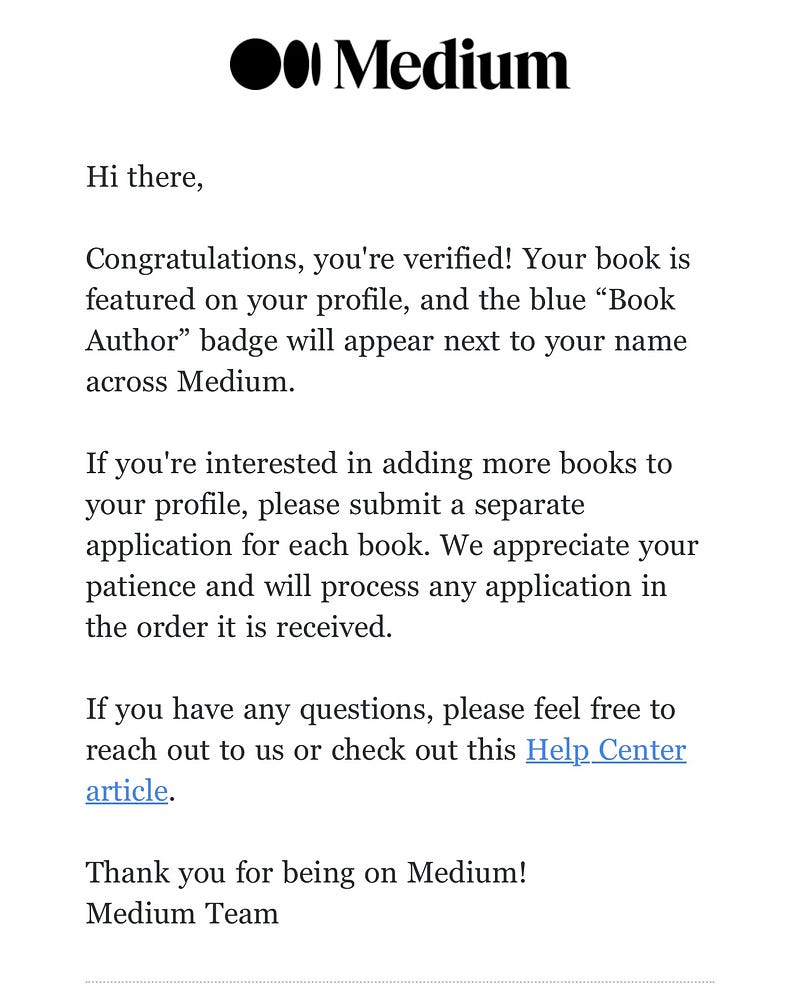
I always wondered what the blue badge was about until I learned it was meant for a verified book author with an ISBN number.

Then, yesterday I decided to submit my application and voila! A day later, Medium emailed the approval!

This is not my latest book; it was an old book that a colleague and I translated into Malay during my academic days in 1997.

Other than writing my Degree, Master’s, and Ph.D. thesis, I wrote several journal papers.

Later, I only focused on building presentation slides due to the nature of my work as an entrepreneur.

Then, I began to blog and write many articles about technology and entrepreneurship.

Only recently, I decided to compile my blog articles and publish them in eBooks below:


Join more than 8,100 subscribers and receive email notifications whenever I publish.

https://mazlanabbas.com/subscribe

A Medium Writer is Like a Badminton Player

Drawing Parallels

The similarities of a Medium Writer and a Badminton Player

Photo by Muktasim Azlan on Unsplash

Not a member? Click here to read the full story for free.

I stumbled upon a metaphor that resonated with me unexpectedly — comparing my writing process to the agility and focus of a badminton player.

While these two disciplines might seem worlds apart, the deeper I delved, the more I realized how intertwined they truly are. They share core elements of finesse, strategy, and tenacity.

Writing Meets Badminton

Every article is like a match,” I often tell myself, contemplating the skills I need to master both on the court and on the page.

Whether it’s the precision of a well-executed drop shot or the impact of a precisely crafted sentence, each requires a deep understanding and constant refinement.

While practicing on a badminton court, players perfect their serves, smashes, and net play.

Similarly, on Medium, I refine my narrative techniques, voice modulation, and thematic clarity.

“Am I engaging the readers as effectively as I aim my shots?”

This question echoes in my mind, pushing me to draw from the player’s playbook: practice, analyze, and enhance.

Engaging the Opponent

As a badminton player who deciphers their opponent’s moves and strategizes accordingly, I find myself in a dance of anticipation and adaptation with my readers.

“Who is my audience today? What do they seek in my words?” Such questions guide my hand, crafting stories that aim to resonate and connect.

A badminton player might surprise their adversary with an unexpected shot; similarly, I aim to captivate my readers with narrative twists or fresh insights.

“It’s about staying a step ahead, isn’t it?” I ponder, recognizing the parallel essence of strategic engagement, whether wielding a racket or a pen.

The Feedback Loop

Reflection and adaptation are as vital to a badminton player as to a writer.

Post-match analyses help players adjust their tactics, like how reader feedback shapes my writing journey.

“What worked? What fell flat?” These reflections are pivotal, fostering a cycle of continuous improvement and deeper connection with my audience.

In both fields, the pursuit of growth is relentless.

“Each critique, each applause, it’s all a stepping stone,” I remind myself, embracing every piece of feedback as an opportunity to evolve, much as a player cherishes their coach’s guidance.

Mental Resilience

The mental parallels between badminton and writing are striking.

Maintaining focus, managing nerves, and overcoming setbacks are challenges that transcend the physical boundaries of the court.

“How do I regroup when my narrative misses the mark or my piece goes unnoticed?” Such moments test my resolve, mirroring a player’s struggle to bounce back after a lost point or game.

In these instances, the fortitude to press on, refine my strategies, and stay committed to my craft defines me, much like it defines a seasoned badminton player.

“Persistence is the game,” I affirm, drawing strength from the athlete’s tenacity.

Celebrating Success — The Joy of Accomplishment

There’s an unmistakable euphoria in clinching a badminton match, just as witnessing my writing resonate with the Medium community.

Whether it’s the thrill of a perfectly landed shot or the satisfaction of a well-received article, these moments are the lifeblood of passion and effort.

“Isn’t this why we endure the grind?” I often reflect, basking in the shared joy of a well-played point or a well-told story.

Recognition and personal fulfillment, whether on the court or Medium, underscore the journey’s worth, fueling the drive to excel and express.


A Symbiotic Journey

Though one may not immediately see the writer in the badminton player or the athlete in the scribe, the parallels between writing on Medium and playing badminton are profound and illuminating.

Both demand a blend of skill, strategic insight, resilience, and the joy of mastering one’s craft.

Embracing the spirit of a badminton player has infused my writing with a new dimension of discipline and passion.

“In every stroke of the keyboard, like every swing of the racket, lies the potential for greatness,” I conclude, inspired to continue my dual pursuit of excellence on the page and the court, guided by the shared ethos of passion, perseverance, and the joy of achievement.


Join more than 8,000 subscribers who receive email whenever Mazlan Abbas publishes.

https://mazlanabbas.com/subscribe

Why Do I View Writing on Medium as Similar to Being a Football Player?

Writer = Footballer

In fact, there are many similarities between both of them.

Photo by Alliance Football Club on Unsplash

“Just as every football player knows that the strength of the team is each individual member, and the strength of each member is the team, every writer on Medium understands that our words gain strength from the community we build and engage with.”

Writing and football might seem worlds apart – one a solitary and reflective activity, the other a dynamic and physical team sport.

However, reflecting on my experiences as a writer on Medium, I inevitably find myself drawing comparisons to the life of a football player.

Let me share my perspective on how crafting articles on this popular platform mirrors the discipline, creativity, and teamwork found in football.

The Training Ground: Honing Skills and Strategy

“Both in football and in writing for Medium, every day is game day, and every publication is a play that demands our best – honing our skills, strategizing our moves, and playing our hearts out in the field of creative expression.”

Every football player knows that success on the field begins with rigorous training off it.

Similarly, as a writer on Medium, I see each piece I write as part of my training.

Just as a footballer drills techniques and strategies, I refine my writing skills – vocabulary, syntax, structure – with every article I publish.

In both arenas, staying informed about the latest trends and strategies is crucial.

A footballer watches matches and learns new tactics; I keep abreast of popular topics and writing styles on Medium.

This ongoing learning process is vital for growth and adaptation, ensuring that we stay relevant and competitive.

The Game Day: Publishing and Performance

Publishing an article on Medium feels akin to a football player stepping onto the pitch on match day.

There’s a mix of excitement and nervousness, knowing that your hard work and practice are about to be put to the test in front of an audience.

In football, players must read the game and adapt to evolving situations.

Similarly, once my article is live on Medium, I monitor its performance – views, reads, and engagement – and respond accordingly.

I might tweak the title, adjust the tags, or promote it on social media, much like how a footballer adjusts their play based on the opponent’s tactics or the game’s flow.

The Team Effort: Community and Collaboration

While writing is often seen as a solitary endeavor, my experience on Medium has been deeply communal, reminiscent of being part of a football team.

On a team, players support one another, celebrate successes, and learn from defeats together.

On Medium, fellow writers and readers form a supportive community where feedback, encouragement, and shared learning flourish.

Collaborations on Medium – be it through responses, highlighting, or joint publications – mirror the cooperative spirit of football, where combining individual strengths leads to greater success.

Just as footballers form alliances on the field, writers on Medium build networks, enhancing each other’s visibility and success.

Overcoming Challenges: Resilience and Adaptation

Both in football and on Medium, setbacks and challenges are inevitable.

A football player might face injuries or poor form, just as a Medium writer encounters writer’s block or fluctuating engagement.

In both cases, resilience is key.

Learning from failures, refining strategies, and persisting despite obstacles are as essential for a Medium writer as for a football player.

Embracing criticism, adapting to change, and maintaining a growth mindset are crucial for long-term success and improvement in both fields.

The Joy of Scoring: Recognition and Reward

“The thrill of scoring on the football field and resonating with readers on Medium share the same core: the joy of making an impact, the exhilaration of shared success, and the sweet reward of recognition for one’s passion and hard work.”

The thrill of scoring a goal in football is unparalleled, offering a sense of achievement and recognition.

Similarly, when an article resonates with readers on Medium, the positive feedback, comments, and applause provide a comparable rush of satisfaction and validation.

Moreover, just as footballers aspire to win championships and earn accolades, successful Medium writers gain recognition through increased readership, Top Writer status, or even monetization opportunities.

These achievements motivate continued effort, creativity, and engagement with the platform.

Final Whistle: Continuous Learning and Passion

“The discipline of a football player and the creativity of a Medium writer merge on the common ground of relentless pursuit – chasing the ball or chasing the word, each stride is fueled by an undying passion to express, engage, and excel

Ultimately, whether playing football or writing on Medium, the journey is one of continuous learning, passion, and growth.

The dedication to improve, the joy found in the process, and the commitment to sharing one’s talents with others are common threads that bind these seemingly disparate activities.


My experience as a writer on Medium resonates deeply with the attributes of a football player.

The discipline, community, adaptability, and pursuit of excellence in both fields underscore the unexpected yet profound parallels between them.

Through this lens, I approach my writing with the same enthusiasm, strategy, and team spirit that I admire in football, striving to make each article a testament to the shared virtues of both passions.

Medium – The Key to Growing as a Writer

Starting My Writing Adventure

Photo by Chris Spiegl on Unsplash

When I began using Medium, it felt like stepping onto a big stage for the first time.

Nervous – no confidence.

English isn’t my first language, so it was tough at first.

Reading other writers and comparing to mine was like earth and heaven.

I wanted to share my thoughts and connect with others through writing, but my early attempts weren’t very good.

My writing lacked depth and didn’t get much attention.

For a long time – Confidence level is low.

Feeling Alone Among Many

At the beginning, my posts on Medium didn’t get much notice.

I felt like I was trying to speak out in a crowded room where no one could hear me.

There were no comments or applause for my work, which made me wonder if anyone would ever notice what I had to say.

Am I going to fail as a writer? I wondered…

Keeping Up the Effort

Despite these challenges, I didn’t give up.

I knew that getting better at writing would take time and effort.

As I kept writing and sharing my articles, I could see myself improving bit by bit.

People start to engage with claps, highlights and leave comments.

Such a welcoming community of writers.

I get excited.

Joining Medium’s Welcoming Community

One of the best things about Medium was becoming part of its community.

I met other writers who were kind and shared their knowledge with me.

Their advice and encouragement helped me improve my writing skills and gain more confidence.

Seeing Real Progress

As I kept writing, more people began to notice and appreciate my work.

I started to get followers and applause, which felt great.

It meant that my writing was getting better and people were enjoying what I had to say.

Learning Valuable Lessons on Medium

Now, I feel much more confident in my writing. Being on Medium has taught me several important things:

  1. Keep Trying: Even when it’s hard, it’s important to keep writing and improving.
  2. Support Matters: The encouragement I got from other Medium users really helped me grow.
  3. Always Learn: Writing is a journey where there’s always something new to learn.

Looking Back at My Journey

Medium has been more than just a place to post my writing.

It’s been a key part of my growth as a writer.

I’ve found my own space in the community and learned a lot from others.

Medium is where I’ve been able to share my thoughts, improve my skills, and connect with readers.

I’m grateful for the experience and excited to keep growing as a writer here.

Create Canva Posters vs Write with AI-Assistance — What’s the Difference?

The Creative Shift

Transforming My Approach to Content Creation

Why can’t I use AI to aid in my writing? Photo from Pexels

Two tools have dramatically reshaped the landscape for people like me — Canva and AI writing aids.

Not too long ago, Photoshop was the go-to for anyone wanting to design anything, but it required a steep learning curve and considerable time investment.

Fast forward to the present, and Canva has become the darling of content marketers, bloggers, educators, and virtually anyone looking to create eye-catching graphics without a degree in design.

On the writing front, AI tools have emerged as a potent ally for non-native English speakers, those less confident in their writing skills, or anyone pressed for time but in need of quality content.

Let me share my thoughts on how these two platforms have changed the game for me, offering empowerment and occasional ethical puzzles.

Canva – Design Democratized

Before Canva, the idea of crafting a professional-looking poster would send me into a mild panic.

My design skills were, let’s say, rudimentary at best.

Canva changed all that.

Intuitive and Inviting

Right off the bat, Canva felt welcoming.

Its drag-and-drop functionality, vast array of templates, and simple interface allowed me to create something visually appealing without prior design knowledge.

Suddenly, I was designing posters, social media graphics, and even branding materials with a newfound sense of confidence and creativity.

Creativity Unleashed

What’s remarkable about Canva is how it levels the playing field.

You don’t need to be an artist or a designer to create beautiful visuals.

The platform provides the tools and inspiration, allowing your ideas to take center stage.

It’s liberating, enabling me to communicate visually in ways I never thought possible.

AI Writing Tools: The Power of Language Unlocked

Moving on to AI writing aids, these tools have been nothing short of revolutionary for me, particularly as someone who doesn’t always easily find the right words.

Enhancing Expression

The AI doesn’t write for me; it writes with me.

I start with my thoughts, however chaotic, and the AI helps me refine them, suggesting better phrasing, correcting grammar, or even proposing new directions for my narrative.

It’s like having a collaborative partner who’s always ready to assist, guide, and improve.

Ethical Considerations

However, with great power comes great responsibility.

Using AI to enhance writing raises questions about authenticity and originality.

Where do my ideas end and the AI’s begin? I’ve come to view it as a tool, much like a thesaurus or an editor.

It enhances my voice without replacing it, ensuring my content remains genuinely mine.

Canva vs. AI: A Comparative Glance

While both Canva and AI writing tools have been game-changers, they serve different facets of content creation.

Here’s how they stack up against each other, in my experience.

User Empowerment

Canva empowers visually, breaking down complex design processes into simple, manageable steps.

AI writing tools empower linguistically, helping articulate thoughts more clearly and persuasively.

Both tools democratize their respective domains but do so in different realms — visual vs. verbal.

Creative Process

With Canva, I’m often inspired by the templates and design elements available, which spark ideas or take my projects in directions I hadn’t anticipated.

In contrast, AI writing feels more linear. It starts with my input and refines it toward a polished outcome.

Canva engages my visual creativity, while AI challenges and enhances my verbal expression.

Learning Curve

Canva’s learning curve is relatively flat, especially for basic tasks.

It’s about selecting, dragging, dropping, and tweaking.

On the other hand, AI writing tools require a deeper understanding of how to interact effectively with the technology, crafting prompts that elicit the best possible output.

Outcome Satisfaction

With Canva, I see the results instantly.

I know when a design clicks because it resonates visually.

With AI writing, the satisfaction is more nuanced, often requiring several iterations to feel “just right.

It’s a more internal, reflective process, where I assess whether the words truly capture what I’m trying to convey.

Embracing the Tools of Today for Tomorrow’s Creations

Ultimately, both Canva and AI writing tools have transformed how I create content.

Canva has given me a visual voice, enabling me to design with confidence and flair.

AI writing aids have sharpened my words, ensuring my message is conveyed clearly and effectively.

While these tools provide incredible support, they also underscore the importance of maintaining a personal touch and authenticity in our creations.

Whether it’s a poster or a piece of prose, the essence of our individuality should always shine through.

Adapting to new technologies can be daunting, but my journey with Canva and AI writing tools has taught me the value of embracing change.

In a world where digital tools are increasingly integral to our creative expressions, being open to learning and adapting is key.

These technologies have the power to transform ordinary ideas into extraordinary creations, and I’m excited to be part of this transformative journey.


You can read this book “Canva: Professional Tips and Tricks When You Design with Canva (Step by Step Canva Guide for Work or Business with Pictures)” to design better pictures.

My perspectives about AI:

View at Medium.comView at Medium.comView at Medium.com


View at Medium.com

The Hard Lessons When Having a Drastic Niche Shift on Medium

The Art of Engagement

Rebuilding a Community Around New Passions

Photo by Alexander Mils on Unsplash

The Unexpected Turn of March

March arrived with its usual unpredictability, but this time, it had a few extra tricks up its sleeve.

As I tried to reshape my content creation focus toward travelogue and poetry, the thrill of embarking on a new adventure was palpable.

Little did I know, this transition would serve up some unexpected lessons in content engagement and audience dynamics.

Why March Became a Desert in My Content Oasis

My previous content, centered on Medium insights and earnings, resonated well with my audience, creating a reliable stream of engagement and income.

The shift to travelogues and poetry, driven by a desire for fresh creativity and exploration, was a stark departure from the norm.

This new direction, while exciting for me, didn’t strike the same chord with my established audience, leading to a notable dip in engagement and earnings.

Understanding Audience Disengagement

The decision to leap into new thematic territories was met with silence and dwindling numbers.

It became clear that the audience I had cultivated was more attuned to my analytical pieces on Medium and earnings rather than the artistic nuance of travel tales or the rhythmic beauty of poetry.

The stark decrease in interaction was a loud and clear message: my audience’s preferences were not aligning with my new content direction.

Embracing Change and Community Engagement

Recognizing the disconnect, I acknowledged the necessity of fostering a new community aligned with my current interests.

Engaging with fellow travel and poetry enthusiasts became my new focus, marking the beginning of planting seeds in a garden I hoped would flourish.

Through active participation, sharing, and interaction within these new niches, I aimed to cultivate a dedicated audience who shared my passion for these genres.

Growth and Optimism Ahead

Despite the challenges, the latter part of March showed glimmers of engagement, suggesting that with persistence and genuine interaction, growth is possible.

While the journey through March was more humbling than celebratory, it underscored the value of adaptability and perseverance in content creation.

Lessons Learned and the Path Forward

This experience taught me that change, while necessary for growth, comes with its own set of challenges.

Audience engagement is not just about content creation but also about nurturing a community that resonates with your message.

As I look to the future, I remain committed to my new path, knowing that with time, effort, and engagement, I can rebuild a connected and supportive audience base.


In conclusion, March was a month of unexpected lessons and reflection, reminding me that the journey of content creation is ever-evolving.

Despite the initial setbacks, the experience has only fueled my resolve to pursue my passions and foster a community that shares them.


Why do some writers and creators become known for a term, a phrase, or even an entire category, while others (talented as they might be) fade away?

To write within your niche, check this Audible Audiobook from Amazon “Become Known for a Niche You Own: Why Legendary Writers Use Languaging to Design New & Different Categories”.


https://mazlanabbas.com/subscribe

3 Things Why This Article Gained the Highest Traction

Writing with Impact

My Blueprint for Writing That Wins Hearts and Minds

Wanna learn the top three things? Photo from Pexel.

As we enter the month of March 2024, I find myself reflecting on the past year with a mix of emotions.

Writing has always been my passion, a way to express my thoughts, share knowledge, and connect with others.

Yet, as I perused my analytics from 2023, I couldn’t help but feel a pang of disappointment.

Despite pouring my heart and soul into over a hundred articles, the majority barely made a ripple in the vast ocean of digital content.

It was disheartening, to say the least.

But I’m not one to wallow in self-pity. Instead, I see this as a valuable learning opportunity, a chance to pivot and evolve.

So, I took a deep dive into what went wrong and emerged with insights that I believe not only transformed my approach to writing but also resonated with a wider audience, catapulting this article “Avoid These 10 Mistakes and Become a Better Writer in 2024” to the pinnacle of success on Medium.

View at Medium.com

1 — Emotional Resonance – The Heartbeat of Connection

The first revelation struck me like a bolt of lightning!

My writing lacked emotional depth.

In my quest to disseminate knowledge, I had neglected the human element, the very essence that transforms mere words into experiences that resonate with readers. I realized that people crave connections, not just information.

They want to feel understood, inspired, and moved.

In 2024, I vowed to inject my genuine emotions into every piece, sharing not just my thoughts but my feelings, hopes, and fears.

This vulnerability was terrifying at first, but it became my strength, drawing readers in and fostering a deeper connection that transcended the screen.

2 — Solving Problems — The Bridge to Relevance

My second epiphany was about relevance.

Previously, my articles were more like lectures, brimming with information but lacking practical application.

I needed to address real-life problems, offer solutions, and provide value that extended beyond mere knowledge sharing.

Thus, I shifted my focus to problem-solving.

Whether it was offering writing tips, life hacks, or industry insights, each article aimed to make a tangible difference in the readers’ lives.

This not only increased engagement but also established my credibility as a go-to source for practical advice and insights.

3 — Engagement and SEO — The Dual Engines of Visibility

Lastly, I recognized the critical role of engagement and search engine optimization (SEO) in expanding my reach.

No matter how profound my articles were, they were doomed to obscurity without effective promotion and visibility.

I honed my skills in crafting compelling headlines, optimizing content for search engines, and actively engaging with my readers and fellow writers.

These efforts paid off, amplifying my voice in the crowded digital landscape and attracting a broader audience to my work.


The Ripple Effect

The culmination of these efforts was an article that struck a chord with many, addressing common writing pitfalls while offering actionable advice and emotional resonance.

It was this blend of practicality, vulnerability, and strategic promotion that resonated with readers and drove the article to achieve unprecedented success on Medium.

Embracing the Journey

As I reflect on this transformative journey, I am filled with gratitude.

The challenges of 2023 have paved the way for growth and success in 2024.

I’ve learned that writing is not just about sharing what we know but about connecting, solving problems, and continuously adapting to the ever-changing digital landscape.

I share these insights not as definitive answers but as waypoints on our collective journey of growth and discovery.

Let us continue to learn, adapt, and support each other, for the world of writing is vast and filled with endless possibilities.


The path to becoming a better writer is ongoing and multifaceted.

It involves deepening emotional connections, providing tangible solutions, optimizing visibility, and above all, embracing the lessons learned along the way.

As we move forward, let us do so with open hearts and minds, ready to write our way into a brighter, more connected future.


Top articles since Day 1:

View at Medium.comView at Medium.comView at Medium.com


View at Medium.com

Why I Chose Medium Over WordPress (And Why You Should Too If You Are a Writer)

Reasons to Migrate from WordPress

Reflection on Community, Monetization, and User Experience

Photo by Andrew Neel on Unsplash

“In the world of blogging, finding the right platform is like finding your voice: once you do, everything else falls into place.”

After a decade of blogging, from the early days on Blogspot to a significant tenure on WordPress, I made a strategic pivot to Medium about four months ago.

Despite being a member for over five years, it was only recently that I became an active contributor.

The transition wasn’t spontaneous but the result of careful consideration and an acknowledgment of what Medium uniquely offers.

In this narrative, I’ll share my journey, highlighting why Medium’s vibrant community, monetization model, and user-friendly interface convinced me to call it my new digital home.

A Sense of Belonging

Blogging, at its core, is about connection.

It’s about sharing your voice and, in return, engaging with the feedback and perspectives of others.

On platforms like Blogspot and WordPress, while I had a voice, it often felt like I was speaking into the void.

The interactions were sporadic, and the sense of community was tenuous.

Medium changed that.

Here, the community is not just active but also encouraging and responsive.

Every comment, every clap feels like an affirmation that what I share resonates with others.

This interaction isn’t superficial; it’s meaningful engagement that fosters growth and learning for both the reader and the writer.

The acknowledgment from the community isn’t just gratifying; it’s motivating, pushing me to hone my craft further.

Monetization – A Rewarding Endeavor

For years, I blogged out of passion without any monetary gain.

On WordPress, despite the effort and time invested, financial rewards were non-existent.

It’s not that monetization was my primary motive, but the lack of it was certainly demotivating over time.

Medium introduced me to a new possibility: earning from my writing.

You can learn from this book “How to Find Success on Medium.com: 100 Tips & Strategies to Make a Profit with Your Writing

The platform’s monetization model, which rewards writers based on the engagement their work receives, was a game-changer for me.

Witnessing earnings from my articles for the first time was exhilarating.

It validated my efforts in a tangible way and transformed writing from a mere hobby to a potential source of income.

This shift not only boosted my motivation but also affirmed the value of my work.

Simplicity and Accessibility

Before Medium, my blogging journey was marked by a constant battle with the technicalities of website management.

WordPress, despite its robustness, required me to navigate through a labyrinth of plugins and design complexities.

The focus was often diverted from writing to managing the website.

Medium’s allure lies in its simplicity.

The editor is intuitive, emphasizing content over form. It eliminates the distractions of complex website management, allowing me to focus on what truly matters: writing.

The platform’s design ethos – centered on readability and user engagement – translates seamlessly to its mobile app, which I frequently use to write and publish my posts.

This accessibility has made it easier for me to maintain a consistent writing schedule, irrespective of where I am.

Summarizing Lessons Learned:

  1. Community Matters: The engagement and support of a community can significantly enhance the blogging experience. It not only provides motivation but also offers valuable feedback that can help improve your writing.
  2. Monetization Can Be Motivating: While writing is often a labor of love, monetary rewards can validate your efforts and provide additional motivation to continue crafting your work.
  3. Simplicity Enhances Productivity: A user-friendly platform can streamline the writing process, removing technical barriers and allowing you to concentrate on creating compelling content.

“Choosing Medium is choosing to be part of a narrative that values depth, engagement, and authenticity in every word.”

My move to Medium was driven by a desire for deeper engagement, potential monetization, and a more user-friendly writing environment.

These factors have profoundly impacted my blogging journey, making it more fulfilling and rewarding.

As I continue to explore the possibilities within this vibrant community, I am excited about the growth and opportunities that lie ahead.


Check out my other Blog-related articles:


Echoes From The Silent Stars – A Poem

Photo by Greg Rakozy on Unsplash

In the heart of youth, where dreams ignite,

Beneath the stars’ ever-watchful light,

Eyes cast upwards, full of wonder,

Tiny souls with dreams asunder.

Gazing at the mountains, vast and steep,

Promising a climb that’s far from cheap,

By the seas, they stand, eyes wide,

Dreaming of a victorious tide.

With ambition sown in tender minds,

Through the maze of time, each wanders and finds,

Failures aplenty on this quest for worth,

Testing the mettle that they bring forth.

Photo by Johannes Plenio on Unsplash

Many a night, their spirits wane,

Under the weight of recurring pain,

Yet within their hearts, a flame persists,

Urging them to climb through mists.

Dawn breaks, and with it, new resolve,

Determined now their dreams to solve,

With grit and grace, they rise and strive,

In their pursuit, they feel alive.

Years pass, and struggles take their toll,

Yet what emerges is a steadfast soul,

With every fall, they’ve risen again,

Learning, growing, through each pain.

Photo by Dipqi Ghozali on Unsplash

One day awakens, bright and clear,

Filled with a power, devoid of fear,

They step forth, their essence revived,

To grasp the success for which they’ve strived.

Now, among peers, they stand tall,

Their youthful dreams realized, after all,

Scaling heights once deemed too steep,

Conquering seas, vast and deep.

Their journey, marked by steadfast hope,

Shows others on the brink how to cope,

For in each heart that dares to dream,

Lies the potential to redeem.

Photo by Rad Pozniakov on Unsplash

So let the youth gaze at the stars,

And dream of healing old scars,

For within them lies the power so grand,

To hold the future in their hand.

In their ambition, let them find,

The strength to be resilient, kind,

For they are the ones who’ll shape our tales,

Sailing forth with wind-filled sails.

In every child who dreams tonight,

Lies a future oh so bright,

For within their hearts, pure and true,

Resides the power to renew.

So here’s to the youth, with eyes aglow,

May their ambitions flourish and grow,

For within their dreams, as they ascend,

Lies our hope, our journey’s end.

AI in Writing – Cheating or Just Another Tool in the Toolbox?

Navigating the Nuances

AI’s Role in Polishing My Prose

Photo by Anita Austvika on Unsplash

AI and the Art of Writing: A Non-Native Speaker’s Perspective.

The integration of artificial intelligence (AI) in our daily lives is a debate that has only grown more intense with time.

From driving cars to predicting weather, AI’s reach seems limitless.

But when it comes to the sacred act of writing, should we lean on AI for assistance, or is that crossing a sacred line of human creativity?

As someone who’s grappling with these questions personally, I’ve got some thoughts to share.

First off, let me be clear — I align with many writers who believe that using AI to write an entire article with just a prompt isn’t the way to go.

The essence of writing, for me, involves a deep personal engagement with the topic, a process that shapes thoughts into words in a way that’s inherently human.

To simply feed a prompt to an AI and let it churn out content feels like a shortcut that bypasses the soul of writing.

But here’s where my perspective might diverge from some purists — I use AI to assist in my writing.

Now, before you raise your eyebrows, hear me out.

English isn’t my first language, and I’m learning to master it.

This journey is filled with nuances, idioms, and syntactical structures that are sometimes baffling.

In my quest to express myself clearly and fluently, I’ve found AI to be a valuable ally.

When I write, the initial draft brims with my thoughts, raw and unfiltered.

It’s me at my most genuine, but it’s also me at my most vulnerable, grappling with a language that isn’t my mother tongue.

After pouring my thoughts onto paper, I turn to AI, not to rewrite my content but to refine it.

The essence, the core ideas, and the originality – all remain untouched, sourced from the wellspring of my creativity.

Now, you might wonder, is that wrong?

Is it cheating, or is it simply using available tools to bridge a linguistic gap?

To me, writing is an expression of the self, an art form that is as personal as it is universal.

When I use AI, it’s a bit like a non-native painter using a more advanced brush to bring their visions to life.

The painting’s concept, its emotion, and its message remain the artist’s own.

The brush is merely a tool to help realize that vision more vividly.

However, I recognize the other side of the argument.

Writing should maintain a human touch, they say.

It should reflect the imperfections, the quirks, and the unique style of its creator.

By involving AI, do we risk sanitizing writing to the point where it loses its individuality, its human essence?

I ponder this, especially when I see AI-written pieces that lack warmth or personal insight.

Yet, I believe the answer isn’t a blanket rejection of AI assistance but a balanced approach.

AI can help polish grammar, enhance clarity, and even suggest ways to make the prose more engaging.

But it should not – and cannot – replace the human experience, the personal stories, and the authentic voice that make writing resonate.

Consider this: every tool, from the quill pen to the word processor, has influenced how we write.

Yet, at their core, these are just tools – they don’t create art on their own.

Similarly, AI is a tool, albeit a sophisticated one.

It can assist, but the spark of creation? That remains distinctly human.

So, to those who argue that AI has no place in writing, I offer this perspective: AI is not a replacement but an enhancement, a means to bridge gaps and elevate expression.

For non-native speakers like me, it’s a way to communicate more effectively, ensuring our voices are heard and our messages understood.

In the end, isn’t the goal of writing to connect, to convey, to communicate?

If AI can help us do that more clearly, more powerfully, then perhaps it’s not the enemy but an ally.

After all, the essence of writing – the ideas, the passion, the message – will always come from the human heart and mind.

Let’s not shun AI in writing outright.

Instead, let’s find ways to use it responsibly, ensuring that it enhances rather than eclipses our human touch.

By doing so, we honor both the tradition of writing and the potential of technology, weaving them together in a way that enriches our expression and our understanding of each other.

Question to ponder — Is using AI … cheating or just another tool in the toolbox?