[Note: Click here to have FREE access to this member-only story]
Secure your enterprise’s data by keeping it on-site. With our on-premise Favoriot IoT platform, you maintain full control over your data, ensuring unparalleled security and privacy.
[Note: Click here to have FREE access to this member-only story]
Smart Cities….
Just saying it out loud has this futuristic vibe, doesn’t it?
Makes me picture this utopia where everything’s interconnected, efficient, and, well, smart.
I’ve been down this rabbit hole more times than I can count, dreaming up the endless possibilities.
But then, reality checks in, and boy, does it bring you back down to Earth with a thud.
Let’s chat about why it feels like we’re stuck in the mud when it comes to getting Smart City projects off the ground in some local councils or municipalities.
It’s like everyone’s excited to talk about the potential, but when it comes to action, it’s a whole different story.
The first roadblock?
Budget. Or rather, the lack of it. It’s the age-old problem, isn’t it? No money, no progress.
But who’s going to solve this puzzle?
It seems like a merry-go-round of pointing fingers and shrugging shoulders when it comes to planning and execution.
And let me tell you, it’s causing quite a bit of frustration among industry players and solution providers. They’re all dressed up with nowhere to go, so to speak.
After stewing over this for a while, a lightbulb moment happened. Maybe we’re approaching this all wrong.
Instead of getting hung up on the budget issue first, what if we focus on getting the right talent and expertise on board?
It’s like, solve this piece of the puzzle, and the rest will start falling into place.
Because, let’s be real, you need people who know their stuff to navigate through the complex web of Smart City projects.
Now, let’s take a step back and really look at what we’re up against.
Smart Cities aren’t just about slapping some tech onto old infrastructure. We’re talking smart traffic lights, environmental monitoring, river monitoring, waste management, smart parking… the list goes on.
These projects are complex and need a dedicated team to handle them.
Think about it.
Can the existing IT team, who previously were just managing the network and computers, suddenly morph into jack-of-all-trades handling these advanced projects?
It’s a bit of a stretch, isn’t it?
I mean, if massive corporations with their fancy Smart Building solutions need a specialized IT team, how can we expect a small municipal IT team to manage an entire city’s worth of smart solutions?
It’s pretty clear that the current setup in the councils isn’t cut out for this monumental task.
What we need is a revolution in the organizational structure, a specialized team whose sole focus is on making Smart Cities a reality, from planning and procurement to implementation, operations, and maintenance.
But here’s the kicker — how many local councils in Malaysia, or anywhere for that matter, have a dedicated Smart Cities Department?
If we’re still scratching our heads on that one, it’s high time for a change.
We need to rethink our approach and start building the foundations for these departments.
So, where does that leave us? Well, I’d like to end on a hopeful note.
The road to Smart Cities might be bumpy, filled with budget woes, and a bit of a logistical nightmare, but it’s not insurmountable.
With the right talent steering the ship, a clear focus, and a bit of restructuring, we can get there.
It’s about building smarter, not just dreaming about it.
Let’s start the conversation, rally the right people, and make those Smart City dreams a reality.
Because, at the end of the day, we’re all in this together, aiming for a future that’s a bit brighter, a bit smarter, and a whole lot more connected.
Here’s to Favoriot’s expansion into new markets, wisely navigating global challenges, and making a mark worldwide with its innovative solutions.
Happy 7th Anniversary FAVORIOT!
[Note: Click here to have FREE access to this member-only story]
I keep tossing this one question back and forth in my head: “Is FAVORIOT gonna keep the lights on for another year?”
It’s like, running a startup feels like being in a marathon with no clear finish line – just hills, mountains, and valleys for days.
Jumping into entrepreneurship, I honestly didn’t see the rollercoaster ride coming.
From the outside, you always hear about these startups going from zero to hero, hitting that IPO jackpot in just a few years. It’s all about the glory days, right?
You often catch stories about startup founders bagging millions in funding, scaling from a duo to hundreds, even thousands of employees, and then making it big internationally.
Those are the success tales.
But for every one of those, there’s a bunch that just… vanish.
They’re part of the grim 90% of startups that crash and burn each year.
Those stories? Not so loud.
FAVORIOT kicked off officially on February 20, 2017, but didn’t really get rolling until April 1, 2017, with just a few of us.
Since then, a lot of the original crew has moved on, replaced by fresh faces.
The past seven years have been a wild ride, to say the least.
Here’s the scoop:
1 — Starting with Zero Revenue – We went a whole year without making a dime, with our costs through the roof.
All because we were deep in the R&D phase, working on our “Raqib” product (an IoT thing for monitoring the elderly and Hajj pilgrims).
Then, just as we were ready to roll in 2019, COVID hit, and Malaysia’s Hajj got postponed for two years (2020–2021).
Just like that, all the money we’d poured into Raqib felt like it went down the drain.
2 — When No One’s Buying – In the early days, folks would come up to me all excited about IoT, wanting to collaborate but not really sure how.
But then, crickets.
No one actually wanted to buy. I’d be lying if I didn’t admit to thinking, “Are they just here to pick my brain or what?”
3 — Turning Down IoT Training Initially – At first, we thought people could just learn IoT on their own with all the tutorials out there.
Boy, were we wrong.
We only started offering commercial IoT courses by the end of 2021, almost four years too late!
4 — From 20 to 8300 Users – It began with just a handful of folks interested in our IoT platform.
Now? We’ve got users from 121 countries.
Talk about growth!
5 — Branding Favoriot – Once upon a time, googling “Favoriot” would get you “Favorito.”
Now, we’re the first thing that pops up.
We’ve made a name for ourselves in Malaysia as an IoT startup.
By some miracle, we’ve managed to claw our way out of the dreaded “Valley of Death,” despite its gravity trying to pull us back in.
Moving Forward
Maybe it’s time to hit up investors again, look for new partners, or VCs.
Back in the day, we didn’t stand a chance without traction or customers.
Rejection was the name of the game, whether pitching to investors or trying to get into accelerators.
But now?
It feels like it’s time to open up Favoriot’s doors again, see if we can snag some VC funding or find a company interested in making IoT part of their business.
Happy 7th Anniversary, FAVORIOT.
Here’s hoping this year, and the years to come, are even better than the last.
“May every team member of Favoriot grow wiser with the company, enjoying personal and professional development that leads to collective success.”
A shoutout to our earliest customers, too. Without their trust, it would’ve been a much tougher sell for the rest.
And finally, to my friends who’ve always had my back, thank you. Your support means the world.
Not a member? Click here to read this story for free.
Just the other day, I stumbled upon a heated discussion on WhatsApp about the hurdles of rolling out Smart City projects in Malaysia. And there’s also a similar discussion on Facebook.
The thread was bursting at the seams with skepticism and a whole lot of negativity.
“It’s too complex!” someone exclaimed. “We’re just not ready,” chimed in another.
Reading through, I couldn’t help but let out a sigh. It’s a familiar tune, this chorus of doubts and pessimism.
But here’s the thing — I’ve been in the trenches with the Malaysia Smart City Alliance Association (MSCA), a melting pot of government bodies, industry giants, academic minds, and individual enthusiasts all buzzing with one common goal: to give Smart City initiatives in Malaysia a real shot.
As an Exco member, I’ve had a front-row seat to the evolution of this dream, from lofty ideas to actionable strategies.
I have the opportunity to sit in high-level meetings, exchange firm handshakes with government officials, be invited as a smart city speaker, or dive deep into panel discussions at conferences.
Sounds pretty standard for this kind of gig, right?
But let me tell you a little secret — the real magic happens in those off-the-record moments.
You know, those coffee breaks, casual lunches, or the quick, hushed conversations that sidestep the formalities.
That’s where you get the unfiltered insights, the candid feedback, the kind of valuable nuggets you just can’t mine from a PowerPoint slide.
And guess what? It feels like we’re finally getting somewhere.
MSCA has become this incredible platform where all these diverse voices can come together, not just to talk the talk but to walk the walk — technically, financially, you name it.
Malaysia’s approach to Smart Cities is getting sharper, more focused. Instead of this massive, unwieldy Smart City Framework, we’re breaking it down into digestible, actionable plans tailored for States or Local Councils.
It’s like we’ve finally found the compass after years of wandering in the wilderness.
We’ve got these Smart City indicators now, a roadmap of sorts that helps local councils pinpoint exactly what they need to prioritize to earn their Smart City stripes.
No more shooting in the dark, claiming Smart City status without the official recognition to back it up.
We’re talking a full spectrum here, from early adopters dabbling in simple online services to the big leagues leveraging IoT and AI solutions.
Reflecting on the journey from when I first started talking Smart Cities back in 2015, it’s been one heck of a ride.
From the chaos and confusion to where we stand now, it’s a night-and-day difference.
The path ahead is clearer, and while the skeptics on social media might not see it yet, we’re no longer lost.
We’ve got a direction, a purpose, and, most importantly, a plan.
So, to all the naysayers out there, I get it. Change is hard, skepticism is easy.
But take it from someone on the inside — we’re on the brink of something big.
Malaysia’s Smart City dream? It’s not just a pipe dream anymore.
There must be a leading factor missing — this is what I found out.
Image created using Canva by Author
[Note: Click here to have FREE access to this member-only story]
Here I am, lounging in my office chair, a cup of my favorite tea in hand, staring out into the vastness of my thoughts.
It’s one of those moments where the world seems to slow down, and you’re left with nothing but your reflections.
Today, my mind wanders to a question that’s been bugging me for years: Why is the adoption of technology, specifically the Internet of Things (IoT), taking so much longer than expected?
I remember when Kevin Ashton coined the term IoT back in 1999.
It was a concept that promised to revolutionize the way we interact with the world around us.
Fast forward to 2014, Malaysia launched its National IoT Strategic Framework, and the buzz was electric. Yet, the excitement quickly fizzled out, and I couldn’t wrap my head around why.
Then came 2017, the year we launched our IoT platform at Favoriot.
We were pumped, ready to change the game, only to be met with a lukewarm response.
It was disheartening.
I spent countless nights looking at the stats, trying to figure out where we went wrong. It wasn’t until I hit the streets, talking to people, that it clicked.
The issue wasn’t with the technology itself but with the understanding of it.
Most people didn’t even grasp what IoT was, let alone why it was necessary. And if they were clueless about the ‘what’ and ‘why,’ the ‘how’ was even more of a mystery.
That’s when it hit me — the lukewarm response to our platform wasn’t about its functionality but about the lack of knowledge and understanding.
Fast forward a few more years, and the landscape started to change.
We realized that if we wanted to jumpstart IoT adoption, we needed to go back to the basics.
We needed to build awareness and nurture talent through IoT training.
It was a slow process, but with the push towards Industry 4.0 and AI, IoT began to gain prominence.
The need to collect data was undeniable, and how could you do that without IoT?
Image from Pixabay
Now, as I sit here in 2024, sipping my tea and looking over the latest stats, I can’t help but feel a sense of accomplishment.
The journey hasn’t been easy, but the growing IoT awareness and adoption is a testament to our efforts.
It’s a reminder that sometimes, to move forward, you have to take a step back and educate.
As I muse over this thought, I realize that the key to technology adoption isn’t just about creating cutting-edge solutions but also about bridging the gap in understanding.
And as the world slowly but surely embraces IoT, I can’t help but think, “We’re finally getting there.”
“The spark of IoT innovation will transform students into architects of tomorrow’s interconnected world.”
Which Universities offer the best IoT education in Malaysia?
But how do we define the best IoT education?
As someone involved in building the IoT curriculum for universities and TVET institutions in Malaysia, I would like to share my perspectives.
Malaysia’s approach to weaving IoT into the academic fabric is cultivating a future workforce ready to navigate and shape the technological frontiers of the local industries.
How many Malaysian universities architect their IoT academia, spotlighting their holistic course offerings, cutting-edge lab environments, synergistic industry ties, and scholarly faculty?
Let’s dive deep into the traits of IoT Education leaders.
Crafting a Multifaceted IoT Curriculum
“Through the loom of academia, the comprehensive IoT curriculum weaves together the essence of innovation and application, shaping the pioneers who will navigate the technological frontiers of tomorrow.”
An exceptional IoT program must be characterized by its comprehensive and multidisciplinary curriculum, addressing all critical facets of IoT technology:
Embedded programming
Programming languages
Microcontrollers
Fundamentals of telecommunications (connectivity options)
Data communications (protocols)
Middleware (IoT Platforms such as Favoriot, Azure IoT or ThingSpeak)
Mobile or web development.
Furthermore, it should delve into specialized skills such as:
Data Analytics
Machine learning
IoT security
The curriculum’s design within these universities must be meticulously crafted to provide a deep dive into IoT’s theoretical underpinnings and practical applications, ensuring a well-rounded education.
Laboratories Equipped for the Future
“Within the crucible of our labs, theory is transformed into action, where every experiment brings us closer to the future we’re not just predicting but creating.”
Hands-on experience is indispensable in IoT education, necessitating laboratories with the latest IoT tech.
These labs are incubators for innovation, where students engage directly with IoT devices, navigate programming challenges with microcontrollers, explore connectivity through various protocols, and send data to the IoT platform.
They have become adept in harnessing IoT platforms (such as Favoriot) for:
Data aggregation
Understanding the IoT protocols such as MQTT, REST, or CoAP
Mastering the art of data visualization and analytics.
This hands-on approach is critical, bridging the gap between theoretical knowledge and real-world application, ensuring graduates are proficient in both.
Fostering Industry-Academia Synergies
“The bridge between academia and industry is built on shared visions, where classrooms extend into the real world, and students emerge not just as graduates but as pioneers of IoT innovation.”
The symbiosis between academia and industry is a cornerstone of IoT education.
Universities with robust industry connections offer students unparalleled access to real-world IoT projects, internships, and the chance to earn IoT Professional Certifications.
These collaborative ventures are more than educational enhancements; they are a conduit to the practicalities of the IoT landscape, preparing students for the dynamic challenges of the industry.
Scholarly Faculty: The Pillars of Excellence
“Behind every great innovation in IoT, there stands a mentor from academia, whose wisdom lights the path from knowledge to wisdom, from classrooms to the cosmos of technology.”
The caliber of an IoT program is significantly uplifted by the faculty’s expertise and industry experience.
The distinction of Malaysian universities in IoT education can be attributed to their accomplished faculty, whose academic rigor and practical insights equip students with a profound understanding of IoT’s technical and business dimensions.
Their guidance ensures students are well-versed in the latest technological advancements and prepared to navigate the complexities of the IoT ecosystem.
Envisioning a Future Forged by IoT Expertise
“In the realm of IoT education, Malaysia is not just a participant but a visionary architect, crafting a future where technology serves as a bridge to an innovative, interconnected world.”
Malaysian universities are at the vanguard of global IoT education, heralding a new era of technological leadership.
By offering a curriculum that is both comprehensive and cutting-edge, fostering hands-on learning through advanced labs, cultivating industry partnerships, and being home to esteemed faculty, these institutions are laying the groundwork for IoT innovation.
The burgeoning demand for skilled IoT professionals underscores the significance of their mission, positioning these graduates as pivotal contributors to the local and global technological landscapes.
The achievements of these educational programs transcend national boundaries, marking Malaysia as a critical influencer in the IoT domain’s future direction.
It aims to tap into the endless potential of IoT technologies, pushing Malaysia to the forefront of the global digital economy and into the Fourth Industrial Revolution.
MyIoTA has set up strategic plans to boost investments in IoT, foster idea sharing among key players, build partnerships across different sectors, showcase Malaysian IoT innovations worldwide, and guide industries on their digital transformation journey.
The Role of MyIoTA in Digital Transformation
MyIoTA plays a crucial role in reshaping Malaysian industries by promoting IoT technologies.
This effort increases efficiency, innovation, and growth in various sectors.
MyIoTA’s commitment includes:
Boosting IoT Investments and Innovations: MyIoTA highlights IoT’s capabilities to spark investment and innovation.
Encouraging Idea Sharing: It creates a space for IoT entrepreneurs, researchers, CIOs, and policymakers to exchange insights and shape the future of IoT.
Building Partnerships: MyIoTA works to ensure a united approach to IoT development, making industries more digitally adept.
Promoting Malaysian IoT Globally: It aims to enhance the global presence of Malaysian IoT companies, opening doors to international opportunities.
Guiding Digital Transformation: MyIoTA leads industries through their digital evolution, using IoT to unlock new efficiencies and opportunities.
Favoriot’s Role and the MyIoTA IoT Sensor Hub
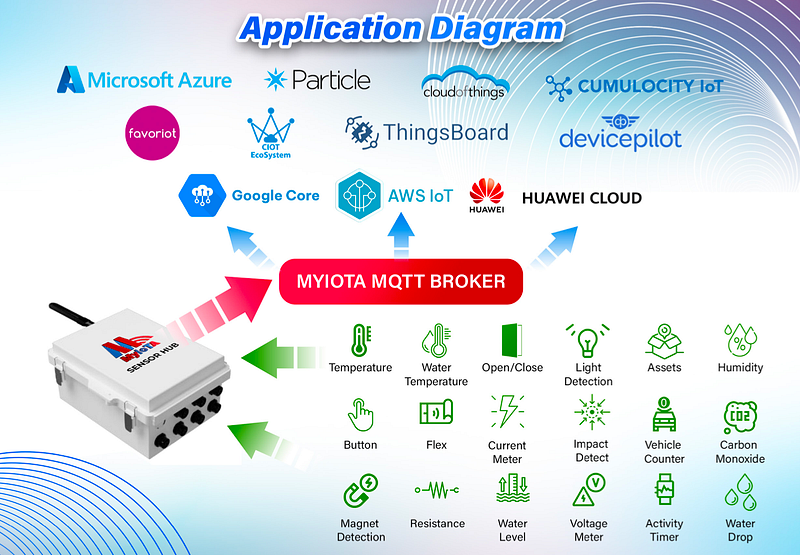
The MyIoTA IoT Sensor Hub is a prime example of local innovation supported by MyIoTA.
Designed and made entirely in Malaysia, this product represents MyIoTA’s collaborative spirit between several members.
MYIoTA Members that contributed to the development of the IoT Sensor Hub
Favoriot, a member of MyIoTA, has contributed to developing the IoT Sensor Hub via its IoT middleware, which makes it easier for users to collect and send data for visualization and analysis.
Transforming the Economy and Industry with IoT
How MyIoTA Sensor Hub can be applied in various use case scenarios
The MyIoTA IoT Sensor Hub, backed by MyIoTA’s open SDK policy, is a crucial driver of innovation, allowing developers to customize IoT solutions.
This device simplifies the deployment of IoT projects, making them more practical and reliable.
It helps businesses and developers quickly move from ideas to implementation, keeping Malaysian companies competitive.
The MyIoTA IoT Sensor Hub is set to create new jobs, launch new businesses, and revamp existing industries.
It paves the way for innovation, leading sectors into the Fourth Industrial Revolution.
This change is about adopting new technology and economic transformation, leading to new business models, tech job growth, and the digital update of traditional industries.
MyIoTA Sensor Hub
A Call for Collaborative Transformation
MyIoTA’s initiatives, especially its collaboration with members like Favoriot and developing the MyIoTA IoT Sensor Hub, aim to make Malaysian IoT companies leaders worldwide.
By making IoT project deployment easier and fostering a network of partners and developers, MyIoTA ensures Malaysia stays ahead in digital innovation.
This collective effort invites everyone to contribute to a future where innovation, connectivity, and advanced digital technologies drive national and global progress.
Awareness and education are among the most important elements when introducing new technologies, especially in the era of IR 4.0.
Although IoT was coined by Kevin Ashton (the Father of IoT) in 1999, IoT has taken a faster pace in 2014 and later became one of the core technologies for IR 4.0.
Without data (from IoT), there will be no intelligence.
Below is the list of the higher education institutions that have adopted or embraced their teaching and learning. (Note: Kindly contact me if your organization is not listed here)
Universiti Malaysia Trengganu (UMT)
Monash University
German-Malaysia Institute (GMI)
Universiti Kuala Lumpur (UniKL) — MIIT & BMI
Universiti Islam Antarabangsa (UIA)
Universiti Tun Hussein Onn Malaysia (UTHM)
Universiti Sultan Zainal Abidin (UniSZA)
Universiti Teknologi Malaysia (UTM)
Universiti Malaysia of Computer Science and Engineering (UNIMY)
Asia Pacific of Technology and Innovation (APU)
Universiti Malaysia Sarawak (UNIMAS)
Universiti Teknologi Malaysia (UiTM)
Universiti Sains Malaysia (USIM)
Kolej Kemahiran Tinggi MARA
Universiti Malaysia Pahang (UMP)
Universiti Malaysia Perlis (UNIMAP)
Institut Teknikal Jepun Malaysia (JMTi)
Universiti Teknikal Malaysia Melaka (UTeM)
Universiti Putra Malaysia (UPM)
Malaysia-Japan International Institute of Technology (MJIIT)
Universiti Pendidikan Sultan Idris (UPSI)
Universiti Pertahanan Nasional Malaysia (UPNM)
Multimedia University (MMU)
Politeknik Malaysia
Favoriot IoT platform has been introduced as part of the syllabus, project tool, and lab.
Interested parties can contact Favoriot (info@favoriot.com) for an appointment or further details.
In the expanding universe of the Internet of Things (IoT), Favoriot has carved its niche with a clear focus – IoT training. But why the emphasis on training? The answer lies in the challenges posed by offering an IoT platform-as-a-service.
1. The Reality Check of an Empty Platform
An IoT platform’s potential remains untapped if there are no takers. When Favoriot first ventured into offering its IoT platform service, the uptake was dishearteningly minimal. A dominant reason? The brand ‘Favoriot’ was a new kid on the block, unfamiliar to the tech-savvy crowd and students who leaned towards platforms they recognized like ThingSpeak, ThingsBoard, Blynk, or Azure.
2. Identifying the Gap in the Market
We noticed a pattern. The Malaysian market had more resellers of IoT products than genuine product creators. For a nation aspiring to transition from a consumer to a producer, this spelled stagnancy. There’s a gaping chasm between importing technology and producing it. To bridge this gap, the nation needed talents capable of pioneering their own IoT innovations.
3. The Favoriot Pivot to Training
Recognizing this void, Favoriot decided to channel its energies into IoT training. From basic tenets to advanced nuances and IoT data analytics, we designed a comprehensive training regimen. The introduction of Professional Certificates was a game-changer, amplifying the professional credibility of participants.
Today, over 15 Malaysian universities have integrated the Favoriot IoT platform into their curriculum, predominantly in final year projects. Some institutions are even contemplating introducing Favoriot’s Professional Certificates, testament to its industry relevance.
4. Expanding Beyond Training
Does Favoriot’s vision culminate with training? Emphatically, no! Our IoT platform has been embraced by diverse sectors, from manufacturing and agriculture to smart cities. The training was the catalyst, the spark that ignited IoT adoption across Malaysia.
In Conclusion
Our journey at Favoriot is characterized by adaptability. We saw a need, recalibrated our strategy, and are now playing a pivotal role in Malaysia’s IoT talent evolution. As we look ahead, our commitment remains unchanged: empowering the nation through state-of-the-art IoT solutions and training.













 Dr. Mazlan Abbas