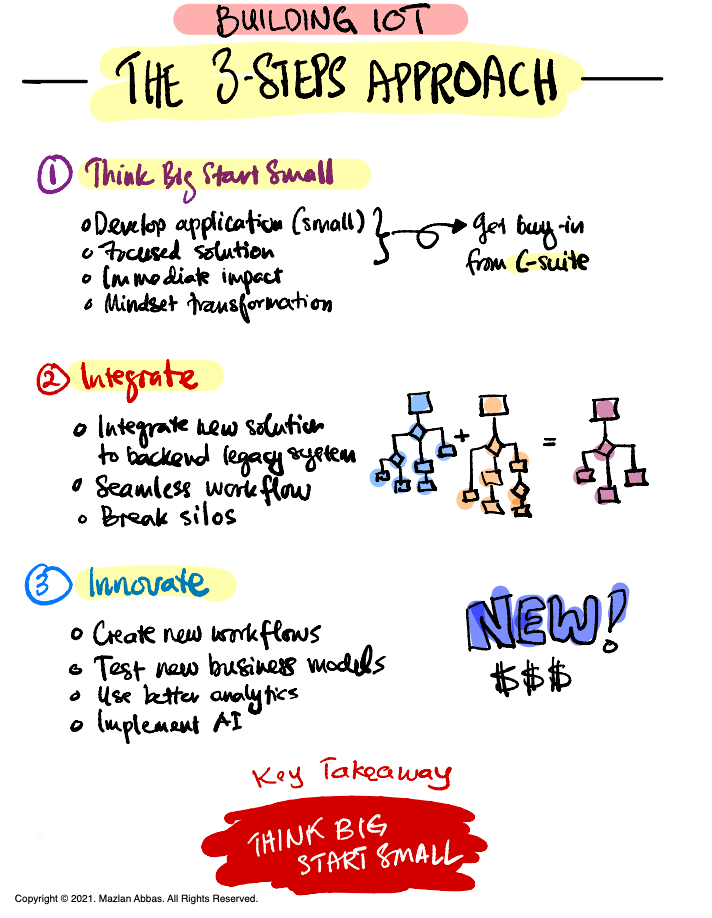
Today, we will explore a simple and practical framework for implementing IoT projects: the 3-Step Approach.
This method ensures a smooth and effective rollout by focusing on small steps, integration, and innovation. Let’s break it down step by step.
Step 1: Think Big, Start Small
The first step is to start with a clear vision (think big) but begin with a small, focused project to gain momentum.
Develop a Small Application: Identify one specific problem and build a targeted solution.
Example: A smart thermostat to monitor energy usage in one building rather than an entire campus.
Deliver Immediate Impact: The solution should show quick results to build confidence in IoT’s value.
Mindset Transformation: This small success shifts how people perceive IoT and its potential.
Get Buy-In from Leadership: Demonstrating early results helps secure support from decision-makers like the C-suite executives for future projects.
Step 2: Integrate
Once the initial IoT solution proves its value, it is integrated into the broader system.
Connect to Legacy Systems: Ensure the new IoT solution works seamlessly with existing infrastructure, such as ERP systems or older databases.
Example: Integrating smart sensors into a factory’s traditional production line.
Seamless Workflow: Avoid disrupting operations by designing smooth processes between old and new systems.
Break Silos: Encourage collaboration between departments to maximise the benefits of IoT across the organisation.
This step ensures that IoT doesn’t operate in isolation but becomes a part of the larger ecosystem.
Step 3: Innovate
The final step is to use IoT to drive innovation and create new opportunities.
Create New Workflows: Leverage IoT to optimise or redesign how work is done.
Example: Using real-time data from IoT sensors to automate maintenance schedules.
Test New Business Models: Experiment with different ways to generate revenue using IoT solutions.
Example: Offering predictive maintenance as a subscription service for customers.
Better Analytics and AI: Use advanced analytics and AI to unlock deeper insights from IoT data and automate decision-making.
This stage transforms IoT from a problem-solving tool into a driver for long-term growth and innovation.
Key Takeaway: Think Big, Start Small
The overall lesson is simple:
Start with a big vision, but focus on small, impactful projects to get started.
Build on early successes by integrating solutions into larger systems.
Use IoT to innovate and create new opportunities.
This approach minimises risk, builds momentum, and ensures sustainable growth.
Let’s discuss: What small IoT applications can you think of to start with? How would you scale and integrate them into a more extensive system? Let’s brainstorm together!
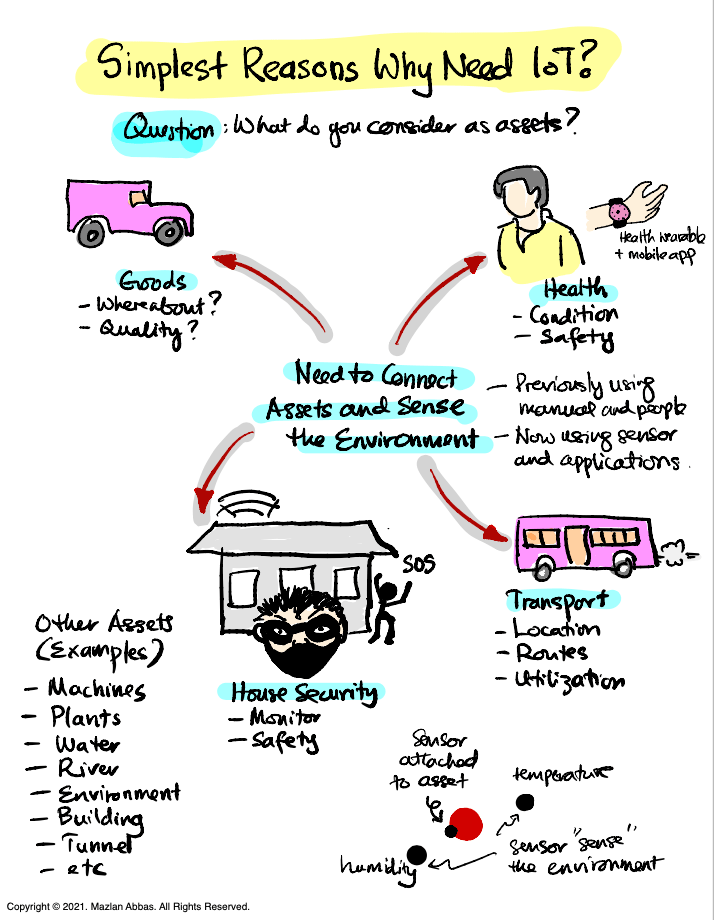
Today, we’ll discuss why the Internet of Things (IoT) is becoming essential in our daily lives.
The diagram simplifies this concept by focusing on assets, how we connect them, and why sensing the environment is so important. Let’s break it down step by step.
1. What Are Assets?
Let’s start with a question: What do you consider as assets?
We value and want to monitor, track, or protect assets. These could include:
Goods:
We would like to know their location (e.g., where is my delivery?)
Or their quality (e.g., is the food shipment fresh?)
Health:
Monitoring our condition and ensuring safety are critical.
Example: A health wearable that tracks your heart rate and connects to a mobile app.
Transport:
Vehicles and public transportation must be tracked for location, routes, and utilisation.
Example: A bus fleet monitored for efficient route planning.
House Security:
Ensuring homes are safe by monitoring for intrusions or emergencies.
Example: A motion sensor that alerts you if there’s unusual activity.
2. The Core Need: Connecting Assets and Sensing the Environment
Why do we need IoT for these assets?
The key lies in sensing and connecting the environment around these assets.
In the past, we relied on manual monitoring and human input.
Today, we use sensors and applications to gather real-time data and automate processes.
3. How IoT Works
Sensors: Devices attached to assets to sense environmental factors like temperature or humidity.
Example: A sensor measuring the humidity in a storage facility for sensitive goods.
Communication: Sensors send this data to an IoT platform for processing and action.
Example: A sensor alerts the homeowner if the temperature inside the house drops below a certain threshold.
4. Examples of Other Assets
IoT can be applied to monitor a wide variety of assets, such as:
Machines: For predictive maintenance in factories.
Plants: To ensure optimal growth conditions in agriculture.
Water and Rivers: These are used to monitor pollution or water levels.
Environment: For tracking air quality and weather changes.
Buildings and Tunnels: For structural safety and efficiency.
5. Why IoT Is Essential
IoT provides us with the ability to:
Monitor assets in real time without human intervention.
Ensure safety and quality by automating alerts and responses.
Improve efficiency by making data-driven decisions.
Final Thoughts
The most straightforward reason we need IoT is to connect our assets and sense the environment effectively.
By doing so, we make life easier and ensure safety, efficiency, and better decision-making.
Let’s discuss: What assets in your life or work could benefit from IoT? How would you use sensors to improve them? Share your thoughts!
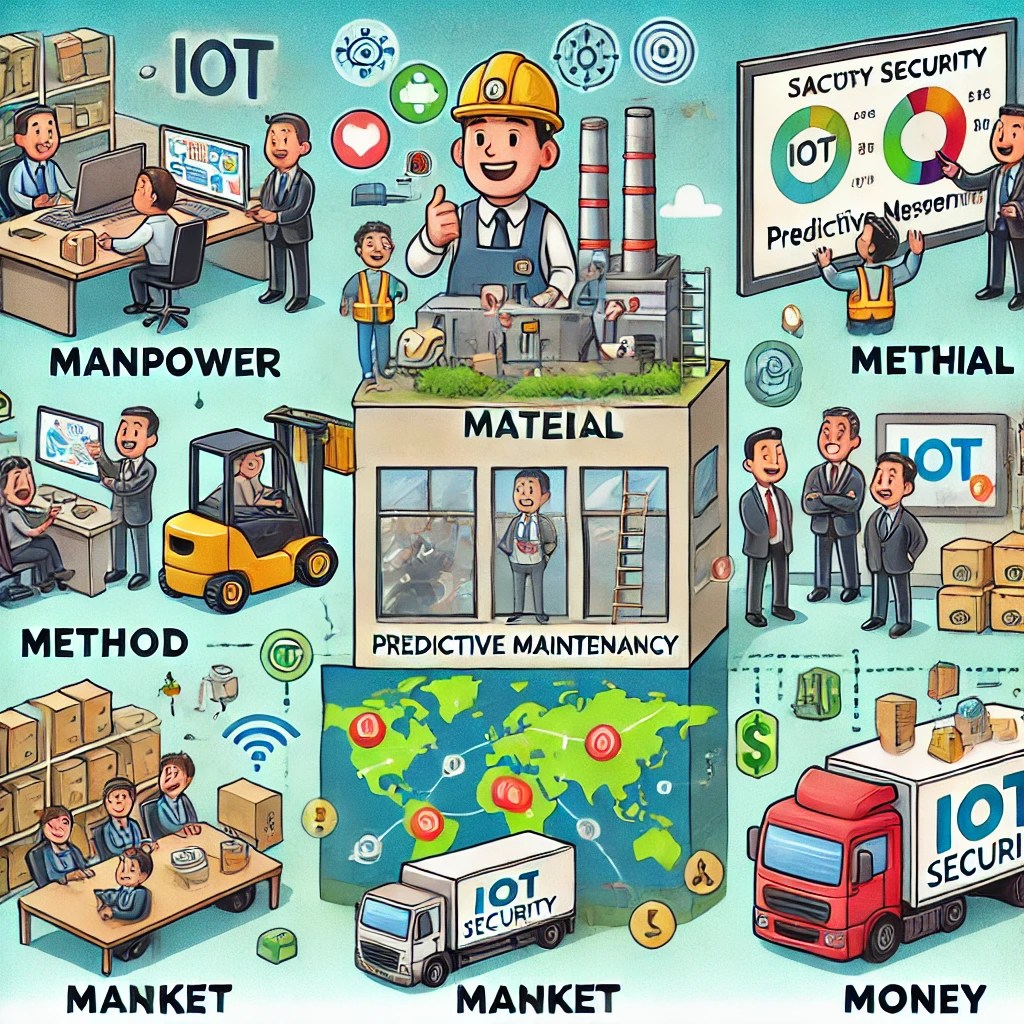
Today, we’ll explore how the Internet of Things (IoT) transforms the 7 M’s of business — key elements that drive an organisation’s operations and strategy.
These 7 M’s are Manpower, Material, Method, Machine, Market, Money, and Management. Let’s break down each one and see how IoT impacts them.
Based on the eBook — IoT Notes by Mazlan Abbas
1. Manpower
IoT helps businesses optimise human resources by reducing costs, improving safety, and increasing productivity.
Impact of IoT:
Cost Reduction: Automating repetitive tasks reduces the need for manual labour.
Worker Safety: IoT devices, such as wearables, can monitor health and alert workers to potential hazards.
Productivity: By enabling remote work and real-time communication, IoT allows employees to focus on high-value tasks.
Example: A construction company using wearables to monitor worker fatigue and ensure safety.
2. Material
IoT ensures better management of materials, improving supply chain efficiency and reducing waste.
Impact of IoT:
Just-In-Time Delivery: Sensors track inventory levels and automatically reorder materials when needed.
Asset Condition Monitoring: IoT devices monitor the condition of materials, ensuring quality and preventing spoilage.
Example: A warehouse using IoT sensors to track stock levels and ensure optimal storage conditions.
3. Method
IoT makes business processes more agile and efficient by simplifying methods.
Impact of IoT:
Reduce Red Tape: Automating workflows eliminates unnecessary administrative steps.
Agility: IoT enables businesses to respond quickly to changing conditions.
Efficiency: Processes become faster and more streamlined with IoT integration.
Example: A manufacturing plant automating quality checks with IoT sensors to speed up production.
4. Machine
IoT maximises the performance of machines, ensuring reliability and reducing downtime.
Impact of IoT:
Uptime: Predictive maintenance ensures machines are operational when needed.
Predictive Maintenance: IoT sensors detect issues before they become critical, preventing failures.
Error Reduction: Machines can self-correct or alert operators when errors occur.
Example: A factory using IoT-enabled machinery to monitor performance and schedule maintenance.
5. Market
IoT helps businesses expand into new markets and improve their customer reach.
Impact of IoT:
New Market Segments: IoT enables innovative products and services, opening new revenue streams.
Global Reach: Businesses can monitor and manage operations worldwide through IoT platforms.
Example: An IoT-enabled home security company entering international markets with smart security systems.
6. Money
IoT creates new revenue opportunities and reduces costs.
Impact of IoT:
New Revenue Streams: IoT drives innovation, leading to new services and products.
Cost Savings: Automating processes and improving efficiency reduces expenses.
Example: A logistics company saving fuel costs by using IoT to optimise delivery routes.
7. Management
IoT improves decision-making through data-driven insights.
Impact of IoT:
Data-Driven Decisions: Real-time data helps managers make informed choices.
Transparency: IoT provides visibility into all areas of the business.
Better Decision-Making: Analytics from IoT systems offer actionable insights.
Example: A retail chain using IoT to monitor sales trends and optimise inventory.
Key Takeaways
IoT has a transformative impact on the 7 M’s of business:
Manpower: Reduces costs and improves safety.
Material: Ensures quality and efficiency.
Method: Simplifies workflows and increases agility.
Machine: Enhances reliability and performance.
Market: Expands opportunities globally.
Money: Generates new revenue and reduces costs.
Management: Improves decisions with real-time insights.
Discussion Question: Which of the 7 M’s most benefits from IoT in your industry? Let’s share ideas and examples!
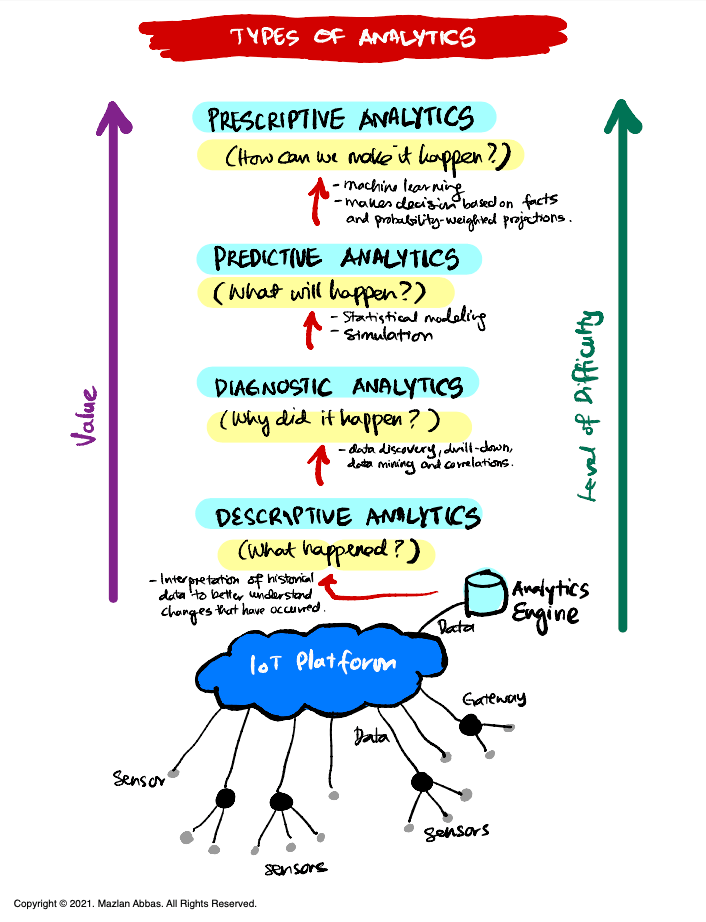
At the base of the analytics hierarchy is descriptive analytics. This is the simplest form of analytics and helps us understand what happened by interpreting historical data.
Purpose: To summarise past events and identify patterns.
Example: A smart thermostat that shows last week’s energy usage patterns.
Methods: Charts, graphs, and dashboards that clearly show past performance.
This type of analytics is great for reviewing the past, but it doesn’t tell us why something happened or what will happen next.
2. Diagnostic Analytics: Why Did It Happen?
Moving up, we have diagnostic analytics, which looks at why something happened. It’s more complex than descriptive analytics because it requires diving deeper into the data.
Purpose: To discover relationships and identify the causes behind past events.
Example: Analysing why a specific day’s energy usage was higher than average by correlating data with external factors like weather.
Methods: Data discovery, drill-down techniques, and correlation analysis.
This stage helps us make sense of the past by understanding the root causes of trends and anomalies.
3. Predictive Analytics: What Will Happen?
Next is predictive analytics, which focuses on forecasting future outcomes. This is where analytics becomes proactive rather than reactive.
Purpose: To predict what might happen based on current and historical data.
Example: A smart thermostat forecasting energy usage for the upcoming week based on weather patterns and past behaviour.
Methods: Statistical modelling and simulations.
By identifying trends and patterns, predictive analytics helps us make informed predictions.
4. Prescriptive Analytics: How Can We Make It Happen?
At the top is prescriptive analytics, the most advanced type. This involves predicting outcomes and recommending actions to achieve desired results.
Purpose: To decide the best course of action based on predictions.
Example: A smart thermostat automatically adjusting settings to save energy while maintaining comfort.
Methods: Machine learning and AI to analyse probabilities and make decisions.
Prescriptive analytics provides the highest value by enabling automated and data-driven decisions.
IoT and Analytics
This diagram also highlights how analytics works in an IoT platform:
Sensors: Collect data from various sources like temperature, humidity, or movement.
IoT Platform: Acts as a central hub to process and store the data.
Analytics Engine: Applies these four types of analytics to generate insights and drive decisions.
Final Thoughts
Each type of analytics builds on the previous one, moving from simple data interpretation to actionable decisions. The value increases as we move up the hierarchy, as does the complexity.
Question to consider: Which type of analytics is most valuable in your industry, and how can you implement it effectively? Let’s discuss it!
Today, we’ll explore two closely related but distinct concepts: Industry 4.0 and the Fourth Industrial Revolution (IR 4.0).
These terms are often used interchangeably but have specific differences, as highlighted in the diagram. Let’s dive in step by step.
1. Revolution vs Evolution
The first thing we need to clarify is the difference between revolution and evolution:
Revolution refers to sudden and drastic change. Think of it as a leap forward that quickly transforms industries and societies.
Evolution, on the other hand, is slow and gradual progress. Changes happen incrementally over time.
Key question: Are we adopting Industry 4.0 technologies suddenly (revolution) or gradually (evolution)? This can vary depending on the industry and region.
2. What is Industry 4.0?
Industry 4.0 focuses on manufacturing and improving industrial processes through advanced technologies like IoT, AI, and robotics. It is the fourth stage in the progression of industrial advancements:
Industry 1.0 (1784):
Introduction of mechanisation and steam power.
Example: Steam engines powering factories.
Industry 2.0 (1870):
Electrical power enabled mass production.
Example: Assembly lines in factories.
Industry 3.0 (1969):
Use of computers, electronics, and automation.
Example: Robots performing repetitive tasks on manufacturing floors.
Industry 4.0 (Today):
Cyber-physical systems integrating IoT, AI, VR, and robotics.
Example: Smart factories where machines communicate and operate autonomously.
3. What is Industrial Revolution 4.0 (IR 4.0)?
The Fourth Industrial Revolution goes beyond manufacturing. It’s about integrating these technologies across all industries and even societies. While Industry 4.0 focuses on production, IR 4.0 impacts healthcare, education, agriculture, and more.
A key question: Are we adopting these 4.0 technologies evenly across all sectors, or is there a focus on specific areas like manufacturing?
4. The Connection Between Industry 4.0 and IR 4.0
Think of Industry 4.0 as a subset of the broader IR 4.0. Industry 4.0 is about the transformation of manufacturing, whereas IR 4.0 encompasses societal changes.
Here’s an example:
Industry 4.0: A factory using IoT sensors to monitor equipment health and reduce downtime.
IR 4.0: IoT sensors used in agriculture to monitor soil moisture for precision farming.
5. Societal Progression Through Industrial Revolutions
The diagram also highlights how societies have evolved alongside industrial advancements:
Society 1.0: Hunting society — Humans relied on nature and survival skills.
Society 2.0: Agriculture society- farming practices transformed societies.
Society 3.0: Industrial society — industries became the backbone of economies.
Society 4.0: Information society – driven by computers and the internet.
Society 5.0 (Japan’s Vision):
A super-smart society where technology integrates seamlessly to improve quality of life.
Focus on AI, robotics, and IoT to solve societal challenges.
6. Why is This Important?
Understanding these concepts helps us prepare for the future:
For businesses: Knowing the difference between Industry 4.0 and IR 4.0 helps align strategies.
For individuals: Skills like AI, IoT, and data analytics are becoming essential.
For society: IR 4.0 encourages us to consider how technology can address global challenges like sustainability and healthcare.
Final Thoughts: Industry 4.0 is revolutionising manufacturing, while IR 4.0 is shaping the future of entire societies.
As we move forward, we aim to embrace these technologies for efficiency and to build a more intelligent, inclusive world.
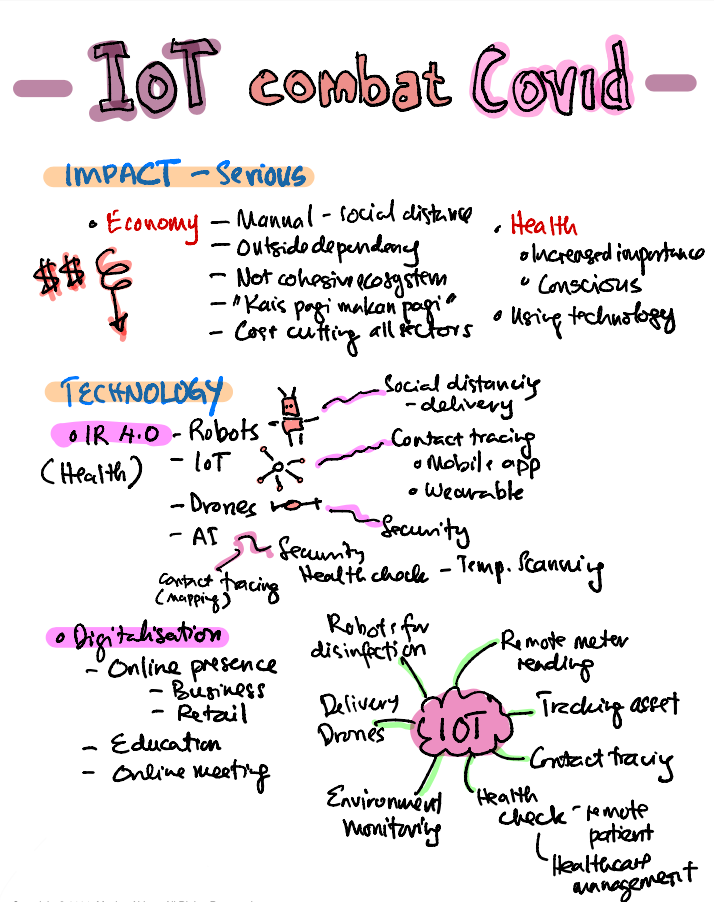
Today, we’ll look at how the Internet of Things (IoT) played a critical role in combating the challenges brought by the COVID-19 pandemic.
The diagram gives us a clear picture of the impacts, technologies, and solutions IoT provided during this global crisis.
1. The Serious Impact of COVID-19
COVID-19 affected every corner of our lives, especially in two major areas:
Economy
Social distancing disrupted manual jobs and heavily impacted daily income earners (“kais pagi makan pagi” — hand-to-mouth living).
Businesses relying on outside dependency suffered due to travel and supply chain restrictions.
Cost-cutting became essential across all sectors.
The lack of a cohesive ecosystem made economic recovery slower.
Health
Health became a top priority.
Awareness and consciousness about hygiene, social distancing, and health monitoring increased.
Technology began to take centre stage in health-related solutions.
2. IoT Technologies Used
IoT, combined with IR 4.0 technologies (Industry 4.0), came into action to address these challenges. Let’s explore the tools and methods:
Robots
Used for tasks like disinfection and delivery, especially in hospitals and public spaces, reducing human contact.
IoT
Enabled real-time data collection and monitoring for applications like health checks and remote patient management.
Drones
Delivered essential items to maintain social distancing and were used for surveillance in lockdown areas.
Artificial Intelligence (AI)
Enhanced contact tracing, temperature scanning, and predictive analytics to track the virus’s spread.
3. Practical Applications of IoT
IoT was at the heart of the pandemic response, enabling innovative applications:
Contact Tracing
Mobile apps and wearable devices tracked individuals’ interactions, helping to identify and isolate potential cases.
Health Monitoring
Remote patient monitoring systems allowed hospitals to track patients’ vital signs without physical visits.
Temperature scanning systems were widely deployed in public places.
Environmental Monitoring
IoT sensors monitored air quality and other environmental factors to maintain healthy surroundings.
Remote Operations
IoT made it possible to manage utilities like remote meter reading and asset tracking.
Delivery Drones
Delivered medicines, food, and other essentials, reducing human-to-human interaction.
4. The Role of Digitalisation
With physical interactions limited, digitalisation became a key enabler:
Online Presence
Businesses and retail shifted online to continue operations.
Education moved to online platforms, and virtual meetings became the norm.
Robots and Automation
Robots handled repetitive tasks, like disinfection, to maintain hygiene standards.
Conclusion
IoT proved to be a game-changer during COVID-19. It connected people, devices, and systems, enabling effective solutions for healthcare, economic recovery, and safety.
The pandemic highlighted the importance of leveraging IoT for crisis management and showed us how technology can adapt to save lives and sustain economies.
Let’s discuss an essential concept in IoT — its key components. The diagram breaks IoT into four main building blocks, which we’ll explore step by step.
1. Sensors: The Eyes and Ears of IoT
The first layer is the sensors. These devices are at the heart of IoT; their job is to sense the environment.
They generate data by measuring things like temperature, humidity, or motion.
Think of them as the “end-nodes” in IoT — they are where the process begins.
Examples include:
A digital thermometer sensing room temperature.
A motion detector in a security system.
Without sensors, IoT wouldn’t have any information to work with!
2. Connectivity: The Communication Bridge
Once sensors collect data, it needs to be transferred somewhere for processing. That’s where connectivity comes in.
IoT uses different communication technologies:
Wireless options like Wi-Fi, Bluetooth, and LPWAN (LoRa or Sigfox).
Fixed methods like Ethernet.
Connectivity ensures the data travels from the sensors to the next stage over the internet or private networks.
Imagine this as a digital highway connecting the physical world to the virtual one.
3. IoT Platform and Middleware: The Brain
The third component is the IoT platform or middleware. This is where all the raw data comes together and is processed.
It acts as a central hub to aggregate data from multiple sensors.
Middleware handles:
Device management.
Data storage and formatting using standard protocols.
Providing APIs (Application Programming Interfaces) so apps can access the data.
Think of this as the “brain” that processes everything and makes sense of the data.
4. Applications and Analytics: Deriving Insights
Finally, all the processed data is used in applications and analytics to deliver value. This is where IoT makes an impact.
Applications:
Use the data to create useful solutions, like apps that track fitness or control smart homes.
Analytics and AI:
Analyse the data using Artificial Intelligence or Big Data techniques.
Generate insights to help make decisions or automate processes.
For example:
A smart farming app could use soil moisture data to trigger irrigation.
An AI system could predict machine failure in a factory.
Bringing It All Together
So, to summarise:
Sensors collect the data.
Connectivity transmits the data.
IoT Platform processes and stores the data.
Applications and Analytics use the data to create actionable insights.
IoT is a powerful combination of hardware, communication, and software working together to solve real-world problems.
On my recent trip to the World Smart Cities Expo in South Korea, I was deeply impressed by their public transportation system. South Korea has truly embraced the concept of a smart, citizen-centric city.
Their intelligent and integrated public transportation system is a remarkable example of how technology can enhance daily life and solve common challenges.
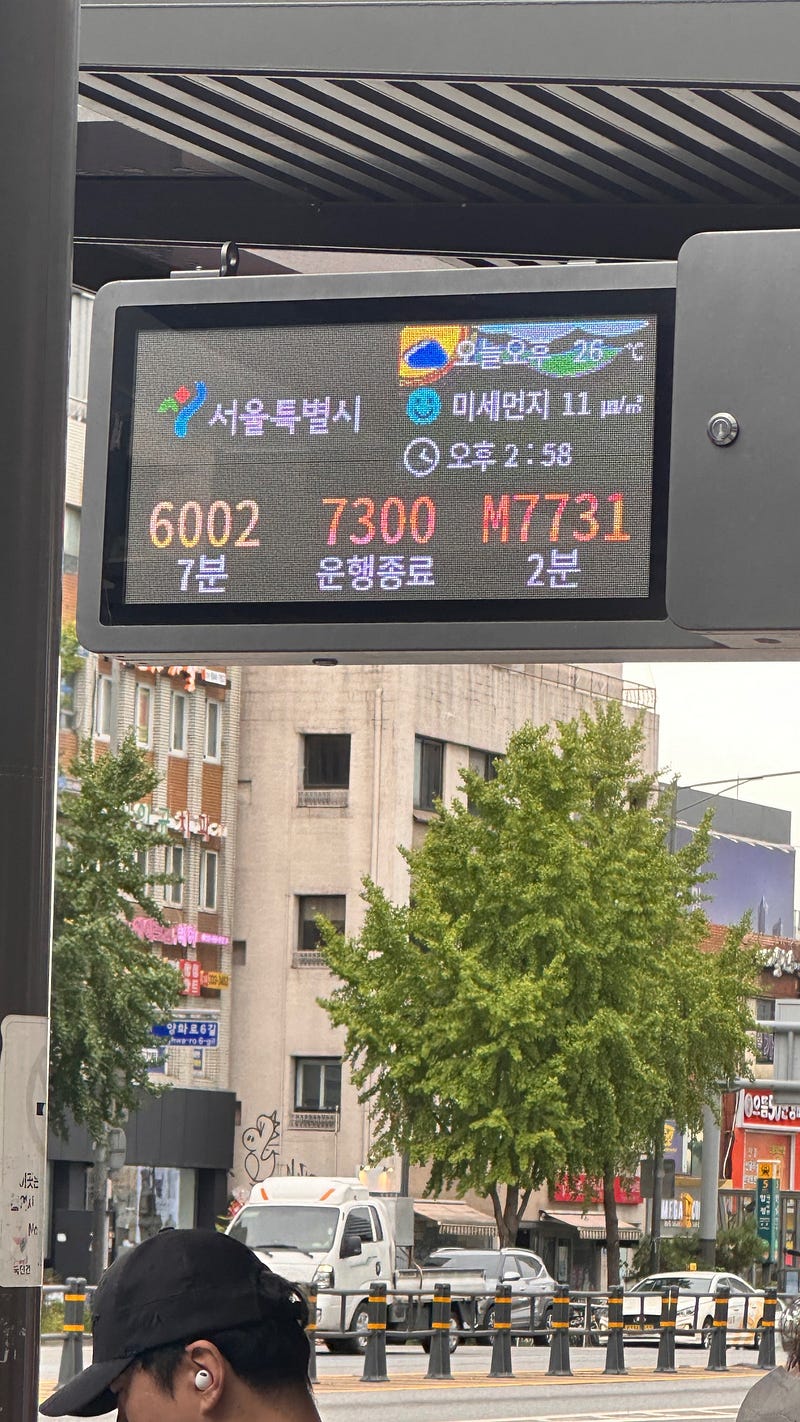
As I stood at a bus stop, staring at the digital monitor showing bus schedules, weather, air quality, and even the next bus’s arrival time, I couldn’t help but compare it to our system back in Malaysia.
In Seoul, everything is interconnected. The buses and subways are seamlessly linked, making it incredibly easy to move around the city.
I have been using the KakaoMap mobile app to plan my journey. This app has all the features one could hope for when navigating a bustling city. It provides real-time information about bus and train schedules and shows walking distances between locations.
The most impressive feature? The app even tells you how many seats are available on the bus you’re waiting for.
I couldn’t help but think, “Why don’t we have this level of convenience in Kuala Lumpur?”
As I stood there, watching the minutes tick down on the bus monitor, I thought about the benefits of real-time updates like this. Imagine standing at a bus stop in the rain, unsure when the bus will arrive.
In Kuala Lumpur, many bus stops lack real-time information, leaving passengers guessing. Here in Seoul, the technology gives passengers peace of mind. You know exactly when the bus will arrive and how crowded it will be—no more guessing or anxiety.
As the bus approached, I glanced at the app again. It showed that there were still seats available.
The bus pulled up on time, and I tapped my Tmoney card to pay as I got on. This card is another great example of convenience in South Korea. You can use it not only for public transportation – buses and subways – but also for purchases in convenience stores.
It’s a truly integrated payment system that further streamlines daily life in the city.
Sitting on the bus, I noticed how smooth the ride was. The onboard display would show the next stop and estimated arrival time every few minutes, keeping passengers informed.
I thought back to when I’d been on buses in Kuala Lumpur, especially during peak hours, and had no idea how long the journey would take.
If we had something similar in Malaysia, it would completely change how people commute, making public transportation more attractive.
I began thinking about the infrastructure behind this smart transportation system.
It’s not just about installing digital screens or launching a mobile app. It’s about creating an ecosystem where data from different modes of transport – subways, buses, taxis – are integrated into one unified system.
In Seoul, I noticed that every part of the transportation system seemed to communicate with each other. Whether on a subway or a bus, the information is consistent and accessible.
This kind of integration is what makes a city truly smart. It’s not just about fancy technology or big infrastructure projects; it’s about making everyday life more efficient and convenient for its citizens. Seoul’s transportation system has achieved that.
The air quality display was another feature that caught my attention. South Korea’s commitment to ensuring a comfortable and safe environment for its people extends even to real-time monitoring of air quality.
Sitting on the bus, I thought about how this feature could benefit our cities. Imagine having this in Kuala Lumpur, where haze and pollution are frequent concerns.
Real-time air quality updates could help people make informed decisions about their day.
When I got off the bus, I was already thinking about how this smart transportation model could be adapted for Kuala Lumpur.
Could we create a similar experience for our commuters?
Could we have real-time bus and train schedules displayed at every stop, with integrated payment systems like the Tmoney card?
As I walked to my next destination, I couldn’t stop thinking about the future of public transportation.
In Malaysia, we often talk about upgrading our infrastructure, but we sometimes overlook the smaller yet equally important aspects – like how easy it is for a person to plan their daily commute.
In South Korea, it’s clear that they’ve thought through every detail. From real-time updates to integrated payment systems, they’ve created a public transportation network that prioritizes the needs of the people.
Reflecting on this, I realized that smart transportation is not just about technology—it’s about creating a better experience for everyone. It’s about reducing uncertainty, saving time, and making city life more convenient and enjoyable.
South Korea has shown me what’s possible when technology is used thoughtfully in the service of its citizens.
As I made my way to my final destination, I kept thinking: This is what we need—a reliable, connected, and easy-to-use transportation system where the buses and trains don’t just get you from point A to point B but also provide a seamless, stress-free experience.
Can we bring this kind of intelligent transportation to Kuala Lumpur now? Do we have the capacity to create a similarly connected system that benefits everyone?
If South Korea can do it, I believe we can too.
It’s just a matter of prioritizing the right solutions and ensuring that we focus on what matters most: the people who use these systems every day.
The Rocky Road of Smart Cities: My Journey from Idealism to Realism.
The Allure of Smart Cities
In 2015, I embarked on a journey into the world of Smart Cities.
The idea was electrifying — technology had the potential to revolutionize urban living, making cities more efficient, sustainable, and responsive to the needs of their citizens. The possibilities seemed endless, and I was eager to participate in this transformation.
However, the reality I encountered was far from the idealistic vision I had in mind. Breaking into the Smart Cities market was a monumental challenge, fraught with unforeseen obstacles and harsh lessons.
The Birth of an Idea: A Reporting App for Citizens
It started with a simple yet powerful concept: a reporting app that allows citizens to easily file complaints about city infrastructure.
The app would let people report issues like potholes, broken streetlights, or uncollected trash directly to local councils. We believed we had a killer app on our hands. The system also allows citizens to track the progress of their complaints, bringing transparency and accountability to local governance.
We planned to roll out the service via the cloud to all local councils across Malaysia, transforming city management.
Initial Optimism: “How Hard Can It Be?”
As we prepared for the launch, I was optimistic. “Surely, local councils would jump at the chance to improve their services and engage with citizens more effectively,” I thought.
After all, who wouldn’t want to streamline their operations and make their cities more responsive to the needs of their residents? But as it turns out, the road to innovation is often paved with unexpected obstacles.
The Harsh Reality: An Open Can of Worms
The first major hurdle was getting local councils to pay for the service. It wasn’t that they didn’t see the value in it; the problem was more complex.
For one, the app was like an open can of worms.
It exposed the inefficiencies and shortcomings of local government, and not everyone was eager to highlight those issues. Additionally, some councils expressed a sense of pride—or perhaps stubbornness.
“We can build this ourselves,” they’d say, and some of them did try. But more often than not, these homegrown solutions fell short.
A Sobering Realisation: “Why Isn’t Anyone Using It?”
After the launch, they were left scratching their heads. “Why isn’t anyone using it?” This question haunted us.
Despite their efforts, nobody seemed to realize that their city had such an app. It was a frustrating experience. They had assumed that the ease of filing complaints and tracking progress would be enough to drive adoption.
But it wasn’t. The app was met with a collective shrug, and the uptake was dismal.
Copycats and a Tough Decision
To add insult to injury, we soon noticed copycat apps popping up. Others had taken our idea and run with it, often with the same lukewarm results.
It was disheartening.
After some time, we made the tough decision to ditch the application. It was a painful lesson in the harsh realities of the Smart Cities market and a sobering reminder that not every good idea translates into success.
The Long Haul: Nine Years of Persistence
Fast forward nearly nine years, and my company, Favoriot, is still trying to penetrate the Smart Cities segment. It’s been a tough nut to crack, and the challenges haven’t gotten any easier.
We even joined the Malaysia Smart City Alliance Association (MSCA) to gain easier market access. I thought being part of this collective would open doors, but the reality was more complicated.
The Complexity of Building Smart Cities in Malaysia
I’ve understood that building smart cities in Malaysia is a tedious and complex process fraught with challenges.
“Where do you even start?” I’ve heard this question countless times from city planners and local councils. Without clear Smart City Indicators to guide them, many cities simply don’t know how to begin their Smart City journey.
There’s a lot of confusion, a lack of vision, and an overwhelming sense of inertia.
Talent Gap and Slow Decision-Making
One of the biggest challenges is the talent gap. There aren’t enough skilled professionals in local councils who understand the nuances of Smart Cities.
Vision is blurred, and decision-making is painfully slow — like a snail inching its way forward.
And then there’s the politics, which adds another layer of complexity to an already complicated process.
The Funding Dilemma: A Major Roadblock
But perhaps the biggest killer of all is funding — or rather, the lack thereof. “How can we afford this?”. The reality is that many local councils don’t have the budget to implement Smart City solutions.
And when they do seek funding, they often turn to solutions providers with an unreasonable expectation: a 100% Private Finance Initiative (PFI). “We need you to front all the costs,” they say, “and maybe, just maybe, you’ll see some return on your investment down the line.”
The Reality of Local Council Services
However, not all local council services are meant to generate money. Most of them aren’t.
The real value of these services lies in cost savings, operational efficiency, and improved quality of life for citizens.
But try explaining that to someone holding the purse strings and looking for immediate financial returns.
It’s a tough sell.
Greenfield vs. Brownfield Cities: Different Challenges
I’ve also learned that not all cities are equal regarding Smart Cities.
Greenfield cities — newly built from the ground up — have different challenges than brownfield cities, which are older and already developed. The pain points are different, and so is the decision-making process.
What works for one city might not work for another, making scaling Smart City solutions daunting.
The Frustration of Trials
And then there’s the issue of trials.
“Let’s start with a proof of concept,” they say.
But all too often, these trials go nowhere. They don’t lead to commercial agreements or full-scale deployments.
Instead, they fizzle out, leaving everyone involved feeling frustrated and disillusioned.
The Reality of Smart Cities in Malaysia
So the next time you hear someone touting the number of Smart Cities launched in Malaysia, take it with a grain of salt.
Many of these so-called Smart Cities are little more than proof-of-concept projects — limited trials that never see the light of day beyond the initial launch.
A Strategic Shift: Diversifying Beyond Smart Cities
Given this challenging landscape, we at Favoriot have made some tough decisions.
While we’re still involved in Smart Cities, we’re no longer putting all our eggs in that basket.
We’ve diversified our focus, taking on other IoT projects unrelated to Smart Cities.
It’s a matter of survival.
As much as I believe in the potential of Smart Cities, I’ve realized that it’s not a silver bullet.
It’s a sexy concept, sure, but it can also be a business killer if you’re not careful.
Balancing Ambition with Practicality
It’s all about balancing ambition with practicality.
Yes, I’m still passionate about Smart Cities, and I’ll continue to support the development of smarter, more sustainable urban environments.
But I’m also realistic about the challenges.
We need to be smart about where we invest our time, energy, and resources. After all, there’s a lot more to IoT than just Smart Cities, and exploring all the possibilities is crucial if we want to stay in the game.
Conclusion: Reflecting on the Journey
As I reflect on this journey, I can’t help but think about how far we’ve come and how much we’ve learned.
The Smart Cities market may have been more complex than I initially imagined.
Still, it’s been an invaluable experience that has shaped how I approach business and innovation.
And who knows?
The next big breakthrough may be around the corner.
The Challenges of Securing Favoriot’s First 10 Customers
Many say that the first breakthrough for a startup is when you get 10 paying customers. This saying holds true.
Every startup developing a product feels the pressure when struggling to get those first 10 customers, and even the very first customer can be challenging.
I still remember the moment when Favoriot received its first paid subscription. “Finally, we did it!” I exclaimed to my team with joy. We were overjoyed, envisioning continuous success. Unfortunately, the joy was short-lived.
Why Is It So Difficult?
I sat pondering, “Is our product not satisfying the customers? Or maybe it doesn’t solve their problems? Or is the price too high?” Many questions ran through my mind. I knew I had to find the answers. “We need to make this product more appealing,” I told myself.
We tried improving the product and experimented with different pricing, but the results were the same.
I found myself puzzled, “Why do ThingSpeak and Blynk have so many users?” We also offered free subscriptions like they did, but the outcome was not satisfactory.
On average, only 5% of free users would convert to paid. Although we achieved this percentage, it still did not meet our revenue targets.
A New Strategy
I began thinking of other strategies. “How about we bundle the product?” I suggested to my team.
We started combining the Favoriot platform with our IoT courses. This approach began to show success. I told myself, “This is a good start, but we can do better.”
Then, we introduced the Enterprise Favoriot IoT platform with a perpetual license. This new package attracted a lot of interest from System Integrators.
I felt this was the right move. “I hope this will bring more success to Favoriot,” I silently prayed.
Lessons Learned
This experience taught me many things. First of all, I learned that getting the first customers is indeed tough, but it is a crucial step. I always tell my team, “Never give up. Every small step is a big achievement.”
I also learned that a good product alone is not enough. “We need to understand the customers’ needs and ensure our product truly solves their problems,” I constantly remind myself.
We strive to understand our customers’ desires and requirements.
Pricing plays a crucial role as well. “A price that’s too high might scare off customers,” I realized.
We tried to find a balance between reasonable pricing and the value we offer.
Moving Forward
Now, with the new Enterprise Favoriot IoT package, we are more confident moving forward. I told my team, “This is a new beginning for Favoriot. We’ve faced many challenges, but we’ve overcome them.”
I also believe that success does not come easily. “It requires continuous effort and persistence,” I always remind myself.
We will keep working to improve our product and find new ways to attract more customers.
Hopes for the Future
I have great hopes for Favoriot. I always think, “How can we make Favoriot a leading IoT platform?” I believe with effort and dedication, we can achieve it.
Whenever I look back at our journey, I feel proud of what we have accomplished. “We’ve faced many challenges, but we never gave up,” I tell myself.
I am confident that with continuous spirit and effort, Favoriot will keep growing and achieving greater success.
Finally, I want to thank everyone who has supported us throughout this journey. “Without your support, we wouldn’t be where we are today,” I say sincerely.
We will keep striving to deliver the best and achieve more successes in the future.
This is the story behind Favoriot – a journey full of challenges, but also full of hope and opportunities. I believe that with effort and dedication, we can achieve anything we dream of.


















 Dr. Mazlan Abbas