How We Build 3 IoT Products

Three (3) FAVORIOT IoT Products

What’s the best strategy to build a business? To focus on a single product or multiple products? Should we place everything (money) into a single basket or not?

Well, it depends … In almost any Startup, the first product can sucks and your initial vision can change along the way. Pivot is normal in any Startup.

The same thing happen to us — when we build our first product called Raqib. It is targeted for elderly people. But later we pivot the market for Hajj pilgrims.

The second product is Favorsense, which is meant to help the local authorities in handling complaints from the public. It can also be used to collect data and identify the real pain-points of the cities before we start building Smart Cities applications.

Even the target market for Favorsense has been expanded for Campus, Housing Developers, Enforcement Agencies and many others.

The third product is the Favoriot IoT platform itself, which is meant to become an enabler to build new IoT applications. It was offered as Platform-as-a-Service (PaaS). It now has more than 5300 users from 115 countries worldwide and still growing.

So far, the Favoriot IoT platform has been more successful than the rest of the products. The traction has been very encouraging. Furthermore, any IoT deployment MUST have an IoT platform and we want our Favoriot platform to be the preferred choice.

Why IoT Adventure Book?

When I have this idea to write another E-book on Internet of Things, I was trying to figure what’s the best way to share my IoT journey.

Earlier, I have published two E-books – Your IoT Journey (815 downloads) and IoT Notes (1445 downloads). Both of these E-books I have made it available for free. Initially when it was first launched, it was offered at a price below USD 2.99.

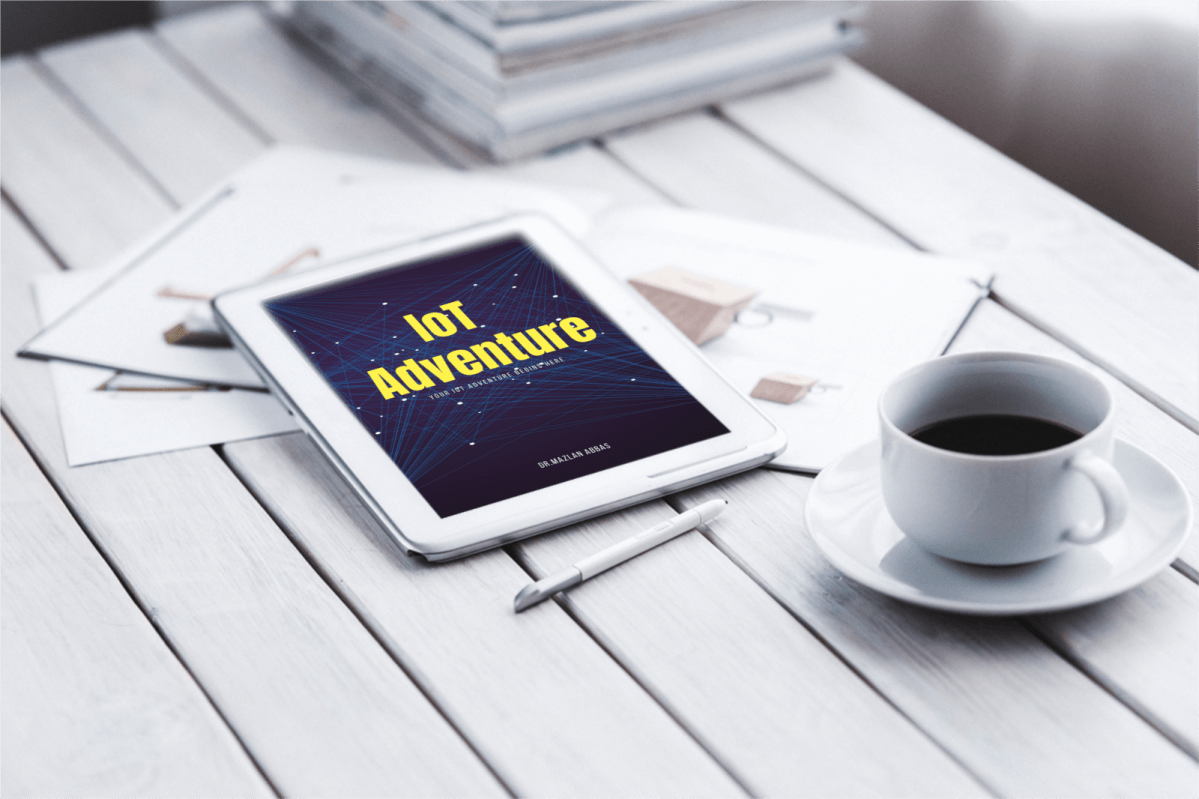
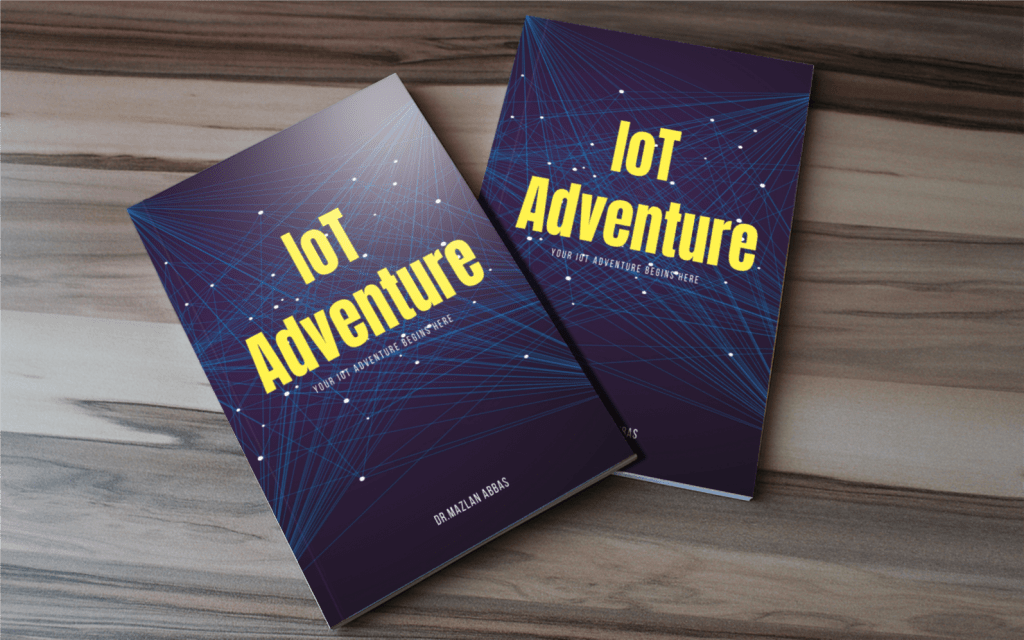
In the latest E-book, IoT Adventure, it will go deeper into the business of IoT. Mainly it will be from my personal experience venturing into IoT entrepreneurship.

IoT Adventure – Your IoT Adventure Begins Here

IoT Adventure Contents

It will highlight several things (list is not exhaustive):

  • Why is IoT as the main business?.
  • In which area should we focus in IoT since it covers a very vast area.
  • Who and where do we find the customers?
  • Do we really have IoT killer apps?
  • How do we build the first IoT product?
  • What are the things we need to avoid failure?
  • How do we market our IoT product?
  • How do we price our solutions?
  • What are the business models?
  • What kind of support is required?
  • How do we grow our IoT business?

You can check more of the IoT Adventure contents here.

Personally, it has been a very exhilarating adventure when I decided to embark on this journey. We have failed and learned a lot and it’s about time to share some of my experience so that we can help new IoT entrepreneurs to be more successful in their mission to solve their customer’s problems.

But I also would like to open to comments from the readers to share their thoughts and experiences about their IoT business too and how it can help the whole IoT ecosystem to spur and grow exponentially.

Sign-up – Please inform me of your new IoT Adventure eBook!
[wpforms id=”231″]

The path in building an IoT business is not straightforward – especially when it involved many IoT Ecosystem players, new market and mindset transformation.

Dr. Mazlan Abbas

IoT in the World of Covid-19

[The article was originally published in IoT World]

Since early last year (2020), most of us have now lived in the new norm. Most of the things that we do physically has now changed drastically either with the usage of technology of the way we interact.

Digital and telecommunications are two forms of technology which are critical in the new norm. With physical distancing or periods during lockdown, the only way we get in touch is via telecommunications. Pen and paper has been reduced drastically with conversion of content into digital. Usage of Internet especially online conferencing for either webinars or meetings have been a new norm.

But how do technology like Internet of Things (IoT) can play a significant role in the new norm? Check out the video from Dr. Mazlan Abbas, FAVORIOT below.

IR 4.0 — To Survive or Become Obsolete

For the last 50 years only 19% of companies are in existence today. Many did not survive or unable to sustain due to many reasons. However, one of the key reasons are due to the fact that they are unable to compete or remained competitive whereas their competitors have transformed their business by leveraging new technologies and new business models.

Digitalisation and Internet has been very key in these transformation. New products and services have been created. Their operations are becoming more agile and productive. This is the outcome when companies embraced new changes openly. Their lleaders are the risk takers and have excellent vision of the future.

Every 3 to 7 years companies need to transform themselves, reinvent their operations and business. They should look at the current and future trends of technologies and see whether they can leverage these powerful technologies and together surf the great waves of disruption.

Check out Dr. Mazlan Abbas, CEO of FAVORIOT video explaining about the great changes happening in IR 4.0.

[Article orginally published here — IoT World]

Tips for Generation-IoT

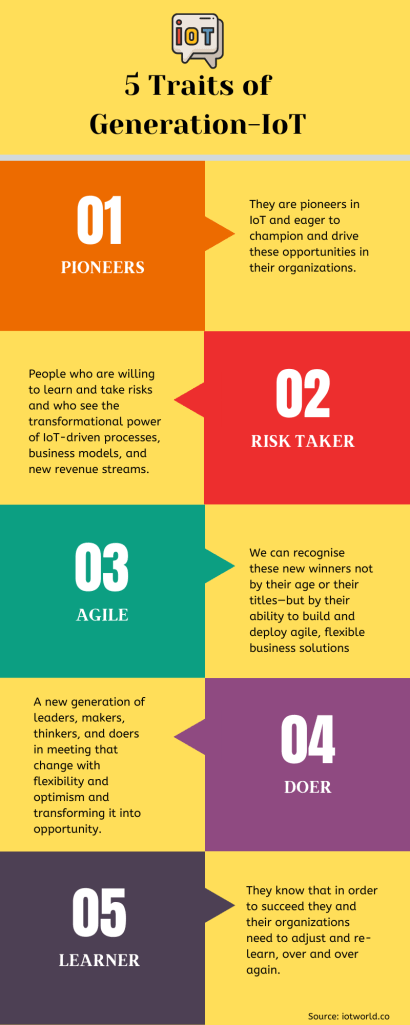
Who are the Generation-IoT? Generation-IoT has been defined by Maciej Kranz in the article “Generation IoT: The Key to Business Survival in the 21st Century. Below are the traits of the Generation-IoT:

  1. They are pioneers in IoT.
  2. All are willing to learn and take risks and are good at building virtual teams internally and partnering externally.
  3. You can recognize these new winners not by their age or their titles — but by their ability to build and deploy agile, flexible business solutions.
  4. A new generation of leaders, makers, thinkers, and doers is meeting that change with flexibility and optimism and transforming it into opportunity.
  5. These are the people who see the transformational power of IoT-driven processes, business models, and new revenue streams.
  6. They are eager to champion and drive these opportunities in their organizations.
  7. These people know that IoT is not just one project, one training session, one change.
  8. They know that in order to succeed they and their organisations need to adjust and re-learn, over and over again.

But how do we encourage the growth of this new “generation”? We need them as many as possible to help us spur the whole industry. We need more fresh and innovative ideas to transform their own business or their customers. But how do we train them and get them ready to be absorb directly into organisations?

We can provide them with the necessary tools to start their journey. One of the common layer that glue the “hardware” and the “software” is the IoT middleware or the platform. The Generation-IoT must understand what are the necessary knowledge to build the electronic devices and find the necessary connectivity to the platform. But if they wish to build innovative IoT applications or using the data for the purpose of machine learning, they need to acquire this data from the IoT platform. They have a choice either to build or subscribe to any IoT platform. And currently, there are hundreds of IoT platforms worldwide as shown below.

[Source: Expert Advice for Generation-IoT]

How Do We Harness The Power of IoT

Harnessing the Power of IoT

[This article is originally published in IoT World]

It all started with when Kevin Ashton, working as a brand manager trying to figure out and track the amount of lipstick available on the shelves. In 1999, the term “Internet of Things” was coined by Kevin Ashton utilising RFID to track such assets. Twenty more years down the road, IoT has become a key technology not only to keep track of such asset but also create new products and services which can disrupt many businesses.

It ranges from manufacturing to agriculture and to Smart Cities. In fact, it can offer better tracking and monitoring solutions for end consumers using wearables devices. What we are seeing now is just the tip of the iceberg. There are many more applications can be built. The combinations of customised hardware or sensors, different kinds of connectivity, the power of the cloud and analytics brings forth unimaginable innovative solutions for the end-users.

Check out how we can harness the power of IoT by Dr. Mazlan Abbas, CEO of FAVORIOT in the below video.

Malaysia National 4IR Policy — An Opinion

[This article was originally published in IoT World]

We are aware that earlier in 2018, Malaysia launched National Industry 4WRD Policy Framework, however, the focus is on the manufacturing sector as we know manufacturing is one the biggest contributor to Malaysia’s GDP. However, it sparked interest in other sectors and industries as well because as described in the World Economic Forum (WEF), that the emerging technologies will have a disruptive impact on jobs of the future.

Here’s my personal opinions on Malaysia 4IR Policy:

  1. World Agenda — When Henrik Von Scheel (also known as Father and Originator of Industry 4.0) masterminded Germany’s digital agenda in 2009 with a belief that the industry will be transform by the fusion of digital, virtual and physical world, also called the cyber-physical systems, and this triggered the emergence of new era of fourth industrial revolution. This has been emphasized again by World Economic Forum in 2016. The fusion of various technologies have transformed and disrupted many businesses. And Malaysia should not be left behind.
  2. Covid-19 the Master Enabler — It took many years for us to educate the importance of digital transformation, but Covid-19 made us realise how important it us to transform our business, education and almost everything using digital. Internet seems to be mandatary in almost every part of lives. And to move towards IR 4.0, we must have the fundamental of IR 3.0 in place i.e. digital and virtual (content in digital with good access to Internet). That’s the more reason Malaysia also launched Malaysia Digital Economy Blueprint (MyDigital) in early 2021 to encourage the usage of digital technology to transform the economic sector.
  3. Humanizing Technology — Although 4IR can create new jobs, but it also create threats to the existing ones. Many people down the street are not aware how complex technologies of 4IR can help them in their daily lives. Thus, the aspiration of 4IR policy to ensure that it can provide quality of life by benefitting the society such as focus on happiness, healthy living, work-life balance, overcome social issues and sustainable living will help the adoption of 4IR technology to be easier and acceptable. Technology should not be seen as a threat but in fact should be seen to help them.
  4. Budget Justification — We hoped that the 4 policy thrusts, 16 strategies and 32 National initiatives can help the relevant agencies to justify for their 2022 budget. Without sufficient funding, it’s very difficult for us to maintain our momentum. We also want that the bureaucracy of 4IR fund approval need to be reduce to avoid unnecessary delays as what we have seen in the Industry 4WRD initiatives (Some SMEs complained that even a 4IR readiness assessment can take a year to complete. This does not include the 4IR intervention programmes).
  5. Producer-Nation Agenda — How do we increase our graduates salary if we are just being a Consumer-Nation? How do we sustain and grow our Startups if all the products and technologies are bought from overseas? How do we (i.e. the industries) share our technology or product map to Universities if we are not in control of our own product roadmap? One of the policy thrust — “Accelerate the 4IR technology innovation and adoption” is a “battle-cry” for many local Startups. Support them even if they are still small and have no reference sites to show or demonstrate. Support the innovators by being the early market adopters that are willing to take the risk to test out the new and untested local products. One day this small companies can grow and create more jobs for the country.

This can be my opinion and probably a wish list. Let’s see the actions that will be taken in the next 6–12 months. A Project Management Office (PMO) need to be setup to ensure transparency and KPIs are met.

IoT & IR 4 0 — Are You Ready for Jobs That Don’t Exist Yet?

The industry always complained that the talents that graduated from the local universities are not equipped with the latest knowledge. The industry expected the graduates that they hired can immediately start their job without sending them to further workshops or courses. The world is moving fast and thus it’s imperative to start contributing in the early part of the career. The employers are getting impatient as the competition heats up.

That’s why it’s important for the Universities to get feedback from their Industry Advisory Panel (IAP) to advice on the current technology and job trends. The lecturers too need to get involve in industry events to understand what’s the hottest job nowadays.

We know that the change the content of the syllabus or approving new programmes in the University can take months or sometimes 1–2 years. This would require the teaching staff to also equip themselves with the new knowledge. It’s a challenge nowadays to keep with the technological pace but that’s the reality.

Looking at the future technological trends and the business disruptions happening worldwide, the Universities should now anticipate what’s coming and to quickly adapt their current courses or programmes to match with the future jobs.

Check out the video below by Dr. Mazlan Abbas, CEO of FAVORIOT regarding this challenge.

FREE IoT eBooks for Download!

Download FREE IoT eBooks

I have decided to make two of my IoT eBooks available for FREE to anyone interested to download.

The first eBook is entitled “Your IoT Journey“. It is a compilation of my best and selected written articles which was published from my IoT World Blog. It’s not written in a very technical manner because the idea is to share the issues, challenges and the tips for anyone who’s interested to take the IoT journey. After several years, the topic about IR 4.0 become a hot one. But it also bring along confusion regarding the different Era of Industrial Revolutions.

The second eBook or rather eNotes entitled simply as “IoT Notes” was originally written to illustrate the complexity of IoT and IR 4.0 in a simpler way. I used GoodNotes application and my iPad Air to draw and add colours to the descriptions. Hopefully, this will become a companion notes to anyone who is learning IoT and IR 4.0.

Hope you enjoy the two eBooks and kindly share with others. Hopefully we can share the knowledge and create the next Generation-IoT.

  1. Your IoT Journey — Download
  2. IoT Notes (Compilation) — Download

IoT — The Fundamental Building Block of IR 4.0

IR 4.0 comprised of many technological building blocks. It is made of AI Block, VR/AR Block, Big Data Blocks, Blockchain Block, IoT Block and many others. However, IoT is seen one the most fundamental block for IR 4.0 is because it the source of collecting data either from people (using wearables with sensors) or things (using sensors) or environment (also sensors).

IoT — The Building Block

As many has said — “Data is King” or “Data is the New Currency”. However, I do believed, collecting raw data which is purely bits and bytes or the zeroes and ones or even numerical numbers are insufficient unless we can turn that data into something more meaningful that can answer the question of who, what, when or where. That is when the data is transformed into “knowledge”. And if it can answer the question of “how”, then it has been turned into “knowledge” and the best part is when it can answer the question of “why”, which is what we called “understanding”. And people make decision based on the understanding.

But the, how do we collect all the relevant data? Which is why it’s very important for us to begin with the right questions. The who, what, where and when can be gathered via relevant sensors such as RFID, GPS, clock, temperature, humidity, etc.

For some, IoT seems to be a very complex “technology” or rather a combination of several technologies. We need to know how sensors and the electronic devices can capture and send data through some for of connectivity. What are the various networks that can support efficiently the amount of data with an affordable cost. And how or where these data will be aggregated — will it be on a normal server with a simple database or will it be hosted on a cloud? What is the sensors came in different forms and protocols? How do we manage these devices?

And what can we do with all the data that has been collected? How should we displayed them — on simple historical or real-time graphs? Can we do more than just a dashboard and go beyond with some form of machine-learning? And how easily for us to manage the data with the never ending customer requests?

It’s important for us to know the various components in IoT and how it relates with each other so that when you embark on an IoT journey, it will be well-planned design and architecture.

[Originally published in IoT World]