The Hard Truth About IoT Startups: Lessons from My Failures

I Failed at Building an IoT Business Before Succeeding. Here’s What I Learned.

“This is it. This idea will work. I can see it changing the world.”

That was my mindset years ago when I first stepped into the world of IoT entrepreneurship. I was confident—too confident, perhaps. With decades of experience in the industry, I thought I had the perfect combination of knowledge, network, and credibility to launch a successful IoT business.

I believed that if I built the right solution, the market would naturally embrace it. After all, IoT was the buzzword at every tech conference, and businesses were talking about the potential of connected devices.

But reality? It had a very different lesson in store for me.

The First Failure: Overestimating Market Readiness

I started FAVORIOT with the assumption that businesses and government agencies were fully prepared to adopt IoT solutions. The Smart City vision was gaining traction, and industry leaders were excited about automation, data-driven decision-making, and real-time monitoring.

So, with high hopes, I built my first IoT solution. I expected clients to immediately recognize its value. But when I went out to pitch my idea, I was met with hesitation, skepticism, and endless bureaucratic challenges.

“Why aren’t they jumping at this? Can’t they see how valuable this technology is?”

The problem wasn’t the technology—it was the mindset. Many organizations were still unsure about IoT. They didn’t fully understand how it worked, they feared implementation risks, and most importantly, they didn’t have dedicated budgets for IoT initiatives. To them, IoT was still an experimental concept, not a necessity.

This was my first painful realization: Just because something is revolutionary doesn’t mean people are ready for it. I had to find a way to bridge the gap between technological potential and real-world adoption.

The Second Failure: Underestimating the Sales Process

“If the product is good, it will sell itself.”

That was a dangerous assumption. I thought that once people saw my IoT solution in action, they would be convinced. After all, logic and data should win, right? But I quickly realized that people don’t just buy technology—they buy trust, relationships, and clear return on investment.

I spent months refining my IoT platform, making sure it was technically superior. But I wasn’t spending nearly enough time understanding the actual pain points of my potential customers. I was offering a futuristic solution to people who weren’t even sure they had a problem that needed solving.

When I approached businesses, they weren’t asking, “How advanced is your platform?” They were asking, “How will this help us save money?”

That’s when it hit me. I was speaking the wrong language.

I had to shift my focus from selling technology to selling solutions. Instead of talking about sensors, APIs, and cloud computing, I had to show how IoT could reduce operational costs, improve efficiency, and generate new revenue streams.

Once I made this adjustment, I noticed a change. Conversations became easier, and decision-makers started seeing the value. It wasn’t just about technology anymore—it was about business outcomes.

The Third Failure: Learning Through Building Partnerships

At first, I thought I needed to build everything on my own. But as I encountered more roadblocks, I realized something crucial: IoT is not a one-man show. It requires an ecosystem.

When I started reaching out to potential partners, I discovered that the IoT adoption challenge wasn’t just mine alone—others were facing similar struggles. System integrators, software developers, and even hardware manufacturers were all trying to navigate the complexities of IoT implementation.

That’s when I started building strategic partnerships.

Instead of trying to convince companies to adopt IoT on my own, I worked with system integrators who already had trusted relationships with businesses. They understood their clients’ operational challenges far better than I did, and they could position our IoT solutions as part of a broader digital transformation strategy.

I also realized that collaborating with universities and research institutions could help us educate the next generation of IoT professionals. Through partnerships, we could develop case studies, provide training programs, and increase awareness about real-world IoT applications.

This was a game-changer. By leveraging partnerships, we accelerated adoption and expanded our market reach much faster than I ever could have done alone.

What I Learned from These Failures

Looking back, these failures were painful, but they were necessary. They forced me to adapt, rethink my strategy, and ultimately build a stronger business.

Here are the key lessons I took away:

1. Timing matters. Just because a technology is exciting doesn’t mean the market is ready for it.

2. Selling is about solving problems, not just promoting features. Speak the language of business impact, not just technology.

3. You can’t build an IoT business alone. Success comes from building partnerships and working within an ecosystem.

4. Resilience is everything. If I had given up after my first failure, I wouldn’t be here today.

Where We Are Today

Today, FAVORIOT is working with partners across multiple countries. We’ve built an IoT platform that helps businesses adopt smart solutions in a practical, scalable way. We’ve collaborated with system integrators, universities, and corporations to drive IoT adoption.

But none of this would have happened if I hadn’t learned from my early failures.

Would I go back and change my struggles? Absolutely not.

Because those failures weren’t the end of my journey—they were the foundation of my success.

The Secret to Faster, More Scalable IoT Deployments for System Integrators

IOT WORLD

Why System Integrators Should Embrace the Favoriot Platform for IoT Solutions

Businesses increasingly leverage the Internet of Things (IoT) to enhance efficiency and unlock new revenue opportunities.

At the heart of these initiatives are system integrators (SIs), whose expertise in connecting diverse devices, protocols, and systems is vital to the success of IoT deployments.

Despite their pivotal role, SIs often face challenges that hinder their progress and complicate projects.

Challenges in Building IoT Solutions

Developing IoT solutions is far from straightforward.

System integrators must juggle various device protocols, manage massive volumes of real-time data, ensure robust security, and scale projects as they grow.

These complexities can lead to prolonged development cycles, labour-intensive custom coding, and fragmented implementations.

As a result, SIs often find it challenging to innovate and meet evolving customer demands.

The Need for Streamlined IoT Deployments

How can system integrators overcome these hurdles and deliver reliable, scalable IoT solutions more efficiently?

Adopting a platform that simplifies and accelerates IoT project development and management is the answer.

Introducing the Favoriot Platform

Favoriot offers a comprehensive solution tailored to the needs of system integrators.

Its secure, scalable cloud environment supports multiple communication protocols, enabling seamless connectivity for diverse IoT devices.

With real-time data ingestion and analytics capabilities, the platform reduces the complexity of managing large-scale deployments.

Favoriot also provides customisable dashboards and API integrations, allowing SIs to effortlessly transform raw data into actionable insights.

Security and Scalability for Confidence

Security and scalability are at the core of the Favoriot platform.

System integrators can confidently deploy solutions that meet industry standards while ensuring their projects can grow alongside their customers’ needs.

By minimising the need for time-consuming custom integrations, Favoriot frees up SIs to focus on delivering value-added services that differentiate them in the market.

Faster Time-to-Market with Favoriot

By leveraging Favoriot, system integrators can significantly reduce project timelines.

The platform’s unified approach eliminates many technical challenges, enabling SIs to bring solutions to market faster.

This efficiency enhances productivity and strengthens customer relationships by delivering reliable results.

Empowering Innovation in IoT

Favoriot equips system integrators with the tools to excel in a competitive IoT landscape.

By simplifying the complexities of IoT projects, the platform allows SIs to concentrate on driving innovation and meeting customer expectations.

With Favoriot, system integrators can unlock the full potential of IoT, creating scalable solutions that deliver lasting impact.

Transforming IoT Labs: A Personal Look at Solving the Biggest Challenges in IoT Education

FAVORIOT STORIES

Solving IoT Education Problems

When I started exploring the world of IoT, one of the first things I noticed was how fragmented the ecosystem seemed.

Every project required a different set of tools, and connecting the dots — devices, platforms, and data — felt like piecing together a jigsaw puzzle without knowing what the final picture would look like.

That’s when the idea behind FAVORIOT — an IoT ecosystem — truly clicked for me.

I didn’t want to create just another IoT platform; I tried to solve real problems that educators, students, and developers face daily.

Let me take you through it in my own words.

The Real Problem with IoT Education

During one of my visits to a university, I candidly chatted with an educator who shared their frustrations about their IoT lab.

We have the hardware,” they said, pointing at a table full of Arduino boards and sensors. “But the students never get the complete picture. They build projects, but these projects live in isolation, never really demonstrating what IoT is capable of in the real world.” That conversation stayed with me.

I started asking others in the field; the story was the same everywhere. Students spend more time figuring out middleware and less time learning how IoT could transform industries.

And worse, most of their projects died after submission — no data continuity, no way to scale, and no means to manage the work if they wanted to revisit it later.

That’s when I realised we needed to bridge this gap.

Enter FAVORIOT: Built with Real Challenges in Mind

When we designed the FAVORIOT IoT Ecosystem, we didn’t start with features — we started with problems.

Could we make it effortless for students and developers to integrate their devices into an IoT platform? What if educators could easily create a complete IoT lab experience without assembling a dozen tools? These questions drove our design.

I remember thinking, “It’s not about cramming features into a platform; it’s about solving headaches.”

Take, for example, the issue of middleware. I’ve seen students spend weeks deciding which middleware to use, only to hit a wall regarding implementation.

FAVORIOT eliminates this by offering a ready-to-use IoT platform that handles device management, data ingestion, and visualisation — all in one place.

What Does This Mean for Educators and Students?

Let’s go back to that IoT lab I visited.

Imagine if those Arduino boards and sensors were connected to FAVORIOT. Suddenly, students wouldn’t just be building isolated projects; they’d be building scalable IoT solutions.

They’d learn how to send real-time data from their devices to the cloud, process and analyse it, and visualise it for meaningful insights. Isn’t that what IoT is all about?

And for educators, the value is clear. “How do I make IoT exciting for my students?” an instructor asked me. FAVORIOT gives them the tools to answer that question.

Providing a complete ecosystem lets them focus on teaching concepts rather than troubleshooting technical hurdles.

Students get hands-on experience with a real-world IoT platform, and educators see their students’ potential fully realised.

Solving the Continuity Problem

One of the most significant pain points I’ve heard is the lack of project continuity. Students build something impressive, present it, and then… it’s gone.

There’s no scalable database to store the data, no device management to maintain the system, and no way to build upon the project later. FAVORIOT changes that.

Features like data storage and device scalability ensure that every project has a future. “What if your final-year project could become the foundation for your startup?” I often ask students, and their eyes light up at the possibility.

Real Impact, Not Just Buzzwords

Sometimes, I ask, “What’s the difference with FAVORIOT?

For me, it’s the focus on solving practical problems. It’s not just another IoT platform; it’s a tool designed to empower users.

One educator shared how FAVORIOT transformed their teaching approach. “Before this, our IoT projects were disconnected. We have a complete ecosystem that lets students see the bigger picture,” they told me.

Hearing that kind of feedback reinforces why we do what we do.

Preparing Students for the 4IR

As we move deeper into the Fourth Industrial Revolution (4IR), IoT skills are no longer optional but essential.

FAVORIOT helps students develop these skills in a meaningful way.

They learn not just how to connect devices but also how to create solutions that can scale and adapt.

And because the platform is affordable, it’s accessible to institutions that might otherwise struggle to provide such opportunities.

A Personal Vision

Creating FAVORIOT wasn’t just about building a product and making an impact.

I often reflect on how my technological journey began with curiosity and access to the right tools.

I wanted to give today’s students the same chance to explore, innovate, and excel. FAVORIOT is more than an IoT ecosystem; it bridges education and industry, ideas and implementation.

Wrapping Up

If there’s one thing I’ve learned, technology is only as good as the problems it solves.

FAVORIOT solves real problems in IoT education and development, empowering users to build solutions that matter.

And for me, that’s what makes all the effort worthwhile.

So, the next time you think about IoT, ask yourself: Are you just building devices, or are you building solutions?

FAVORIOT is here to help you do the latter.

From Hardware to Insights: Why Universities Should Prioritise Data Analytics and AI Over IoT Hardware

A Change in Our Universities Focus Areas

Artificial Intelligence (AI) and Big Data Analytics have become the talk of the town.

Everywhere I go, someone discusses how these technologies are transforming industries and reshaping how organisations work.

But let me tell you, all of this innovation boils down to one thing: data. AI can’t learn without data, and analytics can’t deliver insights.

This realisation has enormous implications for how universities prepare students and educators for the future.

Over the years, many universities have focused on teaching students to build their Internet of Things (IoT) hardware.

Don’t get me wrong, it’s a great way to learn the technical basics, but I’ve always felt it’s not the best use of resources or time.

The truth is that the hardware is just a means to an end.

The real value is in the data these devices collect and what you do with that data. That’s where I think universities should shift their focus: data analytics and AI.

Why Data is the Real Hero in AI and Big Data Analytics

Here’s the thing about AI: it’s only as good as the data you feed.

Whether you’re predicting customer behaviour, analysing health trends, or optimising supply chains, the first step is always about collecting, cleaning, and understanding data.

And guess what generates a lot of that data? IoT devices.

From smart sensors to wearables, these devices are constantly collecting information streams. But the value isn’t in the device; it’s in the insights you can extract from the data.

Take smart cities, for example. IoT sensors might monitor traffic flow, air quality, or energy usage.

That’s impressive, but more amazing is how AI models and analytics make sense of all that data to improve city living.

Building the hardware for these sensors is straightforward; developing the AI and analytics platforms behind them is the real challenge.

Why Universities Need to Prioritise Data Analytics

1. Meeting Industry Needs

Let me be honest — the industry doesn’t need more people building IoT hardware.

They’re hungry for data analysts, AI developers, and data scientists. Companies are about insights that drive decisions, not the physical gadgets that generate the data.

Shifting the focus to data analytics would better prepare students for what’s waiting for them in the real world.

2. Endless Applications

Consider this: data analytics and AI can be applied across many industries. Whether it’s healthcare, agriculture, manufacturing, or retail, the possibilities are endless.

With skills in data analytics, students can work on anything from predicting machinery maintenance to forecasting disease outbreaks or personalising customer experiences.

Meanwhile, hardware skills are mostly limited to niche engineering roles.

3. Lowering Barriers to Entry

Let’s face it: building IoT hardware isn’t cheap. You need tools, components, and a workshop.

That’s a big ask, especially for students or universities with limited budgets.

In contrast, data analytics only requires access to software tools, cloud platforms, and datasets, which are much more accessible.

4. Using What’s Already Available

These days, you don’t even have to build IoT devices from scratch.

There are ready-made solutions, like FAVORIOT, AWS IoT, and Azure IoT.

These platforms make collecting, storing, and managing IoT data easy. So why reinvent the wheel? Use these tools and focus on creating value through analytics and application development.

How Universities Can Make the Shift

1. Rethink the Curriculum

If I were designing a university course, I’d ensure it included data analytics, AI, and IoT platforms. Students should learn how to:

  • Collect and preprocess IoT data.
  • Use tools like Python or MATLAB to analyse data.
  • Build machine learning models and deploy them in real-world scenarios.
  • Understand cloud computing and work with IoT platforms to manage data.

2. Partner with Industry

One of the smartest moves universities can make is partnering with companies. Industry collaboration gives access to real-world datasets, tools, and expertise.

Plus, internships and collaborative projects can give students the hands-on experience they need to hit the ground running.

3. Focus on Real-World Problems

When I was a student, I always enjoyed projects that felt meaningful.

Educators should design projects that challenge students to solve actual problems.

For example, they could predict energy usage patterns on campus or analyse traffic data to improve transportation systems.

4. Train the Trainers

Let’s not forget the educators.

They need to stay ahead of the curve, too.

Universities should invest in training programmes for lecturers, helping them stay updated on the latest AI and data analytics trends.

5. Provide the Right Tools

Students can’t learn data analytics without the right tools.

Universities should give them access to software, cloud-based platforms, and open-source datasets. This doesn’t have to break the bank — many affordable or even free options exist.

Imagine the Applications Students Can Build

By focusing on data analytics, students can work on exciting applications like:

  • Smart Agriculture: Analysing soil and weather data to optimise irrigation and fertilisation.
  • Healthcare: Using wearable data to predict health trends.
  • Retail: Analysing customer behaviour to personalise shopping experiences.
  • Manufacturing: Implementing predictive maintenance to cut costs and downtime.

These examples show how data analytics can drive innovation across industries.

Isn’t that more impactful than soldering circuit boards?

My Advice to Universities

The world is changing fast, and universities need to keep up.

It’s time to move away from DIY IoT hardware and focus on the bigger picture: data analytics.

By doing this, universities can prepare their students for a future where data is king.

As educators, it’s our job to help students see the actual value of IoT — not the gadgets but the insights they enable.

And for students, my advice is simple: dive into data analytics and AI. These skills will open doors and help you make a real difference.

The future is all about harnessing the power of data.

Let’s make sure our universities are ready to lead the way.

About Favoriot — Part 13: Does Winning Awards Help a Startup Succeed?

About Favoriot Series

Which is more critical — customers or awards?

The Early Days and Initial Recognition

Since Favoriot’s inception, we’ve won numerous awards. One notable example is being named Malaysia’s Best IoT Startup in 2019. I remember the excitement and pride that came with that achievement.

It felt like a validation of all the hard work and sleepless nights we had put into building the company. “This is it,” I thought. “We’re finally being recognized.

The Surge in Exposure

After winning that award, we received invitations to appear on podcasts, TV shows, and radio interviews.

The exposure was immense.

This kind of publicity was gold for a startup like ours, where getting the word out is half the battle. “Maybe this is what we needed to push us to the next level,” I mused as I prepared for another interview.

The Tough Questions Begin

But as the excitement of the award began to settle, I asked some tough questions. “Is this making a difference? Is this award going to translate into tangible results for Favoriot?” The reality, as I soon discovered, was more sobering.

Customers: The Missing Link

Did the award bring in customers? No, not really.

Despite all the exposure, we didn’t see a significant uptick in clients knocking on our door. “Surely, people have heard of us by now,” I would tell myself.

But recognition doesn’t always equate to sales.

The truth is, getting your name out there is just one piece of the puzzle. It’s not enough to be known; you must be trusted, which takes more than an award.

Investors: The Harsh Reality

What about investors? Did the award make them come running? Again, the answer was no.

How can they not see the potential in us?” I wondered, frustrated.

But investors are looking for more than just accolades.

They want a solid business model, a clear path to profitability, and, most importantly, evidence that your startup can scale.

No matter how prestigious, an award isn’t going to convince them on its own.

Big Projects: The Elusive Prize

And then there’s the question of projects.

Did we land any big contracts because of the award?

Unfortunately, no.

What’s the point of all this recognition if it doesn’t lead to real opportunities?” I found myself asking. It was a tough pill to swallow, but the fact remained: while awards are nice, they don’t necessarily open doors to significant deals.

The Importance of Merit

At Favoriot, we’ve always believed that if you’re going to give out awards, they should be based on merit.

Too often, I’ve seen awards handed out to those who can afford to pay for a fancy dinner or an editorial spot.

What’s the value of an award if it’s just bought and paid for?” I questioned. We’ve never been interested in that kind of recognition.

If we’re going to win something, we want it to be because we’ve earned it, not because we’ve paid for it.

Shifting Focus: Beyond Awards

So, where does that leave us now?

The truth is, we’re no longer chasing awards. They’ve lost their luster for us.

What’s more important,” I remind myself, “is attracting customers who believe in our product and are willing to pay for it.” That’s the real measure of success for a startup – not the trophies on the shelf but the customers who keep returning.

Aiming for Global Impact

We’ve shifted our focus to the international market.

Let the world see what we can do,” I often think. Our aim now is to be recognized globally, not just for the awards we’ve won but for our impact in the IoT space. We want the world to see the value we bring, not because we’ve won an award but because we’ve delivered real results.

The Road Ahead: Challenges and Hopes

Of course, this journey isn’t easy.

It’s filled with challenges, setbacks, and moments of doubt. But it’s also filled with hope, determination, and a belief that what we’re doing matters.

May our journey be made easier with the prayers of our friends,” I often reflect. And for those who have supported us, I can only say thank you.

Your belief in us means more than any award ever could.

The True Measure of Success

In the end, I’ve come to realize that awards are just that – awards.

They’re a nice pat on the back, but they don’t define success.

What matters more is the work we do daily, the relationships we build, and our impact on the world.

That’s the legacy I want Favoriot to leave behind, and that’s what we’re working towards, one step at a time.

About Favoriot – Part VII: The Task of Finding the First 10 Customers

ABOUT FAVORIOT SERIES

The Challenges of Securing Favoriot’s First 10 Customers

Many say that the first breakthrough for a startup is when you get 10 paying customers. This saying holds true.

Every startup developing a product feels the pressure when struggling to get those first 10 customers, and even the very first customer can be challenging.

I still remember the moment when Favoriot received its first paid subscription. “Finally, we did it!” I exclaimed to my team with joy. We were overjoyed, envisioning continuous success. Unfortunately, the joy was short-lived.

Why Is It So Difficult?

I sat pondering, “Is our product not satisfying the customers? Or maybe it doesn’t solve their problems? Or is the price too high?” Many questions ran through my mind. I knew I had to find the answers. “We need to make this product more appealing,” I told myself.

We tried improving the product and experimented with different pricing, but the results were the same.

I found myself puzzled, “Why do ThingSpeak and Blynk have so many users?” We also offered free subscriptions like they did, but the outcome was not satisfactory.

On average, only 5% of free users would convert to paid. Although we achieved this percentage, it still did not meet our revenue targets.

A New Strategy

I began thinking of other strategies. “How about we bundle the product?” I suggested to my team.

We started combining the Favoriot platform with our IoT courses. This approach began to show success. I told myself, “This is a good start, but we can do better.”

Then, we introduced the Enterprise Favoriot IoT platform with a perpetual license. This new package attracted a lot of interest from System Integrators.

I felt this was the right move. “I hope this will bring more success to Favoriot,” I silently prayed.

Lessons Learned

This experience taught me many things. First of all, I learned that getting the first customers is indeed tough, but it is a crucial step. I always tell my team, “Never give up. Every small step is a big achievement.”

I also learned that a good product alone is not enough. “We need to understand the customers’ needs and ensure our product truly solves their problems,” I constantly remind myself.

We strive to understand our customers’ desires and requirements.

Pricing plays a crucial role as well. “A price that’s too high might scare off customers,” I realized.

We tried to find a balance between reasonable pricing and the value we offer.

Moving Forward

Now, with the new Enterprise Favoriot IoT package, we are more confident moving forward. I told my team, “This is a new beginning for Favoriot. We’ve faced many challenges, but we’ve overcome them.”

I also believe that success does not come easily. “It requires continuous effort and persistence,” I always remind myself.

We will keep working to improve our product and find new ways to attract more customers.

Hopes for the Future

I have great hopes for Favoriot. I always think, “How can we make Favoriot a leading IoT platform?” I believe with effort and dedication, we can achieve it.

Whenever I look back at our journey, I feel proud of what we have accomplished. “We’ve faced many challenges, but we never gave up,” I tell myself.

I am confident that with continuous spirit and effort, Favoriot will keep growing and achieving greater success.

Finally, I want to thank everyone who has supported us throughout this journey. “Without your support, we wouldn’t be where we are today,” I say sincerely.

We will keep striving to deliver the best and achieve more successes in the future.

This is the story behind Favoriot – a journey full of challenges, but also full of hope and opportunities. I believe that with effort and dedication, we can achieve anything we dream of.

About Favoriot – Part VI: Expanding the Business Models

The Evolution of Favoriot from B2C to B2B and Global Reach

Regenerated by Glam

When we first launched the Favoriot IoT platform, we envisioned it as a B2C service.

The idea was simple – create a platform that anyone, from students to hobbyists, could use to build IoT applications.

By targeting individuals, we could generate widespread interest and slowly build a community around our platform. I remember thinking, “If we can get people talking about Favoriot, the rest will follow.

With that mindset, we set out to promote the platform. Social media was the obvious choice. Everyone was on Facebook, YouTube was the go-to for tutorials, and newer platforms like TikTok were quickly gaining popularity.

So, we took the plunge. I took charge of the promotion, using my social media channels to spread the word. I posted on Facebook, made videos for YouTube, wrote blog posts, and even tried my hand at TikTok.

Regenerated by Glam

At first, it was exciting to see the initial reactions. People were interested; they were curious about what Favoriot could do.

But as the weeks went by, I started to feel a sense of unease. Sure, there were some engagements – likes, shares, comments – but it wasn’t translating into actual usage of the platform. I kept asking myself, “Why isn’t this working? What are we missing?

I realized that while social media was great for generating buzz, it wasn’t enough to convince people to take the next step.

I needed something more tangible that would tell people about Favoriot and show them how it could be valuable to them.

That’s when the idea of writing an eBook came to me. I’ve always enjoyed writing, so why not use that skill to create something that could educate people about IoT and subtly introduce them to Favoriot simultaneously?

IoT eBook

So, I got to work. The eBook wasn’t just about the technical aspects of IoT; it was about the broader picture – how IoT transforms industries, what it means for the future, and where Favoriot fits into this. Throughout the book, I weaved in information about the Favoriot platform, highlighting its features and how it could help users in their IoT projects.

Once the eBook was ready, we decided to offer it for free. I thought that if we could get the book into as many hands as possible, it would naturally lead to more people trying out the platform.

And it worked. The eBook started getting downloaded, not just locally, but internationally. I was amazed to see the download statistics – people from almost 120 countries had downloaded the book!

I remember sitting at my desk, looking at the numbers, and thinking, “This is it. This is the breakthrough we’ve been waiting for.

But with this new wave of international interest came a new set of challenges. The platform was designed for a general audience, but now we have users worldwide, each with unique needs.

We started receiving feedback from users who wanted more advanced features, better scalability, and the ability to use the platform in a more professional setting. It was clear that the B2C model had its limitations.

Around this time, we began exploring the idea of pivoting to a B2B model. The thought of shifting our focus was daunting, but I knew it was something we had to consider seriously.

We had to evolve if we wanted Favoriot to grow and thrive. I spent many sleepless nights pondering over the decision. “Is this the right move? What if it doesn’t work out?

Eventually, after much deliberation and discussion with the team, we decided to go for it. We introduced a B2B model where the Favoriot platform could be installed on-premise or on a private cloud.

This shift allowed us to cater to System Integrators – companies that needed a robust IoT platform to develop complex projects, manage high data transmissions, and ensure that all data was securely stored within their infrastructure.

Another critical decision was the introduction of the “perpetual” license. Unlike traditional subscription models, which required customers to pay recurring fees, this license was a one-time purchase.

Regenerated by Glam

It provided lifetime access to the platform, making it a more cost-effective option for long-term projects. I remember thinking, “This could be a game-changer.” Our customers’ cost savings were substantial, allowing them to offer end-to-end IoT solutions more quickly and at a lower cost.

This shift to B2B didn’t just open up new revenue streams for Favoriot; it also solidified our position in the market.

We were addressing a significant pain point in the industry by providing a reliable and scalable platform that didn’t require customers to build their own IoT infrastructure from scratch.

Developing an IoT platform is no small feat – it requires time, money, and expertise many companies don’t have. By offering Favoriot as a ready-made solution, we were able to fill that gap.

Since 2017, the Favoriot IoT platform has undergone many changes. What started as a simple B2C platform has evolved into a versatile solution catering to individual developers and large enterprises.

And along the way, we’ve achieved some significant milestones. One of my proudest moments was when Favoriot received MySTI certification from MOSTI, officially marking it as a Malaysian local product.

This recognition validated our efforts and positioned Favoriot as a credible and reliable IoT platform on a national level.

Looking back, I can see how far we’ve come. The journey hasn’t been easy, and there were moments when I doubted whether we would ever get to this point.

But through perseverance, adaptability, and a willingness to listen to our users, we’ve built something that we can truly be proud of.

But the story doesn’t end here. There are still many challenges ahead, primarily as we work to penetrate the Malaysian market further.

In Part VII, I’ll share more about those challenges and how we plan to overcome them.

The road ahead is long, but I’m confident that with the lessons we’ve learned and the team we have, Favoriot will continue to grow and make an impact in the IoT industry.

So, stay tuned. The journey of Favoriot is far from over, and I’m excited to see where it will take us next.

Past Stories to Read:

View at Medium.comView at Medium.comView at Medium.comView at Medium.comView at Medium.com

About Favoriot – Part V: Find Product-Market Fit to Survive

Finding the Right Fit: The Early Challenges and Breakthroughs of Favoriot

At Favoriot’s booth — Regenerated by Glam

I still remember how difficult it was to secure our first ten customers, even though the Favoriot Platform was offered for free initially.

Despite the offer, it wasn’t easy to attract interest. At that time, I was genuinely worried. I kept wondering, would this product succeed? Or would it just become another obsolete product forgotten shortly after its launch?

“Is all this effort going to be in vain?” That was the question that often crossed my mind. What if the product we had developed with such dedication wasn’t accepted by the market? What if all the hard work my team put in, tirelessly day and night, to make Favoriot a success, didn’t bear fruit?

I knew I couldn’t let them down. My team had given their best, and as their leader, I couldn’t allow their efforts to go to waste.

But as time went on, I felt more and more pressure to ensure that Favoriot found its rightful place in the market.

I often sat and pondered, sometimes late into the night, trying to figure out how to gain the necessary market traction. Market traction isn’t something easily achieved, especially when you’re a new player in a competitive industry like IoT.

At Favoriot’s booth — Regenerated by Glam

At first, we started by offering Favoriot to individuals. We targeted university students and freelancers who might be interested in using the platform for their projects.

But even with this strategy, the results were not what we had hoped for. I began to think that maybe our approach wasn’t quite right.

I then considered, “Perhaps we should offer this platform to university lecturers.” They had students involved in IoT projects, so maybe they would see the value in Favoriot.

But unfortunately, this effort also didn’t yield satisfying results. I began to feel anxious. “What else can we do?” I asked myself, searching for a way forward.

We then shifted our focus to offering Favoriot directly to customers. We tried introducing the platform to companies and organizations that might need IoT solutions.

However, once again, a new challenge arose. Many didn’t know how to use the platform. “Are we too early to the market?” I wondered. Maybe, at that time, awareness of IoT among customers wasn’t mature enough.

At Favoriot’s booth — Regenerated by Glam

In the startup world, there’s a concept known as “Product-Market Fit” (PMF). This is the point where your product truly meets the needs of the market.

If you don’t achieve PMF quickly, your product might fail. And I knew that if Favoriot didn’t reach PMF, there was a high chance we would have to shut down operations.

But I didn’t give up. I kept searching for the right customers, those who truly needed what Favoriot offered.

After many trials and errors, we finally found that the best customers for our platform were IoT System Integrators. These were companies or individuals who provided IoT solutions to their own customers. They needed a platform like Favoriot to build IoT applications that could meet the specific needs of their clients.

Finally, Favoriot found its way. We started offering the platform in two models – cloud-based and enterprise-based.

The cloud-based model was for customers who wanted a more flexible solution that could be accessed from anywhere. Meanwhile, the enterprise-based model was more suited for System Integrators who wanted full control over their platform.

This model came with a perpetual license and unlimited API, allowing them to build IoT applications without worrying about the high API costs typically charged by other major platforms like AWS or Azure.

With this discovery, Favoriot began to find its place in the market. I felt a bit of relief, but at the same time, I knew that the journey was far from over.

We still needed to continue innovating and ensuring that the platform remained relevant in an ever-changing industry.

But at least now, I was more confident that Favoriot had a bright future.

This isn’t the end of the story. I will continue to share our journey, how we found other customers, and how we grew Favoriot into one of the leading IoT platforms. But that will be in the next part.

Stay with me on this journey, because I believe that every step we take has its own story that can inspire those striving in the startup world.

In the next part, I will share more about who else became customers of the Favoriot IoT Platform and how we won their hearts.

About Favoriot — Part IV: Finding the Right Market Fit

Behind the Scenes of Favoriot IoT Platform — Part IV

When we developed the Favoriot IoT Platform, it wasn’t meant for everyone but just for our use. My team and I sought ways to overcome our problems managing IoT data at that time. The existing platforms did not fully meet our needs, so we developed our own.

However, when I saw foreign IoT platforms like ThingSpeak and Blynk being widely used in higher education institutions in Malaysia, I thought, “Why don’t we offer the same thing?

Our platform could also benefit students and researchers in Malaysia. We just needed to find a way to introduce Favoriot more effectively.

Whenever I was invited to give an IoT lecture at a university, I would introduce Favoriot and give students free access. I hoped these students would use our platform in their projects and expand its use.

However, reality did not match my expectations.

My main problem was that ThingSpeak and Blynk were still the preferred choices. I wondered, “Why is that?” After some investigation, I found that one of the main reasons was the lack of video tutorials and learning content on our platform.

ThingSpeak and Blynk had a lot of content that made it easy for students and researchers to understand and use their platforms.

I need to do something,” I thought. I started encouraging students or anyone using Favoriot to share their tutorial videos on YouTube. However, I realized that not many were willing to spend the time to create educational content.

Understandably, Malaysians are reluctant to create scholarly content. So, we developed several YouTube tutorials and used social media like TikTok to introduce Favoriot.

Initially, only students used Favoriot. I often wondered, “Will this effort succeed? Can we compete with the bigger platforms?” However, I kept trying and did not give up. Gradually, the results started to show.

Students and many external organizations use Favoriot for various applications in agriculture, industry, smart cities, security, etc.

I feel very grateful. “Alhamdulillah… this effort will not stop here.” We continue to introduce several unique ways to use Favoriot that differ from what ThingSpeak or Blynk offers. We continually strive to improve our platform and ensure it meets users’ needs better.

This story is not over yet.

I have much more to share about our journey in developing the Favoriot IoT Platform.

Stay tuned for Part V, where I will discuss our challenges and successes.


View at Medium.comView at Medium.comView at Medium.com

About Favoriot — Part III: The Growing Pains

The Story Behind Favoriot IoT Platform — Part III

In 2019, we began offering our self-developed IoT services. However, no one wanted to use it. I still remember how hard it was to get our first customers. We offered it for free to the first ten customers, but that wasn’t easy.

Why doesn’t anyone want to use our platform?” I asked myself almost every night. “Is there something wrong with our product, or is there something we missed?

It turned out the problem wasn’t with our product. The real issue was that most people didn’t know how to use an IoT platform. They lacked knowledge about IoT. It was a hard truth to accept, but I knew we had to do something.

As an Industry Advisory Panel member at several universities, I started suggesting changes in their curriculum. “We need to teach students how to use IoT technology more systematically,” I said in meetings with lecturers and deans. I hoped these changes would help increase students’ understanding of IoT.

Slowly, I saw changes happening. Many universities have started offering more systematic IoT courses. However, I faced a significant challenge when I saw many students choosing Blynk and ThingSpeak as their primary choices for their final-year projects.

Why aren’t they using Favoriot?” I wondered again. “What does our platform lack?

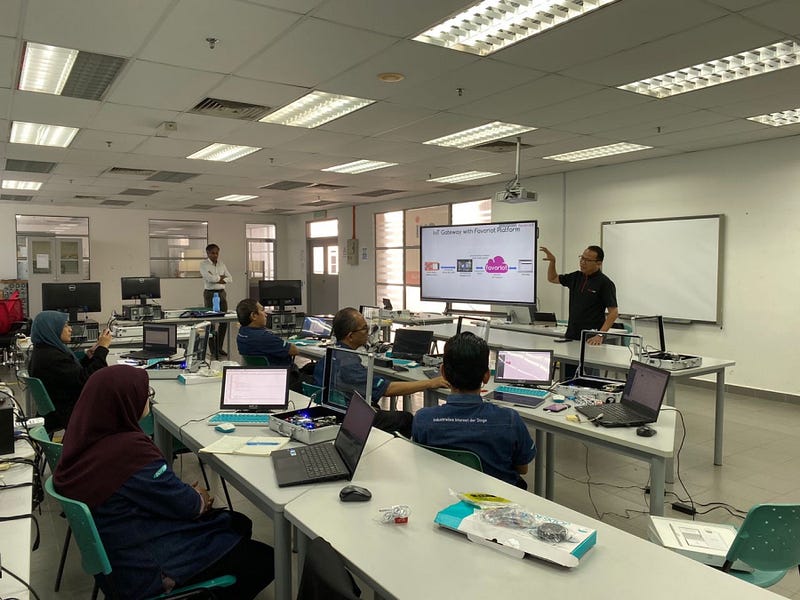
I knew I couldn’t give up. I had to keep working hard to introduce the Favoriot IoT Platform to the public. I began organizing many seminars and workshops to introduce this platform. I would stand in front of the participants each time and passionately explain the advantages of using Favoriot.

This platform is not just for students but also for professionals and large companies,” I always said. “It can be used for larger R&D projects and other commercial projects.

The Favoriot IoT Platform started to become well-known slowly. Users began to see the potential and benefits offered by our platform.

Finally, in 2024, we managed to get 80% of Favoriot platform users from Malaysia. Out of 8,800 users, the majority were from our own country.

I felt proud of this achievement. “We did it,” I told my team. “We have proven that we can compete with other platforms.

The Favoriot IoT Platform is now used to collect data for larger R&D projects and other commercial projects. Our journey is still long, but this success gives me confidence that we are on the right track.

(This story will continue in Part IV)

Want to read Part I & II?

View at Medium.comView at Medium.com