How We Build Our Third IoT Product

Favoriot IoT Platform is the third IoT product that we developed. This is the turning point of our business – To IoTise Every Business.

It took us nearly two years to build our first IoT product – Raqib. Mainly because we have so many things to do, and we are very new to this kind of IoT entrepreneurship.

Since Raqib is an end-to-end solution, we need to identify the partner for the hardware since we can’t build the wearable in-house. Furthermore, the devices need to send data and connect to our IoT platform, create a mobile app, and develop a CRM system.

In 2018, we started with a simple trial, and later in 2019, we were able to have our first few customers using the solution during their trip to Hajj.

As per the second IoT product, Favorsense, we built it within a year and quickly introduced it to the market. We received a lot of feedback which we used to improve the solution.

But then, we also realized that we already had our third IoT product, i.e., the IoT middleware itself, while building the rest of the ioT products. Still, we never thought of offering this solution to others. We have begun to get user feedback by allowing users to use it for free until we started charging them in March 2019.

The Problem Statement

When we built our first IoT product, we learned that it is such a massive effort and takes a lot of resources – time and money. The same goes for our second product. 

We decided if somehow we could collaborate with others to develop other IoT solutions by using our platform. We thought that the country had many IoT talents ready to build its IoT solutions, and we were wrong!

There are not many takers who can jump straight into the IoT world and build their IoT products. That’s when I realized the country is lacking this kind of talent? Where are they?

I am fortunate to be in many local Universities as their Industrial Advisory Panel or Adjunct Professors. That’s when we realized many of the current syllabi did not cover structured content about IoT. However, many universities are excited to get their students to select the IoT as their Final Year Projects (FYP). Still, unfortunately, many of the students have to learn on their own.

In the industry, they have started to get more interested in how IoT impacts their business but are unsure how to build or deploy their innovative solutions using IoT.

Even the whole ecosystem of IoT in Malaysia is not very strong because there are not many players as yet.

For Favoriot, we see this as an opportunity because our IoT platform can become the enabler to learn IoT and be used in commercial IoT deployment. 

How Big is the Market

According to Mordor Intelligence, the IoT market reached $761.4 billion in 2020 and is expected to reach $1.39 trillion by 2026. 

There are four (4) components in building end-to-end IoT solutions – Sensors, Connectivity, IoT platforms, and Applications. We have touched a sweet spot, i.e., to become a preferred IoT platform for any IoT deployments.

IoT was “officially” introduced in Malaysia in 2014 when the Nation launched its National IoT Strategic Framework. However, it seems to be early days, and it took some time to make people aware of its impact. However, IoT got another “jump-start” when Malaysia Industry 4WRD -National Policy on Industry 4.0 at the end of 2018.

In 2020, the world was hit by the Covid-19 pandemic, and many industries were affected by the lockdown—the idea of using emerging technologies to solve social distancing issues. Thus, the time for the IoT market to grow is about to begin.

The IoT Solution

The reasons why we want to offer our IoT platform as the third IoT product are as follows:

  • In every IoT deployment or project, there will be an IoT platform component. The idea is to deploy IoT solutions without involving high cost by using a Cloud-based IoT platform.
  • We are not able to build and customize to all user requirements.
  • We want to create a platform where the students can also use in their IoT projects.
  • This platform also can be used for Laboratory experiments.
  • Thus, the platform needs to be open and easily used with user-friendly APIs
  • The middleware comprises security, business rules, and notification engine and supports various protocols such as MQTT, CoAP, and REST.
  • Offer this as Platform-as-a-Service to allow as many users to subscribe to the platform and create their own innovative IoT applications easily while maintaining the ownership of their data.
  • Have the ability to charge the user in various subscription Plans such as Free, Beginner, and Developer Plans. Furthermore, we can also have a customized package and make it available on-premise.
  • Build a Generation-IoT (Favoriot) community that can share and learn each other’s projects and success stories.
  • Complete documentation, tutorials, GitHub, and forums are made available.
How to Choose an IoT Platform

Go-to-Market

Initially, we started offering the free package to the Universities in early 2019; we noticed not many active users. Many of them use other competitive platforms such as ThingSpeak, ThingsBoard, or Blynk. 

We realized that due to the unfamiliarity of the Favoriot platform and not many tutorials regarding the usage, we decided to compile as many use-cases, step-by=step tutorials made by some community members and upload them to our Favoriot YouTube channel.

I take the opportunity to introduce the Favoriot IoT platform in many of the invited talks, conferences, or webinars. Coupled with contests and special offers and bundled with training packages, we have reached more than 115 countries worldwide and more than 5300 users. 

We started with users subscribing to the platform themselves, but now we have begun engaging with corporate users by having customized solutions.
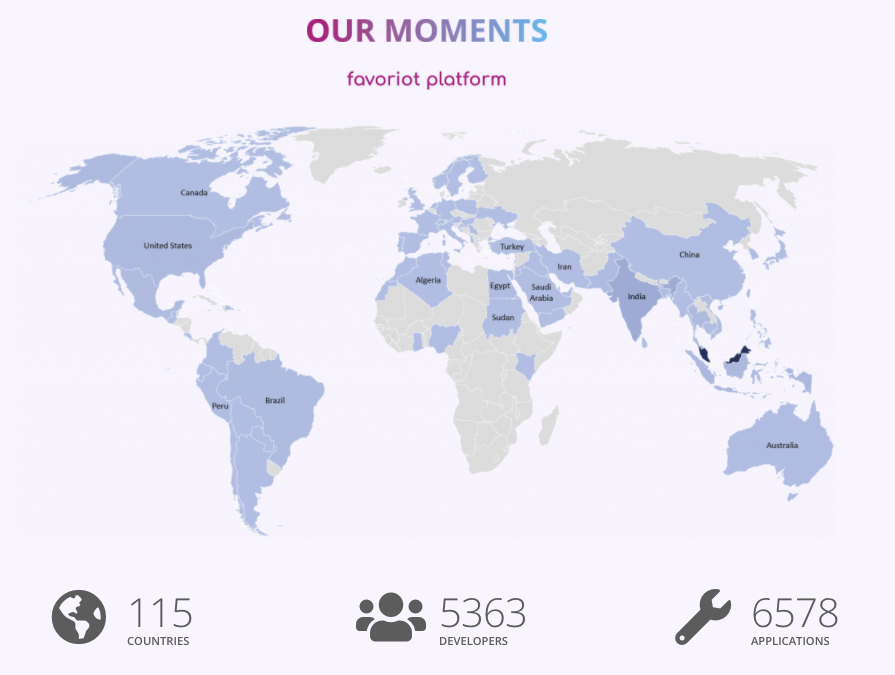
Favoriot Worldwide

The Growth Point

We have reached a stage whereby talents who graduated from the Universities are equipped with the knowledge of building IoT projects (and using the Favoriot IoT platform) more structured.

These new talents will become the catalyst for the growth of IoT in Malaysia and other countries around the world.

The IoT Adventure has become more enjoyable than ever!

Want to know more about our IoT Adventure?

  1. How We Build Our First IoT Product
  2. How We Build Our Second IoT Product
  3. How We Build Our Third IoT Product
  4. How We Build Our Fourth IoT Product
IoT Quotes by Dr. Mazlan Abbas

How We Build Our Second IoT Product

Here’s how we build our second IoT product targeted at Smart Cities.

In my previous article, our team set out to build our first IoT product called Raqib (formerly named Favorwatch). We also make another IoT product not so “IoT” in the proper definition because it involves humans to trigger the process. 

It is a mobile application that uses the GPS and camera, the phone’s sensors, and sends the data to a platform. We built this because, in our previous company, we have in-depth experience in building a similar solution. Still, now we take this opportunity to develop a new version.

The Problem Statement

City dwellers will always see problems in our city infrastructure and services daily – potholes, garbage unattended, faulty lights or traffic lights, vandalism, pipe bursts, fallen trees, and many others.

Usually, we will either make the usual complaint via phone or email the local councils. Sometimes, the reports are left unattended, or you might not be aware of the status of the information. Either you call again, or you might get too angry and rant on social media.

The moment it goes viral unnecessarily on radio, tv, or social media, the harm to the local council’s image is not reversible. Sometimes, a minor issue can become a piece of massive news on national media.

Thus, how do we avoid this problem from happening? How do we get a proper channel for the citizens to make complaints easily and have simple means to monitor the status of their complaints? 

How do we assist the local authorities to be more efficient in responding to the citizen’s complaints and be more transparent in their work? 

How do we portray the local council and the local politicians to be more responsible in managing their cities or areas? Can we use the app to build better intelligent cities?

How Big is the Market

In Malaysia, 21 City Councils, 42 Municipal Councils, and 91 District Councils manage their areas. Malaysia’s population is around 32.37 Million, and the big cities in Malaysia have more than 500,000 people each.

Some big cities in Malaysia have started to utilize mobile apps to allow citizens to complain directly to them, but many cities still don’t have that facility. 

Many still depend on phone calls, emails, or websites to receive complaints from their citizens.

Globally there a more than 10,000 cities worldwide. Thus, the market is still vast and untapped.

Official favorsense Video

The IoT Solution

The idea is to use the citizens to become part of the “sensors” to report issues in the cities. How do we capture and locate the report quickly? How do you make the invisible visible? If we are to deploy sensors everywhere, it can be very costly; thus, the idea of using the concept of “crowdsensing” intrigues us.

We choose to build a smartphone app because of the following reasons:

  • Almost all users have smartphones. It will become the device to help them capture the data.
  • A smartphone has a camera (the eye) and a GPS (location). It has built-in connectivity to send data to the cloud or platform.
  • Cheap to deploy and install.
  • When a user sees a problem, he will open the app and capture the photo. The app will automatically geotag the photo and time stamp to indicate the location and time of the actual report. We want to avoid a user uploading from his phone photo album because it will cause the issue of fake complaints (taking photos from a different place and reporting at another location)
  • It’s also easier to send the status of reports back to the person who makes that complaint.
Favorsense
Favorsense – Crowdsensing Cities Problems

However, the smartphone phone app is just one of the main components of the total solution. There are three more components:

(i) Crowdsensing Management Platform (CMP)

  • The authorities appointed an Admin responsible for handling all the complaints.
  • A trouble-ticket ID can be generated from every complaint received, and the Admin is responsible for escalating it to the relevant field force or contractor.
  • Once the contractor has resolved the issue, the Admin will be responsible for either accepting or rejecting the work.
  • The status of the report will be tracked and shown on a Timeline.

(ii) Field-Force

  • The contractor or the internal field force of the local authorities will receive all the jobs assigned to them.
  • The report will show the location and photo and can easily trace it back for resolution.
  • Once the job is completed, another image can upload as proof.

(iii) Insights

  • A simple dashboard shows the KPI of the Division that handles the cases, such as the status of the reports and closed, pending, and rejected cases, among others.
  • Such reports are made in real-time and accessible anywhere. The management needs to have instant access to these insights.

Go-to-Market Strategy

This IoT solution is Favorsense – a crowdsensing platform that allows users to make reports regarding any issues in the cities. It will automatically collect the actual “pain points” of the cities. Favorsense will be an excellent tool for city authorities to identify these problems and turn them into innovative city applications. Thus, the app can become an official way for local councils to engage with the citizens.

But how do we reach out to our target market, i.e., local councils? We started with a direct engagement with the local councils themselves, making presentations and proposals. Talking at Smart Cities conferences also helped us in reaching out to them. Events like conferences are the best place to meet and have first introductions.

However, we didn’t anticipate this council’s long sales cycle and tedious procurement process. Nowadays, we take a different approach whereby we work via MSCA (Malaysia Smart City Alliance). We have an earlier opportunity to share our proposal for any Smart Cities initiatives.

Similar to our first IoT product, the second IoT product also has challenges, especially going to the market. This will be shared in a different blog post (8 Top Challenges Building a Citizen Engagement App) as our IoT Adventure continues!

Articles worth reading next!

  1. How We Build Our First IoT Product
  2. How We Build Our Second IoT Product
  3. How We Build Our Third IoT Product
  4. How We Build Our Fourth IoT Product
Favorsense for Enforcement
old building at intersection in manhattan new york usa

“Build Smart Cities Through the Eyes of the Citizens.”

–Mazlan Abbas

How Silicon Valley Changed My View on the World of Startups

The visit to Silicon Valley companies changed my view about the world of Startups. Many started with a humble beginning. Technology was born here. Anything seems possible!

At the end of the 2016 visit, I had the opportunity to visit Silicon Valley with the MDEC delegation in the Silicon Valley Immersion Program. This trip transformed the way I look at entrepreneurship – “Anything is possible” and “Have a grand vision, and you can turn it into a reality” attitude.

I have never thought in my whole life to become an entrepreneur. All I think was to become a CTO in any big corporate organisation – that’s all. However, that business trip changed my whole life! On my return home, I decided to build a Startup in IoT – and that’s how FAVORIOT was born in early 2017.

The Inspiring Logos

For a first-time visitor, I was excited watching the Logos of famous companies on buildings, offices, parks, and shops – it’s the everyday hardware and software that we used back home. Hewlett Packard, GE, Cisco, Apple, Google, Facebook are among the logos that inspired me. My heart was beating fast to be at the place where the technology or product that I used daily was born!

The History

For any computer enthusiasts, the Computer History Museum at Mountain View is an excellent place to visit. You can see how computer history began here, starting with the vacuum valve to integrated circuits and the first PC and Apple computer. What you see in photos can now be seen physically, and that already amazes me. Imagine the power of our computers and smartphones begin with a small step from the brilliant minds of the inventors and innovators of Silicon Valley. For a first-time visitor, I was excited watching the Logos of famous companies on buildings, offices, parks, and shops – it’s the everyday hardware and software that we used back home. Hewlett Packard, GE, Cisco, Apple, Google, Facebook are among the logos that inspired me. My heart was beating fast to be at the place where the technology or product that I used daily was born!

Birth Place of Unicorns

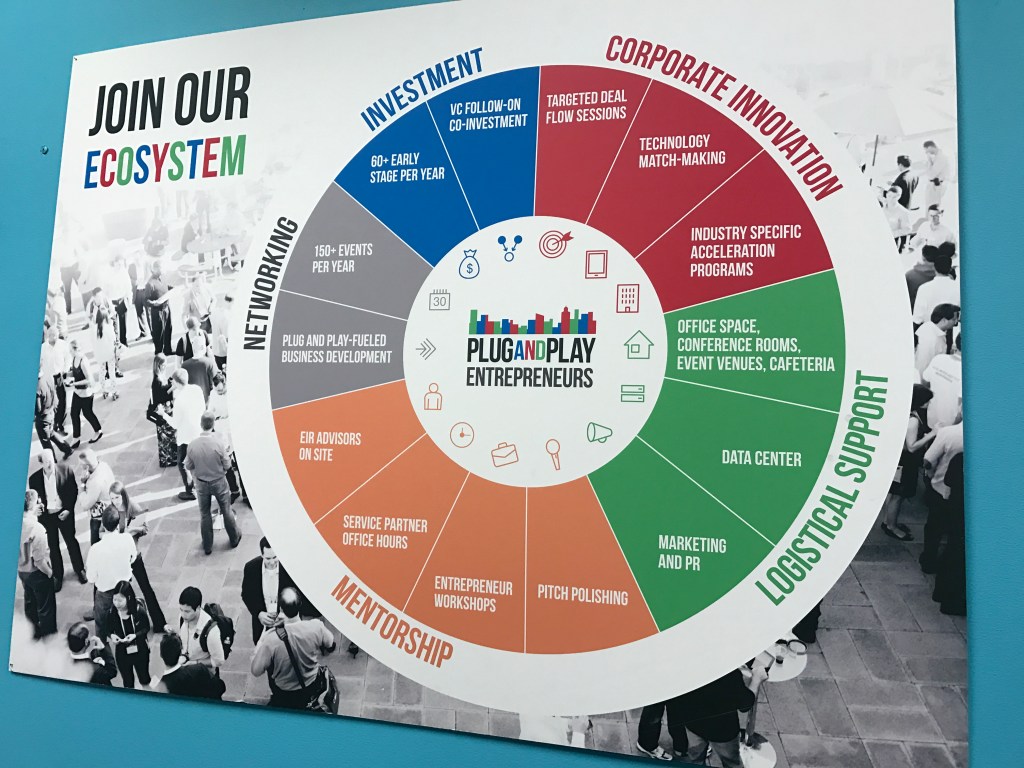
Many Unicorns started with a humble beginning, and some started at Plug and Play Tech Center. For example, Dropbox started from within a small cubicle in Plug and Play, and it has now valued at USD 10 Billion. Other examples are PayPal, LendingClub, Guardant, Hippo, and many others. Seeing that logos on their walls made you believe, “If they can do it, why can’t we?

Plug and Play

Pitching Valley

We had the opportunity to pitch in front of investors at Hero City, Draper University. It was a very nerve-wracking experience – even though we had practiced the pitch many times before arriving in Silicon Valley. It seems to pitch is like an everyday thing here, and you can either pitch on an official platform or pitch to an individual investor after the event. Personally, the term “pitch” is synonymous with a short talk to convince investors about your Startup.

Sharing Culture

Almost all the people we talked to here are amicable and keen to listen to our ideas and give constructive feedback. They are more than willing to recommend us to other parties if they see their peers or friends benefit from our solutions.

Startup Ecosystem

The place is always bursting with new ideas, and no one seems to get worried if their ideas get stolen or not. Maybe it’s because many of these ideas are not unique to them, and they would instead share with others so that they can help to improve the ideas further. There are so many Startup Founders and Investors, and you might be lucky if you happen to have lunch or dinner in a restaurant and meet them.

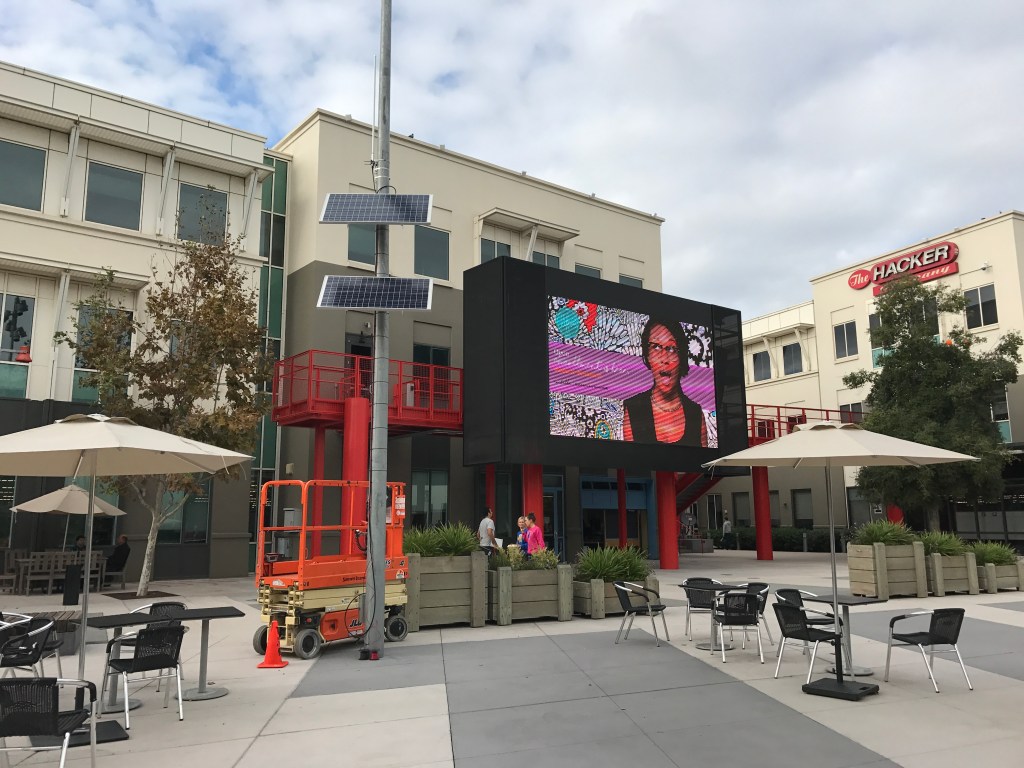
The highlight of the visit is the walk-around on Google and Facebook Campus. It’s like a small Google or Facebook city!

Google Campus
Facebook Campus

Anything is Possible!

The energy, enthusiasms, and excitement made you believe that your ideas could soar higher and conquer the world. Age doesn’t matter anymore – anyone can start their entrepreneurship journey with a small cubicle or co-working space. Ideas can spark quickly and maybe can fuse with other ideas to make it better. The conducive Startup ecosystem of supporting each other made you believe that you are not alone in this world, and everyone here seems to be open enough to help you.

I will share the rest of the entrepreneurship journey in another article – why I choose the Internet of Things (IoT) as our business focus and why we build the first IoT solution that we think can conquer the world!

Silicon Valley USA 2016 Trip

Year 2022 – The Death of Blogging

Yes – there’s a truth in this. That’s what they said a couple of years ago. However, there are many type of blogging such as personal journal, lifestyle, travel, health, technology and many others.

The trend for personal blogging have decline. People might no longer have interest to follow an individual daily activities, their families, trips etc. This type of content can easily followed via their social media channels such as Facebook or Instagram.

Entertainment vs Educational Blogs

However, blogs which covered specific topics that solve the reader’s problems would be the ones that have longer lifetime. The topics are more educational as compared to entertainment.

The contents for educational type of blogs can remained evergreen as people still searched the Internet for solutions.

So yes, people still read blogs. Multiple times a day, even! It just looks a little different because the content of blog posts has shifted from being writer-focused to being reader-focused. Blogs that focused on value to readers will have a higher reading rate.

This is something which I need to decide when I created Mazlan Abbas Blog – should it be personal blogging or a blog which is more educational such as the one I created at IoT World Blog.

Today, is my third day of blogging, and I will always monitor the traffic to see how the contents impact the traffic to the blog.

3-Days Stats
Demographics of Visitors

Why should you read and follow this Blog? If you want to read IoT contents, you may visit IoT World Blog, but here you will get constant updates about my journey in developing projects such as my Startup, FAVORIOT, Podcasts,, YouTube, Online marketplace and E-Books.

Sharing Platform

Along the way, I will share the ups and downs or probably some tips that we should avoid in building such projects. I hoped this will also become a platform to listen yo your ideas and thoughts too. Please leave you comments on the posts.

Are you ready to follow me on this journey?

Tips for Generation-IoT

Who are the Generation-IoT? Generation-IoT has been defined by Maciej Kranz in the article “Generation IoT: The Key to Business Survival in the 21st Century. Below are the traits of the Generation-IoT:

  1. They are pioneers in IoT.
  2. All are willing to learn and take risks and are good at building virtual teams internally and partnering externally.
  3. You can recognize these new winners not by their age or their titles — but by their ability to build and deploy agile, flexible business solutions.
  4. A new generation of leaders, makers, thinkers, and doers is meeting that change with flexibility and optimism and transforming it into opportunity.
  5. These are the people who see the transformational power of IoT-driven processes, business models, and new revenue streams.
  6. They are eager to champion and drive these opportunities in their organizations.
  7. These people know that IoT is not just one project, one training session, one change.
  8. They know that in order to succeed they and their organisations need to adjust and re-learn, over and over again.

But how do we encourage the growth of this new “generation”? We need them as many as possible to help us spur the whole industry. We need more fresh and innovative ideas to transform their own business or their customers. But how do we train them and get them ready to be absorb directly into organisations?

We can provide them with the necessary tools to start their journey. One of the common layer that glue the “hardware” and the “software” is the IoT middleware or the platform. The Generation-IoT must understand what are the necessary knowledge to build the electronic devices and find the necessary connectivity to the platform. But if they wish to build innovative IoT applications or using the data for the purpose of machine learning, they need to acquire this data from the IoT platform. They have a choice either to build or subscribe to any IoT platform. And currently, there are hundreds of IoT platforms worldwide as shown below.

[Source: Expert Advice for Generation-IoT]

IoT & IR 4 0 — Are You Ready for Jobs That Don’t Exist Yet?

The industry always complained that the talents that graduated from the local universities are not equipped with the latest knowledge. The industry expected the graduates that they hired can immediately start their job without sending them to further workshops or courses. The world is moving fast and thus it’s imperative to start contributing in the early part of the career. The employers are getting impatient as the competition heats up.

That’s why it’s important for the Universities to get feedback from their Industry Advisory Panel (IAP) to advice on the current technology and job trends. The lecturers too need to get involve in industry events to understand what’s the hottest job nowadays.

We know that the change the content of the syllabus or approving new programmes in the University can take months or sometimes 1–2 years. This would require the teaching staff to also equip themselves with the new knowledge. It’s a challenge nowadays to keep with the technological pace but that’s the reality.

Looking at the future technological trends and the business disruptions happening worldwide, the Universities should now anticipate what’s coming and to quickly adapt their current courses or programmes to match with the future jobs.

Check out the video below by Dr. Mazlan Abbas, CEO of FAVORIOT regarding this challenge.

FREE IoT eBooks for Download!

Download FREE IoT eBooks

I have decided to make two of my IoT eBooks available for FREE to anyone interested to download.

The first eBook is entitled “Your IoT Journey“. It is a compilation of my best and selected written articles which was published from my IoT World Blog. It’s not written in a very technical manner because the idea is to share the issues, challenges and the tips for anyone who’s interested to take the IoT journey. After several years, the topic about IR 4.0 become a hot one. But it also bring along confusion regarding the different Era of Industrial Revolutions.

The second eBook or rather eNotes entitled simply as “IoT Notes” was originally written to illustrate the complexity of IoT and IR 4.0 in a simpler way. I used GoodNotes application and my iPad Air to draw and add colours to the descriptions. Hopefully, this will become a companion notes to anyone who is learning IoT and IR 4.0.

Hope you enjoy the two eBooks and kindly share with others. Hopefully we can share the knowledge and create the next Generation-IoT.

  1. Your IoT Journey — Download
  2. IoT Notes (Compilation) — Download

IoT — The Fundamental Building Block of IR 4.0

IR 4.0 comprised of many technological building blocks. It is made of AI Block, VR/AR Block, Big Data Blocks, Blockchain Block, IoT Block and many others. However, IoT is seen one the most fundamental block for IR 4.0 is because it the source of collecting data either from people (using wearables with sensors) or things (using sensors) or environment (also sensors).

IoT — The Building Block

As many has said — “Data is King” or “Data is the New Currency”. However, I do believed, collecting raw data which is purely bits and bytes or the zeroes and ones or even numerical numbers are insufficient unless we can turn that data into something more meaningful that can answer the question of who, what, when or where. That is when the data is transformed into “knowledge”. And if it can answer the question of “how”, then it has been turned into “knowledge” and the best part is when it can answer the question of “why”, which is what we called “understanding”. And people make decision based on the understanding.

But the, how do we collect all the relevant data? Which is why it’s very important for us to begin with the right questions. The who, what, where and when can be gathered via relevant sensors such as RFID, GPS, clock, temperature, humidity, etc.

For some, IoT seems to be a very complex “technology” or rather a combination of several technologies. We need to know how sensors and the electronic devices can capture and send data through some for of connectivity. What are the various networks that can support efficiently the amount of data with an affordable cost. And how or where these data will be aggregated — will it be on a normal server with a simple database or will it be hosted on a cloud? What is the sensors came in different forms and protocols? How do we manage these devices?

And what can we do with all the data that has been collected? How should we displayed them — on simple historical or real-time graphs? Can we do more than just a dashboard and go beyond with some form of machine-learning? And how easily for us to manage the data with the never ending customer requests?

It’s important for us to know the various components in IoT and how it relates with each other so that when you embark on an IoT journey, it will be well-planned design and architecture.

[Originally published in IoT World]