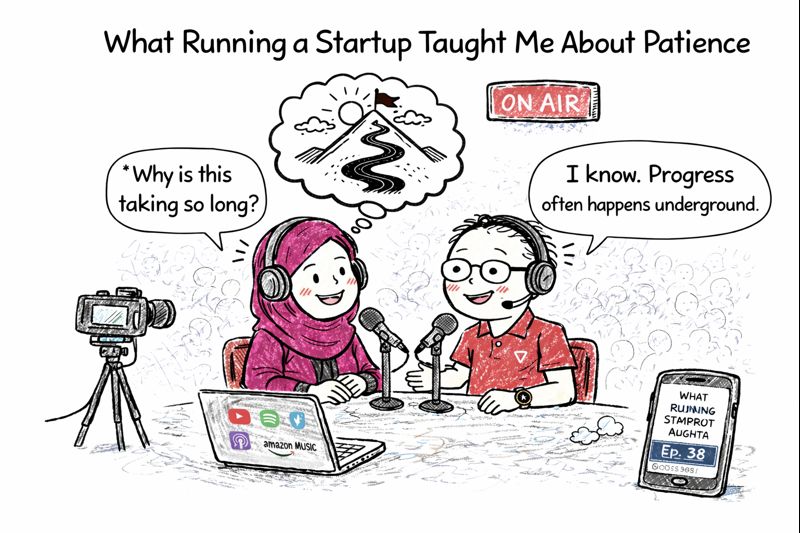
What Running a Startup Taught Me About Patience

Most people think startups teach you speed.

Move fast. Execute faster. Ship now. Fix later.

I used to believe that too.

Then I actually ran one.

And somewhere between missed targets, delayed deals, unanswered emails, broken assumptions, and quiet months where nothing seemed to move, I realised something unexpected.

Running a startup did not teach me speed first.

It taught me patience.

Not the polite, wait-in-line kind of patience.

But the stubborn, teeth-gritted, stay-the-course patience that only shows up when quitting would be easier.

I did not learn this lesson from books or talks. I knew it the hard way. Day by day. Year by year.

And often, while talking to myself.

Why is this taking so long?
Why does progress feel invisible?
Am I doing something wrong?

This is what running a startup feels like when nobody is watching.

The Early Myth: Effort Equals Immediate Results

When I first stepped into building a startup, I carried a simple mental model.

If you work hard enough, things move.
If you work longer hours, you see results faster.
If the idea is good, people will notice.

That belief did not survive long.

I remember days when I felt exhausted yet strangely empty. I had meetings, emails, plans, documents, and dashboards. Everything looked busy.

But externally, nothing changed.

No new customers.
No exciting announcements.
No visible breakthroughs.

This feels wrong, I thought. Shouldn’t the effort show results by now?

That was my first real encounter with patience. The uncomfortable kind.

Progress Often Happens Underground

One of the most critical lessons patience taught me is this.

Most progress in a startup happens where you cannot see it.

It happens in conversations that go nowhere today but matter next year.
It happens in drafts that never get published, but sharpen your thinking.
It happens in failed pitches that quietly improve the next one.

From the outside, it looks like stagnation.

From the inside, it feels like pushing a heavy object that barely moves.

I had to remind myself often.

Roots grow before branches.
Foundations come before buildings.
Understanding comes before momentum.

Patience is learning to trust work that hasn’t yet received applause.

Timing Is a Ruthless Teacher

There were moments when I was sure something should work.

The product made sense.
The message was clear.
The market seemed ready.

But reality disagreed.

People listened politely. Then disappeared.
Emails went unanswered.
Follow-ups ended with silence.

At first, I blamed myself.

Maybe I am not convincing enough.
Maybe the idea is flawed.
Maybe I started too late.

Only later did I realise another truth.

Sometimes you are early.
Sometimes the market needs to catch up.
Sometimes people need their own pain first.

Patience taught me to stop forcing doors that were not ready to open.

Not every no means never.
Some no simply means not yet.

Building Trust Is a Slow Craft

In startups, everyone talks about traction.

Users. Numbers. Growth charts.

But very few talk about trust.

Trust does not move at startup speed.
Trust moves at human speed.

I learned that credibility cannot be rushed.

People watch quietly.
They read what you write.
They observe how you respond when things do not work.

They take mental notes long before they ever reach out.

There were times when someone contacted us and said, “We have been following you for years.”

Years.

And I would pause.

All that writing. All that sharing. Someone noticed.

Patience taught me that consistency compounds even when feedback is silent.

The Loneliness of the Long Game

One part nobody warns you about is how lonely patience can feel.

When you are patient, you wait.
When you wait, you stand still.
When you stand still, it feels like everyone else is moving ahead.

You see announcements.
You see funding news.
You see loud successes on social media.

And you ask yourself quietly.

Am I falling behind?

Patience is staying in your lane while others sprint past you, not knowing who will last longer.

I learned to stop comparing timelines.

Every startup runs its own race.
Some are sprints.
Some are marathons.
Some are endurance climbs.

Mine taught me endurance.

Small Wins Are Not Small

Patience sharpened my ability to notice small wins.

A clearer conversation.
A better question from a customer.
A mistake was avoided because of a past failure.

Earlier in my career, I would have ignored these moments.

Now, I pay attention.

Because patience is not passive waiting.
It is active noticing.

Noticing progress that does not trend on charts.
Noticing growth that does not fit a slide deck.

These moments keep you sane when the big wins take time.

Control Is an Illusion

Running a startup slowly strips away the illusion of control.

You cannot control timing.
You cannot control decisions made in other boardrooms.
You cannot control the budget tightening elsewhere.

At first, this frustrated me.

If I just work harder, I can control this, I told myself.

Patience taught me a calmer truth.

You control effort.
You control preparation.
You control how you respond.

Everything else is negotiation with reality.

Once I accepted that, my energy shifted. Less panic. More focus.

Patience Does Not Mean Lack of Ambition

This is important.

Patience is often misunderstood as complacency.

It is not.

Patience is ambition with discipline.

It is knowing what you want while accepting that forcing outcomes usually backfires.

I still push.
I still aim high.
I still feel restless at times.

But patience gives that restlessness direction rather than panic.

The Quiet Confidence That Comes With Time

Something subtle changed over the years.

I stopped rushing to explain myself.
I stopped needing immediate validation.
I stopped chasing every shiny opportunity.

Patience built a quieter confidence.

Not the loud kind.
The grounded kind.

The kind that says, I know what I am building, even if it takes longer than expected.

That confidence is hard-earned. And fragile if you rush.

What I Would Tell My Younger Self

If I could sit across the table from my younger self, I would say this.

You are not slow.
You are early in the process.

You are not failing.
You are learning in public.

You are not stuck.
You are building something that needs time.

And most importantly.

Patience is not the absence of action.
It is action without desperation.

Closing Thoughts

Running a startup did not just teach me how to build products, teams, or strategies.

It taught me how to wait without giving up.

How to stay calm when timelines stretch.
How to keep showing up when results whisper instead of shout.
How to trust work that feels invisible today.

And if you are in that quiet phase right now, where effort feels heavy and progress feels distant, know this.

Patience is not wasted time.

It is preparation disguised as waiting.

I would love to hear your story.

What has patience taught you on your own journey?

Why Quiet Years Often Matter More Than Busy Ones

Some years shout.

They announce themselves with launches, awards, headlines, travel photos, packed calendars, and endless updates. They feel loud even before they are over.

Then some years barely whisper.

No fireworks. No dramatic milestones to post about. No big celebration dinners. Just long days, repetitive work, silent thinking, and a calendar that looks strangely empty from the outside.

For a long time, I feared those quiet years.

Am I falling behind?
Why does it feel like everyone else is moving faster?
Did I miss something important?

Only later did I realise something that changed how I look at time, work, and progress.

Quiet years often matter more than busy ones.

Not in obvious ways. Not in ways that attract applause. But in ways that shape everything that comes after.

Let me explain.

The Illusion of Busy Years

Busy years are addictive.

They make you feel relevant. Needed. In demand. Every week is filled with meetings, events, decisions, and quick wins. You move from one task to another with momentum. There is little time to question direction because speed itself feels like purpose.

I have lived through those years.

There were times when my calendar looked impressive. Meetings stacked back-to-back. Travel plans every month. Panels, talks, deadlines, emails at midnight. From the outside, it looked like progress.

Inside, something else was happening.

Thinking time disappeared.

Reflection became a luxury. Decisions were made reactively. You respond more than you choose. You move fast, but you are not always sure where you are heading.

This feels productive, I used to tell myself.
At least things are happening.

Busy years reward motion. Quiet years demand clarity.

What Quiet Years Feel Like

Quiet years feel uncomfortable at first.

Fewer external signals are telling you that you are doing well. Fewer invitations. Fewer people are checking in. Less validation. Your work becomes less visible and more internal.

Most of the effort goes into things that do not translate into instant results.

Reading.
Thinking.
Fixing fundamentals.
Rewriting plans.
Building systems that nobody sees yet.

You spend more time alone with your thoughts than with applause.

I remember sitting in the office late one evening during one of those quiet stretches. No urgent calls. No deadlines screaming for attention. Just me, a notebook, and an uneasy feeling.

Is this stagnation? I asked myself.
Or is this preparation?

That question stayed with me.

Quiet Years Are When Foundations Are Rebuilt

When everything is loud, you rarely touch the foundations. You are too busy adding floors.

Quiet years force you to look down instead of up.

You start noticing cracks you ignored before. Processes that no longer make sense. Assumptions that worked five years ago but feel wrong today. Goals that were inherited rather than chosen.

During quiet periods, I found myself revisiting basic questions:

Why are we building this?
Who are we really serving?
What should we stop doing?
What must work even when attention disappears?

These are not questions you answer in between meetings. They need space.

Quiet years give you that space.

They allow you to rebuild without pressure to perform for an audience. You can redesign systems, rethink direction, and strengthen weak links while nobody is watching.

By the time noise returns, the structure is already stronger.

The Invisible Compounding Effect

One of the hardest things about quiet years is that progress becomes invisible.

There is effort, but little evidence. Work is happening, but outcomes lag behind. You plant seeds without knowing which ones will grow.

This is where many people quit.

They mistake silence for failure. They assume that if nothing is visible, nothing is working.

I have learned that quiet years often hide compounding effects.

Writing without immediate readers.
Building products before the market is ready.
Training people who will only show results years later.
Documenting processes that will save time long after you forget writing them.

None of these produces instant feedback.

Yet, when momentum finally arrives, it feels sudden to outsiders.

Overnight success, they call it.

You and I know better.

Busy Years Consume Energy, Quiet Years Restore Direction

Busy years strangely drain energy.

Even when things go well, you feel stretched. Decisions pile up. Context switches exhaust the mind. There is constant urgency, even when nothing is truly urgent.

Quiet years slow things down.

Energy flows differently. Instead of being pulled in ten directions, it focuses on fewer priorities. You stop chasing everything and start choosing deliberately.

I noticed this shift clearly.

In busy years, my thinking stayed tactical. Solve this problem. Respond to that request. Fix today’s issue.

In quieter years, thinking became strategic again. Long arcs. Five-year questions. Structural changes.

If we continue like this, where will we end up?
What must be true for the next phase to work?

These questions do not scream for attention. They wait patiently.

Quiet Years Test Your Relationship With Ego

This might be the most uncomfortable part.

Busy years feed ego. Quiet years starve it.

When external recognition fades, you are left with one question.

Do you still believe in the work when nobody is watching?

I had to confront that question honestly.

There were moments when I missed the noise. The feedback. The sense of being visible. Quiet years strip away performance, leaving only intention.

If this never gets applause, would I still do it?
If progress takes longer than expected, do I still commit?

These questions reshape you.

They make motivation cleaner. Less dependent on reactions. More grounded in purpose.

The Trap of Measuring Life in Short Bursts

We live in a culture that celebrates bursts.

Quarterly results.
Monthly growth.
Weekly metrics.

Busy years fit perfectly into this worldview. They produce frequent updates and visible milestones.

Quiet years refuse to cooperate.

They stretch across time. They do not fit neatly into slides or social posts. They demand patience in a world that rewards speed.

I have come to see life less as a series of sprints and more as a series of seasons.

Some seasons are for harvesting.
Some are for planting.
Some are for repairing tools.
Some are for letting the soil rest.

Quiet years are not empty seasons. They are preparation seasons.

Why Many Breakthroughs Are Born in Silence

Look closely at most meaningful breakthroughs, and you will notice something.

They rarely happen during the noisiest periods.

They emerge after long stretches of thinking, trial, error, and refinement that nobody paid attention to at the time.

The idea matures quietly.
The skill sharpens privately.
The system stabilises out of sight.

Then one day, the world notices.

It looks sudden. It never is.

Quiet years create the conditions for breakthroughs. Busy years often only showcase them.

Learning to Trust Quiet Progress

Trust is hard when evidence is scarce.

During quiet years, you learn to measure progress differently.

Not by likes or invitations, but by questions such as:

Are decisions getting clearer?
Are mistakes repeating less often?
Is the team thinking more independently?
Do systems break less under pressure?

These signals are subtle. They require attention.

I started keeping private markers of progress. Notes to myself. Minor improvements that only I could see. They became reminders that something real was happening, even if it was not visible yet.

Stay with the process, I would tell myself.
Noise will come later.

When Quiet Years End

Quiet years do not last forever.

They give way to movement, visibility, and activity again. When that happens, the difference becomes obvious.

Decisions feel calmer.
Growth feels steadier.
Pressure feels manageable.

You are not scrambling to catch up. You are responding from a more substantial base.

People often ask what changed.

Nothing obvious.
Everything fundamental.

A Different Way to Look at Your Current Year

If this year feels quiet for you, pause before labelling it as wasted.

Ask yourself different questions.

What am I rebuilding right now?
What foundations am I strengthening?
What clarity am I gaining that I did not have before?

You might be in a year that will never make headlines but will quietly decide the next decade of your life.

Those years deserve respect.

Closing Thoughts

Busy years are visible. Quiet years are essential.

One without the other creates an imbalance. Noise without preparation leads to collapse. Preparation without patience leads to frustration.

I have stopped fearing quiet years.

I treat them as a sign that deeper work is happening. Work that does not ask for attention but shapes outcomes in lasting ways.

If you are in one now, stay with it.

Something important is forming, even if it has not yet learned to speak.

I would love to hear your thoughts.

Are you in a busy year or a quiet one right now?
What has it been teaching you?

Share in the comments.