AI Is Everywhere Today, But the Real Power Still Comes From Somewhere Else

There are moments when I sit back after a lecture, pack my bag, and feel a strange mix of pride and worry.

Pride because I have seen how far technology has come.

Worry because I know how easily we forget the foundations.

That Friday lecture on the relevance of IoT and the rise of AI stayed with me long after I left the room. Not because the topic was new. I have lived with IoT for more than a decade. It stayed with me because of the silence that follows whenever I ask a simple question.

Where does your data actually come from?

Everyone lights up when we talk about AI. Eyes widen. Phones come out. Someone mentions ChatGPT. Someone else talks about image generation, voice cloning, videos that look real enough to fool our parents and sometimes ourselves.

Then I bring up sensors.

And the room goes quiet.

I Have Seen This Story Before
I thought to myself, This feels familiar.

Back in 2014, when we published the national IoT roadmap, the words “Internet of Things” sounded foreign to many. We talked about low-powered networks, sensors, connected devices, and data that flows quietly in the background. At that time, most people were still trying to understand what IoT even meant.

Later came the Fourth Industrial Revolution hype. AI, blockchain, cloud, analytics. Big words. Big slides. Big expectations.

Then COVID arrived and forced everyone online. Suddenly, digitising forms was no longer optional. Meetings went virtual. Systems moved to the cloud. People realised something uncomfortable.

We were talking about advanced technologies, but many organisations were still doing basics by hand.

We wanted intelligence without instrumentation.

The Quiet Truth About AI

Here is the uncomfortable truth that does not trend well on social media.

AI without data is just hope.

AI without sensor data is mostly guessing.

Most of the “intelligent” things people want today depend on time-based data from the physical world. Energy usage. Temperature. Vibration. Traffic flow. Air quality. Machine health. Human movement.

All of these begin with IoT.

When someone says they want predictive insights, I gently ask, How long have you been collecting data?

When they say they want anomaly detection, I ask, Do you know what normal looks like for your system?

These are not trick questions. They are reminders.

AI does not magically appear. It grows from data that has been quietly collected, cleaned, and understood over time.

Dashboards Make Us Feel Safe

I have seen countless dashboards.

Beautiful charts. Moving lines. Big screens in control rooms. Red, amber, green indicators blinking politely.

And yet, I always ask myself, What decision changed because of this screen?

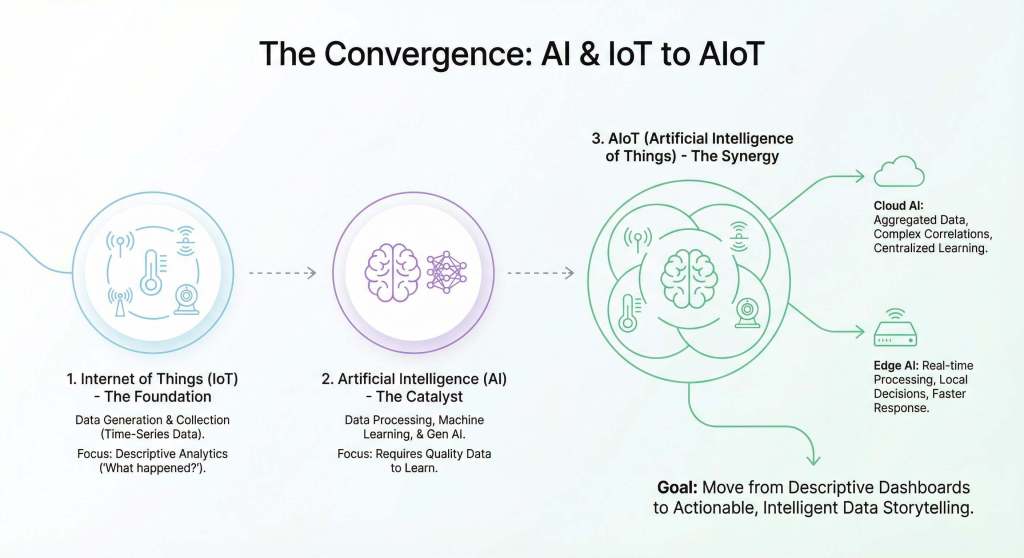
Dashboards tell us what has already happened. That is useful, but limited. It is like driving while looking only in the rearview mirror.

What people really want is to know why something is happening. Or what might happen next. Or what they should do about it.

That is where analytics, machine learning, and edge intelligence come in.

But none of that works if the data is poor, sparse, or misunderstood.

The Rise of Edge Thinking

One part of the lecture that excited me was the discussion of edge intelligence.

I remember thinking, This is where things finally feel grounded.

Not every decision needs to travel to the cloud and back. Cameras detecting unusual behaviour. Machines sense abnormal vibration. Safety systems reacting in milliseconds.

These decisions must happen close to where the data is created.

That requires discipline in how we design systems. What runs on the device. What runs centrally. What gets escalated to humans.

Technology is not just about speed. It is about trust.

Why IoT Feels Invisible Now

IoT has become so normal that people barely talk about it anymore. It works quietly. Sensors sit on walls, poles, machines, and vehicles. Data flows without fanfare.

AI, on the other hand, talks loudly. It writes. It draws. It speaks. It performs.

So attention shifts.

But I keep reminding myself, and my students, that the loudest technology is not always the most important one.

AI sits atop IoT, not beside it.

Universities Are Catching Up, and That Gives Me Hope

One of the most encouraging things I see today is how universities are changing.

Students are no longer just learning theory. They are building devices. Choosing protocols. Sending data into platforms. Visualising it. Asking questions. Experimenting with machine learning.

When students understand the full journey of data, from sensor to insight, something clicks.

They stop chasing shiny features.

They start thinking like builders.

A Subtle Lesson From the Field

Over the years, working closely with real deployments, I have learned something simple.

Systems fail not because of a lack of intelligence, but because of a lack of patience.

AI needs time. IoT needs consistency. Data needs care.

Platforms that respect this reality are the ones that last. I have always believed that an IoT platform should quietly support learning, experimentation, and growth without demanding attention. It should help teams move from visibility to understanding, and later to confidence.

That philosophy has shaped how we build things at Favoriot. Not chasing headlines, but supporting people who want to do the hard work properly.

Advice I Keep Repeating to Myself

As I reflect on that lecture, I find myself repeating a few reminders.

Do not rush AI before you understand your data.

Do not replace thinking with automation too early.

Do not trust dashboards that cannot explain themselves.

Do not ignore sensors just because they are quiet.

Most importantly, do not forget that technology exists to help humans make better decisions, not to impress them.

Progress is not about who adopts AI first.

It is about who builds understanding that lasts.

If this reflection resonates with you, share your thoughts. I would love to hear how you are balancing IoT and AI in your own work, and what lessons you are learning along the way.

The Story Behind Favoriot – Part 12: The Dream of M&A Exit

I had this ultimate dream that many of us have when we start a company: that grand exit.

Why Startups Opt for This Path

The idea of an IPO—the pinnacle where our company becomes publicly listed, and the rewards are far beyond what we’ve ever imagined—can feel like the ultimate destination.

The dream is intoxicating.

But the reality is far more complex. The path to an IPO isn’t a straight highway; it’s a winding trail filled with unexpected challenges, tough decisions, and occasional compromises.

When I started, the vision seemed crystal clear—build something valuable, scale it, and eventually take it public.

Sounds simple, right? Well, that was naïve Mazlan talking.

I remember those early days vividly. The excitement was palpable.

We had endless discussions about Pre-Seed, Seed, Series A funding rounds. The belief was strong: If we just worked hard enough and stayed smart, we’d be among the chosen few to make it to an IPO.

But as time passed, reality caught up with me. That dream, while not impossible, was far from guaranteed.

The Harsh Reality of IPOs

Achieving an IPO isn’t just about having a good idea or even a great product. It’s about building a business with substantial revenue, stable income, and scalable global operations.

And that’s not something you accomplish overnight—or even in a few years.

It requires relentless innovation and flawless execution over a long period, often under the unforgiving scrutiny of investors and competitors.

Even then, the odds remain slim. Many founders, myself included, have faced the tough decision: Do we keep pushing toward the elusive IPO, or do we consider an alternative exit like a merger or acquisition (M&A)?

The Case for M&A: When the Alternative Makes Sense

Selling the company—especially to a larger corporate entity—can seem attractive when scaling becomes overwhelming. But here’s the thing: selling is not just about cashing out.

It’s about finding the right buyer who sees the real value in what you’ve built. Sometimes, that value lies in your technology, team, or even your foothold in a specific market.

When I started exploring M&A options, I quickly learned that companies acquire startups for various reasons. Let’s break it down.

1. Technology Acquisition

One of the most common reasons large corporations acquire startups is to gain access to cutting-edge technology. Developing something innovative in-house takes time, resources, and risk. Bureaucratic layers in big companies make it hard to iterate quickly or pivot when things go wrong.

Acquiring a startup that has already proven its worth is often the fastest route to innovation.

I’ve seen firsthand how some startups became prime targets because they had unique technology that a larger company couldn’t replicate. It’s faster—and often cheaper—for the big players to buy a startup than to build it from scratch.

2. Talent Acquisition or “Acqui-Hiring”

Talent is the lifeblood of innovation. However, finding skilled people with a startup mindset is incredibly difficult in today’s market, and large corporations know this all too well.

Sometimes, the quickest way to bring fresh talent into the organization is to acquire a startup outright.

I’ve seen startups being acquired just for their talent. This process, known as “acqui-hiring,” may not be the dream exit for every founder, but it can be a viable and profitable option. It also allows team members to take on more prominent roles within the acquiring company, often with more resources at their disposal.

3. Market Access

Startups are nimble. We can pivot quickly, explore niche markets, and enter spaces that larger corporations might overlook or deem too risky.

Larger companies often want in once a startup proves that a market is viable. Acquiring the startup becomes their fastest way to capture that market without starting from scratch.

I’ve experienced this scenario personally. Big companies aren’t constantly chasing technology alone; sometimes, they’re after the customer base and market positioning that the startup has painstakingly built.

4. Killing the Competition

Here’s the darker side of M&A.

In highly competitive industries, some companies acquire startups just to shut them down. It sounds counterintuitive, right?

But it happens. A large corporation might see a startup as a potential threat—not because it’s taking market share now, but because it could in the future. By acquiring and dismantling the startup, they eliminate a competitor before it becomes a problem.

Reflecting on Personal Experiences

I was once approached by a large corporation interested in acquiring my startup. They were impressed with our technology and saw it as a perfect fit for their portfolio. I remember sitting down and thinking, “Is this the right move? “Would selling mean giving up control of something I’ve poured my heart and soul into? “

These decisions aren’t easy. You start questioning everything:

  • Am I ready to let go?
  • Will my team thrive in a corporate environment?
  • What happens to my vision once I step away?

Looking back, I realize that exits—whether through an IPO or an acquisition—are just milestones, not the end goal. The real value lies in the experiences, lessons learned, and impact you make.

Advice to Founders Contemplating an Exit

If I had to offer advice to fellow founders considering their exit strategy, it would be this:

  • Don’t rush the decision. Take your time to evaluate all your options.
  • Think beyond the financials. Consider what’s best for your personal and professional growth.
  • Stay true to your vision and values. The right exit will come when the timing is right.

Ultimately, whether you exit through an IPO, an acquisition, or by moving on to your next venture, what matters most is that you’ve built something meaningful. Something that made a difference.

And that’s a legacy no exit strategy can ever take away.

Final Thoughts: Building for the Journey, Not Just the Exit

The dream of a grand exit might be what fuels many of us in the early days, but as the journey unfolds, you realize it’s about much more than that.

It’s about the people you meet, the obstacles you overcome, and the solutions you bring to life. It’s about the lives you touch and the legacy you leave behind.

If you’re building a startup, remember this:

Don’t just build for the exit. Build for the journey.

The exit will take care of itself when the time is right.

More Favoriot Entrepreneurship Stories

  1. The Story Behind Favoriot – Part 11: The Rocky Road of Smart Cities
  2. The Story Behind Favoriot — Part 10: Age Does Not Matter in Business
  3. The Story Behind Favoriot — Part 9: Leaving the Comfort Zone
  4. The Story Behind Favoriot – Part 8: The Frustration of Unanswered Emails and Missed Opportunities
  5. The Story Behind Favoriot – Part 7: The Task of Finding Favoriot’s First 10 Customers
  6. The Story Behind Favoriot – Part 6: Expanding The Business Models
  7. The Story Behind Favoriot – Part 5: Finding the Right Fit
  8. The Story Behind Favoriot – Part 4: How Favoriot Became More Than Just an IoT Platform
  9. The Story Behind Favoriot – Part 3: Why No One Wanted Our IoT Platform—And How We Turned It Around
  10. The Story Behind Favoriot – Part 2: Turning Failures into Milestones
  11. The Story Behind Favoriot – Part I: The Humble Beginnings of Favoriot

Understanding the Difference Between AI Agents and Agentic AI: My Take with Real-World Examples

When I first came across the term Agentic AI, I instinctively brushed it off as just another buzzword. Isn’t this just another AI agent with a fancy name? After all, we’ve been living with AI agents for quite some time—chatbots, virtual assistants, and recommendation engines—all working tirelessly behind the scenes. But the more I read about it, the more I realised that Agentic AI is not just an incremental improvement; it’s a whole new level of intelligence and autonomy.

Let me start by explaining the basics: What is an AI agent, and what makes Agentic AI so different?

AI Agents: The Reliable Taskmasters

Think of an AI agent as your dependable assistant. It performs specific tasks based on well-defined rules and algorithms. It doesn’t think beyond its programmed scope, and it certainly doesn’t surprise you with any independent decisions. In fact, you could say it’s like a diligent clerk who follows instructions to the letter without question. It gets the job done—no more, no less.

Here are a few examples of AI agents that you’ve probably interacted with:

  1. Customer Support Chatbots:
    Imagine you’re on a website trying to reset your password. You type your question into a chat window, and the bot quickly provides a step-by-step guide. You’ll get your answer in seconds if your question falls within its programmed scope. But if you ask something more complex about a unique error message, it politely directs you to a human representative.
    That’s a classic AI agent. Efficient for routine tasks but limited in scope.
  2. E-commerce Product Recommendation Engines:
    You browse for a new smartphone on your favourite online store. The AI behind the scenes tracks your clicks, analyses your preferences, and suggests related products like phone cases or screen protectors. It works based on data patterns, but it doesn’t truly understand why you want a particular product. It just knows how to push related items your way.
  3. Virtual Personal Assistants (to a Limited Extent):
    AI assistants like Siri or Google Assistant can tell you the weather, set reminders, or give directions. But try asking them to solve a complex, multi-step problem, and they’ll quickly hit their limits. They’re programmed to help with specific tasks—not to independently pursue a goal or adapt in real time.

In short, AI agents are practical tools. They’re predictable, reliable, and perfect for repetitive or straightforward tasks. But they cannot go beyond what they’ve been programmed to do.

Agentic AI: The Autonomous Strategist

Now, here’s where things get exciting. Agentic AI is not just about following instructions—it’s about adapting, learning, and making independent decisions based on broader goals.

If an AI agent is a clerk, then Agentic AI is more like an experienced project manager who understands the bigger picture. It doesn’t wait for step-by-step instructions. Instead, it analyses the situation, sets its own goals, and figures out how to achieve them—all while adapting to changing circumstances.

Let me give you some real-world examples to illustrate how Agentic AI stands apart:

  1. Autonomous Financial Analysts:
    Imagine an AI system that monitors the stock market in real time, identifies investment opportunities, and makes decisions without human intervention. Unlike traditional AI agents, which might only send alerts or generate reports, Agentic AI can buy and sell stocks, adjust its strategy based on market trends, and learn from past mistakes.
    This isn’t just automation; it’s a new level of autonomy and adaptability.
  2. Drug Discovery in Pharmaceutical Research:
    In the field of drug discovery, Agentic AI systems can predict how molecules will behave, propose new compounds, and optimise chemical synthesis processes—all without human guidance. These systems reduce the time it takes to develop new drugs from years to months.
    Think about that for a second—AI independently proposing and testing new drugs! That’s Agentic AI in action.
  3. Autonomous Vehicles (Beyond Self-Driving Cars):
    When people hear about autonomous vehicles, most think of self-driving cars. But Agentic AI goes further. Imagine an AI managing an entire fleet of autonomous delivery drones. It not only plans optimal delivery routes but also adapts to changing weather, traffic conditions, and customer demands without a single human intervention.

My Take: Why This Difference Matters

When I first tried to wrap my head around the difference between AI agents and Agentic AI, I struggled. I thought, Does this really matter in the grand scheme of things? Aren’t they both just AI doing what AI does best—helping us?

But the more I thought about it, the more significant this distinction was. AI agents are like tools that extend our abilities. At the same time, Agentic AI represents an entirely new collaborative partner that can take the initiative, learn, and adapt in ways we never thought possible.

Imagine the potential:

  • Businesses could rely on Agentic AI to autonomously manage entire operations, reducing human workload and enabling employees to focus on creative, high-level tasks.
  • In healthcare, Agentic AI can monitor patients, adjust treatments in real-time, and even predict potential complications before they arise.
  • Governments could use Agentic AI to manage smart city infrastructures, balancing energy consumption, traffic flow, and public safety without human intervention.

What Could Go Wrong?

Of course, this kind of autonomy comes with risks. We’re entering uncharted territory. What happens when Agentic AI makes decisions that conflict with human values or priorities? How do we ensure it remains aligned with our goals?

We need to grapple with these questions as we embrace this new wave of AI technology. It’s exciting, but it’s also a bit intimidating. How do we strike the right balance between autonomy and control?

Final Thoughts

Understanding the difference between AI agents and Agentic AI isn’t just an academic exercise—it’s essential for anyone working with technology today. AI agents will continue to play an important role in handling routine tasks, but the future belongs to Agentic AI.

The next time you interact with a chatbot or an AI-powered system, think about where it falls on this spectrum. Is it an AI agent, just following a script? Or is it something more—an independent strategist capable of adapting, learning, and making decisions on its own?

Personally, I can’t wait to see how Agentic AI evolves.

It’s not just about making life easier but redefining what’s possible.

Harnessing the Power of Positive Thinking: Your Blueprint for a Resilient Mindset

In life, it’s easy to get caught up in negativity, especially when things don’t go your way.

You’ve probably faced days when problems felt overwhelming and solutions seemed out of reach.

But what if you could change how you respond to those challenges?

By shifting your mindset and adopting positive thinking, you’ll not only navigate difficulties more effectively but also improve your overall well-being.

Let’s break down how you can cultivate this powerful mindset in your everyday life.

1. Understanding Why Mindset Matters

Think of your mindset as the lens through which you view the world. If that lens is clouded with negativity, everything appears difficult and discouraging. On the flip side, when you approach life with a positive mindset, obstacles become opportunities, and failures turn into valuable lessons.

Positive thinking isn’t about ignoring reality or pretending that everything is perfect. It’s about controlling your response to what happens around you. Instead of focusing on problems, you’ll start seeing solutions. Science supports this idea too—research shows that positive thinking reduces stress, improves mental health, and helps build stronger relationships.

2. Spotting Negative Thought Patterns

You can’t change what you don’t notice. Pay close attention to your inner dialogue. How often do you catch yourself thinking things like:

• “I’ll never succeed at this.”

• “Why does this always happen to me?”

• “I’m just not good enough.”

These negative thought patterns don’t just lower your confidence; they also limit your potential. But here’s the good news—you can rewire your mind by replacing these thoughts with empowering alternatives.

Action Tip: The next time a negative thought pops up, challenge it. Ask yourself: “Is this thought helping me? How can I reframe it?”

For instance, change “I’ll never succeed” into “I’m learning and getting better every day.”

3. Daily Habits to Cultivate Positivity

Adopting a positive mindset takes practice, but small daily habits can make a big difference. Here’s how you can get started:

Start Your Day with Gratitude

Every morning, write down three things you’re grateful for. It could be as simple as a good night’s sleep or a supportive friend. This simple act shifts your focus from what’s lacking to what’s already abundant in your life.

Surround Yourself with Positivity

You are the sum of the people you spend the most time with. If your circle is full of negative energy, it’s time to rethink who you let into your space. Seek out people who uplift you, inspire you, and share your enthusiasm for growth.

Limit Negative Inputs

The news, social media, or even toxic conversations can drain your energy. While staying informed is essential, be mindful of how much negativity you consume. Take breaks and protect your mental space.

Learn from Setbacks

Failures are inevitable, but how you react to them makes all the difference. Instead of dwelling on what went wrong, focus on what you can learn. Each failure is a step closer to success.

Practice Positive Self-Talk

Your inner dialogue can be your biggest supporter or harshest critic. Treat yourself with the same kindness and encouragement you would offer a close friend. Speak words that build you up rather than tear you down.

4. Self-Talk: Your Inner Coach

Imagine you’re about to give an important presentation, but anxiety creeps in. Your inner voice starts whispering: “What if I mess this up? Everyone will think I’m a failure.”

Now, pause for a second. What if you could switch that voice into an encouraging coach instead? “I’ve prepared for this. I’m ready. I’ve got this.”

Talking to yourself isn’t strange—it’s a powerful tool for realigning your thoughts. When self-doubt creeps in, speak to yourself out loud as you would advise a friend. You’ll be surprised how much clarity it brings.

5. Positivity as a Leadership Tool

If you’re in a leadership role—whether at work, in your family, or within your community—your mindset directly impacts those around you. Your energy is contagious. When you stay calm, focused, and optimistic during tough times, others will follow your lead.

As a leader, it’s essential to model the mindset you want others to adopt. It’s not just about solving problems; it’s about showing resilience and inspiring those around you to keep pushing forward.

6. The Ripple Effect of Positive Thinking

Positivity doesn’t just benefit you—it creates a ripple effect that spreads to those around you. Your friends, family, and colleagues will notice the shift. They’ll feed off your energy and feel more encouraged to approach life with the same optimism.

When you choose positivity, you’re not just improving your own life; you’re making the world around you a little brighter too.

7. A Daily Commitment to Growth

Positive thinking isn’t a one-time fix; it’s a lifelong practice. Some days will be easier than others, and that’s okay. What matters is your commitment to getting back on track when negativity creeps in.

Remind yourself: “I have the power to choose how I respond to this.”

Embrace the Power Within You

Your thoughts are more powerful than you realise. They shape your reality and dictate your actions. By adopting positive thinking, you open yourself up to endless possibilities. Start small—replace one negative thought today. Add a daily gratitude practice. Surround yourself with uplifting influences.

With time, you’ll notice the shift—not just in your mindset but in every area of your life. You’ll become more resilient, more confident, and more equipped to handle whatever comes your way.

The power of positive thinking is within your reach. The only question is: Are you ready to harness it?

Let me know if you want this expanded with more personal anecdotes or examples!

The Story Behind Favoriot – Part 11: The Rocky Road of Smart Cities

The Allure of Smart Cities

When I first entered the world of Smart Cities in 2015, I was brimming with excitement. The concept was mesmerizing — technology could transform urban living, making cities more efficient, sustainable, and responsive to the needs of their citizens.

Imagine a city where traffic jams are minimized through intelligent transportation systems, waste collection is optimized, and city services are seamlessly integrated into residents’ lives. It was hard not to get excited about being part of this transformation.

However, what seemed like an adventure full of promise quickly became a reality check. I soon realized that the road from idealism to realism was filled with unforeseen challenges, complex processes, and harsh lessons. The idea of Smart Cities was perfect on paper but far more complicated in practice.

The Birth of an Idea: A Reporting App for Citizens

It all began with a simple yet ambitious idea — a citizen reporting app called Favorsense. This app would allow people to report issues like potholes, broken streetlights, and uncollected trash directly to local councils.

Not only that, but users could also track the progress of their complaints, bringing a new level of transparency and accountability to local governance. We believed we had created the perfect solution for improving city management. Our plan was to roll it out to all local councils across Malaysia through a cloud-based system. It felt like a game-changer.

Initial Optimism: “How Hard Can It Be?”

I remember thinking, “Surely, local councils will embrace this innovation!” After all, who wouldn’t want to improve city services and engage better with citizens? The app could streamline operations and boost efficiency overnight.

But my optimism didn’t last long. The first few meetings with local councils were eye-opening, and the challenges were more significant than I had anticipated.

The Harsh Reality: An Open Can of Worms

The first major hurdle was convincing local councils to adopt and pay for the system. It wasn’t that they didn’t see the value; it was more about what the app would reveal.

The app was like an open can of worms. It exposed inefficiencies and shortcomings in city services that many preferred to keep hidden. Some council representatives resisted, saying, “We can build this ourselves.” Others attempted to create their own versions, only to end up with poorly developed solutions that didn’t work.

The Sobering Realization: “Why Isn’t Anyone Using It?”

Once the app was launched, another issue arose: nobody seemed to use it. Despite its simplicity and functionality, citizens remained unaware of its existence.

The question haunted us: “Why isn’t anyone using it?” We had assumed that just building a great app would be enough to drive adoption. Unfortunately, we learned that even the best ideas need proper promotion and education to succeed.

Copycats and Tough Decisions

As if things weren’t challenging enough, we soon saw copycat apps emerge. Competitors replicated our idea, flooding the market with similar solutions.

It was disheartening. After some time, we made the difficult decision to stop supporting the app. This was a painful lesson in the realities of the Smart Cities market—not every great idea translates into success.

Nine Years of Persistence

Fast forward nearly nine years, and my company, FAVORIOT, is still trying to penetrate the Smart Cities segment. It’s been a long and challenging road. We even joined the Malaysia Smart City Alliance Association (MSCA), hoping it would provide easier market access.

Being part of the alliance did offer new perspectives, but the reality was still complicated. Building Smart Cities in Malaysia is a long and tedious process, fraught with uncertainties and obstacles.

The Complexity of Building Smart Cities in Malaysia

One of the most common questions I hear from local councils is, “Where do we even start?”

Without clear Smart City Indicators to guide them, many cities don’t know how to begin their transformation. There is a lack of a unified vision, confusion about priorities, and an overwhelming sense of inertia.

Talent Gap and Slow Decision-Making

Another significant challenge is the talent gap. Many local councils lack professionals with the expertise to manage Smart City initiatives.

Decision-making is painfully slow, with proposals often stuck in layers of bureaucracy.

And then there’s politics. Decision-making in public projects often involves political interests, making things even more complicated.

The Funding Dilemma

Perhaps the biggest challenge of all is funding. Most local councils don’t have the budget to implement Smart City solutions. When they seek financing, they often turn to private companies with a risky proposition:

“We want you to fund everything upfront. Maybe you’ll see a return on your investment later.”

It’s a tough sell because most local council services don’t generate revenue. Their true value lies in cost savings, operational efficiency, and improved quality of life for citizens — concepts that don’t always resonate with decision-makers seeking immediate financial returns.

Greenfield vs. Brownfield Cities

Not all cities are created equal. Greenfield cities — built from scratch — have different challenges than brownfield cities, which are older and more developed.

Each type of city presents unique obstacles, making it difficult to scale solutions across multiple locations. What works in one city may fail in another, adding to the complexity of Smart City projects.

The Frustration of Endless Trials

I’ve also encountered the frustrating trend of endless trials. “Let’s start with a proof of concept,” they often say.

However, many of these trials never progress beyond the testing phase. They fizzle out, leaving everyone involved feeling disillusioned.

The Reality of Smart Cities in Malaysia

Whenever I hear someone proudly mention the number of Smart Cities launched in Malaysia, I approach it cautiously. Many so-called Smart Cities are proof-of-concept projects that never complete full-scale implementation.

A Strategic Shift: Diversifying Beyond Smart Cities

Given the challenges, we had to make some tough decisions at FAVORIOT. While we remain involved in Smart Cities, we’ve diversified our focus. We started taking on other IoT projects in industries like manufacturing and agriculture.

We couldn’t afford to put all our eggs in the Smart Cities basket. It was a matter of survival.

Balancing Ambition with Practicality

I’m still passionate about the potential of Smart Cities, but I’ve learned to balance ambition with practicality. Not every solution will become a commercial success, and that’s okay.

Smart Cities are an exciting concept, but they’re also highly complex. We must be smart about where we invest our time and resources.

Reflecting on the Journey

Looking back, the journey has been both humbling and enlightening. The Smart Cities market wasn’t the easy win I had imagined. Still, the experience taught me valuable lessons about persistence, adaptability, and the realities of innovation.

Who knows? The next big breakthrough may be just around the corner.

Until then, we keep moving forward — wiser, more resilient, and ready for whatever comes next.

More Favoriot Entrepreneurship Stories

  1. The Story Behind Favoriot – Part 11: The Rocky Road of Smart Cities
  2. The Story Behind Favoriot — Part 10: Age Does Not Matter in Business
  3. The Story Behind Favoriot — Part 9: Leaving the Comfort Zone
  4. The Story Behind Favoriot – Part 8: The Frustration of Unanswered Emails and Missed Opportunities
  5. The Story Behind Favoriot – Part 7: The Task of Finding Favoriot’s First 10 Customers
  6. The Story Behind Favoriot – Part 6: Expanding The Business Models
  7. The Story Behind Favoriot – Part 5: Finding the Right Fit
  8. The Story Behind Favoriot – Part 4: How Favoriot Became More Than Just an IoT Platform
  9. The Story Behind Favoriot – Part 3: Why No One Wanted Our IoT Platform—And How We Turned It Around
  10. The Story Behind Favoriot – Part 2: Turning Failures into Milestones
  11. The Story Behind Favoriot – Part I: The Humble Beginnings of Favoriot

How IoT Impacts the 7 M’s of Business

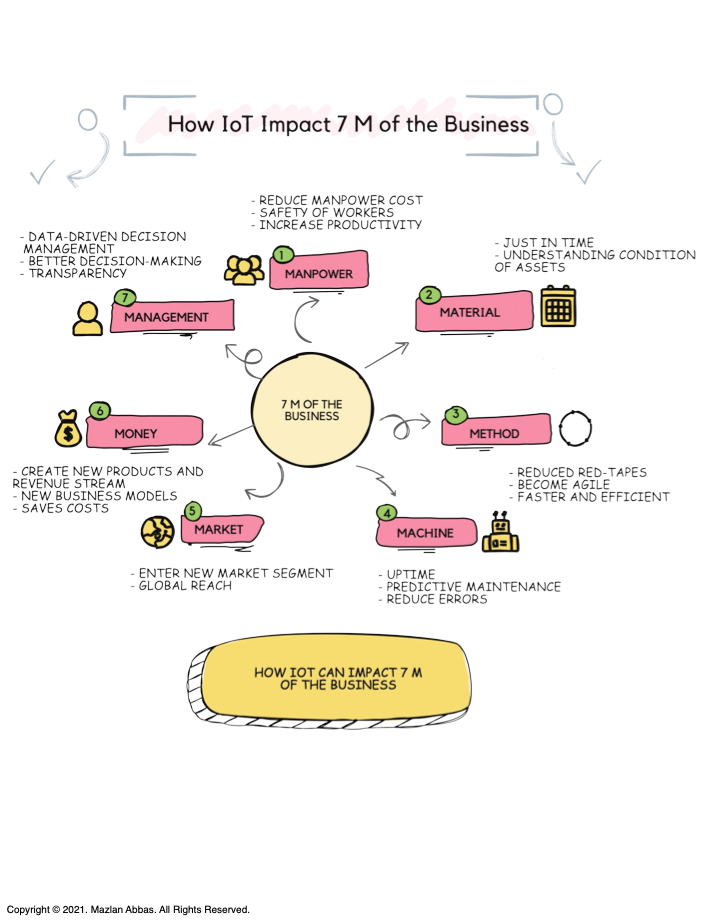
Today, we’ll explore how the Internet of Things (IoT) transforms the 7 M’s of business — key elements that drive an organisation’s operations and strategy.

These 7 M’s are Manpower, Material, Method, Machine, Market, Money, and Management. Let’s break down each one and see how IoT impacts them.

Based on the eBook — IoT Notes by Mazlan Abbas

1. Manpower

IoT helps businesses optimise human resources by reducing costs, improving safety, and increasing productivity.

Impact of IoT:

  • Cost Reduction: Automating repetitive tasks reduces the need for manual labour.
  • Worker Safety: IoT devices, such as wearables, can monitor health and alert workers to potential hazards.
  • Productivity: By enabling remote work and real-time communication, IoT allows employees to focus on high-value tasks.

Example: A construction company using wearables to monitor worker fatigue and ensure safety.

2. Material

IoT ensures better management of materials, improving supply chain efficiency and reducing waste.

Impact of IoT:

  • Just-In-Time Delivery: Sensors track inventory levels and automatically reorder materials when needed.
  • Asset Condition Monitoring: IoT devices monitor the condition of materials, ensuring quality and preventing spoilage.

Example: A warehouse using IoT sensors to track stock levels and ensure optimal storage conditions.

3. Method

IoT makes business processes more agile and efficient by simplifying methods.

Impact of IoT:

  • Reduce Red Tape: Automating workflows eliminates unnecessary administrative steps.
  • Agility: IoT enables businesses to respond quickly to changing conditions.
  • Efficiency: Processes become faster and more streamlined with IoT integration.

Example: A manufacturing plant automating quality checks with IoT sensors to speed up production.

4. Machine

IoT maximises the performance of machines, ensuring reliability and reducing downtime.

Impact of IoT:

  • Uptime: Predictive maintenance ensures machines are operational when needed.
  • Predictive Maintenance: IoT sensors detect issues before they become critical, preventing failures.
  • Error Reduction: Machines can self-correct or alert operators when errors occur.

Example: A factory using IoT-enabled machinery to monitor performance and schedule maintenance.

5. Market

IoT helps businesses expand into new markets and improve their customer reach.

Impact of IoT:

  • New Market Segments: IoT enables innovative products and services, opening new revenue streams.
  • Global Reach: Businesses can monitor and manage operations worldwide through IoT platforms.

Example: An IoT-enabled home security company entering international markets with smart security systems.

6. Money

IoT creates new revenue opportunities and reduces costs.

Impact of IoT:

  • New Revenue Streams: IoT drives innovation, leading to new services and products.
  • Cost Savings: Automating processes and improving efficiency reduces expenses.

Example: A logistics company saving fuel costs by using IoT to optimise delivery routes.

7. Management

IoT improves decision-making through data-driven insights.

  • Impact of IoT:
  • Data-Driven Decisions: Real-time data helps managers make informed choices.
  • Transparency: IoT provides visibility into all areas of the business.
  • Better Decision-Making: Analytics from IoT systems offer actionable insights.

Example: A retail chain using IoT to monitor sales trends and optimise inventory.

Key Takeaways

IoT has a transformative impact on the 7 M’s of business:

  1. Manpower: Reduces costs and improves safety.
  2. Material: Ensures quality and efficiency.
  3. Method: Simplifies workflows and increases agility.
  4. Machine: Enhances reliability and performance.
  5. Market: Expands opportunities globally.
  6. Money: Generates new revenue and reduces costs.
  7. Management: Improves decisions with real-time insights.

Discussion Question: Which of the 7 M’s most benefits from IoT in your industry? Let’s share ideas and examples!

{You can download the FREE eBook IoT Notes by Mazlan Abbas]

Types of Analytics

Today, we’ll discuss types of analytics and their importance in turning raw data into actionable insights.

This diagram shows four types of analytics, ranked by their difficulty level and the value they provide. Let’s go through them step by step.

Based on the eBook — IoT Notes by Mazlan Abbas

1. Descriptive Analytics: What Happened?

At the base of the analytics hierarchy is descriptive analytics. This is the simplest form of analytics and helps us understand what happened by interpreting historical data.

  • Purpose: To summarise past events and identify patterns.
  • Example: A smart thermostat that shows last week’s energy usage patterns.
  • Methods: Charts, graphs, and dashboards that clearly show past performance.

This type of analytics is great for reviewing the past, but it doesn’t tell us why something happened or what will happen next.

2. Diagnostic Analytics: Why Did It Happen?

Moving up, we have diagnostic analytics, which looks at why something happened. It’s more complex than descriptive analytics because it requires diving deeper into the data.

  • Purpose: To discover relationships and identify the causes behind past events.
  • Example: Analysing why a specific day’s energy usage was higher than average by correlating data with external factors like weather.
  • Methods: Data discovery, drill-down techniques, and correlation analysis.

This stage helps us make sense of the past by understanding the root causes of trends and anomalies.

3. Predictive Analytics: What Will Happen?

Next is predictive analytics, which focuses on forecasting future outcomes. This is where analytics becomes proactive rather than reactive.

  • Purpose: To predict what might happen based on current and historical data.
  • Example: A smart thermostat forecasting energy usage for the upcoming week based on weather patterns and past behaviour.
  • Methods: Statistical modelling and simulations.

By identifying trends and patterns, predictive analytics helps us make informed predictions.

4. Prescriptive Analytics: How Can We Make It Happen?

At the top is prescriptive analytics, the most advanced type. This involves predicting outcomes and recommending actions to achieve desired results.

  • Purpose: To decide the best course of action based on predictions.
  • Example: A smart thermostat automatically adjusting settings to save energy while maintaining comfort.
  • Methods: Machine learning and AI to analyse probabilities and make decisions.

Prescriptive analytics provides the highest value by enabling automated and data-driven decisions.

IoT and Analytics

This diagram also highlights how analytics works in an IoT platform:

  1. Sensors: Collect data from various sources like temperature, humidity, or movement.
  2. IoT Platform: Acts as a central hub to process and store the data.
  3. Analytics Engine: Applies these four types of analytics to generate insights and drive decisions.

Final Thoughts

Each type of analytics builds on the previous one, moving from simple data interpretation to actionable decisions. The value increases as we move up the hierarchy, as does the complexity.

Question to consider: Which type of analytics is most valuable in your industry, and how can you implement it effectively? Let’s discuss it!

[Note: Download IoT Notes by Mazlan Abbas ]