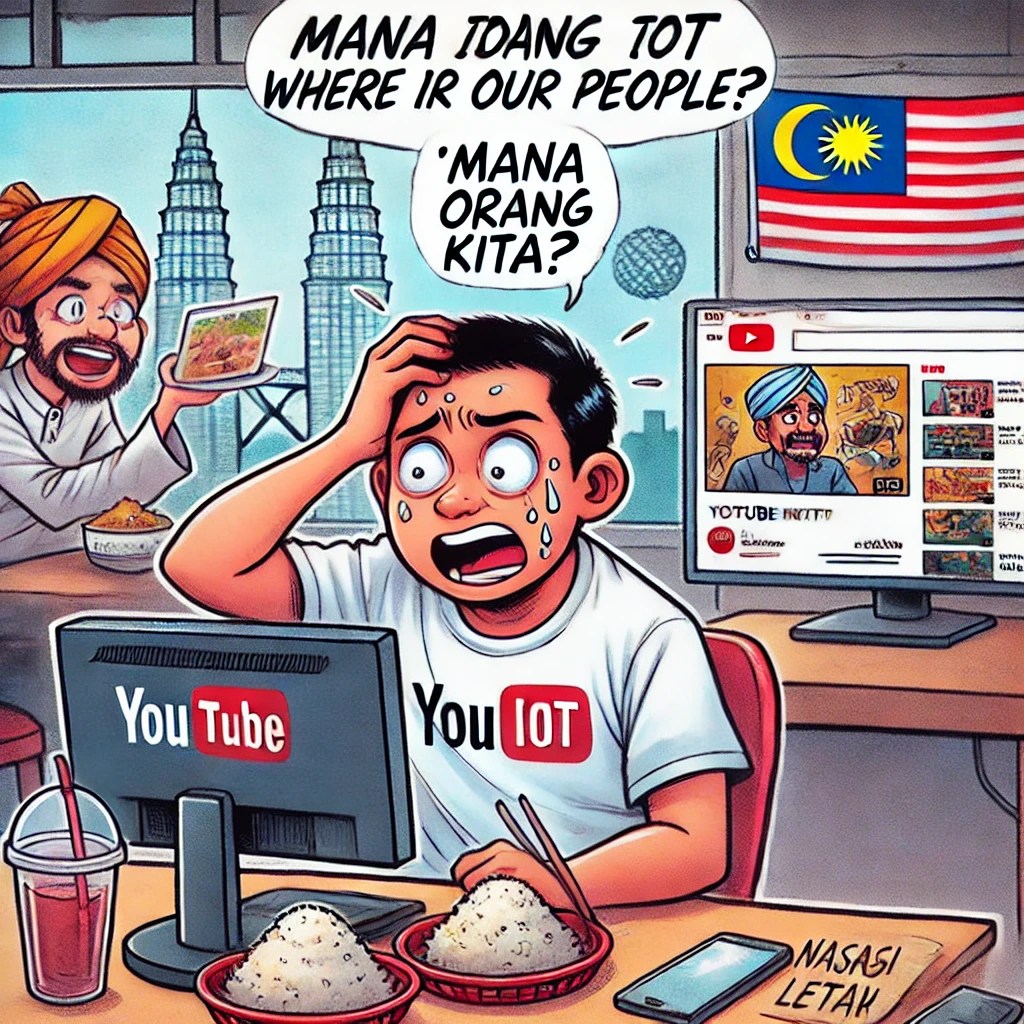
Why Are Malaysians Not Creating IoT Content on YouTube?

I was scrolling through my social media and came across an interesting observation—very few Malaysians create IoT tutorial content on YouTube. The majority of these tutorials come from India. Why is that?

So, I threw the question out there, hoping to spark some discussion. And wow, did people have opinions!

“Malaysia is Small Compared to India.”

One of the first responses I got was, “Malaysia is much smaller compared to India. If you compare us with our ASEAN neighbours, maybe it makes more sense.”

Okay, I get it. India has a massive population and a thriving tech ecosystem. But does that mean we just accept that we aren’t producing enough content? Shouldn’t our ambition go beyond just comparing ourselves with our neighbours?

“Sharing Knowledge Isn’t Our Culture.”

Another comment caught my attention: “India suka sharing knowledge kali.

That hit me hard. Is it true that we don’t have a strong culture of sharing technical knowledge? I know plenty of Malaysian engineers and tech enthusiasts who are brilliant at what they do, but why aren’t they making educational content? Are we too protective of what we know? Are we afraid that sharing our expertise might somehow put us at a disadvantage?

One person even admitted, “Source code aku, aku yang susah-susah buat, aku punya, tak nak share dengan orang lain. Kongsi je lah.” That made me chuckle, but deep down, I felt a little sad. If we all think this way, how do we expect to build a community of learning?

“People Prefer Entertainment Over Education.”

Another perspective: “Expertise tak ramai compared to India + audience sukakan content hiburan compared to education.

This one stings. It’s no secret that entertainment content dominates YouTube in Malaysia. Food reviews, travel vlogs, comedy skits—they all get millions of views. But educational content, such as IoT tutorials, barely gets any traction.

Does this mean Malaysians aren’t interested in learning tech? Or is it because no one is making content that makes tech exciting? Maybe we need to find a way to blend education with entertainment. After all, if a cooking channel can get millions of views, surely a well-presented IoT tutorial can capture some attention, right?

“Technology Isn’t in Our DNA.”

Then came a comment that really made me pause: “Sembang technology bukan budaya dalam masyarakat kita. Tengok industri filem saja lah. Teknologi dalam filem kita hanyalah fiksyen sains yang entah apa-apa. Cuma bezakan dengan filem Bollywood macam Three Idiots… Bapa kat kampung pun nak anaknya jadi engineer dan kerja di multinational kat Silicon Valley.

Ouch.

I don’t want to believe this, but there’s some truth to it. In India, engineering and technology are deeply embedded in their aspirations. Parents push their kids towards STEM careers. In Malaysia, how many parents encourage their children to be engineers, developers, or IoT experts? Not many. And if we don’t nurture this mindset early, how can we expect a surge of local content creators in technical fields?

“Go Where the Grass is Greener.”

Then someone simply commented: “Go for greener grass.

Is that the answer? Just abandon hope and move to a place where IoT content is more appreciated? I refuse to believe that. There’s potential here. There’s talent here. The problem is that we haven’t created a culture where sharing knowledge is normal, where technical education is valued, and where engineers feel motivated to teach others.

What’s the Solution?

I don’t want to just sit here and complain. I want to do something about it. So, here’s my plan:

  1. Start Creating More IoT Content – If no one else is doing it, I’ll do it. I’ll make IoT tutorials, I’ll share what I know, and I’ll make it accessible to everyone.
  2. Encourage More People to Share – If you’re an engineer, a tech enthusiast, or anyone with IoT knowledge, start sharing. Even if it’s a short video, a blog post, or a simple explainer—put it out there!
  3. Make IoT Fun and Engaging – If entertainment dominates, let’s make IoT entertaining. Let’s present it in a way that captures attention and excites people.
  4. Build a Community – Let’s create a space where Malaysians who are passionate about IoT can exchange ideas, support each other, and grow together.

I refuse to accept that Malaysia can’t be a hub for IoT education.

It starts with us, with sharing, and it starts today.

The Internet: The Greatest Invention of My Lifetime

Looking back at how life used to be, it’s astonishing how much the internet has transformed the world.

The connection was slow, unreliable, and expensive when I first encountered it in the early 1990s. A dial-up modem would make its signature screeching sound as it struggled to connect, often cutting off if someone picked up the landline.

At the time, it felt like a luxury, but little did I know that it would soon become the backbone of modern civilization.

Before the Internet, access to information was tedious. If I needed references for research, I had to manually search through library card catalogues, flipping through hundreds of index cards just to locate a book or journal.

If the resource wasn’t available, I had to wait days—sometimes weeks—for an interlibrary loan. Once I finally got my hands on a journal article, the only way to keep a copy was to photocopy every page, hoping I didn’t miss a critical section.

Researchers were also challenging to reach. Since they didn’t have personal email addresses, the only way to contact them was through their university’s administration office, which meant waiting indefinitely for a response. I

nternational communication was equally challenging—long-distance calls were expensive, often requiring careful planning to avoid excessive charges.

Then the internet arrived, and the world we knew it changed forever.

1. The Digital Transformation of Knowledge

One of the internet’s most remarkable impacts is its revolutionized access to information. Instead of relying on physical books, libraries, or printed journals, knowledge is now just a few keystrokes away.

Search engines have replaced card catalogues, offering instant access to research papers, academic articles, and books. Online databases like Google Scholar and IEEE Xplore have made high-quality research available in seconds. What used to take weeks to obtain can now be accessed in mere moments.

Education has also evolved. Online courses, video tutorials, and digital textbooks have made learning more accessible. Whether university students attend virtual lectures or self-learners take free courses from top institutions, knowledge is no longer limited by geography or financial constraints.

Had the internet existed when I was a student, I imagine how much easier research and learning would have been. The barriers that once made education exclusive have now been dismantled, making knowledge a universal asset.

2. The Evolution of Communication

The way we connect with others has undergone a drastic transformation. In the past, international communication was slow and costly. Writing letters meant waiting weeks for a reply, and long-distance calls were prohibitively expensive.

Today, messaging apps and video conferencing tools have made global communication instant and nearly free. Emails replaced traditional mail, while WhatsApp, Zoom, and other platforms made real-time conversations possible across continents. What once required careful budgeting is now an everyday convenience.

Even within professional and academic circles, networking has become effortless. Researchers and experts are now accessible via email, LinkedIn, and social media, fostering faster collaborations and knowledge sharing. We no longer have to rely on university administrators to forward our inquiries.

It’s fascinating to think about how disconnected the world once was compared to today. Borders have blurred, and communication is no longer a privilege but an expectation.

3. The Rise of a Digital Economy

The internet improved communication, but it also reshaped business and work. Entire industries have been transformed, with traditional models giving way to digital platforms.

  • E-commerce has replaced physical stores, making shopping a seamless online experience.
  • Streaming services have overtaken CDs and DVDs, shifting entertainment into the digital realm.
  • Remote work and freelancing have allowed people to earn a living from anywhere, breaking the dependency on physical office spaces.

Even my own company, FAVORIOT, thrives because of the internet. Our IoT solutions depend on cloud-based platforms that enable real-time monitoring and automation. Smart cities, connected industries, and digital transformation would remain a distant dream without the Internet.

The shift from traditional to digital business models has created new job opportunities and redefined how work is done. The internet has empowered entrepreneurship, enabling individuals to launch businesses with minimal resources and a global reach.


4. The Internet of Things: From SMS to Smart Connectivity

Before widespread internet adoption, early machine-to-machine (M2M) communication relied on SMS. Utilities like electricity and water meters sent data via text messages—a slow and costly method.

With the advent of the internet, IoT has evolved dramatically. Devices now communicate through cloud platforms, enabling seamless automation and real-time analytics. IoT has unlocked once unimaginable capabilities, from smart homes that adjust to user preferences to industrial systems that optimize efficiency.

This transformation isn’t just about convenience—it has real-world applications in agriculture, healthcare, transportation, and urban planning. By integrating IoT with artificial intelligence, industries can optimize processes, reduce costs, and improve decision-making like never before.

The internet didn’t just connect people and machines, paving the way for a future where data-driven automation is the norm.

5. Challenges and Responsibilities in the Digital Age

Despite its many advantages, the internet has introduced new challenges. The rise of cybercrime, misinformation, and privacy concerns has raised questions about security and ethical responsibility.

  • Cybersecurity threats continue to grow, with hackers exploiting vulnerabilities in digital systems.
  • Misinformation spreads rapidly, making it harder to distinguish fact from fiction.
  • Data privacy concerns are more prominent than ever as companies collect vast amounts of personal information.

While the internet has democratized access to information and communication, it has also created a landscape where digital literacy and security awareness are essential. As technology evolves, society must adapt to ensure the internet remains a tool for progress rather than exploitation.

6. The Future of the Internet

What lies ahead for the internet? Connectivity continues to evolve, with advancements that promise to further reshape the digital landscape:

  • 5G and beyond will make internet speeds faster and more reliable.
  • AI-driven personalization will make digital interactions more intuitive and efficient.
  • Quantum computing may redefine encryption and security standards.
  • Decentralized systems (Web3) could shift power back to users, promoting greater data ownership.

As we move forward, the internet’s influence will only expand. The possibilities are endless, and its role in shaping future innovations is undeniable.

The Invention That Defined an Era

Reflecting on the past few decades, imagining life without the internet is hard. It has shaped my career, business, and daily interactions. The transformation is extraordinary from struggling with library catalogues to having unlimited knowledge at my fingertips, from expensive phone calls to instant global communication.

Had the internet never existed, we might still be waiting weeks for letters, manually searching for references, and relying on costly international calls. The convenience, accessibility, and opportunities it has created are immeasurable.

The internet didn’t just change how we live—it redefined the very fabric of society.

And for that reason, I firmly believe it is the greatest invention of my lifetime.

A Letter to My Future Self

Dear Mazlan,

As you sit in your grand office atop the towering Favoriot Building, overlooking a city that once seemed like a distant dream, I hope you take a moment to pause.

Yes, you’ve made it.

The name “Favoriot” shines not just on that magnificent skyscraper but across 25 countries, each with its own bustling branch, and the crown jewel—IoT Campus—where the next generation of innovators walks the halls, inspired by a journey that started long before the world knew your name.

But Mazlan, I’m writing this to remind you: don’t forget where it all began.

Remember that tiny office in IOI Business Park—not exactly glamorous, was it? Small desks crammed into a space barely big enough to contain our ambitions, let alone our team. The whiteboard stained with faded markers, the flickering fluorescent lights, and the cheap coffee that fueled countless late nights. It wasn’t luxury, but it was ours.

Remember the struggles during COVID-19—those dark days when uncertainty knocked louder than opportunity. The world paused, but you couldn’t. The team—our team—sacrificed so much. They showed up, not just physically but with heart, even when fear lingered in every breath. There were days when morale dipped, cash flow threatened to suffocate us, and hope felt like a fragile thread. But we clung to it.

Do you recall the pain of landing our first customer? How many times did we pitch—a hundred? A thousand? Rejections stacked higher than the proposals we printed. Investors smiled politely, nodding through presentations, only to pass us by. They didn’t believe in Favoriot. But we did.

Remember the feeling after every rejection? That hollow ache in your chest, the self-doubt whispering, “Maybe they’re right.” But you didn’t let it win. You went back to the drawing board, reworked the slides, tweaked the demos, and pitched again. Not because you were fearless—you were terrified. But because giving up was never an option.

Now, as you sit surrounded by accolades, global partnerships, and a team that’s grown beyond your wildest dreams, stay humble.

Never forget the people who stood by you when Favoriot was nothing more than an idea scribbled on paper. The team who accepted cut salaries during Covid, who believed in the vision even when the bank account said otherwise. The friends who listened to your endless rants about IoT, investors, and cash flow. The mentors who gave advice for free because they believed in you more than you believed in yourself.

Success has a way of making the past feel distant, almost like it happened to someone else. Don’t let it.

Walk the halls of IoT Campus and remember that it’s built on the sweat, tears, and sacrifices of people who dared to dream with you. Visit the small office at IOI Business Park whenever you can. Stand there. Let the memories wash over you—not to romanticize the struggle but to honor it.

And when you speak to young entrepreneurs, don’t just tell them about the success. Tell them about the sleepless nights, the empty bank accounts, the rejections, the fear. That’s where the real story lives.

Be proud, Mazlan. But more importantly, be grateful.

With all my heart,

Your Past Self

(Back when Favoriot was just a name, not an empire)