Crafting Impactful Final Year Projects: A Guide

I’ve sat on many evaluation panels over the years.

Different universities. Different rooms. Different faces.

But strangely, the pattern is always familiar.

Students walk in carrying posters, prototypes, sometimes with wires still exposed, sometimes with boxes made from recycled lab scraps. They look nervous. Excited. Hopeful. Tired.

And almost every presentation begins the same way.

“This project is about…”
“The objective of this project is…”

I sit back in my chair and quietly think to myself, Ah… here we go again.

Because at that moment, something important is missing.

The Moment Evaluators Lean In or Tune Out

When I evaluate a Final Year Project, I’m not hunting for perfection. I’m not expecting commercial-grade products. I’m not counting how polished the slides are.

I’m listening for one thing.

Do you understand why you built this?

Many students rush straight into objectives, features, and functions. But they forget to set the stage. They forget to frame my mind.

Without a background.
Without a problem that feels real.
Without a pain point that matters.

And when that happens, evaluators start asking questions not because the project is weak, but because the story is unclear.

Help me care first, I always think. Then help me understand.

Start With Pain, Not Purpose
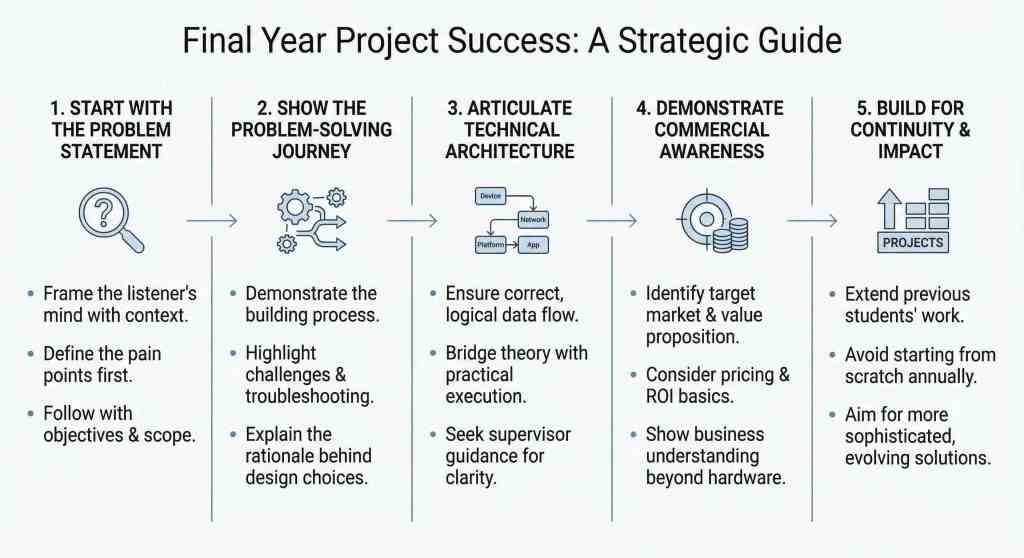
The strongest projects I’ve seen don’t start with what was built.

They start with what hurts.

A system that fails silently.
A manual process that wastes hours.
A safety issue nobody notices until it’s too late.
A data gap nobody talks about.

When students explain the background clearly, something shifts. The room wakes up. The evaluator’s brain starts connecting dots.

Only after that does the objective make sense.

Because now, the solution has a reason to exist.

Scope Is Not a Weakness

Another thing I notice again and again.

Projects that look “complete,” but aren’t honest about their limits.

Students are afraid to admit constraints. Limited time. Limited budget. Limited access to hardware. Limited skills.

But here’s the truth.

A clear scope shows maturity.

When you explain what you chose not to build and why, you’re telling me you understand trade-offs. You understand reality. You’re not pretending.

That impresses evaluators more than pretending everything is done.

The Story of Struggle Matters More Than the Result

Some of the most memorable presentations weren’t the ones that worked perfectly.

They were the ones where students said:

“We tried this. It failed.”
“So we changed this.”
“It broke again.”
“Here’s why we finally chose this approach.”

That tells me you didn’t just follow a tutorial. You wrestled with the problem. You learned where things break.

And that’s exactly what real engineers, builders, and problem solvers do.

Architecture Is Not Just a Diagram

I’ve lost count of how many times I’ve seen architecture diagrams that don’t reflect reality.

Devices sending data to nowhere.
Networks are magically working.
Platforms floating without context.

When I ask, “Where does the data go next?”
Silence.

Architecture is not an artwork. It’s a thinking tool.

If you can’t explain how data moves from device to network, from network to platform, from platform to application, then you don’t fully own your system yet.

This is where supervisors play a big role. And this is where students must slow down and really understand what they are drawing.

Prototypes Don’t Need to Look Pretty

Some students apologise for their mock-ups.

“Sorry, sir, this is just a box.”
“Sorry, sir, we used old parts.”

I always smile.

Because that’s not what I’m judging.

What excites me is when students act out real scenarios. When they simulate how users interact. When they demonstrate behaviour, not just hardware.

I still remember sitting inside a car to experience a student-built parking system. That wasn’t about polish. That was about empathy.

The Question That Makes Everyone Nervous

Then comes the part that always makes students laugh nervously.

“So… who would buy this?”

Suddenly, the room gets quiet.

Many students talk about the cost of components. Few talk about customers. Fewer talk about value.

I’m not expecting a full business plan. I’m testing awareness.

Do you understand that solutions exist to be used?
Do you know who benefits from what you built?

Because a project that solves a real problem for a real group of people already has more value than one that only looks good on demo day.

When Systems Break, Thinking Is Revealed

The most important questions often come at the end.

“What happens if the system fails?”
“How do you troubleshoot this?”
“What would you check first?”

These answers reveal everything.

They show whether learning happened.
They show whether the student truly built the system or just assembled it.

In team projects, I watch carefully. Everyone should understand their role. Everyone should be able to support each other. Silence from team members tells its own story.

Forty Years of Change, One Pattern That Remains

I’ve watched student projects evolve from the 1980s until today.

Better tools. Better access. Better exposure.

Yet one problem remains.

Projects restart from zero every year.

Limited budgets force repetition. The same sensors. The same ideas. The same level of impact.

Imagine if universities treated projects as living systems.

One cohort builds the base.
The next improves it.
Another adds data analysis.
Another adds intelligence.

That’s how meaningful systems grow.

Especially in IoT, where data collected over time becomes more valuable than the device itself.

My Advice to Students and Educators

If you’re a student, remember this.

Your project is not judged by perfection.
It’s judged by understanding.
Clarity.
Honesty.
Growth.

Tell the story of your problem.
Explain your decisions.
Show your struggles.
Own your limits.

If you’re an educator or supervisor, help students see beyond grades.

Teach continuity.
Teach systems thinking.
Teach them to build on each other’s work.

Because the real world doesn’t reset every semester.

And the most important lesson a Final Year Project can teach is not how to build something that works.

It’s how to think when things don’t.

The Moment the Smart City Dashboards Stopped Impressing Me

There was a time when I was impressed by command centres.

Rows of screens.
Maps glowing in neon colours.
Charts are moving in real time.
Operators are pointing at dashboards like air traffic controllers.

It looked powerful.
It looked serious.
It looked… convincing.

But one day, standing quietly at the back of the room, I caught myself thinking something uncomfortable.

If one screen goes dark, who notices?
If the data contradicts another system, who decides?
If something breaks at 2 a.m., who actually understands what is happening?

That was the moment the screens stopped impressing me.

Because cities are not run by visuals.
Cities are run by clarity.

And clarity does not come from dashboards alone.

How Cities Slowly Accumulate Silos Without Realising It

Most local councils chose not to fragment.

Fragmentation happened to them.

Projects arrived one by one.
Budgets were approved year by year.
Each initiative solved a real problem at the time.

Flood monitoring came first.
Then air quality.
Then lakes.
Then traffic.
Then parking.

Each project was justified.
Each vendor delivered.
Each system worked.

Individually.

What nobody planned for was the moment when all these systems would need to speak to each other.

So the command centre slowly became a collection of disconnected truths.

Each dashboard told its own story.
None of them told the whole truth.

When a Dashboard Is Mistaken for a Platform

I often hear this sentence.

“Yes, we already have a smart city platform.”

Then I look closer.

What I see is usually a visual layer.
A presentation surface.
A beautifully designed window.

But behind it, there is no device management.
No rule engine.
No action triggers.
No real-time orchestration.

Just data being shown.

And showing data is not the same as running a city.

A true platform does not just display.
It listens.
It reacts.
It remembers.
It connects.

Two Types of Data That Rarely Shake Hands

Cities live in two data worlds.

The first world is structured, administrative, and familiar.

Assets.
Licences.
Collections.
Population data.
Facilities.

This data is critical. It reveals the city’s shape. It is refreshed periodically and often lives inside systems branded as urban observatories.

The second world is restless.

Sensor data.
Live streams.
Alarms.
Failures.
Spikes.
Drops.

This is IoT data.
It does not wait politely.
It arrives when it wants.
It demands attention.

The mistake happens when we treat both worlds as if they behave the same way.

They do not.

GIS and Digital Twins Without Real-Time Truth

Many councils have strong GIS platforms.

Layers upon layers of insight.
Maps that tell stories about people, land, and risk.

Some go even further with digital twins.
Virtual representations of buildings, roads, and infrastructure.

I admire these efforts.

But without live sensor input, these systems are frozen in time.

They show structure.
Not behaviour.

A city is not just where things are.
It is how things change.

Without IoT data, even the most beautiful digital twin is only a photograph, not a mirror.

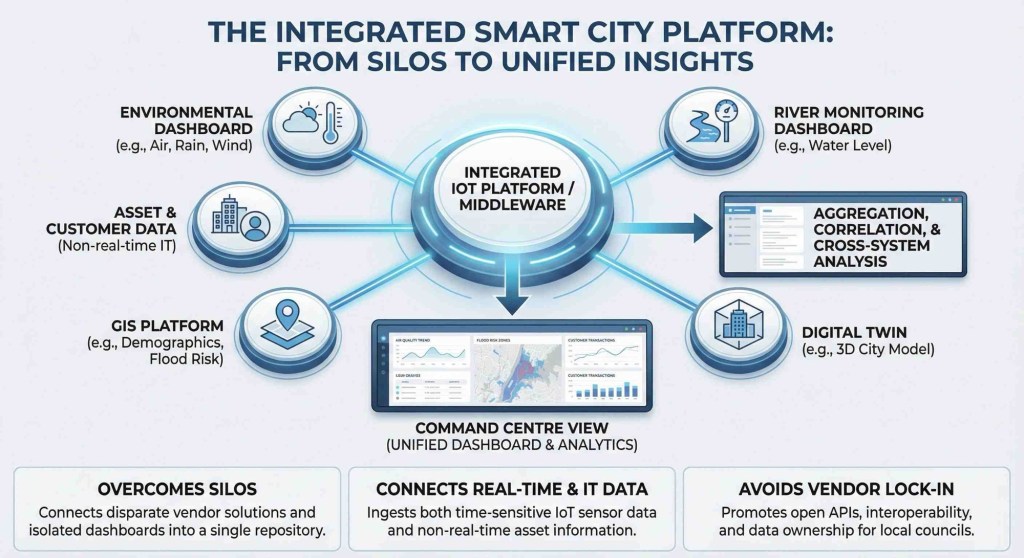
Why an Integrated IoT Platform Is Not Optional Anymore

At some point, cities reach a tipping point.

They stop asking for new dashboards.
They start asking better questions.

Why did flooding worsen after that traffic upgrade?
Why does air quality dip only in specific zones?
Why do alarms trigger too late?

These questions cannot be answered inside silos.

They require correlation.

This is where an integrated IoT platform matters.

Not to replace everything.
But to connect everything.

A layer where data from rivers, rain, air, traffic, parking, and buildings can coexist.
A place where patterns emerge.
A place where decisions are supported, not guessed.

This is the role of IoT middleware.
This is where platforms like FAVORIOT were designed to sit.

The Fantasy of One Platform to Rule Them All

Every city dreams of simplicity.
Every vendor dreams of being central.

The idea of one master platform controlling everything is seductive.

But reality is less romantic.

Platforms are built with different goals.
Vendors protect their niches.
Legacy systems do not disappear quietly.

Trying to force everything into one system usually creates resistance, delays, and disappointment.

Cities do not need domination.
They need coordination.

The Quiet Risk Nobody Likes to Talk About

There is a dangerous sentence I hear too often.

“We don’t mind. Let the vendor manage everything.”

It sounds efficient.
It sounds hands-off.

Until the day the council asks for raw data.
Or integration rights.
Or historical access.

And discovers they cannot.

No API.
No export.
No control.

That is vendor lock-in.
And by then, it is too late to complain.

A smart city without data ownership is not smart.
It is dependent.

Procurement Is the Real Smart City Strategy

Smart cities are not won in control rooms.

They are won in procurement documents.

When councils specify openness.
When they demand interoperability.
When they insist on owning their data.

That is when cities protect their future.

Technology can always be upgraded.
Contracts are harder to undo.

Integration Is an Act of Maturity

I no longer believe in replacing everything.

I believe in respecting what already works.
Connecting what matters.
Opening what was once closed.

Legacy platforms should remain.
Specialised systems should continue.
But data must flow.

Sometimes that means managing two or three core platforms instead of one.

That is not failure.
That is realism.

Why I Keep Writing About This

I am not chasing trends.
I am chasing calm.

Calm operators.
Calm decision-makers.
Calm cities that respond instead of react.

When systems are integrated, nights are quieter.
When data is shared, trust grows.
When platforms cooperate, leaders sleep better.

If you are building a smart city, pause before asking for another screen.

Ask instead:
Can this system talk?
Can it share?
Can it last?

If this reflection sounds familiar, I would love to hear from you.

What have you seen in your city?
Where did silos slow you down?
What worked when integration finally happened?

Drop your thoughts in the comments.
Let us learn from each other and build cities that truly understand themselves.

The Story Behind Favoriot — Part 9: Leaving the Comfort Zone

Stepping Away from Comfort

I never imagined the day would come when I’d step away from the security of a stable paycheck and a corporate career spanning over three decades. For over 30 years, I climbed the corporate ladder, navigating the structured world of management, cushioned by the perks that came with it.

How Leaving a 30-Year Career to Build FAVORIOT Taught Me the True Meaning of Resilience, Adaptability, and Personal Growth

It was a good life.

Business-class flights, luxury hotel stays, and the comforting rhythm of a regular, substantial income. Yet, despite the success, something kept gnawing at me.

“Is this it? Is this all there is to my journey?” I’d often wonder.

For years, I nurtured a vision—an idea to revolutionize industries with the Internet of Things (IoT). FAVORIOT was the manifestation of that dream. But dreams, as it turns out, come with their own set of sacrifices, ones I hadn’t fully anticipated.

And boy, there were plenty.

The Financial Rollercoaster

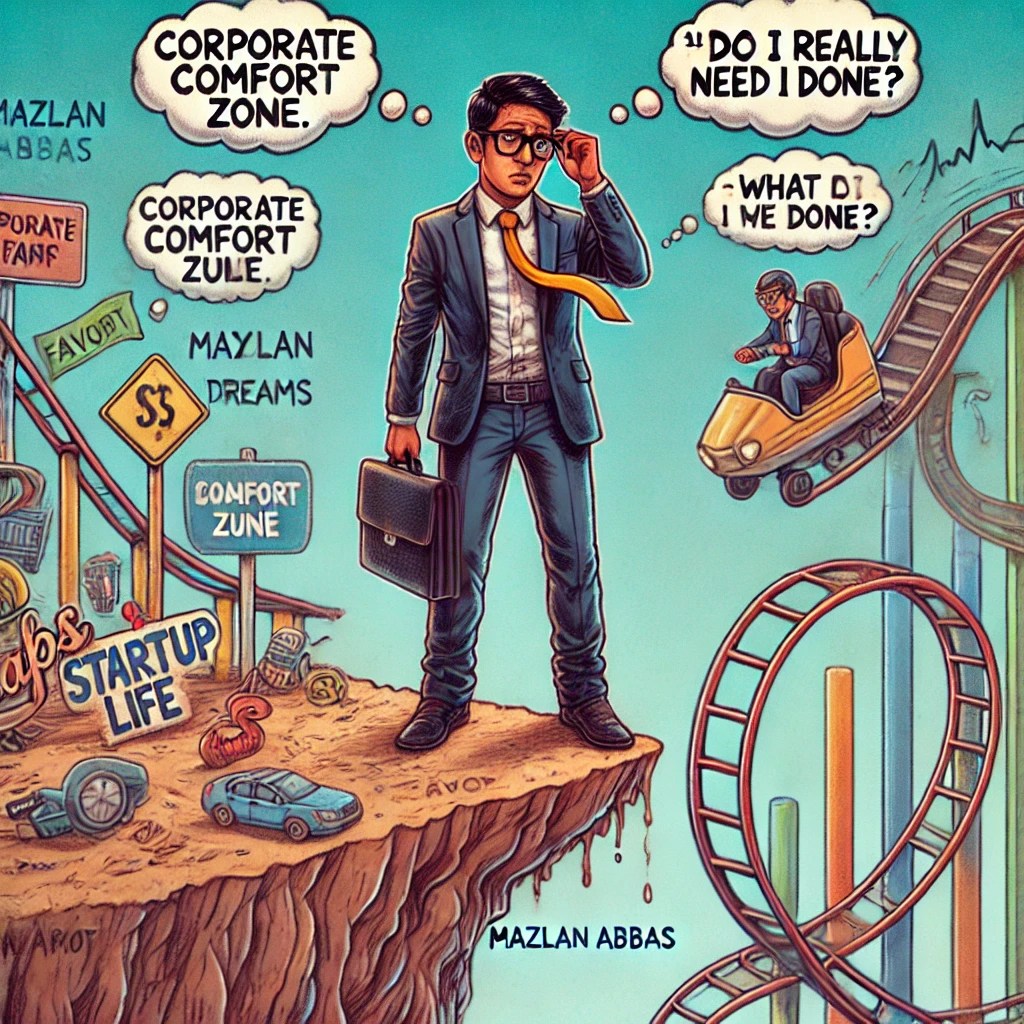
The first punch in the gut? The financial shock. Trading a consistent income for the erratic, unpredictable rollercoaster of startup finances was like jumping off a cliff without knowing if there was water below.

One month, we had cash flow. The next? Empty accounts staring back at me.

No salary. No safety net. Just uncertainty.

“What have I done?” I’d mutter, glaring at spreadsheets that refused to make sense.

There were days I questioned my sanity, wondering if I’d miscalculated the risks. But turning back wasn’t an option. FAVORIOT wasn’t just a company; it had become my mission.

I was no longer just Mazlan Abbas, the corporate executive. I was now Mazlan Abbas, the entrepreneur responsible for a team and a vision.

Adjusting to New Realities

With financial uncertainty came a drastic shift in lifestyle. Gone were the days of business-class flights and luxury hotels. My new reality? Budgeting down to the last ringgit, stretching every expense, and redefining what “essential” meant.

I vividly remember standing in a store, eyeing a sleek new laptop. In the past, I’d have bought it without a second thought.

“Do I really need this?” I asked myself.

The answer was no.

My old laptop would do just fine. Every ringgit saved was a lifeline for the business.

Vacations? A distant memory. Overseas trips were replaced with local getaways, if any. Each sacrifice was a reminder: this was temporary, all part of a bigger picture.

But knowing that didn’t make it any easier.

Cutting Back on Personal Luxuries

Starting a business from scratch demands ruthless prioritization. Gadgets, spontaneous upgrades, and luxury splurges became relics of the past.

I missed the freedom to indulge. But scaling back taught me discipline. It forced me to focus on what truly mattered: growing FAVORIOT.

“Why am I doing this?” I’d sigh during moments of frustration.

But deep down, I knew the answer. I believed in FAVORIOT—its mission, its potential, and the impact it could create.

And that belief kept me going.

Navigating Uncertainty and Isolation

The sacrifices weren’t just financial. The emotional toll of entrepreneurship is a beast of its own.

Every day felt like walking a tightrope, balancing decisions with no safety net below. The uncertainty was suffocating.

And then there was the loneliness.

Sure, I had a team, but what was the ultimate responsibility? That was mine to bear.

“Is this really what I want?” I’d wonder during sleepless nights, staring at the ceiling.

But those moments of doubt? They were the crucible where resilience was forged.

I discovered strength I didn’t know I had, learning that this journey wasn’t just about building a business. It was about building myself.

Perseverance and Growth

Over time, I stopped seeing challenges as obstacles. Instead, they became growth opportunities.

Each setback taught me to adapt, persevere, and trust the process.

I remember a deal that could have been a game-changer for FAVORIOT. We chased it for weeks, only to face rejection.

Frustrated, I vented to a colleague.

“Mazlan, every ‘no’ gets us closer to the right ‘yes,'” they said.

That shifted my mindset.

Failures weren’t dead ends. They were lessons in disguise, pushing me to refine our approach and grow as a leader.

Reflecting on the Sacrifices

So, was it worth it?

The financial strain, lifestyle changes, and emotional rollercoaster?

Yes.

Because in losing the comforts I once knew, I gained something far more valuable: resilience, adaptability, and personal growth.

I’ve had the privilege of building FAVORIOT from the ground up, watching an idea evolve into reality.

But more importantly, I realized that entrepreneurship isn’t just about financial success. It’s about impact, purpose, and creating a legacy.

FAVORIOT isn’t just a business to me.

It’s a testament to what’s possible when you dare to step out of your comfort zone.

The Entrepreneur’s Mindset

One of the greatest lessons I’ve learned? Embracing uncertainty.

Entrepreneurship is a leap into the unknown. Success isn’t guaranteed, and failure is always a possibility.

But that’s what makes it thrilling.

Every day brings new challenges and opportunities to grow.

And if there’s one thing I know for sure, it’s this: resilience is the backbone of entrepreneurship.

The Power of Community and Support

Entrepreneurship may feel lonely, but it doesn’t have to be.

Surrounding yourself with mentors, peers, and a support system is crucial.

I’ve been blessed with a network that believed in my vision, celebrated my wins, and stood by me during the tough times.

Because while the entrepreneurial journey feels personal, it’s never a solo act.

The Entrepreneurial Journey is Yours to Define

As I reflect on my journey with FAVORIOT, I see the sacrifices and growth etched into every milestone.

It’s been a rollercoaster. But I wouldn’t change a thing.

The challenges shaped me. The sacrifices strengthened me.

For anyone considering this path, know this: it’s not easy. The sacrifices are real. The uncertainty is daunting.

But if you embrace the journey, learn from every stumble, and keep moving forward, the rewards—both personal and professional—are beyond worth it.

Entrepreneurship isn’t just a career.

It’s a mindset.

A way of life.

And for me, despite all the sacrifices, it’s been the most fulfilling experience of my life.

Favoriot Entrepreneurship Stories

  1. The Story Behind Favoriot – Part 8: The Frustration of Unanswered Emails and Missed Opportunities
  2. The Story Behind Favoriot – Part 7: The Task of Finding Favoriot’s First 10 Customers
  3. The Story Behind Favoriot – Part 6: Expanding The Business Models
  4. The Story Behind Favoriot – Part 5: Finding the Right Fit
  5. The Story Behind Favoriot – Part 4: How Favoriot Became More Than Just an IoT Platform
  6. The Story Behind Favoriot – Part 3: Why No One Wanted Our IoT Platform—And How We Turned It Around
  7. The Story Behind Favoriot – Part 2: Turning Failures into Milestones
  8. The Story Behind Favoriot – Part I: The Humble Beginnings of Favoriot
  9. Building My Personal Brand: The Stepping Stone to Favoriot’s Success
  10. From Research Lab Critiques to Startup Pitches: My Slide Story
  11. The Illusion of RFPs in the IoT World: Managing Expectations as a Startup
  12. Favoriot’s Odyssey: Navigating the Rough Waters of Early Revenue
  13. From Early Days to VC Pursuit: A Startup Founder’s Odyssey
  14. Blogging My Way Through Entrepreneurship: A Habit I Cherish
  15. Beyond Accolades: The Real Impact on Our Entrepreneurial Journey
  16. Embracing the Diverse Entrepreneurial Journey: Why Success Takes Different Roads
  17. The Subtle Art of Hiring: A Peek Into My Experience
  18. The Entrepreneur’s Balancing Act: A Deep Dive into the Complexities of Startup Product Pricing
  19. The Timing Trap: Our Venture with an IoT Solution and a Global Pandemic
  20. Navigating Product Failure: A Tale of Three Missteps and Lessons Learned
  21. Networking in Startup: An Introvert’s Tale of Growth and Connection
  22. The Startup Burnout: A Founder’s Tale of Striving, Stress, and Solace
  23. The Entrepreneur’s Challenge: Navigating the Pitfalls of Lack of Focus
  24. The Crucial Importance of Product-Market Fit: Lessons from My Entrepreneurship Journey
  25. Embracing Change: Lessons Learned from Clinging to Three Products without Pivoting
  26. Learning on the Go: The Power of Podcasts in My Daily Commute
  27. Learning from Mistakes: Building the Fourth Product – Favoriot IoT Platform
  28. Building the Right Team: My Journey of Managing a Startup
  29. Navigating The Storm: Managing Cash Flow in a Bootstrapped Startup
  30. Outpacing the Startup Race: Lessons Learned from Building a Citizen Engagement App
  31. Finding Harmony in Chaos: My Journey of Building 4 Products
  32. Embracing Life’s Adventure: My Journey From an Academician to an Entrepreneur
  33. How To Increase Your Paid Users From Free Users
  34. 7 Tips How to Get Your Startup Acquired
  35. Advice From ChatGPT as The Investor
  36. When No New Ideas Are Generated
  37. Dateline for the Next eBook
  38. Academia, Industry & Government
  39. Starting The Next IoT Ebook
  40. An Entrepreneur – The Last Career
  41. IoT eBooks by Mazlan Abbas
  42. Navigating the Entrepreneurial Journey with Limited Funds
  43. Navigating the IoT Wave: Secrets to Capturing the IoT Platform Market
  44. Audience Personas for Favoriot IoT Platform
  45. Social Media Strategy for Favoriot IoT Platform
  46. Innovate or Die: Embracing Steve Jobs’ Principles to Catapult Favoriot to IoT Stardom
  47. How We Define the “Why” of FAVORIOT
  48. FAVORIOT 6th Anniversary – The Journey Continues!
  49. IoT Projects from Education to Commercialisation
  50. 8 Top Challenges Building a Citizen Engagement App
  51. 6 Great Challenges Building an IoT Solution for Hajj
  52. How We Build Our Fourth IoT Product
  53. On a Journey of IoTising Business
  54. How We Build Our Third IoT Product
  55. How We Build Our Second IoT Product
  56. How We Build Our First IoT Product
  57. How Silicon Valley Changed My View on the World of Startups

A Usual Day in My Life: From Dawn to Dusk

I often reflect on what my usual day looks like—not one where everything is extraordinary, but one that feels fulfilling and balanced and leaves me content as I drift off to sleep. Here’s a glimpse into my day, from dawn to dusk.

5:00 AM – The Quiet Hour

My day starts before the sun peeks over the horizon. No alarm is needed—my internal clock knows when it’s time. There’s something special about these early hours. The house is still, the world outside is hushed, and it’s just me, my thoughts, and the gentle whisper of dawn.

I sit on the prayer mat at Surau nearby, grounding myself with Subuh. It’s a moment of reflection, gratitude, and connection. After prayers, I take a few quiet minutes, no phone or emails, just pure stillness.

6:00 AM – Morning Rituals

I ease into the morning with light stretches, sometimes a brisk walk if the weather allows, or simple exercises at home. It’s not about intensity but about shaking off sleep and clearly welcoming the day.

Breakfast follows—a simple, healthy meal. Maybe oats, eggs, and, of course, a cup of tea. That first sip feels like a handshake with the day, setting the tone for what’s ahead.

7:00 AM – Diving into Work

Before emails flood and meetings take over, I carve out sacred writing time. My mind feels sharpest now. I open my laptop, fingers poised over the keyboard, and let the words flow—whether it’s a blog on IoT or entrepreneurship.

Writing is more than sharing ideas; it’s a conversation with myself. Sometimes, I start with a question like, “Why do people give up on writing?” and soon find myself deep in thought, discovering new perspectives.

9:00 AM – The IoT Hustle Begins

Now, it’s full-throttle Favoriot mode. I have meetings with the team, brainstorming sessions, and partner calls—a mix of strategic discussions and problem-solving. Some days, I present IoT solutions to clients, explaining how we can transform smart agriculture or address energy challenges.

I enjoy watching ideas evolve into tangible impacts. Not every meeting is a revelation, but each is a step forward.

12:30 PM – The Midday Pause

Lunch is more than a meal; it’s a mental reset. Sometimes with the team, sharing stories beyond work, or alone with a plate of nasi campur, lost in thought or scrolling through Medium for inspiration.

A brief walk post-lunch helps shake off sluggishness and recharges my focus.

2:00 PM – The Afternoon Grind

Afternoons are for deep work. Strategic planning or preparing presentations —tasks that need full attention. I tackle emails too, managing the endless flow without letting it overwhelm me.

Inspiration can strike anytime. A quirky TikTok idea, an analogy for an article—I jot them down quickly because ideas are fleeting, like mischievous cats.

5:00 PM – Wrapping Up

I review my day before logging off. What did I achieve? What could’ve gone better? There is no formal checklist, just a mental debrief. Planning tomorrow’s priorities helps me mentally clock out, knowing everything’s noted.

A deep breath signals the day’s end, a small ritual before stepping away from work.

6:30 PM – Family & Personal Time

Evenings are for family. We share stories, laugh, watch shows, or simply enjoy each other’s company. These moments remind me of the bigger picture.

I remember the days when I might strum my guitar, revisit old Bee Gees tunes, and let the music reconnect me with simpler times. But unfortunately, there’s no more guitar with me.

9:00 PM – The Wind Down

Before bed, I read—an article, a book, or just a reflection on the day. I try to avoid screens, but curiosity sometimes wins, leading me down YouTube rabbit holes of obscure tech facts.

I jot down lingering thoughts—fragments, ideas, and reflections.

10:00 PM – Lights Out

Lying in bed, I flip through the day’s snapshots in my mind: the laughter, the challenges, the small victories. I whisper a prayer of gratitude, close my eyes, and let sleep take over, ready to greet another day.

And that’s my usual day—not perfect, but perfectly mine.

The Story Behind Favoriot – Part 7: The Task of Finding Favoriot’s First 10 Customers

They say the first real breakthrough for any startup is securing ten paying customers. It sounds simple, doesn’t it? Just ten. But the journey to reach that number felt like climbing Mount Everest—without oxygen.

I still remember the day we got our first paid Favoriot subscription. The notification popped up, and I felt a rush of disbelief. “We did it!” I shouted loud enough to startle a few birds outside the window. My team and I were ecstatic, high-fiving like we’d just won a championship. For a moment, it felt like the floodgates had opened.

But reality had other plans.

Why Is It So Difficult?

Late at night, I found myself lost in thought, asking the universe, “Why is it so hard?” Was our product not good enough? Did it fail to solve real problems? Was our pricing scaring people off? My brain became a broken record, playing these questions on a loop.

We tweaked the product, experimented with pricing models, and added new features. “This has to work,” I thought after every adjustment. But the results? Meh. Crickets.

Then, I started comparing Favoriot with other platforms like ThingSpeak and Blynk. “Why do they have so many users?” We even offered free subscriptions, thinking it would open the floodgates. However, only about 5% of free users converted to paid plans. While that conversion rate wasn’t terrible, it wouldn’t pay the bills either.

A New Strategy

“Maybe we’re looking at this all wrong,” I wondered during our team meetings. That’s when it hit me—what if we bundled Favoriot with something people already wanted?

So, we paired the Favoriot platform with our IoT courses. “Let’s give them value beyond just the platform,” I suggested. And guess what? It worked. Slowly but surely, interest grew. We weren’t just selling software anymore; we offered a learning journey.

But we didn’t stop there. We introduced the Enterprise Favoriot IoT platform with a perpetual license. This was a game-changer. System Integrators loved owning the platform outright without worrying about subscription renewals.

“This feels right,” I thought, cautiously optimistic. And for once, my optimism paid off.

Lessons Learned

This rollercoaster taught me a few things:

  1. Getting the first 10 customers is brutal. It’s like trying to push a car uphill with flat tyres. But every small win counts. “Celebrate the little victories,” I always tell my team.
  2. A great product isn’t enough. You can build the most advanced platform in the world, but if it doesn’t solve a real problem, it’s just digital clutter. “Understand your customers’ pain points,” I remind myself daily.
  3. Pricing is tricky. Too high, and you scare people off. Too low, and you undervalue your product. It’s a balancing act—like seasoning a dish just right.

Moving Forward

With the new Enterprise Favoriot IoT package, our confidence grew. “This is just the beginning,” I told my team. We’d faced countless challenges, but each one taught us something valuable.

Success doesn’t show up overnight with a bow on top. It demands persistence, creativity, and a healthy dose of stubbornness. We’ll keep refining, learning, and evolving. Because that’s what startups do—we adapt.

Hopes for the Future

When I reflect on our journey, pride wells up. “We didn’t give up,” I whisper to myself during quiet moments. Our story is far from over. In fact, it’s just getting interesting.

I dream of Favoriot becoming a leading IoT platform in Malaysia and globally. And I believe we’ll get there—not through luck, but through relentless effort and the unwavering support of people who believe in us.

To everyone who’s been part of our journey—thank you. “Without your support, we wouldn’t be here,” I say from the bottom of my heart.

Favoriot’s story is one of grit, growth, and endless possibilities.

More Entrepreneurship Stories

  1. The Story Behind Favoriot – Part 6: Expanding The Business Models
  2. The Story Behind Favoriot – Part 5: Finding the Right Fit
  3. The Story Behind Favoriot – Part 4: How Favoriot Became More Than Just an IoT Platform
  4. The Story Behind Favoriot – Part 3: Why No One Wanted Our IoT Platform—And How We Turned It Around
  5. The Story Behind Favoriot – Part 2: Turning Failures into Milestones
  6. The Story Behind Favoriot – Part I: The Humble Beginnings of Favoriot
  7. Building My Personal Brand: The Stepping Stone to Favoriot’s Success
  8. From Research Lab Critiques to Startup Pitches: My Slide Story
  9. The Illusion of RFPs in the IoT World: Managing Expectations as a Startup
  10. Favoriot’s Odyssey: Navigating the Rough Waters of Early Revenue