
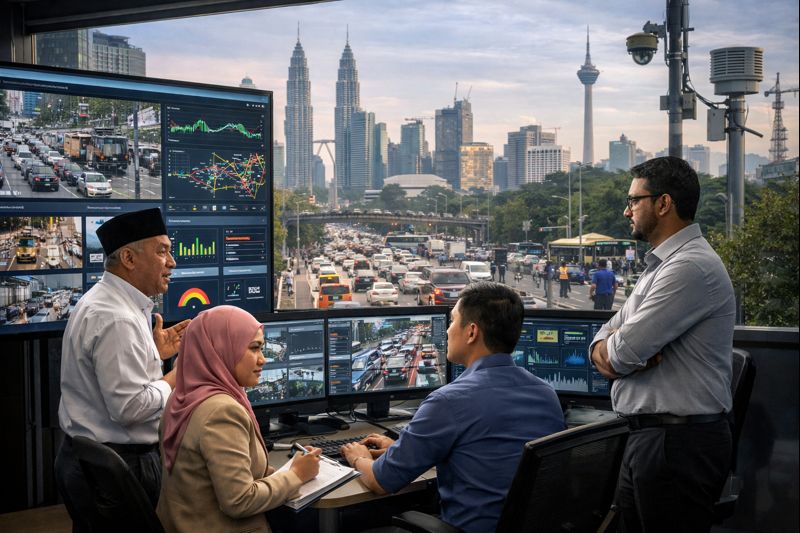
There is a kind of silence I remember very clearly.
Not the silence of an empty room.
But the silence appears when too many slides are shown, too many big words are used, and too few honest questions are asked.
I was sitting in yet another Smart City presentation. Everyone was talking about master plans, KPIs, ISO standards, indicators, and rankings. The slides looked polished. The diagrams were neat. The language sounded confident.
Yet inside, a quiet question kept repeating.
Who will take care of this after the launch?
Who will wake up when the system fails?
Who will face the public when citizens are angry?
Those questions rarely appear on slides.
And that, for me, is where the real Smart City problem in Malaysia begins.
Why We Talk About Smart Cities at All
Smart Cities are not about technology.
They are about people.
They are about parents stuck in traffic every morning.
Children breathe unhealthy air.
Small business owners suffer when flash floods arrive without warning.
I often say this, and I truly believe it.
The final goal of a Smart City is very simple.
People can live healthier lives.
People can live happier lives.
Cities can run without constant chaos.
That’s it.
Not rankings.
Not awards.
Not plaques on office walls.
Yet somewhere along the way, we lost that simplicity.
When Everyone Wants to Be “Smart”
Today, almost everyone wants the Smart City label. Some go further and call themselves “AI Cities”.
I usually smile when I hear that.
Which AI?
Where is the intelligence?
Or is it just a new signboard?
Many systems branded as AI are simply basic automation. This is not a technology problem. It is a misunderstanding.
What troubles me more is this.
Some cities work quietly, building systems that actually function, yet receive no recognition because they never submitted an application. Others receive recognition early simply because they know how to fill out forms.
That’s when we learn a hard truth.
Recognition does not always reflect maturity.
From 30,000 Feet to 3 Feet
To be fair, Malaysia does have a solid Smart City framework.
On paper, it makes sense.
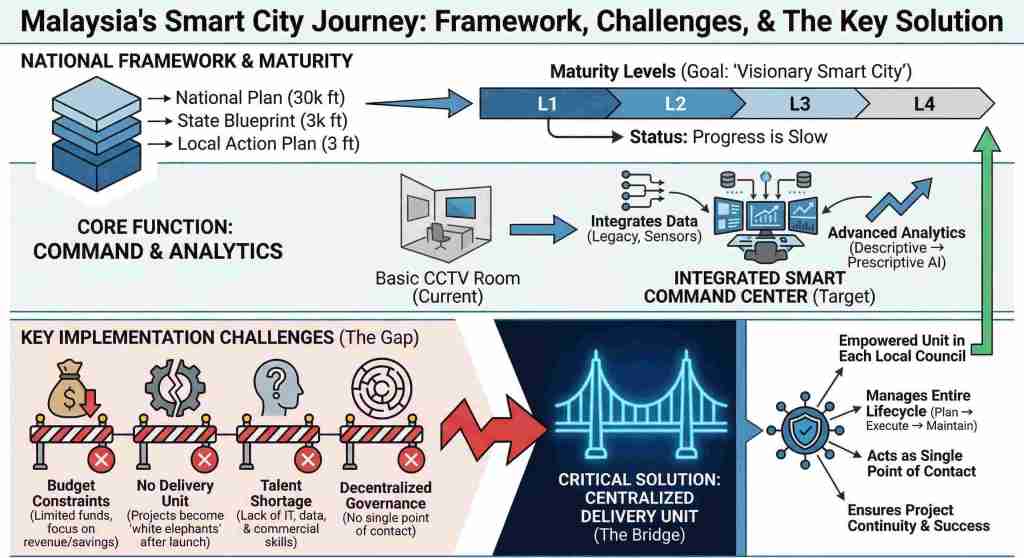
At 30,000 feet, there is the national master plan.
At 3,000 feet, there are state-level blueprints.
At ground level, around 3 feet, there should be detailed action plans for local councils.
Everything looks structured.
But in reality, many councils are stuck somewhere in between.
Some are still writing plans.
Some are experimenting with pilot projects.
Very few are running systems consistently, day after day.
Not because they don’t care.
Not because they are lazy.
But because something fundamental is missing.
Delivery structure.
Command Centres That Feel Empty
I have visited many command centres.
The name sounds powerful. Command centre. It feels important.
But once inside, the scene is often the same.
CCTV screens.
Live video feeds.
A few officers are watching.
That’s all.
I quietly ask myself.
Where is the data integration?
Where is the analysis?
Where are the decisions driven by this data?
A command centre should be the brain of the city.
Not just its eyes.
Imagine traffic data, air quality, noise levels, parking systems, citizen complaints, legacy databases, all connected and analysed together.
First, we know what has happened.
Then, we understand why it happened.
Next, we anticipate what might happen.
Finally, we know what action to take.
This is where technology truly matters. Not to impress, but to guide decisions.
The Challenges We Rarely Admit
Since around 2015, I have seen the same issues repeat.
Budget That Is Never Enough
Local councils are not money-making machines.
They rely on limited revenue sources. Assessment taxes. Parking fees. Licenses.
With limited funds, choices become limited too.
Projects that generate revenue or reduce costs often get priority. Long-term social impact projects struggle to survive.
Risk-heavy concession models usually favour large companies with deep pockets. Smaller local players, often full of ideas and energy, get pushed aside.
Sometimes I ask myself quietly.
Do we really want local ecosystems to grow?
Or are we just choosing the easiest path?
Projects Without Guardians
This one hurts the most.
Many Smart City projects are launched with excitement. Press conferences. Posters. Promotional videos.
A year later, the system is silent.
No maintenance.
No monitoring.
No clear ownership.
The project becomes a white elephant.
Not because the technology failed.
But because no one was assigned to take care of it.
Skills Gap Is Real
Smart Cities demand new skills.
Data management.
IT infrastructure.
Commercial thinking.
Long-term contract handling.
Many council officers come from strong urban planning backgrounds. They are good at what they do.
But we cannot expect them to suddenly manage complex digital systems without proper support.
This is not an individual failure. It is a structural one.
Fragmented Governance
For solution providers, one simple question often becomes complicated.
Who should we speak to?
Without a clear focal point, discussions lose direction. Time is wasted. Trust slowly fades.
One Answer I Strongly Believe In
If there is one thing that matters most, it is not technology.
It is a Delivery Unit.
A dedicated team.
Given authority.
Given responsibility.
Given continuity.
This unit becomes the caretaker of the entire Smart City lifecycle.
From strategy.
To execution.
To daily operations.
For long-term maintenance.
When this unit exists, everything changes.
Communication becomes clear.
Ownership becomes visible.
Projects do not get abandoned.
Citizens start feeling real benefits.
Smart City stops being a document.
It becomes a service.
Why I Still Have Hope
I am not writing this out of frustration.
I am writing because I still believe.
I believe our local councils are capable.
I believe our local talent is strong.
I believe technology is just a tool, not the answer.
What we need is the courage to admit weaknesses and the wisdom to build the right structure.
Smart City is not a race.
It is a responsibility.
If we want public trust, we must start taking care of what we build.
And it begins with one honest question.
Who will make sure this city still works tomorrow morning?
If this piece made you pause and think, I would love to hear your thoughts.
Leave a comment. Let’s talk.


 Dr. Mazlan Abbas