Connected World Song — Dedicated to IoT Enthusiasts
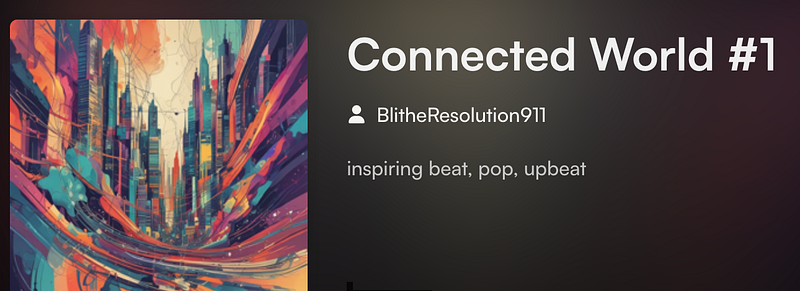
I generated this beautiful song, “Connected World,” using an app called Suno AI. Use a prompt to create the lyrics and describe the style of music you like.
[Verse] Wires crossing Signals talk In a world that never sleeps Tech is here Future walks
[Verse 2] Smart cities Bright and clear IoT AI blend Transformations Drawing near
[Chorus] Connected world Flying high Data streams that paint the sky In our hands Change is nigh Future dreams can never die
[Verse 3] Sensors pulse Code ignite Every moment is aligned Nodes that sparkle in the night
[Bridge] Artificial Brings to life Possibilities so wide Changing minds In every stride
[Chorus] Connected world Flying high Data streams that paint the sky In our hands Change is nigh Future dreams can never die
Not a member? Click here to read this story for free.
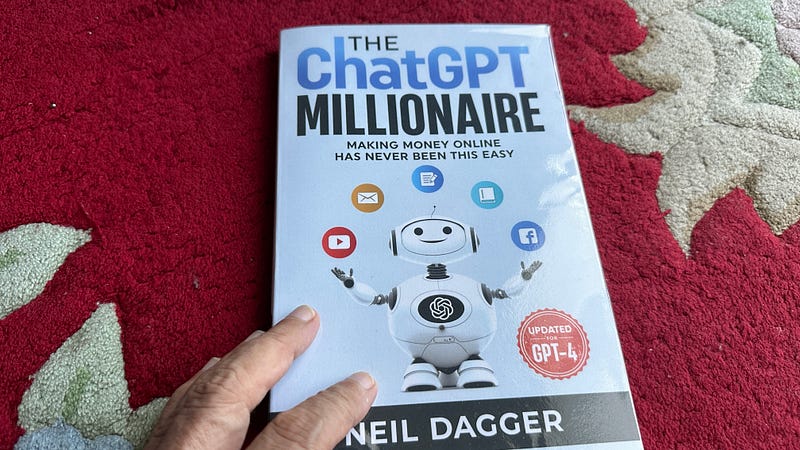
Having dabbled with ChatGPT before, I approached “The ChatGPT Millionaire” with a mix of skepticism and curiosity.
While I’ve had my share of exposure to AI and its utilities, this book promised to offer new insights and methods for monetizing this tool, particularly with GPT-4.
Here’s my take on whether it lives up to its promise.
From the start, the book emphasizes creating value with minimal effort — a proposition too tempting to ignore.
The idea of generating passive income by leveraging AI is not just enticing but revolutionary in today’s gig economy.
What struck me was the simplicity of the guide. It’s as if the author is holding your hand and walking you through each step with ease.
“Can I really create a sustainable income source this easily?” I wondered initially.
But as I delved deeper, the book’s pragmatic approach and clear, actionable steps dispelled my doubts.
It’s not just about making quick money; it’s about smart, efficient work capitalizing on the current market gap in AI utilization.
Practical and Actionable
One of the book’s strengths is its practicality.
The section on impressing clients by delivering high-quality work at lightning speed resonated with me.
As someone who values efficiency and quality, I believe the strategies outlined here are game-changers.
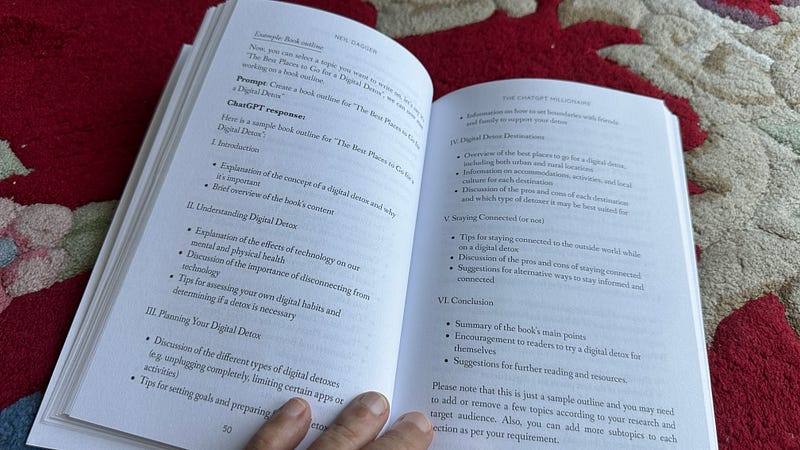
For instance, the guide on creating engaging content provides not just the ‘how-to’ but also the ‘why’ — a crucial aspect often overlooked in similar guides.
As I experimented with the “Act as” prompts provided, I was amazed at the versatility and adaptability of GPT-4.
The prompts are not just instructions but keys to unlocking the AI’s potential in various niches, from writing to coding to social media management.
Beyond Theoretical Knowledge
The book offers real-world applications and examples, making the leap from theory to practice seamless.
The narrative of becoming a “superhuman freelancer” isn’t far-fetched when you see the tangible examples and templates provided.
It’s empowering to envision oneself completing tasks with such efficiency and precision, thanks to AI.
Yet, it’s not all roses.
The author doesn’t shy away from discussing the limitations of ChatGPT, grounding the book in reality.
This transparency builds trust and sets realistic expectations—a crucial element in any guide that aspires to be actionable and reliable.
The Verdict — A Must-Read for Aspiring Entrepreneurs
In conclusion, “The ChatGPT Millionaire” is more than just a manual; it’s a blueprint for tapping into an emerging market.
Whether you’re a seasoned freelancer or a newbie looking for innovative income streams, this book has something for you.
Its simplicity, depth, and practicality blend make it a standout resource.
While I entered somewhat skeptical, I emerged enlightened and excited about the possibilities.
This isn’t just a book; it’s a great way to transform how we approach work and income generation in the AI age.
The added bonus materials only sweeten the deal, offering ongoing value and a toolkit for success.
So, would I recommend it? Absolutely.
Whether you’re looking to enhance your productivity, expand your business, or just curious about AI’s potential, “The ChatGPT Millionaire” is a treasure trove of insights and strategies that promise to inform and transform.
Why can’t I use AI to aid in my writing? Photo from Pexels
Two tools have dramatically reshaped the landscape for people like me — Canva and AI writing aids.
Not too long ago, Photoshop was the go-to for anyone wanting to design anything, but it required a steep learning curve and considerable time investment.
Fast forward to the present, and Canva has become the darling of content marketers, bloggers, educators, and virtually anyone looking to create eye-catching graphics without a degree in design.
On the writing front, AI tools have emerged as a potent ally for non-native English speakers, those less confident in their writing skills, or anyone pressed for time but in need of quality content.
Let me share my thoughts on how these two platforms have changed the game for me, offering empowerment and occasional ethical puzzles.
Canva – Design Democratized
Before Canva, the idea of crafting a professional-looking poster would send me into a mild panic.
My design skills were, let’s say, rudimentary at best.
Canva changed all that.
Intuitive and Inviting
Right off the bat, Canva felt welcoming.
Its drag-and-drop functionality, vast array of templates, and simple interface allowed me to create something visually appealing without prior design knowledge.
Suddenly, I was designing posters, social media graphics, and even branding materials with a newfound sense of confidence and creativity.
Creativity Unleashed
What’s remarkable about Canva is how it levels the playing field.
You don’t need to be an artist or a designer to create beautiful visuals.
The platform provides the tools and inspiration, allowing your ideas to take center stage.
It’s liberating, enabling me to communicate visually in ways I never thought possible.
AI Writing Tools: The Power of Language Unlocked
Moving on to AI writing aids, these tools have been nothing short of revolutionary for me, particularly as someone who doesn’t always easily find the right words.
Enhancing Expression
The AI doesn’t write for me; it writes with me.
I start with my thoughts, however chaotic, and the AI helps me refine them, suggesting better phrasing, correcting grammar, or even proposing new directions for my narrative.
It’s like having a collaborative partner who’s always ready to assist, guide, and improve.
Ethical Considerations
However, with great power comes great responsibility.
Using AI to enhance writing raises questions about authenticity and originality.
Where do my ideas end and the AI’s begin? I’ve come to view it as a tool, much like a thesaurus or an editor.
It enhances my voice without replacing it, ensuring my content remains genuinely mine.
Canva vs. AI: A Comparative Glance
While both Canva and AI writing tools have been game-changers, they serve different facets of content creation.
Here’s how they stack up against each other, in my experience.
User Empowerment
Canva empowers visually, breaking down complex design processes into simple, manageable steps.
AI writing tools empower linguistically, helping articulate thoughts more clearly and persuasively.
Both tools democratize their respective domains but do so in different realms — visual vs. verbal.
Creative Process
With Canva, I’m often inspired by the templates and design elements available, which spark ideas or take my projects in directions I hadn’t anticipated.
In contrast, AI writing feels more linear. It starts with my input and refines it toward a polished outcome.
Canva engages my visual creativity, while AI challenges and enhances my verbal expression.
Learning Curve
Canva’s learning curve is relatively flat, especially for basic tasks.
It’s about selecting, dragging, dropping, and tweaking.
On the other hand, AI writing tools require a deeper understanding of how to interact effectively with the technology, crafting prompts that elicit the best possible output.
Outcome Satisfaction
With Canva, I see the results instantly.
I know when a design clicks because it resonates visually.
With AI writing, the satisfaction is more nuanced, often requiring several iterations to feel “just right.”
It’s a more internal, reflective process, where I assess whether the words truly capture what I’m trying to convey.
Embracing the Tools of Today for Tomorrow’s Creations
Ultimately, both Canva and AI writing tools have transformed how I create content.
Canva has given me a visual voice, enabling me to design with confidence and flair.
AI writing aids have sharpened my words, ensuring my message is conveyed clearly and effectively.
While these tools provide incredible support, they also underscore the importance of maintaining a personal touch and authenticity in our creations.
Whether it’s a poster or a piece of prose, the essence of our individuality should always shine through.
Adapting to new technologies can be daunting, but my journey with Canva and AI writing tools has taught me the value of embracing change.
In a world where digital tools are increasingly integral to our creative expressions, being open to learning and adapting is key.
These technologies have the power to transform ordinary ideas into extraordinary creations, and I’m excited to be part of this transformative journey.
AI and the Art of Writing: A Non-Native Speaker’s Perspective.
The integration of artificial intelligence (AI) in our daily lives is a debate that has only grown more intense with time.
From driving cars to predicting weather, AI’s reach seems limitless.
But when it comes to the sacred act of writing, should we lean on AI for assistance, or is that crossing a sacred line of human creativity?
As someone who’s grappling with these questions personally, I’ve got some thoughts to share.
First off, let me be clear — I align with many writers who believe that using AI to write an entire article with just a prompt isn’t the way to go.
The essence of writing, for me, involves a deep personal engagement with the topic, a process that shapes thoughts into words in a way that’s inherently human.
To simply feed a prompt to an AI and let it churn out content feels like a shortcut that bypasses the soul of writing.
But here’s where my perspective might diverge from some purists — I use AI to assist in my writing.
Now, before you raise your eyebrows, hear me out.
English isn’t my first language, and I’m learning to master it.
This journey is filled with nuances, idioms, and syntactical structures that are sometimes baffling.
In my quest to express myself clearly and fluently, I’ve found AI to be a valuable ally.
When I write, the initial draft brims with my thoughts, raw and unfiltered.
It’s me at my most genuine, but it’s also me at my most vulnerable, grappling with a language that isn’t my mother tongue.
After pouring my thoughts onto paper, I turn to AI, not to rewrite my content but to refine it.
The essence, the core ideas, and the originality – all remain untouched, sourced from the wellspring of my creativity.
Now, you might wonder, is that wrong?
Is it cheating, or is it simply using available tools to bridge a linguistic gap?
To me, writing is an expression of the self, an art form that is as personal as it is universal.
When I use AI, it’s a bit like a non-native painter using a more advanced brush to bring their visions to life.
The painting’s concept, its emotion, and its message remain the artist’s own.
The brush is merely a tool to help realize that vision more vividly.
However, I recognize the other side of the argument.
Writing should maintain a human touch, they say.
It should reflect the imperfections, the quirks, and the unique style of its creator.
By involving AI, do we risk sanitizing writing to the point where it loses its individuality, its human essence?
I ponder this, especially when I see AI-written pieces that lack warmth or personal insight.
Yet, I believe the answer isn’t a blanket rejection of AI assistance but a balanced approach.
AI can help polish grammar, enhance clarity, and even suggest ways to make the prose more engaging.
But it should not – and cannot – replace the human experience, the personal stories, and the authentic voice that make writing resonate.
Consider this: every tool, from the quill pen to the word processor, has influenced how we write.
Yet, at their core, these are just tools – they don’t create art on their own.
Similarly, AI is a tool, albeit a sophisticated one.
It can assist, but the spark of creation? That remains distinctly human.
So, to those who argue that AI has no place in writing, I offer this perspective: AI is not a replacement but an enhancement, a means to bridge gaps and elevate expression.
For non-native speakers like me, it’s a way to communicate more effectively, ensuring our voices are heard and our messages understood.
In the end, isn’t the goal of writing to connect, to convey, to communicate?
If AI can help us do that more clearly, more powerfully, then perhaps it’s not the enemy but an ally.
After all, the essence of writing – the ideas, the passion, the message – will always come from the human heart and mind.
Let’s not shun AI in writing outright.
Instead, let’s find ways to use it responsibly, ensuring that it enhances rather than eclipses our human touch.
By doing so, we honor both the tradition of writing and the potential of technology, weaving them together in a way that enriches our expression and our understanding of each other.
Question to ponder — Is using AI … cheating or just another tool in the toolbox?
I was sitting in front of my computer screen, scrolling through yet another article post, hammering in the point that using AI or ChatGPT for our writing is a big no-no.
The frustration was real.
My mind was swirling with thoughts, “Really? Not even a little help?”
It felt like being handed a paintbrush but told not to use any colors.
Here’s the deal — I get it, okay?
The idea of just tossing a simple prompt into the AI abyss and letting it spit out a full-blown article or book without a second thought doesn’t sit right with me either.
That’s not creativity; that’s just being lazy.
But here’s where my frustration bubbles up like a volcano on the verge of eruption: English isn’t my first language. Getting those perfect, grammatically flawless sentences down?
It’s like trying to navigate a maze blindfolded.
Hours, I tell you, hours spent wrestling with a 500 or 1000-word article, trying to make it sound just right.
And it’s not just about grammar.
Conveying what I want to say, filling my articles with the right emotions, the nuances, the color — it’s daunting.
So, here’s the forbidden thought: what if I draft my thoughts, outline my content, and then, just then, let AI or ChatGPT fine-tune it?
Is that really so wrong? A sin, even?
“But what if the article turns out better? What if it actually gets read, appreciated, or — dare I say — earns something on Medium? Wouldn’t that be a good thing?”
The thing is, some of my articles that had a touch of AI assistance received good responses and even earned a bit. Meanwhile, the ones I slaved over, pouring my heart and soul into every word without any AI help, barely made a ripple.
It’s enough to make you wonder, isn’t it?
“Why is it that the ones I work hardest on, the ones I pour my everything into, just… flop?” I’d ask myself, staring at the screen, waiting for an answer that never comes.
And yet, there’s this lingering fear — what if a Medium publication outright rejects my work because it got a helping hand from AI?
Even if I’m the one steering the ship, drafting the content, and ensuring it reflects my voice, my ideas?
So here’s the confession, the moment of truth at the end of this tale of frustration and inner turmoil: this article, the very one you’re reading now, had a bit of help from ChatGPT.
Yeah, I said it.
With its assistance, I managed to shape my thoughts, polish my words, and hopefully, make this piece engaging and coherent.
Can you forgive me?
In a world where the line between human and machine creativity is becoming ever so blurred, maybe it’s not about who writes the article but the story it tells, the emotions it evokes, and the impact it has.
If using AI means breaking down language barriers and bringing our stories to life in ways we never could on our own, perhaps it’s not such a sin after all.
Imagine Steve Jobs as the Founder of Favoriot, a Malaysian IoT Startup
[Note: Click this if you are not a Medium Partner Program member. It will give full access to this article.]
Imagine if Steve Jobs became the Founder of Favoriot (a Malaysian IoT Startup) and made his opening speech at Favoriot Worldwide Developers Conference 2024.
As we all know, his speech has a unique voice, tone, and similar messaging.
With the help of ChatGPT, I wrote a prompt for ChatGPT to act as Steve Jobs and be the Founder of Favoriot including giving his speech or pitch.
“Ladies and gentlemen, in a world where technology increasingly touches every aspect of our lives, there’s one frontier we’re just beginning to explore: the Internet of Things, or IoT.
Imagine a world where every device, every sensor, every heartbeat, and every breath is connected, creating a symphony of data designed to improve our lives.
This is not just a dream. This is the reality we’re building at Favoriot.
At Favoriot, we believe in a future where technology serves humanity, not the other way around.
We’re pioneering IoT solutions that empower individuals, businesses, and communities to connect and engage with the environment around them in ways never before possible.
Our platform is more than just technology; it’s a bridge between the digital and physical worlds, designed to enhance health, safety, and efficiency.
Imagine smart cities that optimize traffic flow in real time, reducing pollution and saving time.
Picture wearable devices that monitor your health, predicting potential issues before they become problems.
Consider agricultural sensors that ensure crops receive precisely the right amount of water, maximizing yield while conserving resources. This is the world Favoriot is creating.
But it’s not just about the technology; it’s about what we do with it. We’re here to start a revolution, one where every piece of data enriches our lives, making the world a more connected, more sustainable, and healthier place.
Our platform is built to scale, to evolve, to become the foundation upon which the future is built.
Innovation. Connection. Transformation.
These aren’t just words; they’re the pillars of everything we do at Favoriot.
We’re not just creating products; we’re crafting experiences, we’re shaping the future, and we invite you to join us on this journey.
The future isn’t waiting.
It’s here, and it’s powered by Favoriot. Let’s build it together.”
Today, AI-driven content creation is on the rise, writers like me are grappling with a fundamental question: Can artificial intelligence coexist with the authentic voice of a human writer?
This question has become particularly pertinent in my journey as a writer, especially in my attempts to gain visibility on platforms like Medium.
The AI Conundrum in Writing
I’ve always been fascinated by the potential of AI to enhance my writing.
Like many others, I envisioned AI as a tool to refine my ideas and craft them into eloquent essays or engaging blog posts.
This led me to experiment with ChatGPT, hoping it would help me expand my main points into full-fledged articles.
However, this approach, I realized, was flawed.
Despite my efforts, my articles weren’t gaining the traction I hoped for on Medium.
They received some views, reads, and claps, but never made it to the coveted “For You” tab.
I couldn’t help but notice that certain authors seemed to have their work promoted almost daily. This discrepancy led me to question: What was I missing?
The insights I gained were eye-opening, to say the least. It was a moment of reckoning, prompting me to reevaluate my approach to writing.
Avoiding the Pitfalls of AI in Writing
The realization hit hard.
Was I too dependent on AI? Was my voice getting lost in the algorithmically generated content?
I needed to find a balance where AI could assist without overshadowing my personal touch. Here’s how I decided to pivot:
Embracing Simplicity and Authenticity
The key, I realized, was to write as naturally as I would chat with friends on WhatsApp or social media.
Embracing simplicity meant opting for shorter, more digestible sentences over complex, long-winded ones.
Short paragraphs became my new norm, often consisting of just one sentence.
This approach not only made my writing more accessible but also lent it a conversational tone, resonating more with readers.
Overcoming Language Barriers
English is not my first language, which added another layer of complexity to my writing process.
To tackle this, I turned to tools like Grammarly, which helped me navigate grammatical nuances and refine the tone of my writing.
This was a game-changer, allowing me to express myself more confidently and clearly.
AI as a Complementary Tool
I began to view AI not as a crutch but as a complementary tool.
It was there to suggest ideas, help with structure, and offer guidance on grammar and style.
However, the core of the content—the soul of the writing—had to come from me.
A New Beginning
Armed with these insights, I embarked on a new journey.
I wrote an article without AI assistance, focusing solely on expressing my thoughts in their most authentic form.
This experiment was not just about testing a different writing method; it was about rediscovering my voice as a writer.
The results were more encouraging than I had anticipated.
There was a noticeable difference in how readers engaged with my content.
The personal touch, the human element in my writing, seemed to resonate more profoundly.
The Road Ahead
As I continue on this path, I’m keenly aware that the world of content creation is constantly changing.
AI will undoubtedly play a significant role in shaping this landscape.
However, it’s crucial to remember that the heart of great writing lies in the human experience—the emotions, perspectives, and insights that only a human can provide.
My journey has taught me that while AI can be a valuable asset, it should never overshadow the authenticity and personal touch that define truly impactful writing.
So, to my fellow writers grappling with this modern dilemma, I say: Embrace AI, but let your unique voice lead the way.
An entirely generated Medium article using AI is no excuse, but what if I used AI to help perfect my points and turn them into a well-written essay or blog?
Using ChatGPT to help me expand my main points into an article would be okay. But oh boy, I was wrong!
No wonder Medium never boosted my articles on the “For You” tab.
I could get some views, reads, and claps, but it never helps boost what all writers seek.
I have seen many articles by the same writers being boosted almost daily, and I questioned myself — why not me?
Embracing AI in the Blogosphere: A Double-Edged Sword
When ChatGPT first graced the digital world, it promised a revolution in content creation.
The allure of instant, AI-generated blog posts was undeniable, especially for those grappling with the complexities of technical subjects.
The initial excitement was palpable: feed ChatGPT a line, and voila, a full-fledged article appeared. Yet, this initial euphoria was short-lived as the drawbacks became evident.
These AI-crafted pieces, although informative, often lacked the personal touch and authenticity that resonate with readers.
They felt mechanical, a tad too perfect, and eerily similar across different platforms. This was the conundrum: AI’s efficiency versus the need for an authentic, human connection in writing.
The Authenticity Challenge: A Crucial Pivot
The true battle is for engagement and connection.
Authenticity isn’t just a buzzword; it’s the cornerstone of effective communication.
The realization that reliance on AI compromised this essential aspect marked a pivotal moment.
The content, though factual, missed the human element – the unique voice and perspective that make each blog distinct and relatable.
Photo by julien Tromeur on Unsplash
A Shift in Strategy: AI as an Enhancer, Not a Replacer
The journey led to a critical insight: ChatGPT’s role isn’t to replace the human touch, but to augment it.
The new methodology involved crafting the initial draft personally, pouring in unique insights and perspectives.
This approach kept the core of the content genuine and reflective of the author’s voice.
Grammar and stylistic nuances took a backseat in this phase, allowing for a free flow of ideas.
For example, if you have been reading my articles, you will know my personal nuances versus an AI-written article.
ChatGPT: The Virtual Copywriting Assistant
Post the creative outpouring, ChatGPT’s role transformed into that of a virtual copywriter.
It wasn’t about generating content anymore but enhancing what was already there. Through prompts like “Rewrite the blog in a more human manner,” the AI tool fine-tuned the draft – fixing grammatical errors, enriching the vocabulary, and improving overall structure.
The outcome? A well-crafted piece that retained its original essence while being polished by AI’s capabilities.
Photo by Mohamed Nohassi on Unsplash
The Best of Both Worlds: Originality and Polish
This synergistic approach redefined the role of ChatGPT in content creation.
It morphed from a creator to an enhancer, ensuring that the author’s unique voice was not just preserved but also elevated.
It’s akin to having a copywriter on standby, one that fine-tunes without overshadowing the originality of the content.
In Conclusion: Harmonizing Creativity and Technology
The journey with ChatGPT in the blogging realm underscores a critical balance: leveraging technology without sacrificing the human element that is at the heart of storytelling.
While ChatGPT may not spark the initial creative flame, it certainly can fan it into a stronger, clearer, and more engaging narrative.
Photo by Andrew Neel on Unsplash
Key Takeaways
AI as a Tool, Not a Crutch: Use ChatGPT to enhance, not replace, your unique voice.
Balance Is Key: Harmonize your authentic content with AI’s ability to refine and polish.
Evolution Over Revolution: Gradually integrate AI into your writing process; let it evolve naturally.
Preserve Your Voice: Always start with your own insights and perspectives – the essence of your blog.
Embrace Technology Wisely: Use ChatGPT as a means to elevate your writing, not as a shortcut to generate it.
This reflective journey, enhanced by ChatGPT, serves as a testament to the evolving relationship between human creativity and artificial intelligence in the realm of blogging.
They said you can asked ChatGPT any questions and it will give answers based on the way you write your prompts.
Recently, I posed a fascinating question to ChatGPT, an advanced AI language model: “Pretend you’re an investor. How should Favoriot’s founders approach VCs for funding or acquisition?”
Here’s the distilled wisdom that ChatGPT, wearing its ‘investor hat’, imparted:
Dear Team Favoriot,
Navigating the labyrinth of venture capital is no small feat. I offer you a blend of time-tested investment wisdom and new-age insights:
1. Know Your Investors:
Dive deep into the portfolios of VCs you’re pitching to. Their past investments can offer clues about their preferences. Make sure your pitch resonates with their focus areas.
2. Your Unique Value:
.What sets you apart in a sea of startups? Highlight the unique problem you address and substantiate with data, testimonials, or case studies.
3. Market Scalability:
It’s not just about the now; it’s about the potential. Offer data on your Total Addressable Market (TAM) and illustrate your strategy to dominate this space.
4. Your Business Blueprint:
Showcase a business model that isn’t just profitable now but has the potential to scale. Emphasize the sustainability of your revenue streams.
5. Progress Report:
In numbers and milestones, chart out your journey so far. VCs love tangible metrics – be it user growth, revenue charts, or strategic collaborations.
6. The Driving Force – Your Team:
Ideas are dime a dozen, but a competent team is a rare gem. Introduce your core team members and their unique strengths that make your startup’s vision achievable.
7. Financial Prudence:
Money entrusted should be wisely used. Chart out a clear plan showcasing how you intend to deploy the funds.
8. Eye on the Exit:
.VCs are in it for the long haul but with a clear exit. Shed light on potential exit strategies, hinting at possible acquisition targets or likening to public companies.
Aiming for Acquisition?
Know Your Suitors:Start by identifying businesses that would gain strategic advantages by acquiring you.
Forge Key Partnerships: A collaboration today could translate into an acquisition tomorrow.
Highlight the Mutual Benefits: Demonstrate how your offerings could be the missing puzzle piece for potential acquirers.
In the realm of venture capital, the idea is just the beginning.
It’s the robust execution plan, the dynamism of the team, and the potential for market capture that truly entices investors.
As you step onto the pitching platform, armed with this knowledge, I wish you nothing but success.
Warm regards,
ChatGPT, Your Virtual Investor Guide
What do you think about this advice? Would you take it?











 Dr. Mazlan Abbas