How I Used the Law of Attraction to Become a Better Writer

WRITER’S STORY

How to Get Inspired

Image created by ChatGPT

There are many instances that I will be waiting for inspiration to strike.

It didn’t happen often, and the words felt forced when it did.

Writing was reserved for the gifted few who had mastered the art of storytelling.

But that belief changed when I discovered the power of the law of attraction.

This wasn’t just some mystical concept; it was a mindset shift that turned writing from a struggle into a passion.

Believing in Myself as a Writer

The first step in my journey was believing I could be a great writer.

It sounds simple. But I had my doubts.

Could I, someone who hadn’t considered writing a serious skill, honestly write something resonating with others?

To overcome this, I started using positive affirmations.

Every morning, I would say, “I am a writer. My words inspire and connect with others.”

I wrote these affirmations on sticky notes and placed them around my workspace.

At first, it felt awkward.

But over time, these affirmations became my truth. I began to see myself as a writer, not just someone trying to write.

Visualising My Ideal Writing Life

One of the most powerful techniques I used was visualisation.

I imagined myself a successful writer — my articles being widely shared, my books on shelves, and my words impacting lives.

I would close my eyes and picture myself typing effortlessly, the ideas flowing freely. I imagined the emails and comments from readers thanking me for sharing insights that helped them.

This mental exercise wasn’t just a daydream.

It became a blueprint for my actions.

If I wanted to live that vision, I needed to write every day.

Visualisation motivated me to show up at my desk, even when writing felt like an uphill battle.

Focusing on Gratitude

One of the critical elements of the law of attraction is gratitude.

Instead of lamenting writer’s block or low readership, I started to appreciate the small victories.

When a single reader commented on my post, I celebrated it.

When I wrote 500 words daily, I felt grateful for the progress.

I kept a journal listing three things I was grateful for in my writing journey each day.

This practice shifted my focus from what I lacked to what I had.

It reminded me that every step was part of the journey, no matter how small.

Surrounding Myself with Inspiration

Another technique I embraced was surrounding myself with inspiration. I followed writers on social media who shared their journeys and struggles. Their stories made me realise that even the best writers face challenges. I read books and articles that resonated with me, paying attention to the style, tone, and structure.

I also curated an environment that sparked creativity.

I added plants to my workspace, played soft instrumental music, and lit scented candles during writing sessions.

These small changes made the act of writing something I looked forward to.

Taking Inspired Action

The law of attraction doesn’t mean sitting back and waiting for the universe to deliver your dreams.

It requires action.

I started taking inspired action once I had the mindset, visualisation, and gratitude.

For me, this meant writing consistently.

I set a goal to write 500 words daily, whether for my blog, Medium, or personal journaling.

Some days, the words flowed effortlessly; others were a struggle.

But I showed up. The more I wrote, the easier it became.

I was writing transformed from a chore into a habit.

Attracting Opportunities

As I continued my writing journey, I noticed opportunities began to appear.

My blog posts started gaining traction, and readers shared my work.

Invitations to speak and collaborate with others in the industry came in.

My belief in myself and consistent efforts were aligned with the opportunities I had visualised.

I also embraced feedback as part of this journey. Instead of feeling disheartened by criticism, I saw it as a chance to grow.

The law of attraction doesn’t guarantee perfection but teaches you to see every experience as a stepping stone toward your goals.

Trusting the Process

The most important lesson I learned was to trust the process.

Writing is a journey, and every writer’s path is unique.

I stopped comparing myself to others and focused on my progress.

The law of attraction helped me develop patience.

I realised that the seeds I planted would grow in their own time.

Now, as I look back, I can see how far I’ve come.

Writing has become a joy, not just a task.

I’ve connected with readers, shared my thoughts, and found my voice.

And all of this started with a simple belief: I am a writer.

Your Journey Begins Now

If you’ve ever felt stuck as a writer, try applying the law of attraction.

Start by believing in yourself and visualising your success.

Embrace gratitude and take consistent action.

Surround yourself with inspiration and trust the process.

Writing isn’t about being perfect; it’s about showing up, expressing yourself, and connecting with others.

Every time I write, I remind myself of the power of this mindset.

It has made me a better writer and a more fulfilled individual.

And if it worked for me, it can work for you, too.

About Me (Part-12) — Mazlan Abbas

ABOUT ME SERIES

You are the painter of your life, and your thoughts are the brushstrokes

As I sit here reflecting on my journey with Favoriot, a quote comes to mind: You are the painter of your life, and your thoughts are the brushstrokes. It’s a simple metaphor, but it holds profound truth.

Over the years, I’ve realised that every decision I’ve made, every path I’ve chosen, and every challenge I’ve faced have all been part of the larger canvas of my life.

The way I approached those moments — my thoughts, my attitude — were the brushstrokes that created the picture I’m looking at now.

The journey to creating Favoriot was never a straight line, and I certainly didn’t have the luxury of knowing what the final picture would look like.

But looking back, I can see how each experience, each minor stroke, came together to form something much bigger than I ever imagined.

It all started with a desire to create something meaningful. I had spent much of my career working in government, academia, and large corporations. At each of these stages, I gathered knowledge and experience.

But deep down, I knew there was more I wanted to do.

I didn’t just want to be part of someone else’s vision; I wanted to paint my own.

That’s when the idea of Favoriot started to take shape in my mind.

Technology, especially the Internet of Things (IoT), has always fascinated me. It was a concept that could revolutionise industries and impact lives.

But at the time, many people didn’t fully understand its potential.

I remember sitting in meetings where I’d explain IoT only to be met with blank stares or polite nods. It was frustrating, but I kept reminding myself that not everyone could see the vision I had in my mind.

Others may not have understood the picture I was painting, but I knew the bigger picture would eventually emerge if I stayed focused on the details.

Starting Favoriot was my way of putting my thoughts into action. I knew that to make an impact, I had to stop waiting for the perfect moment and start making deliberate brushstrokes.

The first few strokes were shaky—there were moments of doubt, times when things didn’t go as planned, and periods when progress felt slow.

But I knew that was all part of the process.

Just like in painting, the early stages can look messy. Only when you step back after some time, do you see how it all fits together.

One of the biggest challenges I faced in the early days was convincing others to believe in the vision of Favoriot.

We were pioneering a new approach to IoT in Malaysia, and breaking into the smart city market was no easy feat. There were sceptics, people who questioned the need for IoT or the practicality of our solutions.

But I kept reminding myself: You are the painter of your life. No one else can see the full picture except you, and it’s your responsibility to keep painting, no matter what others think.

I remember a particular moment when things felt tough. We had just launched a pilot project with a local city council to implement IoT solutions for the command centre.

It was a groundbreaking project, and we were excited to get started. But soon after, we hit a wall of red tape. Bureaucracy slowed everything down, and it felt like we were losing momentum.

I could feel the frustration building among the team, and I began to doubt whether we could pull it off.

But then I took a step back and reminded myself of the bigger picture. This was just one part of the canvas — a challenging part, no doubt, but not the whole picture.

I realised that every project, every obstacle, was a brushstroke.

Some strokes might be more challenging, but they were still necessary to complete the painting.

We eventually got through that rough patch, and the project succeeded. That experience taught me an important lesson: the most meaningful brushstrokes often take the most effort.

They may need to look better, but they add depth, texture, and character to the final work.

As Favoriot grew, I saw the picture I had in my mind start to come to life. We began partnering with universities, local councils, and businesses to implement IoT solutions that improved efficiency, reduced costs, and solved real-world problems.

Whether helping warehouses monitor their assets or enabling cities to manage their IoT solutions more effectively, each project felt like another brush stroke, adding more colour and detail to the canvas.

But the painting isn’t finished yet—I don’t think it ever will be.

That’s the beauty of life—you are always adding new strokes and layers. Some strokes are bold, others subtle, but they all contribute to the larger picture.

One of the things I’ve learned along this journey is that you can’t always control the challenges you face, but you can control how you respond to them.

And that response, that thought process, becomes a brushstroke on your canvas.

For instance, when we faced the challenge of scaling Favoriot, I could have panicked or played it safe. But instead, I chose to see it as an opportunity—a chance to paint something new, something more significant.

We expanded our platform with new business models and entered new markets. It was a bold stroke, but it added a richness to the canvas that wasn’t there before.

The metaphor of life as a painting also reminds me that not every stroke has to be perfect. Sometimes, we make mistakes. Sometimes, I make decisions that don’t work out how I had hoped.

But I’ve learned that mistakes are just part of the process.

You can always paint over them or incorporate them into the bigger picture. Some of the most beautiful paintings have layers of mistakes hidden beneath the final strokes.

It’s what gives them depth and complexity.

I often share this perspective with the Favoriot team. I remind them that we are all painters, each contributing our brushstrokes to the larger canvas of the company’s journey.

Some days, the strokes feel effortless — everything falls into place, and progress is smooth. Other days, the strokes feel laboured — challenges arise, and it’s hard to see how things will come together.

But we’re moving forward as long as we keep painting and adding to the canvas.

Today, Favoriot is a testament to the power of persistence, vision, and creative thinking.

We’ve helped shape the future of IoT in Malaysia, and our solutions are making a difference in people’s lives.

But the painting is far from complete.

There are still so many more brushstrokes to make and so many more layers to add.

Looking at where we are now, I’m filled with gratitude.

I am grateful for the challenges that forced me to grow, the people who believed in the vision, and the opportunities that allowed me to paint my picture.

You are the painter of your life, and your thoughts are the brushstrokes. This journey has taught me that, above all else, your thoughts shape your reality.

They are the brushstrokes that define your canvas.

And while the painting may never be finished, it will always be yours to create.

So, if there’s one message I hope to leave behind, it’s this: don’t be afraid to pick up the brush. Don’t be scared to make bold strokes, try new things, paint over mistakes, and keep adding to your canvas.

Ultimately, you are the only one who can paint a picture of your life. And with every stroke, you bring your vision closer to reality.

Aligning with Your Dreams: The Journey to Becoming Who You’re Meant to Be

Inspiring Quotes

How This Quote Transform Me

Your Dreams Are Waiting for You to Align with Them

I often reflect on the early days of my journey, back when I was just a curious boy fascinated by science fiction, cartoons like The Jetsons, and stacks of DC comics.

Those stories of futuristic worlds, innovative gadgets, and unthinkable possibilities weren’t just entertainment — they planted wonder in my mind.

I dreamt of creating something that could change the world.

But dreams, as I’ve learned, don’t come to life alone. They wait for us to align with them and rise to their call.

The quote, “Your dreams are not far; they are waiting for you to align with them,” resonates deeply with me. It’s not about chasing dreams; it’s about becoming capable of realising them.

In my career, I’ve navigated vastly different environments — a university, a government agency, a corporate world, and a startup. Each phase felt like stepping into a new dimension of time and challenges. Yet, those experiences were essential.

They moulded my perspective, sharpened my skills, and tested my patience. I had to learn to adapt, to fail, and most importantly, to persevere.

When we founded FAVORIOT, it wasn’t just another tech company for me. It embodied a vision — an IoT platform that could simplify complex solutions and improve lives.

But the path wasn’t as smooth as I had envisioned. The hurdles were plenty: convincing stakeholders, educating a market that wasn’t ready, and navigating financial constraints.

There were days when the vision felt like a distant star, almost unreachable.

But here’s the truth: dreams don’t drift away; we do. And to bring them closer, I had to realign my mindset and actions.

It meant going back to the drawing board, simplifying our goals, and surrounding myself with a team that believed in the vision as much as I did.

It wasn’t just about building a company; it was about building resilience, trust, and a relentless spirit.

I also realised the power of small steps.

Often, we think of dreams as giant leaps, but they are built on the foundation of consistent effort.

Writing one article at a time, connecting with one potential client, and sharing one innovative idea — each moment contributed to making FAVORIOT what it is today.

To anyone reading this, I want you to know that your dreams are closer than you think. They are patiently waiting for you to take that first step, embrace the discomfort of growth, and push through moments of doubt.

Looking back, I see that everything I’ve achieved wasn’t because I chased my dreams. It was because I became aligned with them. I became the scientist, the innovator, and the entrepreneur I always envisioned.

So, take a moment today to ask yourself: Are you aligned with your dreams?

Because they are waiting — not far away, not out of reach, but within you, waiting for you to rise to the occasion.

About Me (Part-11) — Mazlan Abbas

ABOUT ME SERIES

What You Think You Become, What You Feel You Attract, What You Imagine You Create

I remember vividly a quote that has shaped my journey: What you think you become, what you feel you attract, what you imagine you create. It’s a mantra that resonates deeply with me, not just in theory but in practice. Looking back on my life and the creation of Favoriot, this quote feels like a summary of how everything unfolded.

When I first embarked on this entrepreneurial journey, Favoriot was just an idea — a seed planted in my mind. At the time, I had already spent decades in the tech industry, working in various roles from academia to government agencies and corporate giants. Each of these experiences brought its own lessons, but they all felt disconnected somehow.

It was as though I had learned the language of innovation and technology, but I had yet to write my own story with it.

I didn’t always see myself as an entrepreneur. If you had asked me years ago, I might have told you I was content being part of large organizations where decisions were slow, processes were rigid, and innovation often took a backseat. But something within me started to shift. I began to realize that the bureaucracy of larger institutions wasn’t just stifling me — it was stifling the potential of the technology I was so passionate about.

I began to think about how things could be different, how technology like the Internet of Things (IoT) could be more accessible and transformative if it were in the hands of more people and businesses.

And that’s where the first part of the quote comes in: What you think, you become. I started to think of myself not just as an employee but as someone who could build something. I imagined myself as the founder of a company that would make IoT accessible, help smart cities flourish, and empower businesses with the right tools. It was just a thought, but thoughts are powerful.

The more I thought about it, the more it felt real.

Something is interesting that happens when you start thinking differently. Your emotions follow. What you feel, you attract. I began to feel a strong pull towards entrepreneurship. The fear of leaving the comfort of a steady paycheck was there, but it was overshadowed by an excitement I hadn’t felt in years. It was the excitement of possibility, of creation.

I began to attract opportunities, people, and ideas that aligned with this new vision I had for myself. Conversations I had never imagined started happening. People began approaching me with ideas, potential collaborations, and support offers. It was as though the universe had been waiting for me to make this mental and emotional shift.

Of course, it wasn’t all smooth sailing. I faced setbacks — plenty of them. From funding issues to technical challenges, there were days when the dream of Favoriot felt far-fetched. But I held on to that quote. What you imagine, you create. I had imagined Favoriot as a platform that would simplify IoT implementation for businesses of all sizes. I had imagined it as a critical player in the future of smart cities in Malaysia and beyond. And every time I faced a challenge, I reminded myself that creation is never easy.

It requires patience, resilience, and, most importantly, belief.

One of the pivotal moments for Favoriot was when we started collaborating with universities and local councils. Initially, it was challenging to convince people of the importance of IoT, primarily when many had never even heard of it. But I had imagined a world where IoT was commonplace, where cities used it to manage traffic, utilities, and public safety more efficiently. I knew that the demand would follow once people could see the value of what we were offering.

Slowly but surely, that vision started to take shape.

We developed a platform that could be integrated into various industries — healthcare, agriculture, and smart cities. We attracted clients from different sectors, each looking to improve their operations through IoT. During this time, I truly began to understand the power of imagination. When you imagine something enough, it’s as though you can see the path forward even when others can’t. And as long as you keep moving forward, step by step, the creation process unfolds.

Sometimes, I doubted myself when the road ahead seemed impossible to navigate, but I always returned to that quote. It was like an anchor that kept me grounded.

I started to understand that thoughts, feelings, and imagination aren’t just abstract concepts — they are the building blocks of everything we do. They shape our reality in ways we don’t always see immediately.

In the years since Favoriot’s inception, we’ve seen significant growth. We’ve been able to help businesses and governments alike implement IoT solutions that improve efficiency, reduce costs, and contribute to sustainability. But perhaps the most fulfilling part of this journey has been watching something I once only imagined become a reality. The idea that started as a mere thought has now impacted many lives. And that’s the beauty of creation — it doesn’t just stop with you.

What you create has a ripple effect, reaching people and places you may never have imagined.

Today, as I reflect on how far we’ve come, I’m reminded of the importance of staying true to your vision, even when the odds seem stacked against you. I’ve learned that what you think, feel, and imagine are not just passive states of being but active forces in shaping your reality. Every challenge I faced along the way only strengthened my resolve, making the eventual successes that much sweeter.

As we move forward with Favoriot, my imagination continues to expand. I see new possibilities for how IoT can transform industries and contribute to solving some of the world’s most pressing challenges, like climate change and urbanization.

I believe that as long as I continue to think positively, feel deeply, and imagine boldly, those possibilities will become realities.

For anyone reading this who might be standing at the crossroads of a big decision — whether it’s starting a business, pursuing a new career path, or embarking on a personal project — I encourage you to remember that quote: What you think, you become. What you feel, you attract. What you imagine, you create. It’s a simple truth, but it can change your life if you let it.

In the end, Favoriot wasn’t just about building a company; it was about building a mindset—a mindset that believes in the power of thoughts, feelings, and imagination, a mindset that understands that creation is an ongoing process, one that requires persistence, passion, and purpose.

As I continue on this journey, I carry that mindset with me, knowing there is always more to create, imagine, and become.

About Favoriot — Part-18: What They Don’t Tell You About Success

ABOUT FAVORIOT SERIES

The Grind of Entrepreneurship

Image created using Glam app

Starting a business is both exhilarating and intimidating. When we began with FAVORIOT, the energy was contagious. We were laser-focused on developing our product, pushing hard to get it to market, and dreaming about the wave of interest we expected.

The energy in those early days was intense. We believed the world would notice as soon as we released the product, and the orders would come flooding in.

But reality, as I quickly learned, doesn’t quite work that way.

The silence after launching the product was deafening. There was no fanfare, buzz, or, most disheartening, customers. We were shouting into a void, and nobody was listening.

I couldn’t help but ask myself, “Did we make the right decision? Is there even a market for what we’ve built?” This question haunted many entrepreneurs early on, but I knew we had to keep pushing.

Giving up wasn’t an option, and the only way forward was through persistence.

In those moments, it became clear that having a great product wasn’t enough. We needed people to know about it. Marketing, awareness, and promotion were no longer side tasks; they became the lifeblood of our survival.

I constantly thought, “How do we get the word out? How do we make people care?

I had to become not just a product developer but a marketer, a salesman, and, at times, a storyteller.

Soon, we started getting requests for demos and presentations. It was a small but significant win. At least someone was interested.

I would go into those meetings with excitement and nerves, presenting our product like it was the best thing since sliced bread. People were polite, nodded in agreement, and seemed impressed—but no one pulled out their chequebook.

Then came the first request for a quotation. I thought to myself, “Finally! This is it; we’re on the verge of making a sale.

But again, silence followed. The quotation was sent, and the waiting game began.

It was a rollercoaster of emotions. You would think that a purchase order (PO) would soon follow after a quotation, but it didn’t always work that way.

When the first purchase order eventually came through, it was like a massive weight had been lifted off my shoulders. I can still vividly recall that moment. “We did it! Someone believes in us enough to buy our product!

It wasn’t just about the money; it was validation that we were on the right track. With that first PO, we gained a renewed sense of confidence in the product and ourselves. We began to believe in scaling.

If one customer believed in us, surely more would follow.

As more purchase orders trickled in, our focus shifted from development and marketing to invoicing and — perhaps the least glamorous part of the process — chasing payments.

It became part of the daily grind, issuing invoices, following up, and sometimes even begging for payment. It’s one of those realities of running a business that no one tells you about.

You assume that once a customer buys your product, the hardest part is over, but getting paid can sometimes be just as challenging.

Along the way, I learned a few hard lessons.

One of the most valuable things was not believing in empty promises. Early on, you meet many potential clients who love your product. They’ll tell you it’s exactly what they’ve been looking for, that it will be a huge success, and that they have big plans for it. They’ll dangle the carrot of future projects and massive scaling opportunities, and in return, they’ll ask for a discount or even a free proof of concept (PoC).

In the beginning, it’s tempting to agree. After all, who doesn’t want to believe that their product is about to hit the big time? But more often than not, those promises never materialise.

I learned to ask myself, “Where’s the purchase order? Until I see that PO, it’s all just talk.

Another pitfall I encountered was dealing with self-proclaimed “brokers.” These people didn’t represent any company but claimed to have the “big cable,” as we say in Malaysia — the connections to get us into significant tenders and projects.

They spoke of million-ringgit deals and massive opportunities if only we’d trust them. It was all so enticing.

But over time, I realised that a valid business deal doesn’t rely on middlemen or promises. An actual transaction happens when you convince a customer of the value of your product, earn their trust, and buy with their own money.

Looking back, these experiences shaped me as an entrepreneur. I learned that building a startup isn’t just about creating a product; it’s about building relationships, earning trust, and navigating the complexities of the business world with a healthy dose of scepticism.

It’s easy to get caught up in the excitement of what could be, but real success comes when you can turn those possibilities into tangible results.

And at the end of the day, the only thing that truly matters is that your customers see the value in what you’re offering and are willing to pay for it.

About Favoriot — Part-17: The Fine Line Between Inspiration and Bragging

Storytelling in Business

Sharing Genuine Stories Without Overdoing It

Image created using ChatGPT

The Dilemma: To Share or Stay Silent?

As I reflect on the journey of growing FAVORIOT, one question has always been at the forefront of my mind: Should we share the stories behind our successes or remain quiet and let the results speak for themselves?

I’ve often pondered this tricky balance.

Some believe in working silently, revealing success only once it becomes undeniable. On the other hand, people are curious; they want to see progress, witness small victories, and learn from their journey.

So, how do we balance being open and relatable without seeming boastful?

The Early Days: A Team Fueled by Passion

When we first started FAVORIOT, the energy was undeniable. We were a small team united by the vision of transforming how IoT could revolutionise businesses and daily life.

The excitement was palpable, but so was the uncertainty. I often asked myself, “Should we share our journey with the world? Should we discuss our vision, milestones, and progress?” I wrestled with the idea of staying silent. “No, Mazlan, keep it quiet. Let the work speak for itself,” a voice in my head said.

But at the same time, I knew that trust is built through openness and sharing the journey, not just the destination.

The Power of Storytelling

I’ve always believed that stories are what connect us. They bring people into your mission, making them feel like they’re not just buying a product but becoming part of something larger.

So why not share?” I asked myself.

Wouldn’t sharing our small wins show others that we’re genuine and making real progress?” Startups thrive on building momentum, after all.

A few people even encouraged me, saying, “Mazlan, people want to see how a company grows. They want to learn from your journey, the ups and the downs. Sharing those stories can inspire others and create a positive vibe around your business.

The Doubts: Criticism and Envy

But with the excitement of sharing also came the inevitable doubts. I realised that sharing too much could open us up to criticism.

People might misinterpret what we say. A small victory could easily be seen as bragging. Worse, some might become envious and even hope for our downfall. “Do I want to attract that kind of negative energy?” I asked myself.

The fear of inviting unwanted attention was real.

There’s also the risk of setting expectations too high. “What if we don’t meet them? What if people start doubting the authenticity of our story?” I thought. “Mazlan, if you keep showing every little success, people might think you’re exaggerating,” a close friend told me.

That struck a chord. I didn’t want FAVORIOT to be seen as all talk with no substance.

Finding the Balance

In the end, I realized that the answer wasn’t about choosing one extreme—silence or constant sharing—but about finding a balance.

The stories we tell need to be authentic.

They need to show the human side of the business, not just the successes but the challenges, struggles, sleepless nights, and small wins that keep us moving forward.

It’s about being honest.

People can tell when a story is genuine. They can sense when you’re sharing because it’s meaningful, not because you’re seeking attention. And when you’re authentic, they relate to you more deeply.

Trust is built through those authentic connections, which is crucial in business.

Emotion vs. Success Stories: The Right Mix

So, how do we balance emotion with success stories? Here’s how I see it: we share enough to let people know the heart of our company, the struggles we face, and the small victories we achieve.

We don’t paint a too glossy picture, but we don’t focus solely on the challenges.

There’s a delicate balance between being open about your journey and avoiding oversharing.

We must show people the progress, the hurdles we’ve overcome, and the small wins that push us forward. But we do it with honesty. We’re transparent, but don’t overwhelm people with too much noise.

Navigating Criticism: Staying True to Our Mission

Of course, there will always be those who view any success as bragging. That’s unavoidable.

But I remind myself that not everyone will root for you. That doesn’t mean you should stay silent. The key is how you share your story.

It’s not about boasting; it’s about connecting with people. It’s about showing them that success isn’t a straight line upward but a journey filled with twists and turns.

Looking Back: Lessons Learned from Sharing the FAVORIOT Journey

Looking back, I’m glad we shared parts of the FAVORIOT journey. It helped us build a community, create trust, and inspire others walking similar paths.

But we also learned to be mindful of how much we share and when. We don’t need to broadcast every detail, but we also don’t need to keep everything under wraps.

It’s all about balance—giving people enough to understand our mission and feel the emotion behind our work without overwhelming them with too much.

The Importance of Authenticity in Business

At the end of the day, it’s about staying true to who we are as a company and being thoughtful about how we tell our story.

We’re not just building a business; we’re building relationships.

Those relationships are strengthened through genuine, heartfelt stories—not just of success but of the journey to get there.

FAVORIOT’s growth is a testament to the power of finding that balance. By being open and honest and sharing our victories and lessons we’ve learned along the way, we’ve connected with people on a deeper level.

That connection is what continues to drive us forward.

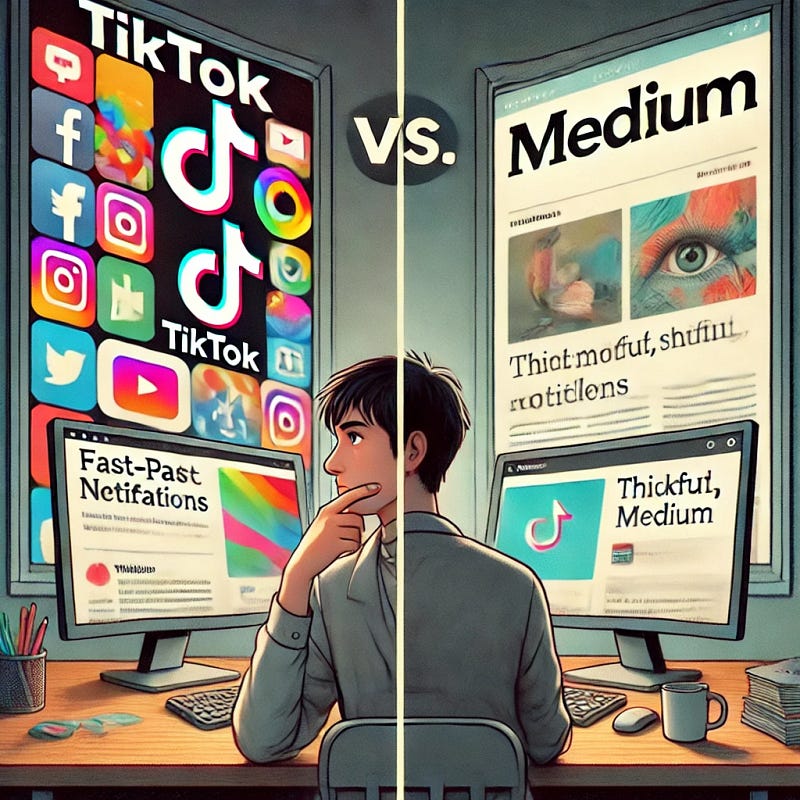
The Struggle Between TikTok and Medium

INFLUENCER’S STRUGGLE

The choice between TikTok or Medium — Which one?

This question kept nagging: why am I splitting my time between TikTok and Medium?

Image created using ChatGPT

The platforms couldn’t be more different, yet both significantly shaped my voice online. This duality, balancing TikTok’s fast-paced allure with Medium’s more reflective, thoughtful environment, has been an exciting challenge.

It’s a constant juggle, but each brings out a different side of my creativity, and I’m starting to embrace both worlds in ways I hadn’t anticipated.

The Allure of TikTok: Fast-Paced and Instant Feedback

It all started when I ventured into TikTok as @iotman2030, exploring short, snappy videos about the Internet of Things (IoT). I didn’t expect much at first — after all, I’m not strictly part of the younger generation that dominates the platform.

But to my surprise, TikTok has been an exhilarating ride, rapidly growing to 6,729 followers. My videos get hundreds, sometimes thousands, of views in hours. It’s instant feedback, and something is thrilling about seeing the numbers climb in real time.

TikTok is a platform that thrives on speed and spectacle. Often, I can craft a video in under a minute. It’s about capturing attention quickly, keeping it visually engaging, and riding the wave of trends.

Every like and every view comes almost instantly, which can be addictive, to be honest. But there’s a catch — monetizing that success isn’t as straightforward as you’d expect. While TikTok offers a burst of engagement, it doesn’t always translate into financial rewards as easily as Medium does.

The Depth of Medium: Slower but More Meaningful

Despite TikTok’s fast success, something keeps pulling me back to Medium. On Medium, things are quieter. My audience is smaller — around 2,531 followers — and my articles rarely pull in big numbers.

At most, I’m seeing about ten reads a day. But here’s the thing: I’m okay with that. I’ve started to appreciate the slower, more thoughtful pace that Medium demands.

Writing on Medium feels like a slow burn. Sometimes, I’ll spend hours, even days, drafting and refining an article. It’s more than just putting words on a page — it’s about crafting something that resonates on a deeper level.

Medium readers are different.

They’re not there for quick entertainment; they want depth, insight, and value. These readers appreciate the time and effort that goes into creating a meaningful article, and in turn, they engage with me in a much more thoughtful way.

Different Audiences, Different Expectations

It’s fascinating to see how the audiences on TikTok and Medium are polar opposites. TikTok is fast, fun, and full of energy.

Most of my viewers are younger and drawn to the edutainment-style content I produce. They come for quick, digestible clips that deliver information playfully and engagingly. It’s a rush to see their reactions within minutes of posting.

Medium, however, attracts a more mature crowd. These readers are looking for depth — they enjoy sinking their teeth into well-researched articles.

My audience on Medium appreciates thoughtful pieces that go beyond surface-level insights, and they expect a higher level of engagement from me as a writer.

My discussions in the comments section often dive deeper into the topics, leading to rich, meaningful exchanges. Knowing I’m connecting with people on a more intellectual level gives me a different kind of satisfaction.

Why Not Both? Embracing the Balance

After reflecting on these differences, I asked myself: Why should I choose between TikTok and Medium? Why not embrace both?

It’s like catering to two different creative appetites—TikTok satisfies my need for instant engagement and creativity, while Medium allows me to connect on a deeper level. Each platform offers something unique, and together, they help me grow as a content creator.

By embracing both platforms, I’ve found a balance that works for me.

On TikTok, I get to experiment with fast-paced, visually engaging content, which fuels my creative energy. Meanwhile, Medium allows me to slow down, reflect, and dive deep into the topics I’m passionate about.

It’s not about choosing one over the other; it’s about leveraging the strengths to reach different audiences and explore different sides of my creativity.

Beyond TikTok and Medium

But my content creation journey doesn’t stop there.

I’ve also dipped my toes into other formats like podcasting and YouTube. Podcasting has been an exciting adventure, allowing me to explore long-form discussions that wouldn’t fit into a TikTok or Medium post.

I can dive into complex topics in a more relaxed, conversational format. In a way, YouTube combines the visual appeal of TikTok with the substance of Medium. It’s another experiment where I’m still figuring out what works best.

But that’s the beauty of content creation; it’s constantly evolving, and I get to try new things, see what sticks, and adjust along the way.

Lessons for Budding Medium Writers

For anyone thinking of jumping into Medium, I have a few takeaways from my experience so far:

  • Know Your Audience: Medium readers aren’t looking for fluff. They crave well-thought-out, insightful content. Take your time to craft pieces that offer value.
  • Engage with Your Readers: Medium thrives on interaction, and the conversations you start in the comments section can be as meaningful as the article.
  • Be Patient: Building a following on Medium takes time. It’s a marathon, not a sprint, but if you stick with it, the personal and financial rewards are worth it.
  • Create Meaningful Content: Unlike TikTok’s quick-hit content, Medium is about depth. Focus on creating articles that stand out and resonate with your audience.
  • Diversify Your Platforms: Don’t limit yourself to one platform. Like I juggle TikTok, Medium, podcasting, and YouTube, explore different formats and reach out to varied audiences.

The Art of Juggling Platforms

Ultimately, I’ve seen my presence across TikTok, Medium, podcasting, and YouTube as a diversified portfolio.

Each channel brings something different to the table, allowing me to connect with various kinds of audiences uniquely.

As I continue this journey, I’m learning that content creation is not about chasing numbers but finding the right balance between speed, depth, and authenticity.

This journey is far from over, but I’m enjoying the ride, juggling different platforms, and discovering more about myself as a creator.

Different strokes for different folks, as they say, and I’m learning to embrace that fully.

About Favoriot — Part 16: Why Favoriot is Looking Beyond Malaysia for Success

ABOUT FAVORIOT SERIES

Breaking Boundaries for Local Homegrown Products

Image created using ChatGPT

Reflecting on Favoriot’s journey, I can’t help but feel a deep sense of frustration. It’s not that we haven’t done the work. We’ve built a robust Internet of Things (IoT) platform, and our solutions are ready to make a real impact.

But are we getting the buy-in from our domestic market? That’s an entirely different battle.

I remember meeting potential Malaysian clients and pitching the benefits of Favoriot’s IoT platform, which we have crafted meticulously to meet the specific needs of our local industries.

The pitch was solid, but the response was indifference, hesitation, and, more often than not, an inclination toward foreign products.

What’s the problem? I’ve asked myself this countless times. Why do these potential clients prefer foreign-made solutions, even when the local option is just as good, if not better, for their needs?

Lack of Confidence in Local Products

It became clear that there was an underlying issue—a lack of confidence in local products. There’s a perception in the Malaysian market that foreign products are inherently better. Whether it’s a smartphone, a software platform, or an IoT solution, many seem to believe that if made overseas, it must be superior.

It’s not just an isolated incident. This sentiment echoes across various industries. I’ve spoken to other Malaysian entrepreneurs, and they share similar frustrations. We have world-class solutions, but local buyers hesitate.

Why? Because in their eyes, if a big foreign brand does not back it, it’s not good enough.

I understand this mindset to some degree. We’ve grown up seeing foreign brands dominate our market. These global giants, from cars to consumer electronics, have conditioned us to trust familiar names from abroad.

But the world has changed. Malaysian companies like Favoriot are now capable of competing on the global stage. Yet, this old habit of looking overseas remains ingrained.

Branding: A Constant Challenge

Another realization struck me: our brand isn’t as strong as some international players. I’ve spent years building Favoriot, but branding is an area where we struggle, like many other local businesses.

When approaching potential clients, we often face an uphill battle because Favoriot doesn’t have the same brand recognition as some established international companies.

Building a brand takes time, and in a world where first impressions matter, having a well-known logo and a familiar brand name can often make or break a deal. But it’s not that our technology isn’t up to the mark; it’s quite the opposite. Our solutions are ideally suited to local needs and designed specifically for the unique challenges we face here in Malaysia. But when our brand is lesser-known, it sometimes feels like our solutions aren’t given the consideration they deserve.

I hate to admit it, but some of this might be on us. Perhaps our marketing materials aren’t as polished or impressive as they should be, or maybe how we present Favoriot in English isn’t as compelling as it could be.

I’ve always been more comfortable speaking in Malay, but for the global market—and even when pitching to local companies that expect presentations in English—having that fluency and flair in communication is crucial.

I’ve had to learn the hard way that even if the product is good, the delivery of that message must be even better.

The Perception Problem

Interestingly, I’ve noticed that this mindset isn’t unique to Malaysia. When we’ve pitched Favoriot in other countries (where their Nationalism is very high), we often encounter the same skepticism, just in reverse.

I’ve had meetings with potential customers overseas where they preferred local solutions, viewing Favoriot as “foreign” and, therefore, somehow less trustworthy.

It’s a strange irony. Here in Malaysia, people look to overseas solutions as more impressive, while in those countries, people prefer homegrown products. It’s clear that many people, regardless of where they are, tend to believe that something “local” can’t possibly be world-class.

The Struggle for Support

Another factor that makes breaking into the domestic market difficult is the need for solid support systems for local startups. We talk a lot about innovation in Malaysia, but the reality is that support for tech startups, particularly in the IoT space, isn’t as robust as it needs to be.

Sure, there are initiatives and grants, but corporate clients and the government should be more committed to adopting local tech solutions.

When I attend conferences or government forums, there’s always talk about “supporting local businesses.” However, many are still drawn to foreign companies when it comes to actual purchases and long-term partnerships. It’s disheartening because it creates an environment where local businesses struggle to get off the ground.

Should Favoriot Look Beyond Malaysian Shores?

So, where does this leave us? Over the years, I’ve concluded that while Malaysia remains an essential market for Favoriot, we cannot afford to limit ourselves to our domestic borders. The global market beckons; many of the most significant opportunities lie.

I’ve had more success pitching Favoriot to overseas clients than I have in my backyard. These clients are often more open to exploring new solutions and less influenced by brand recognition. If the technology meets their needs, they will take a chance on a company like Favoriot.

Moreover, going international allows us to position Favoriot as a global player, not just a local one. We can return to Malaysia with greater credibility by proving ourselves in other markets.

It’s unfortunate that sometimes, being recognized globally makes you more attractive locally. When local clients see that international companies trust your product, they think, “Maybe we should too.

Overcoming Domestic Challenges

Several factors contribute to the lack of support for local products in Malaysia:

  1. Bias Toward Foreign Brands: As I’ve mentioned, many local clients believe foreign products are inherently better, even when local solutions are just as good or better suited to their needs.
  2. Brand Recognition: Building a solid brand takes time, and Favoriot is still working on achieving the level of recognition that foreign companies enjoy.
  3. Marketing and Presentation: Our marketing materials and pitch presentations must be as compelling as the product. We continue to improve in this area.
  4. Lack of Government and Corporate Support: While there are initiatives to support local businesses, the actual adoption of local tech solutions by the government and corporate clients still needs to be improved.

Despite these challenges, I remain optimistic. Favoriot has already made headway in international markets. By expanding our global reach, I believe we can eventually overcome the biases and hurdles we face at home.

But for now, the path is clear. Favoriot must look beyond Malaysian shores.

We need to position ourselves as global players because the world is waiting, and if we don’t seize these opportunities, someone else will.

As frustrating as facing these domestic challenges is, they strengthen my resolve to push forward and prove that Malaysian-made solutions can compete on the world stage.

10 Contents Tips to Create Viral Posts

INFLUENCER MARKETING

I asked ChatGPT for answers — for self-improvement.

Here are ten (10) ideas for social media content that can help create viral posts while portraying a positive image for you and Favoriot:

  1. “Day in the Life of a CEO” Series — Show behind-the-scenes moments of your daily activities as CEO of Favoriot. This can include meetings, decision-making processes, or brainstorming sessions to humanize leadership.
  2. Success Stories of Favoriot Clients — Share real-life success stories of businesses that have benefited from Favoriot’s IoT solutions. Add engaging visuals or short video testimonials from clients.
  3. Quick Tips on IoT and Smart Cities — Short educational videos where you explain complex IoT concepts and engagingly. Use analogies that people from various industries can relate to.
  4. Interactive Polls/Quizzes on IoT Trends — Engage followers by creating polls or quizzes about smart cities, technology, and future trends. This will encourage interaction and help you understand your audience.
  5. Inspirational Quotes with a Personal Touch — Create posts that combine inspirational quotes from you or famous figures with your perspective on leadership, innovation, and challenges in the IoT space.
  6. Employee Spotlights — Showcase the diversity and expertise within the Favoriot team. Short videos or images highlighting their contributions can create a sense of community and loyalty.
  7. “Then and Now” Comparisons — Create visually compelling posts showing how technology has evolved over the years, with a focus on IoT and smart city advancements. This creates a narrative of progress and future innovation.
  8. Sustainability and IoT Impact Stories — Share how Favoriot’s IoT solutions contribute to environmental sustainability, such as reducing waste or optimizing energy consumption in smart cities.
  9. “Ask Me Anything” (AMA) Sessions — Host live or recorded AMA sessions on your social media platforms where you answer questions about IoT, smart cities, or entrepreneurship, allowing followers to engage directly.
  10. Motivational Content for Young Entrepreneurs — Share your journey as an entrepreneur, the challenges you’ve overcome, and advice for young people looking to innovate and create their tech solutions.

These posts will engage your audience and enhance Favoriot’s reputation as a forward-thinking, socially responsible brand.

The Importance of Transparency in AI

AI ETHICS

Building Trust in AI Software

Image created using ChatGPT

I was fascinated by AI’s power to automate complex tasks, solve problems, and even make decisions that typically require human judgment.

But as I dug deeper into the mechanics of AI, one question kept coming to my mind: How do we ensure that AI is doing what it’s supposed to do?

More importantly, how do we ensure everyone affected by AI decisions understands what’s happening behind the scenes? That’s where the principle of transparency comes into play.

Transparency in AI isn’t just about ensuring the technical aspects are visible to a select group of developers or engineers. It’s about ensuring that the processes and decisions made by AI systems can be explained to all stakeholders — whether they’re technical experts, end users, or decision-makers.

AI must not be a “black box” where decisions are made, but no one understands how or why.

This idea of transparency is essential when AI makes decisions that impact people’s lives. Whether deciding who gets a loan, determining the outcome of a legal case, or even influencing hiring decisions, transparency allows stakeholders to evaluate the risks and address any issues.

Full Disclosure: When AI is Making Decisions

One key aspect of transparency is being upfront when AI is involved in decision-making.

Let’s consider a scenario in the hiring process.

Imagine applying for a job, going through an interview, and later finding out that the final decision on whether you were hired was made by an AI system instead of a human.

I often think about this: Wouldn’t it be frustrating if you didn’t know an AI was involved? That’s why it’s so crucial for companies and organizations to disclose when AI systems are being used in decision-making processes.

People have a right to know if an algorithm is influencing the decisions that affect their lives.

It’s not just a matter of ethics — it’s about trust.

Let’s say a company uses an AI system to screen job applicants. Full disclosure would mean informing applicants upfront that an AI tool is part of the selection process, explaining how it works, and outlining what data it considers.

With this transparency, candidates may feel confident in the outcome, especially if rejected without explanation.

Transparency gives people the opportunity to understand and even challenge decisions if needed.

The Purpose Behind the AI System

Another critical element of transparency is ensuring the AI system’s purpose is clear.

Take, for example, a facial recognition system used in security.

How many people understand the full extent of facial recognition’s purpose? Is it merely for security, or is it also used to track individuals for marketing purposes?

Stakeholders should always be aware of the purpose of the AI systems they interact with. For example, suppose a facial recognition system is used at an airport for security purposes. In that case, passengers must know precisely what the system is doing, what kind of data is being collected, and how it’s being used.

Without this clarity, there’s a risk of misuse or mistrust.

One real-world example is when social media platforms use AI to filter content.

If users are unaware that AI systems are screening and categorizing their posts, they might need to understand why specific posts are taken down or flagged. This lack of transparency can create confusion, making people feel their rights are being violated.

Understanding the Data: Bias and Quality Control

Whenever I think about AI transparency, the issue of training data comes to mind.

AI systems are only as good as the data they’re trained on, but often, the data contains biases that reflect historical or social inequalities. The data must be used in training AI to be disclosed and scrutinized to ensure fairness.

Take the example of AI systems used in the legal system.

Imagine an AI tool designed to predict the likelihood of someone reoffending after being released from prison. If the data used to train the AI is biased — perhaps it overrepresents specific communities — it could lead to unfair outcomes.

What if the AI system was unknowingly biased against a specific demographic? These biases could go unchecked without transparency about the training data, perpetuating discrimination.

In my view, transparency in AI isn’t just about disclosing that AI is being used — it’s also about being open about the data and processes behind it. Stakeholders need to know what historical and social biases might exist in the data, what procedures were used to ensure data quality, and how the AI system was maintained and assessed.

Maintaining and Assessing AI Systems

An often overlooked but equally important aspect of AI transparency is how these systems are maintained over time.

Just because an AI model works well today doesn’t mean it will work as expected tomorrow. What if the data changes or the system starts to degrade over time?

I always think of this in the context of healthcare. Imagine an AI system used to assist doctors in diagnosing patients. The system was trained on medical data several years ago, but medical knowledge and treatments have evolved rapidly. The AI could become updated with regular updates and assessments, leading to accurate diagnoses.

Transparency means informing users about how the AI system works now and keeping them updated on how it’s maintained and monitored over time. This ensures that AI systems remain effective and fair.

The Right to Challenge AI Decisions

Finally, AI transparency must include people’s ability to challenge decisions made by AI systems.

This is crucial for building trust.

If someone feels an AI system has unfairly treated them—say, by denying them a loan or flagging them incorrectly by a security system—they should have the right to question and appeal the decision.

I often ask myself, How would I feel if an AI decided for me, and I had no way to contest it? This is where transparency plays a pivotal role.

It’s not enough for people to know an AI system made a decision — they also need to know how to challenge that decision.

Transparency ensures that AI systems are accountable through a human review process or by providing clear channels for appeals.

Moving Forward with Transparent AI

It’s clear that transparency is not a luxury—it’s a necessity.

Without it, AI systems risk becoming tools people don’t trust or understand. AI must be practical and transparent in its processes, decisions, and data usage to succeed.

Transparency principles — whether they involve disclosing AI’s role in decision-making, clarifying its intended purpose, or allowing for challenges — are essential to building trust in AI systems.

This is the only way to ensure AI systems benefit everyone fairly and responsibly.