Powering IoT Success: Five Key Traits Behind ThingsBoard’s Rise

ThingsBoard, an open-source Internet of Things (IoT) platform, has emerged as a significant player in the rapidly evolving IoT landscape. Here are the five key traits that have played pivotal roles in ThingsBoard’s success:

ThingsBoard’s open-source nature is at the core of its appeal. This allows developers and businesses to access the platform’s source code, offering them the flexibility to customize it according to their specific requirements. Moreover, it fosters a sense of community where developers can contribute to the platform’s evolution, leading to constant improvement and innovation.

One of ThingsBoard’s major strengths is its high scalability and performance. The platform is built to handle millions of devices, making it an excellent choice for businesses dealing with large-scale IoT projects. This ability to scale efficiently and maintain high performance under heavy loads has made ThingsBoard a reliable choice in the IoT platform market.

ThingsBoard’s support for multiple IoT protocols, including MQTT, CoAP, and HTTP, is a significant advantage. This flexibility allows the platform to cater to a wide range of IoT applications and devices, making it a versatile solution in the diverse IoT landscape.

ThingsBoard provides powerful data visualization and analytics capabilities. Users can create dynamic dashboards to track real-time data, conduct complex analytics, and generate actionable insights. This capability to turn raw data into meaningful information is a standout feature that drives ThingsBoard’s success.

ThingsBoard’s comprehensive device and asset management capabilities offer users complete control over their IoT devices. The platform supports device provisioning, remote device control, and the ability to define relationships between devices and assets. These features simplify the management of complex IoT ecosystems, further enhancing ThingsBoard’s appeal.

In conclusion, ThingsBoard’s success can be attributed to its open-source nature, scalability, multi-protocol support, robust data visualization and analytics capabilities, and comprehensive device and asset management. These traits have positioned ThingsBoard as a powerful tool in the IoT platform space. As the IoT continues to grow and transform various industries, ThingsBoard’s commitment to innovation and meeting user needs is likely to solidify its place in the market.


Originally published at https://iotworld.co on July 14, 2023.

My Journey to Building an Engaged TikTok Following Through IoT Education

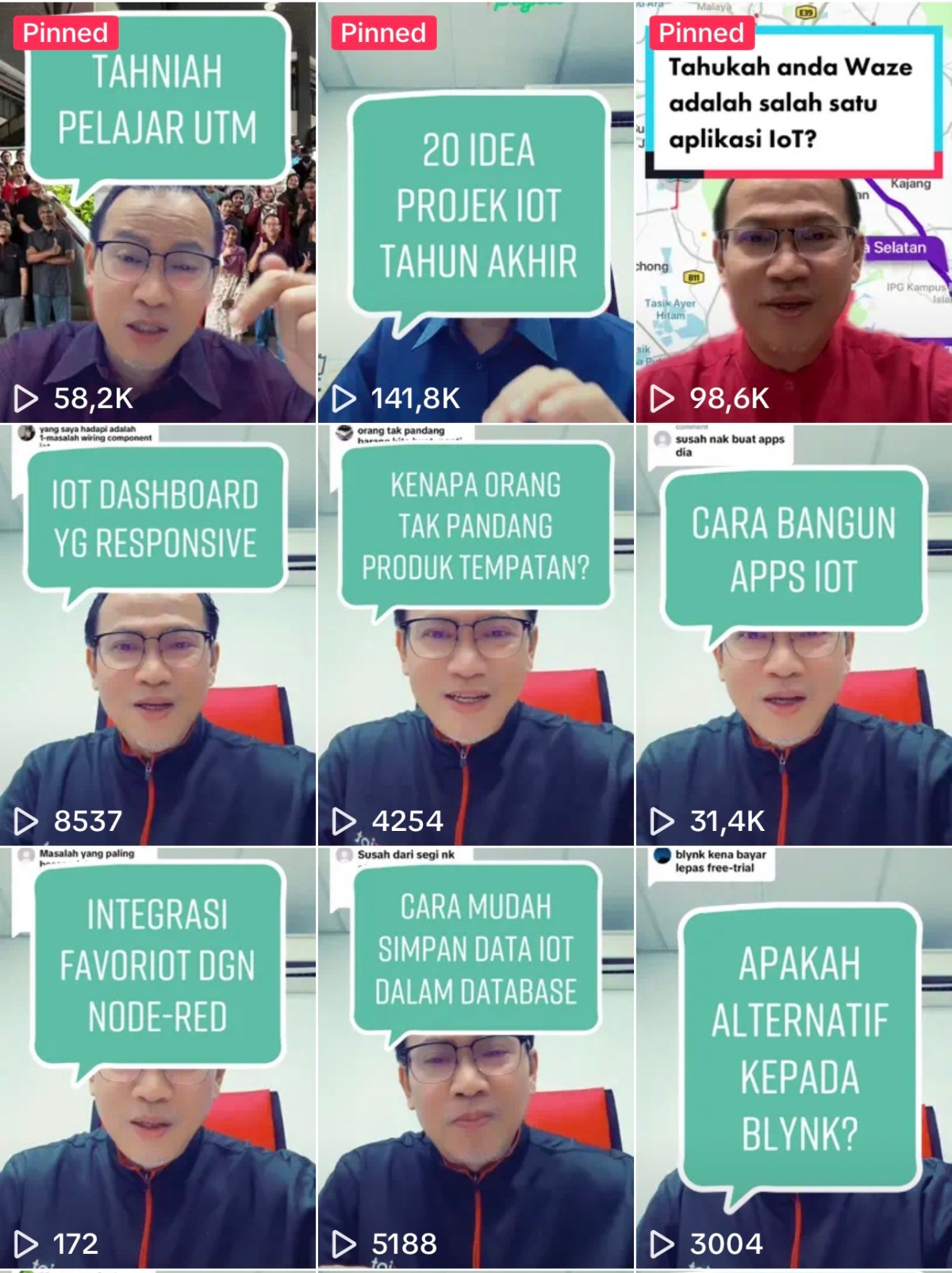
When I embarked on my journey to create an educational TikTok channel focusing on the Internet of Things (IoT), I was brimming with optimism. I envisioned myself as a digital pioneer, breaking down the complexities of IoT into bite-sized nuggets of wisdom for my audience. I was determined to explain the basics of IoT, elaborate on its benefits, and illuminate its numerous applications. The results, however, were humbling. My likes and followers grew at a sluggish pace, making me question if I was on the right track.

I pondered my approach and decided to pivot. Instead of merely disseminating information about IoT, I shifted my focus to address the current issues and challenges faced by IoT developers. By addressing the struggles and pain points in the field, I hoped to add an extra layer of relevance and engagement to my content.

The shift in approach paid off! I noticed a gradual increase in likes, comments, and shares. But the most gratifying change was the deeper level of engagement. My followers began to pose thought-provoking questions, sparking robust discussions on my channel. By answering these questions, I was not just fostering an active learning environment, but also cementing my place as a go-to resource for IoT-related knowledge.

I discovered my content had struck a chord with an audience I hadn’t initially anticipated. Youngsters and university students started to flock to my channel, seeking knowledge and guidance on IoT. It turns out that educational, or “edutainment,” content was the magic formula that resonated with this demographic.

The transformation of my TikTok channel has been a revelation. I now see that my platform is not just about sharing what I know, but also about creating a community where knowledge exchange happens. With this newfound understanding, I am committed to continuing my edutainment-focused content to serve and enrich the community.

This journey has taught me that engaging followers isn’t just about doling out information, but about addressing their concerns, answering their questions, and creating content that is relevant and relatable. As I look forward to the growth of my TikTok channel, I remain rooted in these valuable lessons that have shaped my journey so far.

Creating a New Era of Living: How IoT and AI are Shaping the Housing Industry

For many of us, our homes are a personal haven, a secure fortress that provides comfort and safety. But what if our homes could be more? What if they could learn our habits, anticipate our needs, and enhance our comfort? Enter the Internet of Things (IoT) and Artificial Intelligence (AI), two technological wonders set to revolutionize the housing development industry.

Harnessing IoT and AI in Housing Development

IoT and AI technologies are transforming our homes into smart spaces, with devices and systems interconnected to provide a seamless and intuitive living experience. By embedding smart devices within the structures of homes, housing developers can offer residents the convenience of a fully integrated, responsive environment.

Imagine a home that adjusts heating based on your arrival time, lights that dim or brighten based on the time of day, or security systems that recognize your face and allow only authorized access. These innovations aren’t future concepts; they’re happening now, thanks to IoT and AI.

Shaping Future Living Spaces

In this digital age, housing developers must take on a new role as pioneers of smart living solutions. As they merge their architectural know-how with the power of IoT and AI, developers can design homes that are not only functional and aesthetically pleasing but also technologically advanced.

Aided by AI, IoT devices can learn and adapt to a family’s routines and preferences, leading to truly personalized homes. These technologies can dramatically improve energy efficiency, security, and convenience, from smart thermostats to AI-powered security systems.

Beyond Bricks and Mortar

Integrating IoT and AI technologies into housing development goes beyond just physical buildings. It’s about creating living spaces that interact with their inhabitants, enhancing their quality of life.

Take smart metering systems as an example. These systems allow residents to monitor and control their energy consumption, leading to cost savings and promoting sustainable living. AI-powered predictive maintenance can notify you of potential issues with appliances or structural components, preventing costly future repairs.

The Future is Smart

Housing developers stand on the brink of an exciting frontier. By harnessing the power of IoT and AI, they can transform how we live and interact with our homes. This approach is not just customer-centric; it’s customer-transformative.

So, as we look towards the future, it’s clear that the home is more than just a dwelling place. It’s a living, evolving entity that, with the help of IoT and AI, can improve our lives in ways we’ve only just begun to imagine. The future is smart, and it starts at home. Welcome to the future of housing development.


Originally published at https://iotworld.co on July 13, 2023.

My Journey With 6 Social Media Channels

Social media has transformed into a bustling digital market square, where brands and individuals converge to exchange ideas, share experiences, and cultivate communities.

My journey through this dynamic landscape, interacting with diverse audiences, has provided fascinating insights into different platforms’ engagement metrics. Here, I’ll share a snapshot of my journey.

Facebook, TikTok, and LinkedIn: The Power Trio

The highest engagement in my social media portfolio comes from a diverse trio: Facebook, TikTok, and LinkedIn.

Facebook remains a sturdy pillar in my social media strategy. With its vast demographic reach, I’ve been able to engage with a broad audience, generating conversations that truly resonate. The in-built interactive features make it a conducive environment for generating likes, shares, and comments, fostering a strong sense of community.

TikTok, the newcomer in the digital arena, has proven incredibly powerful for engagement. The platform’s video-centric nature and algorithm have worked favorably, pushing my content to a broader audience. The high-energy, viral nature of TikTok has made it a fantastic platform to engage with younger demographics, fostering dynamic interactions.

LinkedIn, traditionally seen as a professional networking site, has surprisingly driven substantial engagement. By focusing on industry-related content and thought leadership, I’ve created meaningful interactions, drawing in professionals looking for expert insights and industry trends.

Twitter, Threads, and Instagram: The Underperformers

On the other end of the spectrum, Twitter, Threads, and Instagram have shown comparatively lower engagement rates.

Despite its real-time communication potential, Twitter engagement has been challenging. The fast-paced nature of the platform might be a factor, with tweets often getting lost in the feed’s rapid flow. The character limit can also restrict deeper conversations.

Threads, while providing a unique space for threaded conversations, hasn’t quite hit the mark for engagement. The platform is perhaps still gaining traction, making audience reach and engagement more limited.

Instagram, with its visually-driven interface, surprisingly falls into the lower engagement category. Despite posting visually appealing content, the platform’s recent algorithm changes seem to have affected reach and engagement negatively.

Final Thoughts

Navigating the social media landscape is a continuous learning journey. These engagement insights provide valuable guidance on where to focus efforts and how to adjust strategies for maximum impact. The goal is to continually experiment, learn, and adapt to the ever-evolving dynamics of each platform. As the journey continues, I remain committed to offering valuable content across all platforms, fostering genuine connections and community building in the digital world.

Channeling Success: Five Key Traits Behind ThingSpeak’s Rise

ThingSpeak, an IoT (Internet of Things) platform first launched in 2010, has significantly gained prominence in the rapidly evolving IoT landscape. Here are the five key traits that contribute to ThingSpeak’s success:

One of ThingSpeak’s significant traits is its ease of use and accessibility. The platform has been designed to be intuitive, with clear interfaces and straightforward data visualization tools. This has made it appealing to both beginners exploring the IoT space and experienced developers needing a rapid prototyping tool.

ThingSpeak’s decision to be an open-source platform has significantly contributed to its success. By making its source code available to the public, ThingSpeak has facilitated a community-driven development approach. This allows for continuous improvements and the ability to customize the platform to meet specific user needs.

ThingSpeak’s capability for real-time data processing and visualization is a core feature driving its success. Users can monitor and analyze live data streams, making it an invaluable tool in many IoT applications, from weather monitoring to home automation systems.

ThingSpeak’s integration with MATLAB, a high-level programming language and environment for numerical computation, visualization, and programming, is a standout feature. This integration allows users to perform complex data analysis and visualization directly within ThingSpeak, adding significant value to the platform.

ThingSpeak has fostered a strong online community and offers comprehensive documentation and learning resources. This supportive ecosystem helps users troubleshoot issues, share ideas, and learn best practices. The community’s knowledge sharing and collaborative problem-solving have undoubtedly contributed to ThingSpeak’s popularity.

In conclusion, ThingSpeak’s success is fueled by its ease of use, open-source nature, real-time data processing capabilities, integration with MATLAB, and strong community support. These traits have positioned ThingSpeak as a preferred choice in the IoT platform space. As the IoT continues to grow and evolve, ThingSpeak’s commitment to user needs and continuous innovation is likely to further cement its position in the industry.


Originally published at https://iotworld.co on July 12, 2023.

How To Increase Comfort in Your Daily Life

What strategies do you use to increase comfort in your daily life?

  1. Treat yourself occasionally: Splurge on that one thing you’ve had your eye on. It can give you something to look forward to.
  2. Connect with nature: Take a walk in a park or garden, or just sit outside for a bit. The fresh air can be surprisingly refreshing.
  3. Learn something new: Take up a hobby or learn a new skill. This can be both engaging and fun.
  4. Set boundaries: Make sure you’re not overextending yourself. It’s okay to say no sometimes.
  5. Practice mindfulness: Take a few minutes each day to just be present in the moment.
  6. Stay organized: Keeping your space clean and organized can go a long way in reducing stress and increasing comfort.

Remember, what works for one person might not work for another, so it’s all about finding what makes you happiest and most comfortable!

The Exciting Fusion of IoT, AI, and Robotics: A Vision of A Smarter Future

What are you most excited about for the future?

For the tech enthusiasts among us, the question, “What am I most excited about for the future?” is answered without missing a beat – it is the promise of technologies that make our world smarter and our lives simpler. Indeed, the future we eagerly anticipate is one where technologies such as Internet of Things (IoT), Artificial Intelligence (AI), and robotics are seamlessly integrated into our everyday life. This futuristic world isn’t merely about shiny new gadgets; it is about enhancing human life, augmenting our capabilities, and solving complex problems with precision and efficiency.

But, how exactly will these three transformative technologies change our lives? Let’s venture into a future where IoT, AI, and robotics meld together to create a smarter, simpler world.

Our Personal Lives: Smarter Homes and Healthier Lifestyles

Imagine waking up to a house that’s already anticipated your morning routine. The IoT-enabled coffee machine has brewed your coffee just in time for when you step out of the AI-powered shower that has adapted the water temperature to your preference. As you get ready, your smart mirror analyzes your health metrics, tracking any anomalies and providing updates on your overall well-being.

With the help of wearable IoT devices that monitor your vital signs and physical activities, preventive healthcare becomes the norm, and AI-powered applications can suggest personalized fitness routines and nutritional plans. Care for the elderly will be revolutionized with robots equipped with AI and IoT technologies offering assistance, companionship, and even medical aid.

Our Work: Increasing Efficiency and Productivity

In our workplaces, these technologies will work in synergy to streamline operations and enhance productivity. Imagine a smart office where your arrival triggers your preferred lighting and temperature settings. AI-powered tools could automate scheduling, organize your tasks based on your productivity patterns, and streamline communication between teams.

Collaborative robots, or ‘cobots,’ equipped with IoT sensors and AI capabilities, will work side by side with human employees. They will perform repetitive or dangerous tasks, leaving humans to focus on more creative and strategic aspects of their jobs. This not only increases safety but also boosts overall productivity.

Our Society: Smarter Cities and Improved Quality of Life

On a grander scale, the combination of IoT, AI, and robotics will facilitate the development of smarter, more efficient cities. IoT sensors could monitor everything from traffic patterns to air quality, helping to optimize urban planning and make cities more sustainable. AI could analyze the data to predict and manage any issues, such as traffic congestion, waste management, or energy use.

In disaster management, AI-powered robots could carry out rescue missions in hazardous environments where it is too dangerous for humans. They can help in search operations, deliver supplies, and even assist in medical procedures, potentially saving countless lives.

Our World: Environmental Conservation and Sustainability

As we grapple with climate change and environmental degradation, these technologies could provide innovative solutions for conservation and sustainability. IoT sensors can track environmental changes, providing valuable data to predict and mitigate the impact of climate change. AI can analyze this data to predict trends, while robots can be deployed for tasks like planting trees or cleaning up waste in hard-to-reach areas.

In conclusion, the fusion of IoT, AI, and robotics promises an exciting future where technology simplifies our lives, augments our abilities, and tackles global challenges. While we need to navigate issues around data privacy, security, and the digital divide, the benefits and potential of these technologies are undeniable. The future is not just about living in a high-tech world; it’s about living in a world where technology enhances human life, making us smarter, safer, healthier, and happier. As we stride into this exciting future, one can only wonder at the transformative changes we’ll see in the coming years.

Navigating the Web: Five Key Traits Driving Google’s Success

From its humble beginnings in 1998, Google has grown into a technology giant, influencing numerous aspects of our digital lives. Let’s uncover the five key traits that have led to Google’s remarkable success:

At the heart of Google’s success is its relentless pursuit of innovation. The company’s initial breakthrough came with the creation of the PageRank algorithm, which drastically improved the quality of search results. Since then, Google has continually innovated, developing a suite of popular products and services, including Gmail, Google Maps, and Google Docs, that showcase its technological prowess.

Google’s user-centric approach has played a pivotal role in its success. Google designs its products to be straightforward and efficient, focusing on delivering the best user experience possible. This commitment to users is encapsulated in Google’s guiding principle, “Focus on the user and all else will follow.”

Google’s innovative ad platform, AdWords (now Google Ads), has been a critical factor in its financial success. By allowing businesses to advertise to users searching for related keywords, Google turned its search engine into a powerful advertising medium. This targeted advertising approach has proven highly effective, driving the bulk of Google’s revenue.

Google’s success can also be attributed to its strategic diversification and expansion. The company has ventured into various technology sectors, from cloud computing with Google Cloud, to operating systems with Android, to hardware with Google Pixel. This diversification has allowed Google to generate multiple streams of revenue and cement its place in numerous tech sectors.

Google’s strategic acquisitions have significantly contributed to its growth. High-profile acquisitions such as YouTube, Android, and DoubleClick have not only enhanced Google’s product portfolio but also eliminated potential competitors, further strengthening Google’s position in the tech industry.

In conclusion, Google’s success can be traced back to its commitment to innovation, user-centric approach, effective monetization of search, strategic diversification, and smart acquisition strategy. These traits have propelled Google to the forefront of the global tech industry. As Google continues to innovate and expand, it is well-positioned to remain a technology powerhouse.


Originally published at https://iotworld.co on July 11, 2023.

What is Dark Factory?

Have you heard this new term called “Dark Factory”? Its interesting to see how our factories evolved.

  1. What is a Dark Factory? A dark factory is a concept from the field of Industry 4.0 where the manufacturing process is entirely automated, with no need for human labor. In such a factory, machinery can run in the dark, without any environmental conditions needed to support a workforce, hence the term ‘dark factory’.
  2. Co-botics as an Alternative: A variation on the dark factory model involves the use of co-botics — collaborative robots that assist human workers in their tasks. These co-bots can operate autonomously but still require some level of human intervention for maintenance and oversight.
  3. Dark Factories as Smart Factories: In the context of a dark factory, all manufacturing procedures, such as processing, handling, testing, packing, and shipping, are automated by industrial machinery. This reduces the need for manual labor, potentially lowers production costs, and improves efficiency.
  4. Use of Advanced Technology in Dark Factories: Some businesses are currently leveraging advanced technology, such as autonomous guided vehicles (AGVs), in their factories. AGVs operate on pre-programmed routes and tasks, furthering the degree of automation in the factory.
  5. Features of Dark Factories: The main features of a dark factory include autonomy, visual technology practice, self-structuring capabilities, and self-learning and maintenance capabilities. Each unit in the system can construct the optimal system structure based on work tasks independently, and faults can be diagnosed and eliminated automatically, or the correct system can be notified.

Originally published at https://iotworld.co on July 10, 2023.

Navigating the Social Network: Five Traits Behind Facebook’s Success

Since its launch in 2004, Facebook has grown into the largest social media platform in the world, boasting billions of users. Here are the five key traits that have contributed to Facebook’s staggering success:

Facebook leverages the power of network effects brilliantly. As more people join the platform, the value of Facebook increases for its existing users, as they can connect with more people. This encourages even more users to join, creating a self-reinforcing cycle that has led to Facebook’s vast user base.

Facebook’s commitment to constant innovation has been crucial to its longevity and success. From the introduction of the News Feed, Live Video, and Marketplace to the acquisition of platforms like Instagram and WhatsApp, Facebook continues to evolve, adapting to user habits and preempting competition in the social media space.

Facebook’s personalized user experience is a significant factor behind its popularity. The platform uses sophisticated algorithms to curate content that aligns with a user’s interests, based on their interactions. This ensures that the News Feed remains relevant and engaging, thereby increasing user time spent on the platform.

Facebook’s ability to foster and build communities has been a key trait behind its success. It enables people to create groups around shared interests, causes, or experiences. These virtual communities have not only made users stick to the platform but also have enriched the level of engagement.

Facebook’s highly targeted advertising model is the backbone of its monetization strategy. Leveraging the vast amount of user data it collects, Facebook allows advertisers to target specific demographics, enhancing the effectiveness of their campaigns. This has made Facebook an indispensable tool for businesses and has driven the company’s revenue growth.

In conclusion, Facebook’s success can be attributed to its leverage of network effects, continuous innovation, personalized user experience, focus on community building, and effective monetization strategy. These traits have allowed Facebook to maintain its dominance in the social media space. As the digital landscape continues to evolve, Facebook’s commitment to adapt and innovate will likely keep it at the forefront of the industry.


Originally published at https://iotworld.co on July 10, 2023.