The Art of Growing on X

INFLUENCER’S STORIES

My Journey

Image created by ChatGPT

When I began navigating the world of X (formerly known as Twitter), I was captivated by its potential.

A platform with millions of active users, all engaged in conversations about ideas, technology, and everything in between, was the perfect space for someone like me, passionate about IoT, smart cities, and entrepreneurship.

But let me be honest: figuring out how to grow my presence wasn’t a straightforward journey.

It required persistence, experimentation, and, most importantly, understanding what my audience valued.

Let me take you through my journey of discovering the best practices for growing on X, peppered with a bit of self-dialogue.

Step 1: Crafting a Magnetic Profile

Photo by Ben Sweet on Unsplash

Why should anyone follow me?” I remember asking myself this question while staring at my barren X profile years ago.

The first step to drawing people in was to communicate my value.

I began with my profile banner. It needed to tell a story – my story.

A simple image highlighting my work with FAVORIOT and my role as an IoT advocate made an immediate impact.

Next, the bio. “What do I stand for? What can I offer?

To attract the right audience, I crafted a concise description of my expertise, including key terms like IoT, smart cities, and entrepreneurship.

The final touch? A pinned post.

This became my digital billboard.

Whenever I had a significant announcement – whether about a new IoT project, an insightful article, or even a speaking engagement – it went there.

Step 2: Engaging with the Giants

Photo by Andrea Huls Pareja on Unsplash

Why waste time commenting on posts by big names? They won’t notice me,” I thought initially.

But I was wrong.

I decided to step out of my comfort zone.

I began following influential figures in IoT and technology. Whenever they posted, I didn’t just ‘like’ or retweet; I added value.

If someone tweeted about IoT’s role in agriculture, I’d share my perspective or a relevant case study.

To my surprise, my comments started gaining traction.

Other followers noticed my contributions, and occasionally, the original poster replied.

I learned a simple truth: the more visible you are in meaningful conversations, the more likely you attract followers who resonate with your insights.

Step 3: Creating Value-Driven Content

Photo by Carl Heyerdahl on Unsplash

What do people want to see from me?” This question guided my content creation.

I realised that my audience wasn’t just interested in IoT – they wanted to learn, be inspired, and sometimes entertained.

I started experimenting with different content formats:

How-To Guides: People loved practical advice. I shared tips like “How to Start Your IoT Journey” or “Three Ways IoT Can Transform Small Businesses.

Personal Stories: Sharing my struggles and triumphs – like the challenges of penetrating the smart cities market – resonated deeply.

Lists: I posted quick, digestible tips, such as “5 Tools Every IoT Developer Needs.

Contrarian Takes: Occasionally, I’d challenge popular narratives, sparking thought-provoking discussions.

Case Studies: Breaking down real-world examples of IoT applications showcased my expertise while providing value.

Every post was an opportunity to build trust and credibility.

I reminded myself that consistency was key.

Some posts didn’t perform well, but others exceeded expectations.

It was a learning process, and I embraced it.

Step 4: Embracing Video Content

Photo by KAL VISUALS on Unsplash

Do I need to be on camera?” I asked myself.

However, I realised that videos were becoming the future of content consumption. People wanted to see faces, hear voices, and connect more deeply.

I began creating short videos – sharing IoT tips, discussing trends, and answering common questions.

My initial attempts were far from perfect, but the engagement was undeniable.

Videos kept people on my posts longer, which boosted their reach.

Step 5: Riding the Wave of Trends

Photo by Silas Baisch on Unsplash

Why should I care about trends? My niche is IoT,” I initially thought.

But then it hit me – trending topics were an opportunity to align my expertise with what people were already discussing.

For example, when a conversation about AI’s impact on the environment was trending, I joined in with my insights on how IoT complements green initiatives.

The result? More engagement and new followers who shared my interests.

Step 6: Leveraging Templates That Work

Photo by Daria Nepriakhina 🇺🇦 on Unsplash

Over time, I noticed specific post structures performed better than others. These weren’t just random observations; they were patterns worth replicating:

Predictions: Forecasting trends like the future of smart cities got people talking.

Challenges: Asking my audience to share their IoT success stories increased interaction.

Each format served a purpose, keeping my content fresh and engaging.

The Takeaway

Photo by Clem Onojeghuo on Unsplash

Growing on X isn’t about chasing followers.

It’s about building a community of like-minded individuals who share your passion and value your insights.

My journey on X has taught me that authenticity, consistency, and adaptability are the keys to success.

I often remind myself of a question I initially asked: “Why should anyone follow me?

Every piece of content I create, every interaction I engage in, and every trend I ride is guided by the answer to that question.

And as long as I stay true to my purpose, I know the journey will continue to be rewarding.
IoT Combating COVID-19

IOT NOTES

Lecture Notes

Based on the eBook — IoT Notes by Mazlan Abbas

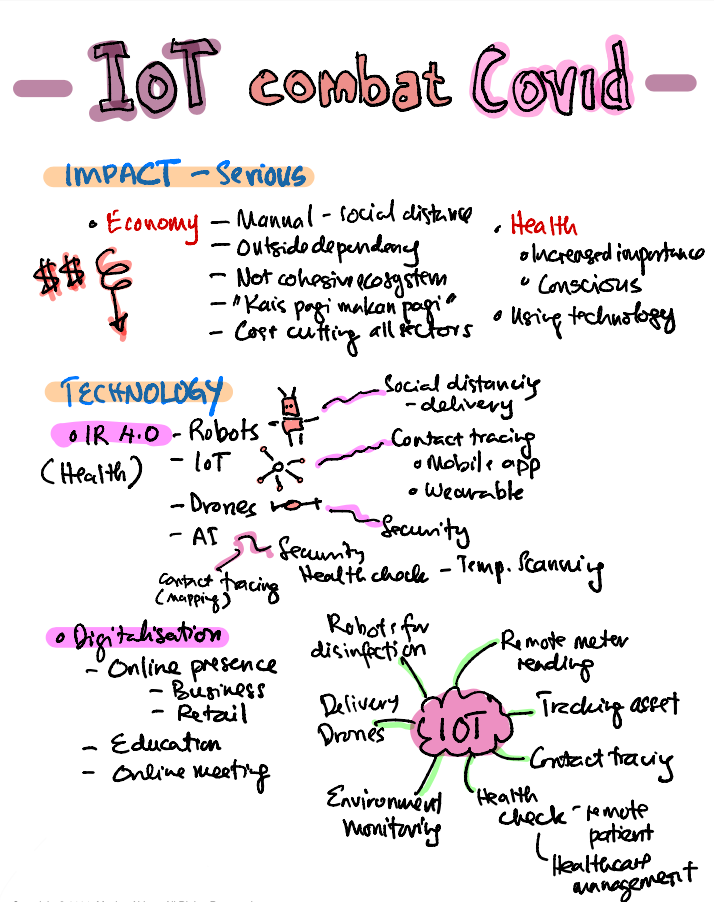
Today, we’ll look at how the Internet of Things (IoT) played a critical role in combating the challenges brought by the COVID-19 pandemic.

The diagram gives us a clear picture of the impacts, technologies, and solutions IoT provided during this global crisis.

1. The Serious Impact of COVID-19

COVID-19 affected every corner of our lives, especially in two major areas:

Economy

  • Social distancing disrupted manual jobs and heavily impacted daily income earners (“kais pagi makan pagi” — hand-to-mouth living).
  • Businesses relying on outside dependency suffered due to travel and supply chain restrictions.
  • Cost-cutting became essential across all sectors.
  • The lack of a cohesive ecosystem made economic recovery slower.

Health

  • Health became a top priority.
  • Awareness and consciousness about hygiene, social distancing, and health monitoring increased.
  • Technology began to take centre stage in health-related solutions.

2. IoT Technologies Used

IoT, combined with IR 4.0 technologies (Industry 4.0), came into action to address these challenges. Let’s explore the tools and methods:

Robots

  • Used for tasks like disinfection and delivery, especially in hospitals and public spaces, reducing human contact.

IoT

  • Enabled real-time data collection and monitoring for applications like health checks and remote patient management.

Drones

  • Delivered essential items to maintain social distancing and were used for surveillance in lockdown areas.

Artificial Intelligence (AI)

  • Enhanced contact tracing, temperature scanning, and predictive analytics to track the virus’s spread.

3. Practical Applications of IoT

IoT was at the heart of the pandemic response, enabling innovative applications:

Contact Tracing

  • Mobile apps and wearable devices tracked individuals’ interactions, helping to identify and isolate potential cases.

Health Monitoring

  • Remote patient monitoring systems allowed hospitals to track patients’ vital signs without physical visits.
  • Temperature scanning systems were widely deployed in public places.

Environmental Monitoring

  • IoT sensors monitored air quality and other environmental factors to maintain healthy surroundings.

Remote Operations

  • IoT made it possible to manage utilities like remote meter reading and asset tracking.

Delivery Drones

  • Delivered medicines, food, and other essentials, reducing human-to-human interaction.

4. The Role of Digitalisation

With physical interactions limited, digitalisation became a key enabler:

Online Presence

  • Businesses and retail shifted online to continue operations.
  • Education moved to online platforms, and virtual meetings became the norm.

Robots and Automation

  • Robots handled repetitive tasks, like disinfection, to maintain hygiene standards.

Conclusion

IoT proved to be a game-changer during COVID-19. It connected people, devices, and systems, enabling effective solutions for healthcare, economic recovery, and safety.

The pandemic highlighted the importance of leveraging IoT for crisis management and showed us how technology can adapt to save lives and sustain economies.

[Full IoT Notes can be downloaded HERE]

Why I Felt Writing is Like Running a Marathon

WRITER’S JOURNEY

My Journey on Medium

Photo by Pietro Rampazzo on Unsplash

I received a comment from Muhammad Ahtisham stating that writing on Medium is a marathon, not a sprint. This tempted me to write the analogy of writing on Medium and running a marathon.

I often find myself drawing analogies between life and the activities we undertake.

Writing on Medium, for instance, is much like running a marathon.

At first glance, the two may seem worlds apart, but the parallels become strikingly clear once you embark on the journey.

Photo by Mārtiņš Zemlickis on Unsplash

Both require endurance, consistency, and, most importantly, a deep-seated purpose. Let me take you through my experience, where these two seemingly different pursuits intertwine.

I remember the day I decided to write on Medium. It wasn’t a grand decision or a well-thought-out plan.

It started as an itch to share my thoughts on IoT and smart cities, which have consumed my professional life. “Will anyone even read this?” I asked myself.

Photo by Tong Su on Unsplash

It was a daunting thought, akin to standing at the starting line of a marathon, surrounded by seasoned runners. Their confidence and experience dwarfed my timid resolve.

Why am I doing this?” That was the question I often asked myself.

The same question nags at you around the fifth kilometre of a marathon. The initial adrenaline fades, and you’re left grappling with your commitment.

For me, the answer lay in a simple yet powerful truth: I wanted to inspire. I wanted to share not just knowledge but the stories behind that knowledge – the challenges, the triumphs, and the lessons learned.

Writing on Medium was never about instant success.

Just like a marathon, it’s a long game.

Photo by Miguel A Amutio on Unsplash

In the beginning, my articles barely got any views. I would refresh the stats page obsessively, hoping for a miracle. “Why aren’t they reading?” I’d wonder, the frustration bubbling up.

But then, I reminded myself of a lesson I’d learned from running: The first few kilometres are for finding your rhythm, not for speed.

Writing, like running, requires patience. Each article was a step forward, a chance to refine my voice and connect with the audience who truly needed my insights.

One day, after posting an article on IoT applications in agriculture, I received a comment: “This is exactly what I was looking for. Thank you!” It was a small win, but it felt like crossing the first checkpoint in a marathon.

Someone was reading. Someone found value in my words.

“Keep going,” I told myself.

That moment shifted my mindset. I stopped obsessing over views and started focusing on writing for the sake of writing.

Photo by Capstone Events on Unsplash

It was liberating.

Instead of sprinting towards elusive metrics, I settled into a comfortable pace, one that allowed me to enjoy the process.

There’s another parallel I discovered: preparation.

A marathon runner doesn’t just wake up and decide to run 42 kilometres. They train, plan their nutrition, and test their limits. Writing is no different. I had to build a routine, carving out daily time to write, read, and think.

Do I really have to do this every day?” I’d groan, especially on days when the words refused to flow.

But I knew skipping a day would make it easier to skip the next.

Consistency was the key, even if it meant writing subpar drafts. Those drafts were like training runs – they weren’t pretty, but they built endurance.

I also learned the importance of pacing.

Going too fast too early in a marathon can leave you exhausted before the finish line. Similarly, I realized that churning out articles daily wasn’t sustainable. Quality mattered more than quantity.

Take your time,” I’d remind myself as I stared at an article draft, unsure if it was good enough.

Instead of rushing to publish, I allowed myself to revisit and refine. Each edit felt like perfecting my stride, making the journey smoother.

Photo by Quino Al on Unsplash

Then there’s the matter of support. No marathoner runs alone.

There are fellow runners, spectators, and coaches cheering you on.

For me, that support came from the Medium community. Fellow writers, readers, and even the occasional critic all played a role in my growth.

One day, after publishing a piece on entrepreneurship, I received a direct message from another writer: “Your story inspired me to start my own business. Thank you for sharing.” That message was like the crowd at a marathon, their cheers pushing me forward.

See? This is why you write,” I told myself.

Of course, there were setbacks. Every marathon has its wall – when exhaustion hits, and you question everything.

For me, it came during a period of writer’s block: no ideas, no motivation, just a gnawing sense of failure.

Why am I even doing this?” I’d mutter, tempted to give up.

But then I remembered the finish line.

In a marathon, you don’t stop because you’re tired; you stop when you’ve crossed the line. Writing had its finish lines – completing an article, reaching a new reader, or simply expressing an idea I’d been mulling over.

Photo by Capstone Events on Unsplash

Looking back, I realise that writing and running a marathon are deeply personal journeys.

They test your limits, reveal your strengths, and force you to confront your weaknesses. But they also offer immense rewards.

Today, as I continue to write on Medium, I see each article as another kilometre in the marathon.

Some are smooth and effortless, while others are gruelling uphill battles. But with each step – or word – I grow stronger.

Would you do it all over again?” someone once asked me about my writing journey. Without hesitation, I said, “Absolutely.

Writing has given me more than just an outlet for my thoughts.

It has taught me resilience, discipline, and the joy of sharing.

It has connected me with people I would never have met otherwise.

Most importantly, it has reminded me that real victory lies not in the destination but in the journey itself.

So here I am, still running this marathon, one article at a time.

And just like every marathoner knows, the finish line isn’t the end – it’s just a new beginning.

Components of IoT

IoT Lecture

Based on IoT Notes

Based on the eBook — IoT Notes by Mazlan Abbas

Let’s discuss an essential concept in IoT — its key components. The diagram breaks IoT into four main building blocks, which we’ll explore step by step.

1. Sensors: The Eyes and Ears of IoT

The first layer is the sensors. These devices are at the heart of IoT; their job is to sense the environment.

  • They generate data by measuring things like temperature, humidity, or motion.
  • Think of them as the “end-nodes” in IoT — they are where the process begins.

Examples include:

  • A digital thermometer sensing room temperature.
  • A motion detector in a security system.

Without sensors, IoT wouldn’t have any information to work with!

2. Connectivity: The Communication Bridge

Once sensors collect data, it needs to be transferred somewhere for processing. That’s where connectivity comes in.

  • IoT uses different communication technologies:
  • Wireless options like Wi-Fi, Bluetooth, and LPWAN (LoRa or Sigfox).
  • Fixed methods like Ethernet.
  • Connectivity ensures the data travels from the sensors to the next stage over the internet or private networks.

Imagine this as a digital highway connecting the physical world to the virtual one.

3. IoT Platform and Middleware: The Brain

The third component is the IoT platform or middleware. This is where all the raw data comes together and is processed.

  • It acts as a central hub to aggregate data from multiple sensors.
  • Middleware handles:
  • Device management.
  • Data storage and formatting using standard protocols.
  • Providing APIs (Application Programming Interfaces) so apps can access the data.

Think of this as the “brain” that processes everything and makes sense of the data.

4. Applications and Analytics: Deriving Insights

Finally, all the processed data is used in applications and analytics to deliver value. This is where IoT makes an impact.

Applications:

  • Use the data to create useful solutions, like apps that track fitness or control smart homes.
  • Analytics and AI:
  • Analyse the data using Artificial Intelligence or Big Data techniques.
  • Generate insights to help make decisions or automate processes.

For example:

  • A smart farming app could use soil moisture data to trigger irrigation.
  • An AI system could predict machine failure in a factory.

Bringing It All Together

So, to summarise:

  1. Sensors collect the data.
  2. Connectivity transmits the data.
  3. IoT Platform processes and stores the data.
  4. Applications and Analytics use the data to create actionable insights.

IoT is a powerful combination of hardware, communication, and software working together to solve real-world problems.

5 Lessons I Learned About Writing (The Hard Way)

Photo by Angelina Litvin on Unsplash

When I started writing, I was excited but clueless.

I followed every advice I could find, thinking it would fast-track my growth.

Some of it helped, but a lot of it wasted my time.

Looking back, I realise many of my mistakes could’ve been avoided.

Here are five simple lessons I learned through trial and error.

1. Write Often, But Fix Your Mistakes

When I was new to writing, I kept hearing, “Just write as much as you can. It doesn’t matter if it’s bad.” So, I wrote and wrote, but I wasn’t getting better.

Why? Because I wasn’t learning from my mistakes.

One day, I took a step back and reread my older pieces. I cringed.

That’s when I realised that writing isn’t just about pouring out words — it’s about learning how to improve them.

Now, every time I write, I also edit and reflect. Mistakes are okay, but fixing them is what makes you improve.

2. Read What Interests You, Not Just to Impress Others

People kept telling me to read a lot to improve my writing.

So, I went overboard. I read anything and everything, but often, I wasn’t paying attention.

I skimmed articles, left a quick “great piece!” comment, and moved on. I thought that’s how you built connections.

But over time, I realised I was fooling myself.

Reading like that didn’t help me write better or connect with anyone.

Now, I only read what genuinely interests me. When I find something good, I take my time to understand it.

This way, I learn and respect the effort the writer put into their work.

3. Comment Like You Mean It

I used to think leaving lots of comments on people’s articles would get me noticed.

So, I’d quickly type things like, “Nice work!” or “Great read!” and move on.

It felt like I was doing something productive, but those comments were shallow.

Writers can tell when your comment is just filler.

They stop engaging with you because you didn’t read their work.

Now, I only comment when I have something meaningful to say.

If I like a piece, I’ll share what stood out or what I learned from it. A good comment goes a long way in building authentic connections.

4. Don’t Play the Follow-for-Follow Game

At first, I thought the secret to growing my audience was simple: follow everyone, and they’ll follow you back.

My follower count grew for a while, but it didn’t feel right.

Most of these “followers” weren’t interested in my writing, and I wasn’t interested in their work either. It felt empty.

Now, I follow people whose work I enjoy or can learn from.

Sure, my growth is slower, but it’s real.

The people who follow me now actually read and engage with my work, and that’s far more rewarding.

5. Write When You Have Something to Say

One piece of advice I used to follow was, “Just keep writing no matter what.” So, I wrote even when I had no ideas, energy, or passion for what I was doing.

The results? My writing felt forced, and I wasn’t proud of it.

Then I realised something: Writing isn’t just about putting words on a page.

It’s about having something to share, an idea, a story, or a lesson.

Now, I write when inspired or strongly about a topic. Writing this way makes the process enjoyable, and the results are much better.

Final Thoughts

Writing is a journey; like any journey, it’s easy to get lost if you follow the wrong map.

I made plenty of mistakes, but each one taught me something valuable.

If you’re starting, take your time to find what works for you.

Write, learn, and connect with people authentically.

It’s not about shortcuts — building something meaningful, one step at a time.

FAVORIOT Global Partner Paths

ABOUT FAVORIOT

A Framework for Strategic Collaboration

Photo by Andrew Stutesman on Unsplash

The FAVORIOT Global Partner Paths are a carefully designed framework for organisations aiming to work closely with FAVORIOT in leveraging its IoT ecosystem.

These structured paths provide businesses with the tools, resources, and programs they need to align their offerings with FAVORIOT’s platform and achieve mutual growth.

By tailoring each path to specific business needs and objectives, FAVORIOT ensures that its partners can access the most relevant benefits, maximise their contributions, and thrive in the IoT industry.

What Are FAVORIOT Global Partner Paths?

FAVORIOT Global Partner Paths are tailored engagement models developed to cater to diverse industries and business focuses.

Each path guides partners in integrating their products, services, or expertise with FAVORIOT’s IoT platform to unlock new opportunities and deliver enhanced value to their customers.

These paths are designed to simplify the collaboration process while ensuring that every partner receives targeted support based on their specific needs.

How FAVORIOT Global Partner Paths Work

Photo by NASA on Unsplash

The paths are divided into five key categories, each addressing a unique type of partnership or business focus. This categorisation allows partners to select the most suitable path to meet their operational goals, whether they are developing software, manufacturing hardware, offering services, providing training, or expanding the platform’s reach through distribution.

  1. Software Path

Purpose: For organisations creating software that operates on or integrates with the FAVORIOT platform.

Examples:

• SaaS providers

• Application developers

• Businesses building IoT applications using FAVORIOT APIs

Key Benefits:

• Technical resources and integration tools

• Co-marketing opportunities to showcase software solutions

• Support for scaling applications within the FAVORIOT ecosystem

2. Hardware Path

Purpose: For businesses producing hardware devices compatible with the FAVORIOT platform.

Examples:

• IoT sensors

• Edge devices

• Gateways

Key Benefits:

• Resources for validating hardware compatibility

• Tools for seamless device integration with FAVORIOT solutions

• Device management support through the FAVORIOT platform

3. Services Path

Purpose: For companies delivering consulting, managed services, or reselling FAVORIOT solutions to end users.

Examples:

• System integrators

• IoT solution providers

• Managed service firms helping clients adopt FAVORIOT technology

Key Benefits:

• Comprehensive support for IoT project implementation

• Tools for optimising client solutions

• Opportunities for joint marketing and co-branded initiatives

4. Training Path

Purpose: For organisations offering training programs related to FAVORIOT’s IoT platform and solutions.

Examples:

• Training academies

• Universities and educational institutions

• Professional development organisations

Key Benefits:

• Access to exclusive training materials and certification programs

• Collaboration with FAVORIOT Academy to deliver IoT expertise

• Opportunities to build recognition as a certified IoT training provider

5. Distribution Path

Purpose: For partners focusing on recruiting, onboarding, and supporting organisations adopting FAVORIOT’s IoT solutions.

Examples:

• Regional distributors

• Partners creating a local ecosystem of FAVORIOT adopters

Key Benefits:

• Partner enablement tools and onboarding resources

• Programs to expand FAVORIOT’s market reach

Core Elements of the FAVORIOT Global Partner Program

The success of the FAVORIOT Global Partner Paths is anchored on several critical components:

• Specialised Programs: Focused initiatives to enable partners, certify their expertise, and support market expansion.

• Extensive Resources: Technical documentation, partner-exclusive tools, and detailed use-case templates to accelerate IoT adoption.

• Value-Driven Benefits: Co-branding opportunities, joint marketing campaigns to drive adoption and growth.

Key Advantages of FAVORIOT Global Partner Paths

Photo by Cytonn Photography on Unsplash

1. Customised Support: Each path is tailored to address specific business requirements, ensuring partners receive the most relevant resources and benefits.

2. Growth Opportunities: By working with FAVORIOT, partners can scale their IoT solutions effectively, expanding their offerings and market presence.

3. Efficient Collaboration: Structured paths simplify the onboarding and integration process, enabling faster time-to-market for IoT innovations.

4. Ecosystem Strengthening: Through these collaborations, FAVORIOT and its partners jointly contribute to building a robust global IoT ecosystem.

Driving Mutual Growth Through Collaboration

Photo by Francis Odeyemi on Unsplash

The FAVORIOT Global Partner Paths are more than just engagement models – they represent a strategic approach to building successful partnerships.

By offering a clear and structured framework, these paths empower organisations to align with FAVORIOT’s vision, extend their market reach, and enhance their IoT capabilities.

This collaborative approach not only fosters innovation but also strengthens the global IoT landscape, enabling businesses and customers to unlock the true potential of connected technologies.

The Frustration of Watching My Medium Earnings Plummet

WRITER’S DILEMMA

I discovered this ONE big issue.

Photo by m. on Unsplash

I logged into my Medium account last month, expecting to see the usual earnings notification that would put a smile on my face.

Writing has always been more about passion than profit, but seeing my words turn into something tangible – a deposit in my bank account – was undeniably satisfying.

But this time, the number staring back at me was shockingly low so low that it didn’t even hit USD 10.

That meant no payout for the month.

My earnings would roll over into the next cycle. A wave of frustration hit me, and I asked myself, “What went wrong?

The Drop in Numbers: What Happened?

It wasn’t long before I pinpointed the stark difference between my previous months of success and this dismal performance.

Photo by Walls.io on Unsplash

I had been actively engaging in a Facebook group tailored for Medium writers for a few months.

The concept was simple: reciprocal engagement. You read my article, I’ll read yours. You clap for my work, I’ll return the favour. It was a well-oiled machine of give-and-take.

And, for a while, it worked.

My stats soared – views, reads, claps, and comments flooded in.

My writing was reaching more people, and the monthly payouts reflected that. But deep down, something didn’t sit right with me.

Why I Stopped Reciprocal Engagement

Photo by Anna Louise on Unsplash

The truth is, I hated it.

I hated the transactional nature of it all.

Writing is deeply personal for me. It is a way to share my thoughts, experiences, and ideas with others who genuinely connect with them.

But this system of engagement felt like cheating the process.

Why should I clap for articles I had no interest in reading? Why should I leave comments that weren’t authentic to play along?

Eventually, the dissonance became too much.

I stepped back from the group and chose to focus on reading and writing based on my interests and instincts.

No more forced claps. No more insincere comments.

I felt liberated, but it came at a cost.

The moment I stopped participating in reciprocal engagement, the numbers on my Medium dashboard plummeted.

Views dried up. Reads were scarce. Claps and comments? A rare sight.

And, of course, the earnings followed suit.

Wrestling with the Frustration

Photo by ahmad gunnaivi on Unsplash

Seeing my earnings nosedive was disheartening.

It wasn’t just about the money – it was the validation that came with it.

When your writing generates income, it feels like a stamp of approval, a sign that your work matters.

Watching that income drop feels like rejection, even if you know its real reason.

I couldn’t help but wonder: Was my writing not good enough? Did I depend too much on these artificial boosts?

My rational side knew the answers, but the emotional side still stung.

Returning to Authenticity

Photo by Kelly Tokas on Unsplash

Despite the frustration, I’m standing by my decision.

Writing has to feel real. It has to come from a place of honesty, not obligation.

I’ve decided to stick to my natural rhythm – writing when inspiration strikes and engaging with articles that interest me.

Will my earnings recover? I don’t know.

But I’d rather have a smaller, more genuine audience than inflate my stats through insincere tactics.

I want readers who connect with my stories, not readers who feel obligated to clap because I clapped for theirs.

Looking Ahead

Photo by Matt Howard on Unsplash

This month feels like a fresh start.

I’m curious to see what happens when I leave behind the shortcuts and focus solely on authentic engagement.

Will the numbers bounce back, or will they stay low?

Either way, I’m ready to embrace the journey – writing isn’t just about the destination or the paycheck at the end of the month.

It’s about staying true to yourself and your voice.

Let’s see where this path takes me.

The Silent Struggles of Researchers

THE INSIDE STORY

My Journey Through the Unknown

Credit image from Unsplash

I leaned back in my chair, staring at the slide deck I’d just presented.

It was a topic I had always been passionate about — the challenges faced by researchers as they navigate the often uncharted territory of their work.

But the more I thought about it, the more I realised how much of my own journey was reflected in the slides.

Viewing Research Through Different Layers

I’ve always seen research as a multi-layered process, much like the layers in a network system.

Each layer — from the application to the physical — represents a different challenge.

Some researchers operate at the surface, working on problems that are more visible and easier to connect with real-world applications.

Others, like myself, often find ourselves delving deeper into the less-explored, less-visible aspects of a problem.

Why do you spend so much time on this layer?” a colleague once asked me. “Does anyone even notice?

I smiled. “Maybe not right now,” I replied, “but it’s the foundation for everything above it. Without this, the entire structure could crumble.

That’s the thing about deep research — it’s often thankless in the short term. But I’ve always believed in its long-term value.

The Valley of Appreciation

One of the biggest challenges I’ve faced — and seen others face — is what I call the “Valley of Appreciation.

It’s that gap between starting your research and seeing its impact.

The journey through this valley is long and often lonely.

I recall a project I worked on years ago.

It was complex, technical, and far removed from the flashy innovations that grabbed headlines.

I poured months into it, only to be met with silence when I presented my findings.

Why do we do this?” I asked myself late one night, staring at my notes. “Does anyone care?

But deep down, I knew the answer.

Research isn’t about instant recognition.

It’s about planting seeds, some of which may take years to bear fruit.

That understanding didn’t make the journey easier, but it gave me a sense of purpose.

Breadth vs Depth: The Eternal Dilemma

Another challenge that often keeps researchers awake at night is deciding whether to focus on breadth or depth.

Should we explore a wide range of topics, scratching the surface of many issues?

Or should we dive deep into a single area, risking irrelevance if that area doesn’t pan out?

I’ve wrestled with this question countless times.

In one particularly heated discussion, a team member argued, “We need to stay broad, Mazlan. The more we cover, the more funding opportunities we’ll get.”

But depth is where breakthroughs happen,” I countered. “Without it, we’re just scratching the surface.”

That conversation ended without a clear resolution, as such discussions often do. But it reminded me of the importance of balance.

While breadth can offer versatility, depth is where true innovation lies.

The Explorer’s Risk

Being a researcher often feels like being a cave explorer.

You venture into the unknown, armed with little more than your knowledge, instincts, and a flickering light of curiosity.

Each step forward is a gamble — you might uncover something groundbreaking, or you might hit a dead end.

I remember a particularly risky project early in my career.

The technology was nascent, the funding was limited, and the expectations were sky-high. Many advised me against it.

It’s a career risk, Mazlan,” a mentor warned. “What if it doesn’t work out?

I hesitated but ultimately decided to proceed.

If we don’t take risks,” I told myself, “we’ll never move forward.

The project didn’t yield the results I’d hoped for, but it taught me lessons I’ve carried ever since.

In research, even failures can pave the way for future success.

Do We Reward the Explorers?

This brings me to a question that has haunted me throughout my career:

Do we adequately reward researchers who take these risks?

Society celebrates the visible results of research — groundbreaking products, influential papers — but what about the countless hours spent in labs, the sleepless nights, the failed experiments?

I once attended an awards ceremony where a colleague was being recognised for their work.

During their speech, they acknowledged the researchers who had laid the groundwork for their success, many of whom remained unknown.

They’re the real heroes,” I thought. “But how often do we remember them?

This realisation has driven me to advocate for better recognition of researchers, especially those who work in the shadows, tackling foundational problems that may not see the light of day for years.

The Need for Platforms

One lesson I’ve learned is that researchers can’t succeed in isolation.

To go deeper into their work, they need platforms — both literal and metaphorical — that support and amplify their efforts.

These platforms could be funding, collaboration opportunities, or simply a culture that values and understands the importance of research.

During my time in leadership roles, I’ve made it a point to provide such platforms.

I’ve encouraged cross-disciplinary collaborations, championed risky projects, and pushed for policies that recognise the contributions of researchers at all levels.

But there’s still much work to be done.

As I often tell my teams, “We need to create an ecosystem where researchers feel supported, not just when they succeed but also when they fail. Because failure is often the first step toward success.”

Moving Forward

As I closed my laptop after revisiting the presentation, I felt a renewed sense of purpose.

The challenges faced by researchers are real and daunting, but they are also surmountable. B

y understanding these challenges and working to address them, we can create an environment where researchers not only survive but thrive.

To my fellow researchers out there, I have this to say: Keep going.

Your work matters, even when it feels like no one notices.

The seeds you plant today may take years to grow, but when they do, they have the power to change the world.

And to those who support researchers — leaders, policymakers, and society at large — remember that innovation doesn’t happen overnight.

It’s the result of countless hours of unseen effort.

Let’s do more to appreciate and reward that effort.

As for me, I’ll continue navigating this journey, both as a researcher (and as an entrepreneur) and as someone who believes deeply in the value of what we do.

Because, in the end, it’s not just about exploring the unknown — it’s about lighting the way for others to follow.

The Challenge of Commercialising R&D in Big Corporations

THE TOUGH LIFE OF BUILDING A PRODUCT

Lessons from My Experience

Image from Unsplash

I sat in my office, reading an email from a colleague at one of our partner organisations.

It was a familiar story.

Their R&D division had spent years developing a product they were convinced would change the game, only for the product team to shelve it in favour of a faster-to-market solution from an external partner.

As someone who has spent years working in and with R&D organisations, I felt a pang of sympathy.

Yet, I also understood the product team’s perspective.

It’s a tug-of-war I’ve seen too many times — one that often ends with bruised egos and strained relationships.

The Slow Pace of R&D

Let me take you back to my days leading an R&D division.

We prided ourselves on our innovative projects, tackling cutting-edge technology that pushed boundaries.

But there was a catch: innovation takes time.

In an ideal world, we could refine our ideas, test them thoroughly, and ensure they were market-ready before launch.

But the market doesn’t wait.

I remember a heated discussion during one project review. The product team was growing increasingly frustrated with our timeline.

Dr. Mazlan,” they said, “we can’t wait another 18 months. Our competitors are already rolling out similar solutions. What’s the point of perfection if we’re late to the party?

I understood their frustration, but I also believed in the importance of doing things right. “If we rush,” I countered, “we risk launching a flawed product that damages the company’s reputation. We need time to get this right.

Despite my reasoning, the gap between R&D’s timeline and the product team’s urgency grew wider.

And the result?

They brought in an external vendor to deliver a quicker solution.

R&D for Publications, Not Products

Another issue I’ve observed is the focus on publications rather than practical solutions.

Don’t get me wrong — publishing research is important.

It showcases expertise and enhances the organisation’s reputation.

But when the primary goal of an R&D team is to publish papers, the end product often becomes secondary.

I’ve seen brilliant engineers and researchers produce groundbreaking work that earned accolades in journals but had little to no commercial viability.

I once asked a colleague, “Why aren’t we aligning our research with customer needs?

He smiled and said, “Dr. Mazlan, publications are what we’re measured on. Commercialisation is the product team’s problem.

That statement hit me hard.

If the R&D division isn’t focused on solving real-world problems, how can we expect their work to translate into products that sell?

Misaligned with Customer Needs

I’ve lost count of how many times I’ve seen products fail because they didn’t address real customer problems.

It’s a classic mistake: assuming we know what customers want without actually engaging with them.

I have known a company that had spent millions developing an IoT device. They were confident it would revolutionise the market.

When I asked how they had validated the concept with customers, their response was telling: “We didn’t. The technology speaks for itself.

When the product launched, sales were abysmal. It turned out the device was too complex for the target audience, and the features they had spent years perfecting weren’t even priorities for their customers.

Reflecting on that experience, I realised how vital it is to involve customers early and often.

Yet, in many R&D teams, there’s a reluctance to do so.

Perhaps it’s fear of criticism or an overconfidence in their expertise.

Either way, the result is the same: products that miss the mark.

The Strain Between R&D and Product Teams

The friction between R&D and product teams is almost inevitable in such scenarios.

The product team has a clear mandate: deliver solutions that generate revenue.

When R&D timelines don’t align with market demands, the product team often looks elsewhere.

I remember a particularly tense meeting where the product head said, “We appreciate the work R&D is doing, but we can’t afford to wait. Our survival depends on getting something out the door now.”

The R&D team felt betrayed. “We’ve been working on this for years,” one researcher said. “Now you’re telling us it’s not good enough? Why didn’t you involve us earlier if time was such a concern?

Both sides had valid points, but the damage was done.

The R&D team felt unappreciated, while the product team saw them as out of touch.

Bridging the Gap

Over the years, I’ve come to believe that the solution lies in better integration between R&D and product teams.

Here are a few approaches that have worked in my experience:

  1. Early Collaboration: Bringing product and R&D teams together from the start can help align goals. When both sides understand the market realities and technological possibilities, they can co-create solutions that are both innovative and practical.
  2. Customer-Centric Approach: R&D teams should be encouraged to engage directly with customers. This doesn’t mean abandoning research but rather ensuring it’s grounded in real-world needs.
  3. Flexible Metrics: Instead of measuring R&D solely on publications, companies should include metrics related to commercial impact. This can motivate teams to focus on creating market-ready solutions.
  4. Leveraging External Partnerships: While it’s ideal to commercialise in-house R&D, external partnerships can sometimes be the best option. The key is ensuring these partnerships are seen as complementary rather than competitive.

A New Mindset

One of the most important lessons I’ve learned is that success requires a mindset shift.

R&D teams need to see themselves as partners in the commercialisation process, not just creators of technology.

At the same time, product teams must recognise the value of R&D’s long-term contributions.

As I reflect on my own journey, I’m reminded of a project where we managed to get it right.

By involving the product team and customers early, we developed a solution that was both innovative and market-ready.

It wasn’t perfect, but it met the needs of the market — and that was enough.

I still believe in the power of R&D to drive innovation, but I also know that innovation must be paired with practicality.

It’s not an easy balance to strike, but when it works, the results can be transformative.

As I finished reading the email, I decided to share my thoughts with the sender. “I understand your frustration,” I wrote. “But perhaps this is an opportunity to reimagine how your teams collaborate. It’s not about choosing between R&D and product — it’s about finding a way to make them work together.

It’s a lesson I’ve learned the hard way, and one I hope others can learn without the same struggles.

The Future of Writing: Can AGI Rival Today’s Writers?

AI REVOLUTION

What if AGI takes over the role of a writer?

Image created by ChatGPT based on this story.

What if AGI becomes as good as me at writing?” I muttered, half amused and half concerned. The thought lingered, almost taunting me.

Could a machine, no matter how intelligent, truly replicate the art of storytelling?

Writing has always been a deeply personal journey for me.

It’s not just about the words; it’s about weaving experiences, emotions, and lessons into a narrative that connects with readers.

But what if AGI learns to do that too?” I challenged myself. The question refused to go away.

The Essence of Writing

I often remind myself why I write.

It’s about more than sharing knowledge; it’s about creating connections.

I poured my soul into every word when I wrote about my journey of building FAVORIOT.

Those articles weren’t just facts — my triumphs, frustrations, and dreams in black and white.

Could AGI ever capture that?” I asked myself aloud.

It could replicate the structure, even the tone, but would it feel the pride I felt when describing our successes?

Would it understand the weight of the sleepless nights behind those stories?

Writing is as much about the process as it is about the product. “Machines don’t have sleepless nights,” I chuckled, though the thought didn’t comfort me.

What Would AGI Need to Learn?

I thought as I sipped my coffee that if AGI wanted to rival human writers, it would have to overcome three major challenges.

First,” I said, leaning back in my chair, “context and nuance.” Writing isn’t just about stringing words together; it’s about understanding the world in all its complexity.

When I write about IoT, I’m not just describing technology — I’m addressing real-world problems, cultural challenges, and user needs. “Can AGI grasp that kind of complexity?” I wondered.

Second, empathy,” I continued, almost as if I were explaining it to an invisible audience. Readers connect with stories because they resonate emotionally.

When I write about entrepreneurship, I think about the struggles of young dreamers reading my words.

Would AGI know how to address their hopes and fears, or would it just give generic advice?

And third,” I paused for effect, “failure.” Every writer knows the pain of scrapping drafts, rewriting paragraphs, and starting over.

Those failures teach us what works and what doesn’t. “Can a machine learn the value of failure? Can it be self-critique like I do?” I mused.

Where AGI Might Excel

I reminded myself that it’s not all doom and gloom. AGI could bring remarkable strengths to the table.

I imagined it working tirelessly, synthesising vast amounts of information in seconds, and crafting perfectly structured articles. “It would be like having a research assistant who never sleeps,” I thought, smiling at the idea.

AGI could adapt its style to suit any audience.

It could shift gears effortlessly, whether writing for IoT experts, poetry lovers, or aspiring entrepreneurs. “Imagine the possibilities,” I said, almost excited now.

But the excitement was tempered by a nagging thought: “Would it feel like cheating to rely on AGI for something so personal?

Human and Machine: A Collaborative Future

Maybe we don’t have to compete,” I said, voicing the thought brewing. “Maybe AGI can be a collaborator, not a rival.

I imagined using AGI to handle the technical aspects of my articles, freeing me to focus on storytelling and emotional resonance.

It could help me write faster, but the heart of the article would still be mine,” I reasoned.

I’d already seen glimpses of this collaboration.

Tools like Grammarly refine my writing, while AI-driven platforms assist with research and brainstorming. “It’s not replacing me; it’s enhancing me,” I concluded, feeling more optimistic.

The Ethical Dilemma

But then,” I hesitated, “what happens when AGI starts writing independently?

If it writes an article that’s indistinguishable from mine, who owns the content? And how do we ensure transparency? “Would readers still value the writer or only care about the content?” I asked, troubled by the implications.

Writing, at its core, is a personal act.

It’s an extension of one’s thoughts, experiences, and beliefs.

If AGI mimics that perfectly, does it diminish the value of human expression? “Or,” I wondered, “does it make human stories even more precious?

A Hopeful Outlook

I glanced at the clock.

I’d spent over an hour lost in this internal debate, yet I felt no closer to an answer. “Maybe it’s not about finding answers,” I admitted. “Maybe it’s about asking the right questions.

As I typed these final words, I reminded myself why I write.

It’s not for perfection or applause. It’s for connection.

It’s for the moments when a reader says, “This resonates with me.

AGI might one-day master writing mechanics, but it will never have my journey—my struggles, triumphs, and voice.

And that,” I said to myself, a small smile creeping across my face, “is what makes every story I write, including this one, uniquely mine.