IoT in Malaysia — Twenty (20) 2025 Predictions

Looking at the crystal ball

Image created by ChatGPT

When I look back on how far IoT has come, I can’t help but feel both amazed and excited. In the early days, IoT was just a concept – a dream of connecting things to improve lives.

But here we are, entering the year 2025, and IoT is no longer just an idea; it’s becoming the backbone of how we live, work, and play.

Let me walk you through what IoT will look like in 2025.

These are not just random guesses but predictions rooted in years of working in this space and observing its evolution.

  1. Massive IoT Deployment Across Industries

“Isn’t IoT already everywhere?” someone might ask.

My answer would be: Not yet, but we’re getting there.

By 2025, IoT will become integral to manufacturing, agriculture, healthcare, energy, and even retail industries.

Factories will use IoT sensors to monitor machinery in real-time, predicting maintenance needs before breakdowns occur.

Farmers will optimise irrigation and fertiliser use through IoT-connected systems, maximising yields while conserving resources.

It’s not just about saving money; it’s about making better decisions.

IoT will help businesses operate more efficiently, reduce waste, and, most importantly, stay competitive in an increasingly digital world.

2. AI-Driven IoT Solutions (AIoT)

When discussing IoT, people often ask, “What about artificial intelligence?”

The truth is that IoT and AI are like two sides of the same coin.

By 2025, the fusion of these technologies – what we call AIoT – will redefine what’s possible.

Imagine traffic lights that adapt to real-time traffic conditions or healthcare devices that predict potential health risks based on continuous monitoring.

This integration will make systems smarter and more autonomous.

Instead of just collecting data, IoT devices will analyse and act on it. It’s not just IoT anymore; it’s intelligent IoT.

3. Sustainability Through IoT

Sustainability is no longer a buzzword – it’s a necessity.

Companies and governments increasingly turn to IoT to tackle environmental challenges.

In 2025, I expect IoT to play a central role in achieving sustainability goals.

For example, IoT-enabled smart grids will help us manage energy consumption more efficiently.

Sensors will monitor air and water quality in real time, allowing us to respond to environmental issues faster.

The idea of a “smart city” is not just about convenience; it’s about creating sustainable and liveable cities. IoT will help us achieve that vision.

4. Proliferation of Edge Computing

Edge computing is something I often talk about when discussing the future of IoT.

It’s a game-changer. Instead of sending all the data to the cloud for processing, edge computing allows devices to process data locally.

This reduces latency and ensures faster responses.

In 2025, edge computing will become indispensable, especially for applications like autonomous vehicles and industrial automation.

Imagine a self-driving car needing to make a split-second decision – there’s no time to send data to a cloud server and wait for a response.

That’s where edge computing comes in.

5. IoT in Healthcare

The healthcare sector is where I see IoT making the most profound impact.

By 2025, wearable devices will go beyond tracking steps or heart rates. They’ll become essential tools for remote patient monitoring.

I envision a world where doctors can receive real-time data about their patients, enabling early intervention and better outcomes.

This is personal because I’ve always believed technology should serve humanity.

IoT in healthcare isn’t just about gadgets; it’s about saving lives and improving the quality of care.

6. Smart Cities Moving Beyond Pilots

If you’ve followed my work, you know I’m passionate about smart cities.

But here’s the thing – many smart city projects are still stuck in the pilot phase.

By 2025, that will change. We’ll see full-scale implementation of IoT solutions for traffic management, utilities, waste management, and public safety.

I often tell people that a smart city isn’t about fancy gadgets; it’s about using technology to make cities more efficient and liveable. IoT will be at the heart of this transformation.

7. IoT Security as a Priority

Let me share a concern that keeps me up at night: IoT security.

As IoT devices become more widespread, they become more vulnerable to cyberattacks.

In 2025, IoT security will take centre stage.

Companies will invest heavily in secure-by-design devices, and blockchain technology may play a role in enhancing protection.

We can’t afford to ignore this. If we want IoT to succeed, security must be a priority.

8. Democratisation of IoT

Here’s an exciting trend: IoT is becoming more accessible.

Low-code and no-code platforms make it easier for small businesses and startups to develop IoT solutions without extensive technical expertise. B

y 2025, I see this trend accelerating, democratising IoT and enabling innovation from unexpected places.

9. IoT for Disaster Management

Climate change is making natural disasters more frequent and severe.

IoT can be a powerful tool for disaster management.

Imagine early warning systems that use IoT sensors to monitor weather conditions in real-time.

In 2025, IoT will play a critical role in disaster preparedness and response especially in cases of flood.

10. Growth of IoT Ecosystems in Emerging Markets

One of the things I’m most excited about is the growth of IoT in emerging markets like Southeast Asia.

By 2025, countries like Malaysia will see a surge in IoT adoption driven by government support and affordable devices.

This will create opportunities for innovation and economic growth.

11. Advanced IoT Analytics

IoT isn’t just about collecting data; it’s about making sense of it.

By 2025, advanced analytics will become a standard part of IoT solutions.

Businesses will use descriptive, diagnostic, predictive, and prescriptive analytics to extract actionable insights, improving decision-making and operational efficiency.

12. National IoT Technology Roadmaps

In Malaysia, we’ve already launched several technology roadmaps focusing on IoT, AI, and blockchain.

By 2025, these roadmaps will guide the development of IoT ecosystems, creating opportunities for local talent and businesses.

13. IoT in Energy and Utilities

Energy efficiency will be a significant focus in 2025.

IoT-enabled smart meters and predictive maintenance systems will help optimise energy usage and reduce waste.

This is not just good for the environment but also for businesses and consumers.

14. Personalised Consumer Experiences

IoT is also transforming retail and marketing.

By 2025, IoT will enable hyper-personalised consumer experiences, using real-time data to predict and meet individual needs.

15. IoT in Education

Lastly, I see IoT transforming education.

Smart classrooms equipped with IoT devices will provide real-time feedback on student engagement and learning outcomes.

This will help educators tailor their approaches to meet the needs of individual students.

Conclusion

These are my predictions for IoT in 2025.

Some may seem ambitious, but I firmly believe we’re heading in this direction.

IoT has the potential to transform industries, improve lives, and create a more sustainable world.

The question is: Are we ready to embrace it?

As someone deeply passionate about IoT, I’m committed to helping make this vision a reality.

Let’s shape the future together.

Scaling IoT Globally: Favoriot’s Journey to Connect the World

The Right Time for Favoriot to Go Global with Its Global Partner Program

Since its inception in 2017, Favoriot has tried empowering IoT developers with a seamless and user-friendly platform.

The Favoriot platform, offered as a B2C solution, has steadily gained traction among developers worldwide, enabling individuals from around the globe to subscribe easily.

By the end of December 2024, the platform had reached an impressive milestone — 111 countries and over 9,200 developers actively leveraging its capabilities.

However, as the IoT ecosystem grew and diversified, it became evident that this was only scratching the surface of Favoriot’s potential.

The question was no longer about whether Favoriot could expand globally but how to scale effectively and make a more significant impact.

While the numbers reflect an inspiring reach, the challenge lies in converting these individual users into broader enterprise implementations. This realisation set the stage for a transformative strategy to take Favoriot’s vision to the next level.

Understanding the Challenges of Going Global

Reaching users overseas is no simple task.

It’s not just about having a great product; it’s about ensuring that the product resonates with the specific needs, regulations, and challenges of different markets.

While the Favoriot platform has always been accessible worldwide, making a lasting impact in foreign markets requires a consistent and relentless marketing effort.

Each country has its complexities, ranging from language barriers to cultural differences and even unique technological and regulatory requirements.

For instance, many countries prioritise data sovereignty, insisting that sensitive data remain within their borders to comply with local policies.

This was a significant hurdle for Favoriot’s initial B2C model, which was designed to operate primarily on a global cloud infrastructure.

The Birth of the Favoriot Enterprise Platform

Recognising these challenges, the team began rethinking its approach.

The solution wasn’t just about increasing subscriptions — it was about localising the platform to better cater to the needs of enterprise clients and government institutions.

This was where the Favoriot Enterprise Platform was born.

Introduced in 2024, the Enterprise Platform was a game-changer for Favoriot. Unlike the traditional model, the Enterprise version was designed to support localised implementations, allowing the platform to be hosted within a country’s borders.

This directly addressed concerns about data sovereignty and compliance with customer policies, making it a more attractive option for large-scale deployments in industries like healthcare, transportation, agriculture, and smart cities.

The platform offers unlimited APIs, with no restrictions on the number of devices connected or APIs utilised, bundled with a perpetual license.

This flexibility and scalability made it a compelling choice for enterprises looking to invest in IoT solutions without worrying about a subscription-based model’s hidden costs or constraints.

The Strategic Role of Global Partners

Launching the Favoriot Enterprise Platform opened up new opportunities and brought a new challenge — how to market and deploy this enterprise-grade solution globally.

The solution is forming partnerships with system integrators and distributors in different countries.

In 2024, Favoriot introduced the Favoriot Global Partner Program, which intends to build a network of trusted partners who could act as system integrators and distributors.

These partners would bring invaluable local expertise, enabling the platform to be tailored to the specific needs of their markets.

The idea was simple but powerful: work with partners who share the same IoT vision and empower them to take Favoriot to new heights in their respective regions.

By becoming the face of Favoriot in their countries, these partners could engage directly with customers, implement the platform, and provide ongoing support.

The partnership model is not just about distribution — it’s about collaboration. Partners can leverage each other’s strengths, engage in cross-selling and cross-marketing activities, and grow their businesses alongside Favoriot.

This creates a win-win situation, fostering mutual growth and ensuring the platform’s success in diverse markets.

Setting Ambitious Goals for 2025

The Favoriot Global Partner Program is not just a short-term strategy; it’s a long-term vision.

For 2025, Favoriot has set an ambitious but achievable goal: to establish partnerships in 25 countries. This means onboarding 25 partners to champion the platform, drive its adoption, and integrate it into their local ecosystems.

Why 25 countries?

This number reflects a strategic focus on markets with high growth potential for IoT.

The program can maximise its impact by carefully selecting partners aligned with Favoriot’s vision and with strong local networks and market knowledge.

Through these partnerships, Favoriot can overcome the barriers of entering foreign markets, such as regulatory hurdles and cultural nuances, while expanding its reach and influence.

The program also enables partners to innovate by combining their local expertise with the technical capabilities of the Favoriot platform.

A Win-Win Strategy for a Global IoT Ecosystem

The Global Partner Program is built on the principle of shared success. For partners, it provides an opportunity to offer a proven IoT platform to their clients, backed by Favoriot’s support and expertise.

For Favoriot, it allows the company to scale its operations without being bogged down by the intricacies of directly managing local markets.

By working with partners, Favoriot can focus on its core mission — empowering IoT developers and enterprises to build smarter, more connected solutions — while its partners drive localisation and implementation.

This synergy is key to the program’s success.

Why Now Is the Right Time

Timing is everything in business, and the decision to go global with the Favoriot Global Partner Program in 2024 couldn’t have been more opportune.

The platform’s footprint in 111 countries and over 9,200 developers demonstrates its global appeal.

However, this traction needs to be converted into tangible enterprise adoption, which the Enterprise Platform and the Global Partner Program are uniquely positioned to achieve.

Furthermore, as IoT continues to gain momentum globally, the demand for localised, scalable, and flexible solutions is growing.

Enterprises are looking for partners who can provide technology and the expertise to implement it effectively.

Favoriot, with its platform and partner-centric strategy, is perfectly poised to meet this demand.

The journey ahead is challenging, but Favoriot is ready to make its mark on the global IoT landscape with the right partners and a clear vision.

The time to go global is now, and Favoriot is stepping forward with confidence, determination, and a strategy that promises growth for everyone involved.

Building a Startup and Writing on Medium: An Unlikely Analogy

Writing vs Startup

When I first started writing on Medium, I never imagined that it would remind me of the journey I embarked on when I co-founded FAVORIOT.

At first glance, writing and building a startup seem worlds apart.

One is solitary, often involving long hours in front of a screen, while the other demands collaboration, strategic planning, and execution. Y

et, the more I immersed myself in both, the more I realised how strikingly similar the two are.

Allow me to take you through this journey, using my personal experience as both a writer and an entrepreneur.

The Beginning: An Empty Page and a Blank Canvas

Starting a Medium blog is like looking at a blank page.

It’s intimidating.

You have no audience, no reputation, and no guarantee that your words will resonate with anyone. Similarly, building a startup begins with a blank canvas.

You have an idea – a vision – but no customers, no revenue, and no market presence.

I remember the early days of FAVORIOT.

We had a big dream: to help businesses and cities integrate IoT into their operations.

But dreams are just dreams without action.

Writing my first article on Medium felt the same.

I had thoughts swirling in my mind, but translating them into coherent words that others would find valuable was daunting.

Defining Your “Why”

One of the first lessons I learned was the importance of having a clear purpose.

Why was I building FAVORIOT? Why was I writing on Medium?

For FAVORIOT, the purpose was clear: to simplify IoT adoption and empower organisations with data-driven insights.

For Medium, my goal was to share knowledge, inspire others, and document my journey in IoT and entrepreneurship.

Both endeavours required me to articulate my “why” because this became the guiding light when things got tough.

And believe me, things did get tough.

The MVP (Minimum Viable Product)

Every startup begins with an MVP. It’s not perfect – it’s far from it – but it’s functional enough to solve a specific problem for early adopters.

My early articles on Medium were my MVPs.

They weren’t polished masterpieces.

Some were just 500 words, hastily written but filled with genuine insights.

I wrote about IoT trends, startup life, and even personal reflections.

Just as FAVORIOT’s first IoT platform had limited features but solved a critical problem for a niche audience, my initial articles aimed to deliver value to a small group of readers.

The goal wasn’t perfection but progression.

Building an Audience is Like Acquiring Customers

In the startup world, your product is nothing without customers.

Similarly, in writing, your articles mean little without an audience.

Both require a strategy to attract, engage, and retain people.

At FAVORIOT, we identified our target customers – companies and cities that needed IoT solutions – and worked relentlessly to reach them.

On Medium, I did the same. I identified my niche – IoT, smart cities, and entrepreneurship – and wrote consistently within those themes.

But the journey didn’t stop there. Just as a startup founder needs to pitch, network, and build relationships, I had to engage with my readers.

Responding to comments, sharing articles on social media, and participating in discussions were all crucial in growing my Medium audience.

The Grind: Consistency Over Time

Building a startup and writing regularly both demand one thing above all: consistency.

There were days when it felt like no one cared about what I was building at FAVORIOT.

Months would go by with no significant sales or partnerships.

Similarly, there were weeks when my articles on Medium received little to no views.

It’s disheartening.

But success doesn’t happen overnight. I learned to embrace the grind.

At FAVORIOT, we kept refining our platform, reaching out to potential clients, and showcasing our value proposition.

On Medium, I kept writing, experimenting with different formats and topics, and learning what resonated with my readers.

Consistency builds momentum. And momentum is what drives growth.

Feedback is Gold

In both ventures, feedback is invaluable.

For FAVORIOT, customer feedback shaped our product development.

It told us what features to add, what to fix, and what to prioritise.

For my Medium writing, reader feedback was equally crucial.

When readers left comments or shared my articles, it gave me insights into what worked and what didn’t.

Some feedback was critical, but I welcomed it. Just as a startup must listen to its customers, a writer must listen to their audience.

Scaling Up

Once you’ve found your footing, the next challenge is scaling.

For FAVORIOT, scaling meant expanding our platform’s capabilities, entering new markets, and forming global partnerships.

For my Medium writing, scaling meant increasing my output, diversifying my topics, and reaching a broader audience.

But scaling comes with its own challenges.

In a startup, you risk losing focus as you try to do too much too quickly. The same is true for writing.

At one point, I tried writing about topics outside my expertise, thinking it would attract more readers. It backfired.

I learned that scaling isn’t just about doing more; it’s about doing more of what you do best.

The Role of Passion

Both writing and building a startup require passion.

Without it, you’ll struggle to persevere through the inevitable challenges.

I’m deeply passionate about IoT and its potential to transform industries and improve lives.

This passion drives my work at FAVORIOT. It’s the same passion that fuels my writing on Medium.

When you’re passionate, it shows. Customers sense it. Readers sense it.

Passion isn’t something you can fake – it’s either there, or it isn’t.

The Payoff

After years of hard work, FAVORIOT is now recognised globally, with partners in multiple countries.

Similarly, my writing on Medium has garnered a loyal following, with some articles reaching thousands of readers.

The payoff isn’t just financial or numerical.

It’s the satisfaction of knowing you’ve built something meaningful.

For FAVORIOT, it’s the impact we’ve had on businesses and cities.

For my writing, it’s the messages I receive from readers who say my articles inspired them.

Final Thoughts

Writing on Medium and building a startup are both about creating value.

They require courage, resilience, and a willingness to learn.

If you’re considering starting a blog or launching a business, remember this: start small, be consistent, and never lose sight of your purpose.

The journey may be challenging, but the rewards are worth it.

Looking back, I’m grateful for both experiences.

They’ve taught me invaluable lessons, shaped my perspective, and allowed me to connect with amazing people.

And who knows?

Maybe your journey as a writer or entrepreneur will inspire others, just as mine has inspired me.

From Hardware to Insights: Why Universities Should Prioritise Data Analytics and AI Over IoT Hardware

A Change in Our Universities Focus Areas

Artificial Intelligence (AI) and Big Data Analytics have become the talk of the town.

Everywhere I go, someone discusses how these technologies are transforming industries and reshaping how organisations work.

But let me tell you, all of this innovation boils down to one thing: data. AI can’t learn without data, and analytics can’t deliver insights.

This realisation has enormous implications for how universities prepare students and educators for the future.

Over the years, many universities have focused on teaching students to build their Internet of Things (IoT) hardware.

Don’t get me wrong, it’s a great way to learn the technical basics, but I’ve always felt it’s not the best use of resources or time.

The truth is that the hardware is just a means to an end.

The real value is in the data these devices collect and what you do with that data. That’s where I think universities should shift their focus: data analytics and AI.

Why Data is the Real Hero in AI and Big Data Analytics

Here’s the thing about AI: it’s only as good as the data you feed.

Whether you’re predicting customer behaviour, analysing health trends, or optimising supply chains, the first step is always about collecting, cleaning, and understanding data.

And guess what generates a lot of that data? IoT devices.

From smart sensors to wearables, these devices are constantly collecting information streams. But the value isn’t in the device; it’s in the insights you can extract from the data.

Take smart cities, for example. IoT sensors might monitor traffic flow, air quality, or energy usage.

That’s impressive, but more amazing is how AI models and analytics make sense of all that data to improve city living.

Building the hardware for these sensors is straightforward; developing the AI and analytics platforms behind them is the real challenge.

Why Universities Need to Prioritise Data Analytics

1. Meeting Industry Needs

Let me be honest — the industry doesn’t need more people building IoT hardware.

They’re hungry for data analysts, AI developers, and data scientists. Companies are about insights that drive decisions, not the physical gadgets that generate the data.

Shifting the focus to data analytics would better prepare students for what’s waiting for them in the real world.

2. Endless Applications

Consider this: data analytics and AI can be applied across many industries. Whether it’s healthcare, agriculture, manufacturing, or retail, the possibilities are endless.

With skills in data analytics, students can work on anything from predicting machinery maintenance to forecasting disease outbreaks or personalising customer experiences.

Meanwhile, hardware skills are mostly limited to niche engineering roles.

3. Lowering Barriers to Entry

Let’s face it: building IoT hardware isn’t cheap. You need tools, components, and a workshop.

That’s a big ask, especially for students or universities with limited budgets.

In contrast, data analytics only requires access to software tools, cloud platforms, and datasets, which are much more accessible.

4. Using What’s Already Available

These days, you don’t even have to build IoT devices from scratch.

There are ready-made solutions, like FAVORIOT, AWS IoT, and Azure IoT.

These platforms make collecting, storing, and managing IoT data easy. So why reinvent the wheel? Use these tools and focus on creating value through analytics and application development.

How Universities Can Make the Shift

1. Rethink the Curriculum

If I were designing a university course, I’d ensure it included data analytics, AI, and IoT platforms. Students should learn how to:

  • Collect and preprocess IoT data.
  • Use tools like Python or MATLAB to analyse data.
  • Build machine learning models and deploy them in real-world scenarios.
  • Understand cloud computing and work with IoT platforms to manage data.

2. Partner with Industry

One of the smartest moves universities can make is partnering with companies. Industry collaboration gives access to real-world datasets, tools, and expertise.

Plus, internships and collaborative projects can give students the hands-on experience they need to hit the ground running.

3. Focus on Real-World Problems

When I was a student, I always enjoyed projects that felt meaningful.

Educators should design projects that challenge students to solve actual problems.

For example, they could predict energy usage patterns on campus or analyse traffic data to improve transportation systems.

4. Train the Trainers

Let’s not forget the educators.

They need to stay ahead of the curve, too.

Universities should invest in training programmes for lecturers, helping them stay updated on the latest AI and data analytics trends.

5. Provide the Right Tools

Students can’t learn data analytics without the right tools.

Universities should give them access to software, cloud-based platforms, and open-source datasets. This doesn’t have to break the bank — many affordable or even free options exist.

Imagine the Applications Students Can Build

By focusing on data analytics, students can work on exciting applications like:

  • Smart Agriculture: Analysing soil and weather data to optimise irrigation and fertilisation.
  • Healthcare: Using wearable data to predict health trends.
  • Retail: Analysing customer behaviour to personalise shopping experiences.
  • Manufacturing: Implementing predictive maintenance to cut costs and downtime.

These examples show how data analytics can drive innovation across industries.

Isn’t that more impactful than soldering circuit boards?

My Advice to Universities

The world is changing fast, and universities need to keep up.

It’s time to move away from DIY IoT hardware and focus on the bigger picture: data analytics.

By doing this, universities can prepare their students for a future where data is king.

As educators, it’s our job to help students see the actual value of IoT — not the gadgets but the insights they enable.

And for students, my advice is simple: dive into data analytics and AI. These skills will open doors and help you make a real difference.

The future is all about harnessing the power of data.

Let’s make sure our universities are ready to lead the way.

Building IoT with the 3-Step Approach

Lecture Notes

Today, we will explore a simple and practical framework for implementing IoT projects: the 3-Step Approach.

This method ensures a smooth and effective rollout by focusing on small steps, integration, and innovation. Let’s break it down step by step.

Step 1: Think Big, Start Small

The first step is to start with a clear vision (think big) but begin with a small, focused project to gain momentum.

Develop a Small Application: Identify one specific problem and build a targeted solution.

  • Example: A smart thermostat to monitor energy usage in one building rather than an entire campus.

Deliver Immediate Impact: The solution should show quick results to build confidence in IoT’s value.

Mindset Transformation: This small success shifts how people perceive IoT and its potential.

Get Buy-In from Leadership: Demonstrating early results helps secure support from decision-makers like the C-suite executives for future projects.

Step 2: Integrate

Once the initial IoT solution proves its value, it is integrated into the broader system.

Connect to Legacy Systems: Ensure the new IoT solution works seamlessly with existing infrastructure, such as ERP systems or older databases.

  • Example: Integrating smart sensors into a factory’s traditional production line.

Seamless Workflow: Avoid disrupting operations by designing smooth processes between old and new systems.

Break Silos: Encourage collaboration between departments to maximise the benefits of IoT across the organisation.

This step ensures that IoT doesn’t operate in isolation but becomes a part of the larger ecosystem.

Step 3: Innovate

The final step is to use IoT to drive innovation and create new opportunities.

Create New Workflows: Leverage IoT to optimise or redesign how work is done.

  • Example: Using real-time data from IoT sensors to automate maintenance schedules.

Test New Business Models: Experiment with different ways to generate revenue using IoT solutions.

  • Example: Offering predictive maintenance as a subscription service for customers.

Better Analytics and AI: Use advanced analytics and AI to unlock deeper insights from IoT data and automate decision-making.

This stage transforms IoT from a problem-solving tool into a driver for long-term growth and innovation.

Key Takeaway: Think Big, Start Small

The overall lesson is simple:

  1. Start with a big vision, but focus on small, impactful projects to get started.
  2. Build on early successes by integrating solutions into larger systems.
  3. Use IoT to innovate and create new opportunities.

This approach minimises risk, builds momentum, and ensures sustainable growth.


Let’s discuss: What small IoT applications can you think of to start with? How would you scale and integrate them into a more extensive system? Let’s brainstorm together!

[FREE IoT Notes to Download]

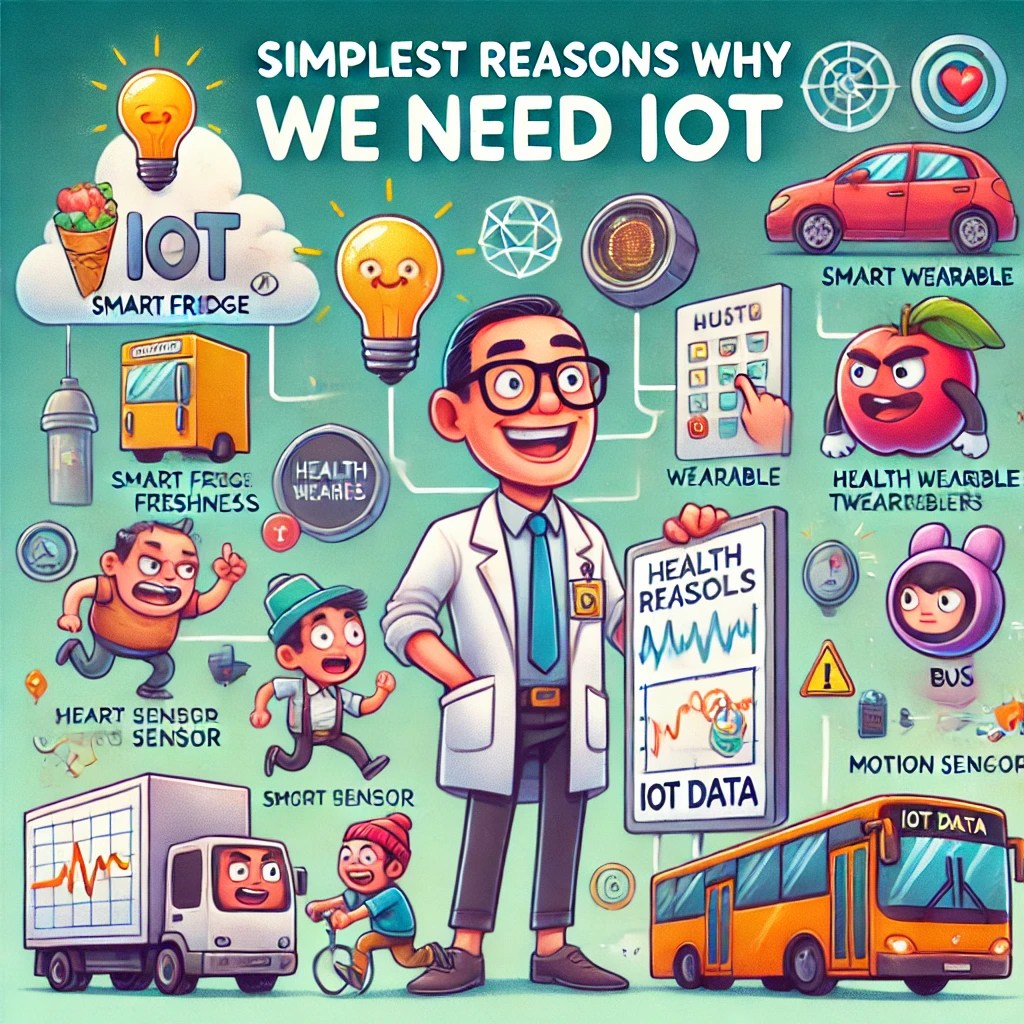
Simplest Reasons Why We Need IoT

Lecture Notes

Today, we’ll discuss why the Internet of Things (IoT) is becoming essential in our daily lives.

The diagram simplifies this concept by focusing on assets, how we connect them, and why sensing the environment is so important. Let’s break it down step by step.

1. What Are Assets?

Let’s start with a question: What do you consider as assets?
We value and want to monitor, track, or protect assets. These could include:

Goods:

  • We would like to know their location (e.g., where is my delivery?)
  • Or their quality (e.g., is the food shipment fresh?)

Health:

  • Monitoring our condition and ensuring safety are critical.
  • Example: A health wearable that tracks your heart rate and connects to a mobile app.

Transport:

  • Vehicles and public transportation must be tracked for location, routes, and utilisation.
  • Example: A bus fleet monitored for efficient route planning.

House Security:

  • Ensuring homes are safe by monitoring for intrusions or emergencies.
  • Example: A motion sensor that alerts you if there’s unusual activity.

2. The Core Need: Connecting Assets and Sensing the Environment

Why do we need IoT for these assets?
The key lies in sensing and connecting the environment around these assets.

  • In the past, we relied on manual monitoring and human input.
  • Today, we use sensors and applications to gather real-time data and automate processes.

3. How IoT Works

Sensors: Devices attached to assets to sense environmental factors like temperature or humidity.

  • Example: A sensor measuring the humidity in a storage facility for sensitive goods.

Communication: Sensors send this data to an IoT platform for processing and action.

  • Example: A sensor alerts the homeowner if the temperature inside the house drops below a certain threshold.

4. Examples of Other Assets

IoT can be applied to monitor a wide variety of assets, such as:

  • Machines: For predictive maintenance in factories.
  • Plants: To ensure optimal growth conditions in agriculture.
  • Water and Rivers: These are used to monitor pollution or water levels.
  • Environment: For tracking air quality and weather changes.
  • Buildings and Tunnels: For structural safety and efficiency.

5. Why IoT Is Essential

IoT provides us with the ability to:

  • Monitor assets in real time without human intervention.
  • Ensure safety and quality by automating alerts and responses.
  • Improve efficiency by making data-driven decisions.

Final Thoughts

The most straightforward reason we need IoT is to connect our assets and sense the environment effectively.

By doing so, we make life easier and ensure safety, efficiency, and better decision-making.

Let’s discuss: What assets in your life or work could benefit from IoT? How would you use sensors to improve them? Share your thoughts!

[FREE Download IoT Notes]

How IoT Impacts the 7 M’s of Business

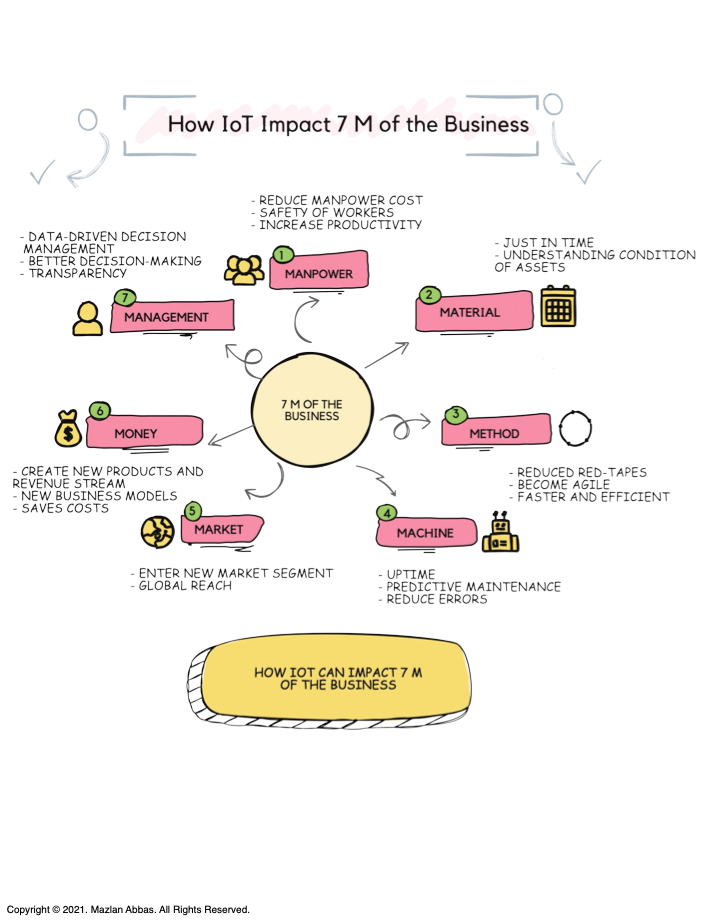
Today, we’ll explore how the Internet of Things (IoT) transforms the 7 M’s of business — key elements that drive an organisation’s operations and strategy.

These 7 M’s are Manpower, Material, Method, Machine, Market, Money, and Management. Let’s break down each one and see how IoT impacts them.

Based on the eBook — IoT Notes by Mazlan Abbas

1. Manpower

IoT helps businesses optimise human resources by reducing costs, improving safety, and increasing productivity.

Impact of IoT:

  • Cost Reduction: Automating repetitive tasks reduces the need for manual labour.
  • Worker Safety: IoT devices, such as wearables, can monitor health and alert workers to potential hazards.
  • Productivity: By enabling remote work and real-time communication, IoT allows employees to focus on high-value tasks.

Example: A construction company using wearables to monitor worker fatigue and ensure safety.

2. Material

IoT ensures better management of materials, improving supply chain efficiency and reducing waste.

Impact of IoT:

  • Just-In-Time Delivery: Sensors track inventory levels and automatically reorder materials when needed.
  • Asset Condition Monitoring: IoT devices monitor the condition of materials, ensuring quality and preventing spoilage.

Example: A warehouse using IoT sensors to track stock levels and ensure optimal storage conditions.

3. Method

IoT makes business processes more agile and efficient by simplifying methods.

Impact of IoT:

  • Reduce Red Tape: Automating workflows eliminates unnecessary administrative steps.
  • Agility: IoT enables businesses to respond quickly to changing conditions.
  • Efficiency: Processes become faster and more streamlined with IoT integration.

Example: A manufacturing plant automating quality checks with IoT sensors to speed up production.

4. Machine

IoT maximises the performance of machines, ensuring reliability and reducing downtime.

Impact of IoT:

  • Uptime: Predictive maintenance ensures machines are operational when needed.
  • Predictive Maintenance: IoT sensors detect issues before they become critical, preventing failures.
  • Error Reduction: Machines can self-correct or alert operators when errors occur.

Example: A factory using IoT-enabled machinery to monitor performance and schedule maintenance.

5. Market

IoT helps businesses expand into new markets and improve their customer reach.

Impact of IoT:

  • New Market Segments: IoT enables innovative products and services, opening new revenue streams.
  • Global Reach: Businesses can monitor and manage operations worldwide through IoT platforms.

Example: An IoT-enabled home security company entering international markets with smart security systems.

6. Money

IoT creates new revenue opportunities and reduces costs.

Impact of IoT:

  • New Revenue Streams: IoT drives innovation, leading to new services and products.
  • Cost Savings: Automating processes and improving efficiency reduces expenses.

Example: A logistics company saving fuel costs by using IoT to optimise delivery routes.

7. Management

IoT improves decision-making through data-driven insights.

  • Impact of IoT:
  • Data-Driven Decisions: Real-time data helps managers make informed choices.
  • Transparency: IoT provides visibility into all areas of the business.
  • Better Decision-Making: Analytics from IoT systems offer actionable insights.

Example: A retail chain using IoT to monitor sales trends and optimise inventory.

Key Takeaways

IoT has a transformative impact on the 7 M’s of business:

  1. Manpower: Reduces costs and improves safety.
  2. Material: Ensures quality and efficiency.
  3. Method: Simplifies workflows and increases agility.
  4. Machine: Enhances reliability and performance.
  5. Market: Expands opportunities globally.
  6. Money: Generates new revenue and reduces costs.
  7. Management: Improves decisions with real-time insights.

Discussion Question: Which of the 7 M’s most benefits from IoT in your industry? Let’s share ideas and examples!

{You can download the FREE eBook IoT Notes by Mazlan Abbas]

Types of Analytics

Today, we’ll discuss types of analytics and their importance in turning raw data into actionable insights.

This diagram shows four types of analytics, ranked by their difficulty level and the value they provide. Let’s go through them step by step.

Based on the eBook — IoT Notes by Mazlan Abbas

1. Descriptive Analytics: What Happened?

At the base of the analytics hierarchy is descriptive analytics. This is the simplest form of analytics and helps us understand what happened by interpreting historical data.

  • Purpose: To summarise past events and identify patterns.
  • Example: A smart thermostat that shows last week’s energy usage patterns.
  • Methods: Charts, graphs, and dashboards that clearly show past performance.

This type of analytics is great for reviewing the past, but it doesn’t tell us why something happened or what will happen next.

2. Diagnostic Analytics: Why Did It Happen?

Moving up, we have diagnostic analytics, which looks at why something happened. It’s more complex than descriptive analytics because it requires diving deeper into the data.

  • Purpose: To discover relationships and identify the causes behind past events.
  • Example: Analysing why a specific day’s energy usage was higher than average by correlating data with external factors like weather.
  • Methods: Data discovery, drill-down techniques, and correlation analysis.

This stage helps us make sense of the past by understanding the root causes of trends and anomalies.

3. Predictive Analytics: What Will Happen?

Next is predictive analytics, which focuses on forecasting future outcomes. This is where analytics becomes proactive rather than reactive.

  • Purpose: To predict what might happen based on current and historical data.
  • Example: A smart thermostat forecasting energy usage for the upcoming week based on weather patterns and past behaviour.
  • Methods: Statistical modelling and simulations.

By identifying trends and patterns, predictive analytics helps us make informed predictions.

4. Prescriptive Analytics: How Can We Make It Happen?

At the top is prescriptive analytics, the most advanced type. This involves predicting outcomes and recommending actions to achieve desired results.

  • Purpose: To decide the best course of action based on predictions.
  • Example: A smart thermostat automatically adjusting settings to save energy while maintaining comfort.
  • Methods: Machine learning and AI to analyse probabilities and make decisions.

Prescriptive analytics provides the highest value by enabling automated and data-driven decisions.

IoT and Analytics

This diagram also highlights how analytics works in an IoT platform:

  1. Sensors: Collect data from various sources like temperature, humidity, or movement.
  2. IoT Platform: Acts as a central hub to process and store the data.
  3. Analytics Engine: Applies these four types of analytics to generate insights and drive decisions.

Final Thoughts

Each type of analytics builds on the previous one, moving from simple data interpretation to actionable decisions. The value increases as we move up the hierarchy, as does the complexity.

Question to consider: Which type of analytics is most valuable in your industry, and how can you implement it effectively? Let’s discuss it!

[Note: Download IoT Notes by Mazlan Abbas ]

What is the Fourth Industrial Revolution?

IOT NOTES

Lecture Notes

Based on the eBook — IoT Notes by Mazlan Abbas

Today, we’ll explore the Fourth Industrial Revolution (IR 4.0) and its significance. This diagram breaks it down into easy-to-understand sections, so let’s walk through it step by step.

1. The Differences Between Revolution and Evolution

Let’s first clarify why it’s called a revolution and not an evolution.

Revolution:

  • Sudden and drastic changes that transform industries and societies.
  • Think of it as a dramatic leap forward in technology and processes.

Evolution:

  • Gradual and slow progress over time.

IR 4.0 is a revolution because it represents rapid and significant advancements in how we live and work.

2. The Bigger Picture: Industry 4.0 vs IR 4.0

It’s important to understand that Industry 4.0 is just a subset of IR 4.0.

  • Industry 4.0 focuses on manufacturing and improving industrial processes using automation, IoT, and robotics.
  • IR 4.0, however, encompasses much more:
  • It impacts various sectors, such as education, healthcare, shopping, and agriculture.
  • It’s a broad transformation, not limited to factories or industries.

3. The Lifestyle Through Industrial Revolutions

Let’s now look at how each industrial revolution shaped our lifestyle:

IR 1.0 — The Age of Manual Tools:

  • People relied on physical and manual tools for work.
  • Example: Ploughing fields with hand tools.

IR 2.0 — The Power of Electricity:

  • Electricity revolutionised industries, enabling mass production.
  • Example: Electric machines replaced manual labour.

IR 3.0 — The Digital Era:

  • The rise of electronics and the internet connected the world.
  • Example: Computers, email, and early e-commerce.

IR 4.0 — The Intelligence Revolution:

  • We’re now using intelligence through AI, robotics, and advanced technologies.
  • Example: Autonomous robots, augmented reality (AR), and virtual reality (VR).

4. Example: How Shopping Evolved

Let’s take shopping as an example of how each industrial revolution changed this activity:

  • IR 1.0: People used cash for transactions.
  • IR 2.0: The cash register was introduced, improving the checkout process.
  • IR 3.0: Credit cards and online shopping emerged with the internet.
  • IR 4.0: We see robotics and AR/VR enhancing the shopping experience, like virtual try-ons or automated warehouses.

Why is IR 4.0 Important?

IR 4.0 is transforming every aspect of our lives, from how we work and learn to how we interact with technology. It’s about leveraging intelligence to solve problems, improve efficiency, and create new possibilities.

[Note: You can download the full eBook — IoT Notes by Mazlan Abbas]

Understanding Industry 4.0 and Industrial Revolution 4.0

IOT NOTES

Lecture Notes

Based on the eBook — IoT Notes by Mazlan Abbas

Today, we’ll explore two closely related but distinct concepts: Industry 4.0 and the Fourth Industrial Revolution (IR 4.0).

These terms are often used interchangeably but have specific differences, as highlighted in the diagram. Let’s dive in step by step.

1. Revolution vs Evolution

The first thing we need to clarify is the difference between revolution and evolution:

  • Revolution refers to sudden and drastic change. Think of it as a leap forward that quickly transforms industries and societies.
  • Evolution, on the other hand, is slow and gradual progress. Changes happen incrementally over time.

Key question: Are we adopting Industry 4.0 technologies suddenly (revolution) or gradually (evolution)? This can vary depending on the industry and region.

2. What is Industry 4.0?

Industry 4.0 focuses on manufacturing and improving industrial processes through advanced technologies like IoT, AI, and robotics. It is the fourth stage in the progression of industrial advancements:

Industry 1.0 (1784):

  • Introduction of mechanisation and steam power.
  • Example: Steam engines powering factories.

Industry 2.0 (1870):

  • Electrical power enabled mass production.
  • Example: Assembly lines in factories.

Industry 3.0 (1969):

  • Use of computers, electronics, and automation.
  • Example: Robots performing repetitive tasks on manufacturing floors.

Industry 4.0 (Today):

  • Cyber-physical systems integrating IoT, AI, VR, and robotics.
  • Example: Smart factories where machines communicate and operate autonomously.

3. What is Industrial Revolution 4.0 (IR 4.0)?

The Fourth Industrial Revolution goes beyond manufacturing. It’s about integrating these technologies across all industries and even societies. While Industry 4.0 focuses on production, IR 4.0 impacts healthcare, education, agriculture, and more.

A key question: Are we adopting these 4.0 technologies evenly across all sectors, or is there a focus on specific areas like manufacturing?

4. The Connection Between Industry 4.0 and IR 4.0

Think of Industry 4.0 as a subset of the broader IR 4.0. Industry 4.0 is about the transformation of manufacturing, whereas IR 4.0 encompasses societal changes.

Here’s an example:

  • Industry 4.0: A factory using IoT sensors to monitor equipment health and reduce downtime.
  • IR 4.0: IoT sensors used in agriculture to monitor soil moisture for precision farming.

5. Societal Progression Through Industrial Revolutions

The diagram also highlights how societies have evolved alongside industrial advancements:

  1. Society 1.0: Hunting society — Humans relied on nature and survival skills.
  2. Society 2.0: Agriculture society- farming practices transformed societies.
  3. Society 3.0: Industrial society — industries became the backbone of economies.
  4. Society 4.0: Information society – driven by computers and the internet.
  5. Society 5.0 (Japan’s Vision):
  • A super-smart society where technology integrates seamlessly to improve quality of life.
  • Focus on AI, robotics, and IoT to solve societal challenges.

6. Why is This Important?

Understanding these concepts helps us prepare for the future:

  • For businesses: Knowing the difference between Industry 4.0 and IR 4.0 helps align strategies.
  • For individuals: Skills like AI, IoT, and data analytics are becoming essential.
  • For society: IR 4.0 encourages us to consider how technology can address global challenges like sustainability and healthcare.

Final Thoughts: Industry 4.0 is revolutionising manufacturing, while IR 4.0 is shaping the future of entire societies.

As we move forward, we aim to embrace these technologies for efficiency and to build a more intelligent, inclusive world.

[You can download the IoT Notes here]