The Story Behind Favoriot – Part I: The Humble Beginnings of Favoriot

When I look back to 2017, I vividly recall the early days of building the Favoriot IoT Platform. We started small, working in a modest room with only a few dedicated staff members. It was a humble beginning, but our vision was anything but small.

The Idea Behind the Platform

The idea for the platform arose from a simple but pressing need—to support our first IoT product, Raqib. At the time, we realised there was a significant gap in the market for an IoT platform that could cater to businesses and developers in a user-friendly and accessible way. But as the idea began to take shape, doubts crept in.

Can we really compete with giants like AWS and Azure?” I often asked myself. The thought was daunting. Competing against well-established platforms felt like an insurmountable challenge. We knew that many people didn’t know who we were, and there were plenty who doubted the capabilities of a small team attempting something so ambitious. But despite the naysayers, we pressed on. Deep down, we were confident in our technology’s potential and our ability to deliver something meaningful.

A Bold Move: Offering the Platform for Free

By 2019, we decided to take a bold step—offering the Favoriot IoT Platform to the public for free. “Maybe this will be the best way to attract attention and build an early user base,” I thought. It seemed like a logical approach. But the reality didn’t match our expectations. The response was underwhelming, to say the least. Only a handful of people showed interest, and our efforts didn’t yield the results we hoped for.

Finding a New Strategy: Education

Sitting down with the team, I voiced my concerns. “We need to do more. This isn’t enough. We must find a better way to introduce our platform.” The team brainstormed tirelessly, and that’s when the idea of offering IoT courses emerged. It was a lightbulb moment. We realised that one of the best ways to attract users was through education—teaching people about IoT while simultaneously showcasing the capabilities of our platform.

But what if no one registers for the courses?” The doubt lingered. Investing time and resources into something that might not succeed was nerve-wracking. Still, we decided to take the plunge. We structured the courses so that participants could learn the fundamentals of IoT and get hands-on experience with the Favoriot IoT Platform.

Success Through IoT Education

Alhamdulillah, the effort paid off. The response to the courses was beyond encouraging. Participants appreciated the knowledge they gained and began to explore our platform in more significant numbers. It was a turning point for us. From those early courses, word began to spread, and the Favoriot IoT Platform started gaining traction. The numbers grew steadily; today, I’m proud to say that we have over 9,343 users from 111 countries. Seeing the global reach of something we built from scratch fills me with immense pride.

I can’t believe we’ve come this far,” I shared with the team during our discussions. “But this is just the beginning. We still have so much more to achieve.

Expanding to New Horizons

With the foundation now solid, we set our sights on the future. Our next goal is to expand our presence to neighbouring countries. The team and I are confident that the Favoriot IoT Platform can achieve even greater success beyond Malaysia. This journey has taught us that with effort and dedication, even the boldest dreams are within reach.

Ready for the next phase?” I asked the team one day, knowing full well that the challenges ahead would be just as demanding as the ones we’ve overcome. Their answer was clear and resolute. We are ready to take on the IoT world.

Reflecting on the Journey

Looking back, I see how every step we took was filled with challenges and uncertainties, but it was also marked by resilience and an unrelenting drive to succeed. No matter how small, each decision was crucial in shaping where we are today. The journey has been extraordinary, from a tiny room with a handful of staff to a global platform with thousands of users.

A Glimpse of What’s Next

This is only part of the story behind the development of the Favoriot IoT Platform. There’s much more to share—the challenges we faced, the lessons we learned, and the milestones we celebrated. Stay tuned for Part II, where I’ll delve deeper into the obstacles we’ve encountered and how we’ve navigated them to reach where we are now.

This journey is a testament to what can be achieved with a clear vision, unwavering determination, and a great team by your side. I hope our story inspires others to pursue their big or small dreams. After all, every outstanding achievement starts with a single step and the willingness to take it.

More Stories

My Startup Journey

The Secret to Faster, More Scalable IoT Deployments for System Integrators

IOT WORLD

Why System Integrators Should Embrace the Favoriot Platform for IoT Solutions

Businesses increasingly leverage the Internet of Things (IoT) to enhance efficiency and unlock new revenue opportunities.

At the heart of these initiatives are system integrators (SIs), whose expertise in connecting diverse devices, protocols, and systems is vital to the success of IoT deployments.

Despite their pivotal role, SIs often face challenges that hinder their progress and complicate projects.

Challenges in Building IoT Solutions

Developing IoT solutions is far from straightforward.

System integrators must juggle various device protocols, manage massive volumes of real-time data, ensure robust security, and scale projects as they grow.

These complexities can lead to prolonged development cycles, labour-intensive custom coding, and fragmented implementations.

As a result, SIs often find it challenging to innovate and meet evolving customer demands.

The Need for Streamlined IoT Deployments

How can system integrators overcome these hurdles and deliver reliable, scalable IoT solutions more efficiently?

Adopting a platform that simplifies and accelerates IoT project development and management is the answer.

Introducing the Favoriot Platform

Favoriot offers a comprehensive solution tailored to the needs of system integrators.

Its secure, scalable cloud environment supports multiple communication protocols, enabling seamless connectivity for diverse IoT devices.

With real-time data ingestion and analytics capabilities, the platform reduces the complexity of managing large-scale deployments.

Favoriot also provides customisable dashboards and API integrations, allowing SIs to effortlessly transform raw data into actionable insights.

Security and Scalability for Confidence

Security and scalability are at the core of the Favoriot platform.

System integrators can confidently deploy solutions that meet industry standards while ensuring their projects can grow alongside their customers’ needs.

By minimising the need for time-consuming custom integrations, Favoriot frees up SIs to focus on delivering value-added services that differentiate them in the market.

Faster Time-to-Market with Favoriot

By leveraging Favoriot, system integrators can significantly reduce project timelines.

The platform’s unified approach eliminates many technical challenges, enabling SIs to bring solutions to market faster.

This efficiency enhances productivity and strengthens customer relationships by delivering reliable results.

Empowering Innovation in IoT

Favoriot equips system integrators with the tools to excel in a competitive IoT landscape.

By simplifying the complexities of IoT projects, the platform allows SIs to concentrate on driving innovation and meeting customer expectations.

With Favoriot, system integrators can unlock the full potential of IoT, creating scalable solutions that deliver lasting impact.

Examples of IoT Applications and Their Benefits

Today, look at some real-world examples of IoT applications and their benefits.

This diagram focuses on two industries—transportation and logistics and Oil and gas —to illustrate how IoT solutions can reduce costs and improve efficiency. Let’s examine each example in detail.

Based on the eBook — IoT Notes by Mazlan Abbas

1. Transportation & Logistics

In this industry, IoT solutions are used to improve the management of vehicles and delivery systems.

IoT Solution:

  • Sensors are installed in vehicles to provide real-time data on their state and performance.
  • These sensors report on engine health, location, and delivery progress.

Benefits (Payback):

Cost Savings:

  • Reduces truck operation and delivery costs by identifying and addressing maintenance issues early.
  • Minimises fuel consumption by optimising delivery routes.

Improved Efficiency:

  • Reduces delivery disruptions and delays.
  • Ensures on-time deliveries and improves overall logistics system performance.

Example in Action: A logistics company uses IoT-enabled fleet management to track delivery vehicles and proactively schedule maintenance, avoiding breakdowns and saving costs.

2. Oil & Gas

The Oil & Gas industry faces unique challenges that IoT can address by enhancing safety and efficiency.

IoT Solution:

  • Sensors are deployed throughout an oil rig to monitor critical components.
  • These sensors detect potential issues and provide operators with real-time alerts.

Benefits (Payback):

Cost Savings:

  • Increases safety by providing early and reliable warnings of potential equipment failures.
  • Prevents costly shutdowns by identifying problems before they escalate.

Improved Efficiency:

  • Real-time alerts enable quicker responses, reducing downtime and improving time-to-revenue.
  • Enhances asset utilisation by ensuring equipment operates optimally (4x improvement).
  • Complete data analysis allows for near real-time decision-making and operational adjustments.

Example in Action: An oil rig uses IoT sensors to monitor drill performance and prevent malfunctions, ensuring smoother operations and faster oil extraction.

Key Takeaways

IoT in Transportation & Logistics:

  • Reduces costs and enhances delivery efficiency through real-time monitoring of vehicles.

IoT in Oil & Gas:

  • Improves safety, reduces downtime, and maximises asset utilisation with real-time alerts and analysis.

Final Thought:
IoT transforms industries by providing actionable data that saves money and improves efficiency. These examples show how IoT can adapt to specific industry needs and bring measurable benefits.

Discussion Question: Which other industries do you think can benefit from similar IoT solutions? Let’s brainstorm together!

[Download IoT Notes eBook for FREE]

How Enablers, Engagers, and Enhancers Drive the IoT Journey

IOT WORLD

The IoT Revolution: Shaping the Future with Enablers, Engagers, and Enhancers

The Internet of Things (IoT) has always been a fascinating space for me.

It’s incredible how a concept that seemed futuristic not too long ago has become a driving force in the tech industry.

IoT has opened up a world of opportunities, with market projections ranging from $2 trillion to $14 trillion. That’s mind-boggling! But here’s the thing – jumping into IoT without understanding your role in the ecosystem is like trying to build a house without knowing which part you’re responsible for.

Let me walk you through this ecosystem as I see it, breaking it into three leading roles: Enablers, Engagers, and Enhancers.

Enablers: The Builders of IoT

Think of Enablers as the architects and construction workers of the IoT world.

They’re laying the groundwork – developing the technologies, hardware, and infrastructure that make IoT possible. Without them, there’s no IoT, period.

When I worked at MIMOS Berhad, Malaysia’s national R&D centre, I saw how challenging this role can be. You’re not just building products; you’re creating the tools others will use to develop their solutions.

Companies like Cisco and Intel are perfect examples. They design the chips, the communication protocols, and the platforms that allow data to flow between devices.

At FAVORIOT, our platform plays a similar role.

It’s a foundation for developers to connect devices and scale their applications. Being an Enabler means thinking about scalability, security, and reliability ahead of time.

It’s demanding but also incredibly rewarding because you’re shaping the future of IoT.

Engagers: Bringing IoT to Life

If Enablers are the builders, Engagers are the storytellers.

They take the raw capabilities provided by Enablers and turn them into solutions that make sense to the everyday user. This is where IoT comes alive for people.

I love this role because it’s all about creativity and problem-solving.

Engagers design and deliver IoT services that address real-world needs. For instance, Nest’s smart thermostats made IoT relatable and accessible to millions of households.

While leading REDtone IOT, I saw how challenging it is to balance innovation with practicality.

You have to create solutions that are not only cutting-edge but also easy to use and affordable.

Whether it’s developing intelligent farming systems, health monitoring devices, or city-wide solutions, Engagers connect IoT to its audience.

At FAVORIOT, we stepped into this role with projects like RAQIB, a health monitoring system for Hajj pilgrims.

The idea was simple: make it easier for caregivers to monitor pilgrims’ health remotely. It’s about identifying and meeting a need with IoT tools.

Enhancers: Turning Data into Action

Here’s where things get exciting.

Enhancers take all the data IoT devices collect and turn it into something meaningful.

They’re the analysts, the data scientists, and the visionaries who uncover patterns and insights that help people make better decisions.

This role is close to my heart because it’s where IoT’s actual value is unlocked.

For example, RAQIB isn’t just about collecting health data – it’s about analysing it to predict potential issues and alert caregivers. Without that intelligence layer, the data would be numbers on a screen.

Enhancers rely on AI and machine learning technologies to transform raw data into actionable insights.

Companies like Palantir and Splunk are masters at this.

They build platforms that help businesses make sense of complex data. It’s a challenging role but incredibly impactful, especially as IoT continues to generate more and more data daily.

At Favoriot, we are now enhancing our IoT platform with Agentic AI, making it an “AIoT”.

Where Do You Fit In?

So, how do you decide where you belong in this ecosystem?

Should you build the infrastructure as an Enabler, create applications as an Engager, or analyse the data as an Enhancer?

Here’s my advice: start with what you’re good at.

If you’re a tech wizard with a hardware and software development knack, the Enabler role might be for you.

If you understand market needs and enjoy creating user-centric solutions, focus on being an Engager. And if data is your thing, Enhancers have plenty of opportunities for innovation.

At FAVORIOT, we started as Enablers, building our IoT platform. Over time, we expanded into the Engager and Enhancer roles by creating solutions like Favorsense, a crowdsensing platform, RAQIB and now become AIoT platform.

It’s a natural progression, but it all began with identifying and focusing on our strengths.

The Real Power of IoT

At its core, IoT isn’t just about connecting devices; it’s about connecting insights.

The more devices you have collecting data, the more opportunities there are to make meaningful discoveries. But here’s the catch – you need the right tools and expertise to turn that data into something valuable.

That’s why Enhancers are so crucial.

With advanced analytics, they can predict equipment failures, improve operational efficiency, or even save lives.

It’s about more than just technology; it’s about creating solutions that make a difference.

Let’s Shape the Future Together

The IoT landscape is vast, and the opportunities are endless.

But success comes down to understanding your role – whether you’re an Enabler, an Engager, or an Enhancer – and playing to your strengths.

Don’t try to do everything.

Focus on where to add the most value, and the rest will follow.

For me, IoT is more than just a field of work – it’s a mission to create smarter, more connected communities.

Whether you’re building the infrastructure, designing the applications, or analysing the data, you’re contributing to something bigger: a future where technology works seamlessly to improve lives.

So, let’s get out there and make it happen.

The IoT revolution is just starting, and there’s plenty of room for us to make our mark.

Where will you begin?

The Startup Playbook: 12 Essential Lessons from Favoriot’s Rise in IoT

IOT STARTUP JOURNEY

Building an IoT Dream: What Favoriot Taught Me About Startups and Success

It’s a rollercoaster ride — that’s how it feels.

As a founder, I’ve lived through every peak, valley, triumph, and stumble.

These experiences have taught us invaluable lessons that resonate with many other startup founders navigating their challenges.

I’ll share some of these insights, weaving in our story and the principles that guided us.

Building a Unique Value Proposition

When we started Favoriot, we knew we couldn’t compete head-to-head with giants like AWS and Azure. But that didn’t deter us.

Instead, we asked ourselves: What can we do differently?

We decided to focus on building a niche — a platform specifically tailored for developers, businesses, and educational institutions.

We saw an opportunity to simplify IoT development and make it accessible to a broader audience.

While others were targeting massive enterprise solutions, we aimed at creating something for the everyday innovator.

This focus allowed us to create a unique space in a crowded market.

Lesson: Find your niche and double down on it. Differentiation is not just a strategy; it’s survival in a world dominated by giants.

Global Expansion through Partnerships

Scaling globally was a dream we dared to chase.

But how could a small Malaysian startup make waves internationally?

The answer was partnerships. We launched the Favoriot Global Partner Program with local experts in Canada, Indonesia, the Philippines, and India.

These partnerships were more than business deals; they were collaborations built on trust and shared vision.

Our partners brought invaluable local insights, helping us tailor our offerings to meet market needs.

Lesson: Don’t try to do it all yourself. Collaborate with local partners who understand the nuances of their markets. Their expertise can be your gateway to scaling internationally.

Community Building

One of the most fulfilling parts of this journey has been building the Favoriot developer community.

Early on, we realized that an engaged community isn’t just a nice-to-have; it’s a cornerstone of growth.

We invested time and resources in listening to our developers, organizing webinars, and creating value-added content.

Their feedback not only improved our platform but also fostered loyalty and advocacy.

Lesson: A strong community can amplify your impact. Engage with your users, listen to their needs, and make them part of your journey.

Solving Real-World Problems

RAQIB, our IoT solution for elderly care, is among our proudest achievements.

The idea was born from a personal need — caring for ageing family members.

This wasn’t just about technology; it was about solving a real-world problem that resonated with many others.

The emotional connection to this project fueled our determination.

It reminded us why we started Favoriot in the first place: to use technology to make lives better.

Lesson: Align your product development with real-world challenges. When you solve meaningful problems, your work becomes more than just a business; it becomes a mission.

Overcoming Resource Constraints

Running a startup often feels like a constant juggling act, especially when resources are limited.

Unlike tech giants, we didn’t have deep pockets. But what we lacked in resources, we made up for with creativity and focus.

We prioritized initiatives with the highest ROI, embraced lean methodologies, and made every dollar count. It wasn’t easy, but it taught us to be resourceful and resilient.

Lesson: Constraints can be a blessing in disguise. They force you to innovate and focus on what truly matters.

Leveraging Education and Training

From the beginning, we saw education as a powerful way to drive IoT adoption.

We partnered with universities, offering our platform as a tool for hands-on learning.

The response was overwhelming. Students and educators alike appreciated having access to a real-world IoT platform.

This initiative boosted Favoriot’s visibility and nurtured the next generation of IoT innovators.

Lesson: Educational partnerships can be a win-win. They expand your reach while contributing to the growth of your industry.

Persistence and Long-Term Vision

Competing in a saturated market requires grit.

There were moments of doubt, times when progress felt excruciatingly slow. But we stayed the course, driven by a clear vision: to enable IoT solutions for everyone.

Persistence paid off. Every small win added up, and over time, we built momentum.

Lesson: Success doesn’t happen overnight. Stay committed to your vision and trust the process.

Adapting to Market Feedback

Feedback has been our most excellent teacher.

Developers, businesses, and even critics have shaped the evolution of the Favoriot platform. Listening to their needs and acting on their suggestions helped us stay relevant and competitive.

Lesson: Feedback isn’t a criticism; it’s an opportunity to grow. Embrace it and use it to refine your offerings.

Focus on Localization

When entering international markets, one size doesn’t fit all.

Our partners were crucial in localizing the Favoriot platform, ensuring it met each region’s cultural and regulatory requirements.

Lesson: Understand the local context. Tailor your solutions to align with the specific needs of each market.

Strong Branding and Storytelling

Sharing our journey — the highs, the lows, and everything in between — has been a powerful way to connect with our audience.

Authentic storytelling helped build Favoriot’s brand and credibility.

Lesson: People connect with stories, not just products. Be authentic and share your journey openly.

Strategic Technology Integration

We’ve always strived to stay ahead of the curve, integrating emerging technologies like AI and data analytics into our platform.

This adaptability kept us relevant and opened new opportunities.

Lesson: Don’t just follow trends; integrate them strategically to enhance your offerings.

Importance of Patience in IoT Projects

IoT adoption, especially in industries like smart cities, often takes time.

Long sales cycles and bureaucratic hurdles can be frustrating, but they’re part of the process.

Lesson: Patience is more than a virtue; it’s a necessity. Build strong relationships and stay the course.

Looking back, Favoriot’s journey has been a combination of challenges, lessons, and growth.

Each step taught us something valuable, shaping who we are today.

To my fellow startup founders, I hope these lessons inspire and guide you on your paths.

Remember, the journey is just as important as the destination.

Reasons to Consider IoT

IOT NOTES

Lecture Notes

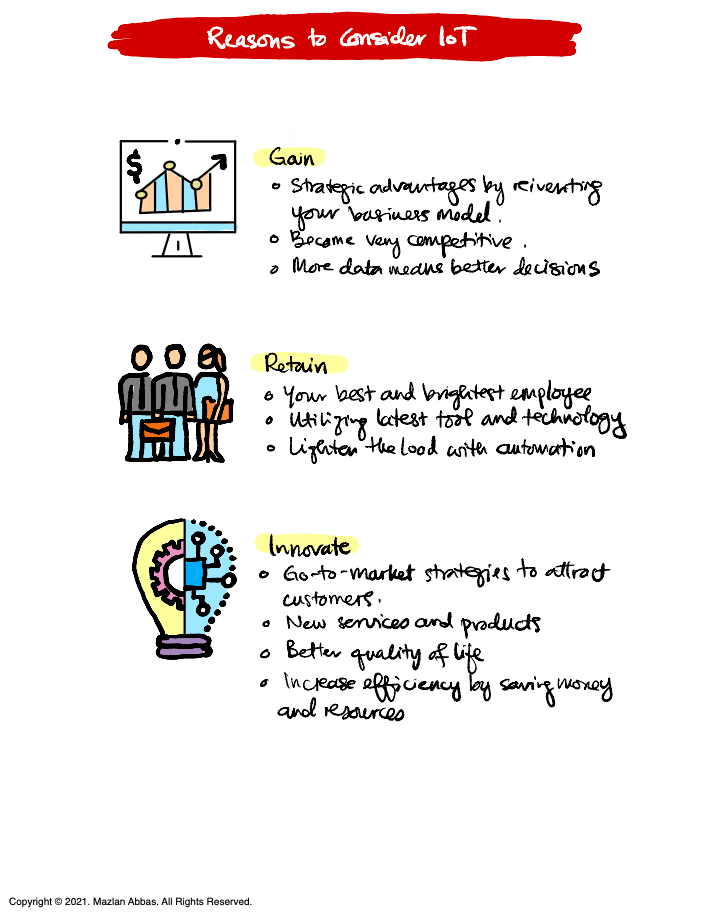
Today, we’re going to discuss the key reasons why organisations should consider adopting IoT (Internet of Things).

The diagram highlights three main benefits: Gain, Retain, and Innovate. Let’s go through each of these in a simple and structured way.

1. Gain

The first reason to consider IoT is the opportunity to gain strategic advantages and stay competitive in the market.

Strategic Advantages: IoT allows businesses to reinvent their business models, offering smarter, data-driven services.

  • Example: A retail store using IoT to track customer preferences and improve in-store experiences.

Become Competitive: By adopting IoT, businesses can stay ahead of competitors who are slow to embrace technology.

  • Example: A logistics company using IoT sensors to optimise delivery routes.

Data-Driven Decisions: IoT provides real-time data, which helps in making better decisions faster.

  • Example: A manufacturer monitoring equipment performance to reduce downtime.

2. Retain

The second reason is about retaining the best employees and maintaining operational efficiency.

Attract and Retain Talent: Employees prefer organisations that use the latest tools and technology to make their work easier and more efficient.

  • Example: Providing engineers with IoT-enabled tools to monitor and control operations remotely.

Ease Workloads with Automation: IoT automates repetitive tasks, allowing employees to focus on higher-value activities.

  • Example: Smart systems in a factory automatically managing inventory levels.

When employees feel supported by modern technology, they are more likely to stay with the organisation.

3. Innovate

The third and perhaps most exciting reason is the ability to innovate with IoT.

Go-to-Market Strategies: IoT enables businesses to develop new strategies to attract and retain customers.

  • Example: A car rental company using IoT for keyless entry and real-time vehicle tracking.

New Products and Services: IoT opens doors to create entirely new offerings that improve the customer experience.

  • Example: Wearable health trackers offering personalised fitness insights.

Better Quality of Life: For individuals and society, IoT can enhance convenience, safety, and overall well-being.

  • Example: Smart homes with automated lighting and security systems.

Efficiency and Savings: IoT reduces costs by optimising resources and processes.

  • Example: Smart irrigation systems saving water in agriculture.

Key Takeaway

The main takeaway is simple: IoT is not just about adopting technology — it’s about creating value by:

  1. Gaining a competitive edge.
  2. Retaining top talent and improving efficiency.
  3. Innovating to improve products, services, and quality of life.

IoT is the key to staying relevant in today’s fast-changing world.


Let’s discuss: Which of these reasons resonates most with your business or personal goals? How can IoT help you achieve them? Let’s explore together!

[Download the FREE eBook— IoT Notes by Mazlan Abbas]

Here’s Why My Top 5 Articles in 2024 Earned the Most

YEAR 2024 STORIES

Analyse to get better results in 2025

I’ve always been curious about what makes some articles perform better than others.

So, when I looked at my top earners, a few patterns jumped out at me.

Let me walk you through what I noticed.

1. Relevant and Practical Topics

The first article on the list, “Five (5) Best Reasons Why I Chose Gumroad to Sell My eBooks,” wasn’t surprising. It speaks directly to content creators like me who want to sell digital products. It’s straightforward, helpful, and, most importantly, actionable. That’s a formula that works.

Similarly, “Avoid These 10 Mistakes and Become a Better Writer in 2024” was a hit because, let’s face it, who doesn’t want to improve their writing?

Tackling common mistakes is something almost every writer can relate to.

That relatability gave it an edge.


2. Timing is Everything

I realised that timing plays a huge role. Articles like “Avoid These 10 Mistakes…” and “Lessons Learned Before and After Joining Medium Partner” were published around the start of the year.

That’s when people are most motivated to learn, grow, and try new things.

It’s like catching a wave at just the right moment.


3. Actionable Tips Win Hearts

I’ve learned that people love actionable advice — stuff they can use right away.

Writing about practical steps, like optimising writing habits or selling eBooks, clicks with readers.

They see immediate value in it. Articles like “Five (5) Best Reasons Why I Chose Gumroad” stand out because they’re not just informative but useful.


4. Engagement Makes a Difference

This part surprised me.

Some articles didn’t just get views — they got a lot of reads. For example, the Gumroad article had 184 reads out of 349 views.

That’s over 50%! It tells me the people who clicked on it stuck around to read the whole thing.

Compare that to other articles that might have more views but fewer reads — it’s clear which ones connected with people.


5. Storytelling Works Wonders

I’ve always loved weaving personal stories into my writing, and readers seem to enjoy that, too. “A Letter to My Younger Self” is a great example.

It’s reflective and emotional; I think people appreciate that human touch.

It’s not just another “how-to” article — it’s a glimpse into my journey.


6. Short and Sweet Wins

Looking at the data, I noticed the sweet spot for article length is around 3–5 minutes.

These are long enough to deliver value but short enough to fit into a busy reader’s day. Articles like “Avoid These 10 Mistakes…” and “Lessons Learned…” are perfect examples.

They pack a punch without dragging on.


7. Niche Matters

Some articles do well because they speak directly to a specific group.

Take “Lessons Learned Before and After Joining Medium Partner,” for instance. It’s aimed at Medium writers, who are probably searching for that content.

I think finding the right niche is half the battle.


8. Eye-Catching Titles

I’ll admit that titles matter more than I used to think. Something like “Tripling My Medium December Earnings: When I Implement These Amazing Things” immediately grabs attention.

Words like “tripling” and “amazing” spark curiosity, and curiosity gets clicks.


Looking back, it’s clear that the combination of timing, practical value, personal voice, and targeting the right audience made these articles stand out.

And while I can’t always predict which ones will resonate the most, seeing these patterns emerge is fascinating.

Writing is as much about experimenting as it is about connecting with readers; I’m always learning.


Below are the top 5 highest earned articles in 2024.

View at Medium.comView at Medium.comView at Medium.comView at Medium.comView at Medium.com

AI Agents: The Game Changer for 2025 and Beyond

AI Journey

IoT and AI Agents: A Perfect Team

As I get ready to start my day, I think about something I often ask myself: “What exactly is an AI agent?” It’s not just another complicated tech term; it’s an idea changing how we use technology and go about our daily lives.

An AI agent is like a super-smart assistant that can understand its surroundings, make decisions, and take actions to meet specific goals— all without needing constant instructions.

But what does “understand its surroundings” actually mean?

Picture a world where IoT sensors are like the eyes and ears of an AI agent. These sensors are embedded everywhere: in your home, your car, factories, farms, and even in your city.

They collect real-time data about everything — temperature, motion, air quality, energy use, etc.

An AI agent processes this data to get a clear picture of what’s happening and decides what to do next.

For example, a smart thermostat uses temperature sensors to learn when to heat or cool your home based on your habits.

On a larger scale, in a smart city, IoT sensors on traffic lights help an AI agent manage traffic flow, reducing congestion during rush hour.

Why AI Agents Matter

Picture a day when your assistant reminds you about meetings, plans your route to avoid traffic, and even orders your favourite snacks when you’re running low.

It’s not just about making life easier; it’s about being smarter with your time and energy.

Here are some reasons why AI agents are so helpful:

  1. Getting Things Done Faster: AI agents handle repetitive tasks like summarizing emails or making reports, leaving you free to focus on more significant ideas. Imagine never having to waste time on tedious chores again.
  2. Making Life Personal: AI agents learn about you — what you like and need — and give you tailored suggestions. Whether finding a new show to watch or giving health advice, they make things feel just right for you.
  3. Handling Big Loads: AI agents can manage a ton of work without slowing down in businesses. From answering customer questions to keeping track of supplies, they handle it all smoothly.
  4. Getting Smarter Over Time: Unlike regular systems that don’t change, AI agents learn from every interaction and improve continuously. They adapt to new challenges and keep getting better at helping you.

As I think about these benefits, I wonder: “Why is 2025 the year for AI agents?” The answer lies in how technology advances, businesses are ready, and people are trusting AI more.

Why 2025 Will Be the Year for AI Agents

There are several reasons why 2025 is shaping up to be a big year for AI agents:

  1. More Companies Using Them: Businesses realise how helpful AI agents can be. From helping customers to improving healthcare, these agents are becoming a must-have tool.
  2. Better Technology: AI agents are more intelligent than ever, thanks to language understanding and decision-making improvements. They can now handle complex tasks and make real-time choices.
  3. People Trust Them More: More and more people are comfortable using AI tools. For example, in 2024, the number of people using chatbots during the holiday shopping season skyrocketed — a clear sign that consumers are embracing AI.
  4. Industry Innovation: New AI tools designed for specific tasks make it easier for businesses and individuals to adopt these technologies. For example, personal virtual assistants are now more competent and more accessible than ever.

It’s not just about cool gadgets,” I remind myself. “It’s about creating a system that works for everyone.” That’s why things like data security and ethical AI are so important.

IoT and AI Agents: A Perfect Team

As someone who works closely with IoT (Internet of Things), I often think about how it fits with AI agents. IoT connects devices — like your smartwatch, fridge, or car — creating a network that collects loads of data.

But data alone isn’t valuable. AI agents are like the brain that makes sense of everything and acts on it.

Here’s how they work together:

  1. Making Data Useful: IoT devices collect information, but AI agents turn it into insights you can use. For example, a smart home can learn your daily habits and automatically adjust the lights or temperature to save energy.
  2. Deciding on Their Own: IoT sensors check the soil in agriculture, and AI agents choose when and how much to water crops. In healthcare, wearable devices monitor your health, and AI agents alert your doctor if something looks off.
  3. Simple and Easy to Use: Instead of confusing dashboards, you can just ask your AI agent questions like, “How much energy did we save this month?” and get clear answers.
  4. Managing Big Systems: Managing IoT networks can be a headache as they grow. AI agents make it simple by adapting to new devices and managing everything efficiently. In smart cities, they can control traffic lights to ease congestion.
  5. Improving Shopping Experiences: IoT sensors track what’s on the shelves in stores, and AI agents reorder items before they run out. It’s all about making sure customers get what they need without waiting.
  6. Helping the Environment: AI agents and IoT can reduce waste and save energy. Smart grids distribute electricity more efficiently, and AI agents optimize energy use at home and in factories.

Imagine this,” I think, “Your car tells your home’s AI agent you’re on your way. The garage door opens, the lights turn on, and the air conditioning adjusts to your preferred temperature. That’s the future — where everything works together seamlessly.

The Road Ahead

Of course, there are challenges. People worry about privacy and security. “How do we ensure AI agents work for us and not against us?” That’s a question I often come back to.

But the potential is enormous.

AI agents combined with IoT can change industries, simplify life, and solve problems in ways we’ve never seen before.

From improving healthcare to creating smarter cities, the possibilities are endless.

As I wrap up my thoughts, I feel excited about what’s to come. The year 2025 will be a turning point for AI agents and how we live and work.

It’s a year that could redefine everything.

So, let’s get ready to embrace this change. Let’s use AI agents to create a more imaginative, more connected world.

The future isn’t something we wait for — it’s something we build together.

Transforming IoT Labs: A Personal Look at Solving the Biggest Challenges in IoT Education

FAVORIOT STORIES

Solving IoT Education Problems

When I started exploring the world of IoT, one of the first things I noticed was how fragmented the ecosystem seemed.

Every project required a different set of tools, and connecting the dots — devices, platforms, and data — felt like piecing together a jigsaw puzzle without knowing what the final picture would look like.

That’s when the idea behind FAVORIOT — an IoT ecosystem — truly clicked for me.

I didn’t want to create just another IoT platform; I tried to solve real problems that educators, students, and developers face daily.

Let me take you through it in my own words.

The Real Problem with IoT Education

During one of my visits to a university, I candidly chatted with an educator who shared their frustrations about their IoT lab.

We have the hardware,” they said, pointing at a table full of Arduino boards and sensors. “But the students never get the complete picture. They build projects, but these projects live in isolation, never really demonstrating what IoT is capable of in the real world.” That conversation stayed with me.

I started asking others in the field; the story was the same everywhere. Students spend more time figuring out middleware and less time learning how IoT could transform industries.

And worse, most of their projects died after submission — no data continuity, no way to scale, and no means to manage the work if they wanted to revisit it later.

That’s when I realised we needed to bridge this gap.

Enter FAVORIOT: Built with Real Challenges in Mind

When we designed the FAVORIOT IoT Ecosystem, we didn’t start with features — we started with problems.

Could we make it effortless for students and developers to integrate their devices into an IoT platform? What if educators could easily create a complete IoT lab experience without assembling a dozen tools? These questions drove our design.

I remember thinking, “It’s not about cramming features into a platform; it’s about solving headaches.”

Take, for example, the issue of middleware. I’ve seen students spend weeks deciding which middleware to use, only to hit a wall regarding implementation.

FAVORIOT eliminates this by offering a ready-to-use IoT platform that handles device management, data ingestion, and visualisation — all in one place.

What Does This Mean for Educators and Students?

Let’s go back to that IoT lab I visited.

Imagine if those Arduino boards and sensors were connected to FAVORIOT. Suddenly, students wouldn’t just be building isolated projects; they’d be building scalable IoT solutions.

They’d learn how to send real-time data from their devices to the cloud, process and analyse it, and visualise it for meaningful insights. Isn’t that what IoT is all about?

And for educators, the value is clear. “How do I make IoT exciting for my students?” an instructor asked me. FAVORIOT gives them the tools to answer that question.

Providing a complete ecosystem lets them focus on teaching concepts rather than troubleshooting technical hurdles.

Students get hands-on experience with a real-world IoT platform, and educators see their students’ potential fully realised.

Solving the Continuity Problem

One of the most significant pain points I’ve heard is the lack of project continuity. Students build something impressive, present it, and then… it’s gone.

There’s no scalable database to store the data, no device management to maintain the system, and no way to build upon the project later. FAVORIOT changes that.

Features like data storage and device scalability ensure that every project has a future. “What if your final-year project could become the foundation for your startup?” I often ask students, and their eyes light up at the possibility.

Real Impact, Not Just Buzzwords

Sometimes, I ask, “What’s the difference with FAVORIOT?

For me, it’s the focus on solving practical problems. It’s not just another IoT platform; it’s a tool designed to empower users.

One educator shared how FAVORIOT transformed their teaching approach. “Before this, our IoT projects were disconnected. We have a complete ecosystem that lets students see the bigger picture,” they told me.

Hearing that kind of feedback reinforces why we do what we do.

Preparing Students for the 4IR

As we move deeper into the Fourth Industrial Revolution (4IR), IoT skills are no longer optional but essential.

FAVORIOT helps students develop these skills in a meaningful way.

They learn not just how to connect devices but also how to create solutions that can scale and adapt.

And because the platform is affordable, it’s accessible to institutions that might otherwise struggle to provide such opportunities.

A Personal Vision

Creating FAVORIOT wasn’t just about building a product and making an impact.

I often reflect on how my technological journey began with curiosity and access to the right tools.

I wanted to give today’s students the same chance to explore, innovate, and excel. FAVORIOT is more than an IoT ecosystem; it bridges education and industry, ideas and implementation.

Wrapping Up

If there’s one thing I’ve learned, technology is only as good as the problems it solves.

FAVORIOT solves real problems in IoT education and development, empowering users to build solutions that matter.

And for me, that’s what makes all the effort worthwhile.

So, the next time you think about IoT, ask yourself: Are you just building devices, or are you building solutions?

FAVORIOT is here to help you do the latter.

Building IoT Using the 3-Question Approach

Today, we will explore a structured way to implement IoT projects called the 3-Question Approach (W-W-H). This approach revolves around asking three key questions: What? Why? How?

Let’s review each step to understand how this framework ensures clarity and direction for IoT solutions.

Based on the eBook — IoT Notes by Mazlan Abbas

1. What? (Problem Statement)

The first question is What? which helps us identify the problem we’re trying to solve.

Purpose: To uncover the actual pain points or gaps in current processes.

Steps:

  • Look for inefficiencies or challenges in operations.
  • Identify areas where IoT can provide value.

Examples:

  • Low production rates in a factory.
  • Increasing operational costs.
  • Poor quality control leads to defects.
  • Safety incidents in a workplace.
  • Intermittent services in logistics or delivery.

Understanding the problem is the foundation of any successful IoT project.

2. Why? (Objective & End Goal)

Next, we ask Why?, which focuses on the objective and the end goal of the IoT implementation.

Purpose: Clearly define what you want to achieve and align everyone toward that goal.

Steps:

  • Get buy-in from stakeholders by explaining the benefits.
  • Ensure the outcome can be monitored and measured effectively.

Examples of Objectives:

  • Improve logistics and delivery efficiency.
  • Reduce operational costs.
  • Enhance asset utilisation and reduce errors.
  • Boost overall safety and performance.

Defining the “why” ensures a clear purpose behind the IoT deployment.

3. How? (Solutions)

The final question is How? which focuses on the solutions to address the problem and achieve the goals.

Steps:

Use the DNA approach:

  • D — Device: Identify the right sensors to collect the required data.
  • N — Network: Choose a suitable network for connectivity (e.g., Wi-Fi, LoRa, 5G).
  • A — Applications: Develop platforms (mobile or web) to process and display the data.
  • Decide on an implementation strategy:
  • Build in-house.
  • Operate internally.
  • Outsource to a third party.
  • Collaborate with partners.

Examples of Solutions:

  • Install sensors to monitor production lines in real time.
  • Ensure the network has sufficient coverage and can handle the amount of data.
  • Develop mobile or web applications to provide actionable insights.

The “how” ensures the project is feasible and actionable.

Key Takeaway

The 3-Question Approach provides a clear path for implementing IoT solutions:

  1. What? — Define the problem.
  2. Why? — Establish the objective.
  3. How? — Develop the solution.

This framework ensures every IoT project is focused, aligned, and effective. Think big, but start small.


Let’s discuss: Can you think of an example where this approach could be applied in your industry or daily life? What “What-Why-How” steps would you take? Share your thoughts!

[Download FREE IoT Notes by Mazlan Abbas]