

There was a time when I was impressed by command centres.
Rows of screens.
Maps glowing in neon colours.
Charts are moving in real time.
Operators are pointing at dashboards like air traffic controllers.
It looked powerful.
It looked serious.
It looked… convincing.
But one day, standing quietly at the back of the room, I caught myself thinking something uncomfortable.
If one screen goes dark, who notices?
If the data contradicts another system, who decides?
If something breaks at 2 a.m., who actually understands what is happening?
That was the moment the screens stopped impressing me.
Because cities are not run by visuals.
Cities are run by clarity.
And clarity does not come from dashboards alone.
How Cities Slowly Accumulate Silos Without Realising It
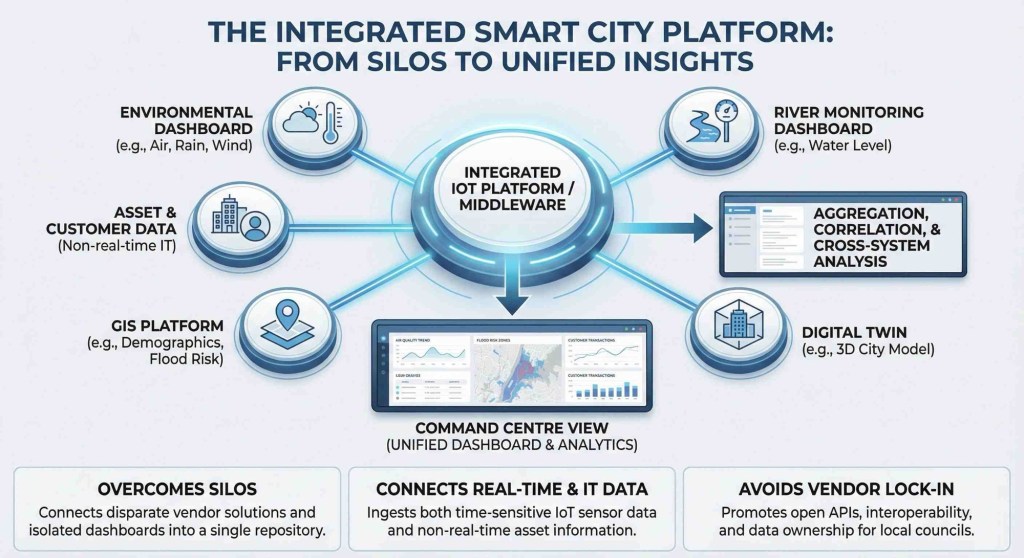
Most local councils chose not to fragment.
Fragmentation happened to them.
Projects arrived one by one.
Budgets were approved year by year.
Each initiative solved a real problem at the time.
Flood monitoring came first.
Then air quality.
Then lakes.
Then traffic.
Then parking.
Each project was justified.
Each vendor delivered.
Each system worked.
Individually.
What nobody planned for was the moment when all these systems would need to speak to each other.
So the command centre slowly became a collection of disconnected truths.
Each dashboard told its own story.
None of them told the whole truth.
When a Dashboard Is Mistaken for a Platform
I often hear this sentence.
“Yes, we already have a smart city platform.”
Then I look closer.
What I see is usually a visual layer.
A presentation surface.
A beautifully designed window.
But behind it, there is no device management.
No rule engine.
No action triggers.
No real-time orchestration.
Just data being shown.
And showing data is not the same as running a city.
A true platform does not just display.
It listens.
It reacts.
It remembers.
It connects.
Two Types of Data That Rarely Shake Hands
Cities live in two data worlds.
The first world is structured, administrative, and familiar.
Assets.
Licences.
Collections.
Population data.
Facilities.
This data is critical. It reveals the city’s shape. It is refreshed periodically and often lives inside systems branded as urban observatories.
The second world is restless.
Sensor data.
Live streams.
Alarms.
Failures.
Spikes.
Drops.
This is IoT data.
It does not wait politely.
It arrives when it wants.
It demands attention.
The mistake happens when we treat both worlds as if they behave the same way.
They do not.
GIS and Digital Twins Without Real-Time Truth
Many councils have strong GIS platforms.
Layers upon layers of insight.
Maps that tell stories about people, land, and risk.
Some go even further with digital twins.
Virtual representations of buildings, roads, and infrastructure.
I admire these efforts.
But without live sensor input, these systems are frozen in time.
They show structure.
Not behaviour.
A city is not just where things are.
It is how things change.
Without IoT data, even the most beautiful digital twin is only a photograph, not a mirror.
Why an Integrated IoT Platform Is Not Optional Anymore
At some point, cities reach a tipping point.
They stop asking for new dashboards.
They start asking better questions.
Why did flooding worsen after that traffic upgrade?
Why does air quality dip only in specific zones?
Why do alarms trigger too late?
These questions cannot be answered inside silos.
They require correlation.
This is where an integrated IoT platform matters.
Not to replace everything.
But to connect everything.
A layer where data from rivers, rain, air, traffic, parking, and buildings can coexist.
A place where patterns emerge.
A place where decisions are supported, not guessed.
This is the role of IoT middleware.
This is where platforms like FAVORIOT were designed to sit.
The Fantasy of One Platform to Rule Them All
Every city dreams of simplicity.
Every vendor dreams of being central.
The idea of one master platform controlling everything is seductive.
But reality is less romantic.
Platforms are built with different goals.
Vendors protect their niches.
Legacy systems do not disappear quietly.
Trying to force everything into one system usually creates resistance, delays, and disappointment.
Cities do not need domination.
They need coordination.
The Quiet Risk Nobody Likes to Talk About
There is a dangerous sentence I hear too often.
“We don’t mind. Let the vendor manage everything.”
It sounds efficient.
It sounds hands-off.
Until the day the council asks for raw data.
Or integration rights.
Or historical access.
And discovers they cannot.
No API.
No export.
No control.
That is vendor lock-in.
And by then, it is too late to complain.
A smart city without data ownership is not smart.
It is dependent.
Procurement Is the Real Smart City Strategy
Smart cities are not won in control rooms.
They are won in procurement documents.
When councils specify openness.
When they demand interoperability.
When they insist on owning their data.
That is when cities protect their future.
Technology can always be upgraded.
Contracts are harder to undo.
Integration Is an Act of Maturity
I no longer believe in replacing everything.
I believe in respecting what already works.
Connecting what matters.
Opening what was once closed.
Legacy platforms should remain.
Specialised systems should continue.
But data must flow.
Sometimes that means managing two or three core platforms instead of one.
That is not failure.
That is realism.
Why I Keep Writing About This
I am not chasing trends.
I am chasing calm.
Calm operators.
Calm decision-makers.
Calm cities that respond instead of react.
When systems are integrated, nights are quieter.
When data is shared, trust grows.
When platforms cooperate, leaders sleep better.
If you are building a smart city, pause before asking for another screen.
Ask instead:
Can this system talk?
Can it share?
Can it last?
If this reflection sounds familiar, I would love to hear from you.
What have you seen in your city?
Where did silos slow you down?
What worked when integration finally happened?
Drop your thoughts in the comments.
Let us learn from each other and build cities that truly understand themselves.
Discover more from Dr. Mazlan Abbas
Subscribe to get the latest posts sent to your email.

 Dr. Mazlan Abbas