

There is a moment in every IoT journey that nobody prepares you for.
It does not happen during Demo Day.
It does not happen when the dashboard looks clean and colourful.
It does not happen when everyone claps after a presentation.
It happens much later.
Usually at night.
Usually, when you are already tired.
Usually, when someone sends you a short message that feels far heavier than it looks.
“Why is there no data?”
I have seen this moment too many times.
With students working on their final-year projects.
With startup founders handling their first paying customer.
With engineers running systems inside real buildings.
With councils operating services that citizens quietly rely on every day.
And every single time, something changes inside the person responsible.
I remember thinking, this is the exact point where IoT stops being exciting and starts being serious.
This piece comes from years of deployments, troubleshooting sessions, and long conversations after systems went silent. Not theory. Not slides. Just reality.
The Comforting Lie After Deployment
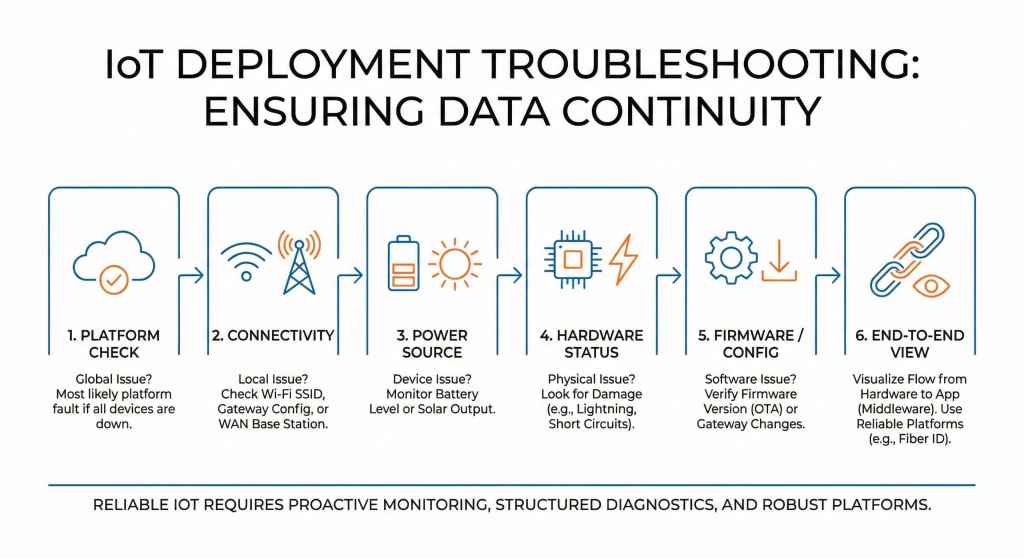
There is a lie many of us tell ourselves.
“The device is configured.”
“The data is visible.”
“The dashboard is live.”
“So… we’re done.”
No, we are not.
IoT is not a setup task. It is a living system. It depends on networks, power, firmware, environments, and people. The moment you walk away thinking the job is finished is the moment problems start lining up quietly.
I caught myself smiling too early more than once.
Dashboards give confidence. Continuity demands discipline.
One shows you data.
The other earns trust.
Start Calm, Not Defensive
When data disappears, panic is natural.
The first instinct is often to blame the IoT platform.
But here is a simple rule that has saved me countless hours.
If the platform were really down, everything would stop.
All devices.
All data streams.
All dashboards.
Platforms do fail, but when they do, they fail loudly.
So if only one device goes quiet, or just a few sensors disappear, the problem is almost always somewhere else.
I tell myself this every time. Breathe first. Then diagnose.
Troubleshooting is not about pointing fingers. It is about narrowing the truth.
Connectivity Breaks More Systems Than Code
Most IoT failures are not complicated.
They are forgotten changes.
One common story involves Wi Fi.
Sensors work perfectly for months.
Data flows.
Everyone forgets they exist.
Then suddenly, silence.
What happened?
Someone changed the network name.
Or updated the password.
Or replaced an access point.
No announcement. No warning.
The IT team did their job. The sensors were simply not in their mind.
Machines never forget. People do.
The same thing happens with cellular networks. Coverage shifts. Base stations go down. Buildings block signals. Sometimes there is simply no other tower to talk to.
Connectivity is fragile. Always question it early.
Power Is Never a Small Detail
If there is one lesson I wish every IoT builder would take seriously, it is this.
Power decides everything.
Battery-powered devices do not fail dramatically. They fade away quietly.
Solar-powered systems look perfect on paper until cloudy days stretch longer than expected.
I have seen devices placed outdoors with confidence in solar charging, only to stop transmitting because the battery never recovered.
I remember asking myself, “Why didn’t we check the battery level?”
Every remote device must report its own energy health.
Battery level matters.
Charging status matters.
Energy trends matter.
If you do not watch power, it will surprise you at the worst time.
Hardware Lives in the Real World
We love talking about cloud systems and apps.
But IoT lives outside.
Rain falls.
Heat builds up.
Humidity creeps in.
Lightning strikes.
Boards short circuit. Connectors loosen. Devices age.
Sometimes the device is simply broken.
No amount of dashboards can fix damaged hardware.
Software forgives. Physics never does.
This is why placement, casing, grounding, and environmental awareness matter far more than people think.
Firmware Can Help or Hurt You
Firmware sits quietly in the background until it does not.
Change it carelessly, and devices disappear.
Never change it, and vulnerabilities grow.
Remote systems need over-the-air updates, but that alone is not enough.
You need to know which device runs which version.
You need a way to recover when updates fail.
You need discipline.
Without that, scaling feels stressful instead of rewarding.
You Must See Both Sides Clearly
Serious IoT work demands a wider view.
You cannot focus only on software.
You cannot focus only on hardware.
You need to understand how the app, device, network, and power behave.
And more importantly, how they fail together.
That is why platforms matter. Not because of charts, but because they help you see the whole chain when things stop working.
A good platform does not just show data. It helps you ask the right questions when data disappears.
The Shift Nobody Warns You About
There is a quiet transition every IoT builder goes through.
At first, dashboards excite you.
Later, inconsistency frustrates you.
Eventually, responsibility humbles you.
The moment someone depends on your system, everything changes.
You stop chasing features.
You start chasing stability.
You stop admiring charts.
You start valuing calm silence.
I once realised that boring systems are often the best ones.
Because boring usually means reliable.
Why This Matters Now
As more devices enter buildings, cities, farms, factories, and public services, silence becomes dangerous.
No data is not just a technical trouble.
It is broken trust.
People stop believing.
Teams lose confidence.
Organisations lose sleep.
Trust takes years to build and seconds to lose.
That is why learning IoT must go beyond dashboards. We need to talk openly about failure, continuity, and responsibility.
A Quiet Invitation
If you are a student, do not rush past problems. Sit with them. They are shaping how dependable you will become.
If you are a developer, stop asking only what features to add. Start asking what can quietly fail.
If you are an organisation, invest in people and systems that understand the whole picture, not just the surface.
And if you have already felt that heavy moment when the dashboard went quiet, you are not alone.
That moment means you care.
Share your story.
When was the first time your system stopped sending data?
What did that moment teach you?
Write it in the comments.
Discover more from Dr. Mazlan Abbas
Subscribe to get the latest posts sent to your email.

 Dr. Mazlan Abbas