

I shared this idea in a recent product presentation, but the more I reflect on it, the more I feel this deserves to be written down properly. Slowly. Honestly. With feeling.
Because this is not just about plans and pricing.
This is about how we teach, how we learn, and how knowledge grows over time.
I remember pausing for a moment before the session began.
“Do people really see this problem yet?” I asked myself.
Most do not. And that is exactly why I want to tell this story.
The quiet problem nobody talks about
For years, I have watched how IoT is taught in universities.
Students are told, “Go subscribe.”
Lecturers say, “Use whatever tools you can find.”
Labs run on goodwill, workarounds, and personal accounts.
On the surface, it looks fine.
Free plans here.
A few paid plans there.
Some students pay out of pocket.
Some lecturers try to stretch limited lab budgets.
But beneath that surface, something feels broken.
I thought to myself, this is not how serious engineering should feel.
IoT is not a hobby once it enters a lab.
It is not a toy when it becomes a Final Year Project.
It is not casual when research data needs months, sometimes years, to mature.
Yet we treat the tooling like disposable apps.
Individual accounts versus institutional thinking
Most users experience Favoriot through individual plans. Free. Lite. Beginner. Developer.
That makes sense at the start.
You are curious.
You want to test.
You want to learn.
But universities are not individuals.
They are systems.
And systems need structure.
What usually happens today is this:
A student creates an account.
They collect data for a semester.
They graduate.
The account disappears.
The data disappears.
The knowledge disappears.
And every time this happens, I feel a quiet sense of loss.
Because data is not just numbers.
Data is effort.
Data is learning.
Data is time that never comes back.
The moment the question became clear
During the session, I asked a simple question.
What if universities could manage IoT accounts the way they manage labs?
What if, instead of hundreds of disconnected student subscriptions, there was one administrator, one place of control, one long-term memory?
That question changed everything.
I remember thinking, this is the missing layer.
What an IoT Ecosystem Plan really means
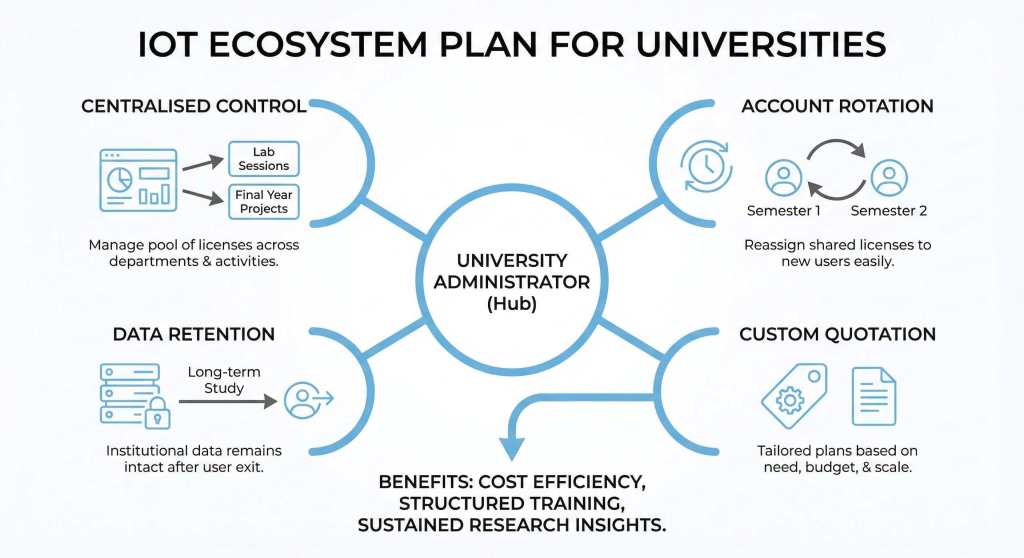
The Favoriot IoT Ecosystem Plan is not a fancy label.
It is a mindset shift.
Instead of students owning accounts, the institution owns the ecosystem.
One administrator manages a pool of plans.
Beginner. Lite. Developer.
Whatever fits the teaching or research need.
Accounts can be allocated.
Accounts can be rotated.
Accounts can be reused.
No chaos.
No loss.
No, starting from zero every semester.
A lab that finally makes sense
Imagine a lab with thirty Beginner plans.
The admin assigns ten accounts for this semester’s lab class.
Students log in.
They build.
They experiment.
They learn.
Next semester, the same accounts are reused by a new cohort.
I smiled when I explained this part.
Because this is how labs should work.
Not emotional budgeting.
Not last-minute subscriptions.
Not students asking, “Sir, do I really need to pay for this?”
Final Year Projects without financial anxiety
Final Year Projects are intense.
Students are already under pressure.
Deadlines.
Expectations.
Demonstrations.
Now add one more burden: the cost of tools.
I paused again when I talked about this.
“Why are we doing this to them?” I wondered.
Under the ecosystem plan, the department allocates accounts to FYP students.
No personal subscriptions.
No awkward reimbursements.
No half-built systems because the plan expired.
Just focus.
Just building.
Just learning.
Research data that does not vanish
This part matters deeply to me.
Research does not run on semesters.
Some datasets need months.
Some need a full year.
Some become valuable only after long observation.
In individual accounts, when a researcher leaves, the data often goes with them.
With an ecosystem plan, the data stays.
The account belongs to the institution.
The history remains intact.
The next researcher continues the story.
I remember thinking, this is how real research continuity should feel.
One dashboard. One view. One sense of control
Administrators often feel blind.
Who is using what?
Who is stuck?
Which lab is active?
Which accounts are idle?
An integrated dashboard changes that.
You can see progress.
You can spot gaps.
You can improve training.
This is not about surveillance.
This is about care.
Care for students.
Care for lecturers.
Care for outcomes.
Not one-size-fits-all, and that is the point
Some universities need thirty Beginner plans.
Some need seventy.
Some mix Beginner with Developer plans.
That is why ecosystem plans are quoted, not clicked.
Because education does not fit into neat boxes.
I told myself, flexibility is respect.
Respect for different teaching styles.
Respect for different research scales.
Respect for different budgets.
Why I feel strongly about this
I have spent decades in education, industry, and startups.
I have seen what happens when systems are built for convenience instead of continuity.
And I have also seen what happens when institutions think long-term.
This ecosystem idea is not about selling more plans.
It is about lifting the quality of learning.
It is about treating IoT education as a serious craft.
A quiet invitation
If you are a lecturer, ask yourself this:
Are your students building knowledge, or just finishing assignments?
If you are a researcher, ask this:
Will your data still matter when you move on?
If you are an administrator, ask this:
Is your IoT lab a collection of accounts, or a living system?
I know my answer.
I believe universities deserve an IoT ecosystem that grows with them, remembers with them, and supports the next generation better than we were supported.
If this idea resonates with you, I would love to hear your thoughts.
Drop a comment.
Challenge it.
Improve it.
That is how ecosystems begin.
Discover more from Dr. Mazlan Abbas
Subscribe to get the latest posts sent to your email.

 Dr. Mazlan Abbas