

There are moments in this journey where I stop, lean back in my chair, and ask myself a very simple question.
Who am I really building this for?
Not the slides.
Not the feature list.
Not the pricing page.
The real humans.
The ones wiring sensors late at night.
The ones deploying devices in places nobody wants to visit twice.
The ones whose customers call at 7 a.m. asking, “Why is the dashboard blank?”
This blog is about those people.
This blog is about why I insisted we needed something called the Favoriot Developer Plan.
And why, for some builders, it changes everything.
Not Everyone Is Just “Using” an IoT Platform
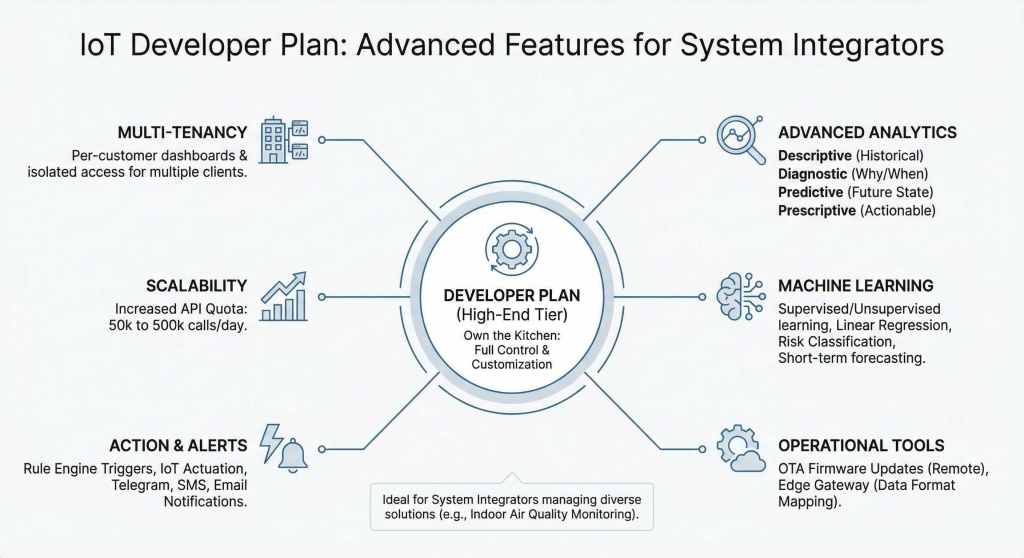
Early on, I realised something uncomfortable.
Many people assumed Favoriot was just another place to view charts.
Log in.
See a graph.
Log out.
But that was never the real story.
I thought to myself, if that’s all we become, we’ve failed the serious builders.
Because some users are not there to monitor one device.
They are there to build services.
They are there to serve clients.
They are there to run a business on top of the platform.
System integrators.
Solution providers.
Engineers who sign contracts, not tutorials.
And these people don’t need toys.
They need a kitchen.
When One Dashboard Is Not Enough
One of my favourite real-world examples comes from a team offering indoor air quality monitoring.
Simple problem on the surface.
Measure CO₂.
Measure temperature.
Measure humidity.
Show the data.
But reality is never that clean.
Each customer wanted their own view.
Each building had different thresholds.
Each management team wanted different access.
So the question became obvious.
How do you serve many customers without creating chaos?
This is where multi-tenancy stopped being a buzzword and became a survival tool.
With the Developer Plan, each customer lives in their own space.
Their own dashboards.
Their own logins.
Their own sense of ownership.
No accidental peeking.
No data leaking.
No shared confusion.
Just clean separation, built for trust.
Analytics Is Not Just Pretty Charts
Let me be honest.
Most people stop at charts.
Real-time lines moving left to right.
Historical graphs with sliders.
That’s descriptive analytics.
Useful. Necessary. But incomplete.
I kept asking myself, what happens after people stare at the dashboard?
This is where things get interesting.
Diagnostic: Understanding the “Why”
At some point, users ask deeper questions.
Why did the spike happen at 3 p.m.?
Why does Monday look different from Friday?
Why did last week feel off?
Diagnostic analytics gives context.
Averages.
Minimums.
Maximums.
Patterns across time windows.
Suddenly, the dashboard stops being a screen and starts becoming a story.
Predictive: Seeing What Comes Next
Now we cross a line.
Instead of reacting, we begin anticipating.
Using machine learning models trained on sensor data, the system can estimate what might happen next.
An hour from now.
Later tonight.
Tomorrow morning.
This is the moment many users go quiet and just stare.
Because the platform is no longer waiting for events.
It’s whispering what might be coming.
Prescriptive: Acting When It Matters
This is where responsibility enters the room.
If the system knows something is heading toward risk, what should it do?
Do nothing?
Notify someone?
Trigger an action?
With prescriptive logic combined with our rule engine, the platform can respond.
Send a Telegram alert.
Email management.
Notify an engineer on duty.
And yes, in some cases, trigger actuation directly.
But I’ll say this clearly.
Some decisions still belong to humans.
Technology should support judgment, not replace it blindly.
Teaching Machines to Understand Risk
One feature I care deeply about is state classification.
Instead of raw numbers, we classify conditions.
Low risk.
Medium risk.
High risk.
This is not about making data fancy.
It’s about making data usable.
Because when someone is responsible for people’s safety, they don’t want to interpret charts at 2 a.m.
They want clarity.
When Devices Are Far Away, and Silence Is Expensive
There’s a painful truth in IoT.
Devices don’t live in offices.
They live on rooftops.
In factories.
In rural areas.
Across states.
Bringing them back just to update firmware is not a plan. It’s a liability.
That’s why over-the-air firmware updates matter so much in the Developer Plan.
You push updates remotely.
You fix bugs without travel.
You sleep a little better.
I’ve seen teams save weeks of work because of this.
The Quiet Hero: Edge Gateway
This is one of those features that few people talk about, but everyone feels.
Devices speak different languages.
Different payloads.
Different structures.
Instead of forcing developers to rewrite firmware again and again, the edge gateway steps in.
It maps data formats.
It normalises inputs.
It makes integration smoother.
Less friction.
Less rework.
More momentum.
Scaling Without Counting Every Call
One subtle pain point system integrators face is limits.
Counting API calls.
Worrying about overages.
Splitting usage by customer.
So we raised the daily API quota.
From fifty thousand to five hundred thousand calls per day.
That change alone unlocked new confidence.
Now builders can focus on serving customers, not watching counters.
The Restaurant Analogy That Still Makes Sense to Me
I still like using food analogies because they are honest.
A free plan is walking into a restaurant to see the menu.
A lite plan is tasting something simple.
A beginner plan is enjoying a full meal.
But the Developer Plan?
That’s owning the kitchen.
You decide the menu.
You cook for different tastes.
You serve customers your way.
And with ownership comes responsibility, pride, and freedom.
Why This Matters to Me
I didn’t build this plan to show off features.
I built it because I’ve been that engineer.
I’ve been that system designer.
I’ve been the one answering tough calls.
I wanted builders to feel supported, not boxed in.
If you are building for others, managing clients, and turning ideas into services, this plan was made with you in mind.
And if you’re still unsure, that’s okay.
Explore.
Ask questions.
Build slowly.
The kitchen will be there when you’re ready.
I’d love to hear from you.
What are you building, and what’s holding you back right now?
Discover more from Dr. Mazlan Abbas
Subscribe to get the latest posts sent to your email.

 Dr. Mazlan Abbas