

Clarity as a Prerequisite
Early in my career, I treated clarity as a requirement.
If the answer was not clear, the decision could wait.
If the direction was not obvious, more thinking was needed.
If the picture felt messy, it meant I was not ready.
At the time, this felt responsible. Careful. Sensible.
Only later did I see how often it quietly delayed progress.
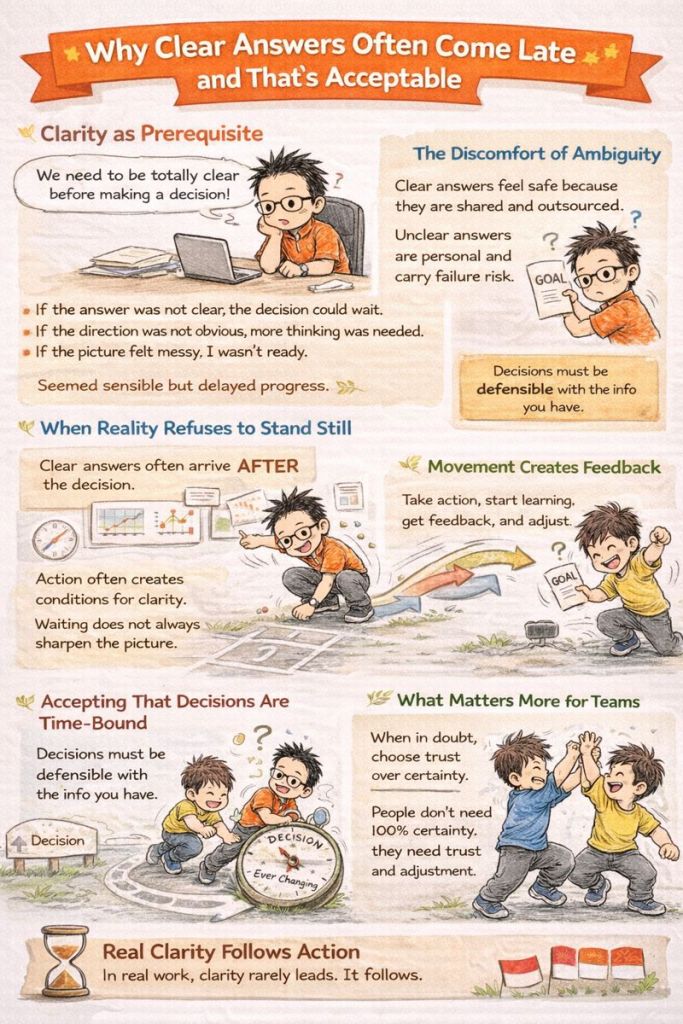
When Reality Refuses to Stand Still
Clear answers have a pattern. They usually arrive after the decision, not before it.
This feels backward to many people. We like to believe clarity leads to action. In practice, action often creates the conditions for clarity. Systems evolve. Context shifts. Human behaviour reveals itself only over time.
Waiting does not always sharpen the picture. Sometimes it blurs it.
In fast-moving or people-driven environments, the very thing you are trying to understand changes while you study it.
The Real Discomfort Behind Unclear Answers
When I kept asking, “Can we be sure?”, I eventually realised what I was really asking.
Can we avoid regret?
Unclear answers are uncomfortable because they remove cover. When data does not settle the question, responsibility lands fully on the decision-maker. There is no spreadsheet to hide behind. No expert consensus to borrow.
That weight changes how decisions feel.
Movement Creates Feedback
Over time, a pattern became obvious.
Decisions made while waiting for clarity tend to stall.
Decisions made while accepting uncertainty tend to move.
Movement creates feedback. Feedback creates learning. Learning shapes judgment. Clarity grows from motion, not from endless analysis.
This does not mean rushing. It means recognising when waiting no longer adds value.
Accepting That Decisions Are Time-Bound
Some answers arrived late and contradicted my early expectations. That did not mean the original decision was careless. It meant the environment had changed.
Decisions are made for a moment in time. Expecting them to remain correct forever is unrealistic. What matters is whether they were reasonable given what was known then.
A decision can be appropriate without being permanent.
Defensible, Adjustable, Honest
Once I stopped demanding immediate clarity, I changed how I evaluated choices.
I began asking three questions:
Is this decision defensible with the information we have?
Can it be adjusted without denial or pride?
Are we honest about what we do not know?
These questions mattered more than confidence or certainty.
The Danger of False Clarity
Not all clarity is real.
False clarity often comes dressed in strong opinions, polished slides, or confident language. It settles debates quickly. It also freezes learning too early.
When reality eventually disagrees, the cost of adjustment becomes higher. The earlier rigidity sets in, the harder it is to change course.
True clarity is quieter. It shows up as fewer surprises. Smoother decisions. Better alignment over time.
Patience Without Passivity
Accepting late clarity does not mean doing nothing.
There is a difference between waiting and waiting well. Passive waiting avoids responsibility. Patient waiting stays attentive. It watches signals, prepares options, and remains ready to move.
This distinction matters more than speed.
What Teams Really Need
Working with others reinforced one simple truth.
People do not need certainty as much as they need trust.
When I stopped promising clarity on timelines shaped by people, policy, or adoption, and focused instead on transparency and adjustment, collaboration improved. Expectations became healthier. Pressure eased.
Clarity as a Byproduct
Looking back, many of the decisions that caused the most anxiety eventually made sense. Not because better answers appeared, but because time revealed context.
Some decisions aged well. Others did not. Both were instructive.
Clarity is rarely the starting point.
It is the result.
This essay follows the first for a reason. If the first was about deciding without complete data, this one is about living with unresolved questions afterwards.
In real work, clarity rarely leads.
It follows.
Discover more from Dr. Mazlan Abbas
Subscribe to get the latest posts sent to your email.

 Dr. Mazlan Abbas