
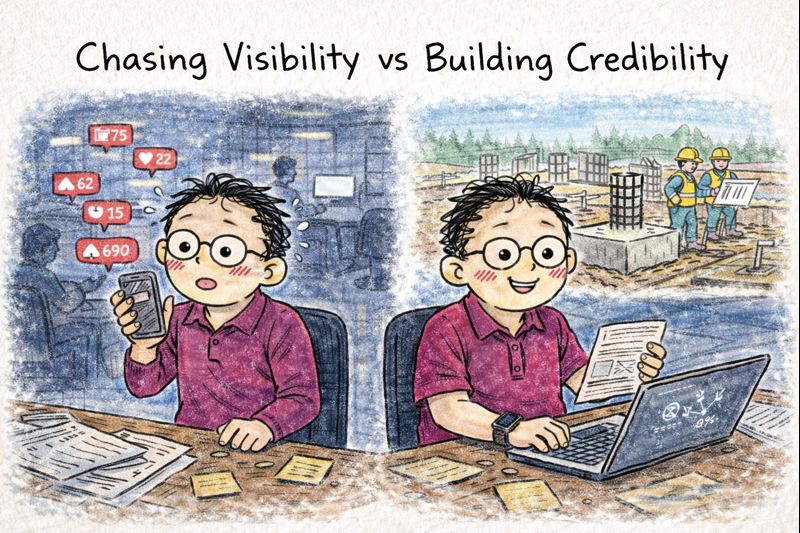
There was a time when I thought visibility was the game.
More views.
More likes.
More stages.
More mentions.
I watched founders celebrate follower counts like revenue. I saw announcements dressed up as progress. I saw loud success everywhere.
And quietly, I asked myself a question I did not say out loud.
“Is this what winning looks like?”
That question stayed with me longer than I expected.
I come from a background where results mattered more than noise. Engineering. Telecommunications. Research. Systems that break if you get one assumption wrong. You cannot bluff physics. You cannot sweet-talk a network into stability. Either it works, or it fails. Publicly. Painfully.
When I stepped into entrepreneurship and started building FAVORIOT, I carried that same mindset with me, though I did not realise how rare it would feel in a world obsessed with attention.
At the beginning, I tried to play both games.
Build quietly, but also stay visible.
Ship code and post updates.
Solve problems, but also explain myself repeatedly.
It was exhausting.
Not because visibility is bad. But because chasing it changes how you think.
The Seduction of Being Seen
Visibility feels productive. That is the danger.
You post something.
People react.
The numbers move.
Your brain rewards you instantly.
I felt it too.
A speaking invitation arrives.
A panel slot opens up.
A logo appears on a slide.
“This must mean we are doing well,” I told myself.
But late at night, when the office lights were off, and the dashboards were still open, another voice appeared.
“Would this platform survive if nobody mentioned it tomorrow?”
That question became my compass.
Because visibility without substance is fragile. The moment the spotlight shifts, so does the relevance.
I had seen this pattern before, long before startups.
In telco projects.
In smart city pilots.
In technology programs with beautiful launches and quiet endings.
Everyone remembers the launch. Few recognise the maintenance.
Credibility works the opposite way.
It grows slowly.
It compounds quietly.
It shows up when no one is clapping.
When I Noticed the Shift
The shift did not happen because I decided to be noble or disciplined.
It happened because of a simple pattern.
People started finding us without us having to chase them.
An email would come in.
A message from overseas.
A partner inquiry that started with, “We’ve been reading your work.”
And every time, I asked the same question.
“How did you hear about us?”
The answers were almost boring.
They searched.
They read.
They compared.
They waited.
No viral post.
No paid campaign.
No dramatic announcement.
Just years of writing, building, fixing, and explaining the same things again and again.
That was when it hit me.
Credibility travels further than visibility, but it moves on its own timeline.
The Cost of Chasing the Wrong Metric
Here is the uncomfortable truth.
Visibility rewards what looks good today.
Credibility rewards what holds up tomorrow.
When you chase visibility, you optimise for speed.
When you build credibility, you optimise for truth.
Speed loves shortcuts.
Truth does not forgive them.
I learned this the hard way in IoT.
You can demo anything.
You can mock data.
You can polish dashboards.
But real deployments are unforgiving.
Sensors fail.
Connectivity drops.
Edge devices behave badly.
Security holes appear where nobody looked.
If your system only works when everything is perfect, it is not a system. It is a slide deck.
So I made a quiet decision.
I stopped asking, “How do we look?”
I started asking, “Would I trust this if I were the customer?”
That question shaped everything.
The way the platform was designed.
The way documentation was written.
The way training was structured.
The way we said no to shortcuts that looked tempting.
No announcement could replace that.
Writing Without Chasing Applause
My writing changed, too.
I used to wonder why some posts did not perform.
Why do some articles feel invisible?
Why did the numbers look flat?
Then I realised something.
I was writing to be understood, not to be shared.
Those are two different goals.
Writing for shares means simplifying until nothing is left to challenge.
Writing for understanding means explaining until clarity replaces confusion.
Clarity takes time.
Understanding takes patience.
And patience does not trend.
But credibility remembers.
Months later, someone would quote an old article.
A student would reference a post I barely remembered writing.
A partner would say, “This helped us avoid a mistake.”
That mattered more than any spike.
Credibility Is Built When Nobody Is Watching
Here is the part nobody glamorises.
Credibility is built in moments that feel invisible.
Fixing a bug nobody will thank you for.
Rewriting documentation for the third time.
Saying no to a deal that feels wrong.
Admitting uncertainty instead of pretending confidence.
These moments never trend.
But they stack.
I spent years in environments where mistakes had consequences. Networks go down. Cities stall. Systems fail publicly. That background wired me to respect fundamentals.
So when trends shifted, buzzwords changed, and hype cycles rotated, I anchored myself to a simple principle.
If this disappears from the internet tomorrow, would the work still stand?
That question saved me from many distractions.
Panels, Stages, and the Quiet Filter
I still speak.
I still write.
I still show up.
But the filter is different now.
I no longer ask, “Will this increase my visibility?”
I ask, “Does this reflect what I actually believe?”
If it does not, I pass.
That choice costs opportunities.
It also protects credibility.
When I sat on panels discussing AI, IoT, and cybersecurity, I was not there because I was loud. I was there because of years of consistent work connecting systems, understanding risks, and dealing with consequences.
That is the kind of visibility credibility earns on its own.
The Long Game: Most People Quit
Here is something I wish more foundershad heard earlier.
Visibility is rented.
Credibility is owned.
Visibility disappears when platforms change.
Credibility stays when people remember.
Visibility flatters.
Credibility humbles.
One feeds the ego.
The other feeds trust.
Trust is slower to build.
It is also harder to destroy.
I chose the long game because I have seen what happens when shortcuts collapse. I have seen systems that looked impressive but could not survive reality.
I did not want to build that.
What I Focus On Now
Today, my priorities are boring in the best way.
Does the platform work when things go wrong?
Can a student learn without being overwhelmed?
Can a partner deploy without calling us every hour?
Can the system explain itself clearly?
These questions do not trend.
They endure.
I still share stories.
I still write reflections.
I still show the work.
But I no longer chase the spotlight.
If it comes, it comes.
If it does not, the work continues.
Because credibility has a strange habit.
It introduces you when you are not in the room.
A Quiet Invitation
If you are building something today and feeling invisible, let me say this gently.
You might not be behind.
You might be early.
Keep building things that last.
Keep explaining things clearly.
Keep choosing substance over speed.
The world is loud.
Credibility whispers.
And whispers travel further than we think.
I would love to hear your thoughts.
Have you felt this tension between being seen and being trusted?
Where are you placing your energy right now?
Share your reflections in the comments.
Discover more from Dr. Mazlan Abbas
Subscribe to get the latest posts sent to your email.

 Dr. Mazlan Abbas