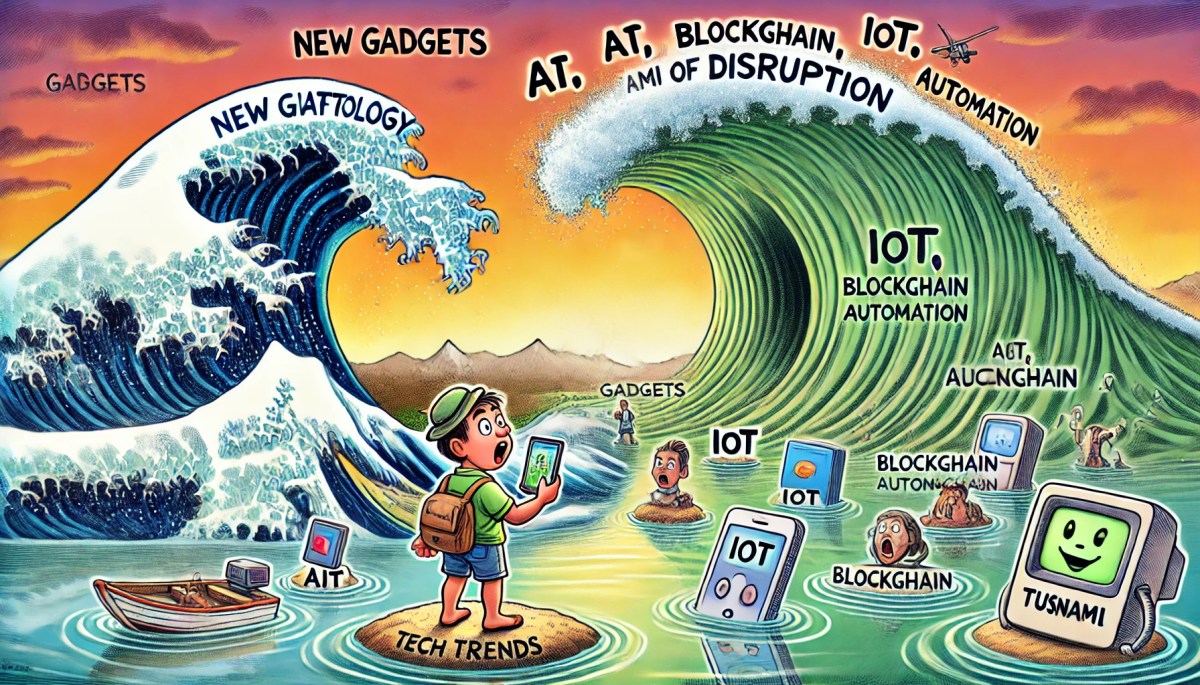
Ripples of Technology and the Tsunami of Disruption

IOT NOTES

Lecture Notes

Today, let’s explore a fascinating analogy between technology waves and a tsunami and what it teaches us about embracing disruptive innovation.

This diagram gives us a vivid understanding of how small technological changes can lead to massive transformations. Let’s break it down step by step.

Based on eBook — IoT Notes by Mazlan Abbas

1. Ripples of Technology

Imagine a drop of water falling into a still pond. That single drop creates ripples that spread outward. Similarly, a single new technology creates small ripples of change. But what happens when multiple waves combine?

  • Small Waves: These represent individual technologies making minor changes.
  • Combining Waves: When multiple small technologies integrate and interact, they create larger impact waves.
  • Tsunami Effect: When these waves grow in size and momentum, they lead to a disruption — a sudden and massive transformation.

Key takeaway: New technologies don’t disrupt on their own; the integration of technologies drives large-scale changes.

2. What Happens Before a Tsunami Hits?

The analogy becomes even more powerful when we think about the moments before a tsunami strikes:

  • Sudden Signs: The beach suddenly empties of water, creating a sense of calm before the storm.
  • White Waves Appear: The signs of disruption become visible, but people often don’t take them seriously.
  • Silence: There’s an eerie pause before the massive wave crashes.
  • Unpreparedness: People on the beach are caught off guard and unable to escape.

This is a perfect metaphor for technological revolutions. They often come suddenly, fast, and disastrously for those who are unprepared.

Characteristics of a Revolution:

  • Sudden: Changes happen quickly, often without warning.
  • Disruptive: Entire industries and systems are transformed.
  • Radical Change: Traditional ways of doing things are replaced.
  • Complete: The change impacts everyone, leaving no sector untouched.

3. Surfing the IoT Waves

Let’s bring this analogy to life with the Internet of Things (IoT). Imagine you’re a surfer facing the waves of IoT innovation. How do you ride them instead of being overwhelmed?

  1. Ride the Waves: Stay updated with the latest technological trends. Learn how IoT, AI, and other advancements are shaping industries.
  2. Be Aware of the Next Wave: Just as a surfer looks for the next big wave, keep an eye on emerging technologies that could disrupt your field.
  3. Be the Innovator, Not the Laggard: Take action early. Innovate and adapt before the waves of disruption leave you behind.

4. Key Lessons from the Tsunami Analogy

  • Disruption is Inevitable: Whether you’re ready or not, technological waves will crash onto the shore of your industry.
  • Integration Drives Change: It’s not just one technology but the combination of many that create a tsunami effect.
  • Prepare, Don’t React: Those who prepare for change will thrive, while those who wait to react will struggle to keep up.

Final Thoughts

The tsunami analogy reminds us that we can’t stop the waves of technology, but we can learn to ride them. Whether IoT, AI, or another innovation, the key is to stay proactive, informed, and adaptable. Are you ready to surf the waves of change?

Let’s open the floor for questions or reflections on how you can prepare for the next big wave in your industry.

[Download full eBook IoT Notes for free]

What is the Fourth Industrial Revolution?

IOT NOTES

Lecture Notes

Based on the eBook — IoT Notes by Mazlan Abbas

Today, we’ll explore the Fourth Industrial Revolution (IR 4.0) and its significance. This diagram breaks it down into easy-to-understand sections, so let’s walk through it step by step.

1. The Differences Between Revolution and Evolution

Let’s first clarify why it’s called a revolution and not an evolution.

Revolution:

  • Sudden and drastic changes that transform industries and societies.
  • Think of it as a dramatic leap forward in technology and processes.

Evolution:

  • Gradual and slow progress over time.

IR 4.0 is a revolution because it represents rapid and significant advancements in how we live and work.

2. The Bigger Picture: Industry 4.0 vs IR 4.0

It’s important to understand that Industry 4.0 is just a subset of IR 4.0.

  • Industry 4.0 focuses on manufacturing and improving industrial processes using automation, IoT, and robotics.
  • IR 4.0, however, encompasses much more:
  • It impacts various sectors, such as education, healthcare, shopping, and agriculture.
  • It’s a broad transformation, not limited to factories or industries.

3. The Lifestyle Through Industrial Revolutions

Let’s now look at how each industrial revolution shaped our lifestyle:

IR 1.0 — The Age of Manual Tools:

  • People relied on physical and manual tools for work.
  • Example: Ploughing fields with hand tools.

IR 2.0 — The Power of Electricity:

  • Electricity revolutionised industries, enabling mass production.
  • Example: Electric machines replaced manual labour.

IR 3.0 — The Digital Era:

  • The rise of electronics and the internet connected the world.
  • Example: Computers, email, and early e-commerce.

IR 4.0 — The Intelligence Revolution:

  • We’re now using intelligence through AI, robotics, and advanced technologies.
  • Example: Autonomous robots, augmented reality (AR), and virtual reality (VR).

4. Example: How Shopping Evolved

Let’s take shopping as an example of how each industrial revolution changed this activity:

  • IR 1.0: People used cash for transactions.
  • IR 2.0: The cash register was introduced, improving the checkout process.
  • IR 3.0: Credit cards and online shopping emerged with the internet.
  • IR 4.0: We see robotics and AR/VR enhancing the shopping experience, like virtual try-ons or automated warehouses.

Why is IR 4.0 Important?

IR 4.0 is transforming every aspect of our lives, from how we work and learn to how we interact with technology. It’s about leveraging intelligence to solve problems, improve efficiency, and create new possibilities.

[Note: You can download the full eBook — IoT Notes by Mazlan Abbas]

Understanding Industry 4.0 and Industrial Revolution 4.0

IOT NOTES

Lecture Notes

Based on the eBook — IoT Notes by Mazlan Abbas

Today, we’ll explore two closely related but distinct concepts: Industry 4.0 and the Fourth Industrial Revolution (IR 4.0).

These terms are often used interchangeably but have specific differences, as highlighted in the diagram. Let’s dive in step by step.

1. Revolution vs Evolution

The first thing we need to clarify is the difference between revolution and evolution:

  • Revolution refers to sudden and drastic change. Think of it as a leap forward that quickly transforms industries and societies.
  • Evolution, on the other hand, is slow and gradual progress. Changes happen incrementally over time.

Key question: Are we adopting Industry 4.0 technologies suddenly (revolution) or gradually (evolution)? This can vary depending on the industry and region.

2. What is Industry 4.0?

Industry 4.0 focuses on manufacturing and improving industrial processes through advanced technologies like IoT, AI, and robotics. It is the fourth stage in the progression of industrial advancements:

Industry 1.0 (1784):

  • Introduction of mechanisation and steam power.
  • Example: Steam engines powering factories.

Industry 2.0 (1870):

  • Electrical power enabled mass production.
  • Example: Assembly lines in factories.

Industry 3.0 (1969):

  • Use of computers, electronics, and automation.
  • Example: Robots performing repetitive tasks on manufacturing floors.

Industry 4.0 (Today):

  • Cyber-physical systems integrating IoT, AI, VR, and robotics.
  • Example: Smart factories where machines communicate and operate autonomously.

3. What is Industrial Revolution 4.0 (IR 4.0)?

The Fourth Industrial Revolution goes beyond manufacturing. It’s about integrating these technologies across all industries and even societies. While Industry 4.0 focuses on production, IR 4.0 impacts healthcare, education, agriculture, and more.

A key question: Are we adopting these 4.0 technologies evenly across all sectors, or is there a focus on specific areas like manufacturing?

4. The Connection Between Industry 4.0 and IR 4.0

Think of Industry 4.0 as a subset of the broader IR 4.0. Industry 4.0 is about the transformation of manufacturing, whereas IR 4.0 encompasses societal changes.

Here’s an example:

  • Industry 4.0: A factory using IoT sensors to monitor equipment health and reduce downtime.
  • IR 4.0: IoT sensors used in agriculture to monitor soil moisture for precision farming.

5. Societal Progression Through Industrial Revolutions

The diagram also highlights how societies have evolved alongside industrial advancements:

  1. Society 1.0: Hunting society — Humans relied on nature and survival skills.
  2. Society 2.0: Agriculture society- farming practices transformed societies.
  3. Society 3.0: Industrial society — industries became the backbone of economies.
  4. Society 4.0: Information society – driven by computers and the internet.
  5. Society 5.0 (Japan’s Vision):
  • A super-smart society where technology integrates seamlessly to improve quality of life.
  • Focus on AI, robotics, and IoT to solve societal challenges.

6. Why is This Important?

Understanding these concepts helps us prepare for the future:

  • For businesses: Knowing the difference between Industry 4.0 and IR 4.0 helps align strategies.
  • For individuals: Skills like AI, IoT, and data analytics are becoming essential.
  • For society: IR 4.0 encourages us to consider how technology can address global challenges like sustainability and healthcare.

Final Thoughts: Industry 4.0 is revolutionising manufacturing, while IR 4.0 is shaping the future of entire societies.

As we move forward, we aim to embrace these technologies for efficiency and to build a more intelligent, inclusive world.

[You can download the IoT Notes here]

Components of IoT

IoT Lecture

Based on IoT Notes

Based on the eBook — IoT Notes by Mazlan Abbas

Let’s discuss an essential concept in IoT — its key components. The diagram breaks IoT into four main building blocks, which we’ll explore step by step.

1. Sensors: The Eyes and Ears of IoT

The first layer is the sensors. These devices are at the heart of IoT; their job is to sense the environment.

  • They generate data by measuring things like temperature, humidity, or motion.
  • Think of them as the “end-nodes” in IoT — they are where the process begins.

Examples include:

  • A digital thermometer sensing room temperature.
  • A motion detector in a security system.

Without sensors, IoT wouldn’t have any information to work with!

2. Connectivity: The Communication Bridge

Once sensors collect data, it needs to be transferred somewhere for processing. That’s where connectivity comes in.

  • IoT uses different communication technologies:
  • Wireless options like Wi-Fi, Bluetooth, and LPWAN (LoRa or Sigfox).
  • Fixed methods like Ethernet.
  • Connectivity ensures the data travels from the sensors to the next stage over the internet or private networks.

Imagine this as a digital highway connecting the physical world to the virtual one.

3. IoT Platform and Middleware: The Brain

The third component is the IoT platform or middleware. This is where all the raw data comes together and is processed.

  • It acts as a central hub to aggregate data from multiple sensors.
  • Middleware handles:
  • Device management.
  • Data storage and formatting using standard protocols.
  • Providing APIs (Application Programming Interfaces) so apps can access the data.

Think of this as the “brain” that processes everything and makes sense of the data.

4. Applications and Analytics: Deriving Insights

Finally, all the processed data is used in applications and analytics to deliver value. This is where IoT makes an impact.

Applications:

  • Use the data to create useful solutions, like apps that track fitness or control smart homes.
  • Analytics and AI:
  • Analyse the data using Artificial Intelligence or Big Data techniques.
  • Generate insights to help make decisions or automate processes.

For example:

  • A smart farming app could use soil moisture data to trigger irrigation.
  • An AI system could predict machine failure in a factory.

Bringing It All Together

So, to summarise:

  1. Sensors collect the data.
  2. Connectivity transmits the data.
  3. IoT Platform processes and stores the data.
  4. Applications and Analytics use the data to create actionable insights.

IoT is a powerful combination of hardware, communication, and software working together to solve real-world problems.