

The Need to Resolve Everything
For years, uncertainty felt like a problem to fix.
An unfinished thought.
An unanswered question.
A situation that had not yet been “figured out.”
I carried it like a weight. If something was unclear, it stayed with me. Followed me into meetings. Lingered after decisions. I believed good leaders reduced uncertainty quickly. Anything left unresolved felt like a personal failure.
That belief created quite a tension.
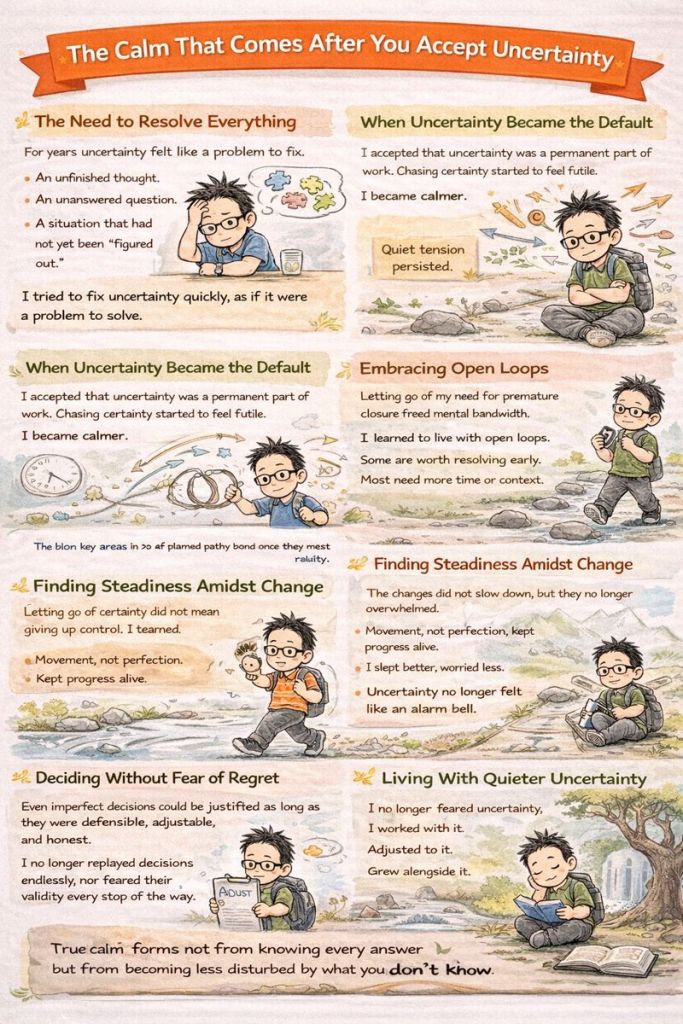
When Uncertainty Became the Default
Over time, the pattern became obvious. Uncertainty was not an exception. It was the environment.
Markets shift. People change their minds. Priorities move. Even the most carefully planned paths bend once they meet reality. The idea that everything could be settled in advance slowly lost its grip on me.
Once I accepted that uncertainty was permanent, something unexpected happened.
I became calmer.
The Difference Between Control and Awareness
Letting go of certainty did not mean giving up control. It meant redefining it.
Control is not knowing exactly what will happen.
Control is knowing where to pay attention.
I stopped trying to resolve every unknown. Instead, I focused on identifying which uncertainties mattered now and which could wait. Some questions demand immediate action. Others only create noise if answered too early.
Awareness replaced anxiety.
Living With Open Loops
There was a time when open questions bothered me deeply. I wanted closure. Resolution. A sense that nothing important was left hanging.
Eventually, I learned that most meaningful work involves open loops. Partnerships evolve. Products mature. Strategies adjust. Forcing closure too early often created an artificial sense of certainty that later collapsed.
Accepting open loops freed mental space.
I no longer felt the need to tie everything neatly before moving forward.
Decisions Without Emotional Exhaustion
Once uncertainty stopped feeling like an enemy, decisions became less draining.
I no longer replayed them endlessly at night. Not because I was careless, but because I understood their limits. A decision made under uncertainty is not a verdict. It is a step.
Steps can be corrected. Verdicts cannot.
That distinction mattered.
What Calm Really Feels Like
The calm I am describing is not confidence.
It is steadiness.
It comes from knowing that uncertainty will always exist and that this does not make the work reckless or incomplete. It makes it human. It makes it real.
Calm is the absence of urgency where urgency is not required.
How This Changed My Leadership
This shift altered how I showed up with others.
I stopped pretending to have all the answers. I named the unknowns early. I allowed space for learning instead of forcing alignment too quickly. Strangely, this made teams more grounded, not less.
People sense when uncertainty is being hidden. They relax when it is acknowledged.
Accepting Imperfect Progress
Progress stopped looking like clean milestones. It looked more like a direction with correction.
Some weeks moved things forward. Others clarified what not to do. Both counted. Once I accepted this, I became more patient with slow periods and less attached to dramatic movement.
Momentum was no longer measured daily.
When Uncertainty Stops Being Loud
Uncertainty does not disappear. It quiets down.
It becomes background noise rather than a constant alarm. You notice it, but it no longer dictates your emotional state. You work with it, not against it.
That is when calm settles in.
A Different Kind of Confidence
The confidence that follows acceptance is subtle. It is not certainty about outcomes. It is confidence in your ability to respond.
I may not know precisely what will happen next. But I trust my capacity to adjust when it does.
That trust changes everything.
Why This Matters
It is about the internal shift that makes both possible.
The calm that comes after you accept uncertainty is not passive. It is active. It creates space for judgment, learning, and better decisions.
Without it, uncertainty feels like pressure.
With it, uncertainty becomes part of the work.
 Dr. Mazlan Abbas