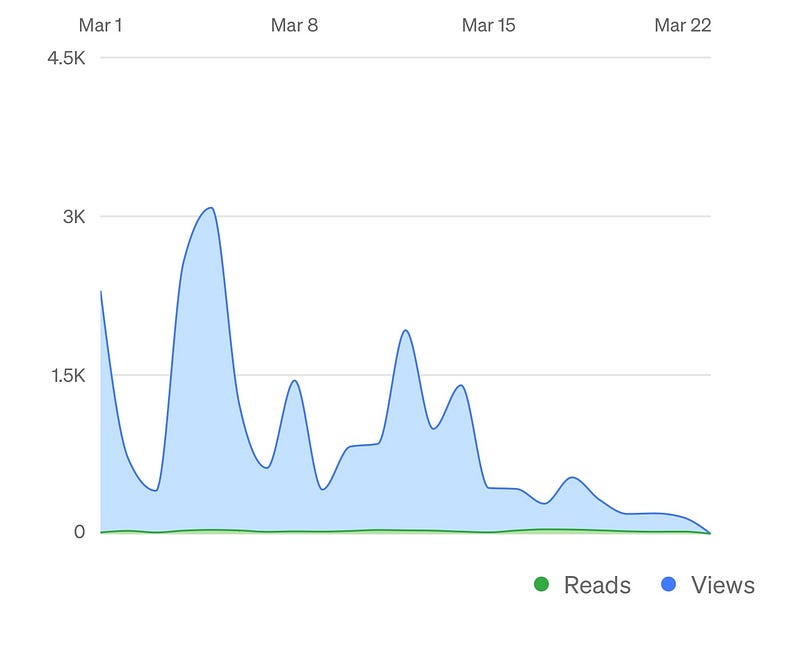
As you can see, most views can reach more than 1K daily.
Sometimes, it dipped down to a couple of hundred.
Author’s December Stats
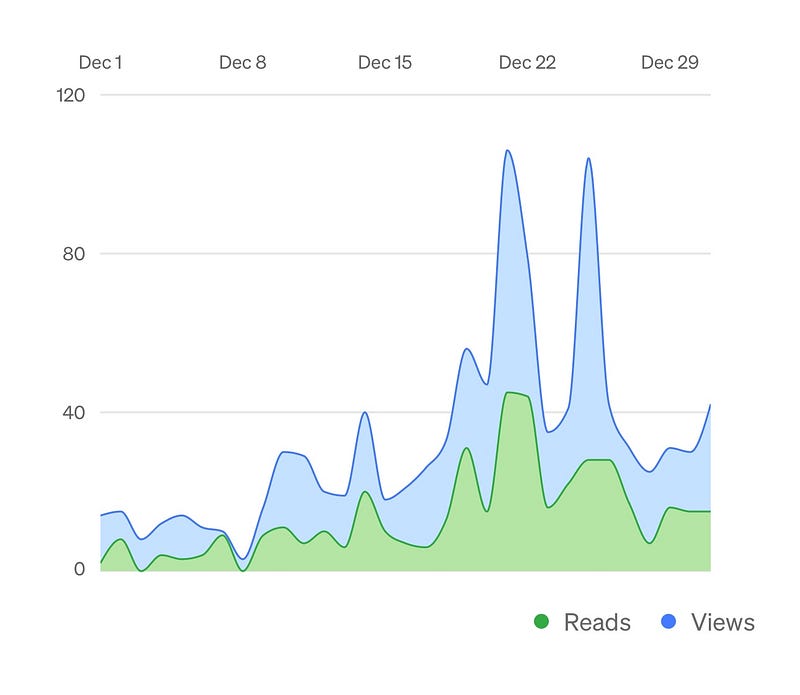
My old December stats look something like this. All the views are less than 100.
And my average reads about 20 daily.
I can easily see the number of reads in my December stats, but it was “drowned” in my March stats. I couldn’t figure out the numbers until I hovered my finger over the stats. The reason because of the huge difference in Views and Reads.
This happened mainly because I have a mailing list that receives email notifications, and the articles are non-paywall.
However, the number of views suddenly dropped whenever I posted a paywall article.
My initial intention was to allow non-member readers to read the full article directly from the email received.
However, I felt I might lose the opportunity to monetize if some MPP members also decided to read from their email rather than go to the Medium platform.
Finally I changed my email notification strategy:
Post non-paywall only when I want to allow non-members to read full article easily without going to Medium. After posting, I will change the article to paywall.
Post paywall article but with a note in the article – “for non-member, they can click the link to have free access.”
Post paywall articles without enabling email notifications.
From now on, I will be using the strategy above.
I am beginning to understand the flow of writing and posting on Medium.
Not a member? Click here to read this story for free.
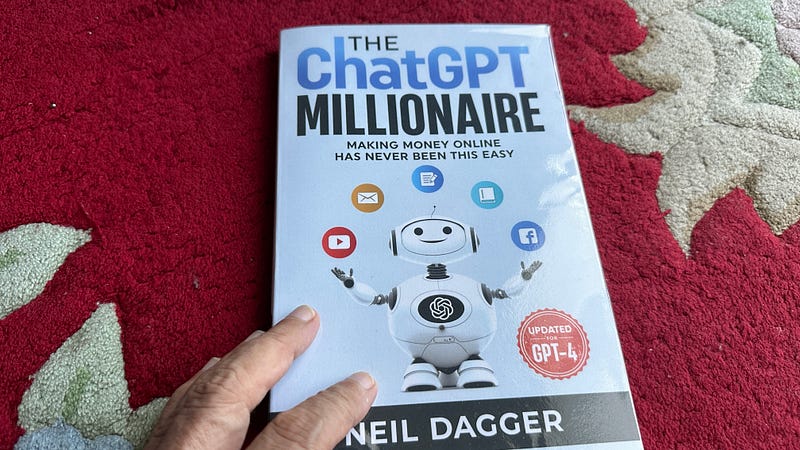
Having dabbled with ChatGPT before, I approached “The ChatGPT Millionaire” with a mix of skepticism and curiosity.
While I’ve had my share of exposure to AI and its utilities, this book promised to offer new insights and methods for monetizing this tool, particularly with GPT-4.
Here’s my take on whether it lives up to its promise.
From the start, the book emphasizes creating value with minimal effort — a proposition too tempting to ignore.
The idea of generating passive income by leveraging AI is not just enticing but revolutionary in today’s gig economy.
What struck me was the simplicity of the guide. It’s as if the author is holding your hand and walking you through each step with ease.
“Can I really create a sustainable income source this easily?” I wondered initially.
But as I delved deeper, the book’s pragmatic approach and clear, actionable steps dispelled my doubts.
It’s not just about making quick money; it’s about smart, efficient work capitalizing on the current market gap in AI utilization.
Practical and Actionable
One of the book’s strengths is its practicality.
The section on impressing clients by delivering high-quality work at lightning speed resonated with me.
As someone who values efficiency and quality, I believe the strategies outlined here are game-changers.
For instance, the guide on creating engaging content provides not just the ‘how-to’ but also the ‘why’ — a crucial aspect often overlooked in similar guides.
As I experimented with the “Act as” prompts provided, I was amazed at the versatility and adaptability of GPT-4.
The prompts are not just instructions but keys to unlocking the AI’s potential in various niches, from writing to coding to social media management.
Beyond Theoretical Knowledge
The book offers real-world applications and examples, making the leap from theory to practice seamless.
The narrative of becoming a “superhuman freelancer” isn’t far-fetched when you see the tangible examples and templates provided.
It’s empowering to envision oneself completing tasks with such efficiency and precision, thanks to AI.
Yet, it’s not all roses.
The author doesn’t shy away from discussing the limitations of ChatGPT, grounding the book in reality.
This transparency builds trust and sets realistic expectations—a crucial element in any guide that aspires to be actionable and reliable.
The Verdict — A Must-Read for Aspiring Entrepreneurs
In conclusion, “The ChatGPT Millionaire” is more than just a manual; it’s a blueprint for tapping into an emerging market.
Whether you’re a seasoned freelancer or a newbie looking for innovative income streams, this book has something for you.
Its simplicity, depth, and practicality blend make it a standout resource.
While I entered somewhat skeptical, I emerged enlightened and excited about the possibilities.
This isn’t just a book; it’s a great way to transform how we approach work and income generation in the AI age.
The added bonus materials only sweeten the deal, offering ongoing value and a toolkit for success.
So, would I recommend it? Absolutely.
Whether you’re looking to enhance your productivity, expand your business, or just curious about AI’s potential, “The ChatGPT Millionaire” is a treasure trove of insights and strategies that promise to inform and transform.
Medium vs Affiliate Earnings – Photo by Nick Morrison on Unsplash
I began my digital writing journey full of optimism, aiming to leverage affiliate marketing through book review articles.
My goal was clear — establish a passive income stream.
However, the outcome of this venture led me to a surprising discovery.
Despite my strategic efforts in affiliate marketing, my engagement with Medium proved more financially fruitful.
This revelation surprised me and prompted a thorough reassessment of my online monetization strategies, shedding light on the varied dynamics of digital content earnings.
Passive Income through Affiliate Marketing
My initial dive into affiliate marketing was motivated by its potential for passive income generation.
The premise was enticing — create engaging content, embed affiliate links, draw in readers, and earn commissions.
Yet, the reality was more complex and nuanced.
Despite my meticulous approach to crafting and placing affiliate links within my book reviews, the resulting earnings were disappointing — a mere $2.23, accounting for only 39% of my total income from these efforts.
More Lucrative Path on Medium
In contrast to my affiliate marketing outcomes, my endeavors on Medium revealed a more promising avenue for revenue.
The platform’s vast readership and supportive environment translated into $3.52 earnings from the same 14 articles, representing about 61% of my total income.
Though seemingly modest, these figures highlighted Medium’s key advantage—its potential to offer a more reliable and direct income source compared to the indirect and fluctuating nature of affiliate marketing.
Analyzing Platform Dynamics and Earnings Potential
Diving deeper into Medium and affiliate marketing details, I noted significant differences in their revenue models.
Medium rewards writers based on reader engagement and time spent on articles, establishing a link between content quality and earnings.
This contrasts with the uncertain and sporadic income from affiliate marketing, which relies heavily on consumer purchasing decisions.
Over two months, I observed that my Medium articles earned variably yet demonstrated the platform’s capacity to reward well-received content consistently.
Reflecting on Lessons Learned and Looking Ahead
Reflecting on this comparative analysis, I recognize that while I was initially drawn to affiliate marketing’s passive income promise, my experiences underline Medium’s superior stability and reliability as an income source for digital content creators.
Although affiliate marketing remains a potential income avenue, its success is less predictable and more influenced by external factors.
In contrast, Medium’s transparent and engagement-based revenue model offers a more stable and predictable earning path.
Photo by Myriam Jessier on Unsplash
This experience with Medium and affiliate marketing has been eye-opening, emphasizing the importance of platform choice in content monetization.
Medium’s model, predicated on direct engagement, offers more transparent and sustainable financial returns.
The insights gained from this experience will be instrumental in guiding my future strategies, reinforcing platform selection’s critical role in achieving success in online writing.
From Fragmentation to Unity — The Transformative Effect of Smart City Platforms
Digital Cities – Too much data? Photo by Donna Elliot on Unsplash
Not a member? Click here to read this story for free.
Local councils often grapple with an array of complex issues that impede progress.
Without integrating Smart City IoT platforms, these problems are magnified, threatening the very fabric of efficient and sustainable city management.
While diverse, I have observed that these challenges share a common root in the absence of advanced technological integration.
Integration Woes
The first area for improvement is integrating new technologies with the existing infrastructure.
In my experience, this often results in a patchwork of solutions that fail to communicate effectively with one another, leading to a fragmented system fraught with inefficiencies and disjointed services.
This stifles innovation and engenders frustration among stakeholders striving for progress.
Scalability Strains
As urban areas expand, the need for services to grow in tandem becomes evident.
Without the flexibility offered by IoT platforms, scaling up to meet the demands of urban growth becomes a Herculean task.
The strain on the existing systems can lead to a potential degradation in the quality of services provided to the community, affecting the reputation and trust in local governance.
The Great Divide — Communication Barriers
A profound challenge lies in the administrative body’s need for unified communication channels.
Siloed departments result in a fragmented flow of information, thereby crippling the coordination of city services.
This issue becomes critically pronounced in emergencies where a seamless response is crucial for the well-being of citizens.
Inefficiency in Resource Management
Another central pain point is the inefficient use of resources.
I’ve witnessed local councils battle rising operational costs and inefficiencies in service delivery due to the lack of IoT platforms.
The laborious task of maintaining disparate systems and databases independently is both time-consuming and costly.
The Data Dilemma: Inadequate Utilization
The inability to utilize the data collected effectively can be a major setback.
Without robust data integration and analysis capabilities, real-time monitoring and informed decision-making remain a far-fetched dream, leaving councils a step behind in understanding and reacting to the needs of their city.
Complexities in Device Management
Managing an increasing array of devices and sensors spread across the urban landscape is an overwhelming task when handled manually.
The complexities and time demands of such an undertaking are significant, often requiring a disproportionate allocation of resources that could be better utilized elsewhere.
IoT devices around the city. Photo by Jorge Ramirez on Unsplash
Security — The Invisible Threat
The vulnerability of a city’s infrastructure without IoT platforms is alarming.
Enforcing consistent security policies across all devices and systems becomes a daunting challenge, exposing the network to potential cyber-attacks and unauthorized access to sensitive information.
The Path to Smart City Transformation
Acknowledging these challenges is the first step toward transformation.
As we delve into the intricacies of each problem, the opportunity for technological intervention becomes increasingly apparent.
Smart City IoT platforms are a great solution, offering a pathway to a more interconnected, scalable, and secure urban environment.
Envisioning a Connected Future
As a decision-maker within a local council, envisioning a connected future is not merely aspirational; it’s essential for the progression of our city’s heartbeat.
A Smart City IoT Platform is not just a tool — it’s the bridge to this future.
It promises to bind disparate elements into streamlined services, optimized resources, and empowered decision-making.
The transition to such a platform is the catalyst for urban revitalization.
Adopting Smart Solutions
Confronted with the daunting list of challenges, our council has to take definitive action.
Implementing a Smart City IoT Platform is not a luxury — it’s a necessity.
We must leverage this technology into a cohesive and resilient network.
Crafting Cohesion through Technology
Integration no longer has to be a struggle.
With a Smart City IoT Platform, disparate systems can seamlessly mesh, improving efficiency and service delivery.
Our existing infrastructure can be augmented and made future-proof, ready to accommodate new technologies without disrupting past endeavors.
Scaling Up with Confidence
Scalability becomes manageable with IoT platforms.
These systems are designed for flexibility, enabling us to expand services as the city flourishes without compromising quality or performance.
This means keeping pace with growth and fostering an environment where innovation thrives.
Enhancing Communication for Effective Governance
Communication barriers are dismantled with the adoption of a unified platform.
Information flows freely between departments, enabling data sharing that supports coordinated efforts across all city services.
In emergencies, this could mean the difference between chaos and order.
Optimizing Resources for Sustainability
IoT platforms that optimize resource use and improve city service efficiency can address resource management inefficiencies.
Through intelligent resource utilization, not only can operational costs be reduced, but the environmental impact of our urban center can also be lessened.
Harnessing Data for Smarter Decisions
With robust data integration and analysis capabilities, we move from being reactive to proactive.
Decision-making becomes data-driven, with real-time monitoring allowing us to respond swiftly and intelligently to various urban scenarios.
Simplifying Complexity in Device Management
The complexity of device management becomes a thing of the past as we embrace remote management of an array of devices and sensors.
This saves time and resources and ensures that our city’s infrastructure remains cutting-edge and fully functional.
Fortifying Security in a Digital Age
Lastly, the heightened security vulnerability can be mitigated.
IoT platforms enforce stringent security policies across all devices and systems, safeguarding our city’s data and infrastructure from cyber threats and ensuring the privacy and trust of our citizens.
Cities of tomorrow. Photo by Tom Chen on Unsplash
Building the Cities of Tomorrow, Today
By acknowledging our shortcomings and decisively implementing a Smart City IoT Platform, the council can commit to transforming our city into a more efficient, sustainable, and secure city.
The benefits are clear, the technology is available, and the time is now.
We’re not just solving today’s challenges — we’re laying the groundwork for the cities of tomorrow.
But when I checked these profiles, my heart sank a bit.
They were void of personality, mere shells pushing the latest in digital currency dogma.
No personal photos, no biographies, just a relentless stream of crypto content.
It felt like every notification was an invitation not to connect but to be converted.
To what, you ask? A believer in the unstoppable march of cryptocurrency, apparently.
What’s more, there seemed to be an unspoken expectation that I should follow back.
As if my digital endorsement was a given, just because they clicked ‘follow’ on my profile.
But follow back whom, exactly?
A faceless, impersonal account that offered me no glimpse of the person behind the crypto curtain? It felt like the social media equivalent of a cold call, and it left me cold indeed.
I began to miss the days when a new follower meant a potential new friend or at least someone genuinely interested in what I had to say.
I missed the diversity of content, the heartfelt personal story, the passionate hobbyist sharing their latest project.
Instead, my followers notification feed started to look like a ticker tape of the crypto stock exchange.
And the irony?
InMedium to escape the constant bombardment of impersonal marketing and targeted ads, seeking instead a semblance of genuine human connection.
Yet here I was, facing an onslaught of faceless, fervent crypto crusaders, all expecting me to join their ranks, read their gospel, and perhaps, invest my hard-earned money into their digital dream.
It’s not that I’m anti-crypto.
I’m not.
I respect innovation and the drive to create new paradigms.
But when the line between connection and marketing blurs, when every new follower is just another sales pitch in disguise, it’s hard not to feel a bit disillusioned.
It’s becoming an annoyance.
I yearn for the days when my follower list was a tapestry of diverse, colorful threads, each representing a unique individual with their own stories, interests, and perspectives.
Not just a sea of sameness, awash with the cold, hard sheen of cryptocurrency.
But here’s the thing – I still believe in the power of social media to forge genuine connections, to bridge divides, and to foster community.
So I won’t be deterred.
I’ll keep sifting through the crypto chaff, looking for those golden grains of true engagement.
Because at the end of the day, it’s those real, human connections that matter most to me.
And who knows?
Maybe some of those crypto enthusiasts are real people seeking genuine interaction, too.
How about you? Do you receive the same kind of followers too?
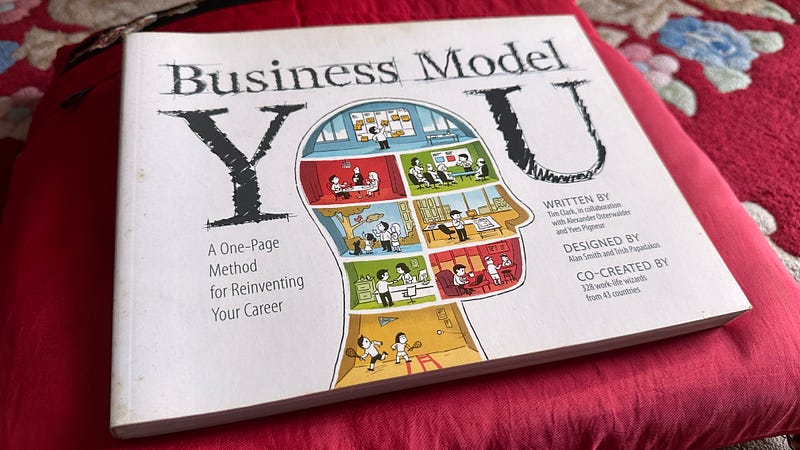
This book is not just another career guide; it’s a transformative tool that encourages you to rethink your professional life on a single page. Yes, you heard that right — one page!
The core concept of the book is built around the idea of personal business modeling.
We’re all familiar with business models in the corporate world, but applying this framework to one’s career is both innovative and incredibly powerful.
The book is structured to help you understand, deconstruct, and rebuild your career aspirations using the Business Model Canvas, a strategic management tool adapted for personal use.
The authors break down the traditional employment mindset, challenging you to view your career as a personal business.
This perspective shift alone was worth the dive into the book.
It nudges you to consider yourself a service provider and your employers or clients as customers.
This approach forces you to clarify your value proposition, understand your market, and articulate how you differentiate yourself from others.
What really stands out is the book’s practicality.
It’s filled with exercises, real-life examples, and step-by-step guides that will help you create your own personal business model.
I found the exercises to be introspective and sometimes challenging but always enlightening.
They pushed me to reflect on my career path, identify my skills and passions, and think critically about how I can align my work with my personal values and goals.
“Business Model You” is also visually appealing, which I didn’t expect from a career development book.
The use of diagrams, charts, and illustrations makes the content accessible and engaging, which is a huge plus when you’re tackling complex ideas like personal business models.
One of the most valuable sections, for me, was the one that dealt with reinvention.
The book acknowledges that our careers are not static and that we evolve as individuals.
The idea that you can revisit and revise your business model as you grow and as the market changes is empowering.
It reminds us that we are not stuck in one trajectory and that we have the agency to change course.
Another aspect of the book I appreciated was the focus on community and networking.
The authors emphasize the importance of external relationships in your business model, suggesting that who you know and collaborate with can be as important as your individual skills and experiences.
This holistic approach to career planning feels particularly relevant in today’s interconnected world.
By the end of the book, I felt equipped with a new framework for thinking about my career.
Creating my own one-page business model was a clarifying experience, helping me articulate what I want from my work and how to achieve it.
The book demystifies career development, making it feel more like a creative project than a daunting task.
In conclusion, “Business Model You” is a must-read for anyone looking to understand and reinvent their career.
Whether you’re just starting out, contemplating a career change, or looking to inject new life into your current path, this book offers valuable insights and tools.
It’s more than just career advice; it’s a blueprint for a more fulfilling professional life tailored entirely to you.
If you’re feeling stuck, uncertain, or just curious about what your career could be like, read this book.
It’s a refreshing departure from the one-size-fits-all career advice out there, offering a personalized approach to work and success.
I plan to revisit my business model in a few months to see how it evolves.
With “Business Model You,” your career is a dynamic, ever-evolving project, and that’s an exciting proposition.
Both musicians and writers are all about connecting with their audience.
Photo by Luwadlin Bosman on Unsplash
Not a member? Click here to read this full story for free.
Did you know that being a writer on Medium is a lot like being a musician?
It’s a pretty cool comparison because both gigs involve getting creative, putting in the work, and connecting with people.
Here are the common reasons why Medium writers are like the rock stars or indie artists of the writing world.
1. Getting Creative
So, whether you’re strumming a guitar or typing away, it’s all about letting your creativity flow.
Musicians mix melodies and lyrics to hit us right in the feels or get us thinking.
Medium writers?
They’re doing their thing with words, painting pictures in our minds, stirring up emotions, or dropping some knowledge.
Every note or word is like a little piece of a bigger masterpiece, making us sit up and pay attention.
2. Skills Matter Too
Alright, having a wild imagination is great, but you’ve got to have the skills to back it up.
Musicians need to know their way around their instruments, get the theory down, and keep their ears sharp.
Writers on Medium?
They have to nail their grammar, structure their stories correctly, and do their homework to ensure their writing is on point.
Being able to blend all that technical know-how with your creative side is what sets the real pros apart.
3. Practice Makes Perfect
Photo by Chase Yi on Unsplash
Whether you’re aiming to be the next big thing in music or writing, you’ve gotta put in the time.
Musicians live and breathe their tunes, practicing for hours and consistently trying to up their game.
Writers on Medium are in the same boat, constantly drafting, editing, and fine-tuning their pieces.
Plus, reading helps them stay sharp and in tune with what’s hot.
It’s all about that grind to get better.
4. It’s Showtime
Here’s where it gets real.
Both musicians and writers are all about connecting with their audience.
Musicians hit the stage, pouring their hearts out and hoping to make a lasting impression.
Medium writers?
They hit ‘publish,’ sharing their thoughts or stories and looking to spark conversations or share new perspectives.
Getting feedback is key in both scenes, helping artists grow and vibe with their fans.
5. Better Together
Photo by Austin Loveing on Unsplash
Even though writing and making music can feel like solo journeys, they’re pretty communal.
Musicians jam with other artists or work with producers to find their sound.
On Medium, writers can collaborate with editors or bounce ideas off other writers.
Plus, there’s this whole community vibe where everyone shares the highs and lows and roots for each other.
6. Keeping It Real
At the end of the day, it’s all about being true to yourself.
Musicians use their tunes to share their stories or take a stand.
Medium writers?
They pour their experiences, opinions, and life lessons into their articles.
This real talk strikes a chord with folks and makes the work stand out.
7. Always Evolving
Both music and writing never stand still—they’re always morphing, with artists trying out new styles or exploring fresh ideas.
Musicians might mix genres or play with new sounds, while Medium writers could experiment with different kinds of articles, mix in some multimedia, or tackle the latest hot topics.
It keeps things exciting and forward-moving.
8. Leaving a Mark
Photo by Kobe Subramaniam on Unsplash
Lastly, both musicians and writers on Medium have this chance to leave a mark, to create something that will last and make a difference.
Music has the magical power to transcend time and cultures, and great writing can shift views, kickstart conversations, or just stay with someone long after they’ve read it.
It’s all about making stuff that matters and lasts.
So, to wrap this up, seeing Medium writing as a kind of musicianship highlights how both paths involve pouring out one’s heart, honing one’s craft, and touching lives.
Whether you belt out a tune or craft a killer article, you’re making art that resonates and sticks with people.
Plan early to avoid unnecessary costs and further investments.
Photo by Kevin Ku on Unsplash
Not a member? Click here to read this story for free.
The vision of Smart Cities has evolved from a mere concept to a strategic framework within reach.
My experience consulting for local governments has shown me their ambition to weave technology into our urban infrastructure.
Nevertheless, this path to an idealized future has its challenges.
I intend to share insights from a recent endeavor to streamline Smart City governance through a unified interface known as the Single Dashboard.
The Single Dashboard Dilemma
Local authorities embarking on the Smart City journey aim to untangle the complex web of urban management.
Anticipation is high for the Single Dashboard, envisioned as a central hub to oversee various city functions.
But this quest for simplification ironically introduces new layers of complexity.
The Challenge of Vendor Dependence
The specter of vendor dependence is a recurring stumbling block.
It’s common for local bodies to become entwined with certain technology providers unintentionally.
Far from abstract, this entanglement manifests as hefty investments in exclusive hardware and software.
Caught in this bind, the councils’ ability to maneuver and innovate is paradoxically restricted, belying the very nature of the adaptable systems they strive to deploy.
Breaking Down Data Barriers
Photo by Joshua Sortino on Unsplash
Data silos present a formidable challenge in the modern cityscape.
Data should flow freely, nourishing the urban processes, yet it often remains isolated within non-cooperative systems.
This division hampers the smooth operation of the city’s gears and deprives us of the full potential of data-informed governance.
The Quest for Cohesive Insights
“Let us break down the barriers of data silos and vendor constraints, for in unity and open standards, we find the keystones of a city that is not only smart but wise.”
Tied closely to the problem of siloed data is the struggle to gain cohesive insights.
Navigating disparate dashboards and data pools to piece together a comprehensive city view is daunting.
Without the capability to derive wide-ranging insights, strategic planning becomes a game of chance rather than a calculated endeavor.
The Promise of the Integrated IoT Platform
Photo by Christina @ wocintechchat.com on Unsplash
In the face of these challenges, I’ve discovered a new hope — the Integrated IoT Smart City Platform.
This platform is poised to act as the city’s central command, allowing diverse technologies to meld into a singular, adaptable interface.
Opening the Gateway with Open Standards
Embracing this platform means breaking free from proprietary chains.
It encourages the seamless integration of both new and existing systems through open standards.
This liberates councils from vendor constraints and clears the path for a more developer-friendly, cost-effective approach to urban management.
The Financial Upside
A welcome byproduct of this integration is a noticeable decrease in costs.
By sidestepping the need for proprietary solutions, cities conserve resources and secure their technological investments from becoming outdated.
Laying the IoT Foundation
“As we lay down the IoT foundation for our Smart Cities, we are building more than infrastructure; we are crafting a legacy of resilience, creativity, and collective intelligence for generations to come.”
The essence of the Single Dashboard lies in deploying the Internet of Things (IoT).
Far from being a trendy term, IoT is the cornerstone of this framework, offering live monitoring and governance of city infrastructure.
The IoT sensors and devices capture detailed data, fueling the Smart City Platform with actionable intelligence.
A Panoramic Perspective
Crafted atop this innovative platform, the Single Dashboard isn’t just an interface — it’s a comprehensive lens that brings the city’s pulse into focus.
This panoramic view enhances the ability to address city life’s intricate dynamics swiftly.
Harnessing AI for a Truly ‘Smart’ City
Artificial Intelligence (AI) and Machine Learning (ML) further amplify the platform’s potential.
These technologies transform raw data into predictive power and automated management, propelling us toward a future where cities think and learn.
The Cradle of Innovation
The platform also serves as a crucible for creativity.
Leveraged by open standards and cost-effectiveness, local authorities are equipped to pilot innovative projects.
Herein lies the opportunity to unlock the full creative capacities of tech specialists and city planners, giving rise to pioneering solutions tailored to the unique heartbeat of our urban environments.
To wrap up, charting the course toward a Smart City is intricate and laden with obstacles such as vendor lock-in, isolated data, and scattered insights.
Yet, the Integrated IoT Smart City Platform illuminates a path that promises to streamline urban management, spark innovation, and reshape our cities into thriving hubs of livability and resilience.
For local councils, adopting this forward-thinking blueprint is a decisive step toward a smarter, brighter urban tomorrow.
The Favoriot IoT Platform has been deployed as a Smart City Platform. Contact Favoriot to schedule an appointment for further clarification or discussion.
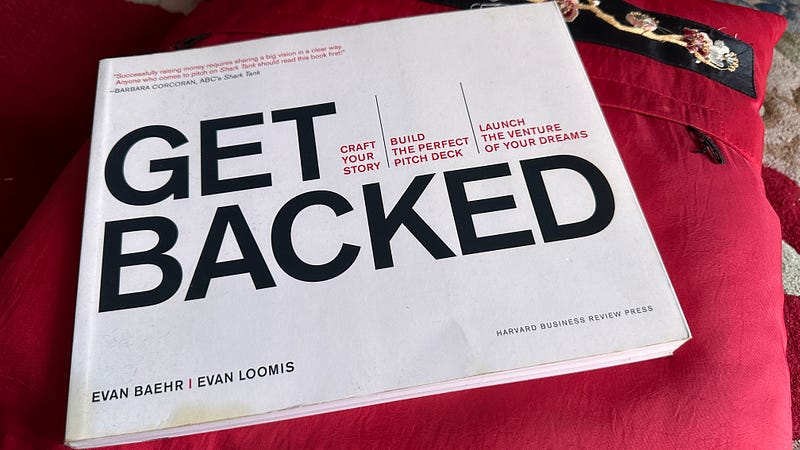
The authors, Evan Baehr and Evan Loomis have put together something special here, not just a book but a toolkit, a mentor in print, if you will, for anyone looking to get their dream venture off the ground.
The first thing that struck me about this book was its clarity and focus.
It’s not one of those vague, motivational reads that leave you feeling inspired but directionless.
Instead, “Get Backed” is like a roadmap, providing detailed instructions, case studies, and even templates to help you craft a compelling story and pitch deck that will grab investors’ attention and, more importantly, their investment.
Now, let me share the details a bit.
The book is divided into two main parts.
The first part deals with crafting your story.
And here’s the thing, the authors stress that every great venture starts with a story.
It’s not just about your product or business model but the narrative you create around it.
They guide you through understanding your audience, refining your message, and presenting your vision in an engaging and convincing way.
I particularly appreciated the emphasis on storytelling because it aligns with what I’ve observed in successful pitches: it’s often the story that sells, not just the numbers.
The authors provide examples of successful stories and dissect why they worked, which I found incredibly insightful.
The second part of the book is all about building the perfect pitch deck.
Now, if you’re like me, you might think, “Oh, just a bunch of slides, right?” Wrong.
The authors lay out a strategic approach to designing a pitch deck, discussing what information should go on each slide, how to visually present your data, and how to structure your presentation for maximum impact.
But here’s the real kicker: the book includes actual pitch decks from successful startups.
We’re talking about decks that have raised millions of dollars.
Analyzing these was like getting a peek into the secret playbook of funded startups.
The authors break down each deck, explaining what works and why, giving you actionable insights you can apply to your own pitch.
Beyond the storytelling and the pitch decks, “Get Backed” delves into the nitty-gritty of the fundraising process.
It covers identifying and reaching out to potential investors, preparing for meetings, and following up effectively.
There’s even a section on managing rejections and learning from them, which I found comforting and practical.
What makes this book stand out is its practicality.
It’s not just theory; it’s a hands-on guide that you can start applying immediately, whether you’re preparing for your first pitch or looking to refine your fundraising strategy.
After reading “Get Backed,” I felt not just informed but empowered.
The book demystifies the process of getting funded and provides clear, actionable steps to increase your chances of success.
It’s like having a seasoned investor guiding you through each step of your fundraising journey.
To wrap up, if you’re an entrepreneur dreaming of launching your venture or in the midst of fundraising, “Get Backed” is a must-read.
It’s comprehensive, insightful, and, above all, incredibly practical.
The lessons you’ll learn from this book are applicable not just for startups but for any venture that requires convincing others to believe in your vision and invest in your dream.
In a sea of startup advice and entrepreneurial literature, “Get Backed” stands out for its clarity, depth, and usability.
It’s a book that I’ll be returning to time and again, and I recommend it wholeheartedly to any aspiring entrepreneur.
[Note: Click here to have FREE access to this member-only story]
I’ve observed a burgeoning interest and commitment toward developing Internet of Things (IoT) projects.
These projects, emerging from various research groups and faculties, signal a promising direction in leveraging technology to solve complex problems, enhance learning, and offer innovative solutions to industry.
However, despite the evident progress and enthusiasm, a critical challenge persists the difficulty of transitioning these projects from academic exercises to commercially viable products.
Observing the Development of IoT Projects in Silos
As I engage with various teams in the Universities, I notice a familiar pattern — many IoT projects operate in isolation.
Each project progresses independently, fueled by its objectives and developmental timelines.
While this approach allows teams to dive deep into their specific challenges and innovations, it inadvertently creates silos that hinder collaboration and scalability.
In these silos, researchers and students dedicate immense efforts to developing bespoke IoT platforms and systems, often reinventing the wheel.
The division is apparent in how technology and standards vary, in the sharing of knowledge, and the use of resources.
This fragmented landscape poses significant barriers to commercialization, as transitioning a project from a university setting to the market requires a level of standardization and interoperability that these isolated projects need to improve.
The Challenge of Bringing Products to Market
“Why can’t we bring these innovations to market more effectively?” I often ponder.
The crux of the issue lies in the inherent diversity and customization of the IoT solutions being developed within academic settings.
Each project, tailored to specific research goals or educational outcomes, evolves on its trajectory, leading to many unique yet incompatible systems and platforms.
While a boon for academic exploration, this diversity becomes a bottleneck for commercialization.
The path to transforming an academic project into a commercial product is fraught with challenges, including aligning with industry standards, ensuring scalability, and integrating with existing ecosystems.
The bespoke nature of university-developed IoT systems demands extensive customization and re-engineering to fit commercial contexts, escalating costs and complicating deployment.
Envisioning a Unified IoT Platform
Imagine a world where these barriers are dismantled—a single, unified IoT platform is the backbone of all university IoT projects.
Such a platform would offer a standard API, enabling seamless data collection and management across diverse projects.
Researchers and students could then focus on their core competencies: data analysis, application development, and innovation rather than the intricacies of platform maintenance.
This shared platform would facilitate knowledge exchange and collaboration and streamline the transition from research to commercialization.
By standardizing the underlying IoT infrastructure, we could reduce the need for extensive customization and ensure that projects are built on a solid, scalable foundation.
Enter Favoriot, an enterprise-based IoT platform that promises to bridge these gaps.
Favoriot offers an on-premise solution tailored for academic and research environments. It aims to simplify IoT development, reduce costs, and foster a more collaborative ecosystem.
With Favoriot, universities can consolidate their IoT initiatives on a single platform, ensuring consistency, interoperability, and easier maintenance.
This consolidation would enable researchers to leverage shared resources and insights, accelerating innovation and enhancing the educational experience.
Furthermore, by standardizing the IoT infrastructure, Favoriot paves the way for smoother commercialization paths.
Projects developed on this common platform can transition to market with fewer hurdles, as the core technological foundation remains consistent and industry-aligned.
A Unified Path Forward
Reflecting on the potential of such a unified IoT platform, I am optimistic about the future of academic IoT projects.
By breaking down the silos and fostering a collaborative environment, we can amplify the impact of our innovations and bring them to market more efficiently.
The journey from academic research to commercial success is undoubtedly complex.
Still, initiatives like Favoriot bring us one step closer to a future in which the fruits of our academic labor can reach wider audiences and create tangible, lasting value in the world.
Contact Favoriot to schedule an appointment for further information.





















 Dr. Mazlan Abbas