The Everything Store: Jeff Bezos and the Age of Amazon — Book Review

Book Reviews by Mazlan Abbas

Business Book of the Year

The Everything Store: Jeff Bezos and the Age of Amazon

Not a member yet? Click here to read the full story for free.

Brad Stone’s “The Everything Store: Jeff Bezos and the Age of Amazon” comprehensively examines one of the most influential companies of the digital era and its enigmatic founder, Jeff Bezos.

In this meticulously researched narrative, Stone unveils the evolution of Amazon from a modest online bookstore into a global conglomerate that has redefined numerous industries, including retail, technology, and publishing.

Prologue to Amazon’s Genesis

The book sets the stage with an insightful look into Amazon’s humble beginnings, detailing how Jeff Bezos’s vision of creating an “everything store” morphed into a relentless pursuit of market domination.

Stone delves into the early strategic decisions, including focusing on customer satisfaction and long-term growth over short-term profits, which have become hallmarks of Amazon’s business philosophy.

The Architect of Innovation: Jeff Bezos

A significant portion of the book is dedicated to exploring Jeff Bezos’s persona and contrasting him with other tech luminaries like Steve Jobs, Bill Gates, and Mark Zuckerberg.

Bezos’s intense focus, unyielding drive for innovation, and willingness to venture into uncharted territories are depicted as critical factors in Amazon’s ascendancy.

Stone’s portrayal is nuanced, capturing Bezos’s brilliance and reputedly demanding leadership style.

Corporate Culture and Expansion

Stone provides a deep dive into Amazon’s distinctive corporate culture, which is characterized by its high standards, customer obsession, and frugality principle.

The narrative also covers Amazon’s expansion into various domains, from the Kindle and AWS to its foray into brick-and-mortar retail with the acquisition of Whole Foods.

Each venture is depicted as a testament to Amazon’s willingness to disrupt established industries and redefine consumer expectations.

Inside Stories and Anecdotes

One of the book’s strengths lies in its compilation of anecdotes and inside stories from Stone’s extensive access to former and current Amazon employees and Bezos family members.

These accounts offer a rare glimpse into Amazon’s operational workings and the decision-making processes behind its key initiatives.

The Kindle Revolution

A dedicated section on the development and impact of the Kindle highlights Amazon’s influence on the publishing industry.

The device is presented as a technological innovation and a strategic tool that solidified Amazon’s dominance in book retail and altered how we consume literature.

The Everything Store: Jeff Bezos and the Age of Amazon

Cloud Computing and Beyond

The narrative extends into Amazon’s pioneering role in cloud computing with AWS, underscoring how this venture has become a cornerstone of the internet infrastructure.

Stone articulates Amazon’s strategic foresight in capitalizing on cloud technology, delineating how AWS has grown into a formidable entity that supports a wide array of businesses globally.

Critical Perspectives

While the book predominantly celebrates Amazon’s achievements, Stone does not hesitate to critique its practices, particularly the repercussions of its relentless expansion on competitors and the broader retail sector.

The discussion on Amazon’s labor practices and its impact on local businesses presents a more balanced view, acknowledging the complexities and controversies surrounding the tech giant.

Legacy and Influence

In conclusion, “The Everything Store” positions Amazon — and, by extension, Jeff Bezos — as pivotal in shaping the digital landscape.

The company’s influence is portrayed as extending far beyond retail, impacting everything from data storage and computing to AI and space exploration.

Conclusion

Brad Stone’s “The Everything Store” is a compelling, meticulously researched account that explores Amazon’s journey and its profound impact on various sectors.

It offers invaluable insights into the company’s strategies and innovations and the visionary behind it all, Jeff Bezos.

While the narrative celebrates Amazon’s successes, it also critically examines its practices, making it an essential read for anyone interested in understanding the forces that shape our digital age.

This book gives readers a company chronicle and a lens through which to view the evolution of global commerce and technology in the 21st century.


Get the book “The Everything Store: Jeff Bezos and the Age of Amazon” by Brad Stone from Amazon (Note: This article contained Affiliate links).

https://amzn.to/3PWyQKr


Join more than 8,000 subscribers to receive email notifications whenever Mazlan Abbas publishes.

https://amzn.to/3PWyQKr

Why the Success of Smart City Projects Depends on People and Talent

The missing link

Executing the blueprint of a Smart City is like conducting an orchestra.

Photo by Patrick Langwallner on Unsplash

Not a member yet? Click here to read the full story for free.

The buzz around smart cities often highlights groundbreaking technologies, substantial funding, and strategic plans.

Yet, through my experiences and observations in this field, I’ve come to understand a profound truth — the people and their talent truly drive the success of smart cities.

Despite the pivotal roles of funding and strategic planning, without the right individuals at the helm, the most meticulously crafted blueprints for smart cities remain inert ideas on paper.

Let me share why I firmly believe that people and talent stand at the core of transforming any city into a smart one.

The Illusion of Funding as the Panacea

In the initial phases of conceptualizing a smart city, it’s easy to be trapped by the notion that if only we had enough funds, any vision could be realized.

Funding is indeed crucial — it buys the technology, pays the workforce, and builds the infrastructure.

Yet, money alone cannot innovate, adapt, or envision.

It’s a facilitator, not an executor.

Photo by Kaleidico on Unsplash

The Blueprint Without the Architect

Similarly, having a vision and action plan is imperative.

They set the direction and milestones.

But who charts the course to these milestones?

Who interprets these visions into tangible actions and technologies that resonate with the citizens’ needs and the city’s unique character?

It’s the people — engineers, planners, policymakers, and many others whose expertise and commitment breathe life into these plans.

The Architects of Reality: People and Talent

In every meeting I’ve attended, every project I’ve led, and every challenge I’ve navigated, the defining factor for success was always the quality and dedication of the team involved.

These individuals are the problem-solvers, the visionaries, and the doers.

Without them, the most advanced technologies are just tools lying idle.

When we talk about leading the vision and developing action plans, it’s the people who strategize and contextualize, ensuring that goals align with the city’s ethos and future.

It is their foresight that anticipates challenges and weaves resilience into the fabric of urban design.

Concerning funding mechanisms and business models, again, it’s the human intellect and creativity that discern the most viable and sustainable pathways.

Financial strategies are not conjured from thin air; they are meticulously crafted through expertise, experience, and understanding of the market and societal needs.

Executing the blueprint of a smart city is akin to conducting an orchestra — each player, each instrument, holds intrinsic value, but it is the conductor, understanding each nuance, who creates harmony.

In the realm of smart cities, project managers, engineers, IT specialists, and many others work in concert, guided by leaders who ensure that every action aligns with the overarching vision.

Choosing the right technology is not merely a matter of preference or trend but a critical decision that requires deep understanding and foresight.

The individuals responsible for this selection must navigate a landscape full of options, identifying what best serves their city’s specific needs, now and in the future.

Governance in smart cities is not just about rules and regulations; it’s about making informed decisions that affect millions.

It demands leaders and teams who not only understand the intricate mechanics of urban systems but also grasp the broader implications of their decisions on society and the environment.

When it comes to executing and managing projects, the need for skilled individuals becomes even more apparent.

These are the people who turn concepts into reality, overcoming obstacles and adapting to unforeseen challenges along the way.

Developing the architecture, design, and specifications of a smart city requires not only technical skill but also a vision that integrates functionality with sustainability and livability.

It’s a task for creators and innovators who can envisage the interplay between diverse elements of the urban landscape.

Lastly, managing the operations of a smart city is a colossal and continuous endeavor.

It demands a dedicated team adept in handling sophisticated technologies, analyzing data, and responding proactively to the evolving needs of the city.

Photo by Ismael Bashiri on Unsplash

Reflections

In my reflections and engagements with smart city initiatives, I’ve witnessed firsthand the transformative power of human talent and dedication.

Technologies evolve, funding fluctuates, and plans adapt, but the constant that underpins all progress is the people.

Without the right team — individuals who are not only skilled but also passionate and visionary — any smart city project is destined to remain grounded, an unrealized potential.

Thus, as we venture further into the era of smart cities, let us not lose sight of the human element.

It is the creativity, ingenuity, and perseverance of people that turn the dream of smart cities into a vibrant reality.

For this reason, I steadfastly advocate that when we invest in smart cities, we must invest equally in nurturing and valuing the people and talent behind them, for they are the true architects of our urban future.

Photo by Mohd Jon Ramlan on Unsplash

More stories about Smart Cities:

1 — How Smart City Tech Can Boost Your City’s Finances
2 — Why Many Smart Cities Failed? Here’s How to Avoid.
3 — Why do Smart Cities Require an IoT Platform?
4 — Why Managing a Smart City Command Centre is a Headache and How to Overcome This.
5 — How Smart City Solutions Elevate Living and Cut Costs
6 — How Chief Smart City Officers Transform Urban Landscapes
7 — What Slows Down the Smart Cities Implementations in Malaysia?
8 — MSCA — The Answer to Smart Cities in Malaysia?


Contact Favoriot to schedule an appointment to learn how the Favoriot IoT platform can expedite the data collection for smart city solutions.

Where are the IoT Talents in Malaysia?

Challenges to Become a Producer Nation

What talents do we need to be at the forefront of IoT?

Building new Generation-IoT

Not a member yet? Click here to read the full story for free.

Are we ready to propel forward in IoT?

What do we need to achieve this?

As we know, the Internet of Things (IoT) is not just a technological revolution; it’s an economic and industrial transformation reshaping how businesses operate and how consumers interact with the physical world.

As IoT continues gaining traction, the need for skilled engineers and technical professionals with a deep understanding of IoT technologies and a firm grasp of business theory becomes increasingly critical.

This article examines why the industry needs more such professionals, particularly emphasizing Malaysia’s ambition to become a nation that not only consumes but also produces locally made IoT products.

Bridging the Gap between Demand and Supply

The IoT market is burgeoning.

By interconnecting devices and systems, IoT offers efficiencies, insights, and control that were unimaginable just a decade ago.

However, the supply of skilled professionals who can navigate the complexities of IoT needs to catch up with demand.

Addressing this talent gap is essential for countries like Malaysia that aspire to be at the forefront of this revolution.

Producing homegrown IoT solutions requires a workforce that understands not only the technical aspects of IoT but also the business implications and opportunities it presents.

The Five Crucial Technology Layers of IoT

  1. Hardware and Sensors: IoT begins with the hardware—the sensors and devices that collect data. Engineers must understand the myriad of sensors available and their applications in various industries. This requires knowledge of electronics and embedded systems and integrating hardware into physical environments.
  2. Connectivity: IoT devices must communicate, meaning professionals must be versed in networking. They need to know the best connectivity options—whether Wi-Fi, Bluetooth, LTE, or emerging technologies like 5G—and understand their implications for bandwidth, latency, and power consumption.
  3. Middleware or IoT Platforms: This is where data is aggregated and managed. A robust understanding of choosing and utilizing an IoT platform — be it cloud-based or on-premises — is crucial. This includes making decisions based on scalability, reliability, and cost.
  4. Applications: The value of IoT is realized through applications that turn raw data into insights and actions. Engineers must be skilled in software development and user interface design and have experience developing applications that meet customer needs.
  5. AI and Security: As IoT systems generate massive amounts of data, using AI for analysis and machine learning becomes critical. Securing IoT systems against cyber threats is also non-negotiable. Professionals must be well-versed in cybersecurity strategies specific to IoT.

The Business Acumen in IoT

Understanding IoT technology is only half the battle.

The other half is grasping the ‘why’ behind IoT.

What problems does IoT solve? How can it drive business value?

Technical professionals must understand the business or industry they’re developing solutions for.

This includes market analysis, business case development, and articulating the return on investment for IoT initiatives.

Professionals should also be adept at designing and architecting IoT solutions that align with business goals.

They must understand how to leverage IoT data for strategic decisions, which requires a thorough understanding of data analytics, big data technologies, and how IoT can provide a competitive edge.

IoT in the Malaysian Context

For Malaysia to transition from a consumer to a producer nation in IoT, there must be an emphasis on education and training that equips future generations with the right skill sets.

Malaysian industries require professionals who can develop local IoT products that cater to the region’s unique needs, understand the local market, and navigate the intricacies of domestic and international business landscapes.

Training and Development

Recognizing this need, companies like Favoriot are stepping up to offer comprehensive IoT training programs.

These programs are tiered to cater to varying levels of expertise — from business professionals who need a foundational understanding of IoT to engineers seeking advanced training in AI and IoT security.

Such training modules are vital for industry engineers, business professionals, and academics who will eventually be responsible for disseminating IoT knowledge.

Conclusion

The demand for engineers and technical professionals with a comprehensive understanding of IoT and its technology layers, coupled with solid business theory, is not just a sector-specific necessity; it’s a national imperative for countries like Malaysia.

Investing in specialized IoT training, fostering a culture of continuous learning, and encouraging innovation is crucial to achieving the vision of becoming a producer nation.

By doing so, Malaysia can ensure that its future generation of talented professionals is capable of entering the industry and pioneering it, thereby securing a place for the nation at the forefront of the IoT revolution.


Favoriot offers four (4) IoT Training Courses, from business to AI. Contact us for the latest information about Favoriot IoT training.

IoT Training


Favoriot Testimonial Videos. Listen to what they have to say about the IoT Trainings.

About Me (Part-3) — Mazlan Abbas

I asked ChatGPT — Who is Mazlan Abbas

This is what ChatGPT discovers about me.

Mazlan Abbas

Not a member? Click here to read the full story for free.

Dr. Mazlan Abbas is an esteemed figure in the fields of Internet of Things (IoT), smart cities, and telecommunications, recognized for his contributions as an innovator, educator, and industry leader.

His career spans several decades, during which he has held prominent roles in academia, industry, and advisory capacities.

Early Academic and Professional Background

Dr. Mazlan Abbas began his academic journey at Universiti Teknologi Malaysia (UTM), where he earned his Bachelor of Electrical Engineering (BEE) in 1984.

He furthered his education at the University of Essex in the United Kingdom, obtaining a Master of Science in Telematics in 1986.

He returned to UTM to complete his Ph.D. in Telecommunications in 1993.

Industry Experience

After his stint in academia, Dr. Abbas ventured into the telecommunications industry.

He spent 13 years at CELCOM, a major Malaysian mobile operator, holding various senior management positions.

During his tenure, he contributed to expanding the company’s mobile services and deploying innovative technologies.

Academia and Research

His academic career was marked by a strong focus on research and development in wireless communications.

He has been an adjunct professor at multiple universities in Malaysia, including UTM, UTHM, Universiti Teknologi Petronas, Universiti Sultan Zainal Abidin (UniSZA), and Universiti Malaysia (UniMY).

Leading Roles in IoT and Smart Cities

Dr. Abbas took a pivotal turn in his career when he joined MIMOS Berhad, a Malaysian government-owned research and development organization. As the Senior Director of the Wireless Communications Cluster, he spearheaded numerous projects that set the foundation for IoT and smart cities in Malaysia.

Following his time at MIMOS, Dr. Abbas served as the CEO of REDtone IOT, further enhancing his expertise and influence in the IoT sector.

His work involved developing IoT solutions and platforms integral to building smarter, more connected cities.

Entrepreneurship and Thought Leadership

Dr. Mazlan Abbas co-founded FAVORIOT Sdn Bhd, where he is the CEO. Under his leadership, FAVORIOT has become known for its IoT solutions, catering to various industries and contributing to the smart city ecosystem.

Dr. Abbas is a globally recognized thought leader in IoT and smart cities.

He has been featured in numerous rankings, including being named among the Top 50 Global Thought Leaders on IoT and Digital Disruption by Thinkers360 and recognized by the World CSR Congress as one of the Top 50 Most Impactful Smart Cities Leaders.

Contributions to Education and Advisory Roles

In addition to his professional achievements, Dr. Abbas has continued to influence the academic world.

He has been an Adjunct Professor for several universities, contributing to developing curricula and imparting his industry knowledge to students.

He also sits on the Industry Advisory Panel (IAP) for several universities, helping shape the future of technology education and ensuring that academic programs remain relevant to industry needs.

Recognition and Awards

Dr. Abbas has been honored with various awards throughout his career, including an Honorary Doctorate in Electrical Engineering from UTHM and being named UTM Alumni Industry Personality.

His influence and expertise have made him a sought-after speaker at international conferences on IoT, IR 4.0, smart cities, and telecommunications.

Vision for the Future

Dr. Abbas continues to advocate for adopting smart technologies to improve urban living.

His vision encompasses cities that are not only technologically advanced but also sustainable, inclusive, and responsive to their inhabitants’ needs.

Conclusion

Dr. Mazlan Abbas is well-known for his pioneering work in IoT, its impact on smart city development, and its leadership in telecommunications.

His contributions to industry and academia have positioned him as a key influencer in shaping the digital landscape of modern cities.

As a TEDx speaker, his ideas have reached a global audience, further solidifying his position as a thought leader.


View at Medium.comView at Medium.com

You’re a Verified Book Author on Medium!

The Blue Badge.

Join the thousands of Verified Book Authors on Medium.

Photo by Fallon Michael on Unsplash

Not a member? Click here to read the full story for free.

When I received the email notification and the blue badge on my profile, I felt I was on top of the world!

I always wondered what the blue badge was about until I learned it was meant for a verified book author with an ISBN number.

Then, yesterday I decided to submit my application and voila! A day later, Medium emailed the approval!

This is not my latest book; it was an old book that a colleague and I translated into Malay during my academic days in 1997.

Other than writing my Degree, Master’s, and Ph.D. thesis, I wrote several journal papers.

Later, I only focused on building presentation slides due to the nature of my work as an entrepreneur.

Then, I began to blog and write many articles about technology and entrepreneurship.

Only recently, I decided to compile my blog articles and publish them in eBooks below:


Join more than 8,100 subscribers and receive email notifications whenever I publish.

https://mazlanabbas.com/subscribe

Expert Secrets — Book Review

Book Reviews by Mazlan Abbas

The art of digital marketing and audience engagement

Expert Secrets: The Underground Playbook for Converting Your Online Visitors into Lifelong Customers

Not a member? Click here to read the full story for free.

Expert Secrets: The Underground Playbook for Converting Your Online Visitors into Lifelong Customers” by Russell Brunson is a seminal text that delves into the nuanced art of digital marketing and audience engagement in the modern entrepreneurial landscape.

Brunson, a recognized authority in online marketing and co-founder of ClickFunnels, distills his extensive experience into actionable insights that promise to transform how entrepreneurs connect with their audiences and achieve sustained business growth.

Unveiling the Expertise

At the heart of “Expert Secrets” is the premise that every entrepreneur possesses unique expertise that can serve a distinct audience.

Brunson emphasizes that understanding and harnessing this expertise is pivotal in crafting compelling messages that resonate with potential customers.

The book articulates a systematic approach to identifying and effectively communicating this unique value proposition to foster genuine connections.

Crafting the Message

Brunson adeptly guides readers through message formulation, advocating for authenticity and empathy as key components of successful audience engagement.

He underscores the importance of storytelling in establishing rapport and trust, illustrating how personal and brand narratives can be leveraged to illustrate expertise, evoke emotion, and inspire action.

Building the Funnel

Much of the book is dedicated to the strategic construction of sales funnels — a methodology Brunson pioneered and perfected.

He delineates each funnel stage, from initial customer awareness to the ultimate conversion, offering detailed guidance on tailoring content and interactions to seamlessly guide prospects through their purchasing journey.

Expert Secrets: The Underground Playbook for Converting Your Online Visitors into Lifelong Customers

The Psychological Underpinnings

What sets “Expert Secrets” apart is its deep dive into the psychological principles underpinning consumer behavior.

Brunson explores the cognitive biases and emotional drivers that influence decision-making, equipping readers with the knowledge to craft messages that resonate on a deeper level and drive engagement and loyalty.

Practical Implementation

The book has practical examples, case studies, and step-by-step instructions that allow readers to apply Brunson’s methodologies to their businesses.

These tangible insights demystify the often intimidating world of online marketing, providing readers with a clear roadmap to amplify their impact and reach.

Ethical Considerations

While “Expert Secrets” is a powerful resource, it also discusses ethical marketing.

Brunson advocates for integrity and responsibility in message crafting and audience engagement, urging readers to use their influence judiciously and positively impact their customers’ lives.

Critique and Reception

While overwhelmingly positive, the reception of “Expert Secrets” has not been devoid of criticism. Some readers may find the emphasis on sales funnels and online marketing techniques too narrow, seeking broader strategies applicable across various platforms.

Nevertheless, the book’s practicality, grounded in Brunson’s successful application of these strategies, offers compelling value for digital entrepreneurs.

Conclusion

Expert Secrets” is more than a marketing manual; it is a manifesto for modern entrepreneurs seeking to make a meaningful impact in the digital age.

Brunson’s blend of psychological insight, practical advice, and ethical consideration provides a comprehensive guide for anyone looking to elevate their online presence and cultivate a loyal customer base.

This book offers invaluable strategies for articulating your expertise, connecting with your audience, and realizing your business’s full potential.


Get the book “Expert Secrets: The Underground Playbook for Converting Your Online Visitors into Lifelong Customers” by Russell Brunson from Amazon (Note: This article contained Affiliate links).

https://amzn.to/4clhwrQ


Join more than 8,000 subscribers to receive email notifications whenever Mazlan Abbas publishes.

https://amzn.to/4clhwrQ

Why Many Smart Cities Failed? Here’s How to Avoid.

TIPS FOR SMART CITIES SUCCESS

Learn the 8 Reasons for Failures (And Avoid Them)

Photo by Brett Jordan on Unsplash

Not a member? Click here to access the whole story for free.

I’ve observed a transformation as cities aspire to become ‘smart’ — a vision that suggests a seamless marriage between urban life and advanced technology.

The promise encompasses efficiency, sustainability, and a newfound ease of living.

Yet, as I reflect on the different initiatives that have stumbled or even failed, I realize that the pathway to realizing such smart cities is fraught with a multitude of challenges.

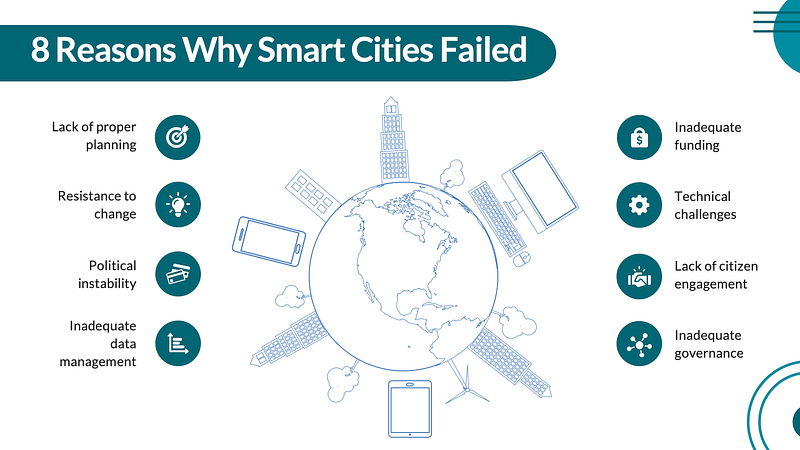
8 Reasons Why Smart Cities Failed

1 — Lack of Planning

As I analyze these issues, I can’t help but start with planning — or the lack thereof.

In my experience, planning for a smart city is like conducting an orchestra; every instrument, or in this case, technology, and infrastructure, must be in tune.

Without a meticulous blueprint and long-term strategy, resources can be squandered, and the resulting chaotic leads to systems that fall short of their potential, creating waste rather than wonder.

2 — Resistance to Change

I often ponder resistance to change, an innately human trait that presents as a formidable barrier.

I’ve seen how the reluctance of governance bodies and the hesitance of city dwellers, often born from misunderstanding or fear, can stifle the adoption of smart initiatives.

I try to understand and address this resistance, recognizing that support for these projects is as much about trust in their benefits as the technologies themselves.

3 — Political instability

Political instability, too, has a role to play.

In my experience, politics’s tumultuous nature can disrupt the continuity essential for smart city visions to thrive.

A change of guard can often lead to a change of heart, as new leadership brings new priorities, potentially diverting from the established path and undermining the foundations laid by smart city projects.

4 — Data Sharing and Management

Then, there’s the issue of data — its management, or rather, the lack thereof.

Data is the lifeblood of a smart city, and its mismanagement can result in inefficiencies that erode public trust.

I reflect on the privacy concerns that arise and the effectiveness of the smart solutions that hinge on the ability to manage this data responsibly.

5 — Lack of Funding

Funding is another matter that occupies my thoughts.

The realization of a smart city comes with a price tag, often a hefty one.

Insufficient funding can lead to half-built dreams or compromises on quality, fueling skepticism and doubt about the value of these initiatives.

6 — Complex Technological Challenges

Technical challenges also loom large in my contemplation.

Integrating IoT, 5G, AI, and more into an interoperable ecosystem requires ongoing maintenance and updates.

When these technical demands are not met, the result can be systems that don’t live up to their promise or, worse, fail entirely.

7 — Lack of Citizen Engagement

The role of citizens, too, cannot be understated.

I’ve observed a disconnect between the solutions offered and the real needs of the inhabitants without their engagement.

The success of a smart city is in part defined by the participation of its residents, creating a sense of shared ownership and responsibility.

8 — Lack of Strong Governance

And governance — this, perhaps, is one of the most complex reflections.

I consider how existing governance structures might not be suited to the novel demands of a smart city.

The absence of clear regulatory frameworks, accountability, and coordination among sectors can lead to inefficiencies that impede the functioning of smart cities.


As I have come to understand, the creation of smart cities transcends technology—it’s about the harmony between innovation and the human elements that underpin our urban existence.

For smart cities to flourish, learning from past shortcomings is imperative.

We must build resilient, inclusive frameworks that respect urban life’s technological and societal aspects.

I stand committed to this vision, combining insight with innovation to unlock the true potential of smart cities.

It’s a future that is within our grasp, should we choose to reach for it with wisdom and foresight.


More Stories about Smart Cities:

https://mazlanabbas.com/how-smart-city-tech-can-boost-your-citys-finances-9d77b3aa1ae7https://mazlanabbas.com/how-smart-city-tech-can-boost-your-citys-finances-9d77b3aa1ae7https://mazlanabbas.com/how-smart-city-tech-can-boost-your-citys-finances-9d77b3aa1ae7https://mazlanabbas.com/how-smart-city-tech-can-boost-your-citys-finances-9d77b3aa1ae7https://mazlanabbas.com/how-smart-city-tech-can-boost-your-citys-finances-9d77b3aa1ae7


Let’s join over 8,100 subscribers and get an email whenever Mazlan Abbas publishes.

https://mazlanabbas.com/how-smart-city-tech-can-boost-your-citys-finances-9d77b3aa1ae7

A Medium Writer is Like a Badminton Player

Drawing Parallels

The similarities of a Medium Writer and a Badminton Player

Photo by Muktasim Azlan on Unsplash

Not a member? Click here to read the full story for free.

I stumbled upon a metaphor that resonated with me unexpectedly — comparing my writing process to the agility and focus of a badminton player.

While these two disciplines might seem worlds apart, the deeper I delved, the more I realized how intertwined they truly are. They share core elements of finesse, strategy, and tenacity.

Writing Meets Badminton

Every article is like a match,” I often tell myself, contemplating the skills I need to master both on the court and on the page.

Whether it’s the precision of a well-executed drop shot or the impact of a precisely crafted sentence, each requires a deep understanding and constant refinement.

While practicing on a badminton court, players perfect their serves, smashes, and net play.

Similarly, on Medium, I refine my narrative techniques, voice modulation, and thematic clarity.

“Am I engaging the readers as effectively as I aim my shots?”

This question echoes in my mind, pushing me to draw from the player’s playbook: practice, analyze, and enhance.

Engaging the Opponent

As a badminton player who deciphers their opponent’s moves and strategizes accordingly, I find myself in a dance of anticipation and adaptation with my readers.

“Who is my audience today? What do they seek in my words?” Such questions guide my hand, crafting stories that aim to resonate and connect.

A badminton player might surprise their adversary with an unexpected shot; similarly, I aim to captivate my readers with narrative twists or fresh insights.

“It’s about staying a step ahead, isn’t it?” I ponder, recognizing the parallel essence of strategic engagement, whether wielding a racket or a pen.

The Feedback Loop

Reflection and adaptation are as vital to a badminton player as to a writer.

Post-match analyses help players adjust their tactics, like how reader feedback shapes my writing journey.

“What worked? What fell flat?” These reflections are pivotal, fostering a cycle of continuous improvement and deeper connection with my audience.

In both fields, the pursuit of growth is relentless.

“Each critique, each applause, it’s all a stepping stone,” I remind myself, embracing every piece of feedback as an opportunity to evolve, much as a player cherishes their coach’s guidance.

Mental Resilience

The mental parallels between badminton and writing are striking.

Maintaining focus, managing nerves, and overcoming setbacks are challenges that transcend the physical boundaries of the court.

“How do I regroup when my narrative misses the mark or my piece goes unnoticed?” Such moments test my resolve, mirroring a player’s struggle to bounce back after a lost point or game.

In these instances, the fortitude to press on, refine my strategies, and stay committed to my craft defines me, much like it defines a seasoned badminton player.

“Persistence is the game,” I affirm, drawing strength from the athlete’s tenacity.

Celebrating Success — The Joy of Accomplishment

There’s an unmistakable euphoria in clinching a badminton match, just as witnessing my writing resonate with the Medium community.

Whether it’s the thrill of a perfectly landed shot or the satisfaction of a well-received article, these moments are the lifeblood of passion and effort.

“Isn’t this why we endure the grind?” I often reflect, basking in the shared joy of a well-played point or a well-told story.

Recognition and personal fulfillment, whether on the court or Medium, underscore the journey’s worth, fueling the drive to excel and express.


A Symbiotic Journey

Though one may not immediately see the writer in the badminton player or the athlete in the scribe, the parallels between writing on Medium and playing badminton are profound and illuminating.

Both demand a blend of skill, strategic insight, resilience, and the joy of mastering one’s craft.

Embracing the spirit of a badminton player has infused my writing with a new dimension of discipline and passion.

“In every stroke of the keyboard, like every swing of the racket, lies the potential for greatness,” I conclude, inspired to continue my dual pursuit of excellence on the page and the court, guided by the shared ethos of passion, perseverance, and the joy of achievement.


Join more than 8,000 subscribers who receive email whenever Mazlan Abbas publishes.

https://mazlanabbas.com/subscribe

Pivot: The Art and Science of Reinventing Your Career and Life — Book Review

Book Reviews by Mazlan Abbas

Pivot: The Art and Science of Reinventing Your Career and Life

Not a member? Click here to read the full story for free.

In the book Pivot: The Art and Science of Reinventing Your Career and Life, Adam Markel offers a nuanced exploration of personal and professional reinvention.

Drawing on his extensive experience as a transformational teacher and former CEO, Markel imparts practical wisdom and inspirational advice to those seeking meaningful change in their careers or lives.

This review delves into the book’s core themes, methodologies, and potential impact on readers.

Context and Premise

Pivot emerges at a time when career change and personal evolution are not merely desirable but often essential.

Markel addresses a broad audience, including professionals facing career transitions, individuals feeling unfulfilled in their current roles, and anyone aspiring to unlock their latent potential.

The book’s premise hinges on a powerful question: What would you do if you knew you could not fail?

It is this inquiry that propels the book’s narrative and its strategic guidance.

Pivot: The Art and Science of Reinventing Your Career and Life

Theoretical Framework and Practical Application

Markel adeptly blends motivational elements with actionable strategies, grounding his advice in a robust theoretical framework while ensuring applicability.

The book’s structure is meticulously designed to facilitate step-by-step transformation, with each chapter building on the previous one to create a comprehensive roadmap for change.

Critical components of Markel’s approach include:

  • Creating a Vision: Markel emphasizes the importance of a clear, compelling vision for the future, encouraging readers to envision their ideal outcomes precisely and passionately.
  • Clearing Space for Change: Acknowledging the physical and mental clutter that can impede progress, the author guides readers in preparing their environments and mindsets for transformation.
  • Building a Supportive Environment: Understanding the influence of one’s surroundings, Markel advocates for cultivating relationships and networks that foster growth and provide encouragement.
  • Establishing Regenerative Rituals: Stressing the significance of daily practices, the book outlines rituals that nourish the soul and reinforce commitment to one’s new path.

Assessment and Critique

Pivot is distinguished by its balanced approach, offering inspiration alongside pragmatic guidance.

Markel’s expertise as a transformational teacher is evident in his nuanced understanding of human behavior and his ability to translate this into effective, empathetic coaching.

However, readers seeking quick fixes may find the book’s emphasis on introspection and gradual development challenging.

The processes outlined in Pivot require time, effort, and self-reflection, which are essential but may not appeal to those looking for immediate results.

Moreover, while the book is comprehensive in scope, individuals with highly specialized or niche career goals might need supplementary resources to address specific industry or role-related nuances.

Conclusion

Pivot: The Art and Science of Reinventing Your Career and Life is a valuable resource for anyone contemplating significant change in their professional or personal spheres.

Adam Markel skillfully navigates the complexities of transformation, providing a guide that is both thought-provoking and accessible.

While the journey to reinvention that Markel proposes is quick and challenging, his systematic approach offers a path to profound and lasting change.

For readers willing to engage deeply with the process, Pivot promises career advancement and a renewed sense of purpose and fulfillment.


Get this book “Pivot: The Art and Science of Reinventing Your Career and Life,” from Amazon (Note: This article contained Affiliate links)


Join more than 8,000 subscribers to receive email notifications whenever Mazlan Abbas publishes.

https://amzn.to/4cvSYwC


https://amzn.to/4cvSYwC

Arduino IoT Cloud for Developers — Book Review

IoT Book Reviews by Mazlan Abbas

A practical book to design and deploy IoT projects.

Arduino IoT Cloud for Developers

Not a member? Click here to read the full story for free.

Arduino IoT Cloud for Developers is an excellent Internet of Things (IoT) book that provides a detailed and structured pathway to understand and deploy IoT solutions using the Arduino IoT Cloud platform.

This text stands out for its depth, practicality, and relevance.

It addresses the nuanced requirements of IoT development, from foundational concepts to advanced implementation strategies.

IoT Ecosystem

The book begins with an articulate exposition of the IoT ecosystem, laying a comprehensive foundation by elucidating the architectural components, communication technologies, and protocols that underpin IoT systems.

This introductory section is adeptly designed to introduce readers to the IoT industry, setting a robust stage for the following detailed exploration.

Hands-on IoT Development Projects

The hands-on projects that serve as the book’s core learning mechanism are at the heart of this guide.

These projects, ranging from environmental sensing applications to developing sophisticated tracking systems, are thoughtfully curated to illustrate the practical application of theoretical knowledge.

Through these projects, readers are not only introduced to the practical facets of IoT development but are also guided through the nuanced process of real-world application design and deployment.

Advanced Features and Customization

Arduino IoT Cloud for Developers

The book delves deeper into the Arduino IoT Cloud ecosystem and provides insightful coverage of advanced functionalities and customization options.

Readers are introduced to the intricacies of the Arduino IoT Cloud SDK and JavaScript, empowering them to tailor IoT solutions to specific requirements.

Topics such as task scheduling, synchronization, and remote updates are meticulously detailed, offering readers a comprehensive understanding of advanced IoT features.

Industry-Specific IoT Applications

The book’s concluding sections focus on applying acquired knowledge to develop industry-specific IoT solutions, such as applications in smart homes and agriculture.

This section is instrumental in demonstrating IoT technologies’ real-world applicability and transformative potential, guiding readers through conceptualizing and implementing solutions tailored to specific industry needs.

Key Learnings:

  1. In-depth IoT Knowledge: The book provides a thorough grounding in IoT essentials, equipping readers with the knowledge to understand and navigate the complex IoT ecosystem.
  2. Practical Project Experience: Through detailed, real-world projects, readers gain hands-on experience in IoT development, enhancing their practical skills and theoretical understanding.
  3. Proficiency with Arduino IoT Cloud: The text offers comprehensive insights into it, enabling readers to leverage its full potential for efficient and innovative IoT development.
  4. Advanced IoT Techniques: Readers learn advanced techniques and functionalities, allowing them to implement sophisticated and feature-rich IoT solutions.
  5. Tailored IoT Solutions: The guide encourages the application of IoT technologies to develop solutions for specific industries, fostering an understanding of how IoT can be used to address real-world challenges.

Conclusion

Arduino IoT Cloud for Developers is an authoritative and comprehensive guide that thoroughly addresses the spectrum of IoT development using the Arduino IoT Cloud.

With its clear structure, detailed explanations, and practical project-based approach, the book is an invaluable resource for anyone looking to deepen their understanding or enhance their skills in IoT development.

Whether you are an aspiring developer, a seasoned professional, a lecturer, a student, or a technology enthusiast, this book provides the insights and guidance necessary to develop innovative, cost-effective IoT solutions.


Get this book Arduino IoT Cloud for Developers” from Amazon (Note: This article contained Affiliate links)

https://amzn.to/3TNZCqw


Join more than 8000 subscribers to receive email notifications whenever I publish:

https://amzn.to/3TNZCqw